

Designers of the Senses
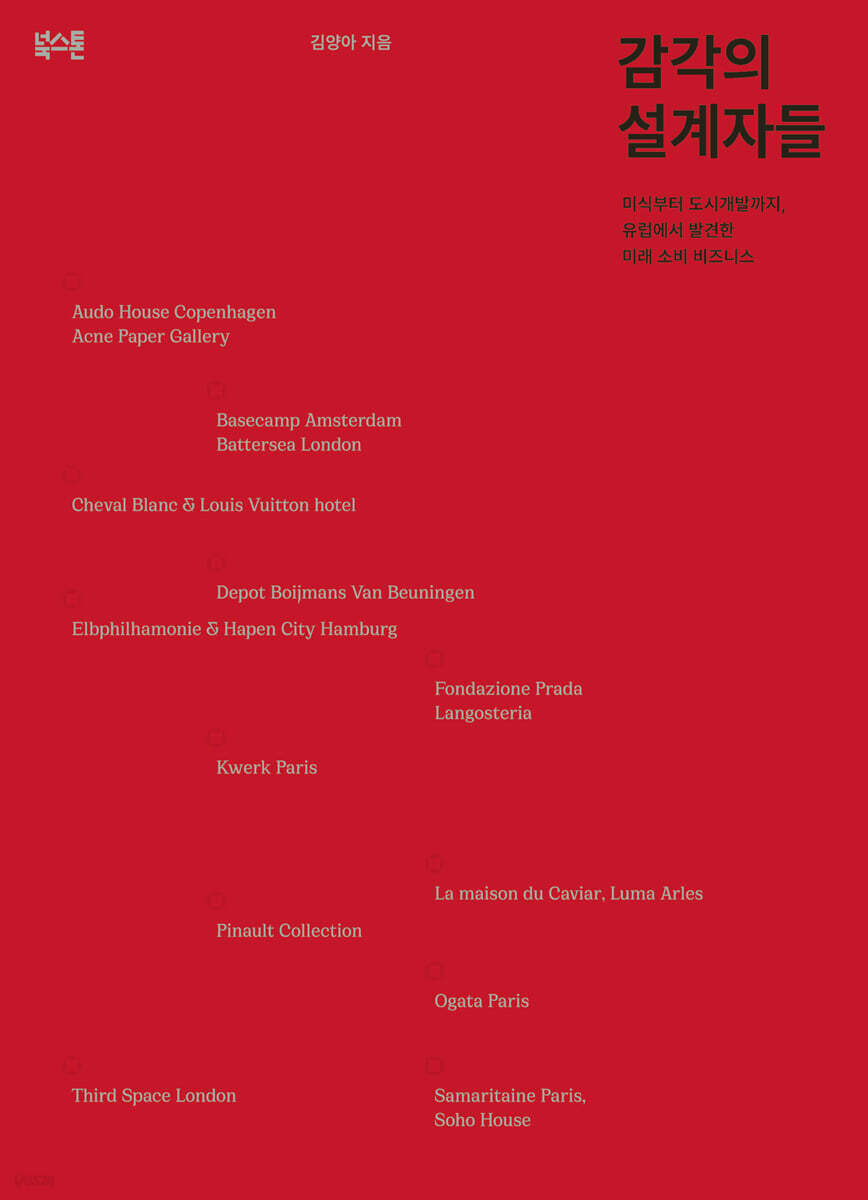 |
Description
Book Introduction
In an era where we sell sensations, not products, how can brands turn experiences into profits?
Today's consumers don't just buy things; they consume 'sensory experiences.'
From gastronomy and hospitality to retail and urban spaces, brands no longer compete on product alone.
What consumers see, what atmosphere they feel, and how they remember that experience will soon become competitiveness.
This is why we need to pay attention to 'future consumption,' a formula for consumption that has evolved one step further based on the senses.
Set in Europe, at the forefront of change, 《Designers of the Senses》 tells the story of how the senses will drive future consumption.
Through 32 specific examples, including Paris' innovative gastronomy, London's experimental retail, Amsterdam's new urban experiment, and LVMH, the empire of the senses, it provides a glimpse into the structure and strategies of future consumption.
Rather than simply listing success stories, the author clearly and concretely explains why "sensation" has become the core of business models, what trends are creating new consumption, and how brands can turn experiences into profits.
It will serve as the most realistic and vivid guide to preparing for the coming 'future consumption' for brand planners, space directors, marketers, and even individuals and companies considering new business models.
Today's consumers don't just buy things; they consume 'sensory experiences.'
From gastronomy and hospitality to retail and urban spaces, brands no longer compete on product alone.
What consumers see, what atmosphere they feel, and how they remember that experience will soon become competitiveness.
This is why we need to pay attention to 'future consumption,' a formula for consumption that has evolved one step further based on the senses.
Set in Europe, at the forefront of change, 《Designers of the Senses》 tells the story of how the senses will drive future consumption.
Through 32 specific examples, including Paris' innovative gastronomy, London's experimental retail, Amsterdam's new urban experiment, and LVMH, the empire of the senses, it provides a glimpse into the structure and strategies of future consumption.
Rather than simply listing success stories, the author clearly and concretely explains why "sensation" has become the core of business models, what trends are creating new consumption, and how brands can turn experiences into profits.
It will serve as the most realistic and vivid guide to preparing for the coming 'future consumption' for brand planners, space directors, marketers, and even individuals and companies considering new business models.
- You can preview some of the book's contents.
Preview
index
prolog.
Future Consumption Discovered in the Age of Sensory Capital
Chapter 1.
Hotels and Retail: Sensory Spaces and the Future
From Trash Can to Hotel: How Bib Became a Model for Spatial Strategy
The Social Hub, Blurring the Lines Between Accommodation and Residence
Ergon House, a Blossoming Culinary Ecosystem in Athens
Audo House: Designing Experiences Beyond Hybrid
WeAona, a meal that redefines the concept of retail.
Acne Paper Gallery Reimagines Retail
Disium Permit Room Lodge, a space that designs memories
Basecamp Amsterdam, a stay experiment that began on the outskirts of the city
Culpeper and Buxton: A Small Revolution Begins in London
Chapter 2.
Gastronomy: Breaking Down the Boundaries of Taste, Body, and Mind
Ogata: A Brand and Gastronomy Redefined by Sense
La Maison du Caviar, the Parisian caviar scene where tradition and modernity intersect.
Attica Designs a Restaurant of the Future
Big Mama, an Italian food startup in the Parisian restaurant industry
Chapter 3.
Art and Brands: Driving a New Sense of Consumption
Hauser & Wirth Redesigns Art Distribution Structure
Fondazione Prada: The Brand's Evolution as a Cultural Designer
The Pinot Collection: A future model of luxury encompassing cities, culture, and art.
Depo Boymans van Beuningen, the moment when behind-the-scenes becomes the stage
Victoria & Albert Storehouse, a new knowledge platform that "calls out" the works you want to see.
Chapter 4.
Urban Regeneration: Urban Transformation and Expansion of Consumption
London's Battersea Project Evolves into a City Within a City
HafenCity and the Elbphilharmonie: How to Design a City as a Brand
Denmark's BIG is changing the logic of urban design.
Luma Arles: How Landmarks Transform the Future of Small Towns
Chapter 5.
New Luxury and Wellness: From Products to Emotions and Experiences
Soho House: A New Luxury Platform Selling Community, Not Party
Quark, the way to meet the luxury of a workspace
Saint Laurent Sushi Park: A New Grammar of Luxury Rewritten by Saint Laurent
Third Space: A Wellness Model Redesigning Urban Life
Laticien, a platform that designs for sensitivity, not information.
Chapter 6. LVMH, the Empire of the Senses Designing the Future
Strategic Hospitality at LVMH's High-End Hotel Cheval Blanc
Samaritaine, a landmark that blurs the lines between city and brand.
Luxury Residences: An Experiment in Branding Customers' Lives
Langosteria, a small focal point that changes the grammar of the empire of the senses.
Epilogue.
When Sense Leads to Business - Why New York?
Future Consumption Discovered in the Age of Sensory Capital
Chapter 1.
Hotels and Retail: Sensory Spaces and the Future
From Trash Can to Hotel: How Bib Became a Model for Spatial Strategy
The Social Hub, Blurring the Lines Between Accommodation and Residence
Ergon House, a Blossoming Culinary Ecosystem in Athens
Audo House: Designing Experiences Beyond Hybrid
WeAona, a meal that redefines the concept of retail.
Acne Paper Gallery Reimagines Retail
Disium Permit Room Lodge, a space that designs memories
Basecamp Amsterdam, a stay experiment that began on the outskirts of the city
Culpeper and Buxton: A Small Revolution Begins in London
Chapter 2.
Gastronomy: Breaking Down the Boundaries of Taste, Body, and Mind
Ogata: A Brand and Gastronomy Redefined by Sense
La Maison du Caviar, the Parisian caviar scene where tradition and modernity intersect.
Attica Designs a Restaurant of the Future
Big Mama, an Italian food startup in the Parisian restaurant industry
Chapter 3.
Art and Brands: Driving a New Sense of Consumption
Hauser & Wirth Redesigns Art Distribution Structure
Fondazione Prada: The Brand's Evolution as a Cultural Designer
The Pinot Collection: A future model of luxury encompassing cities, culture, and art.
Depo Boymans van Beuningen, the moment when behind-the-scenes becomes the stage
Victoria & Albert Storehouse, a new knowledge platform that "calls out" the works you want to see.
Chapter 4.
Urban Regeneration: Urban Transformation and Expansion of Consumption
London's Battersea Project Evolves into a City Within a City
HafenCity and the Elbphilharmonie: How to Design a City as a Brand
Denmark's BIG is changing the logic of urban design.
Luma Arles: How Landmarks Transform the Future of Small Towns
Chapter 5.
New Luxury and Wellness: From Products to Emotions and Experiences
Soho House: A New Luxury Platform Selling Community, Not Party
Quark, the way to meet the luxury of a workspace
Saint Laurent Sushi Park: A New Grammar of Luxury Rewritten by Saint Laurent
Third Space: A Wellness Model Redesigning Urban Life
Laticien, a platform that designs for sensitivity, not information.
Chapter 6. LVMH, the Empire of the Senses Designing the Future
Strategic Hospitality at LVMH's High-End Hotel Cheval Blanc
Samaritaine, a landmark that blurs the lines between city and brand.
Luxury Residences: An Experiment in Branding Customers' Lives
Langosteria, a small focal point that changes the grammar of the empire of the senses.
Epilogue.
When Sense Leads to Business - Why New York?
Detailed image

Into the book
Europe does not stay in the past.
Rather, they are quietly but surely dominating the future consumer market by using their senses as weapons.
This book is a blueprint for the future market that I witnessed firsthand in Europe.
In an era where intuition is the key to competitiveness, this is the record of a marketer who was the first to read the rules of the game from the front lines.
For Korean companies, Europe is not an easy market to understand.
Rather, it is often viewed as a ‘heterogeneous and complex market.’
The market structure, built on a foundation of diverse linguistic and cultural backgrounds and a long history and artistic overlapping, is by no means simple.
But for that very reason, Europe also serves as a vast laboratory for great insights.
From hotels to restaurants, galleries, retail stores, and small boutique membership clubs, every space, large and small, delicately engages people's senses, suggesting stories and tastes that match.
The sensory design know-how they have accumulated is so diverse and sophisticated that it is difficult to experience anywhere else.
The more I interacted with European brands, the more I realized that they weren't just "old-timers" relying on their reputation for "tradition."
--- From the "Prologue"
Bib Hotel does not list products or describe brands.
Instead, it is meticulously designed to allow guests to truly 'live the experience' within the philosophy of Bib.
Especially in all hotels, their iconic iron pedal trash can quietly reveals the brand's aesthetic in the most natural and everyday moments.
When you open the kitchen drawer, you will find Bibb's cutlery, and in the bathroom, towels, lighting, furniture, and all other elements are organically integrated into the flow of daily life.
Here, people do not ‘consume’ brands, but rather stay within them, use them, and acquire them.
--- From "From Trash Can to Hotel: How Bib Became a Model for Spatial Strategy"
Opened in 2006 in Amsterdam, Netherlands, The Student Hotel (TSH) emerged as a private solution to the housing shortage for international students that was prevalent throughout Europe.
This model, which offers more freedom than traditional university dormitories and is more suitable for long-term stays than hotels, soon emerged as a new asset management standard in the European real estate market.
From the beginning, the brand has experimented with new possibilities in the 'middle ground between hotel and dormitory'.
The cities they have advanced into, such as Amsterdam, Florence, Paris, and Barcelona, have something in common.
The high number of international students creates a high demand for mid- to long-term stays, and the public system cannot meet this demand, leading to active private real estate development. TSH delved into this very issue.
It presents an independent space structure that delicately combines ‘staying’ and ‘residence’, providing a convenient and sophisticated environment like a hotel while also allowing for long-term stays like a dormitory.
But over time, TSH discovered that their business model wasn't limited to students.
The landscape of lobbies and lounges began to change in the mid-2010s.
There has been a noticeable increase in the number of digital nomads who move from city to city, freelancers working on global projects, and young edtech entrepreneurs who connect cities and pursue education and entrepreneurship.
These were a new type of stayer, one that was difficult to find in traditional hotels or residences.
They wanted the emotional stability of a home rather than the convenience of a hotel, while at the same time hoping for a community that was much more open and vibrant than their home.
In 2022, TSH made a decision.
The word 'Student' was boldly removed from the brand name.
The newly born brand is ‘The Social Hub.’
This wasn't just a rebranding with a name change.
It was an evolution into an innovative 'stay asset platform' that encompasses all of these attributes without being completely confined to any of the categories of hotels, dormitories, residences, or share houses, and does not limit the value they provide to a specific customer base.
--- From "The Social Hub, Blurring the Lines Between Accommodation and Residence"
Soho House's most powerful strategic asset is not simply its "good space," but the "sensory and emotional experience" realized within that space.
Lighting that seems perfectly calculated without calculation, leather sofas that look even more stylish with the touch of hands, and art pieces that seem to be placed without much thought.
Soho House has created a thoroughly intentional form of 'perfect extraordinary' based on a unique sensibility that is more comfortable than home but not easily found anywhere else.
Soho Home is a strategic example of liberating the Soho House brand experience from the confines of clubs and hotels, and expanding the lifestyle they pursue into a business model by commercializing it.
Many people want to take home the comfortable bedding and texture of the space they experience at a hotel.
Soft linens, a duvet of just the right thickness, and even soft lighting on the side table.
A hotel is a place where we can enjoy complete comfort, even if only for a moment.
However, most hotel brands keep this desire limited to peripheral areas such as amenities and MD products.
Soho House has turned this sensibility into a strategic business.
Soho Home does not simply sell furniture or objects placed in hotels, but proposes a 'way of staying' and 'emotion of space' designed by Soho House as a single product line.
--- From "Soho House, a new luxury platform that sells community, not parties"
The concept that Third Space particularly emphasizes is ‘performance wellness.’
It is not limited to simply creating a beautiful body, but aims to improve overall physical abilities and manage health, contributing to wellness.
To achieve this, Third Space uses the space itself as a ‘performance amplifier.’
Optimized temperature, humidity, flow, music, and lighting maximize exercise performance and help members focus solely on their physical and mental well-being.
Furthermore, this place aims to be a space where people can discover themselves through exercise, interact with others, and continuously improve their quality of life.
This is clearly evident in the design and composition of the space and the arrangement of the programs.
Third Space meticulously designs not only the basic fitness club programs such as treadmills, weight training, and group classes, but also behaviors and emotional states before and after exercise.
For example, members might participate in a high-intensity fitness session after work, then head to a spa or meditation room to unwind.
Afterwards, relax in the lounge, enjoy healthy food and drinks, and interact naturally with other members.
Within this flow, customers perceive Third Space not as a simple fitness facility, but as a 'center space for everyday, repetitive life.'
--- From "Third Space: A Wellness Model Redesigning Urban Life"
Langosteria has integrated all elements of the restaurant, from the atmosphere and spatial composition of the restaurant, to the flow of the menu and even the way the staff serve customers, into a single brand language, and has precisely implemented this in different environments such as Milan, Paris and St. Moritz.
Through this, each store avoids the "experiential mismatch" and emotional disconnect common among global gourmet brands, consistently conveying the brand's essence and emotion. It's clear why LVMH has taken notice of this model.
Traditional luxury categories like fashion, jewelry, and hotels have a fundamental limitation: it's difficult for customers to experience the brand's emotional essence on a daily basis outside the physical confines of the store.
On the other hand, Langosteria had already completed a structure that could naturally and continuously expand the brand experience into customers' lives by utilizing food, the most everyday and intimate medium.
Rather, they are quietly but surely dominating the future consumer market by using their senses as weapons.
This book is a blueprint for the future market that I witnessed firsthand in Europe.
In an era where intuition is the key to competitiveness, this is the record of a marketer who was the first to read the rules of the game from the front lines.
For Korean companies, Europe is not an easy market to understand.
Rather, it is often viewed as a ‘heterogeneous and complex market.’
The market structure, built on a foundation of diverse linguistic and cultural backgrounds and a long history and artistic overlapping, is by no means simple.
But for that very reason, Europe also serves as a vast laboratory for great insights.
From hotels to restaurants, galleries, retail stores, and small boutique membership clubs, every space, large and small, delicately engages people's senses, suggesting stories and tastes that match.
The sensory design know-how they have accumulated is so diverse and sophisticated that it is difficult to experience anywhere else.
The more I interacted with European brands, the more I realized that they weren't just "old-timers" relying on their reputation for "tradition."
--- From the "Prologue"
Bib Hotel does not list products or describe brands.
Instead, it is meticulously designed to allow guests to truly 'live the experience' within the philosophy of Bib.
Especially in all hotels, their iconic iron pedal trash can quietly reveals the brand's aesthetic in the most natural and everyday moments.
When you open the kitchen drawer, you will find Bibb's cutlery, and in the bathroom, towels, lighting, furniture, and all other elements are organically integrated into the flow of daily life.
Here, people do not ‘consume’ brands, but rather stay within them, use them, and acquire them.
--- From "From Trash Can to Hotel: How Bib Became a Model for Spatial Strategy"
Opened in 2006 in Amsterdam, Netherlands, The Student Hotel (TSH) emerged as a private solution to the housing shortage for international students that was prevalent throughout Europe.
This model, which offers more freedom than traditional university dormitories and is more suitable for long-term stays than hotels, soon emerged as a new asset management standard in the European real estate market.
From the beginning, the brand has experimented with new possibilities in the 'middle ground between hotel and dormitory'.
The cities they have advanced into, such as Amsterdam, Florence, Paris, and Barcelona, have something in common.
The high number of international students creates a high demand for mid- to long-term stays, and the public system cannot meet this demand, leading to active private real estate development. TSH delved into this very issue.
It presents an independent space structure that delicately combines ‘staying’ and ‘residence’, providing a convenient and sophisticated environment like a hotel while also allowing for long-term stays like a dormitory.
But over time, TSH discovered that their business model wasn't limited to students.
The landscape of lobbies and lounges began to change in the mid-2010s.
There has been a noticeable increase in the number of digital nomads who move from city to city, freelancers working on global projects, and young edtech entrepreneurs who connect cities and pursue education and entrepreneurship.
These were a new type of stayer, one that was difficult to find in traditional hotels or residences.
They wanted the emotional stability of a home rather than the convenience of a hotel, while at the same time hoping for a community that was much more open and vibrant than their home.
In 2022, TSH made a decision.
The word 'Student' was boldly removed from the brand name.
The newly born brand is ‘The Social Hub.’
This wasn't just a rebranding with a name change.
It was an evolution into an innovative 'stay asset platform' that encompasses all of these attributes without being completely confined to any of the categories of hotels, dormitories, residences, or share houses, and does not limit the value they provide to a specific customer base.
--- From "The Social Hub, Blurring the Lines Between Accommodation and Residence"
Soho House's most powerful strategic asset is not simply its "good space," but the "sensory and emotional experience" realized within that space.
Lighting that seems perfectly calculated without calculation, leather sofas that look even more stylish with the touch of hands, and art pieces that seem to be placed without much thought.
Soho House has created a thoroughly intentional form of 'perfect extraordinary' based on a unique sensibility that is more comfortable than home but not easily found anywhere else.
Soho Home is a strategic example of liberating the Soho House brand experience from the confines of clubs and hotels, and expanding the lifestyle they pursue into a business model by commercializing it.
Many people want to take home the comfortable bedding and texture of the space they experience at a hotel.
Soft linens, a duvet of just the right thickness, and even soft lighting on the side table.
A hotel is a place where we can enjoy complete comfort, even if only for a moment.
However, most hotel brands keep this desire limited to peripheral areas such as amenities and MD products.
Soho House has turned this sensibility into a strategic business.
Soho Home does not simply sell furniture or objects placed in hotels, but proposes a 'way of staying' and 'emotion of space' designed by Soho House as a single product line.
--- From "Soho House, a new luxury platform that sells community, not parties"
The concept that Third Space particularly emphasizes is ‘performance wellness.’
It is not limited to simply creating a beautiful body, but aims to improve overall physical abilities and manage health, contributing to wellness.
To achieve this, Third Space uses the space itself as a ‘performance amplifier.’
Optimized temperature, humidity, flow, music, and lighting maximize exercise performance and help members focus solely on their physical and mental well-being.
Furthermore, this place aims to be a space where people can discover themselves through exercise, interact with others, and continuously improve their quality of life.
This is clearly evident in the design and composition of the space and the arrangement of the programs.
Third Space meticulously designs not only the basic fitness club programs such as treadmills, weight training, and group classes, but also behaviors and emotional states before and after exercise.
For example, members might participate in a high-intensity fitness session after work, then head to a spa or meditation room to unwind.
Afterwards, relax in the lounge, enjoy healthy food and drinks, and interact naturally with other members.
Within this flow, customers perceive Third Space not as a simple fitness facility, but as a 'center space for everyday, repetitive life.'
--- From "Third Space: A Wellness Model Redesigning Urban Life"
Langosteria has integrated all elements of the restaurant, from the atmosphere and spatial composition of the restaurant, to the flow of the menu and even the way the staff serve customers, into a single brand language, and has precisely implemented this in different environments such as Milan, Paris and St. Moritz.
Through this, each store avoids the "experiential mismatch" and emotional disconnect common among global gourmet brands, consistently conveying the brand's essence and emotion. It's clear why LVMH has taken notice of this model.
Traditional luxury categories like fashion, jewelry, and hotels have a fundamental limitation: it's difficult for customers to experience the brand's emotional essence on a daily basis outside the physical confines of the store.
On the other hand, Langosteria had already completed a structure that could naturally and continuously expand the brand experience into customers' lives by utilizing food, the most everyday and intimate medium.
--- From "Langosteria, a small center that changes the grammar of the empire of the senses"
Publisher's Review
A global creative director captures the future consumption trends he experienced on the ground!
From hotels to real estate, how Europe designs the senses.
“People create memories of specific spaces or brands through their senses.
As those memories accumulate, brand loyalty is created, which leads to repeat visits, repeat purchases, and even word of mouth to spread the word to those around you.
Rather than creating something new, it is about evolving the current consumption pattern to a more sophisticated level based on ‘sense.’
This is the essence of future consumption that this book deals with.” - From the text.
Europe is no longer a continent of tradition and tourism.
Europe now functions as a laboratory for future consumption, where every space—hotels, restaurants, galleries, retail stores, and even membership clubs—is meticulously designed to appeal to the senses.
Consumers don't simply buy things; they stay in the world created by the brand, experience it, and build memories.
If the core of future consumption shines at the point where the five human senses are satisfied, then Europe will be at the forefront of future consumption.
The future they are creating cannot be explained by the cutting-edge technologies that are often talked about.
The future of Europe revolves around senses, space, taste and ways of life.
How will Europe, at the forefront of sensory capital, design its senses?
The first strategy is the fusion of space and narrative.
Whether in a small cafe with an old building's vaulted ceiling and the aroma of freshly baked bread, or in a Michelin-starred restaurant or a modern hotel, the key differentiating factor is 'sensory design.'
Carefully curated lighting, music, interior colors, and scents are integrated into a single story.
As a result, customers embody the sensory experience designed by the brand through their five senses, which in turn leads to premium value.
The second strategy is convergence, which breaks down boundaries between industries.
Fashion, art, design, and technology combine with Europe's cultural heritage to create unprecedented business models.
The most iconic example is LVMH, which this book refers to as the “empire of the senses.”
LVMH, which redefined luxury as a "lifestyle ecosystem" rather than a simple product category, organically integrated art, culture, and experiences, imprinting a new consumption standard of "satisfaction of the five senses" on the market.
The third is the barrier to entry created by time.
Europe's sensory capital is a competitive advantage that cannot be imitated overnight.
Behind the splendid architecture and sophisticated interiors, hundreds of years of accumulated cultural codes and aesthetic standards operate.
European companies excel at "realizing heritage"—the ability to delicately connect these ancient cultural assets with modern desires.
This point is the core of future consumption and the essence of the sensory economy.
A field report on the future of consumption through hotels, retail, gastronomy, art, urban regeneration, and new luxury, as seen through LVMH.
《Designers of the Senses》 divides the flow of future consumption into six stages: hotels and retail, gastronomy, art, urban regeneration, new luxury and wellness, and LVMH.
The core message of this book is clear.
That sense is the core asset of future consumption.
The author, who has worked on multinational projects in Europe and between Europe and Korea, focused on how sensations become concrete "experiences" and create "willingness to pay" rather than flashy success stories based on his own experiences.
In addition, we have personally discovered and included examples from Europe that best illustrate this process.
From LVMH's revitalization of Paris's Samaritaine department store into a city icon, to the urban regeneration project that transformed London's Battersea Power Station into a new lifestyle hub, to Prada's Fondazione Prada, which straddles the line between art and fashion, to new luxury clubs like Soho House spreading across Europe, the book's six themes and 32 case studies vividly illustrate how senses become business models.
LVMH, the world's largest luxury goods conglomerate, is referred to in this book as the "Empire of the Senses." LVMH is not simply a company that sells luxury goods.
He revived the Samaritaine department store in Paris as a symbol of the city, and branded the lives of guests at the Cheval Blanc Hotel, creating an ecosystem encompassing wine, fashion, art, and wellness.
This expansion of luxury into an entire way of life is the best example of the ultimate model of future consumption.
Not only luxury brands, but also smaller brands across Europe are accumulating sensory capital in their own way and creating unique positions.
The author, who has worked on-site designing global brands, spaces, and city strategies in Europe and Korea, emphasizes that European companies excel at creating a single lifestyle by naturally aligning what people want with the values pursued by the brand.
Hotels are no longer simply places to stay, but stages for designing emotions, and gastronomy is no longer simply a meal, but an act of revealing identity.
Art becomes a core asset of the brand, and the city transforms into a new stage where consumption meets consumption.
Luxury is being redefined as an experience of community and emotion, not a thing.
The author concludes the book with the message that what is more important than huge capital is the ability to design senses.
For individuals and businesses struggling to find new business models, and for anyone seeking to redefine the essence of the consumer experience, this book will serve as a strategic guide for the future.
From hotels to real estate, how Europe designs the senses.
“People create memories of specific spaces or brands through their senses.
As those memories accumulate, brand loyalty is created, which leads to repeat visits, repeat purchases, and even word of mouth to spread the word to those around you.
Rather than creating something new, it is about evolving the current consumption pattern to a more sophisticated level based on ‘sense.’
This is the essence of future consumption that this book deals with.” - From the text.
Europe is no longer a continent of tradition and tourism.
Europe now functions as a laboratory for future consumption, where every space—hotels, restaurants, galleries, retail stores, and even membership clubs—is meticulously designed to appeal to the senses.
Consumers don't simply buy things; they stay in the world created by the brand, experience it, and build memories.
If the core of future consumption shines at the point where the five human senses are satisfied, then Europe will be at the forefront of future consumption.
The future they are creating cannot be explained by the cutting-edge technologies that are often talked about.
The future of Europe revolves around senses, space, taste and ways of life.
How will Europe, at the forefront of sensory capital, design its senses?
The first strategy is the fusion of space and narrative.
Whether in a small cafe with an old building's vaulted ceiling and the aroma of freshly baked bread, or in a Michelin-starred restaurant or a modern hotel, the key differentiating factor is 'sensory design.'
Carefully curated lighting, music, interior colors, and scents are integrated into a single story.
As a result, customers embody the sensory experience designed by the brand through their five senses, which in turn leads to premium value.
The second strategy is convergence, which breaks down boundaries between industries.
Fashion, art, design, and technology combine with Europe's cultural heritage to create unprecedented business models.
The most iconic example is LVMH, which this book refers to as the “empire of the senses.”
LVMH, which redefined luxury as a "lifestyle ecosystem" rather than a simple product category, organically integrated art, culture, and experiences, imprinting a new consumption standard of "satisfaction of the five senses" on the market.
The third is the barrier to entry created by time.
Europe's sensory capital is a competitive advantage that cannot be imitated overnight.
Behind the splendid architecture and sophisticated interiors, hundreds of years of accumulated cultural codes and aesthetic standards operate.
European companies excel at "realizing heritage"—the ability to delicately connect these ancient cultural assets with modern desires.
This point is the core of future consumption and the essence of the sensory economy.
A field report on the future of consumption through hotels, retail, gastronomy, art, urban regeneration, and new luxury, as seen through LVMH.
《Designers of the Senses》 divides the flow of future consumption into six stages: hotels and retail, gastronomy, art, urban regeneration, new luxury and wellness, and LVMH.
The core message of this book is clear.
That sense is the core asset of future consumption.
The author, who has worked on multinational projects in Europe and between Europe and Korea, focused on how sensations become concrete "experiences" and create "willingness to pay" rather than flashy success stories based on his own experiences.
In addition, we have personally discovered and included examples from Europe that best illustrate this process.
From LVMH's revitalization of Paris's Samaritaine department store into a city icon, to the urban regeneration project that transformed London's Battersea Power Station into a new lifestyle hub, to Prada's Fondazione Prada, which straddles the line between art and fashion, to new luxury clubs like Soho House spreading across Europe, the book's six themes and 32 case studies vividly illustrate how senses become business models.
LVMH, the world's largest luxury goods conglomerate, is referred to in this book as the "Empire of the Senses." LVMH is not simply a company that sells luxury goods.
He revived the Samaritaine department store in Paris as a symbol of the city, and branded the lives of guests at the Cheval Blanc Hotel, creating an ecosystem encompassing wine, fashion, art, and wellness.
This expansion of luxury into an entire way of life is the best example of the ultimate model of future consumption.
Not only luxury brands, but also smaller brands across Europe are accumulating sensory capital in their own way and creating unique positions.
The author, who has worked on-site designing global brands, spaces, and city strategies in Europe and Korea, emphasizes that European companies excel at creating a single lifestyle by naturally aligning what people want with the values pursued by the brand.
Hotels are no longer simply places to stay, but stages for designing emotions, and gastronomy is no longer simply a meal, but an act of revealing identity.
Art becomes a core asset of the brand, and the city transforms into a new stage where consumption meets consumption.
Luxury is being redefined as an experience of community and emotion, not a thing.
The author concludes the book with the message that what is more important than huge capital is the ability to design senses.
For individuals and businesses struggling to find new business models, and for anyone seeking to redefine the essence of the consumer experience, this book will serve as a strategic guide for the future.
GOODS SPECIFICS
- Date of issue: September 25, 2025
- Page count, weight, size: 408 pages | 584g | 152*210*26mm
- ISBN13: 9791175230095
- ISBN10: 117523009X
You may also like
카테고리
korean


korean

![ELLE 엘르 스페셜 에디션 A형 : 12월 [2025]](http://librairie.coreenne.fr/cdn/shop/files/b8e27a3de6c9538896439686c6b0e8fb.jpg?v=1766436872&width=3840)


