

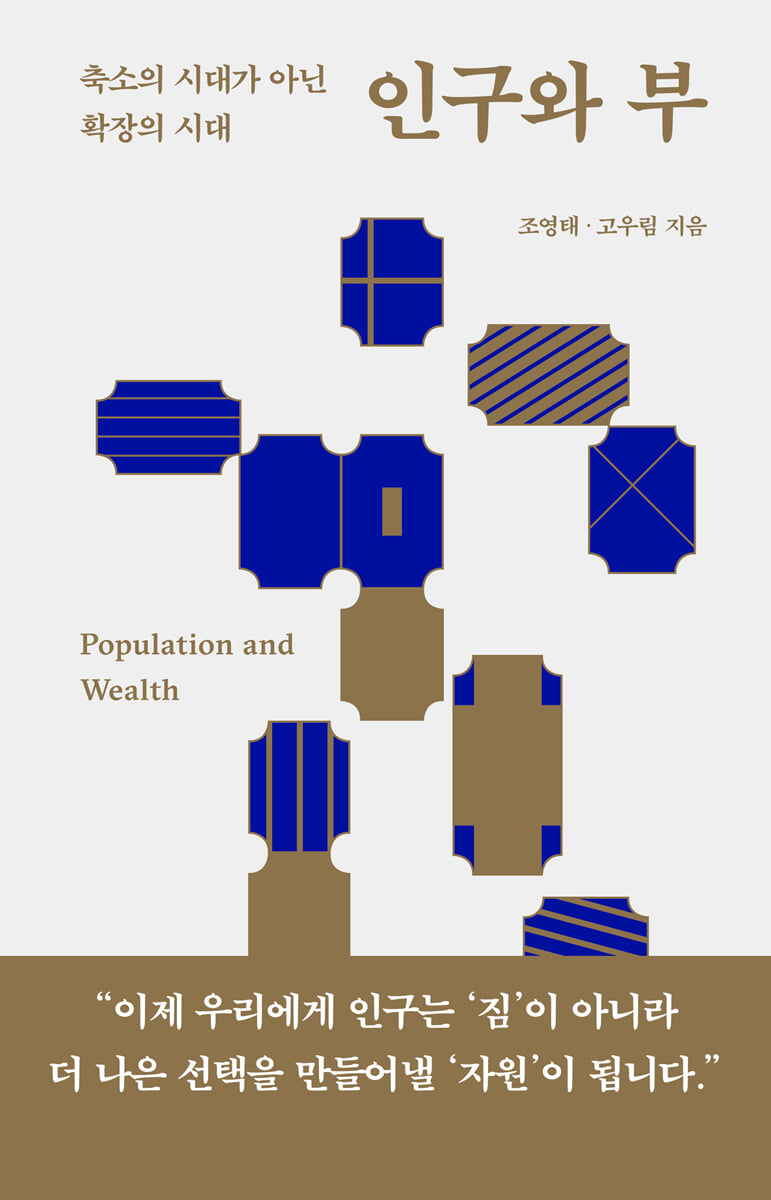
population and wealth
 |
Description
Book Introduction
“Population may decrease, but wealth may increase!”
A new population strategy that connects "A Determined Future" and "Coexistence of the Future Population"
Population is the most realistic basis for imagining the future and the foundation for strategies to expand wealth in uncertain times.
But so far we have been accustomed to thinking of population only in terms of crisis.
This book teaches us how to read population in the language of 'wealth'.
Professor Cho Young-tae, a leading demographer in Korea, goes beyond the discourse of the "birth rate crisis" facing Korea and presents evidence that changes in population structure create new wealth opportunities.
In doing so, we propose a population strategy that creates better choices, rather than one that promotes fragmented crises or unfounded optimism.
Now, let's look at population not as an indicator of 'extinction', but as a 'map' for designing the future.
A new population strategy that connects "A Determined Future" and "Coexistence of the Future Population"
Population is the most realistic basis for imagining the future and the foundation for strategies to expand wealth in uncertain times.
But so far we have been accustomed to thinking of population only in terms of crisis.
This book teaches us how to read population in the language of 'wealth'.
Professor Cho Young-tae, a leading demographer in Korea, goes beyond the discourse of the "birth rate crisis" facing Korea and presents evidence that changes in population structure create new wealth opportunities.
In doing so, we propose a population strategy that creates better choices, rather than one that promotes fragmented crises or unfounded optimism.
Now, let's look at population not as an indicator of 'extinction', but as a 'map' for designing the future.
- You can preview some of the book's contents.
Preview
index
At the beginning of the book
Prologue | Population: The Foundation of Strategy for Opening Future Markets
Chapter 1.
A Shift in Perspective: The Problem Isn't Population Decline
A perspective to overcome: pessimistic realism
Let's look at it through the lens of "population strategy," not "population policy."
The population is changing rapidly, so what is the response strategy?
Is the company's population response appropriate?
A Ramen Company's Demand Analysis and Factory Location Strategy / The Labor Shortage Caused by the Delay in Population Response 20 Years Ago
How Should Individuals Respond to Population Change?
From the perspective of expansion rather than population pressure
Chapter 2.
Three Lenses for Reading Population into Wealth: Age Effects, Period Effects, and Cohort Effects
Looking only at the age effect misses the point where "economies of scale" come into play.
Demographic Methodology for Reading the Future
Q1.
The elderly population is growing, but why isn't the senior industry booming?
Let's look at their life trajectories instead of their ages / The future market is visible only when we look at cohort, age, and timing effects together.
Q2.
So, is the population without purchasing power ultimately increasing?
Baby Boomers Are Not "Poor Old People"
Q3.
Are the first generation of baby boomers and the industrial generation really that different in terms of personality?
Differences in educational attainment lead to differences in health / So that health can lead to economic stability
Q4.
Isn't the health food market booming due to the increasing number of elderly people taking care of their health?
Let's focus on multi-aging that replaces the age effect.
Q5.
Wouldn't suburban senior towns thrive if the number of wealthy seniors increases?
Post-retirement mobility paths differ by generation.
Q6.
So, does that mean we shouldn't do senior business?
3 Suggestions for Success in the Senior Industry
Chapter 3.
A three-tiered population strategy: from population size changes to lifestyle shifts.
How to Read the Scale and Depth of Change
The 3M Framework for Simultaneously Seeking Crisis and Opportunity
Macro: Changes that look far and deep
Preparation for reading population as more than just numbers
The potential for expanding "population" data / Let's focus more on changes in the number of households in the future.
Meso: Capturing Industrial Change in Interaction with Social Change
Q1.
Doesn't the size of the demand base directly translate to the size of the market?
The Infant Industry and the New Aristocracy: An Opportunity to Unfold a Rational Alternative Model
Q2.
Are there really no alternatives or business opportunities to offset the population problem in rural areas?
The Need for a Shift in Population Concepts / Analysis of Factory Locations Using Population
Micro: Big and small changes in our daily lives
Q3.
What should businesses look for to reflect demographic changes?
Q4.
How do you research and read the data?
The Transition from Single-Person Households to Single-Person Systems / Outsourcing of "Family" Relationships and the "Trust-Based Purchasing Society" / Kimchi Demand Analysis Using the 3M Framework and APC Methodology
3M Framework Practical Application Guide
Chapter 4.
Overseas Expansion Strategy: Understanding Population Dynamics
Let's prepare a 'prosperity dividend' that follows the 'demographic dividend'.
The country that met the population dividend conditions the fastest in the world
Q1.
Which country should I go to?
Look at the population, not the numbers
Q2.
Should we move into the production base or the consumer market?
Emerging consumer markets are opening sooner than expected / Finding a generation like the "South Korean baby boomer."
Q3.
If there is too much racial and cultural diversity, won't development be delayed?
Pluralism Beyond Diversity / Pragmatism in Religion
Q4.
What data should I look at when making decisions about expanding overseas?
If data is to be alive, it must be able to see itself and determine its timing.
Q5.
Emerging countries have severe economic polarization.
The possibility of a rebound after going through ups and downs
Q6.
Are the characteristics of Generation Z, the core target group, similar in every country?
Interpretations of shared values vary from country to country.
Q7.
Which should we consider more: demographic change or political change?
The key is to be able to demonstrate 'future leadership' amidst change.
Q8.
If you were to enter a market other than emerging markets, where would you go?
2037: America's Ownership Changes / Why Hispanics in the US Are Important to Korean Companies
Q9.
What happens when K-food and K-culture end?
Korea will become a style beyond a trend.
Chapter 5.
The power to transform population into wealth: talent and capabilities
The population is a moving group and an agent of change.
On-site concerns surrounding population change
Q1.
Is it possible to become a manufacturing powerhouse with a population of only 30 million?
I must break the old population formula within me.
Q2.
Is our country's manufacturing industry over?
By 2027, the mismatch in workforce will lead to a workforce decline. / The state of Korea's manufacturing industry by population. / If both expertise and skill are low, exit or modernize. / The top priority for highly skilled industries is automation.
Q3.
Will it really be easier to get a job in 2030?
Let's understand the essence of our karma and upgrade it.
Q4. In the age of AI, wouldn't it be okay if the population decreased slightly?
Why AI Must Be Human-Centric As It Advances
Q5.
So the outlook for R&D personnel is good?
The R&D workforce shortage is more serious than the low birth rate.
Q6.
Are we at risk of being overtaken by China? I heard China is also facing a population crisis.
China Accumulates Growth with Huge R&D Population
Q7.
Can't we fill the manpower shortage with foreigners?
Attracting foreigners isn't the answer / Time isn't given only to our country.
Q8.
How can we attract foreign talent?
Attracting overseas talent goes hand in hand with market opening.
Q9.
How will demographic changes impact our organization?
The more urgent it is, the more courage there is to turn back
Q10.
What are the organizational changes resulting from aging?
Aging, promotion aversion, and the sense of deprivation among the middle generation
Q11.
The reason I'm leaving the company is because it's in the area. What should I do?
Metropolitan cities that have not been developed into metropolitan areas
Q12.
Is it possible for companies to retain talent in the region?
Identifying the gap between corporate and local demographics / Managing the sense of belonging of young people from other regions / Expanding living areas rather than retaining them / Automation, diversifying employment, and hiring foreigners
Q13.
Are corporate family-friendly policies effective?
Beyond Goodwill: From Good Management to Survival Strategy
Q14.
Which family-friendly policies are most effective?
A system that remains stuck in the current state of affairs, with its parameters called pride, only leads to a fight over rice bowls.
Epilogue | Beyond Numbers, Wisdom Connecting Generations
Note
Prologue | Population: The Foundation of Strategy for Opening Future Markets
Chapter 1.
A Shift in Perspective: The Problem Isn't Population Decline
A perspective to overcome: pessimistic realism
Let's look at it through the lens of "population strategy," not "population policy."
The population is changing rapidly, so what is the response strategy?
Is the company's population response appropriate?
A Ramen Company's Demand Analysis and Factory Location Strategy / The Labor Shortage Caused by the Delay in Population Response 20 Years Ago
How Should Individuals Respond to Population Change?
From the perspective of expansion rather than population pressure
Chapter 2.
Three Lenses for Reading Population into Wealth: Age Effects, Period Effects, and Cohort Effects
Looking only at the age effect misses the point where "economies of scale" come into play.
Demographic Methodology for Reading the Future
Q1.
The elderly population is growing, but why isn't the senior industry booming?
Let's look at their life trajectories instead of their ages / The future market is visible only when we look at cohort, age, and timing effects together.
Q2.
So, is the population without purchasing power ultimately increasing?
Baby Boomers Are Not "Poor Old People"
Q3.
Are the first generation of baby boomers and the industrial generation really that different in terms of personality?
Differences in educational attainment lead to differences in health / So that health can lead to economic stability
Q4.
Isn't the health food market booming due to the increasing number of elderly people taking care of their health?
Let's focus on multi-aging that replaces the age effect.
Q5.
Wouldn't suburban senior towns thrive if the number of wealthy seniors increases?
Post-retirement mobility paths differ by generation.
Q6.
So, does that mean we shouldn't do senior business?
3 Suggestions for Success in the Senior Industry
Chapter 3.
A three-tiered population strategy: from population size changes to lifestyle shifts.
How to Read the Scale and Depth of Change
The 3M Framework for Simultaneously Seeking Crisis and Opportunity
Macro: Changes that look far and deep
Preparation for reading population as more than just numbers
The potential for expanding "population" data / Let's focus more on changes in the number of households in the future.
Meso: Capturing Industrial Change in Interaction with Social Change
Q1.
Doesn't the size of the demand base directly translate to the size of the market?
The Infant Industry and the New Aristocracy: An Opportunity to Unfold a Rational Alternative Model
Q2.
Are there really no alternatives or business opportunities to offset the population problem in rural areas?
The Need for a Shift in Population Concepts / Analysis of Factory Locations Using Population
Micro: Big and small changes in our daily lives
Q3.
What should businesses look for to reflect demographic changes?
Q4.
How do you research and read the data?
The Transition from Single-Person Households to Single-Person Systems / Outsourcing of "Family" Relationships and the "Trust-Based Purchasing Society" / Kimchi Demand Analysis Using the 3M Framework and APC Methodology
3M Framework Practical Application Guide
Chapter 4.
Overseas Expansion Strategy: Understanding Population Dynamics
Let's prepare a 'prosperity dividend' that follows the 'demographic dividend'.
The country that met the population dividend conditions the fastest in the world
Q1.
Which country should I go to?
Look at the population, not the numbers
Q2.
Should we move into the production base or the consumer market?
Emerging consumer markets are opening sooner than expected / Finding a generation like the "South Korean baby boomer."
Q3.
If there is too much racial and cultural diversity, won't development be delayed?
Pluralism Beyond Diversity / Pragmatism in Religion
Q4.
What data should I look at when making decisions about expanding overseas?
If data is to be alive, it must be able to see itself and determine its timing.
Q5.
Emerging countries have severe economic polarization.
The possibility of a rebound after going through ups and downs
Q6.
Are the characteristics of Generation Z, the core target group, similar in every country?
Interpretations of shared values vary from country to country.
Q7.
Which should we consider more: demographic change or political change?
The key is to be able to demonstrate 'future leadership' amidst change.
Q8.
If you were to enter a market other than emerging markets, where would you go?
2037: America's Ownership Changes / Why Hispanics in the US Are Important to Korean Companies
Q9.
What happens when K-food and K-culture end?
Korea will become a style beyond a trend.
Chapter 5.
The power to transform population into wealth: talent and capabilities
The population is a moving group and an agent of change.
On-site concerns surrounding population change
Q1.
Is it possible to become a manufacturing powerhouse with a population of only 30 million?
I must break the old population formula within me.
Q2.
Is our country's manufacturing industry over?
By 2027, the mismatch in workforce will lead to a workforce decline. / The state of Korea's manufacturing industry by population. / If both expertise and skill are low, exit or modernize. / The top priority for highly skilled industries is automation.
Q3.
Will it really be easier to get a job in 2030?
Let's understand the essence of our karma and upgrade it.
Q4. In the age of AI, wouldn't it be okay if the population decreased slightly?
Why AI Must Be Human-Centric As It Advances
Q5.
So the outlook for R&D personnel is good?
The R&D workforce shortage is more serious than the low birth rate.
Q6.
Are we at risk of being overtaken by China? I heard China is also facing a population crisis.
China Accumulates Growth with Huge R&D Population
Q7.
Can't we fill the manpower shortage with foreigners?
Attracting foreigners isn't the answer / Time isn't given only to our country.
Q8.
How can we attract foreign talent?
Attracting overseas talent goes hand in hand with market opening.
Q9.
How will demographic changes impact our organization?
The more urgent it is, the more courage there is to turn back
Q10.
What are the organizational changes resulting from aging?
Aging, promotion aversion, and the sense of deprivation among the middle generation
Q11.
The reason I'm leaving the company is because it's in the area. What should I do?
Metropolitan cities that have not been developed into metropolitan areas
Q12.
Is it possible for companies to retain talent in the region?
Identifying the gap between corporate and local demographics / Managing the sense of belonging of young people from other regions / Expanding living areas rather than retaining them / Automation, diversifying employment, and hiring foreigners
Q13.
Are corporate family-friendly policies effective?
Beyond Goodwill: From Good Management to Survival Strategy
Q14.
Which family-friendly policies are most effective?
A system that remains stuck in the current state of affairs, with its parameters called pride, only leads to a fight over rice bowls.
Epilogue | Beyond Numbers, Wisdom Connecting Generations
Note
Detailed image

Into the book
The problem is this.
In 2017, Statistics Korea released its future population projections, but by 2018, the predictions had already begun to deviate significantly.
At the time, the National Statistical Office said that about 420,000 people were born, but in reality, about 350,000 people were born.
Although statistical errors are inevitable, we found that the differences were significant and beyond the margin of error.
If that's the case, wouldn't it be possible to discard the data and recalculate? However, the staff member in charge likely wouldn't have been able to do so unless the Statistics Act was revised.
For a long time, there has been criticism in academic circles that the population change rate is fast and the estimation cycle is too long.
However, since the law was not revised, the Ministry of Education had no choice but to use the statistical results from the National Statistical Office, and the National Statistical Office could not re-evaluate.
So in the end, no one is at fault.
Civil servants are people who carry out work according to procedures, and experts can provide direction and opinions, but they cannot be the ones to change laws and regulations.
(Fortunately, the National Statistical Office changed the cycle of future population projections from once every five years to every two years.)
However, there were people who actually suffered losses within that structure.
These are prospective teachers who were preparing to become teachers at the time, and teachers who had just been hired.
This is the phenomenon of population stagnation.
The population changes rapidly, and there is no system in place to design and implement future strategies accordingly, or it does not work.
That's the real problem.
--- From Chapter 1, "A Shift in Perspective: The Problem Is Not Population Decline"
Even population structure, which is described as a disaster, may not be a disaster if we expand our perspective to a global level.
The most populous generation in the world today is the so-called 'Zalpha'.
As you may know, the Jalpa Generation is a term that encompasses Generation Z and Generation Alpha, and refers to people born from the mid-1990s to the mid-2010s.
Although it is the smallest generation in Korea, it is becoming the largest generation in the world.
Moreover, since they will live a long time, the current large cohort size will be maintained for a long time.
Considering that the total fertility rate is on a downward trend not only in Korea but also around the world, and that the number of infants and toddlers being born has been decreasing recently, it is highly likely that when the Jalpa generation becomes the center of society, they will not be shrinking under population pressure, but will be active as a proper central generation.
The reason I bring this up is to suggest that we should not look at Korea's population change in a gloomy manner, but rather view it in a global context.
Here is the way for individuals to keep up with population growth.
--- From Chapter 1, "A Shift in Perspective: The Problem Is Not Population Decline"
"Will baby boomers live like this?" When their children grow up and become independent, will they sell their assets to help them secure a place to live? When I ask this question to first-generation baby boomers during lectures, nine out of ten shake their heads.
He said he would not live sacrificing himself for his children like that.
I don't know what I'll do when that time comes, but my will is firm.
If you ask the same question to the second generation of baby boomers, the answer you get is this:
“I don’t think you have enough money saved up to give it to me.”
This is the point.
Although we are quite familiar with age-related trends, we cannot interpret this graph solely in terms of the age effect.
In fact, people were thinking in a generational perspective.
These individuals come together and demonstrate behaviors based on generational values in the marketplace.
--- From Chapter 2, “Three Lenses for Reading Population as Wealth: Age Effect, Period Effect, and Cohort Effect”
Once, I received an inquiry from a securities firm asking if it was worth investing in a high-end senior town that was being built with a deposit of over 1 billion won and a monthly rent of over 4 million won.
When I asked where it was located, I was told it was at the foot of Mt. Bukhan in the northwest of Seoul, a place with good air and a good place to play golf.
Since they say they are targeting a population that enjoys golf as a daily leisure activity, they said that it is not the right location.
Why is that? The answer is also in the diagram above.
Looking at 〔Diagram 2-10〕, there is another peculiar point that was not mentioned before.
Whether in 2009 or 2024, the Han River is wider and deeper than the Military Demarcation Line, so it will never be crossed.
The only way to cross the Han River is to travel between Gwangjin-gu and Songpa/Gangdong.
But where do people come from who can afford to put down a deposit of over 1 billion won and pay over 4 million won per month in housing costs, as listed above? The Gangnam area.
Now, with movement from Gangnam to Bundang decreasing, is there a possibility of a shift north of Seoul? I explained this while showing the chart, and the securities firm promptly withdrew its investment.
--- From Chapter 2, “Three Lenses for Reading Population as Wealth: Age Effect, Period Effect, and Cohort Effect”
The subtlety of population strategy is that these three layers of change occur at different rates and intensities.
Therefore, it is difficult to establish a specific response strategy simply by knowing that ‘the population is changing.’
A more systematic approach is needed to determine which level of change will have the greatest impact on our business and the future we envision, when those changes will become fully realized, which social phenomena we should examine more deeply, and what data we should collect and to what extent.
So, in this chapter, I would like to introduce 'population phenomena that should be noted in Korea' in line with the flow of the 3M framework.
If we look at population only from a macro perspective, the future may look bleak.
Then, when we look at it from a medium or micro perspective, new opportunities are revealed within it, and we can even find clues to overcome problems that were seen from a macro perspective.
It is at this point that the 3M framework becomes a useful strategic tool for simultaneously interpreting both crises and opportunities.
--- From Chapter 3, "Population Strategy Designed in Three Layers: From Changes in Scale to Changes in Lifestyle"
Company B was having trouble deciding whether to build an additional production plant.
We had already completed a certain amount of review on where to build to reduce logistics costs, and had already decided on several candidate sites.
Factories had no choice but to be built in areas outside the metropolitan area, but the problem was that it had been difficult to find management positions in regional factories recently.
In the past, there was no problem sending employees to regional factories even if they were hired in Seoul, but now there is a growing trend of reluctance to go to regional factories.
Among the candidate regions were Cheonan and Asan, and in 2022, many people moved from these two regions to Pyeongtaek.
In particular, many 3-4 person households with children moved.
At first glance, this could be viewed negatively as a major population outflow.
However, when we closely analyzed the resident population along with the movement of registered residents, we found that Pyeongtaek, Asan, and Cheonan were already grouped into one living area.
Although the administrative districts are different in Gyeonggi-do (Pyeongtaek) and Chungcheongnam-do (Asan and Cheonan), Pyeongtaek is in charge of residential and living infrastructure, Asan is a major commuting area, and Cheonan is a consumption and leisure area.
Perhaps with the establishment of Samsung Electronics' semiconductor campus in Pyeongtaek, the number of advanced manufacturing jobs has increased, attracting a young, well-educated population.
As living infrastructure improved, it appears that young people from nearby areas such as Cheonan and Asan moved to Pyeongtaek.
Even when the road is congested, it is only a 30-minute drive, so it is not burdensome to live in Pyeongtaek and commute to Asan and Cheonan.
In this way, beyond administrative boundaries, the three regions were already operating as one city.
Currently, among households with children aged 30 to 49 living in Pyeongtaek, Cheonan, and Asan, there are approximately 100,000 households.
This number far exceeds the number of households with children in Daejeon or Ulsan.
And this scale remains constant without major fluctuations.
And he's young.
The company, which discovered the demographic trend of commuting and living created by young households, decided to take advantage of this by creating an environment that makes commuting as comfortable as possible, rather than building dormitories near the factory.
--- From Chapter 3, "Population Strategy Designed in Three Layers: From Changes in Scale to Changes in Lifestyle"
Individualism is also a characteristic shared by Generation Z around the world (in fact, millennials were also labeled as individualists when they first emerged), but it seems that the modifiers added to it have become important.
For example, while the individualism of Generation Z in our country goes beyond simple individualization and is expressed as 'nuclear individualism,' Indonesia has a strong communal nature that can be called 'inclusive individualism.'
Although the lifestyle is individualistic, the value of success is inclusive enough to include the cause of serving the community.
Just because they value community doesn't mean they are blindly patriotic.
This characteristic becomes more evident when compared to Vietnam's Generation Z, which has a strong "economic patriotism" that prioritizes consuming domestic brands and wants to contribute to the country's economic growth.
Vietnamese youth rejoiced when Vietnam's electric car brand VinFast listed on the U.S. stock market in 2023.
He said he was proud that the country had become an automobile manufacturing country.
Even though the company's value plummeted immediately after listing and the company was on the verge of bankruptcy, I bought the company's cars.
Doesn't this look familiar? It was like that in our country and China in the past.
This is the case in Vietnam now, but this kind of thing does not appear in Indonesia.
Rather, they describe Hyundai as a “quasi-domestic brand” because Hyundai Motors built a factory in their country.
Even if we assume that automobiles are like this because they do not have a domestic brand, it is interesting to note that this characteristic also appears in other goods that do have domestic brands.
Even global brands like Nike proudly talk about "Made in Indonesia" as if it were their own brand.
From personal experience, I once had an Indonesian friend check the shoe tags at a Nike store in Korea and bewildered when he said, "Why are there more 'Made in Vietnam' items in Korea? If it's made in Indonesia, it must be better."
--- From Chapter 4, “Overseas Expansion Strategy: Reading Population Dynamics”
If the incentive to advance to graduate school weakens, even Seoul National University will have difficulty recruiting graduate students.
The signs are already appearing.
According to an analysis commissioned by the Seoul National University Research Office conducted by our center, if the current talent pool continues to be maintained, the number of graduate students at Seoul National University in 2040 is projected to decrease by approximately 33% compared to the current level.
This is not just a problem at Seoul National University.
If Seoul National University cannot produce enough master's and doctoral students, then Korea's prestigious universities such as KAIST, Yonsei University, and Korea University will also not be able to produce master's and doctoral students.
Then, companies will lack the R&D personnel they need in the future, the young people who can go into the first quadrant I showed you earlier.
If the low birth rate is a long-term crisis, the shortage of R&D personnel is a more immediate and real crisis.
--- From Chapter 5, "The Power to Transform Population into Wealth: Talent and Capability"
Family-friendly policies are no longer a symbol of 'good management.'
In a future where competition for talent is fierce, family-friendly systems will become a key corporate survival strategy.
If all job seekers preferred flexible work arrangements, companies would change their systems to hire these people.
Of course, the definition of flexibility we are talking about here will vary from company to company.
We also need to closely examine whether the rigidity of our labor market has ultimately worked to reduce the autonomy of companies' work systems.
No matter how much the government emphasizes the necessity of this system, what ultimately drives companies is the sense of crisis that "without this system, we cannot secure talent."
Whether it starts from national and social imperatives or from corporate survival, even if the actions are the same, if the reasons are different, the execution ability will differ.
In 2017, Statistics Korea released its future population projections, but by 2018, the predictions had already begun to deviate significantly.
At the time, the National Statistical Office said that about 420,000 people were born, but in reality, about 350,000 people were born.
Although statistical errors are inevitable, we found that the differences were significant and beyond the margin of error.
If that's the case, wouldn't it be possible to discard the data and recalculate? However, the staff member in charge likely wouldn't have been able to do so unless the Statistics Act was revised.
For a long time, there has been criticism in academic circles that the population change rate is fast and the estimation cycle is too long.
However, since the law was not revised, the Ministry of Education had no choice but to use the statistical results from the National Statistical Office, and the National Statistical Office could not re-evaluate.
So in the end, no one is at fault.
Civil servants are people who carry out work according to procedures, and experts can provide direction and opinions, but they cannot be the ones to change laws and regulations.
(Fortunately, the National Statistical Office changed the cycle of future population projections from once every five years to every two years.)
However, there were people who actually suffered losses within that structure.
These are prospective teachers who were preparing to become teachers at the time, and teachers who had just been hired.
This is the phenomenon of population stagnation.
The population changes rapidly, and there is no system in place to design and implement future strategies accordingly, or it does not work.
That's the real problem.
--- From Chapter 1, "A Shift in Perspective: The Problem Is Not Population Decline"
Even population structure, which is described as a disaster, may not be a disaster if we expand our perspective to a global level.
The most populous generation in the world today is the so-called 'Zalpha'.
As you may know, the Jalpa Generation is a term that encompasses Generation Z and Generation Alpha, and refers to people born from the mid-1990s to the mid-2010s.
Although it is the smallest generation in Korea, it is becoming the largest generation in the world.
Moreover, since they will live a long time, the current large cohort size will be maintained for a long time.
Considering that the total fertility rate is on a downward trend not only in Korea but also around the world, and that the number of infants and toddlers being born has been decreasing recently, it is highly likely that when the Jalpa generation becomes the center of society, they will not be shrinking under population pressure, but will be active as a proper central generation.
The reason I bring this up is to suggest that we should not look at Korea's population change in a gloomy manner, but rather view it in a global context.
Here is the way for individuals to keep up with population growth.
--- From Chapter 1, "A Shift in Perspective: The Problem Is Not Population Decline"
"Will baby boomers live like this?" When their children grow up and become independent, will they sell their assets to help them secure a place to live? When I ask this question to first-generation baby boomers during lectures, nine out of ten shake their heads.
He said he would not live sacrificing himself for his children like that.
I don't know what I'll do when that time comes, but my will is firm.
If you ask the same question to the second generation of baby boomers, the answer you get is this:
“I don’t think you have enough money saved up to give it to me.”
This is the point.
Although we are quite familiar with age-related trends, we cannot interpret this graph solely in terms of the age effect.
In fact, people were thinking in a generational perspective.
These individuals come together and demonstrate behaviors based on generational values in the marketplace.
--- From Chapter 2, “Three Lenses for Reading Population as Wealth: Age Effect, Period Effect, and Cohort Effect”
Once, I received an inquiry from a securities firm asking if it was worth investing in a high-end senior town that was being built with a deposit of over 1 billion won and a monthly rent of over 4 million won.
When I asked where it was located, I was told it was at the foot of Mt. Bukhan in the northwest of Seoul, a place with good air and a good place to play golf.
Since they say they are targeting a population that enjoys golf as a daily leisure activity, they said that it is not the right location.
Why is that? The answer is also in the diagram above.
Looking at 〔Diagram 2-10〕, there is another peculiar point that was not mentioned before.
Whether in 2009 or 2024, the Han River is wider and deeper than the Military Demarcation Line, so it will never be crossed.
The only way to cross the Han River is to travel between Gwangjin-gu and Songpa/Gangdong.
But where do people come from who can afford to put down a deposit of over 1 billion won and pay over 4 million won per month in housing costs, as listed above? The Gangnam area.
Now, with movement from Gangnam to Bundang decreasing, is there a possibility of a shift north of Seoul? I explained this while showing the chart, and the securities firm promptly withdrew its investment.
--- From Chapter 2, “Three Lenses for Reading Population as Wealth: Age Effect, Period Effect, and Cohort Effect”
The subtlety of population strategy is that these three layers of change occur at different rates and intensities.
Therefore, it is difficult to establish a specific response strategy simply by knowing that ‘the population is changing.’
A more systematic approach is needed to determine which level of change will have the greatest impact on our business and the future we envision, when those changes will become fully realized, which social phenomena we should examine more deeply, and what data we should collect and to what extent.
So, in this chapter, I would like to introduce 'population phenomena that should be noted in Korea' in line with the flow of the 3M framework.
If we look at population only from a macro perspective, the future may look bleak.
Then, when we look at it from a medium or micro perspective, new opportunities are revealed within it, and we can even find clues to overcome problems that were seen from a macro perspective.
It is at this point that the 3M framework becomes a useful strategic tool for simultaneously interpreting both crises and opportunities.
--- From Chapter 3, "Population Strategy Designed in Three Layers: From Changes in Scale to Changes in Lifestyle"
Company B was having trouble deciding whether to build an additional production plant.
We had already completed a certain amount of review on where to build to reduce logistics costs, and had already decided on several candidate sites.
Factories had no choice but to be built in areas outside the metropolitan area, but the problem was that it had been difficult to find management positions in regional factories recently.
In the past, there was no problem sending employees to regional factories even if they were hired in Seoul, but now there is a growing trend of reluctance to go to regional factories.
Among the candidate regions were Cheonan and Asan, and in 2022, many people moved from these two regions to Pyeongtaek.
In particular, many 3-4 person households with children moved.
At first glance, this could be viewed negatively as a major population outflow.
However, when we closely analyzed the resident population along with the movement of registered residents, we found that Pyeongtaek, Asan, and Cheonan were already grouped into one living area.
Although the administrative districts are different in Gyeonggi-do (Pyeongtaek) and Chungcheongnam-do (Asan and Cheonan), Pyeongtaek is in charge of residential and living infrastructure, Asan is a major commuting area, and Cheonan is a consumption and leisure area.
Perhaps with the establishment of Samsung Electronics' semiconductor campus in Pyeongtaek, the number of advanced manufacturing jobs has increased, attracting a young, well-educated population.
As living infrastructure improved, it appears that young people from nearby areas such as Cheonan and Asan moved to Pyeongtaek.
Even when the road is congested, it is only a 30-minute drive, so it is not burdensome to live in Pyeongtaek and commute to Asan and Cheonan.
In this way, beyond administrative boundaries, the three regions were already operating as one city.
Currently, among households with children aged 30 to 49 living in Pyeongtaek, Cheonan, and Asan, there are approximately 100,000 households.
This number far exceeds the number of households with children in Daejeon or Ulsan.
And this scale remains constant without major fluctuations.
And he's young.
The company, which discovered the demographic trend of commuting and living created by young households, decided to take advantage of this by creating an environment that makes commuting as comfortable as possible, rather than building dormitories near the factory.
--- From Chapter 3, "Population Strategy Designed in Three Layers: From Changes in Scale to Changes in Lifestyle"
Individualism is also a characteristic shared by Generation Z around the world (in fact, millennials were also labeled as individualists when they first emerged), but it seems that the modifiers added to it have become important.
For example, while the individualism of Generation Z in our country goes beyond simple individualization and is expressed as 'nuclear individualism,' Indonesia has a strong communal nature that can be called 'inclusive individualism.'
Although the lifestyle is individualistic, the value of success is inclusive enough to include the cause of serving the community.
Just because they value community doesn't mean they are blindly patriotic.
This characteristic becomes more evident when compared to Vietnam's Generation Z, which has a strong "economic patriotism" that prioritizes consuming domestic brands and wants to contribute to the country's economic growth.
Vietnamese youth rejoiced when Vietnam's electric car brand VinFast listed on the U.S. stock market in 2023.
He said he was proud that the country had become an automobile manufacturing country.
Even though the company's value plummeted immediately after listing and the company was on the verge of bankruptcy, I bought the company's cars.
Doesn't this look familiar? It was like that in our country and China in the past.
This is the case in Vietnam now, but this kind of thing does not appear in Indonesia.
Rather, they describe Hyundai as a “quasi-domestic brand” because Hyundai Motors built a factory in their country.
Even if we assume that automobiles are like this because they do not have a domestic brand, it is interesting to note that this characteristic also appears in other goods that do have domestic brands.
Even global brands like Nike proudly talk about "Made in Indonesia" as if it were their own brand.
From personal experience, I once had an Indonesian friend check the shoe tags at a Nike store in Korea and bewildered when he said, "Why are there more 'Made in Vietnam' items in Korea? If it's made in Indonesia, it must be better."
--- From Chapter 4, “Overseas Expansion Strategy: Reading Population Dynamics”
If the incentive to advance to graduate school weakens, even Seoul National University will have difficulty recruiting graduate students.
The signs are already appearing.
According to an analysis commissioned by the Seoul National University Research Office conducted by our center, if the current talent pool continues to be maintained, the number of graduate students at Seoul National University in 2040 is projected to decrease by approximately 33% compared to the current level.
This is not just a problem at Seoul National University.
If Seoul National University cannot produce enough master's and doctoral students, then Korea's prestigious universities such as KAIST, Yonsei University, and Korea University will also not be able to produce master's and doctoral students.
Then, companies will lack the R&D personnel they need in the future, the young people who can go into the first quadrant I showed you earlier.
If the low birth rate is a long-term crisis, the shortage of R&D personnel is a more immediate and real crisis.
--- From Chapter 5, "The Power to Transform Population into Wealth: Talent and Capability"
Family-friendly policies are no longer a symbol of 'good management.'
In a future where competition for talent is fierce, family-friendly systems will become a key corporate survival strategy.
If all job seekers preferred flexible work arrangements, companies would change their systems to hire these people.
Of course, the definition of flexibility we are talking about here will vary from company to company.
We also need to closely examine whether the rigidity of our labor market has ultimately worked to reduce the autonomy of companies' work systems.
No matter how much the government emphasizes the necessity of this system, what ultimately drives companies is the sense of crisis that "without this system, we cannot secure talent."
Whether it starts from national and social imperatives or from corporate survival, even if the actions are the same, if the reasons are different, the execution ability will differ.
--- From Chapter 5, "The Power to Transform Population into Wealth: Talent and Capability"
Publisher's Review
To utilize the population as a 'resource' rather than a 'crisis'
What should we prepare now?
It has been well over 10 years since 'population decline' was identified as a structural crisis factor threatening Korea's future.
By the end of 2024, Korea will have become a super-aged society, with one in five people aged 65 or older.
Every time we hear news like this, someone preaches pessimism, saying, “Korea is finished.”
But someone asks, “So what should we do?”
There are countless discourses and policies surrounding population, but what individuals, companies, small business owners, and public institutions ultimately want to know is this.
If population decline is a definite future, what should we do next?
We are past the stage where demography alerts our society by showing numbers about when the population will decline.
A population discourse that only highlights the generational conflict between the shrinking economy and the rapidly increasing elderly population and the young people who are crushed by the burden of supporting them only breeds helplessness and division.
Demography must now move beyond simply predicting the future to providing a framework that can be used to make better choices.
This book answers this need.
Demography is not just a tool for predicting the future; it guides us through how to imagine how we will eat, drink, and move within it, and connect this to actionable strategies.
In doing so, it transcends the fear of a 'population cliff' represented by low birth rates and an aging population, and presents a new perspective that views population as a source of wealth.
"Now is not an era of contraction, but an era of expansion." Ten years after "The Determined Future," this is the question Seoul National University Professor Cho Young-tae once again poses to Korean society.
This book is presented as a joint work by Professor Cho Young-tae and Researcher Koh Woo-rim.
The co-authored work of authors in their 50s and 30s reflects a broad perspective that spans generations.
It is true that the generational gap in perspectives surrounding population change is so large that it could easily lead to social conflict and division.
This book offers a broader and deeper interpretation of population, social, and market changes by moving beyond the established generation-centric perspective and adding the perspective of the younger generation.
Reading Population as "Wealth": Expanding Perspective, Expanding Scope
The authors find the way to convert population into wealth in 'expansion'.
What is the expansion of? It is 'expansion of perspective' and 'expansion of domain.'
'Expanding perspective' means moving beyond the mindset that focuses solely on numbers and fosters a sense of crisis and division, and instead looking at the population from various angles and levels in a three-dimensional way.
If we look at the population from a conventional perspective, it is easy to fall into the trap of ‘population stagnation’.
Examples like the Ministry of Education's error in predicting the number of teachers and the shortage of workers at companies' factories are abundant around us.
The authors offer practical solutions, including the 3M framework and how to check Statistics Korea data, to help you avoid repeating these mistakes.
When we broaden our perspective in that way, we can see both possibilities and real problems when looking at the same population.
The elderly are often thought of as a burden on society, but the truth is that the medical expenses that future seniors will save amount to 652 trillion won, and that the real fuse of the super-aged society of South Korea may not be the poverty of the elderly, but the debt of millennials.
As perspectives expand, stories that cross borders and generations become more three-dimensional.
The future of Korean manufacturing and youth employment both must be answered within the context of the reshaping of the global population landscape.
To this end, we will examine what to consider when expanding overseas, based on an analysis of emerging markets such as Indonesia and Vietnam, which have recently attracted the attention of many companies, as well as representative global markets such as the United States.
In addition, we will talk about the most important 'talent' to carry out all of this well.
A blueprint unfolds across national and industry boundaries, exploring how companies will retain talent and how individuals will forge their own paths in a future where labor shortages will intensify.
This book begins with questions the authors received from business practitioners, parents, and students during lectures and research.
The story of a ramen company trying to increase production but redesigning its factory location strategy based on an analysis that "there will be no one to work in 20 years," the struggle of not knowing how to incorporate population analysis into a strategy report, ways to recover sales of products with declining demand, and even the earnest curiosity about whether employment will become easier in the future—the concerns of the field are vivid and familiar, as if they were my own story.
To answer these questions, the authors present practical solutions based on multi-layered research, including demographic theory, corporate and overseas market analysis, population movement data, industry workforce distribution analysis, and field interviews.
Each solution demonstrates a shift in thinking that seeks practical alternatives rather than negatively consuming the population.
While some people view Korea as a country suffering from a low birth rate crisis, many countries praise Korea, saying, "A country that has risen to the ranks of advanced nations with a single population but no resources."
The population they are talking about is not 'number of people' but 'our capacity'.
But before we knew it, we were fixated on the declining population and only understood it as a crisis.
If we only look at the numbers, we cannot escape the pessimistic view that 'Korea is finished.'
Now is the time to move beyond the perspective obsessed with numbers and re-create new wealth through our own capabilities.
In today's rapidly changing population, what capabilities do we need? Let's develop the capacity to determine what our organization can do, how our family will live, and what decisions and choices we will make within this structure.
If you find a vision of expansion through this book, you will be able to find a way to build the kind of wealth you desire with that power.
This wealth will not remain merely an individual asset, but will become the foundation for lasting prosperity built through coexistence across generations.
What should we prepare now?
It has been well over 10 years since 'population decline' was identified as a structural crisis factor threatening Korea's future.
By the end of 2024, Korea will have become a super-aged society, with one in five people aged 65 or older.
Every time we hear news like this, someone preaches pessimism, saying, “Korea is finished.”
But someone asks, “So what should we do?”
There are countless discourses and policies surrounding population, but what individuals, companies, small business owners, and public institutions ultimately want to know is this.
If population decline is a definite future, what should we do next?
We are past the stage where demography alerts our society by showing numbers about when the population will decline.
A population discourse that only highlights the generational conflict between the shrinking economy and the rapidly increasing elderly population and the young people who are crushed by the burden of supporting them only breeds helplessness and division.
Demography must now move beyond simply predicting the future to providing a framework that can be used to make better choices.
This book answers this need.
Demography is not just a tool for predicting the future; it guides us through how to imagine how we will eat, drink, and move within it, and connect this to actionable strategies.
In doing so, it transcends the fear of a 'population cliff' represented by low birth rates and an aging population, and presents a new perspective that views population as a source of wealth.
"Now is not an era of contraction, but an era of expansion." Ten years after "The Determined Future," this is the question Seoul National University Professor Cho Young-tae once again poses to Korean society.
This book is presented as a joint work by Professor Cho Young-tae and Researcher Koh Woo-rim.
The co-authored work of authors in their 50s and 30s reflects a broad perspective that spans generations.
It is true that the generational gap in perspectives surrounding population change is so large that it could easily lead to social conflict and division.
This book offers a broader and deeper interpretation of population, social, and market changes by moving beyond the established generation-centric perspective and adding the perspective of the younger generation.
Reading Population as "Wealth": Expanding Perspective, Expanding Scope
The authors find the way to convert population into wealth in 'expansion'.
What is the expansion of? It is 'expansion of perspective' and 'expansion of domain.'
'Expanding perspective' means moving beyond the mindset that focuses solely on numbers and fosters a sense of crisis and division, and instead looking at the population from various angles and levels in a three-dimensional way.
If we look at the population from a conventional perspective, it is easy to fall into the trap of ‘population stagnation’.
Examples like the Ministry of Education's error in predicting the number of teachers and the shortage of workers at companies' factories are abundant around us.
The authors offer practical solutions, including the 3M framework and how to check Statistics Korea data, to help you avoid repeating these mistakes.
When we broaden our perspective in that way, we can see both possibilities and real problems when looking at the same population.
The elderly are often thought of as a burden on society, but the truth is that the medical expenses that future seniors will save amount to 652 trillion won, and that the real fuse of the super-aged society of South Korea may not be the poverty of the elderly, but the debt of millennials.
As perspectives expand, stories that cross borders and generations become more three-dimensional.
The future of Korean manufacturing and youth employment both must be answered within the context of the reshaping of the global population landscape.
To this end, we will examine what to consider when expanding overseas, based on an analysis of emerging markets such as Indonesia and Vietnam, which have recently attracted the attention of many companies, as well as representative global markets such as the United States.
In addition, we will talk about the most important 'talent' to carry out all of this well.
A blueprint unfolds across national and industry boundaries, exploring how companies will retain talent and how individuals will forge their own paths in a future where labor shortages will intensify.
This book begins with questions the authors received from business practitioners, parents, and students during lectures and research.
The story of a ramen company trying to increase production but redesigning its factory location strategy based on an analysis that "there will be no one to work in 20 years," the struggle of not knowing how to incorporate population analysis into a strategy report, ways to recover sales of products with declining demand, and even the earnest curiosity about whether employment will become easier in the future—the concerns of the field are vivid and familiar, as if they were my own story.
To answer these questions, the authors present practical solutions based on multi-layered research, including demographic theory, corporate and overseas market analysis, population movement data, industry workforce distribution analysis, and field interviews.
Each solution demonstrates a shift in thinking that seeks practical alternatives rather than negatively consuming the population.
While some people view Korea as a country suffering from a low birth rate crisis, many countries praise Korea, saying, "A country that has risen to the ranks of advanced nations with a single population but no resources."
The population they are talking about is not 'number of people' but 'our capacity'.
But before we knew it, we were fixated on the declining population and only understood it as a crisis.
If we only look at the numbers, we cannot escape the pessimistic view that 'Korea is finished.'
Now is the time to move beyond the perspective obsessed with numbers and re-create new wealth through our own capabilities.
In today's rapidly changing population, what capabilities do we need? Let's develop the capacity to determine what our organization can do, how our family will live, and what decisions and choices we will make within this structure.
If you find a vision of expansion through this book, you will be able to find a way to build the kind of wealth you desire with that power.
This wealth will not remain merely an individual asset, but will become the foundation for lasting prosperity built through coexistence across generations.
GOODS SPECIFICS
- Date of issue: October 30, 2025
- Page count, weight, size: 344 pages | 434g | 135*210*22mm
- ISBN13: 9791175230187
- ISBN10: 1175230189
You may also like
카테고리
korean


korean

![GQ KOREA Mark (Monthly): December [2025]](http://librairie.coreenne.fr/cdn/shop/files/8ef265dbbfbf186523ed75ba7319009d.jpg?v=1765340328&width=3840)


