

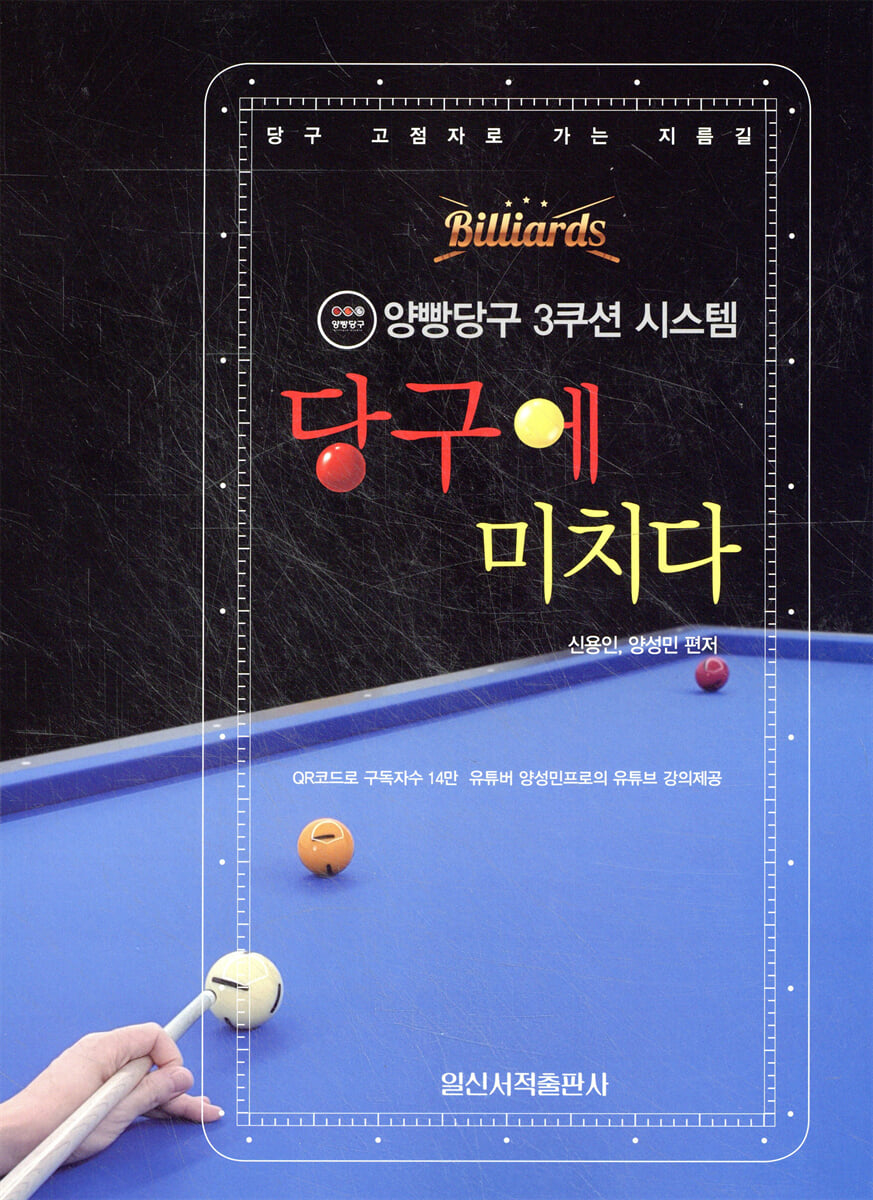
Crazy about billiards
 |
Description
Book Introduction
Through numerous verifications, we have systematically organized the core best systems.
We've created a concise and visually appealing presentation that highlights the essential points.
This summary of the main video lectures from the YouTube channel "Yangbbangdanggu" clearly reflects the overall content. You can easily view the video lectures by scanning the QR code.
We've created a concise and visually appealing presentation that highlights the essential points.
This summary of the main video lectures from the YouTube channel "Yangbbangdanggu" clearly reflects the overall content. You can easily view the video lectures by scanning the QR code.
index
1.
General
introduction
Recommendation
Key Features of this Book
Our store
speed
Thickness and separation angle
Types of grips: Loose grip and Firm grip
Separation angle and grip type (loose grip and firm grip)
master eye
Squat and curve phenomena
Critical slope
stroke and bridge
Establishing the foundation (fundamentals) for a perfect stroke
Why High-Score Players Reduce Bridge Length
Why Professional Players So Often Use Open Bridge
7 basic strokes
The Importance of Preparatory Strokes
Correction of the striking stroke
The difference between a jab shot and a follow shot
Tips for Raising Your Average / Becoming a High Score
Tips for when billiards is not going well, when the empty shot is long, or when you are in a slump
Basic principles of choice
The Importance of Banking and the First Ball / How to Adapt to Table Conditions
2.
5½ system
The core of the 5½ system
Our store
Long angle (starting value of 70 or more) 3 cushions 50 or more when starting
Correction value
Correction of special section (3 cushions 35-45)
4-6 cushions for the grand slam
Short 7-cushion system for the grand final
Progression path from 3 cushions to 4 cushions
4-tip 5½ system
3-tip 5½ system: 1/2 table
1 tip 5½ system
3.
35½ system (Joy's short angle)
Basic principles
expansion
4.
30-symmetry system and 35-symmetry system
30 Symmetry System (3-point Secret): Aim for the top 3 points (30)
30 Symmetry System: Aiming for the lower 3-point (50)
30 Symmetry System: Comparison of the two cushion points of the upper 30 and lower 30 (50) systems.
35-symmetry system
5.
Plus system
Basic principles
Corner value (α)
Water polo start 60 or more (60~80)
Water polo start under 15
4 cushion line
Kansu calculation method (simple method)
Plus 15 (3 tips) system
Return to Place System: Starting from the Jang Cushion
Maximum 4 Tip Plus System
No-Spin Plus (multiple of 3) system
6.
Rodriguez system
Basic principles
How to send to a 2-cushion point (simple method)
Tips for being good at pulling
7.
No-rotation system
No-Spin 5½ System: The Origin of the 5½ System
No-rotation 2/3 system: Type A, B, C, D, E
No-spin 1/2 system (single cushion start: short, long, short)
No-spin 1/4 system (long cushion start: short, long, short)
New York Bobby system
No-turn corner angle 1/2 system
No-spin x 6 system
No-spin ½ 4-cushion symmetrical system
Non-spin 4-cushion 991 system
No-spin upright/deflecting system
Non-rotating 3-cushion corner line system
No-spin 4-cushion system: starting value of cue ball 40 or less
Non-rotational parallel translation method
No-rotation double cushion system
8.
Maximum 4-tip system
Maximum 40 System: 1/4 Table
Maximum 18 System: 1/4 Table
3-tip 15 system: 1/4 table
Maximum in-place 15 system
Maximum 40 (4 spaces) system
Maximum 4-tip 1/2 system
3-tip reverse rotation system
Spin shot
9.
Reverse system
double rail system
● Let’s figure out your own counter-rotation power!
● How to set the cushion point
● Corner aiming method
● Maximum return system using the 5½ system
● Practical tips
● Return beyond the limit angle (line)
● Return to maximum spin shot
● Side turn vs.
Come back
● Return from 1/4 table
plate system
● Long cushion plate system
● Schaefer system
● Single cushion plate system
Other various reverse rotation systems
● Reverse ball system
● Reverse 0, 5, 10 system
● Various reverse shots
10.
Avoid kissing
Avoiding the outward kiss
● Basic principles
● Four patterns of avoiding kisses by turning outside
● When the 1st ball is close to the corner
● When the ball is 1.5 to 2 balls away from the long cushion
● Staggered arrangement
● When the ball and the first ball are located near the bottom corner of the table
● When the distance between the ball and the target is far: Push thickly
Avoiding a sideways kiss
● 6 Patterns to Avoid a Sideways Kiss
● The slope of the cue ball and the first ball
● Movement distance of the ball 〈 Movement distance of 1 ball
● Movement distance of the ball 1 Movement distance of the ball
● The red ball is located near the center of the cushion.
● The enemy is located at the 3-point of the long cushion
● Giant slalom
● Long side turn
Case analysis
Avoiding a forward kiss
Case analysis
● Giant slalom
Avoiding a stray kiss
11.
Position play
Basic principles of positional play
Outside rotation position play
● Basic principles
● 4 patterns
● Example of application of positional play pattern
● Position play with an outward rotation of the staggered position
● Play various positions
Side turn position play
● Basic type
● 6 patterns
● Play various positions
Forward turn position play
Deflect position play
Double cushion position play
General
introduction
Recommendation
Key Features of this Book
Our store
speed
Thickness and separation angle
Types of grips: Loose grip and Firm grip
Separation angle and grip type (loose grip and firm grip)
master eye
Squat and curve phenomena
Critical slope
stroke and bridge
Establishing the foundation (fundamentals) for a perfect stroke
Why High-Score Players Reduce Bridge Length
Why Professional Players So Often Use Open Bridge
7 basic strokes
The Importance of Preparatory Strokes
Correction of the striking stroke
The difference between a jab shot and a follow shot
Tips for Raising Your Average / Becoming a High Score
Tips for when billiards is not going well, when the empty shot is long, or when you are in a slump
Basic principles of choice
The Importance of Banking and the First Ball / How to Adapt to Table Conditions
2.
5½ system
The core of the 5½ system
Our store
Long angle (starting value of 70 or more) 3 cushions 50 or more when starting
Correction value
Correction of special section (3 cushions 35-45)
4-6 cushions for the grand slam
Short 7-cushion system for the grand final
Progression path from 3 cushions to 4 cushions
4-tip 5½ system
3-tip 5½ system: 1/2 table
1 tip 5½ system
3.
35½ system (Joy's short angle)
Basic principles
expansion
4.
30-symmetry system and 35-symmetry system
30 Symmetry System (3-point Secret): Aim for the top 3 points (30)
30 Symmetry System: Aiming for the lower 3-point (50)
30 Symmetry System: Comparison of the two cushion points of the upper 30 and lower 30 (50) systems.
35-symmetry system
5.
Plus system
Basic principles
Corner value (α)
Water polo start 60 or more (60~80)
Water polo start under 15
4 cushion line
Kansu calculation method (simple method)
Plus 15 (3 tips) system
Return to Place System: Starting from the Jang Cushion
Maximum 4 Tip Plus System
No-Spin Plus (multiple of 3) system
6.
Rodriguez system
Basic principles
How to send to a 2-cushion point (simple method)
Tips for being good at pulling
7.
No-rotation system
No-Spin 5½ System: The Origin of the 5½ System
No-rotation 2/3 system: Type A, B, C, D, E
No-spin 1/2 system (single cushion start: short, long, short)
No-spin 1/4 system (long cushion start: short, long, short)
New York Bobby system
No-turn corner angle 1/2 system
No-spin x 6 system
No-spin ½ 4-cushion symmetrical system
Non-spin 4-cushion 991 system
No-spin upright/deflecting system
Non-rotating 3-cushion corner line system
No-spin 4-cushion system: starting value of cue ball 40 or less
Non-rotational parallel translation method
No-rotation double cushion system
8.
Maximum 4-tip system
Maximum 40 System: 1/4 Table
Maximum 18 System: 1/4 Table
3-tip 15 system: 1/4 table
Maximum in-place 15 system
Maximum 40 (4 spaces) system
Maximum 4-tip 1/2 system
3-tip reverse rotation system
Spin shot
9.
Reverse system
double rail system
● Let’s figure out your own counter-rotation power!
● How to set the cushion point
● Corner aiming method
● Maximum return system using the 5½ system
● Practical tips
● Return beyond the limit angle (line)
● Return to maximum spin shot
● Side turn vs.
Come back
● Return from 1/4 table
plate system
● Long cushion plate system
● Schaefer system
● Single cushion plate system
Other various reverse rotation systems
● Reverse ball system
● Reverse 0, 5, 10 system
● Various reverse shots
10.
Avoid kissing
Avoiding the outward kiss
● Basic principles
● Four patterns of avoiding kisses by turning outside
● When the 1st ball is close to the corner
● When the ball is 1.5 to 2 balls away from the long cushion
● Staggered arrangement
● When the ball and the first ball are located near the bottom corner of the table
● When the distance between the ball and the target is far: Push thickly
Avoiding a sideways kiss
● 6 Patterns to Avoid a Sideways Kiss
● The slope of the cue ball and the first ball
● Movement distance of the ball 〈 Movement distance of 1 ball
● Movement distance of the ball 1 Movement distance of the ball
● The red ball is located near the center of the cushion.
● The enemy is located at the 3-point of the long cushion
● Giant slalom
● Long side turn
Case analysis
Avoiding a forward kiss
Case analysis
● Giant slalom
Avoiding a stray kiss
11.
Position play
Basic principles of positional play
Outside rotation position play
● Basic principles
● 4 patterns
● Example of application of positional play pattern
● Position play with an outward rotation of the staggered position
● Play various positions
Side turn position play
● Basic type
● 6 patterns
● Play various positions
Forward turn position play
Deflect position play
Double cushion position play
GOODS SPECIFICS
- Date of issue: April 10, 2025
- Page count, weight, size: 318 pages | 188*254*30mm
- ISBN13: 9788936629038
- ISBN10: 8936629034
You may also like
카테고리
korean


korean

![GQ KOREA Mark (Monthly): December [2025]](http://librairie.coreenne.fr/cdn/shop/files/8ef265dbbfbf186523ed75ba7319009d.jpg?v=1765340328&width=3840)


