

Lee Ki-dong's Study of English Phrasal Verbs
 |
Description
Book Introduction
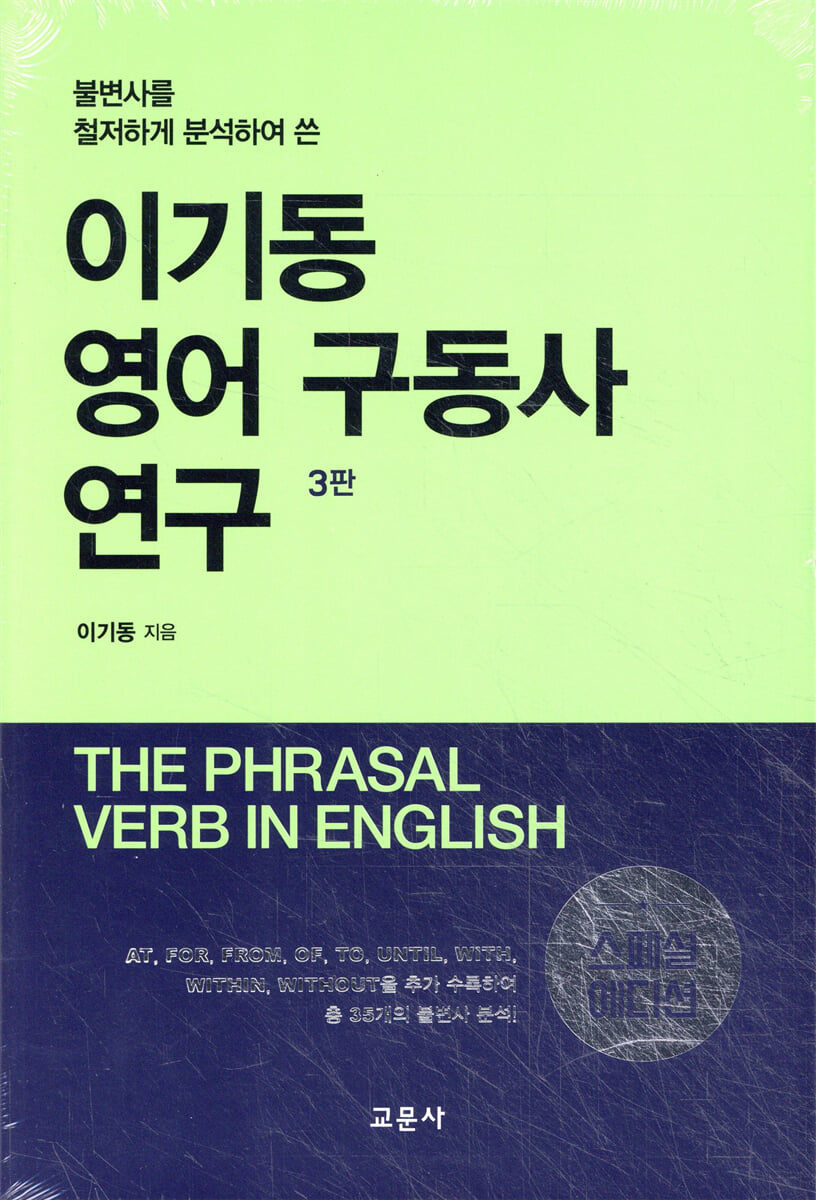
The 3rd edition of 『Lee Ki-dong's Study of English Phrasal Verbs』 includes 9 particle verbs that could not be included in the 2nd edition: at, for, from, of, to, until, with, within, and without, for a total of 35 particle verbs.
In the overview section, which previously only covered phrasal verbs, verbs, and particle verbs, we added figurative language and iconicity, and compared English phrasal verbs and Korean compound verbs to help readers understand.
Additionally, while previously we provided as many examples as possible, the revised edition only covers 5 or 6 examples where necessary, helping readers understand the key elements at a glance.
Lastly, section numbers and example numbers were inserted to make the book more convenient to use.
In the overview section, which previously only covered phrasal verbs, verbs, and particle verbs, we added figurative language and iconicity, and compared English phrasal verbs and Korean compound verbs to help readers understand.
Additionally, while previously we provided as many examples as possible, the revised edition only covers 5 or 6 examples where necessary, helping readers understand the key elements at a glance.
Lastly, section numbers and example numbers were inserted to make the book more convenient to use.
- You can preview some of the book's contents.
Preview
index
PART 1 GENERAL OVERVIEW
01 Verbs
02 Verb
03 Invincible Temple
04 Concepts needed to understand verbs
05 Comparison of English phrasal verbs and Korean compound verbs
PART 2 Verb Analysis
01 about
02 across
03 ahead
04 along
05 apart
06 around
07 aside
08 at
09 away
10 back
11 by
12 down
13 for
14 forward
15 from
16 in
17 inside
18 into
19 of
20 off
21 on
22 onto
23 out
24 out of
25 outside
26 over
27 through
28 to
29 together
30 under
31 until
32 up
33 with
34 within
35 without
01 Verbs
02 Verb
03 Invincible Temple
04 Concepts needed to understand verbs
05 Comparison of English phrasal verbs and Korean compound verbs
PART 2 Verb Analysis
01 about
02 across
03 ahead
04 along
05 apart
06 around
07 aside
08 at
09 away
10 back
11 by
12 down
13 for
14 forward
15 from
16 in
17 inside
18 into
19 of
20 off
21 on
22 onto
23 out
24 out of
25 outside
26 over
27 through
28 to
29 together
30 under
31 until
32 up
33 with
34 within
35 without
Detailed image
Publisher's Review
AT, FOR, FROM, OF, TO, UNTIL, WITH, WITHIN, WITHOUT
A total of 35 invariant words have been analyzed, including additional ones!
This book is the third edition of Lee Ki-dong's Study of English Phrasal Verbs.
Due to the vastness of the content, we were afraid that it might be burdensome for readers who are about to study English, so we added nine particle verbs (at, for, from, of, to, until, with, within, and without) that could not be included in the second edition, bringing the total number of particle verbs to 35.
In the overview section, which previously only covered phrasal verbs, verbs, and particle verbs, we added figurative language and iconicity, and compared English phrasal verbs and Korean compound verbs to help readers understand.
Also, although we previously provided as many examples as possible, there was a possibility that too many examples could cause discomfort to readers.
In the revised edition, only five or six examples are provided for the necessary parts, helping readers understand the key elements at a glance.
Lastly, section numbers and example numbers were inserted to make the book more convenient to use.
Selected by a popular YouTuber who introduces the best English study method
My favorite book!
Professor Emeritus Lee Ki-dong of Yonsei University, who has published over 50 books and 100 papers, wrote this book by compiling his research findings on prepositions, verbs, and phrase verbs.
His clear explanations, based on his extensive research, are useful not only for English teachers who must explain the complex meaning of prepositions to their students, but also as a reference for major students who struggle to understand the meaning of prepositions.
Recently, a famous English study YouTuber praised this book, saying that he learned English expressions by reading it so often that the cover became worn out.
This book, which he introduced as his favorite book that shows the true mindset of a native speaker, is different from existing grammar books in that it minimizes complex usage and explanations and instead provides as many diverse examples as possible.
For those who have only understood prepositions as part of grammar, various examples and practical applications are more important than detailed explanations.
This book is designed to encourage readers to construct their own sentences based on numerous examples.
This helps you naturally learn the commonalities of the verbs used in the examples.
Through a variety of examples and detailed diagrams, readers will have the opportunity to study the subtle meanings and sophisticated expressions of English verbs.
In addition, this book presents a comparison of English phrasal verbs and Korean compound verbs.
It is often said that if you don't have a foundation in Korean, you will have difficulty learning a language.
This is because people who have a foundation in Korean language structure can appropriately utilize that structure when understanding other languages.
This book takes this idea and compares English phrasal verbs with Korean compound verbs.
By comparing the 'verb-particular' structure of English phrasal verbs with the 'verb-verb-verb' structure of Korean, such as examining 'put down' as 'put down-er(ryo) put' and 'put up' as 'put up-er(ryo) put', and diagramming this, it helps to imagine replacing English phrasal verbs with Korean.
Verbs, if you memorize them without context, you'll never catch them!
Verbs that used to hinder English learning are now understood through diagrams.
In English, a combination of a verb and an adverb or a verb and a preposition that creates a different meaning than before is called a 'phrasal verb'.
Many high school students learn this phrasal verb in English class under the name of "idiom."
For example, the English word 'get on' is memorized as a formula, meaning 'get on' in Korean.
Furthermore, in the sentence 'John ate up the lunch', we sometimes hear people say, "'up' has no meaning, so it can be omitted."
Students memorize the prepositions without considering the context or meaning of the prepositions, as the teacher says.
However, this unconditional memorization cannot explain the difference between 'A walk to B' and 'A walk up to B'.
Idioms memorized without context become unusable expressions even if they are applied slightly differently.
This book is a guide to phrasal verbs for those who have been memorizing idioms without understanding their meaning or context.
Unlike existing English grammar books that suggest understanding it through simple combinations of meanings or abstractly saying, "It's an idiom, so memorize it first," this book presents it in detail using appropriate diagrams so that you can visualize the meaning in your head.
The diagrams in the book allow us to imagine that while 'A walk to B' means simple movement, 'A walk up to B' is a form of perspective in which A becomes increasingly larger (and therefore increasingly higher up) from the perspective of observer B as A moves towards B.
A total of 35 invariant words have been analyzed, including additional ones!
This book is the third edition of Lee Ki-dong's Study of English Phrasal Verbs.
Due to the vastness of the content, we were afraid that it might be burdensome for readers who are about to study English, so we added nine particle verbs (at, for, from, of, to, until, with, within, and without) that could not be included in the second edition, bringing the total number of particle verbs to 35.
In the overview section, which previously only covered phrasal verbs, verbs, and particle verbs, we added figurative language and iconicity, and compared English phrasal verbs and Korean compound verbs to help readers understand.
Also, although we previously provided as many examples as possible, there was a possibility that too many examples could cause discomfort to readers.
In the revised edition, only five or six examples are provided for the necessary parts, helping readers understand the key elements at a glance.
Lastly, section numbers and example numbers were inserted to make the book more convenient to use.
Selected by a popular YouTuber who introduces the best English study method
My favorite book!
Professor Emeritus Lee Ki-dong of Yonsei University, who has published over 50 books and 100 papers, wrote this book by compiling his research findings on prepositions, verbs, and phrase verbs.
His clear explanations, based on his extensive research, are useful not only for English teachers who must explain the complex meaning of prepositions to their students, but also as a reference for major students who struggle to understand the meaning of prepositions.
Recently, a famous English study YouTuber praised this book, saying that he learned English expressions by reading it so often that the cover became worn out.
This book, which he introduced as his favorite book that shows the true mindset of a native speaker, is different from existing grammar books in that it minimizes complex usage and explanations and instead provides as many diverse examples as possible.
For those who have only understood prepositions as part of grammar, various examples and practical applications are more important than detailed explanations.
This book is designed to encourage readers to construct their own sentences based on numerous examples.
This helps you naturally learn the commonalities of the verbs used in the examples.
Through a variety of examples and detailed diagrams, readers will have the opportunity to study the subtle meanings and sophisticated expressions of English verbs.
In addition, this book presents a comparison of English phrasal verbs and Korean compound verbs.
It is often said that if you don't have a foundation in Korean, you will have difficulty learning a language.
This is because people who have a foundation in Korean language structure can appropriately utilize that structure when understanding other languages.
This book takes this idea and compares English phrasal verbs with Korean compound verbs.
By comparing the 'verb-particular' structure of English phrasal verbs with the 'verb-verb-verb' structure of Korean, such as examining 'put down' as 'put down-er(ryo) put' and 'put up' as 'put up-er(ryo) put', and diagramming this, it helps to imagine replacing English phrasal verbs with Korean.
Verbs, if you memorize them without context, you'll never catch them!
Verbs that used to hinder English learning are now understood through diagrams.
In English, a combination of a verb and an adverb or a verb and a preposition that creates a different meaning than before is called a 'phrasal verb'.
Many high school students learn this phrasal verb in English class under the name of "idiom."
For example, the English word 'get on' is memorized as a formula, meaning 'get on' in Korean.
Furthermore, in the sentence 'John ate up the lunch', we sometimes hear people say, "'up' has no meaning, so it can be omitted."
Students memorize the prepositions without considering the context or meaning of the prepositions, as the teacher says.
However, this unconditional memorization cannot explain the difference between 'A walk to B' and 'A walk up to B'.
Idioms memorized without context become unusable expressions even if they are applied slightly differently.
This book is a guide to phrasal verbs for those who have been memorizing idioms without understanding their meaning or context.
Unlike existing English grammar books that suggest understanding it through simple combinations of meanings or abstractly saying, "It's an idiom, so memorize it first," this book presents it in detail using appropriate diagrams so that you can visualize the meaning in your head.
The diagrams in the book allow us to imagine that while 'A walk to B' means simple movement, 'A walk up to B' is a form of perspective in which A becomes increasingly larger (and therefore increasingly higher up) from the perspective of observer B as A moves towards B.
GOODS SPECIFICS
- Date of issue: December 1, 2020
- Page count, weight, size: 762 pages | 940g | 152*225*40mm
- ISBN13: 9788936321154
- ISBN10: 8936321153
You may also like
카테고리
korean


korean

![GQ KOREA Mark (Monthly): December [2025]](http://librairie.coreenne.fr/cdn/shop/files/8ef265dbbfbf186523ed75ba7319009d.jpg?v=1765340328&width=3840)


