

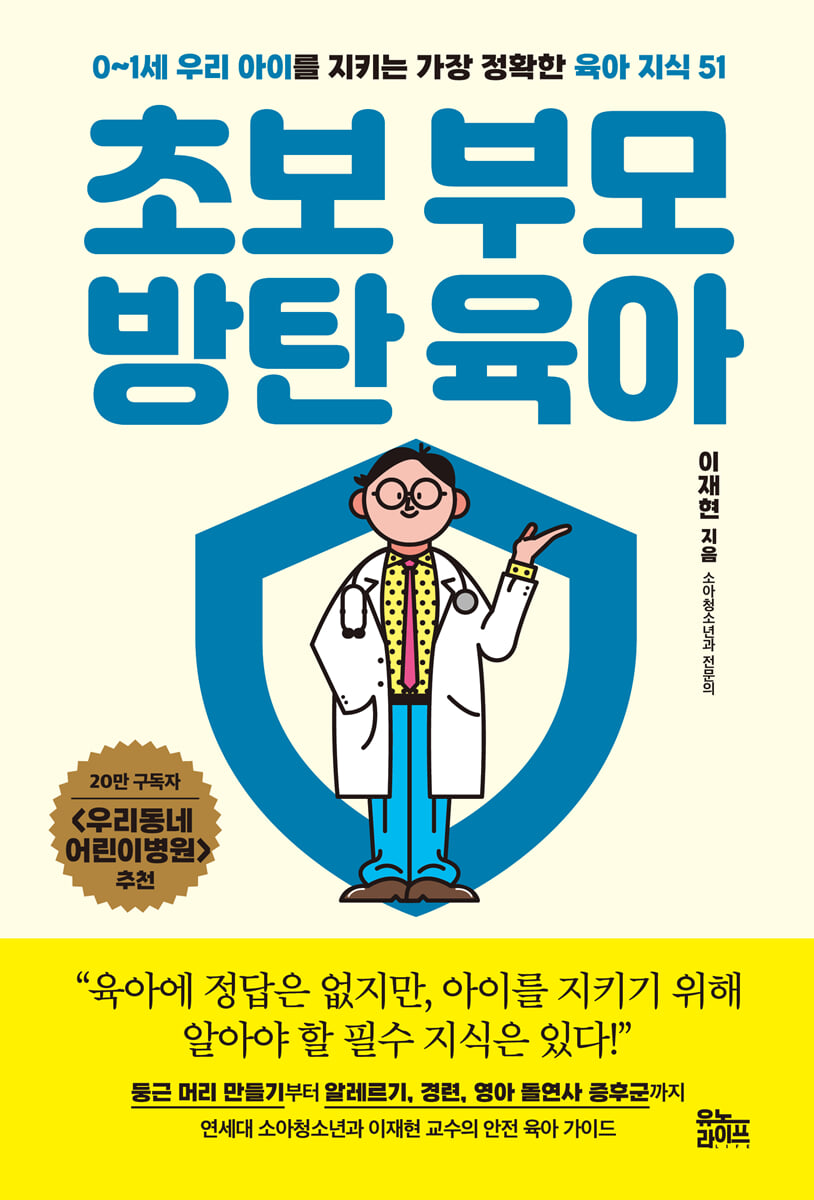
Bulletproof Parenting for New Parents
 |
Description
Book Introduction
There is no right answer to parenting, but to protect your child,
There is essential knowledge you need to know!
A parenting textbook for the first year of life, all in one volume.
Recommended by Park So-young and Son Su-ye from "Our Neighborhood Children's Hospital"!
“How do I make a round head?”
“I keep vomiting. Is that okay?”
“The area around my mouth is red. Could it be an allergy?”
Even after going through the difficult pregnancy and childbirth, new parents face another challenge: childcare.
From colic to sleep habits, nutritional supplements, and even baby care, there are so many things you want to know, but taking your child to the hospital can be overwhelming, and with so much information online, it can be confusing to know what to do.
In these situations, if you listen to the advice of those around you, you may end up doing something that is harmful to your child.
Parenting is not difficult or overwhelming.
The author, a professor who treats critically ill newborns in a neonatal intensive care unit and a father of a three-year-old, says that new parents can reduce their fears by knowing and understanding the changes that occur in their child during the first year of life.
If you know when to go to the emergency room and what developmental milestones your child should show at each stage, you can raise your child safely without panicking or feeling overwhelmed.
The most important thing in raising a child between 0 and 1 year old is the desire for the child to grow up ‘healthily.’
Many things we do in hopes of making our children smarter, taller, or faster walkers actually do more harm than good.
For example, there are still widespread misconceptions about parenting, such as that using a walker helps children grow taller or that a walker helps children learn to walk.
Based on the latest medical knowledge and experience, the author distinguishes between conditions that new parents should be concerned about and those that they should not, and selects and provides parenting tips that are beneficial to children.
The author has included in this book only the essential knowledge needed to know for the first year of life, from making a round head to allergies, seizures, and sudden infant death syndrome.
Additionally, the author increased reliability by organizing the content based on frequently asked questions in pediatrics.
The author's experience as a father of a 3-year-old child also resonates with many new parents.
I hope this book will inspire courage and confidence in countless parents who are worried about raising their children.
There is essential knowledge you need to know!
A parenting textbook for the first year of life, all in one volume.
Recommended by Park So-young and Son Su-ye from "Our Neighborhood Children's Hospital"!
“How do I make a round head?”
“I keep vomiting. Is that okay?”
“The area around my mouth is red. Could it be an allergy?”
Even after going through the difficult pregnancy and childbirth, new parents face another challenge: childcare.
From colic to sleep habits, nutritional supplements, and even baby care, there are so many things you want to know, but taking your child to the hospital can be overwhelming, and with so much information online, it can be confusing to know what to do.
In these situations, if you listen to the advice of those around you, you may end up doing something that is harmful to your child.
Parenting is not difficult or overwhelming.
The author, a professor who treats critically ill newborns in a neonatal intensive care unit and a father of a three-year-old, says that new parents can reduce their fears by knowing and understanding the changes that occur in their child during the first year of life.
If you know when to go to the emergency room and what developmental milestones your child should show at each stage, you can raise your child safely without panicking or feeling overwhelmed.
The most important thing in raising a child between 0 and 1 year old is the desire for the child to grow up ‘healthily.’
Many things we do in hopes of making our children smarter, taller, or faster walkers actually do more harm than good.
For example, there are still widespread misconceptions about parenting, such as that using a walker helps children grow taller or that a walker helps children learn to walk.
Based on the latest medical knowledge and experience, the author distinguishes between conditions that new parents should be concerned about and those that they should not, and selects and provides parenting tips that are beneficial to children.
The author has included in this book only the essential knowledge needed to know for the first year of life, from making a round head to allergies, seizures, and sudden infant death syndrome.
Additionally, the author increased reliability by organizing the content based on frequently asked questions in pediatrics.
The author's experience as a father of a 3-year-old child also resonates with many new parents.
I hope this book will inspire courage and confidence in countless parents who are worried about raising their children.
- You can preview some of the book's contents.
Preview
index
Introductory text.
I hope you grow up healthy
Chapter 1.
Protecting our baby from 0 to 1 month
: Colic, Sudden Infant Death Syndrome, When to Go to the Hospital
I can't hold up my neck | Motor development |
Why do I cry so often? | Language Development |
Feel and react | Cognitive, social, and sensory development |
The best way to be intimate is to take a bath
Let's prevent and deal with the dreaded stomachache in advance.
You must use a car seat
Putting Your Baby to Sleep Safely: Sudden Infant Death Syndrome
Is my hip dislocated? | Frequently asked question in the clinic |
I keep vomiting. Is this okay? | Frequently asked questions in the clinic |
When to take your child to the hospital urgently | Frequently asked questions in the doctor's office |
14-35 days after birth | Infant and toddler health checkup |
Breastfeeding vs. Formula Feeding | Parenting Plus |
Chapter 2.
Protecting our baby for 2-3 months
: How to deal with a runny nose, shaken baby syndrome, and making a round head
Increase tummy time little by little | Motor development |
Make Your Voice Speak | Language and Social Development |
Seeing movement well | Cognitive development |
The Road to Deep Sleep: Developing Sleep Habits
Make a round head!
Don't shake too much, shaken baby syndrome
Can I pick my nose? | Common questions in the doctor's office |
Are there any supplements I should be taking? | Frequently asked questions in the clinic |
Do I need to get all my vaccinations? | Frequently asked questions in the doctor's office |
How to Breastfeed Regularly | Parenting Plus |
Chapter 3.
Protecting our babies from 4 to 6 months
: Preparing baby food, studying for health checkups, and checking developmental status
Roll and Sit! | Motor Development |
Grab a toy and giggle! | Language Development |
Beginning to be shy | Cognitive and social development |
No exposure to electronic media!
When should I start giving solid foods?
Prepare baby food like this!
Be careful not to get burned
Is development okay? | Frequently asked questions in the clinic |
My leg is bent. Is it okay? | Frequently asked question in the clinic |
Just looking at the health checkups is a learning experience | Infant and Toddler Health Checkups |
Making Baby Food | Parenting Plus |
Chapter 4.
Protecting Your Baby from 7 to 9 Months
: The Dark Ages of Immunity, Preparing for Your First Steps, and Finding Allergies
Start your adventure by crawling | Motor development |
Communication Begins | Language Development |
Independence and Separation Anxiety Collide | Cognitive and Social Development |
Overcoming the 'Dark Ages of Immunity'
How to overcome toothache fear
Creating a safe environment for first steps
My mouth is red. Could it be an allergy?
Suddenly Stops Eating Baby Food | Frequently Asked Questions in the Clinic |
Preparing for Mid- and Late-Child Weaning | Parenting Plus |
Chapter 5.
Protecting Your Baby from 10 to 12 Months
: How to deal with falls and febrile seizures, knowing about rashes, and feeding when sick
Start walking little by little | Motor development |
Mom and Dad Start Talking | Language Development |
Disobeys and tries to do things on his own | Cognitive and social development |
Discipline, can we begin?
The baby fell!
What is 'sudden rash'? | Frequently asked questions in clinics |
I'm scared of 'febrile seizures' | A common question in the doctor's office |
When a detailed examination is needed | Infant and toddler health checkups |
What should I feed my baby when he or she is sick? | Parenting Plus |
I hope you grow up healthy
Chapter 1.
Protecting our baby from 0 to 1 month
: Colic, Sudden Infant Death Syndrome, When to Go to the Hospital
I can't hold up my neck | Motor development |
Why do I cry so often? | Language Development |
Feel and react | Cognitive, social, and sensory development |
The best way to be intimate is to take a bath
Let's prevent and deal with the dreaded stomachache in advance.
You must use a car seat
Putting Your Baby to Sleep Safely: Sudden Infant Death Syndrome
Is my hip dislocated? | Frequently asked question in the clinic |
I keep vomiting. Is this okay? | Frequently asked questions in the clinic |
When to take your child to the hospital urgently | Frequently asked questions in the doctor's office |
14-35 days after birth | Infant and toddler health checkup |
Breastfeeding vs. Formula Feeding | Parenting Plus |
Chapter 2.
Protecting our baby for 2-3 months
: How to deal with a runny nose, shaken baby syndrome, and making a round head
Increase tummy time little by little | Motor development |
Make Your Voice Speak | Language and Social Development |
Seeing movement well | Cognitive development |
The Road to Deep Sleep: Developing Sleep Habits
Make a round head!
Don't shake too much, shaken baby syndrome
Can I pick my nose? | Common questions in the doctor's office |
Are there any supplements I should be taking? | Frequently asked questions in the clinic |
Do I need to get all my vaccinations? | Frequently asked questions in the doctor's office |
How to Breastfeed Regularly | Parenting Plus |
Chapter 3.
Protecting our babies from 4 to 6 months
: Preparing baby food, studying for health checkups, and checking developmental status
Roll and Sit! | Motor Development |
Grab a toy and giggle! | Language Development |
Beginning to be shy | Cognitive and social development |
No exposure to electronic media!
When should I start giving solid foods?
Prepare baby food like this!
Be careful not to get burned
Is development okay? | Frequently asked questions in the clinic |
My leg is bent. Is it okay? | Frequently asked question in the clinic |
Just looking at the health checkups is a learning experience | Infant and Toddler Health Checkups |
Making Baby Food | Parenting Plus |
Chapter 4.
Protecting Your Baby from 7 to 9 Months
: The Dark Ages of Immunity, Preparing for Your First Steps, and Finding Allergies
Start your adventure by crawling | Motor development |
Communication Begins | Language Development |
Independence and Separation Anxiety Collide | Cognitive and Social Development |
Overcoming the 'Dark Ages of Immunity'
How to overcome toothache fear
Creating a safe environment for first steps
My mouth is red. Could it be an allergy?
Suddenly Stops Eating Baby Food | Frequently Asked Questions in the Clinic |
Preparing for Mid- and Late-Child Weaning | Parenting Plus |
Chapter 5.
Protecting Your Baby from 10 to 12 Months
: How to deal with falls and febrile seizures, knowing about rashes, and feeding when sick
Start walking little by little | Motor development |
Mom and Dad Start Talking | Language Development |
Disobeys and tries to do things on his own | Cognitive and social development |
Discipline, can we begin?
The baby fell!
What is 'sudden rash'? | Frequently asked questions in clinics |
I'm scared of 'febrile seizures' | A common question in the doctor's office |
When a detailed examination is needed | Infant and toddler health checkups |
What should I feed my baby when he or she is sick? | Parenting Plus |
Detailed image
.jpg)
Into the book
However, the parenting information that is popular these days seems to be focused on raising children to be ‘smart’ rather than on their health.
And as uncertain claims become popular and consumed, we often see parents without access to essential information.
In the midst of all this chaos that parents face, I found my role as a father raising a child and as a pediatrician working for children's health.
“We must spread accurate information widely so that children can grow up healthy and safe!”
---From the "Introductory Note"
However, breastfeeding, especially breastfeeding, requires caution when using pacifiers.
The shape of a baby's mouth when sucking on the mother's breast and the shape of its mouth when sucking on a nipple are different, so if a baby is not careful, they may get confused about how to suck on the mother's breast while sucking on a nipple, which can lead to 'nipple confusion', which means they cannot breastfeed properly.
In such cases, breastfeeding may not proceed smoothly, and the baby may experience symptoms such as dehydration, hypoglycemia, and jaundice, while the mother may experience pain such as breast engorgement and sore nipples.
So, if you are breastfeeding a baby, it is recommended that you do not use a pacifier during the newborn period, and that you use it after the baby is over 1 month old.
---From "Feel and React"
It is very important to stop feeding when your baby wants to stop feeding.
When I explain how much to feed a baby, I always say, feed as much as the baby wants.
If the mother or father decides how much the child eats and force-feeds the child when he or she is full, or if the mother or father abnormally increases the amount of feeding by comforting the child with food even when the child is crying for other reasons, this is also a bad habit that can cause colic.
Feeding your baby as much as he or she wants is the beginning of respecting your baby.
---From "Let's prevent and deal with the stomachache of fear in advance"
However, recently, cushions that help children sleep in a slightly upright position have become popular, claiming to prevent reflux.
As a pediatrician, I do not recommend using this cushion as it not only does little to prevent reflux, but it also compromises your baby's sleep safety.
---From "Sudden Infant Death Syndrome: Putting Your Baby to Sleep Safely"
It is important to make your baby turn his head from side to side while he is sleeping.
The way to do this is to lay the baby on his back.
Imagine putting a baby to sleep with the wall on the right and the mother on the left, with the head and feet turned in the opposite direction.
So this time, the mother will be on the baby's right and the wall will be on the baby's left.
The baby wants to fall asleep looking at his mother, so this time he falls asleep looking to the right instead of the left.
It would be nice to do this every day, but for those who find it difficult to do so, it would be fine to do it once a week.
---From "Make a Round Head"
One thing I think is particularly important is being able to sit still.
Baby food is more viscous and contains lumps than formula or breast milk, so if it accidentally goes into the airway, it can cause choking.
So, you should eat in a sitting position, not lying down.
Because the age at which a child begins to sit up varies slightly from child to child, the timing of starting solid food cannot be determined simply by age.
---From "When should I start giving solid food?"
Not having too many toys around your child is good for both safety and development.
When trying to attract a child's interest, stimulate development, or communicate with a child, concentration is important.
When there are a lot of interesting toys around, children's attention wanders everywhere and it becomes difficult to concentrate.
That's a drawback in terms of inducing various developments.
---From "Creating a Safe Environment for First Steps"
In our country, the most popular baby product purchased as a gift is a baby walker.
However, walkers are banned from sale in Canada, and the American Academy of Pediatrics is petitioning to ban their sale and production.
Pediatricians in our country also recommend against using walkers.
And as uncertain claims become popular and consumed, we often see parents without access to essential information.
In the midst of all this chaos that parents face, I found my role as a father raising a child and as a pediatrician working for children's health.
“We must spread accurate information widely so that children can grow up healthy and safe!”
---From the "Introductory Note"
However, breastfeeding, especially breastfeeding, requires caution when using pacifiers.
The shape of a baby's mouth when sucking on the mother's breast and the shape of its mouth when sucking on a nipple are different, so if a baby is not careful, they may get confused about how to suck on the mother's breast while sucking on a nipple, which can lead to 'nipple confusion', which means they cannot breastfeed properly.
In such cases, breastfeeding may not proceed smoothly, and the baby may experience symptoms such as dehydration, hypoglycemia, and jaundice, while the mother may experience pain such as breast engorgement and sore nipples.
So, if you are breastfeeding a baby, it is recommended that you do not use a pacifier during the newborn period, and that you use it after the baby is over 1 month old.
---From "Feel and React"
It is very important to stop feeding when your baby wants to stop feeding.
When I explain how much to feed a baby, I always say, feed as much as the baby wants.
If the mother or father decides how much the child eats and force-feeds the child when he or she is full, or if the mother or father abnormally increases the amount of feeding by comforting the child with food even when the child is crying for other reasons, this is also a bad habit that can cause colic.
Feeding your baby as much as he or she wants is the beginning of respecting your baby.
---From "Let's prevent and deal with the stomachache of fear in advance"
However, recently, cushions that help children sleep in a slightly upright position have become popular, claiming to prevent reflux.
As a pediatrician, I do not recommend using this cushion as it not only does little to prevent reflux, but it also compromises your baby's sleep safety.
---From "Sudden Infant Death Syndrome: Putting Your Baby to Sleep Safely"
It is important to make your baby turn his head from side to side while he is sleeping.
The way to do this is to lay the baby on his back.
Imagine putting a baby to sleep with the wall on the right and the mother on the left, with the head and feet turned in the opposite direction.
So this time, the mother will be on the baby's right and the wall will be on the baby's left.
The baby wants to fall asleep looking at his mother, so this time he falls asleep looking to the right instead of the left.
It would be nice to do this every day, but for those who find it difficult to do so, it would be fine to do it once a week.
---From "Make a Round Head"
One thing I think is particularly important is being able to sit still.
Baby food is more viscous and contains lumps than formula or breast milk, so if it accidentally goes into the airway, it can cause choking.
So, you should eat in a sitting position, not lying down.
Because the age at which a child begins to sit up varies slightly from child to child, the timing of starting solid food cannot be determined simply by age.
---From "When should I start giving solid food?"
Not having too many toys around your child is good for both safety and development.
When trying to attract a child's interest, stimulate development, or communicate with a child, concentration is important.
When there are a lot of interesting toys around, children's attention wanders everywhere and it becomes difficult to concentrate.
That's a drawback in terms of inducing various developments.
---From "Creating a Safe Environment for First Steps"
In our country, the most popular baby product purchased as a gift is a baby walker.
However, walkers are banned from sale in Canada, and the American Academy of Pediatrics is petitioning to ban their sale and production.
Pediatricians in our country also recommend against using walkers.
---From "Creating a Safe Environment for First Steps"
Publisher's Review
When you're in a hurry, searching is slow, so know in advance and prepare!
A safe parenting guide from Professor Jaehyun Lee of Yonsei University's Department of Pediatrics and Adolescent Medicine.
When a child is born, all parents have only one thought in their mind.
“Just grow up healthy.” But as children grow up, many people expect their children to grow up to be perfect.
The author, a professor who treats critically ill newborns in a neonatal intensive care unit and a father of a three-year-old, explains that parenting is about building fences.
The idea is to protect children from harm and discourage misbehavior outside the fence, while encouraging them to eat, sleep, and play as much as they want inside the fence.
“Never leave pillows, blankets, or dolls in the bedroom.”
- Protecting our baby from 0 to 1 month
0-1 months is when the baby is at his weakest.
Many parents put pillows, orthodontic pillows, blankets, or dolls in their children's beds in the hopes that their children's heads will be round, but this should never be done.
This is because a child who cannot even hold up his head properly cannot turn his head even when he is out of breath.
Taking a newborn to the hospital is not easy at all.
It's helpful to know the seven symptoms that require a trip to the emergency room.
If you have a fever of 38 degrees or higher, a body temperature of around 35 degrees, decreased urine output indicating dehydration, feel lethargic and unresponsive, have difficulty breathing, have convulsions, or fall from a high place.
“Be sure to remember terminal time.”
- Protecting our babies from 2 to 3 months and 4 to 6 months
Tummy time is an exercise that a child does while lying face down.
Before 100 days, it is a simple action of folding the legs and bringing the arms in front of the chest, and after 100 days, raising the upper body with the arms (page 113).
However, this exercise is the best way for your child to improve his motor skills and build a round head in the future.
When a child starts crying, new parents panic and try to comfort the child, but without realizing it, they end up shaking the child too hard.
Because a newborn's head is not yet fully developed, shaking it violently for a long time can cause a concussion or cerebral hemorrhage.
A few years ago in Japan, a three-month-old baby died of a cerebral hemorrhage after being left in a car for eight hours. The cause was shaken baby syndrome.
“Know how to deal with febrile convulsions”
- Protecting our babies from 7 to 9 months and 10 to 12 months
During this period, the child begins to get sick frequently.
This is because of the 'dark age of immunity', where antibodies temporarily decrease.
A baby is born with antibodies in the mother's womb, but as these antibodies age and decrease, the body's ability to produce them on its own cannot keep up with the rate at which these antibodies are produced, resulting in a weakened immune system.
This period lasts from 6 months after birth to 2-3 years of age.
So what should we do? We're already putting this method into practice during our COVID-19 experience.
Stay up to date with vaccinations, maintain good hygiene and quarantine, and eat a healthy diet.
“My eyes suddenly started rolling back and I started shaking so much that I couldn’t calm down!” Convulsions, which are sudden, fever-like shaking, occur in about 3 to 5 percent of all children.
More children than you might think experience febrile convulsions.
Knowing these six behavioral tips will help you respond calmly and without panicking.
Lay the child on a flat surface, do not press on the arms and legs, turn the head to the side, do not give medicine or water, take a video, and report it to 119.
The most important thing in parenting is not to be greedy and try to create a perfect child.
It's understandable to want to do more for your child, but it can easily harm them and make them unhappy.
Let's remember again.
Parenting is about building fences.
This book will be a great opportunity for new parents to understand the changes and characteristics of each child-rearing period and practice how to live happily together with their children.
A safe parenting guide from Professor Jaehyun Lee of Yonsei University's Department of Pediatrics and Adolescent Medicine.
When a child is born, all parents have only one thought in their mind.
“Just grow up healthy.” But as children grow up, many people expect their children to grow up to be perfect.
The author, a professor who treats critically ill newborns in a neonatal intensive care unit and a father of a three-year-old, explains that parenting is about building fences.
The idea is to protect children from harm and discourage misbehavior outside the fence, while encouraging them to eat, sleep, and play as much as they want inside the fence.
“Never leave pillows, blankets, or dolls in the bedroom.”
- Protecting our baby from 0 to 1 month
0-1 months is when the baby is at his weakest.
Many parents put pillows, orthodontic pillows, blankets, or dolls in their children's beds in the hopes that their children's heads will be round, but this should never be done.
This is because a child who cannot even hold up his head properly cannot turn his head even when he is out of breath.
Taking a newborn to the hospital is not easy at all.
It's helpful to know the seven symptoms that require a trip to the emergency room.
If you have a fever of 38 degrees or higher, a body temperature of around 35 degrees, decreased urine output indicating dehydration, feel lethargic and unresponsive, have difficulty breathing, have convulsions, or fall from a high place.
“Be sure to remember terminal time.”
- Protecting our babies from 2 to 3 months and 4 to 6 months
Tummy time is an exercise that a child does while lying face down.
Before 100 days, it is a simple action of folding the legs and bringing the arms in front of the chest, and after 100 days, raising the upper body with the arms (page 113).
However, this exercise is the best way for your child to improve his motor skills and build a round head in the future.
When a child starts crying, new parents panic and try to comfort the child, but without realizing it, they end up shaking the child too hard.
Because a newborn's head is not yet fully developed, shaking it violently for a long time can cause a concussion or cerebral hemorrhage.
A few years ago in Japan, a three-month-old baby died of a cerebral hemorrhage after being left in a car for eight hours. The cause was shaken baby syndrome.
“Know how to deal with febrile convulsions”
- Protecting our babies from 7 to 9 months and 10 to 12 months
During this period, the child begins to get sick frequently.
This is because of the 'dark age of immunity', where antibodies temporarily decrease.
A baby is born with antibodies in the mother's womb, but as these antibodies age and decrease, the body's ability to produce them on its own cannot keep up with the rate at which these antibodies are produced, resulting in a weakened immune system.
This period lasts from 6 months after birth to 2-3 years of age.
So what should we do? We're already putting this method into practice during our COVID-19 experience.
Stay up to date with vaccinations, maintain good hygiene and quarantine, and eat a healthy diet.
“My eyes suddenly started rolling back and I started shaking so much that I couldn’t calm down!” Convulsions, which are sudden, fever-like shaking, occur in about 3 to 5 percent of all children.
More children than you might think experience febrile convulsions.
Knowing these six behavioral tips will help you respond calmly and without panicking.
Lay the child on a flat surface, do not press on the arms and legs, turn the head to the side, do not give medicine or water, take a video, and report it to 119.
The most important thing in parenting is not to be greedy and try to create a perfect child.
It's understandable to want to do more for your child, but it can easily harm them and make them unhappy.
Let's remember again.
Parenting is about building fences.
This book will be a great opportunity for new parents to understand the changes and characteristics of each child-rearing period and practice how to live happily together with their children.
GOODS SPECIFICS
- Date of issue: May 30, 2024
- Page count, weight, size: 392 pages | 678g | 152*224*30mm
- ISBN13: 9791191104929
- ISBN10: 1191104923
You may also like
카테고리
korean


korean

![GQ KOREA Mark (Monthly): December [2025]](http://librairie.coreenne.fr/cdn/shop/files/8ef265dbbfbf186523ed75ba7319009d.jpg?v=1765340328&width=3840)


