

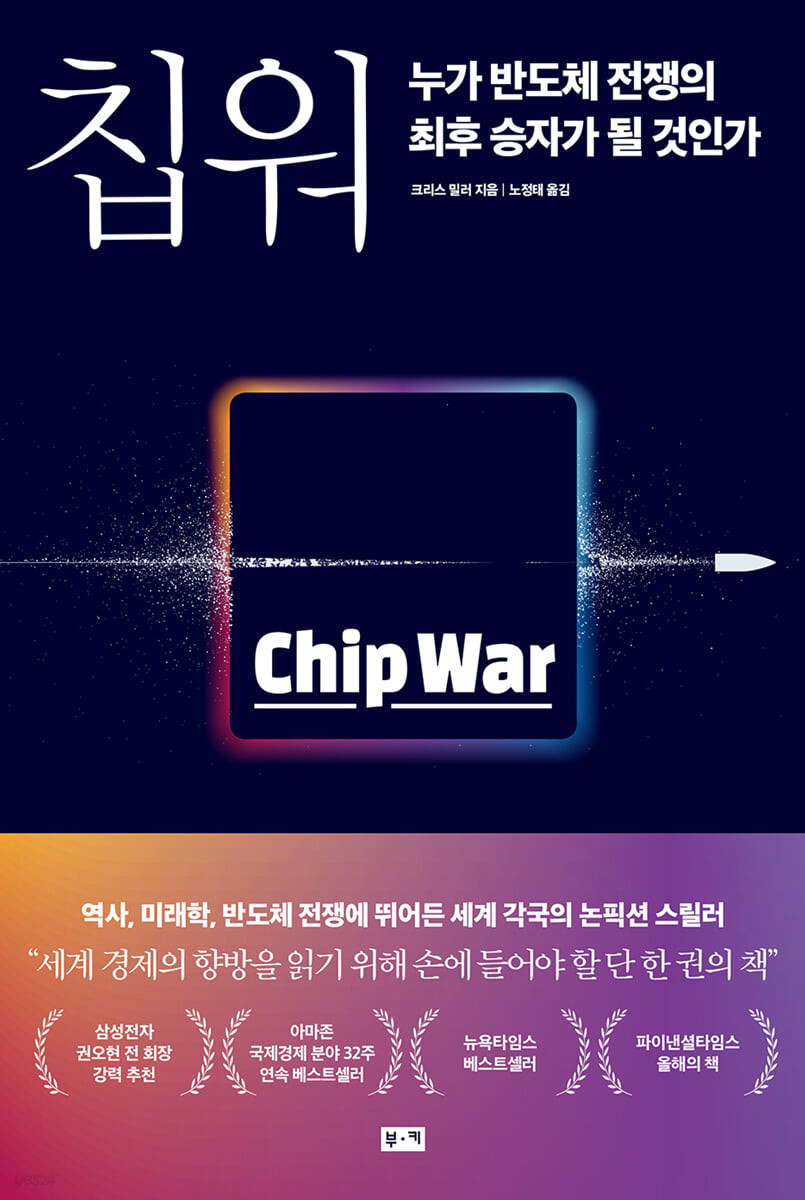
Chip War
 |
Description
Book Introduction
Everything about semiconductors is integrated into a precision circuit. A dizzying and elegant monumental historical nonfiction! Products that didn't exist just 70 years ago have become deeply ingrained in the daily lives of the world's 8 billion people, playing a key role in everything from home appliances to digital technology, artificial intelligence, national security, and even industry and the economy as a whole. Chips and semiconductors are called the rice of industry. Just as the 20th century cannot be understood without oil, it is impossible to view the 21st century without semiconductors. Chris Miller's "Chip Wars" is a monumental non-fiction history of the semiconductor industry, covering 70 years of its history, from its inception to the semiconductor hegemony battle between the United States and China, to the fierce technological competition and future strategies among Korea, Taiwan, Japan, and Silicon Valley. Semiconductors form the foundation of modern digital technology, but acquiring the nanometer-scale technology and equipment required to create such chips requires long-term, intensive investment. "Chip Wars" traces the semiconductor supply chain's establishment in East Asia and the industry's pioneers as a result of the pursuit of efficiency and focus. Combining meticulous analysis of industry and technology with rich interviews, the author presents readers with a compelling account of how who controls the 21st-century semiconductor industry could dramatically alter the global economy and political order, presenting the most crucial and strategic battles in today's geopolitical competition. The New York Times' rave review, "If there is one book that can make the Silicon Age accessible to a broad audience, it is 'Chip Wars,'" is no exaggeration. This book will provide overwhelming interest, intellectual pleasure, and rich, deep insights to readers seeking to understand the fundamentals and history of the semiconductor industry, businesspeople and investors curious about the international competition surrounding chips and the future of Korean semiconductor companies, and anyone seeking to forecast the unfolding technological competition and the direction of 21st-century geopolitics. |
- You can preview some of the book's contents.
Preview
index
Foreword | Praise for this Book | Preface to the Korean Edition | Characters | Glossary | Introduction
PART I: CHIP OF THE COLD WAR
1 From Steel to Silicon | 2 Switches | 3 Noyce, Kilby, and the Integrated Circuit | 4 Liftoff | 5 Mortars and Mass Production | 6 "I Want to Be... Rich"
PART II The Circuitry of the American World
7 Soviet Silicon Valley | 8 "Copy It" | 9 The Transistor Salesman | 10 "Transistor Girls" | 11 Precision Strikes | 12 The Art of Supply Chain and Diplomacy | 13 Intel's Revolutionaries | 14 The Pentagon's Offset Strategy
PART III Loss of Leadership?
15 "This Fierce Competition" | 16 "War with Japan" | 17 "Selling Garbage" | 18 Crude Oil in the 1980s | 19 The Death Spiral | 20 Japan's Ability to Say "No"
PART IV The Resurrected America
21 The King of Potato Chips | 22 Intel in Disarray | 23 "The Enemy of My Enemy is My Friend": The Rise of Korea | 24 "This is the Future" |
25 KGB Director T | 26 "Weapons of Mass Destruction": Offset Shock | 27 War Hero | 28 "The Cold War is Over, and You Won"
PART V A world trapped in integrated circuits?
29 "We Want a Taiwanese Semiconductor Industry" | 30 "All People Should Make Semiconductors" | 31 "Sharing the Lord's Love with the Chinese" | 32 The Lithography Wars | 33 The Innovator's Dilemma | 34 Run Faster?
PART VI Is Offshoring an Innovation?
35 "A real man should have a fab" | 36 The fabless revolution | 37 Morris's creative coalition | 38 Apple silicon | 39 EUV extreme ultraviolet equipment | 40 "There is no plan B" | 41 Intel forgets innovation
PART VII China's Challenge
42 Made in China | 43 "We Must Shout Out" | 44 Technology Transfer | 45 "The Mergers That Will Happen Will Happen" | 46 The Rise of Huawei | 47 5G is the Future | 48 Next-Generation Alternative Strategies
PART VIII STRANGING THE BOTTOM LINE WITH SEMICONDUCTORS
49 "Everything We Compete In" | 50 Fujian Jinhua Semiconductor | 51 Huawei Raid | 52 China's Sputnik Moment? | 53 Supply Chain Shortages | 54 Taiwan's Dilemma
Acknowledgments | Translator's Note | Endnotes | Index
PART I: CHIP OF THE COLD WAR
1 From Steel to Silicon | 2 Switches | 3 Noyce, Kilby, and the Integrated Circuit | 4 Liftoff | 5 Mortars and Mass Production | 6 "I Want to Be... Rich"
PART II The Circuitry of the American World
7 Soviet Silicon Valley | 8 "Copy It" | 9 The Transistor Salesman | 10 "Transistor Girls" | 11 Precision Strikes | 12 The Art of Supply Chain and Diplomacy | 13 Intel's Revolutionaries | 14 The Pentagon's Offset Strategy
PART III Loss of Leadership?
15 "This Fierce Competition" | 16 "War with Japan" | 17 "Selling Garbage" | 18 Crude Oil in the 1980s | 19 The Death Spiral | 20 Japan's Ability to Say "No"
PART IV The Resurrected America
21 The King of Potato Chips | 22 Intel in Disarray | 23 "The Enemy of My Enemy is My Friend": The Rise of Korea | 24 "This is the Future" |
25 KGB Director T | 26 "Weapons of Mass Destruction": Offset Shock | 27 War Hero | 28 "The Cold War is Over, and You Won"
PART V A world trapped in integrated circuits?
29 "We Want a Taiwanese Semiconductor Industry" | 30 "All People Should Make Semiconductors" | 31 "Sharing the Lord's Love with the Chinese" | 32 The Lithography Wars | 33 The Innovator's Dilemma | 34 Run Faster?
PART VI Is Offshoring an Innovation?
35 "A real man should have a fab" | 36 The fabless revolution | 37 Morris's creative coalition | 38 Apple silicon | 39 EUV extreme ultraviolet equipment | 40 "There is no plan B" | 41 Intel forgets innovation
PART VII China's Challenge
42 Made in China | 43 "We Must Shout Out" | 44 Technology Transfer | 45 "The Mergers That Will Happen Will Happen" | 46 The Rise of Huawei | 47 5G is the Future | 48 Next-Generation Alternative Strategies
PART VIII STRANGING THE BOTTOM LINE WITH SEMICONDUCTORS
49 "Everything We Compete In" | 50 Fujian Jinhua Semiconductor | 51 Huawei Raid | 52 China's Sputnik Moment? | 53 Supply Chain Shortages | 54 Taiwan's Dilemma
Acknowledgments | Translator's Note | Endnotes | Index
Detailed image
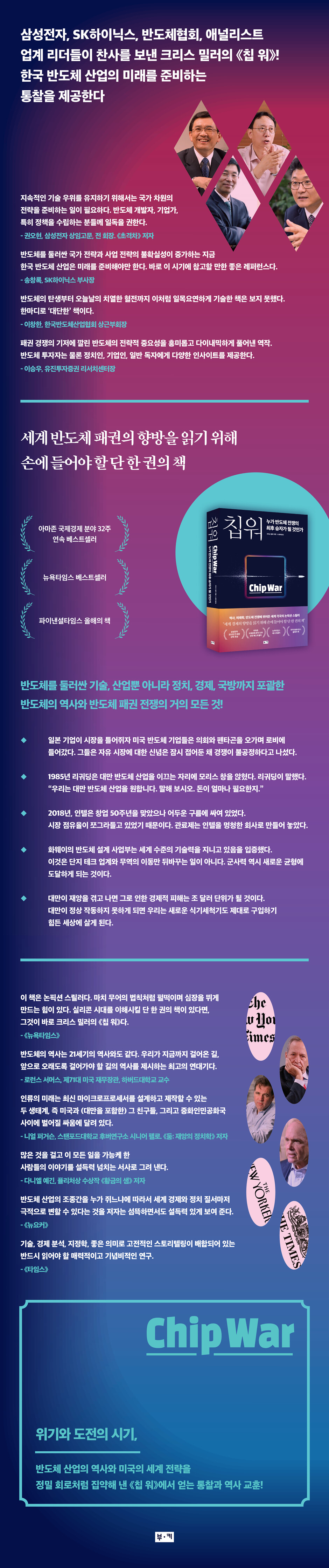
Into the book
The entire digital world is possible because engineers have learned to control the most minute streams of electrons racing through silicon.
“Big tech” wouldn’t exist if the cost of remembering and processing 1s and 0s hadn’t fallen to a billionth of a percent over the past half-century.
(Omitted) Today's semiconductor supply chain requires components from multiple cities and countries.
Yet, nearly every chip produced today has a connection to Silicon Valley or is built with tools designed and built in California.
The pool of scientific experts in the United States is very large.
The American scientific community thrives on government research funding and grows in power by poaching top scientists from other countries.
This provides the core knowledge that can maintain technological superiority.
American venture capital firms and stock markets provide the startup funding needed to grow new companies, while ruthlessly weeding out failed ones.
At the same time, the world's largest consumer market, the United States, has been driving growth by funding decades of research and development to develop new types of chips.
Other countries realized that it was impossible to overcome all of this on their own.
Among them, those that chose to delve deep into Silicon Valley's supply chain have found success.
--- p.34~35
Shockley, widely regarded as one of the greatest theoretical physicists of his time, was eventually forced to give up his ambitions of making a fortune and landing a spot in the Wall Street Journal.
His contributions to the theorization of transistors were significant.
But it was eight rebels who left his company, or a similar group that gathered at Texas Instruments, who turned Shockley's transistor into a useful product, a chip, and sold it to the US military, paving the way for mass production.
--- p.86
Meanwhile, the “copy it” attitude unexpectedly resulted in the Soviet semiconductor industry becoming mentally subservient to the United States.
One of the Soviet Union's most sensitive and secretive industries was being run poorly and was behaving like a backward Silicon Valley subcontractor.
In that sense, Zelenograd was just one part of a global semiconductor production network, with American chipmakers at its center.
--- p.114
From Korea to Taiwan, from Singapore to the Philippines, laying out semiconductor production facilities on a map is like looking at the locations of U.S. military bases across Asia.
Even after the United States conceded defeat in Vietnam and withdrew its military bases from the region, the semiconductor supply chain scattered across the Pacific persisted.
By the late 1970s, communism had begun to fall like dominoes, and America's allies in Asia were maintaining closer ties with the United States than ever before.
--- p.146
In 1985, Japanese companies' capital expenditure on semiconductors amounted to 46 percent of total global capital expenditure, while the United States' amount remained at 35 percent.
In 1990, this gap widened further.
Japanese companies' investment in semiconductor production facilities and equipment amounts to half of global investment.
As long as banks were willing to lend money, the CEO of a Japanese semiconductor company was poised to continue building new facilities.
--- p.180
The new power of the United States, which easily defeated Saddam Hussein's Iraq, was enormous.
The Soviet military and KGB were in crisis when they saw this.
They are at a loss because they cannot admit how far behind they are.
A coup d'état targeting Gorbachev by senior security officials was suppressed after three days.
Looking only at the conventional military power, the situation was not so dire, but the once mighty nation was heading towards a miserable end.
In the 1990s, the Russian semiconductor industry suffered a shameful decline.
A Russian semiconductor production facility was making tiny chips that would go into McDonald's Happy Meal toys.
The Cold War is over and Silicon Valley has won.
--- p.283
The geopolitics of semiconductor manufacturing changed dramatically during the 1990s and 2000s.
In the 1990s, American manufacturers were making 37 percent of the world's semiconductors, but by 2000 that number had fallen to 19 percent, and by 2010 it was just 13 percent.
Japan's market share also collapsed.
This is because Korea, Singapore, and Taiwan each poured money into their semiconductor industries and rapidly increased production.
--- p.310
With the rise of foundries like TSMC, one company has benefited the most.
Most people wouldn't even think of that company as a semiconductor design company: Apple.
Apple, founded by Steve Jobs, has always had a hardware-focused edge, so it's no surprise that they'd want to control even the silicon chips that power the devices they make.
Even from the time he first founded Apple, Jobs was deeply concerned with the relationship between hardware and software.
--- p.377
However, although ASML's extreme ultraviolet equipment is mostly assembled in the Netherlands, it is difficult to say that it is actually Dutch.
This is because the core components come from Cymer in California and Zeiss and Trumpf in Germany.
Moreover, this German company also relies on American-made equipment as a crucial element.
The point here is that no one country can claim ownership and pride in the production of this wondrous piece of equipment.
This is the product of an intellectual effort involving several countries.
--- p.391
Huawei's semiconductor design division has proven that it possesses world-class technological capabilities.
So it wasn't hard to imagine a future where Chinese semiconductor design firms would become as big of a customer of TSMC as the big Silicon Valley companies.
If the trends of the late 2010s continue, China's semiconductor industry will have an influence comparable to Silicon Valley by 2030.
This isn't just about shifting the tech industry and trade.
Military power will also reach a new balance.
--- p.467
Within the Pentagon and the National Security Council, Huawei was viewed as more than just a threat from espionage.
American officials had no doubt that Huawei was aiding China in its espionage, and the company was seen as the first battleground in a long battle for technological dominance.
--- p.510
Yet, it was surprising that China took no revenge when the US was crippling China's top global tech companies.
He has repeatedly threatened to punish American tech companies, but has ultimately not pulled the trigger.
Beijing has threatened to place foreign companies it deems to be undermining China's security on an "unreliable entity list," but no companies have been added to the list.
It was a move based on Beijing's clear calculation that it would be better for Huawei to survive as a second-tier tech company than to disappear under the influence of the United States.
Ultimately, the United States was strengthening its dominance by cutting off supply chains.
--- p.519
The global economy and supply chains, which hang over Asia and the Taiwan Strait, are precariously balanced on this precarious peace.
Companies with investments on both sides of the Taiwan Strait, from Apple to Huawei and even TSMC, are absolutely pinning their hopes on peace.
These companies have invested trillions of dollars in facilities located in the Taiwan Strait, Shenzhen, Hong Kong, Fujian and Taipei, all of which are easy targets for missiles.
The global semiconductor industry, and even the assembly of the electronic products that make semiconductors useful, all depend on the Taiwan Strait and the South China Sea coastline, and their importance is growing.
The only place more important than that is Silicon Valley.
--- p.550
In short, if Taiwan suffers a disaster, the resulting economic damage will amount to trillions of dollars.
Losing 37 percent of the computing power we expect to gain each year would be far more costly than the economic devastation caused by the coronavirus pandemic and the resulting lockdowns.
It will take at least five years to recover lost semiconductor production capacity.
During the semiconductor shortage caused by COVID-19, we experienced delays in new 5G networks and the metaverse.
But if Taiwan fails to function properly, we will live in a world where it is difficult to even afford a new dishwasher.
“Big tech” wouldn’t exist if the cost of remembering and processing 1s and 0s hadn’t fallen to a billionth of a percent over the past half-century.
(Omitted) Today's semiconductor supply chain requires components from multiple cities and countries.
Yet, nearly every chip produced today has a connection to Silicon Valley or is built with tools designed and built in California.
The pool of scientific experts in the United States is very large.
The American scientific community thrives on government research funding and grows in power by poaching top scientists from other countries.
This provides the core knowledge that can maintain technological superiority.
American venture capital firms and stock markets provide the startup funding needed to grow new companies, while ruthlessly weeding out failed ones.
At the same time, the world's largest consumer market, the United States, has been driving growth by funding decades of research and development to develop new types of chips.
Other countries realized that it was impossible to overcome all of this on their own.
Among them, those that chose to delve deep into Silicon Valley's supply chain have found success.
--- p.34~35
Shockley, widely regarded as one of the greatest theoretical physicists of his time, was eventually forced to give up his ambitions of making a fortune and landing a spot in the Wall Street Journal.
His contributions to the theorization of transistors were significant.
But it was eight rebels who left his company, or a similar group that gathered at Texas Instruments, who turned Shockley's transistor into a useful product, a chip, and sold it to the US military, paving the way for mass production.
--- p.86
Meanwhile, the “copy it” attitude unexpectedly resulted in the Soviet semiconductor industry becoming mentally subservient to the United States.
One of the Soviet Union's most sensitive and secretive industries was being run poorly and was behaving like a backward Silicon Valley subcontractor.
In that sense, Zelenograd was just one part of a global semiconductor production network, with American chipmakers at its center.
--- p.114
From Korea to Taiwan, from Singapore to the Philippines, laying out semiconductor production facilities on a map is like looking at the locations of U.S. military bases across Asia.
Even after the United States conceded defeat in Vietnam and withdrew its military bases from the region, the semiconductor supply chain scattered across the Pacific persisted.
By the late 1970s, communism had begun to fall like dominoes, and America's allies in Asia were maintaining closer ties with the United States than ever before.
--- p.146
In 1985, Japanese companies' capital expenditure on semiconductors amounted to 46 percent of total global capital expenditure, while the United States' amount remained at 35 percent.
In 1990, this gap widened further.
Japanese companies' investment in semiconductor production facilities and equipment amounts to half of global investment.
As long as banks were willing to lend money, the CEO of a Japanese semiconductor company was poised to continue building new facilities.
--- p.180
The new power of the United States, which easily defeated Saddam Hussein's Iraq, was enormous.
The Soviet military and KGB were in crisis when they saw this.
They are at a loss because they cannot admit how far behind they are.
A coup d'état targeting Gorbachev by senior security officials was suppressed after three days.
Looking only at the conventional military power, the situation was not so dire, but the once mighty nation was heading towards a miserable end.
In the 1990s, the Russian semiconductor industry suffered a shameful decline.
A Russian semiconductor production facility was making tiny chips that would go into McDonald's Happy Meal toys.
The Cold War is over and Silicon Valley has won.
--- p.283
The geopolitics of semiconductor manufacturing changed dramatically during the 1990s and 2000s.
In the 1990s, American manufacturers were making 37 percent of the world's semiconductors, but by 2000 that number had fallen to 19 percent, and by 2010 it was just 13 percent.
Japan's market share also collapsed.
This is because Korea, Singapore, and Taiwan each poured money into their semiconductor industries and rapidly increased production.
--- p.310
With the rise of foundries like TSMC, one company has benefited the most.
Most people wouldn't even think of that company as a semiconductor design company: Apple.
Apple, founded by Steve Jobs, has always had a hardware-focused edge, so it's no surprise that they'd want to control even the silicon chips that power the devices they make.
Even from the time he first founded Apple, Jobs was deeply concerned with the relationship between hardware and software.
--- p.377
However, although ASML's extreme ultraviolet equipment is mostly assembled in the Netherlands, it is difficult to say that it is actually Dutch.
This is because the core components come from Cymer in California and Zeiss and Trumpf in Germany.
Moreover, this German company also relies on American-made equipment as a crucial element.
The point here is that no one country can claim ownership and pride in the production of this wondrous piece of equipment.
This is the product of an intellectual effort involving several countries.
--- p.391
Huawei's semiconductor design division has proven that it possesses world-class technological capabilities.
So it wasn't hard to imagine a future where Chinese semiconductor design firms would become as big of a customer of TSMC as the big Silicon Valley companies.
If the trends of the late 2010s continue, China's semiconductor industry will have an influence comparable to Silicon Valley by 2030.
This isn't just about shifting the tech industry and trade.
Military power will also reach a new balance.
--- p.467
Within the Pentagon and the National Security Council, Huawei was viewed as more than just a threat from espionage.
American officials had no doubt that Huawei was aiding China in its espionage, and the company was seen as the first battleground in a long battle for technological dominance.
--- p.510
Yet, it was surprising that China took no revenge when the US was crippling China's top global tech companies.
He has repeatedly threatened to punish American tech companies, but has ultimately not pulled the trigger.
Beijing has threatened to place foreign companies it deems to be undermining China's security on an "unreliable entity list," but no companies have been added to the list.
It was a move based on Beijing's clear calculation that it would be better for Huawei to survive as a second-tier tech company than to disappear under the influence of the United States.
Ultimately, the United States was strengthening its dominance by cutting off supply chains.
--- p.519
The global economy and supply chains, which hang over Asia and the Taiwan Strait, are precariously balanced on this precarious peace.
Companies with investments on both sides of the Taiwan Strait, from Apple to Huawei and even TSMC, are absolutely pinning their hopes on peace.
These companies have invested trillions of dollars in facilities located in the Taiwan Strait, Shenzhen, Hong Kong, Fujian and Taipei, all of which are easy targets for missiles.
The global semiconductor industry, and even the assembly of the electronic products that make semiconductors useful, all depend on the Taiwan Strait and the South China Sea coastline, and their importance is growing.
The only place more important than that is Silicon Valley.
--- p.550
In short, if Taiwan suffers a disaster, the resulting economic damage will amount to trillions of dollars.
Losing 37 percent of the computing power we expect to gain each year would be far more costly than the economic devastation caused by the coronavirus pandemic and the resulting lockdowns.
It will take at least five years to recover lost semiconductor production capacity.
During the semiconductor shortage caused by COVID-19, we experienced delays in new 5G networks and the metaverse.
But if Taiwan fails to function properly, we will live in a world where it is difficult to even afford a new dishwasher.
--- p.553
Publisher's Review
Technology, industry, politics, and even the military are intertwined.
A 21st century non-fiction thriller!
There are already many books published on semiconductors and the US-China semiconductor war.
But this book differs from others in several respects.
First, "Chip Wars" was written by an international politics major, not a semiconductor expert.
Therefore, this book comprehensively covers the current complex global situation surrounding semiconductors, encompassing not only technological and industrial aspects, but also political, economic, and military aspects.
That is also a thoroughly American perspective.
Therefore, this book honestly and openly reveals the true intentions of the United States, which currently holds the semiconductor hegemony.
Second, "Chip Wars" is a book that can be considered an in-depth report on semiconductors, written by the author who researched various documents from libraries in the United States and Europe as well as the archives of the Russian Academy of Sciences and interviewed over 100 key figures in the semiconductor industry, academia, and government at home and abroad.
But for readers, "Chip War" will be so exciting that it will read like a thriller.
The New York Times book reviewer said, “This book is a nonfiction thriller.
It is not an empty phrase when he says, “It is as tense as the movies [China Syndrome] or [Mission Impossible].”
This is probably why this book has remained a bestseller in the international economics category for 32 consecutive weeks since its publication.
Military necessity, that is, preparation for war
He was the greatest contributor to the birth of semiconductor technology.
So, how did semiconductors, the starting point of all these stories, come into existence, how did they develop, and why did they occupy such a central position that every country is clamoring for them today?
Semiconductors themselves are not that complicated.
A substance through which electricity flows is called a conductor, and a substance through which electricity does not flow is called an insulator. Some elements, such as silicon and germanium, have the property of allowing electricity to flow or not flow depending on certain conditions.
Scientists who discovered this phenomenon named objects that utilize this characteristic 'semiconductor'.
It would not be wrong to say that this semiconductor was actually initially developed for military purposes.
Because all modern military operations and tasks, such as launching missiles, dropping bombs, and developing airplanes, require extremely complex calculations.
Until World War II, countries around the world met their needs for these calculations with mechanical calculators.
You input numbers into a calculator made of gears and pulleys, turn it by hand, and the result comes out.
However, mechanical calculators were slow, prone to breakdowns, and could only handle one type of calculation.
Scientists and engineers saw the need for electronic calculators.
'If current flows, it gives a signal of 1, and if no current flows, it gives a signal of 0.
Convert all numbers to be calculated into binary, consisting of 0s and 1s.
Then, all calculations can be processed using only the signals 0 and 1. This is the operating principle of the famous 'Turing machine'.
This idea was successful.
In 1943, the United States created the ENIAC, a giant electronic calculator.
Consisting of 18,000 vacuum tubes, ENIAC could perform hundreds of multiplications per second.
It was faster and more accurate than any human cashier.
The problem was the nature of the 'switches' that went into electronic calculators like the ENIAC.
The vacuum tube, which was the size of an adult's fist, was too large and had a short lifespan.
Because the power input was so great, the ENIAC, which filled a large conference room, emitted a blazing heat every time it was turned on.
Vacuum tubes, which broke down on average once every two days, were also a headache.
America needed a new kind of technology.
Semiconductors provide the answer.
Switches made from semiconductor materials such as silicon or germanium do not break down like vacuum tubes.
More importantly, we were able to innovatively reduce its size.
At first, people made it by looking through a microscope and dropping chemicals with an eyedropper.
That alone made it very small compared to vacuum tubes, but the American geniuses didn't stop there.
This gave birth to the so-called 'integrated circuit', which consists of all semiconductor elements, including transistors, on a single substrate.
America's aerospace industry has powered space with the power of semiconductors, specifically integrated circuits.
It was impossible to send people to the moon in a spaceship controlled by a vacuum tube computer.
The Apollo program put Fairchild Semiconductor, which had been suffering from management crises since its founding, on a solid foundation.
America abandons Japan and chooses Korea
Start raising it as a rival
But there is no law that says that an object is only used for its original purpose.
No, in some cases, what is used as a secondary purpose may actually create a larger and more powerful market.
Semiconductors were a representative example.
Initially, the United States sought to maintain military superiority during the Cold War through advanced technology called semiconductors.
But the world began to change completely when Shockley discovered a way to replace vacuum tubes with transistors and threw his hat into the ring, saying that there was a lot of money to be made in the rapidly growing electronics industry, and when Noyce, independent of Shockley, started making integrated circuits, or semiconductors, at Fairchild and expanded their use beyond supplying them to the US military and defense contractors to the electronics industry.
With the advent of computers, the Internet, and wireless communication, a world where we can connect anywhere, anytime has opened up, and semiconductors have been incorporated into almost every type of mechanical device in the world.
In short, when the semiconductor market, a huge new market that no one could claim dominance over, opened up, Japanese companies rushed in like crazy.
In the 1970s, Japan was dominating the global electronics industry with the introduction of transistor technology.
For such a Japan, semiconductors were a technology that had to be secured.
Then came the news that Texas Instruments, a giant in the semiconductor industry, was looking for its first overseas semiconductor production base.
Japanese managers have been working tirelessly to make the semiconductor symbiosis work.
Texas Instruments was looking for its first overseas semiconductor manufacturing base and decided to open a plant in Japan, but the regulatory hurdles were steep.
Sony's Morita agreed to help Texas Instruments in exchange for a share of its profits.
He instructed Texas Instruments executives to secretly visit Japan, book hotel rooms under false names, and not leave their rooms.
Morita secretly visited the hotel and proposed a joint venture.
Texas Instruments was manufacturing chips in Japan, and Sony was dealing with bureaucrats.
Morita told Texas Instruments executives:
"We'll cover your back." The Texans assumed Sony was on a "robbery run," but there was a certain amount of wonder in his words. (pp. 122-123)
After Japanese companies began to dominate the market, American semiconductor companies began lobbying Congress and the Pentagon.
They set aside their belief in free markets and argued that competition was unfair.
Silicon Valley reacted furiously to the claim that there was no difference between a computer chip and a potato chip.
Silicon Valley argued that semiconductors had strategic value, while potatoes did not, and therefore the chips they made deserved government assistance (p. 225).
American semiconductor companies had every reason to do so.
Even Intel, the world's best company, could not withstand Japan's semiconductor offensive and gave up on the DRAM sector.
In that situation, Sony founder Akio Morita shocked Washington politics by writing “A Japan That Can Say ‘No’” with far-right politician Shintaro Ishihara.
It was a moment when the sense of crisis that we could no longer give up the semiconductor leadership to Japan began to take hold.
It was during this period that Samsung began to enter the semiconductor industry in earnest.
The United States welcomed and supported the emergence of Korean semiconductor companies that could potentially compete with Japan.
This was the beginning of the Korean semiconductor myth.
How the Soviet Union and China were pushed out
How Taiwan Succeeded
Thus, today's semiconductor industry is the result of a combination of American global strategy and the capitalist aspirations of American companies to make more money by using semiconductor technology in civilian, rather than military, markets.
But the world is not just about America.
Would the Soviet Union or China have just watched this happen?
The Soviet Union recognized the importance of semiconductors early on and began developing them.
But the Soviet Union ultimately failed.
It wasn't because physicists were lacking or falling behind.
Initially, the Soviet Union had many excellent physicists, enough to lead the United States in space development.
The Soviet Union even had Zhores Alferov, who shared the 2000 Nobel Prize in Physics with Jack Kilby (Bob Noyce, co-inventor of the integrated circuit, had already passed away).
But why did the Soviet Union fail to develop semiconductors? And this despite top-level encouragement, even urging them to "copy" semiconductors from Silicon Valley?
The reason is that although the Soviet Union could produce quantity, it showed a significant gap with the United States in quality and purity.
Moreover, we couldn't even properly equip ourselves with the equipment.
This is because the Committee for Controlling Exports to the Communist Bloc (COCOM) blocked the export of advanced technologies, including semiconductors, to the Soviet Union. (Chapter 8)
Ultimately, Soviet semiconductor facilities were forced to work with less sophisticated equipment and less pure materials, which meant that they produced fewer functioning chips.
What about spies then?
There were limits to what Shokin and the engineers could achieve through espionage.
Even if you stole the chip, figuring out how to make it was a different matter.
It's like stealing a cake without knowing how it was made.
The recipe for baking the cake called semiconductors had already become unimaginably complex.
An exchange student who took Shockley's class at Stanford might have been a brilliant physicist, but the knowledge of which chemicals to mix at which temperatures, how long to expose photoresist to light, and so on, belonged to engineers like Andy Grove or Mary Ann Porter.
Chip manufacturing required specialized knowledge at every step, knowledge that was often unknown even to people involved in other processes within the same company.
This type of know-how is often not even documented.
Soviet spies had already infiltrated the most advanced companies in the semiconductor industry, but semiconductor production required far more detail and knowledge than even the most skilled spies could steal. (pp. 111-112)
So what about China? In fact, China made a similar mistake to the Soviet Union.
It was also a much more extreme form.
In the case of China, semiconductor devices were designated as a scientific research priority in Beijing in the early 1950s and experts in the field were invited from around the world.
And in 1960, he also established the first semiconductor research institute.
In 1965, they actually produced Chinese semiconductors.
This was five years after Bob Noyce and Jack Kilby developed the semiconductor.
But Mao Zedong's Cultural Revolution in 1966 ruined everything.
And since then, China has had to endure a 'lost 20 years' in semiconductors.
Meanwhile, South Korea and Taiwan have taken steps to become advanced manufacturing countries based on semiconductor technology (pp. 301-303). In effect, China's Mao Zedong provided South Korea with a tremendous opportunity.
On the other hand, another Chinese province, Taiwan, took a completely different stance.
They clung to semiconductors, practically throwing everything away, as reenacted in the following quote:
The result was a great success.
The United States, Korea, and Taiwan have firmly established themselves as one of the three pillars of the semiconductor industry.
In 1985, Li Kuoding appointed Morris Chang to lead Taiwan's semiconductor industry.
Li Guoding said.
“We want Taiwan’s semiconductor industry.
Tell me.
“How much money do you need?” (Omitted) When the Taiwanese government offered to give him full control of the semiconductor industry and write him a blank check, Morris Chang was tempted.
The 54-year-old wanted to take on a new challenge.
Most people said that Chang had “returned” to Taiwan.
However, he had only visited Taiwan once before for business purposes (pp. 289-292).
What does America want?
What should we do?
Regardless of whether we are progressive or conservative, there is an imagination that we often have.
The U.S. government, especially the Department of Defense, believes it knows everything in the world and has control over all technological advancements.
That was true until about the 1970s.
However, as American semiconductor companies expanded their profits by producing semiconductors at low prices and spreading the electronics revolution to the private market, they weakened the US government's control.
In fact, the geopolitics surrounding semiconductors taking their current form was never the U.S. government's "intention."
It is simply the result of fierce competition among Silicon Valley companies.
We will produce semiconductors at lower prices, sell them to more people, and create greater demand.
The power of capitalism, which is running towards this, is moving inexorably towards globalization.
Initially, Japan was the source of 'cheap labor', and thanks to American policies wary of Japan becoming too large, Korea and Taiwan took Japan's place.
And the United States is desperately trying to prevent China from interfering with it, or more precisely, from becoming as threatening as, or even more threatening than, Japan in the past.
What position should we take in this situation? "Chip War" contains "partial" answers to this question.
But it doesn't answer all your questions.
Instead, it provides enough information and context for readers to come up with those answers themselves.
"Chip Wars" is a kind of leak of insider information produced by a geek in the American academic world after interviewing and researching "insiders" in American politics and industry.
In the process, we need to keep one thing in mind.
Semiconductors have become the brains of intercontinental ballistic missiles that fly from American nuclear bases.
Missiles guided by the power of semiconductors made their debut in the Vietnam War and demonstrated their overwhelming power in the Gulf War.
Iraq's elite army, once considered the most powerful military force in the Middle East, was helplessly defeated by American missiles that flew in and struck as if they had eyes.
Victory in the Gulf War and the dissolution of the Soviet Union were like two sides of the same coin.
Watching the American "fireworks," the Soviet elite lost the will to fight back.
In early 1991, the Gulf War ended in American victory.
At the end of 1991, the Cold War also ended with American victory.
The 'offset strategy' adopted by the United States in the face of the Soviet Union's material offensive achieved such great success.
Of course, semiconductors did not remain solely the power of the United States forever.
Developing a national defense strategy based on advanced semiconductors is not much different from saying that we depend on those advanced semiconductors.
The problem is that as semiconductor technology advances and becomes more complex, the United States will no longer have full control over semiconductors.
Perhaps it was in that context that the United States began to seriously check Japan.
Technology, military, economy.
A single product called a semiconductor contains so many contexts.
Chris Miller, author of "Chip Wars," is a promising young historian and international political scientist who has diligently researched and studied every aspect of the semiconductor industry, achieving the feat of condensing these three elements into a single book.
It is a book that is like a cutting-edge 3-nanometer semiconductor composed of a three-dimensional circuit.
A 21st century non-fiction thriller!
There are already many books published on semiconductors and the US-China semiconductor war.
But this book differs from others in several respects.
First, "Chip Wars" was written by an international politics major, not a semiconductor expert.
Therefore, this book comprehensively covers the current complex global situation surrounding semiconductors, encompassing not only technological and industrial aspects, but also political, economic, and military aspects.
That is also a thoroughly American perspective.
Therefore, this book honestly and openly reveals the true intentions of the United States, which currently holds the semiconductor hegemony.
Second, "Chip Wars" is a book that can be considered an in-depth report on semiconductors, written by the author who researched various documents from libraries in the United States and Europe as well as the archives of the Russian Academy of Sciences and interviewed over 100 key figures in the semiconductor industry, academia, and government at home and abroad.
But for readers, "Chip War" will be so exciting that it will read like a thriller.
The New York Times book reviewer said, “This book is a nonfiction thriller.
It is not an empty phrase when he says, “It is as tense as the movies [China Syndrome] or [Mission Impossible].”
This is probably why this book has remained a bestseller in the international economics category for 32 consecutive weeks since its publication.
Military necessity, that is, preparation for war
He was the greatest contributor to the birth of semiconductor technology.
So, how did semiconductors, the starting point of all these stories, come into existence, how did they develop, and why did they occupy such a central position that every country is clamoring for them today?
Semiconductors themselves are not that complicated.
A substance through which electricity flows is called a conductor, and a substance through which electricity does not flow is called an insulator. Some elements, such as silicon and germanium, have the property of allowing electricity to flow or not flow depending on certain conditions.
Scientists who discovered this phenomenon named objects that utilize this characteristic 'semiconductor'.
It would not be wrong to say that this semiconductor was actually initially developed for military purposes.
Because all modern military operations and tasks, such as launching missiles, dropping bombs, and developing airplanes, require extremely complex calculations.
Until World War II, countries around the world met their needs for these calculations with mechanical calculators.
You input numbers into a calculator made of gears and pulleys, turn it by hand, and the result comes out.
However, mechanical calculators were slow, prone to breakdowns, and could only handle one type of calculation.
Scientists and engineers saw the need for electronic calculators.
'If current flows, it gives a signal of 1, and if no current flows, it gives a signal of 0.
Convert all numbers to be calculated into binary, consisting of 0s and 1s.
Then, all calculations can be processed using only the signals 0 and 1. This is the operating principle of the famous 'Turing machine'.
This idea was successful.
In 1943, the United States created the ENIAC, a giant electronic calculator.
Consisting of 18,000 vacuum tubes, ENIAC could perform hundreds of multiplications per second.
It was faster and more accurate than any human cashier.
The problem was the nature of the 'switches' that went into electronic calculators like the ENIAC.
The vacuum tube, which was the size of an adult's fist, was too large and had a short lifespan.
Because the power input was so great, the ENIAC, which filled a large conference room, emitted a blazing heat every time it was turned on.
Vacuum tubes, which broke down on average once every two days, were also a headache.
America needed a new kind of technology.
Semiconductors provide the answer.
Switches made from semiconductor materials such as silicon or germanium do not break down like vacuum tubes.
More importantly, we were able to innovatively reduce its size.
At first, people made it by looking through a microscope and dropping chemicals with an eyedropper.
That alone made it very small compared to vacuum tubes, but the American geniuses didn't stop there.
This gave birth to the so-called 'integrated circuit', which consists of all semiconductor elements, including transistors, on a single substrate.
America's aerospace industry has powered space with the power of semiconductors, specifically integrated circuits.
It was impossible to send people to the moon in a spaceship controlled by a vacuum tube computer.
The Apollo program put Fairchild Semiconductor, which had been suffering from management crises since its founding, on a solid foundation.
America abandons Japan and chooses Korea
Start raising it as a rival
But there is no law that says that an object is only used for its original purpose.
No, in some cases, what is used as a secondary purpose may actually create a larger and more powerful market.
Semiconductors were a representative example.
Initially, the United States sought to maintain military superiority during the Cold War through advanced technology called semiconductors.
But the world began to change completely when Shockley discovered a way to replace vacuum tubes with transistors and threw his hat into the ring, saying that there was a lot of money to be made in the rapidly growing electronics industry, and when Noyce, independent of Shockley, started making integrated circuits, or semiconductors, at Fairchild and expanded their use beyond supplying them to the US military and defense contractors to the electronics industry.
With the advent of computers, the Internet, and wireless communication, a world where we can connect anywhere, anytime has opened up, and semiconductors have been incorporated into almost every type of mechanical device in the world.
In short, when the semiconductor market, a huge new market that no one could claim dominance over, opened up, Japanese companies rushed in like crazy.
In the 1970s, Japan was dominating the global electronics industry with the introduction of transistor technology.
For such a Japan, semiconductors were a technology that had to be secured.
Then came the news that Texas Instruments, a giant in the semiconductor industry, was looking for its first overseas semiconductor production base.
Japanese managers have been working tirelessly to make the semiconductor symbiosis work.
Texas Instruments was looking for its first overseas semiconductor manufacturing base and decided to open a plant in Japan, but the regulatory hurdles were steep.
Sony's Morita agreed to help Texas Instruments in exchange for a share of its profits.
He instructed Texas Instruments executives to secretly visit Japan, book hotel rooms under false names, and not leave their rooms.
Morita secretly visited the hotel and proposed a joint venture.
Texas Instruments was manufacturing chips in Japan, and Sony was dealing with bureaucrats.
Morita told Texas Instruments executives:
"We'll cover your back." The Texans assumed Sony was on a "robbery run," but there was a certain amount of wonder in his words. (pp. 122-123)
After Japanese companies began to dominate the market, American semiconductor companies began lobbying Congress and the Pentagon.
They set aside their belief in free markets and argued that competition was unfair.
Silicon Valley reacted furiously to the claim that there was no difference between a computer chip and a potato chip.
Silicon Valley argued that semiconductors had strategic value, while potatoes did not, and therefore the chips they made deserved government assistance (p. 225).
American semiconductor companies had every reason to do so.
Even Intel, the world's best company, could not withstand Japan's semiconductor offensive and gave up on the DRAM sector.
In that situation, Sony founder Akio Morita shocked Washington politics by writing “A Japan That Can Say ‘No’” with far-right politician Shintaro Ishihara.
It was a moment when the sense of crisis that we could no longer give up the semiconductor leadership to Japan began to take hold.
It was during this period that Samsung began to enter the semiconductor industry in earnest.
The United States welcomed and supported the emergence of Korean semiconductor companies that could potentially compete with Japan.
This was the beginning of the Korean semiconductor myth.
How the Soviet Union and China were pushed out
How Taiwan Succeeded
Thus, today's semiconductor industry is the result of a combination of American global strategy and the capitalist aspirations of American companies to make more money by using semiconductor technology in civilian, rather than military, markets.
But the world is not just about America.
Would the Soviet Union or China have just watched this happen?
The Soviet Union recognized the importance of semiconductors early on and began developing them.
But the Soviet Union ultimately failed.
It wasn't because physicists were lacking or falling behind.
Initially, the Soviet Union had many excellent physicists, enough to lead the United States in space development.
The Soviet Union even had Zhores Alferov, who shared the 2000 Nobel Prize in Physics with Jack Kilby (Bob Noyce, co-inventor of the integrated circuit, had already passed away).
But why did the Soviet Union fail to develop semiconductors? And this despite top-level encouragement, even urging them to "copy" semiconductors from Silicon Valley?
The reason is that although the Soviet Union could produce quantity, it showed a significant gap with the United States in quality and purity.
Moreover, we couldn't even properly equip ourselves with the equipment.
This is because the Committee for Controlling Exports to the Communist Bloc (COCOM) blocked the export of advanced technologies, including semiconductors, to the Soviet Union. (Chapter 8)
Ultimately, Soviet semiconductor facilities were forced to work with less sophisticated equipment and less pure materials, which meant that they produced fewer functioning chips.
What about spies then?
There were limits to what Shokin and the engineers could achieve through espionage.
Even if you stole the chip, figuring out how to make it was a different matter.
It's like stealing a cake without knowing how it was made.
The recipe for baking the cake called semiconductors had already become unimaginably complex.
An exchange student who took Shockley's class at Stanford might have been a brilliant physicist, but the knowledge of which chemicals to mix at which temperatures, how long to expose photoresist to light, and so on, belonged to engineers like Andy Grove or Mary Ann Porter.
Chip manufacturing required specialized knowledge at every step, knowledge that was often unknown even to people involved in other processes within the same company.
This type of know-how is often not even documented.
Soviet spies had already infiltrated the most advanced companies in the semiconductor industry, but semiconductor production required far more detail and knowledge than even the most skilled spies could steal. (pp. 111-112)
So what about China? In fact, China made a similar mistake to the Soviet Union.
It was also a much more extreme form.
In the case of China, semiconductor devices were designated as a scientific research priority in Beijing in the early 1950s and experts in the field were invited from around the world.
And in 1960, he also established the first semiconductor research institute.
In 1965, they actually produced Chinese semiconductors.
This was five years after Bob Noyce and Jack Kilby developed the semiconductor.
But Mao Zedong's Cultural Revolution in 1966 ruined everything.
And since then, China has had to endure a 'lost 20 years' in semiconductors.
Meanwhile, South Korea and Taiwan have taken steps to become advanced manufacturing countries based on semiconductor technology (pp. 301-303). In effect, China's Mao Zedong provided South Korea with a tremendous opportunity.
On the other hand, another Chinese province, Taiwan, took a completely different stance.
They clung to semiconductors, practically throwing everything away, as reenacted in the following quote:
The result was a great success.
The United States, Korea, and Taiwan have firmly established themselves as one of the three pillars of the semiconductor industry.
In 1985, Li Kuoding appointed Morris Chang to lead Taiwan's semiconductor industry.
Li Guoding said.
“We want Taiwan’s semiconductor industry.
Tell me.
“How much money do you need?” (Omitted) When the Taiwanese government offered to give him full control of the semiconductor industry and write him a blank check, Morris Chang was tempted.
The 54-year-old wanted to take on a new challenge.
Most people said that Chang had “returned” to Taiwan.
However, he had only visited Taiwan once before for business purposes (pp. 289-292).
What does America want?
What should we do?
Regardless of whether we are progressive or conservative, there is an imagination that we often have.
The U.S. government, especially the Department of Defense, believes it knows everything in the world and has control over all technological advancements.
That was true until about the 1970s.
However, as American semiconductor companies expanded their profits by producing semiconductors at low prices and spreading the electronics revolution to the private market, they weakened the US government's control.
In fact, the geopolitics surrounding semiconductors taking their current form was never the U.S. government's "intention."
It is simply the result of fierce competition among Silicon Valley companies.
We will produce semiconductors at lower prices, sell them to more people, and create greater demand.
The power of capitalism, which is running towards this, is moving inexorably towards globalization.
Initially, Japan was the source of 'cheap labor', and thanks to American policies wary of Japan becoming too large, Korea and Taiwan took Japan's place.
And the United States is desperately trying to prevent China from interfering with it, or more precisely, from becoming as threatening as, or even more threatening than, Japan in the past.
What position should we take in this situation? "Chip War" contains "partial" answers to this question.
But it doesn't answer all your questions.
Instead, it provides enough information and context for readers to come up with those answers themselves.
"Chip Wars" is a kind of leak of insider information produced by a geek in the American academic world after interviewing and researching "insiders" in American politics and industry.
In the process, we need to keep one thing in mind.
Semiconductors have become the brains of intercontinental ballistic missiles that fly from American nuclear bases.
Missiles guided by the power of semiconductors made their debut in the Vietnam War and demonstrated their overwhelming power in the Gulf War.
Iraq's elite army, once considered the most powerful military force in the Middle East, was helplessly defeated by American missiles that flew in and struck as if they had eyes.
Victory in the Gulf War and the dissolution of the Soviet Union were like two sides of the same coin.
Watching the American "fireworks," the Soviet elite lost the will to fight back.
In early 1991, the Gulf War ended in American victory.
At the end of 1991, the Cold War also ended with American victory.
The 'offset strategy' adopted by the United States in the face of the Soviet Union's material offensive achieved such great success.
Of course, semiconductors did not remain solely the power of the United States forever.
Developing a national defense strategy based on advanced semiconductors is not much different from saying that we depend on those advanced semiconductors.
The problem is that as semiconductor technology advances and becomes more complex, the United States will no longer have full control over semiconductors.
Perhaps it was in that context that the United States began to seriously check Japan.
Technology, military, economy.
A single product called a semiconductor contains so many contexts.
Chris Miller, author of "Chip Wars," is a promising young historian and international political scientist who has diligently researched and studied every aspect of the semiconductor industry, achieving the feat of condensing these three elements into a single book.
It is a book that is like a cutting-edge 3-nanometer semiconductor composed of a three-dimensional circuit.
GOODS SPECIFICS
- Date of issue: May 19, 2023
- Page count, weight, size: 656 pages | 882g | 147*219*32mm
- ISBN13: 9788960519831
- ISBN10: 8960519839
You may also like
카테고리
korean


korean

![ELLE 엘르 스페셜 에디션 A형 : 12월 [2025]](http://librairie.coreenne.fr/cdn/shop/files/b8e27a3de6c9538896439686c6b0e8fb.jpg?v=1766436872&width=3840)


