

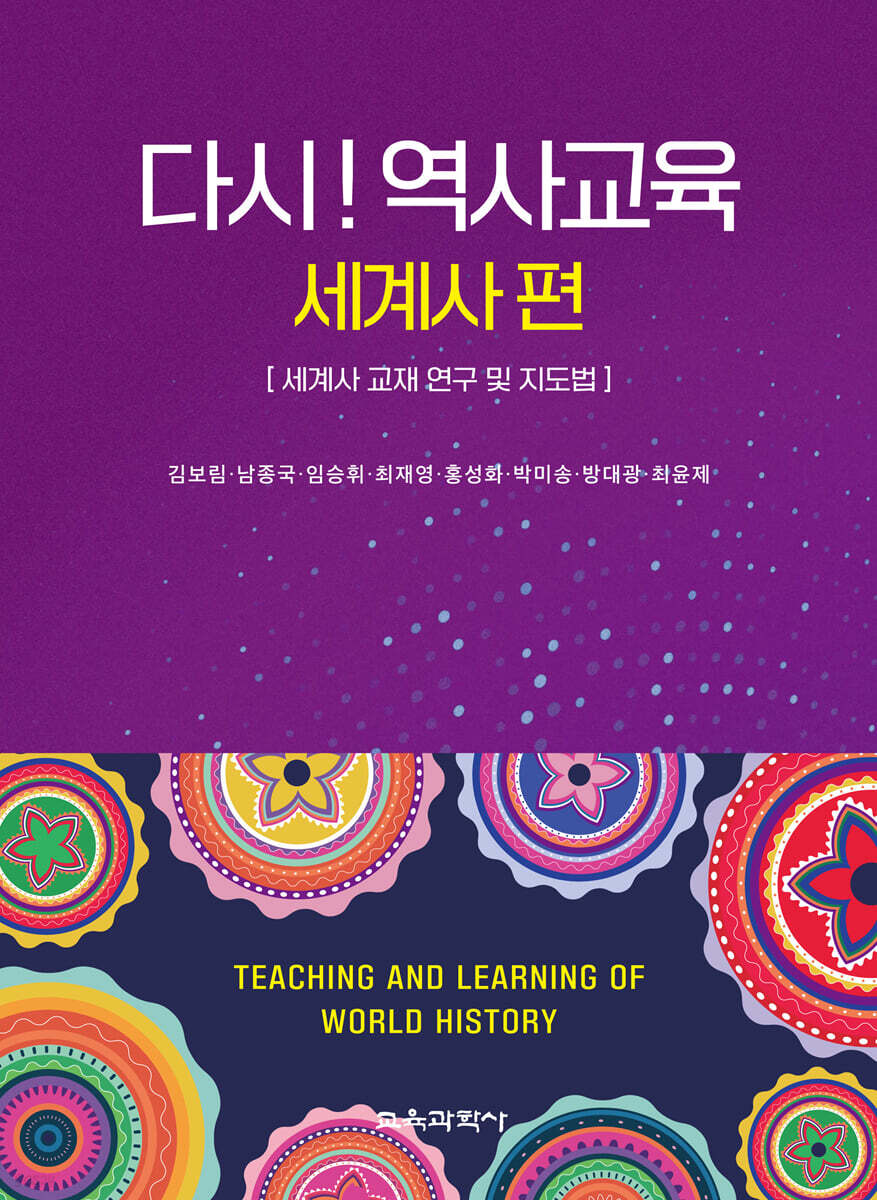
Again! History Education: World History Edition
 |
Description
Book Introduction
Written by a professor and a current teacher
A guidebook on the theory and practice of research and teaching methods for world history!
Hidden within the events, cultures, ideas, and institutions of humanity's past are clues that illuminate the situations and problems we face today, such as the development of the internet, smartphones, artificial intelligence, and big data, as well as historical and religious conflicts and fake news.
This book was designed to teach world history through precisely that kind of 'understanding of humanity.'
The title of this book, "Again! History Education?", suggests a renewed approach to history education in line with the changing educational environment. Recognizing the current lack of specialized textbooks tailored to world history majors for prospective history teachers, the book combines the in-depth historical research of professors specializing in content history with the vivid teaching experience of current teachers. This approach, breaking away from the existing focus on history teaching methods, encompasses a deeper understanding of historical content and research into textbooks.
Through this, not only prospective teachers, but also current teachers and a wide range of readers interested in world history education will be able to expand the depth of world history content as well as learn the latest teaching methods.
A guidebook on the theory and practice of research and teaching methods for world history!
Hidden within the events, cultures, ideas, and institutions of humanity's past are clues that illuminate the situations and problems we face today, such as the development of the internet, smartphones, artificial intelligence, and big data, as well as historical and religious conflicts and fake news.
This book was designed to teach world history through precisely that kind of 'understanding of humanity.'
The title of this book, "Again! History Education?", suggests a renewed approach to history education in line with the changing educational environment. Recognizing the current lack of specialized textbooks tailored to world history majors for prospective history teachers, the book combines the in-depth historical research of professors specializing in content history with the vivid teaching experience of current teachers. This approach, breaking away from the existing focus on history teaching methods, encompasses a deeper understanding of historical content and research into textbooks.
Through this, not only prospective teachers, but also current teachers and a wide range of readers interested in world history education will be able to expand the depth of world history content as well as learn the latest teaching methods.
index
Preface / 3
Part 1: World History Education Theory
CHAPTER 01: Evolution of World History Education in Korea 21
1.
Enlightenment 21
2.
Japanese colonial period 24
3.
From liberation to present 27
CHAPTER 02: World History Education 51
1.
China 51
2.
Japan 56
3.
UK 62
4.
US 63
5.
Canada 66
6.
Germany 67
7.
France 70
CHAPTER 03: Characteristics and Limitations of Oriental History Education in Korea 75
1.
75 Historical Curriculum and the Structure of a Grand Course in Eastern History
2.
Current Status of Expansion of Research Areas in Oriental History in Korea 84
3.
Addressing the Limitations of Eastern History Education: Understanding Historical Terminology and Eastern History Education 88
CHAPTER 04: Characteristics and Limitations of Western History Education in Korea 95
1.
The Development of Western History after Liberation 95
2.
Characteristics of Western History Education after Liberation 96
3.
Eurocentrism and Its Criticism 103
4.
Characteristics and Limitations: Lack of storytelling and lack of sources 107
CHAPTER 05 Narrating and Teaching World History: Trends and Challenges 115
1.
World History and Reflection: What We Learned in the 20th Century 115
2.
New Attempts at the End of the 20th Century 120
3.
A World History of Connection and Interaction in the 21st Century 123
4.
How to educate? 127
Part 2: World History Class Theory
CHAPTER 01 Designing a World History Class 131
1.
Instructional Design Process 131
1) Setting class goals 132
2) Learner Diagnosis and Situation Analysis 132
3) Textbook selection and development 133
4) Developing Teaching and Learning Strategies 134
5) Formative Assessment Design 134
6) Faculty Feedback Plan 135
2.
The Meaning of Learner Assessment 135
1) The Importance of Learner Diagnosis 135
2) Learner Development 136
3) Learner's interest 142
4) Learner's prior learning 143
3.
Level of content, materials, and methods 145
1) Learner Literacy 145
2) Meaning of easy content, materials, and teaching methods 146
4.
Teachers' Class Restructuring 148
1) Two criteria for the World History Operation Plan 148
2) Textbook Restructuring 153
3) Restructuring class content 154
5.
The Influence of Teachers' Views of History and History Education on Lesson Design 156
CHAPTER 02: Goals of World History Classes 159
1.
Classification of Lesson Objectives 159
1) Tyler-Bloom-Coldham and Fiennes's Behavioral Goals 159
2) Eisner (Elliot W.
Eisner's implementation goal 168
3) Objective 170: Assess historical thinking skills
2.
The Reality of Class Objectives: Focusing on Knowledge, Understanding, Skills, Values, and Attitudes 171
1) Statement of Course Objectives 171
2) World History National Curriculum Achievement Standards and Learning Objectives 173
3) Presentation of lesson objectives by level based on world history learner diagnosis 175
CHAPTER 03 World History Class Materials 179
1.
What is the Textbook in a World History Class? 179
1) Concept of textbooks in world history classes 179
2) The significance of textbooks in world history classes 180
3) Selection of World History Textbooks and Precautions 181
2.
Types of World History Textbooks 183
1) Literature textbook 183
2) Audiovisual teaching materials 198
3) Web-based textbook 233
4) Experience textbook 245
5) Teacher-made textbook 251
CHAPTER 04: Teaching World History 255
1.
Traditional Teaching Methodology 257
1) Lecture-style class 257
2) Inquiry-style class 261
3) Historical Writing Class 263
4) Historical Drama Class 265
5) Discussion-style class 268
6) Discussion-style class 271
7) Cooperative Class 275
8) Production Class 279
2.
Recent Teaching Methodology 282
1) Flipped Learning 282
2) Online Museum Education 284
3) Generative AI (Artificial Intelligence) Utilization Class 287
4) Culturally Sensitive Teaching Methods 289
5) Blended learning 291
6) Project Class 292
7) Book Curation Class 294
8) Visual Thinking Class 296
9) Smart Classes Using Educational Apps 298
10) Social Media Utilization Class 303
11) History Reenactment Activity Lesson 305
3.
Microteaching 307
4.
Writing Lesson and Study Plans 311
1) Class Procedure 311
2) The Importance of Learning Guidelines 312
3) Use of lesson plans in schools 316
CHAPTER 05: Theory and Practice of World History Evaluation 317
1.
Direction of World History Evaluation 317
1) Changes in the World History Education Environment 317
2) Changes in evaluation perspective 321
2.
Process-Oriented Assessment and Feedback 322
1) Characteristics of process-centered evaluation 322
2) Personalized Feedback and Student Growth 322
3.
Evaluation Plan 323
4.
Characteristics of Evaluation Types 344
1) Diagnostic assessment, formative assessment, and summative assessment 344
2) Self-evaluation, peer evaluation, teacher evaluation 344
3) Individual and group evaluations 346
5.
Written Examination and Case Studies by Type 346
1) Multiple Choice Assessment 346
2) Parenthesized (complete) and short answer questions 348
3) Descriptive evaluation, essay evaluation 348
6.
Performance Evaluation 349
7.
Utilizing World History Assessment 352
8.
Classification of Rubrics and Practice of Assessment 355
1) Components of the Rubric 355
2) Holistic Rubric 356
3) Analytical Rubric 357
Part 3: The Reality of World History Classes
Teacher Essay: A New History Teacher's Bumpy First Month in World History Classes 363
Part 3: Characteristics of the Structure 367
CHAPTER 01 Oriental History I 369
1.
Topic 1.
Spring and Autumn Period and Warring States Period 369
1) The Spring and Autumn Period and the Warring States Period described in world history textbooks 369
2) Research trends in academia 371
3) How to Teach the Spring and Autumn Period and the Warring States Period: The Arguments and Governance of the Hundred Schools of Thought 373
2.
Topic 1.
Classroom Practice: Spring and Autumn and Warring States Period (Basic) - Discussion-based class using historical materials and resources (buzz group discussion) - 377
1) Curriculum Analysis and Class Objective Setting 377
2) Content selection 378
3) Learner Diagnosis 379
4) Textbook Research 379
5) Writing a lesson plan 381
6) Lesson 394
7) Performance evaluation implementation 395
8) Feedback and planning for the overall teaching and learning process 397
3.
Topic 2.
The Party's Internationality 398
1) The Party's Internationality as Described in World History Textbooks 398
2) Academic Research Trends: Criticism of the 'East Asian World Theory' and the Emergence of the 'Eastern Eurasian Theory' 399
3) What to Teach and How to Teach: Utilizing Mutual Mediating Materials from the Tang Dynasty and the Western Regions 401
4.
Practice of Level-Based Classes: Topic 2 (Basic) - The Party's Internationality - Exploratory Classes Through Guidance - 404
1) Curriculum Analysis and Class Objective Setting 404
2) Content selection 405
3) Learner Diagnosis 406
4) Textbook Research 406
5) Writing a lesson plan 408
6) Lesson 417
7) Performance evaluation implementation 419
8) Feedback and planning for the overall teaching and learning process 421
5.
Practice of Level-Based Classes: Topic 2 (Advanced) - The Internationality of the Party - Havruta Class - 422
1) Curriculum Analysis and Class Objective Setting 422
2) Content selection 423
3) Learner Diagnosis 424
4) Textbook Research 424
5) Writing a lesson plan 426
6) Lesson 438
7) Performance evaluation implementation 439
8) Feedback and planning for the overall teaching and learning process 441
CHAPTER 02 Western History I 443
6.
Topic 1.
Caesar's Character Assessment: Did Caesar Want to Be King? 443
1) Caesar 443 as described in world history textbooks
2) Research trends in academia 444
3) How to Teach Caesar? 447
7.
Topic 1.
Reality in Class: Caesar's Character Evaluation - Did Caesar Want to Become King? (Advanced) - Historical Dramatization Class Using Historical Materials - 450
1) Curriculum Analysis and Class Objective Setting 450
2) Content selection 451
3) Learner Diagnosis 452
4) Textbook Research 452
5) Writing a lesson plan 454
6) Lesson 475
7) Performance evaluation implementation 475
8) Feedback and planning for the overall teaching and learning process 476
8.
Topic 2.
Relations between Medieval Christianity and Islam 478
1) The Relationship Between Medieval Christianity and Islam in World History Textbooks: The Absence of Research and Textbook Descriptions 478
2) Research trends in academia 479
3) How to Teach the Relationship Between Medieval Christianity and Islam 481
9.
Practice of Level-Based Classes: Topic 2 (Basic) - The Relationship between Medieval Christianity and Islam - Creating a Chronology Using Records from Different Perspectives - 485
1) Curriculum Analysis and Class Objective Setting 485
2) Content selection 486
3) Learner Diagnosis 487
4) Textbook Research 487
5) Writing a lesson plan 488
6) Lesson 509
7) Performance evaluation implementation 509
8) Feedback and planning for the overall teaching and learning process 511
10.
Practice of Level-Based Classes: Topic 2 (Advanced) - The Relationship between Medieval Christianity and Islam - Historical Writing through Records and Historical Imagination - 512
1) Curriculum Analysis and Class Objective Setting 512
2) Content selection 513
3) Learner Diagnosis 513
4) Textbook Research 514
5) Writing a lesson plan 516
6) Lesson 536
7) Performance evaluation implementation 537
8) Feedback and planning for the overall teaching and learning process 538
CHAPTER 03 Oriental History II 541
11.
Topic 1.
Ming and Qing Dynasty Taxation System 541
1) Taxation systems of the Ming and Qing Dynasties described in world history textbooks 541
2) Research trends in academia 542
3) How to Teach the Taxation System of the Ming and Qing Dynasties 546
12.
Topic 1.
Real-World Classes: Ming and Qing Dynasty Tax Systems (Advanced) - Jigsaw I Collaborative Class Using Maps and Statistics - 549
1) Curriculum Analysis and Class Objective Setting 549
2) Content selection 549
3) Learner Diagnosis 549
4) Textbook Research 550
5) Writing a lesson plan 551
6) Lesson 563
7) Performance evaluation implementation 563
8) Feedback and planning for the overall teaching and learning process 564
13.
Topic 2.
Foreign Policy of the Edo Period 565
1) Edo Period Foreign Policy Described in World History Textbooks 565
2) Research trends in academia 566
3) How to Teach Edo Period Foreign Policy 569
14.
Practice of Level-Based Classes: Topic 2 (Basic) - Edo Period Foreign Policy - Visual Thinking Class Using Pictures and Photographs - 572
1) Curriculum Analysis and Class Objective Setting 572
2) Content selection 572
3) Learner Diagnosis 573
4) Textbook Research 573
5) Writing a lesson plan 575
6) Class 589
7) Performance evaluation implementation 590
8) Feedback and planning for the overall teaching and learning process 591
15.
Practice of Level-Based Classes: Topic 2 (Advanced) - Edo Period Foreign Policy - Fish Bowl Group Discussion Using Literary Sources - 592
1) Curriculum Analysis and Class Objective Setting 592
2) Content selection 592
3) Learner Diagnosis 593
4) Textbook Research 593
5) Writing a lesson plan 595
6) Lesson 609
7) Performance evaluation implementation 609
8) Feedback and planning for the overall teaching and learning process 610
CHAPTER 04 Western History II 613
16.
Topic 1.
Financial and Military State 613
1) The Financial and Military State Described in World History Textbooks: From Absolutism to Financial and Military State 613
2) Academic Research Trends: The Emergence of the Concept of a Financial and Military State 614
3) How should we teach the financial and military aspects of a state? 617
17.
Topic 1.
Lesson Reality: Financial and Military State (Basic) - Production Learning (Travel Board Game) - 618
1) Curriculum Analysis and Class Objective Setting 618
2) Content selection 618
3) Learner Diagnosis 619
4) Textbook Research 619
5) Writing a lesson plan 620
6) Lesson 641
7) Performance evaluation implementation 642
8) Feedback on the overall teaching and learning process and lesson plans 644
18.
Topic 2.
Cold War 645
1) The Cold War as Described in World History Textbooks: Traditional Cold War Narratives 645
2) Academic Research Trends: A New History of the Cold War 646
3) How to Teach the Cold War? 648
19.
Practice of Level-Based Classes: Topic 2 (Basic) - Cold War - Exploration and Drawing Using Caricature - 650
1) Curriculum Analysis and Class Objective Setting 650
2) Content selection 650
3) Learner Diagnosis 651
4) Textbook Research 651
5) Writing a lesson plan 652
6) Lesson 668
7) Performance evaluation implementation 669
8) Feedback on the overall teaching and learning process and lesson plans 670
20.
Practice of Level-Based Classes: Topic 2 (Advanced) - Cold War - Creating Card News Using Newspaper Articles and Pictures (Posters) - 672
1) Curriculum Analysis and Class Objective Setting 672
2) Content selection 672
3) Learner Diagnosis 673
4) Textbook Research 673
5) Writing a lesson plan 675
6) Lesson 693
7) Performance evaluation implementation 694
8) Feedback on the overall teaching and learning process and lesson plans 695
Reference 696
Americas 713
Search 736
Part 1: World History Education Theory
CHAPTER 01: Evolution of World History Education in Korea 21
1.
Enlightenment 21
2.
Japanese colonial period 24
3.
From liberation to present 27
CHAPTER 02: World History Education 51
1.
China 51
2.
Japan 56
3.
UK 62
4.
US 63
5.
Canada 66
6.
Germany 67
7.
France 70
CHAPTER 03: Characteristics and Limitations of Oriental History Education in Korea 75
1.
75 Historical Curriculum and the Structure of a Grand Course in Eastern History
2.
Current Status of Expansion of Research Areas in Oriental History in Korea 84
3.
Addressing the Limitations of Eastern History Education: Understanding Historical Terminology and Eastern History Education 88
CHAPTER 04: Characteristics and Limitations of Western History Education in Korea 95
1.
The Development of Western History after Liberation 95
2.
Characteristics of Western History Education after Liberation 96
3.
Eurocentrism and Its Criticism 103
4.
Characteristics and Limitations: Lack of storytelling and lack of sources 107
CHAPTER 05 Narrating and Teaching World History: Trends and Challenges 115
1.
World History and Reflection: What We Learned in the 20th Century 115
2.
New Attempts at the End of the 20th Century 120
3.
A World History of Connection and Interaction in the 21st Century 123
4.
How to educate? 127
Part 2: World History Class Theory
CHAPTER 01 Designing a World History Class 131
1.
Instructional Design Process 131
1) Setting class goals 132
2) Learner Diagnosis and Situation Analysis 132
3) Textbook selection and development 133
4) Developing Teaching and Learning Strategies 134
5) Formative Assessment Design 134
6) Faculty Feedback Plan 135
2.
The Meaning of Learner Assessment 135
1) The Importance of Learner Diagnosis 135
2) Learner Development 136
3) Learner's interest 142
4) Learner's prior learning 143
3.
Level of content, materials, and methods 145
1) Learner Literacy 145
2) Meaning of easy content, materials, and teaching methods 146
4.
Teachers' Class Restructuring 148
1) Two criteria for the World History Operation Plan 148
2) Textbook Restructuring 153
3) Restructuring class content 154
5.
The Influence of Teachers' Views of History and History Education on Lesson Design 156
CHAPTER 02: Goals of World History Classes 159
1.
Classification of Lesson Objectives 159
1) Tyler-Bloom-Coldham and Fiennes's Behavioral Goals 159
2) Eisner (Elliot W.
Eisner's implementation goal 168
3) Objective 170: Assess historical thinking skills
2.
The Reality of Class Objectives: Focusing on Knowledge, Understanding, Skills, Values, and Attitudes 171
1) Statement of Course Objectives 171
2) World History National Curriculum Achievement Standards and Learning Objectives 173
3) Presentation of lesson objectives by level based on world history learner diagnosis 175
CHAPTER 03 World History Class Materials 179
1.
What is the Textbook in a World History Class? 179
1) Concept of textbooks in world history classes 179
2) The significance of textbooks in world history classes 180
3) Selection of World History Textbooks and Precautions 181
2.
Types of World History Textbooks 183
1) Literature textbook 183
2) Audiovisual teaching materials 198
3) Web-based textbook 233
4) Experience textbook 245
5) Teacher-made textbook 251
CHAPTER 04: Teaching World History 255
1.
Traditional Teaching Methodology 257
1) Lecture-style class 257
2) Inquiry-style class 261
3) Historical Writing Class 263
4) Historical Drama Class 265
5) Discussion-style class 268
6) Discussion-style class 271
7) Cooperative Class 275
8) Production Class 279
2.
Recent Teaching Methodology 282
1) Flipped Learning 282
2) Online Museum Education 284
3) Generative AI (Artificial Intelligence) Utilization Class 287
4) Culturally Sensitive Teaching Methods 289
5) Blended learning 291
6) Project Class 292
7) Book Curation Class 294
8) Visual Thinking Class 296
9) Smart Classes Using Educational Apps 298
10) Social Media Utilization Class 303
11) History Reenactment Activity Lesson 305
3.
Microteaching 307
4.
Writing Lesson and Study Plans 311
1) Class Procedure 311
2) The Importance of Learning Guidelines 312
3) Use of lesson plans in schools 316
CHAPTER 05: Theory and Practice of World History Evaluation 317
1.
Direction of World History Evaluation 317
1) Changes in the World History Education Environment 317
2) Changes in evaluation perspective 321
2.
Process-Oriented Assessment and Feedback 322
1) Characteristics of process-centered evaluation 322
2) Personalized Feedback and Student Growth 322
3.
Evaluation Plan 323
4.
Characteristics of Evaluation Types 344
1) Diagnostic assessment, formative assessment, and summative assessment 344
2) Self-evaluation, peer evaluation, teacher evaluation 344
3) Individual and group evaluations 346
5.
Written Examination and Case Studies by Type 346
1) Multiple Choice Assessment 346
2) Parenthesized (complete) and short answer questions 348
3) Descriptive evaluation, essay evaluation 348
6.
Performance Evaluation 349
7.
Utilizing World History Assessment 352
8.
Classification of Rubrics and Practice of Assessment 355
1) Components of the Rubric 355
2) Holistic Rubric 356
3) Analytical Rubric 357
Part 3: The Reality of World History Classes
Teacher Essay: A New History Teacher's Bumpy First Month in World History Classes 363
Part 3: Characteristics of the Structure 367
CHAPTER 01 Oriental History I 369
1.
Topic 1.
Spring and Autumn Period and Warring States Period 369
1) The Spring and Autumn Period and the Warring States Period described in world history textbooks 369
2) Research trends in academia 371
3) How to Teach the Spring and Autumn Period and the Warring States Period: The Arguments and Governance of the Hundred Schools of Thought 373
2.
Topic 1.
Classroom Practice: Spring and Autumn and Warring States Period (Basic) - Discussion-based class using historical materials and resources (buzz group discussion) - 377
1) Curriculum Analysis and Class Objective Setting 377
2) Content selection 378
3) Learner Diagnosis 379
4) Textbook Research 379
5) Writing a lesson plan 381
6) Lesson 394
7) Performance evaluation implementation 395
8) Feedback and planning for the overall teaching and learning process 397
3.
Topic 2.
The Party's Internationality 398
1) The Party's Internationality as Described in World History Textbooks 398
2) Academic Research Trends: Criticism of the 'East Asian World Theory' and the Emergence of the 'Eastern Eurasian Theory' 399
3) What to Teach and How to Teach: Utilizing Mutual Mediating Materials from the Tang Dynasty and the Western Regions 401
4.
Practice of Level-Based Classes: Topic 2 (Basic) - The Party's Internationality - Exploratory Classes Through Guidance - 404
1) Curriculum Analysis and Class Objective Setting 404
2) Content selection 405
3) Learner Diagnosis 406
4) Textbook Research 406
5) Writing a lesson plan 408
6) Lesson 417
7) Performance evaluation implementation 419
8) Feedback and planning for the overall teaching and learning process 421
5.
Practice of Level-Based Classes: Topic 2 (Advanced) - The Internationality of the Party - Havruta Class - 422
1) Curriculum Analysis and Class Objective Setting 422
2) Content selection 423
3) Learner Diagnosis 424
4) Textbook Research 424
5) Writing a lesson plan 426
6) Lesson 438
7) Performance evaluation implementation 439
8) Feedback and planning for the overall teaching and learning process 441
CHAPTER 02 Western History I 443
6.
Topic 1.
Caesar's Character Assessment: Did Caesar Want to Be King? 443
1) Caesar 443 as described in world history textbooks
2) Research trends in academia 444
3) How to Teach Caesar? 447
7.
Topic 1.
Reality in Class: Caesar's Character Evaluation - Did Caesar Want to Become King? (Advanced) - Historical Dramatization Class Using Historical Materials - 450
1) Curriculum Analysis and Class Objective Setting 450
2) Content selection 451
3) Learner Diagnosis 452
4) Textbook Research 452
5) Writing a lesson plan 454
6) Lesson 475
7) Performance evaluation implementation 475
8) Feedback and planning for the overall teaching and learning process 476
8.
Topic 2.
Relations between Medieval Christianity and Islam 478
1) The Relationship Between Medieval Christianity and Islam in World History Textbooks: The Absence of Research and Textbook Descriptions 478
2) Research trends in academia 479
3) How to Teach the Relationship Between Medieval Christianity and Islam 481
9.
Practice of Level-Based Classes: Topic 2 (Basic) - The Relationship between Medieval Christianity and Islam - Creating a Chronology Using Records from Different Perspectives - 485
1) Curriculum Analysis and Class Objective Setting 485
2) Content selection 486
3) Learner Diagnosis 487
4) Textbook Research 487
5) Writing a lesson plan 488
6) Lesson 509
7) Performance evaluation implementation 509
8) Feedback and planning for the overall teaching and learning process 511
10.
Practice of Level-Based Classes: Topic 2 (Advanced) - The Relationship between Medieval Christianity and Islam - Historical Writing through Records and Historical Imagination - 512
1) Curriculum Analysis and Class Objective Setting 512
2) Content selection 513
3) Learner Diagnosis 513
4) Textbook Research 514
5) Writing a lesson plan 516
6) Lesson 536
7) Performance evaluation implementation 537
8) Feedback and planning for the overall teaching and learning process 538
CHAPTER 03 Oriental History II 541
11.
Topic 1.
Ming and Qing Dynasty Taxation System 541
1) Taxation systems of the Ming and Qing Dynasties described in world history textbooks 541
2) Research trends in academia 542
3) How to Teach the Taxation System of the Ming and Qing Dynasties 546
12.
Topic 1.
Real-World Classes: Ming and Qing Dynasty Tax Systems (Advanced) - Jigsaw I Collaborative Class Using Maps and Statistics - 549
1) Curriculum Analysis and Class Objective Setting 549
2) Content selection 549
3) Learner Diagnosis 549
4) Textbook Research 550
5) Writing a lesson plan 551
6) Lesson 563
7) Performance evaluation implementation 563
8) Feedback and planning for the overall teaching and learning process 564
13.
Topic 2.
Foreign Policy of the Edo Period 565
1) Edo Period Foreign Policy Described in World History Textbooks 565
2) Research trends in academia 566
3) How to Teach Edo Period Foreign Policy 569
14.
Practice of Level-Based Classes: Topic 2 (Basic) - Edo Period Foreign Policy - Visual Thinking Class Using Pictures and Photographs - 572
1) Curriculum Analysis and Class Objective Setting 572
2) Content selection 572
3) Learner Diagnosis 573
4) Textbook Research 573
5) Writing a lesson plan 575
6) Class 589
7) Performance evaluation implementation 590
8) Feedback and planning for the overall teaching and learning process 591
15.
Practice of Level-Based Classes: Topic 2 (Advanced) - Edo Period Foreign Policy - Fish Bowl Group Discussion Using Literary Sources - 592
1) Curriculum Analysis and Class Objective Setting 592
2) Content selection 592
3) Learner Diagnosis 593
4) Textbook Research 593
5) Writing a lesson plan 595
6) Lesson 609
7) Performance evaluation implementation 609
8) Feedback and planning for the overall teaching and learning process 610
CHAPTER 04 Western History II 613
16.
Topic 1.
Financial and Military State 613
1) The Financial and Military State Described in World History Textbooks: From Absolutism to Financial and Military State 613
2) Academic Research Trends: The Emergence of the Concept of a Financial and Military State 614
3) How should we teach the financial and military aspects of a state? 617
17.
Topic 1.
Lesson Reality: Financial and Military State (Basic) - Production Learning (Travel Board Game) - 618
1) Curriculum Analysis and Class Objective Setting 618
2) Content selection 618
3) Learner Diagnosis 619
4) Textbook Research 619
5) Writing a lesson plan 620
6) Lesson 641
7) Performance evaluation implementation 642
8) Feedback on the overall teaching and learning process and lesson plans 644
18.
Topic 2.
Cold War 645
1) The Cold War as Described in World History Textbooks: Traditional Cold War Narratives 645
2) Academic Research Trends: A New History of the Cold War 646
3) How to Teach the Cold War? 648
19.
Practice of Level-Based Classes: Topic 2 (Basic) - Cold War - Exploration and Drawing Using Caricature - 650
1) Curriculum Analysis and Class Objective Setting 650
2) Content selection 650
3) Learner Diagnosis 651
4) Textbook Research 651
5) Writing a lesson plan 652
6) Lesson 668
7) Performance evaluation implementation 669
8) Feedback on the overall teaching and learning process and lesson plans 670
20.
Practice of Level-Based Classes: Topic 2 (Advanced) - Cold War - Creating Card News Using Newspaper Articles and Pictures (Posters) - 672
1) Curriculum Analysis and Class Objective Setting 672
2) Content selection 672
3) Learner Diagnosis 673
4) Textbook Research 673
5) Writing a lesson plan 675
6) Lesson 693
7) Performance evaluation implementation 694
8) Feedback on the overall teaching and learning process and lesson plans 695
Reference 696
Americas 713
Search 736
Publisher's Review
“World History Class: Only Methods, No Textbooks!”
Now, the first specialized textbook that encompasses both the theory and practice of world history education has been published.
While various teaching methods have been introduced in the field of history education, there has been little research on teaching materials and teaching methods that teachers can directly utilize in world history classes.
"Again! History Education, World History" was created to fill this gap by combining the in-depth historical research of a specialist professor with the vivid teaching experience of a practicing teacher.
This book offers meaningful reflections on world history education in general, cutting-edge theories and methods tailored to the specific needs of world history education, and 12 vivid classroom examples, demonstrating the authors' efforts to integrate theory and practice.
World history is an important window through which we can reflect on the path humanity has taken to understand humanity, as well as on the problems of today and the challenges of tomorrow.
This book covers the entire process of teaching world history, from textbook analysis to lesson design. It will serve as a reliable guide for prospective teachers, a new teaching resource for current teachers, and a window into human history for all readers interested in world history education.
Now, the first specialized textbook that encompasses both the theory and practice of world history education has been published.
While various teaching methods have been introduced in the field of history education, there has been little research on teaching materials and teaching methods that teachers can directly utilize in world history classes.
"Again! History Education, World History" was created to fill this gap by combining the in-depth historical research of a specialist professor with the vivid teaching experience of a practicing teacher.
This book offers meaningful reflections on world history education in general, cutting-edge theories and methods tailored to the specific needs of world history education, and 12 vivid classroom examples, demonstrating the authors' efforts to integrate theory and practice.
World history is an important window through which we can reflect on the path humanity has taken to understand humanity, as well as on the problems of today and the challenges of tomorrow.
This book covers the entire process of teaching world history, from textbook analysis to lesson design. It will serve as a reliable guide for prospective teachers, a new teaching resource for current teachers, and a window into human history for all readers interested in world history education.
GOODS SPECIFICS
- Date of issue: October 15, 2025
- Page count, weight, size: 744 pages | 188*257*40mm
- ISBN13: 9788925419459
- ISBN10: 8925419459
You may also like
카테고리
korean


korean

![GQ KOREA Mark (Monthly): December [2025]](http://librairie.coreenne.fr/cdn/shop/files/8ef265dbbfbf186523ed75ba7319009d.jpg?v=1765340328&width=3840)


