

Thoughts on investing
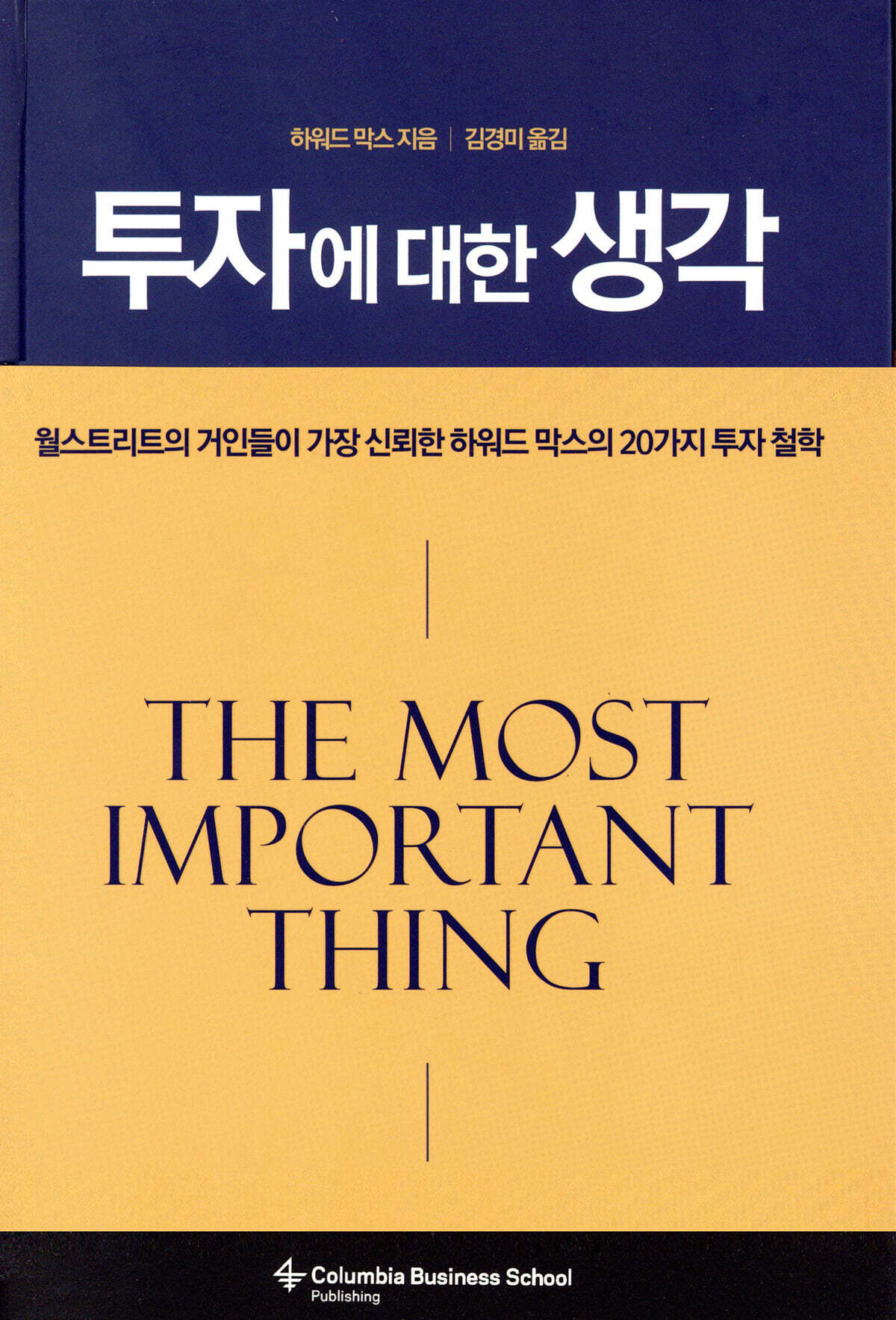 |
Description
Book Introduction
A Wall Street philosopher throws
A short but profound insight into investing
Howard Marks, the investment philosopher most trusted by Wall Street giants such as Warren Buffett, the Sage of Omaha, and John Bogle, the founder of index funds.
He compiled his notes containing deep insights into his investments into a book.
This letter, written in the form of a memo to clients by the author, chairman and co-founder of Oaktree Capital Management, offers sharp commentary and 20 of the most important, wise, and time-tested principles for successful investing.
Not many people have the qualities to become a great investor.
Some people may be able to do it if they learn, but this is not the case for everyone.
Even effective investment strategies may only be effective in some cases, not all of the time.
Even the best investment experts can't always be right.
Therefore, successful investing requires careful consideration of several different aspects simultaneously.
If you miss even one, the results may not be satisfactory.
Just as individual bricks come together to form a strong wall and a house, each of the "most important things" discussed in this book will come together to form the foundation for successful investment.
A short but profound insight into investing
Howard Marks, the investment philosopher most trusted by Wall Street giants such as Warren Buffett, the Sage of Omaha, and John Bogle, the founder of index funds.
He compiled his notes containing deep insights into his investments into a book.
This letter, written in the form of a memo to clients by the author, chairman and co-founder of Oaktree Capital Management, offers sharp commentary and 20 of the most important, wise, and time-tested principles for successful investing.
Not many people have the qualities to become a great investor.
Some people may be able to do it if they learn, but this is not the case for everyone.
Even effective investment strategies may only be effective in some cases, not all of the time.
Even the best investment experts can't always be right.
Therefore, successful investing requires careful consideration of several different aspects simultaneously.
If you miss even one, the results may not be satisfactory.
Just as individual bricks come together to form a strong wall and a house, each of the "most important things" discussed in this book will come together to form the foundation for successful investment.
- You can preview some of the book's contents.
Preview
index
Even investing in the West requires a philosophyㆍ11
The Most Important Principle 01: Think Deeplyㆍ15
The Most Important Principle 02: Understand Market Efficiencyㆍ24
The Most Important Principle 03: What Are Values?ㆍ38
The Most Important Principle 04: Understand the Relationship Between Price and Valueㆍ51
The Most Important Principle 05: What is Risk?ㆍ62
The Most Important Principle 06: Recognize Riskㆍ86
The Most Important Principle 07: Control Riskㆍ102
The Most Important Principle: Pay Attention to the Cycleㆍ116
The Most Important Principle 09: Understand the Characteristics of the Investment Marketㆍ126
The 10 Most Important Principles: Confront Negative Influencesㆍ137
The 11 Most Important Principles: What is Contrarian Investment?ㆍ155
The 12 Most Important Principles: Find Low-Price Buysㆍ169
The Most Important Principle 13: Be Patient and Wait for Your Opportunityㆍ181
The Most Important Principle 14: The One Thing I Know Is That I Don't Knowㆍ196
The Most Important Principle #15: Know Where We Areㆍ208
The Most Important Principle #16: Don't Underestimate Luckㆍ222
The Most Important Principle #17: Invest Defensivelyㆍ234
The Most Important Principle 18: Avoid Invisible Trapsㆍ253
The Most Important Principle 19: Create Added Valueㆍ275
The Most Important Principle 20: Obey All Principlesㆍ286
The Most Important Principle 01: Think Deeplyㆍ15
The Most Important Principle 02: Understand Market Efficiencyㆍ24
The Most Important Principle 03: What Are Values?ㆍ38
The Most Important Principle 04: Understand the Relationship Between Price and Valueㆍ51
The Most Important Principle 05: What is Risk?ㆍ62
The Most Important Principle 06: Recognize Riskㆍ86
The Most Important Principle 07: Control Riskㆍ102
The Most Important Principle: Pay Attention to the Cycleㆍ116
The Most Important Principle 09: Understand the Characteristics of the Investment Marketㆍ126
The 10 Most Important Principles: Confront Negative Influencesㆍ137
The 11 Most Important Principles: What is Contrarian Investment?ㆍ155
The 12 Most Important Principles: Find Low-Price Buysㆍ169
The Most Important Principle 13: Be Patient and Wait for Your Opportunityㆍ181
The Most Important Principle 14: The One Thing I Know Is That I Don't Knowㆍ196
The Most Important Principle #15: Know Where We Areㆍ208
The Most Important Principle #16: Don't Underestimate Luckㆍ222
The Most Important Principle #17: Invest Defensivelyㆍ234
The Most Important Principle 18: Avoid Invisible Trapsㆍ253
The Most Important Principle 19: Create Added Valueㆍ275
The Most Important Principle 20: Obey All Principlesㆍ286
Into the book
The environment is uncontrollable and situations rarely repeat themselves exactly.
Moreover, causality cannot be relied on because investor sentiment is a significant factor in the market and is influenced by many variables.
One investment strategy might work for a while, but as everyone else follows it, its effectiveness eventually diminishes, and the need for a new investment strategy arises.
Because the strategies that other investors imitate are less effective.
Like economics, investing is more art than science, as mistakes can happen. ---The most important principle 01: Think deeply.
The most important conclusion that can be drawn from the efficient market hypothesis is that 'you can't beat the market.'
The Chicago School's view of the market not only provides the logical basis for this conclusion, but also research on mutual fund performance supports it.
Only a very small number of mutual funds have been able to differentiate themselves from this conclusion.
Some might ask, what about the funds that received five stars?
Let's take a look at the following cautions in the fund terms and conditions.
“Mutual funds are rated based on relative valuation.
Therefore, it does not mean that the rating can beat objective criteria such as market indices.” ---The most important principle 02 Understand the efficiency of the market
Compared to value investing, growth investing focuses on finding stocks with the potential for significant growth.
But if that rise isn't happening in the near future, why risk the uncertainty of guessing the future? There's no doubt about that.
Because it is more difficult to know the future than the present, the success rate of growth investors is bound to be low, but if they do succeed, the rewards will be greater.
The reward for accurately predicting which company will produce the best new drug, the best computer, or the most successful movie must be substantial.
Generally, if your judgment about growth is correct, the resulting upside potential (potential price increases that can be expected) is more dramatic, and if your judgment about value is correct, the resulting upside potential is more sustained.
What I pursue is 'value,' and this book also values sustainability over such drama. ---The most important principle 03 What is value?
It remains clear that investor psychology is a crucial yet extremely difficult area to fully understand.
First, psychology is like a cloud in the sky, and second, the psychological factors that pressure other investors' psychology and influence their actions will also pressure your psychology.
As you'll see later in this book, these influences can cause people to act in ways that are contrary to what a good investor would do.
Therefore, even for the sake of self-protection, you should invest time and energy in understanding market psychology.
It's crucial to understand that intrinsic value is only one factor in determining the price of a security on the day you buy it, and to be able to use psychological and technical factors to your advantage. ---Most Important Principle 04: Understand the Relationship Between Price and Value
Investing consists of exactly one thing.
It's about facing the future.
The problem is that none of us can know for sure about the future, so we cannot avoid risk.
Therefore, managing risk is an essential element of investing.
Finding investment targets that will rise in price is not that difficult.
If you can find enough of these targets, you're on the right track. ---Most Important Principle 05 What is Risk?
Risk perception often begins with an investor realizing that they have either been extremely unaware of the risks involved, or that they have been overly optimistic and overpaid for a particular asset.
This means that the higher the risk, the higher the price generally is.
Whether it's individual securities, overvalued, expensive assets, or a booming market, investing when prices are high is a major source of risk. ---Most Important Principle 06: Recognize Risk
A good investor is not someone who has achieved greater returns than others, but rather someone who has achieved the same returns with less risk through risk management (or perhaps someone who has achieved slightly lower returns with much less risk).
Of course, when prices are stable or rising, we cannot know how much risk our portfolio contains.
This is similar to what Warren Buffett said when the tide goes out, you can tell who is swimming in their swimsuits and who is swimming naked.
Moreover, causality cannot be relied on because investor sentiment is a significant factor in the market and is influenced by many variables.
One investment strategy might work for a while, but as everyone else follows it, its effectiveness eventually diminishes, and the need for a new investment strategy arises.
Because the strategies that other investors imitate are less effective.
Like economics, investing is more art than science, as mistakes can happen. ---The most important principle 01: Think deeply.
The most important conclusion that can be drawn from the efficient market hypothesis is that 'you can't beat the market.'
The Chicago School's view of the market not only provides the logical basis for this conclusion, but also research on mutual fund performance supports it.
Only a very small number of mutual funds have been able to differentiate themselves from this conclusion.
Some might ask, what about the funds that received five stars?
Let's take a look at the following cautions in the fund terms and conditions.
“Mutual funds are rated based on relative valuation.
Therefore, it does not mean that the rating can beat objective criteria such as market indices.” ---The most important principle 02 Understand the efficiency of the market
Compared to value investing, growth investing focuses on finding stocks with the potential for significant growth.
But if that rise isn't happening in the near future, why risk the uncertainty of guessing the future? There's no doubt about that.
Because it is more difficult to know the future than the present, the success rate of growth investors is bound to be low, but if they do succeed, the rewards will be greater.
The reward for accurately predicting which company will produce the best new drug, the best computer, or the most successful movie must be substantial.
Generally, if your judgment about growth is correct, the resulting upside potential (potential price increases that can be expected) is more dramatic, and if your judgment about value is correct, the resulting upside potential is more sustained.
What I pursue is 'value,' and this book also values sustainability over such drama. ---The most important principle 03 What is value?
It remains clear that investor psychology is a crucial yet extremely difficult area to fully understand.
First, psychology is like a cloud in the sky, and second, the psychological factors that pressure other investors' psychology and influence their actions will also pressure your psychology.
As you'll see later in this book, these influences can cause people to act in ways that are contrary to what a good investor would do.
Therefore, even for the sake of self-protection, you should invest time and energy in understanding market psychology.
It's crucial to understand that intrinsic value is only one factor in determining the price of a security on the day you buy it, and to be able to use psychological and technical factors to your advantage. ---Most Important Principle 04: Understand the Relationship Between Price and Value
Investing consists of exactly one thing.
It's about facing the future.
The problem is that none of us can know for sure about the future, so we cannot avoid risk.
Therefore, managing risk is an essential element of investing.
Finding investment targets that will rise in price is not that difficult.
If you can find enough of these targets, you're on the right track. ---Most Important Principle 05 What is Risk?
Risk perception often begins with an investor realizing that they have either been extremely unaware of the risks involved, or that they have been overly optimistic and overpaid for a particular asset.
This means that the higher the risk, the higher the price generally is.
Whether it's individual securities, overvalued, expensive assets, or a booming market, investing when prices are high is a major source of risk. ---Most Important Principle 06: Recognize Risk
A good investor is not someone who has achieved greater returns than others, but rather someone who has achieved the same returns with less risk through risk management (or perhaps someone who has achieved slightly lower returns with much less risk).
Of course, when prices are stable or rising, we cannot know how much risk our portfolio contains.
This is similar to what Warren Buffett said when the tide goes out, you can tell who is swimming in their swimsuits and who is swimming naked.
---The most important principle 07: Control risk
Publisher's Review
When I see an email from Howard Marks in my mailbox, I read it first.
I always learn something from him,
This book contains twice as much of his wisdom.
Warren Buffett
This book contains notes on investment from Howard Marks, the investment philosopher most trusted by Wall Street giants such as Warren Buffett, the Sage of Omaha, and John Bogle, the founder of index funds, and his profound insights into investment.
The author, chairman and co-founder of Oaktree Capital Management, writes a memo to his clients, filled with sharp commentary and time-tested philosophy.
Now, for the first time, all readers, amateur or experienced, can upgrade their investments with this one book that distills his wisdom.
Who will be the winner?
What great investors need is not technology, but philosophy!
There is a proverb about basketball that says, “You can’t coach a player’s height.”
This means that no matter how much a coach coaches a player, it has no effect on that player's natural height.
The same goes for investing.
Insight isn't something you can teach someone. Like any skill, some people simply have a better understanding of investing than others.
In other words, what Benjamin Graham so eloquently emphasized is the "little bit of wisdom" that investors desperately need.
Wisdom comes from experience.
And experience is given when you don't get what you wanted.
The boom only teaches us useless lessons.
The boom tells us that investing is easy, that you already know the secrets of investing, and that you don't have to worry about risks.
But the recession teaches us valuable lessons.
The Arab oil crisis, stagflation, and the crash of the Nifty 50 (the 50 best-performing stocks that dominated the U.S. stock market from 1969 to 1973) made the 1970s the "death of equities."
What lessons can we learn from the crises that drove countless investors to despair: Black Monday in 1987, when the Dow Jones Industrial Average plunged 22.6 percent overnight; the bankruptcy of Long-Term Capital Management in 1998; the tech bubble burst and accounting scandals of the early 2000s; and the global financial crisis of 2007?
Howard Marks, chairman of Oaktree Capital Management, an alternative investment firm, presented 20 excellent, wise, and most important principles for successful investing in his book, "The Most Important Thing."
In both the worst crisis and the best opportunity
The 20 Most Important Investment Principles for Outstanding Performance
Everyone wants to make money.
Everything in economics is based on the belief that everyone pursues profit.
The same goes for capitalism.
The pursuit of profit motivates people to work harder and take risks with their money.
Moreover, as a result of the pursuit of profit, mankind has achieved and enjoyed much material progress.
But because of its universality, it is difficult to beat the market.
Today, millions of people are competing for their own investment returns.
To outperform other investors, you need either luck or exceptional insight.
However, hoping for luck is not a good investment strategy.
The author emphasized that one must focus on one's own insights.
The author calls this second-level thinking.
For example, the thought, “It’s a good company, so I should buy the stock,” is first-level thinking, while second-level thinking is, “It’s a good company, but everyone is overvaluing it.”
Because of that, the stock is overvalued and expensive.
“Let’s sell!”
Primary thinking is simple and superficial, so anyone can do it.
But just because anyone can do it doesn't mean that everyone can achieve outstanding results.
Remember, the goal of investing is to achieve above-average returns, not average returns.
Primary thinking is only an opinion about the future.
But secondary thinking is profound, complex, and difficult.
To achieve above-average investment performance, you need to be different from the average investor.
That means you have to think smarter than other investors.
You have to be different from others and better than others.
This is secondary thinking.
The author also provides excellent insights into risk and intrinsic value.
In particular, the importance of risk control and management is emphasized in three chapters.
The author argued that investing consists of exactly one thing.
It's about facing the future.
The problem is that no one knows the future for sure.
Risk is unavoidable.
The author emphasizes that coping with this risk is an essential element of investment.
The author outlines the principles of risk awareness as follows:
First, determine how much risk there is and whether you can afford to take it.
Second, face the risks involved as well as the potential returns.
Third, be sure to evaluate the risks you take on when investing.
Elroy Dimson, a professor at London Business School, said risk means that more could happen than will happen.
That's why the path to long-term success lies in risk management rather than aggressive investing.
The authors argue that, across an investor's entire investment history, most investors' performance is determined not by how great their successes have been, but by the number and severity of their failures.
In other words, an investor who can skillfully manage risk is an excellent investor.
In addition, principles such as patience and waiting for opportunities, the existence of luck, contrarian investment, and defensive investment will offer wise guidance to investors enduring the worst of times.
In an era of recession, a Wall Street philosopher asks:
A short but profound insight into investing
This book is very unique.
It doesn't explain how to invest, nor does it provide any absolute secrets or step-by-step training for investment success.
There is also no valuation formula that involves numbers or fixed ratios.
Rather than simplifying investing, the author has released a special note filled with brilliant insights to demonstrate just how complex investing can be.
Not many people have the qualities to become a great investor.
Some people may be able to do it if they learn, but this is not the case for everyone.
Even effective investment strategies may only be effective in some cases, not all of the time.
Even the best investment experts can't always be right.
Therefore, successful investing requires careful consideration of several different aspects simultaneously.
If you miss even one, the results may not be satisfactory.
Just as individual bricks come together to form a strong wall and a house, each of the "most important things" discussed in this book will come together to form the foundation for successful investment.
I always learn something from him,
This book contains twice as much of his wisdom.
Warren Buffett
This book contains notes on investment from Howard Marks, the investment philosopher most trusted by Wall Street giants such as Warren Buffett, the Sage of Omaha, and John Bogle, the founder of index funds, and his profound insights into investment.
The author, chairman and co-founder of Oaktree Capital Management, writes a memo to his clients, filled with sharp commentary and time-tested philosophy.
Now, for the first time, all readers, amateur or experienced, can upgrade their investments with this one book that distills his wisdom.
Who will be the winner?
What great investors need is not technology, but philosophy!
There is a proverb about basketball that says, “You can’t coach a player’s height.”
This means that no matter how much a coach coaches a player, it has no effect on that player's natural height.
The same goes for investing.
Insight isn't something you can teach someone. Like any skill, some people simply have a better understanding of investing than others.
In other words, what Benjamin Graham so eloquently emphasized is the "little bit of wisdom" that investors desperately need.
Wisdom comes from experience.
And experience is given when you don't get what you wanted.
The boom only teaches us useless lessons.
The boom tells us that investing is easy, that you already know the secrets of investing, and that you don't have to worry about risks.
But the recession teaches us valuable lessons.
The Arab oil crisis, stagflation, and the crash of the Nifty 50 (the 50 best-performing stocks that dominated the U.S. stock market from 1969 to 1973) made the 1970s the "death of equities."
What lessons can we learn from the crises that drove countless investors to despair: Black Monday in 1987, when the Dow Jones Industrial Average plunged 22.6 percent overnight; the bankruptcy of Long-Term Capital Management in 1998; the tech bubble burst and accounting scandals of the early 2000s; and the global financial crisis of 2007?
Howard Marks, chairman of Oaktree Capital Management, an alternative investment firm, presented 20 excellent, wise, and most important principles for successful investing in his book, "The Most Important Thing."
In both the worst crisis and the best opportunity
The 20 Most Important Investment Principles for Outstanding Performance
Everyone wants to make money.
Everything in economics is based on the belief that everyone pursues profit.
The same goes for capitalism.
The pursuit of profit motivates people to work harder and take risks with their money.
Moreover, as a result of the pursuit of profit, mankind has achieved and enjoyed much material progress.
But because of its universality, it is difficult to beat the market.
Today, millions of people are competing for their own investment returns.
To outperform other investors, you need either luck or exceptional insight.
However, hoping for luck is not a good investment strategy.
The author emphasized that one must focus on one's own insights.
The author calls this second-level thinking.
For example, the thought, “It’s a good company, so I should buy the stock,” is first-level thinking, while second-level thinking is, “It’s a good company, but everyone is overvaluing it.”
Because of that, the stock is overvalued and expensive.
“Let’s sell!”
Primary thinking is simple and superficial, so anyone can do it.
But just because anyone can do it doesn't mean that everyone can achieve outstanding results.
Remember, the goal of investing is to achieve above-average returns, not average returns.
Primary thinking is only an opinion about the future.
But secondary thinking is profound, complex, and difficult.
To achieve above-average investment performance, you need to be different from the average investor.
That means you have to think smarter than other investors.
You have to be different from others and better than others.
This is secondary thinking.
The author also provides excellent insights into risk and intrinsic value.
In particular, the importance of risk control and management is emphasized in three chapters.
The author argued that investing consists of exactly one thing.
It's about facing the future.
The problem is that no one knows the future for sure.
Risk is unavoidable.
The author emphasizes that coping with this risk is an essential element of investment.
The author outlines the principles of risk awareness as follows:
First, determine how much risk there is and whether you can afford to take it.
Second, face the risks involved as well as the potential returns.
Third, be sure to evaluate the risks you take on when investing.
Elroy Dimson, a professor at London Business School, said risk means that more could happen than will happen.
That's why the path to long-term success lies in risk management rather than aggressive investing.
The authors argue that, across an investor's entire investment history, most investors' performance is determined not by how great their successes have been, but by the number and severity of their failures.
In other words, an investor who can skillfully manage risk is an excellent investor.
In addition, principles such as patience and waiting for opportunities, the existence of luck, contrarian investment, and defensive investment will offer wise guidance to investors enduring the worst of times.
In an era of recession, a Wall Street philosopher asks:
A short but profound insight into investing
This book is very unique.
It doesn't explain how to invest, nor does it provide any absolute secrets or step-by-step training for investment success.
There is also no valuation formula that involves numbers or fixed ratios.
Rather than simplifying investing, the author has released a special note filled with brilliant insights to demonstrate just how complex investing can be.
Not many people have the qualities to become a great investor.
Some people may be able to do it if they learn, but this is not the case for everyone.
Even effective investment strategies may only be effective in some cases, not all of the time.
Even the best investment experts can't always be right.
Therefore, successful investing requires careful consideration of several different aspects simultaneously.
If you miss even one, the results may not be satisfactory.
Just as individual bricks come together to form a strong wall and a house, each of the "most important things" discussed in this book will come together to form the foundation for successful investment.
GOODS SPECIFICS
- Date of publication: September 21, 2012
- Format: Hardcover book binding method guide
- Page count, weight, size: 300 pages | 564g | 158*232*20mm
- ISBN13: 9788962604658
- ISBN10: 8962604655
You may also like
카테고리
korean


korean

![GQ KOREA Mark (Monthly): December [2025]](http://librairie.coreenne.fr/cdn/shop/files/8ef265dbbfbf186523ed75ba7319009d.jpg?v=1765340328&width=3840)


