

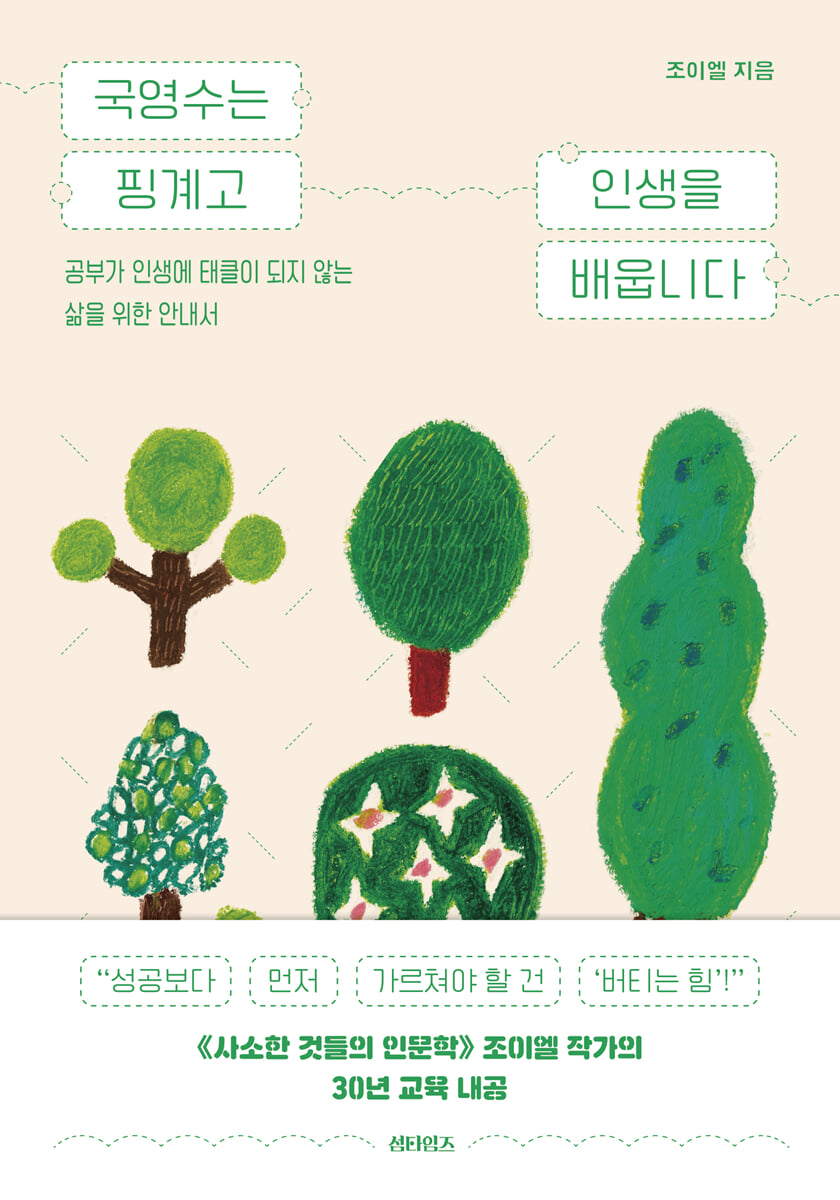
Korean, English, and math are just excuses, but you learn about life.
 |
Description
Book Introduction
Author Joyel, who has brought the joy of humanities to life with stories that boldly cross the boundaries of history, philosophy, literature, and science and unfold with exceptional perspective, now reveals surprising insights gleaned from her experience in the real world of education.
"Korean, English, and Math Are Not Excuses, They're Life Lessons" is the result of the author's 30 years of hard work as a "therapist" who sticks by children's side like a shadow, identifying their learning shortcomings and chronic illnesses. It is a guidebook that contains the small but crucial core of studying.
It contains real study methods that fill the gaps in Korean, English, and math-centered education, along with various case studies, including those from the top 1%, bottom students, dropouts, and children going through intense puberty.
Having met countless children at the forefront of education, the author uncovers the child's fundamental problems, rather than focusing on grades, and also provides ways to improve self-esteem, concentration, and self-management skills, as well as customized study strategies for each child.
If you feel limited by the current educational landscape and wonder what role adults should play for children, I encourage you to open this book.
"Korean, English, and Math Are Not Excuses, They're Life Lessons" is the result of the author's 30 years of hard work as a "therapist" who sticks by children's side like a shadow, identifying their learning shortcomings and chronic illnesses. It is a guidebook that contains the small but crucial core of studying.
It contains real study methods that fill the gaps in Korean, English, and math-centered education, along with various case studies, including those from the top 1%, bottom students, dropouts, and children going through intense puberty.
Having met countless children at the forefront of education, the author uncovers the child's fundamental problems, rather than focusing on grades, and also provides ways to improve self-esteem, concentration, and self-management skills, as well as customized study strategies for each child.
If you feel limited by the current educational landscape and wonder what role adults should play for children, I encourage you to open this book.
- You can preview some of the book's contents.
Preview
index
Prologue Every child has their own story.
CHAPTER 1: Breaking Fate and Being Accepted to Seoul National University
Strange Child | How to Optimize Life Beyond the Desk | I Want to Go to Seoul National University! | The Fine Line Between Medicine and Poison | Let's Read, Not Translate | Acceptance to Seoul National University is Determined by Korean Language
#Life is a series of twists and turns
CHAPTER 2: Even the nation's top 3,000 students can fail.
The blind spot of a top-tier math student | The hope that passing is possible | The lecture-oriented student vs. the self-study-oriented student | Pre-study is necessary, not just pre-study | Missing the prize you've set aside
#No questions, no change
CHAPTER 3 How an Ordinary Child Grows
Everyone makes mistakes | A teacher is someone who waits | Which life is happier?
#What kind of mark do you want to leave on the world?
CHAPTER 4 Even the Last Place Has a Chance
Why I Make the Last Student in My Class Get Private Tutoring | There's Hope Even in a Life of Torrential Rain | Going All-In on Korean
#Even the last place has a breath of fresh air
CHAPTER 5 Everything is fun except studying
A mother who can't leave 119 · Children grow on their own with even a little attention 123 · Live first
A person who has seen it, a teacher | Everyday life is a blessing
#Love is a rational decision
CHAPTER 6: Pre-learning as Poison, Pre-learning as Medicine
The Monster of Television | The Intelligence of a Three-Year-Old | Shaken Children | The Beauty of Mathematics
#Humans are thinking reeds
CHAPTER 7 It's Okay If You Can't Concentrate
Why I'm Giving Up on Math | The Half-Time Study Method | Math is Life, Too
#A world where ordinary people can live ordinary lives
CHAPTER 8 Between Control and Grazing
A child meant to shine is destined to shine | The impact of controlling parents on children | How to protect a free spirit | How to rescue a Tyrannosaurus trapped in a doghouse
#Between control and grazing
CHAPTER 9 If the speed is slow, it is slow
I set the pace | Plan B instead of blaming | When I drink too much
#HateOnlyHate
CHAPTER 10 How to avoid becoming a stumbling block in your child's life
A child who is slow at math | The lie that "everything will be alright" | A life that won't even last a hundred years creates a thousand-year worry | A comprehensive guide to the failures of private math education: Adults are the problem.
#Pus does not become flesh
CHAPTER 11 It's Hard Being Kind
Is shepherding the only answer? | A man has to endure that much | What kind of adult will that child become?
#The last straw that brought that child down
CHAPTER 12 To succeed in life
Studying as a means of earning a living | Desperate times bring challenges | The secret to passing Seoul National University | The power of cumulative review
#One sentence that will guide you for a lifetime
CHAPTER 13 Sometimes stopping is also a strategy.
Seung-gyu, an international school repeater | A boy who only sleeps | A Taoist priest living in Jeju
#Mom needs rest too
CHAPTER 14 Children Who Stopped Thinking
A child who gets 100 points if he makes no mistakes | A child who hates literature | Metaphorical ability is also connected to math | How to improve Korean language skills | Those who know only one thing know nothing | Korean study methods for ordinary children
#In the end, reading is the answer
Epilogue
CHAPTER 1: Breaking Fate and Being Accepted to Seoul National University
Strange Child | How to Optimize Life Beyond the Desk | I Want to Go to Seoul National University! | The Fine Line Between Medicine and Poison | Let's Read, Not Translate | Acceptance to Seoul National University is Determined by Korean Language
#Life is a series of twists and turns
CHAPTER 2: Even the nation's top 3,000 students can fail.
The blind spot of a top-tier math student | The hope that passing is possible | The lecture-oriented student vs. the self-study-oriented student | Pre-study is necessary, not just pre-study | Missing the prize you've set aside
#No questions, no change
CHAPTER 3 How an Ordinary Child Grows
Everyone makes mistakes | A teacher is someone who waits | Which life is happier?
#What kind of mark do you want to leave on the world?
CHAPTER 4 Even the Last Place Has a Chance
Why I Make the Last Student in My Class Get Private Tutoring | There's Hope Even in a Life of Torrential Rain | Going All-In on Korean
#Even the last place has a breath of fresh air
CHAPTER 5 Everything is fun except studying
A mother who can't leave 119 · Children grow on their own with even a little attention 123 · Live first
A person who has seen it, a teacher | Everyday life is a blessing
#Love is a rational decision
CHAPTER 6: Pre-learning as Poison, Pre-learning as Medicine
The Monster of Television | The Intelligence of a Three-Year-Old | Shaken Children | The Beauty of Mathematics
#Humans are thinking reeds
CHAPTER 7 It's Okay If You Can't Concentrate
Why I'm Giving Up on Math | The Half-Time Study Method | Math is Life, Too
#A world where ordinary people can live ordinary lives
CHAPTER 8 Between Control and Grazing
A child meant to shine is destined to shine | The impact of controlling parents on children | How to protect a free spirit | How to rescue a Tyrannosaurus trapped in a doghouse
#Between control and grazing
CHAPTER 9 If the speed is slow, it is slow
I set the pace | Plan B instead of blaming | When I drink too much
#HateOnlyHate
CHAPTER 10 How to avoid becoming a stumbling block in your child's life
A child who is slow at math | The lie that "everything will be alright" | A life that won't even last a hundred years creates a thousand-year worry | A comprehensive guide to the failures of private math education: Adults are the problem.
#Pus does not become flesh
CHAPTER 11 It's Hard Being Kind
Is shepherding the only answer? | A man has to endure that much | What kind of adult will that child become?
#The last straw that brought that child down
CHAPTER 12 To succeed in life
Studying as a means of earning a living | Desperate times bring challenges | The secret to passing Seoul National University | The power of cumulative review
#One sentence that will guide you for a lifetime
CHAPTER 13 Sometimes stopping is also a strategy.
Seung-gyu, an international school repeater | A boy who only sleeps | A Taoist priest living in Jeju
#Mom needs rest too
CHAPTER 14 Children Who Stopped Thinking
A child who gets 100 points if he makes no mistakes | A child who hates literature | Metaphorical ability is also connected to math | How to improve Korean language skills | Those who know only one thing know nothing | Korean study methods for ordinary children
#In the end, reading is the answer
Epilogue
Detailed image

Into the book
Studying is half at the desk and half outside the desk.
From tips for managing your spare time to how much you use your phone, to how quickly you can overcome a half-asleep state after waking up to how you spend your weekends, your relationships and even how much you eat can subtly impact your studies.
If you can optimize these details, your chances of success in your studies will significantly increase.
--- p.31
Whether it was 20 years ago or now, Korean language proficiency determines admission to Seoul National University.
To be clear and exaggerated, math and English have little differentiation.
Why is that? Because almost all applicants to Seoul National University get perfect scores in math and English.
Since everyone gets full marks, there's no way to tell the difference.
The Korean language was very different.
The full score for the Korean language section of the CSAT is 120 points, and if you score 110 points or higher, you are accepted to Seoul National University.
Donggyu's score on the mock exam fluctuated between 80 and 90 points.
Literature and classics are okay, but non-literature is a minefield.
This is exactly the symptom when literacy is weak.
--- p.52
The method used for the large intestine cannot be generalized.
At that time, it was a method specialized only for those with large appetites in the college entrance exam system.
These days, there is definitely a way to be the last one.
After that, I took care of various 'lower-ranking' students for over 20 years, and developed a one-point strategy that suited them and helped them get into a decent university.
If adults don't give up first, there is definitely a way for the last place winners.
Because a question properly asked has an answer.
--- p.114
If your goal is to be in the top 4% or 10%, is it worth the trouble? You can achieve it by gradually climbing the ladder.
It saves money and time, and is good for your child's mental health.
I warn you again.
If children who are not gifted do good deeds in a reckless manner, it will actually ruin them.
Trying to keep up with something that doesn't work builds up stress, makes you emotionally unstable, and leaves you with big and small mental health problems.
There's a reason why there are so many child psychiatrists in Gangnam.
The biggest problem that pre-learning causes is that it changes one's attitude toward life to become passive, avoidant, and cynical.
--- p.153
Woosung went on strike and Yeonhee went on strike.
A strike is not doing work, and a work stoppage is doing work but not doing it properly.
This condition is not limited to studying, but can spread to all stages of life.
Yeonhee, when I asked her what was the hardest part of her school life, she said something heartbreaking.
“Teacher, I feel really comfortable once I go to school.
It's hard from the moment I leave the school gate after school.
“My mom is waiting for me in the car near the school.”
--- p.203
How can I increase my speed at solving Korean language problems?
To solve non-literature problems on time, you need to have good vocabulary and literacy skills.
Having a solid background knowledge also helps a little.
To solve literature problems within the time limit, you need to solve many problems on a regular basis, and you need to solve them systematically.
It is better to analyze poetry by work and novels by author.
Anyway, what do you mean? It's similar to what the instructor said, and although it's a bit like that, if you have good skills, you can solve problems faster.
It is a task that takes a lot of time and effort.
Whether shallow or deep, technique and skill are difficult.
Whether it's Korean or math.
Speed is not a goal, it's a result.
From tips for managing your spare time to how much you use your phone, to how quickly you can overcome a half-asleep state after waking up to how you spend your weekends, your relationships and even how much you eat can subtly impact your studies.
If you can optimize these details, your chances of success in your studies will significantly increase.
--- p.31
Whether it was 20 years ago or now, Korean language proficiency determines admission to Seoul National University.
To be clear and exaggerated, math and English have little differentiation.
Why is that? Because almost all applicants to Seoul National University get perfect scores in math and English.
Since everyone gets full marks, there's no way to tell the difference.
The Korean language was very different.
The full score for the Korean language section of the CSAT is 120 points, and if you score 110 points or higher, you are accepted to Seoul National University.
Donggyu's score on the mock exam fluctuated between 80 and 90 points.
Literature and classics are okay, but non-literature is a minefield.
This is exactly the symptom when literacy is weak.
--- p.52
The method used for the large intestine cannot be generalized.
At that time, it was a method specialized only for those with large appetites in the college entrance exam system.
These days, there is definitely a way to be the last one.
After that, I took care of various 'lower-ranking' students for over 20 years, and developed a one-point strategy that suited them and helped them get into a decent university.
If adults don't give up first, there is definitely a way for the last place winners.
Because a question properly asked has an answer.
--- p.114
If your goal is to be in the top 4% or 10%, is it worth the trouble? You can achieve it by gradually climbing the ladder.
It saves money and time, and is good for your child's mental health.
I warn you again.
If children who are not gifted do good deeds in a reckless manner, it will actually ruin them.
Trying to keep up with something that doesn't work builds up stress, makes you emotionally unstable, and leaves you with big and small mental health problems.
There's a reason why there are so many child psychiatrists in Gangnam.
The biggest problem that pre-learning causes is that it changes one's attitude toward life to become passive, avoidant, and cynical.
--- p.153
Woosung went on strike and Yeonhee went on strike.
A strike is not doing work, and a work stoppage is doing work but not doing it properly.
This condition is not limited to studying, but can spread to all stages of life.
Yeonhee, when I asked her what was the hardest part of her school life, she said something heartbreaking.
“Teacher, I feel really comfortable once I go to school.
It's hard from the moment I leave the school gate after school.
“My mom is waiting for me in the car near the school.”
--- p.203
How can I increase my speed at solving Korean language problems?
To solve non-literature problems on time, you need to have good vocabulary and literacy skills.
Having a solid background knowledge also helps a little.
To solve literature problems within the time limit, you need to solve many problems on a regular basis, and you need to solve them systematically.
It is better to analyze poetry by work and novels by author.
Anyway, what do you mean? It's similar to what the instructor said, and although it's a bit like that, if you have good skills, you can solve problems faster.
It is a task that takes a lot of time and effort.
Whether shallow or deep, technique and skill are difficult.
Whether it's Korean or math.
Speed is not a goal, it's a result.
--- p.252
Publisher's Review
“What we must teach before success is the power to persevere!”
30 Years of Teaching Experience by Joyel, Author of "The Humanities of Small Things"
In this rapidly changing world, with its focus on entrance exams, overheated private education markets, and a rapidly changing world, how can we help our children live better lives? Parents live with a ambivalent feeling: exhausted by excessive private education, yet anxious that their children will fall behind.
In "Korean, English, and Math Are Excuses, but Learning About Life", these concerns are addressed head-on.
In the book, the author asks about the "essence of studying" that parents should truly consider, based on the trial and error and realizations he gained from observing children's dazzling growth and moments of frustration.
In particular, it addresses the issues that parents overlook due to their focus on competitive education centered on Korean, English, and math, and the problem of uniform study methods that ignore each child's different growth rhythms, through humanistic insight.
He says that there is a 'study path' that is right for each child, and suggests a way for parents to find their center and design their child's life together in the midst of the ever-changing and uncertain educational reality.
This is a must-read book to raise children who are not just good at studying, but who take charge of their own lives.
“What study method is most necessary for my child right now?”
Life lessons from the desk to raise strong children who never give up.
The author, who entered the education industry at an early age, founded a math problem bank and also built a database for the Korean language section of the College Scholastic Ability Test.
He became famous in Gangnam and Mokdong by sending ordinary students to Sky with his own learning know-how.
As I was always a strong supporter behind my children, I started to be called a 'therapist' rather than a teacher among the mothers.
“I want to know the secret to getting into Seoul National University,” “My child studies hard, but his grades are always the same,” “He can’t even concentrate for 10 minutes. Is that okay?” Countless parents ask the author for advice.
I feel at a loss as to how to deal with children who are exhausted by the competition-oriented college entrance exam system and how to help them since I cannot study for them.
The author, who has been meeting children and parents for over 30 years, says that each child has a study method that suits them, and that strategies should change according to the flow of life.
Even children in the top 1%, children who have lost their motivation to study, and children who study slowly all need a study method that suits their individual rhythm and environment.
Above all, this book talks about the 'essence' of studying, not the 'technique' of studying.
The way the author guides children is not by making them understand formulas and solving problems.
Joyel's teaching method is closer to "making children think for themselves" rather than "how to solve problems," as she naturally discusses philosophy and history with children and encourages them to change their thinking through books and conversations.
Children grow on their own by becoming curious and asking questions just by reading books together and touching on changing points in their thinking.
Because studying is not just something that happens at a desk, it is ultimately connected to one's attitude towards life.
“If adults don’t give up first,
“Even the last place has a way.”
A 100% empathetic story that answers realistic concerns about raising children.
A child who successfully entered Seoul National University after improving his mock exam scores by over 50% in just one year, a child who had been wandering as the last in his class for years but successfully entered university and is pursuing his dream, a child who entered a foreign language high school and received everyone's attention but was ultimately forced to give up his dream due to his parents' excessive expectations and educational views, etc.
The book honestly discusses how children become frustrated and fall apart when parents impose their expectations on them without properly assessing their abilities, as well as success stories of those who achieved their goals.
In addition, it generously includes specific study know-how that has been personally devised and applied over 30 years while working with children, including study know-how for children who advance to prestigious universities, secrets to English reading comprehension, and ways to improve Korean language skills, and its effectiveness has been proven.
At the end of each chapter, there is a column that explores stories that have actually helped children and various stories that parents should read to ensure their children's true happiness from a humanistic perspective.
Even after the exams are over, a child's life goes on.
Although immediate test scores are important, fostering the 'strength to endure life' should take precedence.
If you're wondering what your child needs now to build their own future, or where parents should stand between control and freedom, you'll find wisdom in this book.
30 Years of Teaching Experience by Joyel, Author of "The Humanities of Small Things"
In this rapidly changing world, with its focus on entrance exams, overheated private education markets, and a rapidly changing world, how can we help our children live better lives? Parents live with a ambivalent feeling: exhausted by excessive private education, yet anxious that their children will fall behind.
In "Korean, English, and Math Are Excuses, but Learning About Life", these concerns are addressed head-on.
In the book, the author asks about the "essence of studying" that parents should truly consider, based on the trial and error and realizations he gained from observing children's dazzling growth and moments of frustration.
In particular, it addresses the issues that parents overlook due to their focus on competitive education centered on Korean, English, and math, and the problem of uniform study methods that ignore each child's different growth rhythms, through humanistic insight.
He says that there is a 'study path' that is right for each child, and suggests a way for parents to find their center and design their child's life together in the midst of the ever-changing and uncertain educational reality.
This is a must-read book to raise children who are not just good at studying, but who take charge of their own lives.
“What study method is most necessary for my child right now?”
Life lessons from the desk to raise strong children who never give up.
The author, who entered the education industry at an early age, founded a math problem bank and also built a database for the Korean language section of the College Scholastic Ability Test.
He became famous in Gangnam and Mokdong by sending ordinary students to Sky with his own learning know-how.
As I was always a strong supporter behind my children, I started to be called a 'therapist' rather than a teacher among the mothers.
“I want to know the secret to getting into Seoul National University,” “My child studies hard, but his grades are always the same,” “He can’t even concentrate for 10 minutes. Is that okay?” Countless parents ask the author for advice.
I feel at a loss as to how to deal with children who are exhausted by the competition-oriented college entrance exam system and how to help them since I cannot study for them.
The author, who has been meeting children and parents for over 30 years, says that each child has a study method that suits them, and that strategies should change according to the flow of life.
Even children in the top 1%, children who have lost their motivation to study, and children who study slowly all need a study method that suits their individual rhythm and environment.
Above all, this book talks about the 'essence' of studying, not the 'technique' of studying.
The way the author guides children is not by making them understand formulas and solving problems.
Joyel's teaching method is closer to "making children think for themselves" rather than "how to solve problems," as she naturally discusses philosophy and history with children and encourages them to change their thinking through books and conversations.
Children grow on their own by becoming curious and asking questions just by reading books together and touching on changing points in their thinking.
Because studying is not just something that happens at a desk, it is ultimately connected to one's attitude towards life.
“If adults don’t give up first,
“Even the last place has a way.”
A 100% empathetic story that answers realistic concerns about raising children.
A child who successfully entered Seoul National University after improving his mock exam scores by over 50% in just one year, a child who had been wandering as the last in his class for years but successfully entered university and is pursuing his dream, a child who entered a foreign language high school and received everyone's attention but was ultimately forced to give up his dream due to his parents' excessive expectations and educational views, etc.
The book honestly discusses how children become frustrated and fall apart when parents impose their expectations on them without properly assessing their abilities, as well as success stories of those who achieved their goals.
In addition, it generously includes specific study know-how that has been personally devised and applied over 30 years while working with children, including study know-how for children who advance to prestigious universities, secrets to English reading comprehension, and ways to improve Korean language skills, and its effectiveness has been proven.
At the end of each chapter, there is a column that explores stories that have actually helped children and various stories that parents should read to ensure their children's true happiness from a humanistic perspective.
Even after the exams are over, a child's life goes on.
Although immediate test scores are important, fostering the 'strength to endure life' should take precedence.
If you're wondering what your child needs now to build their own future, or where parents should stand between control and freedom, you'll find wisdom in this book.
GOODS SPECIFICS
- Date of issue: August 1, 2025
- Page count, weight, size: 340 pages | 140*200*25mm
- ISBN13: 9791198520357
- ISBN10: 1198520353
You may also like
카테고리
korean


korean

![GQ KOREA Mark (Monthly): December [2025]](http://librairie.coreenne.fr/cdn/shop/files/8ef265dbbfbf186523ed75ba7319009d.jpg?v=1765340328&width=3840)


