

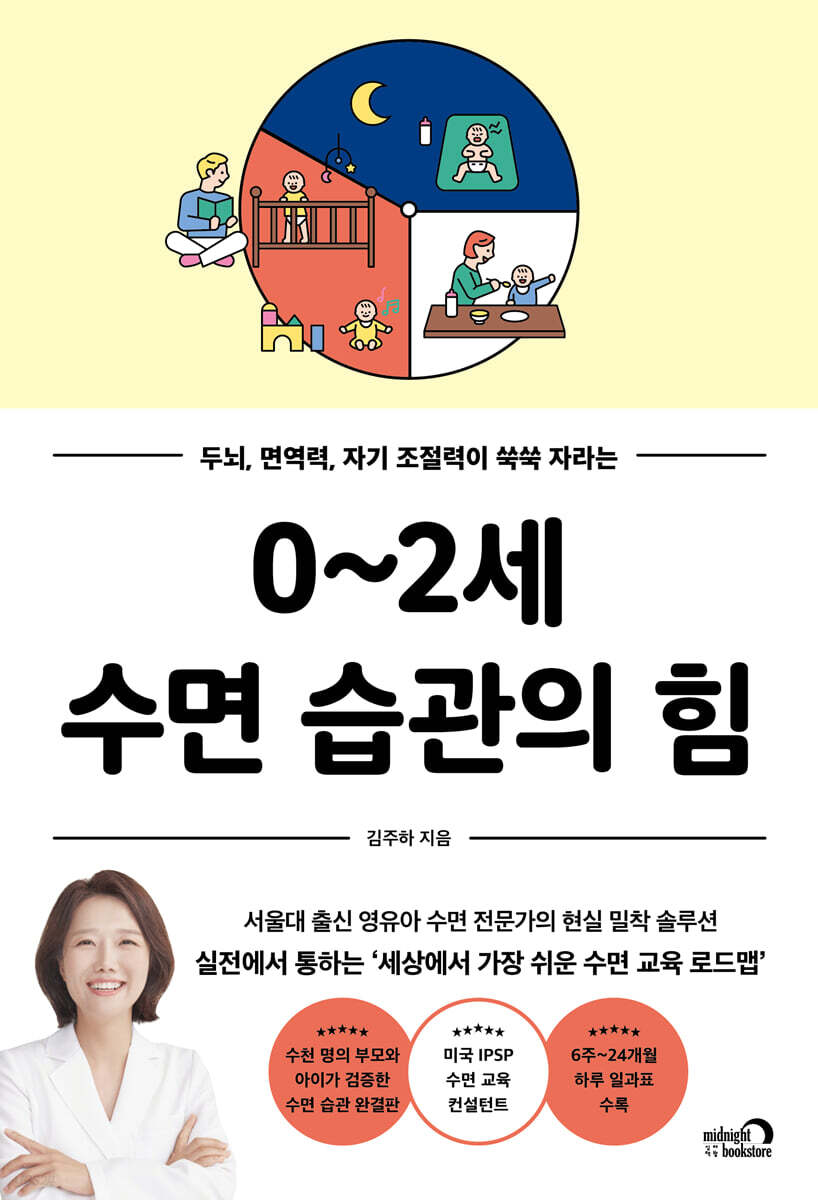
The Power of Sleep Habits for 0-2 Year Olds
 |
Description
Book Introduction
“The best infant and toddler sleep expert in the country
“Experience vivid coaching at home!”
A hot topic lecture that swept public health centers and postpartum care centers.
Real-world solutions from a Seoul National University graduate and early childhood sleep expert.
Are you feeling overwhelmed by your child's completely reversed day-night routine? Wondering what your child needs for health and growth? Want to know the right sleep training method for your child? Now you don't have to worry about this alone or spend all night searching mom communities.
Here's the clearest way to solve your child's sleep problems.
Kim Joo-ha, a popular speaker at public health centers and postpartum care centers and a sleep expert for infants and toddlers chosen by 50,000 mothers on Instagram, has compiled all her expertise into a single book.
The sleep training roadmap presented in this book is based on methods already experienced and proven by thousands of parents and children.
It is based on various case studies, so anyone can easily understand it, and the moment you close the book, you can immediately apply it to your child and feel the real changes.
Above all, the biggest advantage is that it allows for customized adjustments at each stage, taking into account the child's developmental status, the parents' parenting philosophy, and even the home environment.
So, it's easy to design a sleep training program that's just right for your child and family.
Sleep habits are not simply about training your child to sleep.
It is the starting point for correcting the daily rhythm of both parents and children and restoring a broken daily life.
So, when the child's daily rhythm becomes stable and he or she can fall asleep on his or her own, the child's condition improves, and the mother can raise the child with a more relaxed mind.
If your child's sleep patterns change every day, leaving you feeling anxious all day long, or if you're constantly fidgeting because you can't recognize your child's crying signals, start sleep training today with this book.
A new daily life will unfold, where parents will be filled with relaxation and smiles instead of anxiety and fatigue, and the whole family will enjoy a comfortable time of recovery.
“Experience vivid coaching at home!”
A hot topic lecture that swept public health centers and postpartum care centers.
Real-world solutions from a Seoul National University graduate and early childhood sleep expert.
Are you feeling overwhelmed by your child's completely reversed day-night routine? Wondering what your child needs for health and growth? Want to know the right sleep training method for your child? Now you don't have to worry about this alone or spend all night searching mom communities.
Here's the clearest way to solve your child's sleep problems.
Kim Joo-ha, a popular speaker at public health centers and postpartum care centers and a sleep expert for infants and toddlers chosen by 50,000 mothers on Instagram, has compiled all her expertise into a single book.
The sleep training roadmap presented in this book is based on methods already experienced and proven by thousands of parents and children.
It is based on various case studies, so anyone can easily understand it, and the moment you close the book, you can immediately apply it to your child and feel the real changes.
Above all, the biggest advantage is that it allows for customized adjustments at each stage, taking into account the child's developmental status, the parents' parenting philosophy, and even the home environment.
So, it's easy to design a sleep training program that's just right for your child and family.
Sleep habits are not simply about training your child to sleep.
It is the starting point for correcting the daily rhythm of both parents and children and restoring a broken daily life.
So, when the child's daily rhythm becomes stable and he or she can fall asleep on his or her own, the child's condition improves, and the mother can raise the child with a more relaxed mind.
If your child's sleep patterns change every day, leaving you feeling anxious all day long, or if you're constantly fidgeting because you can't recognize your child's crying signals, start sleep training today with this book.
A new daily life will unfold, where parents will be filled with relaxation and smiles instead of anxiety and fatigue, and the whole family will enjoy a comfortable time of recovery.
- You can preview some of the book's contents.
Preview
index
Knowing the Prologue Principle Will Reduce Anxiety and Increase Confidence
Part 1: Why can't children fall asleep easily?
Chapter 1: Understanding Your Child's Sleep Rhythm
01 Why sleep is important in the first two years of life
02 0~2 years old sleep development process
03 Understanding Your Child's Sleep Rhythm
04 What is sleep association?
05 Reasons why children wake up frequently
06 Why do babies cry when they fall asleep?
07 Normal crying vs. sleep crying
08 Understanding Sleep-Related Behavioral Language
09 Months of Awake Time by Number
10 Minimum and maximum nap times
11 months of sleep time by age
12 Check the World Health Organization growth curve
Chapter 2: Understanding Sleep Education
01 Sleep training is not training.
02 Why sleep training is absolutely necessary
03 Misconceptions and Truths about Sleep Training
04 Three Key Factors for Sleep Training Success
05 When should sleep training begin?
06 The correct order of sleep training
Part 2: A Real-World Sleep Education Roadmap
Chapter 3 [Steps 1-2] Setting up your sleep environment
01 Mom's Preparation
02 10 Conditions for a Comfortable Sleep
03 Create a sleep routine
04 Create a Wake-Up Routine
Chapter 4 [Step 3] Creating a Daily Routine That Fits Your Child
01 Set your wake-up and bedtime
02 Creating a rhythm of eating, playing, and sleeping
Example of a daily schedule by month
Chapter 5 [Step 4] Practicing Falling Asleep on Your Own
01 What is self-sleep?
02 Types of methods for practicing falling asleep on your own
03 Guide to Falling Asleep on Your Own
04 Nap Extension Guide
Chapter 6 [Step 5] Practice increasing deep sleep
01 Overcoming the Conditions and Interferences of Deep Sleep
Chapter 7: 24 Hours a Day of Practicing Falling Asleep on Your Own
01 Example of a 4-month-old child's daily routine
Part 3: Continuing Your Sleep Habits
Chapter 8: How to Deal with Emergency Situations
01 How to solve the shuttle problem
02 Early Wake-up Solution
03 How to Deal with Flipping Hell
04 How to Deal with Hell
05 Sleep Training When You're Sick
06 Sleep Education When Traveling Abroad
Chapter 9: A Guide to the Heart When Parents Feel Uneasy
01 Things to Remember When Sleep Training is Difficult
Part 1: Why can't children fall asleep easily?
Chapter 1: Understanding Your Child's Sleep Rhythm
01 Why sleep is important in the first two years of life
02 0~2 years old sleep development process
03 Understanding Your Child's Sleep Rhythm
04 What is sleep association?
05 Reasons why children wake up frequently
06 Why do babies cry when they fall asleep?
07 Normal crying vs. sleep crying
08 Understanding Sleep-Related Behavioral Language
09 Months of Awake Time by Number
10 Minimum and maximum nap times
11 months of sleep time by age
12 Check the World Health Organization growth curve
Chapter 2: Understanding Sleep Education
01 Sleep training is not training.
02 Why sleep training is absolutely necessary
03 Misconceptions and Truths about Sleep Training
04 Three Key Factors for Sleep Training Success
05 When should sleep training begin?
06 The correct order of sleep training
Part 2: A Real-World Sleep Education Roadmap
Chapter 3 [Steps 1-2] Setting up your sleep environment
01 Mom's Preparation
02 10 Conditions for a Comfortable Sleep
03 Create a sleep routine
04 Create a Wake-Up Routine
Chapter 4 [Step 3] Creating a Daily Routine That Fits Your Child
01 Set your wake-up and bedtime
02 Creating a rhythm of eating, playing, and sleeping
Example of a daily schedule by month
Chapter 5 [Step 4] Practicing Falling Asleep on Your Own
01 What is self-sleep?
02 Types of methods for practicing falling asleep on your own
03 Guide to Falling Asleep on Your Own
04 Nap Extension Guide
Chapter 6 [Step 5] Practice increasing deep sleep
01 Overcoming the Conditions and Interferences of Deep Sleep
Chapter 7: 24 Hours a Day of Practicing Falling Asleep on Your Own
01 Example of a 4-month-old child's daily routine
Part 3: Continuing Your Sleep Habits
Chapter 8: How to Deal with Emergency Situations
01 How to solve the shuttle problem
02 Early Wake-up Solution
03 How to Deal with Flipping Hell
04 How to Deal with Hell
05 Sleep Training When You're Sick
06 Sleep Education When Traveling Abroad
Chapter 9: A Guide to the Heart When Parents Feel Uneasy
01 Things to Remember When Sleep Training is Difficult
Detailed image

Into the book
Sleep crying has a completely different purpose than regular crying.
Sleep crying is one of the self-regulation strategies that children use to lower their level of arousal and relax their body and mind to transition into sleep.
While awake, a child's nervous system is actively stimulated by various stimuli, but to fall asleep, this tension must be released and the child must move into a state of complete relaxation.
When a child is sleepy and tired but still tense, he or she may cry to calm down and lower his or her arousal level.
--- p.43, Chapter 1, 07.
From "Normal Crying VS Sleep Crying"
Sleep training is not about teaching your child anything or fixing problems.
Children are born with the inherent ability to sleep.
Sleep training is the process by which mothers learn to understand their baby's rhythms, create an environment for them to develop their abilities, and learn to respond sensitively to their signals.
--- p.81, 「Chapter 2 01.
Sleep training is not training
One of the most misunderstood aspects of sleep training is attachment.
“Will my child be emotionally hurt?”, “Will my relationship become distant if I let him sleep alone?” These anxieties are completely natural.
But in reality, it's quite the opposite.
Sleep training is not about damaging attachment, but rather about stabilizing sleep based on attachment.
In fact, the more trust there is between the child and the mother, the more smoothly sleep training will proceed.
--- p.90, Chapter 2 03.
From “Misconceptions and Truths about Sleep Education”
The first thing to decide when creating a daily routine is your ‘wake-up time.’
If the time you wake up in the morning is irregular, the flow of everything from naps to feedings to nighttime sleep becomes unstable.
Set your wake-up time to be between 6 and 7 a.m. every day.
Just because you set a wake-up time of 7 o'clock doesn't mean you have to sleep in until that time.
Depending on the child's condition, he or she may wake up a little early, which is okay in itself.
However, you need to be careful because sleeping past 7 o'clock can disrupt your rhythm.
--- p.141, 「Chapter 4 01.
From “Setting the wake-up and bedtime”
Sleep training is a mother's first step.
Sleep training isn't just for children.
This is my first time doing this, too.
Waiting for a child to cry, trusting the process rather than the outcome, and managing emotions and maintaining consistency are all new and unfamiliar things from start to finish.
You can't do it well from the beginning, and mistakes are a 'natural process of growth'.
“I did my best today too.
“Let’s do it again tomorrow,” “This whole process is part of living a happy life with your child!” These simple words bring peace to the mother’s heart, and that peace of mind is passed on to the child as a sense of stability.
Sleep crying is one of the self-regulation strategies that children use to lower their level of arousal and relax their body and mind to transition into sleep.
While awake, a child's nervous system is actively stimulated by various stimuli, but to fall asleep, this tension must be released and the child must move into a state of complete relaxation.
When a child is sleepy and tired but still tense, he or she may cry to calm down and lower his or her arousal level.
--- p.43, Chapter 1, 07.
From "Normal Crying VS Sleep Crying"
Sleep training is not about teaching your child anything or fixing problems.
Children are born with the inherent ability to sleep.
Sleep training is the process by which mothers learn to understand their baby's rhythms, create an environment for them to develop their abilities, and learn to respond sensitively to their signals.
--- p.81, 「Chapter 2 01.
Sleep training is not training
One of the most misunderstood aspects of sleep training is attachment.
“Will my child be emotionally hurt?”, “Will my relationship become distant if I let him sleep alone?” These anxieties are completely natural.
But in reality, it's quite the opposite.
Sleep training is not about damaging attachment, but rather about stabilizing sleep based on attachment.
In fact, the more trust there is between the child and the mother, the more smoothly sleep training will proceed.
--- p.90, Chapter 2 03.
From “Misconceptions and Truths about Sleep Education”
The first thing to decide when creating a daily routine is your ‘wake-up time.’
If the time you wake up in the morning is irregular, the flow of everything from naps to feedings to nighttime sleep becomes unstable.
Set your wake-up time to be between 6 and 7 a.m. every day.
Just because you set a wake-up time of 7 o'clock doesn't mean you have to sleep in until that time.
Depending on the child's condition, he or she may wake up a little early, which is okay in itself.
However, you need to be careful because sleeping past 7 o'clock can disrupt your rhythm.
--- p.141, 「Chapter 4 01.
From “Setting the wake-up and bedtime”
Sleep training is a mother's first step.
Sleep training isn't just for children.
This is my first time doing this, too.
Waiting for a child to cry, trusting the process rather than the outcome, and managing emotions and maintaining consistency are all new and unfamiliar things from start to finish.
You can't do it well from the beginning, and mistakes are a 'natural process of growth'.
“I did my best today too.
“Let’s do it again tomorrow,” “This whole process is part of living a happy life with your child!” These simple words bring peace to the mother’s heart, and that peace of mind is passed on to the child as a sense of stability.
--- p.311, Chapter 9 01.
From “Things to Remember When Sleep Training is Difficult”
From “Things to Remember When Sleep Training is Difficult”
Publisher's Review
“The first two years of life, sleep habits shape the rest of your child’s life!”
The crucial secret to boosting your child's brain development, immunity, and self-control.
Why are sleep habits important in the first two years of a child's life? This is the period when a child's growth and development occur most rapidly.
The brain's structure is formed, neural circuits are connected, and sensations and responses to the external world are created.
Depending on the type of sleep experience a child has during this crucial period, the basic rhythms of life will be formed differently, including how a child perceives the world, how he or she cares for himself, and how he or she regulates his or her emotions.
Additionally, children learn a sense of security and develop self-regulation skills through sleep.
It is about learning how to end the day by repeating the process of falling asleep on your own and preparing for a new day.
These rhythms continue through infancy, childhood, and adolescence, and serve as the foundation for overall development, including lifestyle habits, concentration, and emotional control.
So, if the sleep cycle is repeatedly disrupted during this time, the world can feel unpredictable and unstable to the child.
It's not just about sleeping problems; it can also lead to tension and mood swings throughout your daily life.
In this way, the way a mother helps her child sleep during the first two years of life can help the child grow up in a healthier body and mind.
However, contrary to the wishes of parents who want to raise their children well, the author has often witnessed pitiful scenes in childcare settings.
This includes cases where parents ignore the sleep training stage in the hope of dramatic results in a short period of time, or start sleep training without any mental preparation, thereby directly transmitting the parents' anxiety and impatience to the child.
The author says, “A mother is not someone who helps her child, but someone who believes in his or her potential first,” and through this book, she presents the most effective and gentle way to establish sleeping habits in a child.
“Knowing the principles reduces anxiety and increases confidence!”
The World's Easiest Sleep Training Roadmap: Real-World Approaches
The so-called "100-day miracle" or "1-year-old miracle," where a child's day and night schedule becomes stable and their sleep patterns stabilize, never happens on their own.
However, if you understand the 'principles and methods of sleep', you can create that miracle surprisingly easily.
This book first guides you through the basic principles and standards of sleep education, such as 'understanding your child's sleep rhythm, why your child cries before going to sleep, the difference between normal crying and sleep crying, and the time awake, nap time, and full sleep time by month', so that you can understand the principles.
After making this easy to understand, the author introduces the 'Sleep Education Roadmap that Works in Practice', which is a compilation of his know-how.
This roadmap consists of five steps, but not all households are required to complete all five steps.
Just by setting up a sleep environment and creating a daily routine in stages 1 to 3, your child's sleep can become noticeably more stable. Stages 4 and 5 can be adjusted according to the child's developmental status, the parents' parenting philosophy, and the home environment, allowing each family to choose the depth and direction that suits them.
In other words, it is a flexible structure that allows you to design a sleep training program that is just right for your child.
The best part of this book is that it provides clear answers and scientific reasons for the anxieties and concerns that mothers have when starting sleep training, such as, "Will my child be emotionally hurt?" and "Will my relationship become distant if I let my child sleep alone?"
It also includes practical guides on how to deal with various unexpected situations and help parents stay centered and continue sleep training whenever they feel unsettled.
This book systematically explains the entire process of sleep training from start to finish, allowing you to naturally understand the overall flow.
Let's follow this roadmap, let go of the burden of having to be perfect and the impatience of not wanting to fail, and move forward lightly, one step at a time.
The peaceful nights and vibrant mornings you've been waiting for will soon become a daily routine rather than a miracle.
The crucial secret to boosting your child's brain development, immunity, and self-control.
Why are sleep habits important in the first two years of a child's life? This is the period when a child's growth and development occur most rapidly.
The brain's structure is formed, neural circuits are connected, and sensations and responses to the external world are created.
Depending on the type of sleep experience a child has during this crucial period, the basic rhythms of life will be formed differently, including how a child perceives the world, how he or she cares for himself, and how he or she regulates his or her emotions.
Additionally, children learn a sense of security and develop self-regulation skills through sleep.
It is about learning how to end the day by repeating the process of falling asleep on your own and preparing for a new day.
These rhythms continue through infancy, childhood, and adolescence, and serve as the foundation for overall development, including lifestyle habits, concentration, and emotional control.
So, if the sleep cycle is repeatedly disrupted during this time, the world can feel unpredictable and unstable to the child.
It's not just about sleeping problems; it can also lead to tension and mood swings throughout your daily life.
In this way, the way a mother helps her child sleep during the first two years of life can help the child grow up in a healthier body and mind.
However, contrary to the wishes of parents who want to raise their children well, the author has often witnessed pitiful scenes in childcare settings.
This includes cases where parents ignore the sleep training stage in the hope of dramatic results in a short period of time, or start sleep training without any mental preparation, thereby directly transmitting the parents' anxiety and impatience to the child.
The author says, “A mother is not someone who helps her child, but someone who believes in his or her potential first,” and through this book, she presents the most effective and gentle way to establish sleeping habits in a child.
“Knowing the principles reduces anxiety and increases confidence!”
The World's Easiest Sleep Training Roadmap: Real-World Approaches
The so-called "100-day miracle" or "1-year-old miracle," where a child's day and night schedule becomes stable and their sleep patterns stabilize, never happens on their own.
However, if you understand the 'principles and methods of sleep', you can create that miracle surprisingly easily.
This book first guides you through the basic principles and standards of sleep education, such as 'understanding your child's sleep rhythm, why your child cries before going to sleep, the difference between normal crying and sleep crying, and the time awake, nap time, and full sleep time by month', so that you can understand the principles.
After making this easy to understand, the author introduces the 'Sleep Education Roadmap that Works in Practice', which is a compilation of his know-how.
This roadmap consists of five steps, but not all households are required to complete all five steps.
Just by setting up a sleep environment and creating a daily routine in stages 1 to 3, your child's sleep can become noticeably more stable. Stages 4 and 5 can be adjusted according to the child's developmental status, the parents' parenting philosophy, and the home environment, allowing each family to choose the depth and direction that suits them.
In other words, it is a flexible structure that allows you to design a sleep training program that is just right for your child.
The best part of this book is that it provides clear answers and scientific reasons for the anxieties and concerns that mothers have when starting sleep training, such as, "Will my child be emotionally hurt?" and "Will my relationship become distant if I let my child sleep alone?"
It also includes practical guides on how to deal with various unexpected situations and help parents stay centered and continue sleep training whenever they feel unsettled.
This book systematically explains the entire process of sleep training from start to finish, allowing you to naturally understand the overall flow.
Let's follow this roadmap, let go of the burden of having to be perfect and the impatience of not wanting to fail, and move forward lightly, one step at a time.
The peaceful nights and vibrant mornings you've been waiting for will soon become a daily routine rather than a miracle.
GOODS SPECIFICS
- Date of issue: June 23, 2025
- Page count, weight, size: 320 pages | 552g | 150*220*20mm
- ISBN13: 9791158733414
- ISBN10: 1158733410
You may also like
카테고리
korean


korean

![GQ KOREA Mark (Monthly): December [2025]](http://librairie.coreenne.fr/cdn/shop/files/8ef265dbbfbf186523ed75ba7319009d.jpg?v=1765340328&width=3840)


