

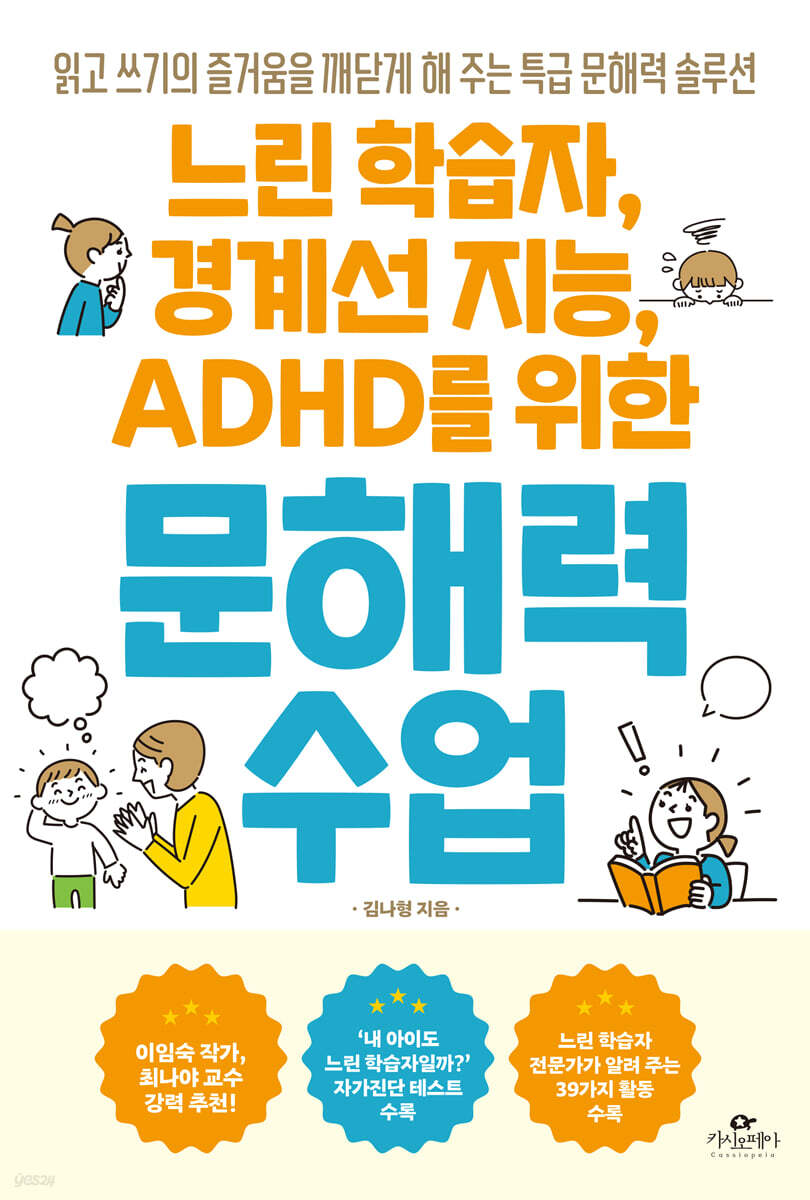
Literacy classes for slow learners, borderline intelligence, and ADHD
 |
Description
Book Introduction
'Why do people read the letters as they please?'
'You speak well, but why is your dictation like this?'
:
“Literacy education for slow learners needs to be different!”
From the basics of literacy, including reading fluency, vocabulary, book conversation, daily literacy, and writing.
Up to 39 activities that allow you to directly experience literacy closely related to daily life.
Slow learner expert Na-hyung Kim shares practical literacy solutions tailored to your daily life!
'Slow learners' is a general term for children who learn slowly and cannot learn more than a certain amount of content at a time.
This behavior is seen in children with intellectual disabilities, autism, learning disabilities, and even borderline intelligence and ADHD.
The borderline intelligence population is surprisingly much larger than the entire disabled population combined.
The estimate from the National Assembly in 2024 alone is approximately 6.97 million people, but it is difficult to estimate the exact number because they are not considered disabled under the current system.
Children with borderline intelligence often also have ADHD, and these children also perform worse in reading and writing than typical children.
In such a situation, parents who do not fully understand the reading and writing characteristics of slow learners cannot help but feel anxious and at a loss as they watch their children fall behind in class, not knowing how to teach them literacy.
Children also become overwhelmed by the amount of learning that is being given to them.
Director Na-Hyeong Kim, who studies and teaches literacy instruction methods for slow learners, wrote “Literacy Classes for Slow Learners, Borderline Intelligence, and ADHD” to allay these parents’ anxieties and provide practical help.
The reason the author understands the feelings of parents of slow learners well is because she herself is a mother who has raised a slow learner for 20 years.
The author realized that slow learners desperately need literacy experiences that are relevant to their lives, not just academic learning, as children grow.
For slow learners who also struggle with social and communication skills, literacy has a significant impact on self-esteem and motivation.
The book presents five literacy keywords and 39 activities that parents of slow learners must know.
The most important thing is that both parents and children should experience reading and writing as if they were getting wet in a drizzle, so that they do not get tired.
The author sympathizes with parents who often nag their children and end up getting angry when teaching them, but advises that literacy can be developed simply by eating, playing games, and talking about things they enjoy.
Let's read this book and re-establish our reading and writing goals for our children.
And let's choose an activity that suits the child's level and interest and repeat it step by step.
Both slow learners and their parents can grow and experience the true joy of reading and writing.
'You speak well, but why is your dictation like this?'
:
“Literacy education for slow learners needs to be different!”
From the basics of literacy, including reading fluency, vocabulary, book conversation, daily literacy, and writing.
Up to 39 activities that allow you to directly experience literacy closely related to daily life.
Slow learner expert Na-hyung Kim shares practical literacy solutions tailored to your daily life!
'Slow learners' is a general term for children who learn slowly and cannot learn more than a certain amount of content at a time.
This behavior is seen in children with intellectual disabilities, autism, learning disabilities, and even borderline intelligence and ADHD.
The borderline intelligence population is surprisingly much larger than the entire disabled population combined.
The estimate from the National Assembly in 2024 alone is approximately 6.97 million people, but it is difficult to estimate the exact number because they are not considered disabled under the current system.
Children with borderline intelligence often also have ADHD, and these children also perform worse in reading and writing than typical children.
In such a situation, parents who do not fully understand the reading and writing characteristics of slow learners cannot help but feel anxious and at a loss as they watch their children fall behind in class, not knowing how to teach them literacy.
Children also become overwhelmed by the amount of learning that is being given to them.
Director Na-Hyeong Kim, who studies and teaches literacy instruction methods for slow learners, wrote “Literacy Classes for Slow Learners, Borderline Intelligence, and ADHD” to allay these parents’ anxieties and provide practical help.
The reason the author understands the feelings of parents of slow learners well is because she herself is a mother who has raised a slow learner for 20 years.
The author realized that slow learners desperately need literacy experiences that are relevant to their lives, not just academic learning, as children grow.
For slow learners who also struggle with social and communication skills, literacy has a significant impact on self-esteem and motivation.
The book presents five literacy keywords and 39 activities that parents of slow learners must know.
The most important thing is that both parents and children should experience reading and writing as if they were getting wet in a drizzle, so that they do not get tired.
The author sympathizes with parents who often nag their children and end up getting angry when teaching them, but advises that literacy can be developed simply by eating, playing games, and talking about things they enjoy.
Let's read this book and re-establish our reading and writing goals for our children.
And let's choose an activity that suits the child's level and interest and repeat it step by step.
Both slow learners and their parents can grow and experience the true joy of reading and writing.
- You can preview some of the book's contents.
Preview
index
[Recommendation]
[Prologue] The necessity and joy of reading and writing: What I learned from living with a slow child for 20 years.
[Before reading] Is my child a slow learner?
- Part 1.
Understanding the Literacy of Slow Learners -
Chapter 1.
In an era of literacy anxiety, children's literacy skills are slow.
“They say literacy is important, but is my child okay with it?”
This is how children who are slower than others read and write
Literacy for 'slow learners' needs a new definition.
6 Commandments for Literacy Instruction for Parents of Slow-Learning Children
Chapter 2.
Literacy Basics Parents Should Take Care of
Reading fluency
Vocabulary
Book conversation
Life literacy
Writing
- Part 2.
Literacy Activities for Parents and Children 39 -
01.
Practice your word fluency
02.
Read nonsense words
03.
Read like an adult's model reader
04.
Practice spacing reading
05.
Read it over and over again
06.
Read and write original and beautiful poems.
07.
Let's organize the story in order.
08.
Guess the character's personality and mind
09.
Use educational cartoons or videos
10.
Read easily written text
11.
Learn reasoning through games
12.
Write down exactly what you said.
13.
Practice ironing your writing
14.
Write with good posture
15.
Build finger strength
16.
Get familiar with dictation
17.
Have fun with dictation in a variety of ways
18.
Learn how to write sentences
19.
Write a Diary ① Four Reasons Why Writing a Diary Is Difficult
20.
Write a diary ② Let's write a diary together
21.
Look at the picture and say and write according to the six principles.
22.
Let's write a simple explanation
23.
Use the network of ideas to find inspiration and write.
24.
Write something about me
25.
Life Literacy for When You're Sick ① Go to the Hospital
26.
Life Literacy for When You're Sick ② Take Medicine
27.
Read simple recipes and cook
28.
Learn time/date concepts related to daily life.
29.
Post reading material here and there
30.
Book your movie tickets and go see it.
31.
Read and write about things that interest you
32.
Write your own experiential learning report
33.
Let's create our family culture
34.
Play a vocabulary game
35.
Get your learning tools and textbook vocabulary
36.
Learn how to look up words in a dictionary
37.
Infer the meaning of the vocabulary ① Find the clues
38.
Infer the meaning of the vocabulary ② Draw a graphic organizer
39.
Read picture books and learn vocabulary and sentences.
[Epilogue] - Supporting all parents with slow learners
[Appendix] - Useful Sites for Parents of Slow Learners
[Prologue] The necessity and joy of reading and writing: What I learned from living with a slow child for 20 years.
[Before reading] Is my child a slow learner?
- Part 1.
Understanding the Literacy of Slow Learners -
Chapter 1.
In an era of literacy anxiety, children's literacy skills are slow.
“They say literacy is important, but is my child okay with it?”
This is how children who are slower than others read and write
Literacy for 'slow learners' needs a new definition.
6 Commandments for Literacy Instruction for Parents of Slow-Learning Children
Chapter 2.
Literacy Basics Parents Should Take Care of
Reading fluency
Vocabulary
Book conversation
Life literacy
Writing
- Part 2.
Literacy Activities for Parents and Children 39 -
01.
Practice your word fluency
02.
Read nonsense words
03.
Read like an adult's model reader
04.
Practice spacing reading
05.
Read it over and over again
06.
Read and write original and beautiful poems.
07.
Let's organize the story in order.
08.
Guess the character's personality and mind
09.
Use educational cartoons or videos
10.
Read easily written text
11.
Learn reasoning through games
12.
Write down exactly what you said.
13.
Practice ironing your writing
14.
Write with good posture
15.
Build finger strength
16.
Get familiar with dictation
17.
Have fun with dictation in a variety of ways
18.
Learn how to write sentences
19.
Write a Diary ① Four Reasons Why Writing a Diary Is Difficult
20.
Write a diary ② Let's write a diary together
21.
Look at the picture and say and write according to the six principles.
22.
Let's write a simple explanation
23.
Use the network of ideas to find inspiration and write.
24.
Write something about me
25.
Life Literacy for When You're Sick ① Go to the Hospital
26.
Life Literacy for When You're Sick ② Take Medicine
27.
Read simple recipes and cook
28.
Learn time/date concepts related to daily life.
29.
Post reading material here and there
30.
Book your movie tickets and go see it.
31.
Read and write about things that interest you
32.
Write your own experiential learning report
33.
Let's create our family culture
34.
Play a vocabulary game
35.
Get your learning tools and textbook vocabulary
36.
Learn how to look up words in a dictionary
37.
Infer the meaning of the vocabulary ① Find the clues
38.
Infer the meaning of the vocabulary ② Draw a graphic organizer
39.
Read picture books and learn vocabulary and sentences.
[Epilogue] - Supporting all parents with slow learners
[Appendix] - Useful Sites for Parents of Slow Learners
Detailed image

Into the book
Have you heard of the term "slow learner"? You've heard it, but are confused about whether your child is a slow learner? The definition of a slow learner varies depending on the institution and the subject.
However, as can be felt from the word, they have the common characteristic of being slow when learning something and not being able to learn more than a certain amount of content at a time.
Children with intellectual disabilities, autism, and learning disabilities, all of whom we know well, all exhibit this behavior.
So, we can say that all these children are slow learners.
---From “[Prologue] Is My Child a Slow Learner?”
I lecture to slow children, their caregivers, and center teachers.
In particular, we open study methods and review classes utilizing Korean language textbooks.
Because it is absolutely necessary to fill in the gaps in children's learning before the next semester or school year begins.
I remember reviewing the first grade Korean language textbook with my second graders.
At that time, there was a passage called “Doljabi” in the first grade Korean language textbook.
We read this article together, had a long discussion, and wrote down what we learned.
But one child wrote this.
I thought the 'dol' in 'doljabi' meant a stone.
I laughed, but my mom felt differently.
---「Part 1.
From "This is how children who are slower than others read and write"
Suho complains that his head hurts and he gets dizzy just reading the words.
I can't read for more than 5 minutes while my phone is on for over an hour without moving.
It seems like you don't have a hard time concentrating when playing games on your phone, but it seems like an excuse to say that your head hurts just from reading.
Why is the level of protection so different when playing a game versus reading a book? The reason has to do with the nature of reading.
Reading may seem like an activity of the eyes at first glance, but it is an activity of the brain.
Moreover, it requires a very complex processing process.
To understand reading comprehension, let's look at which parts of the brain are involved in reading.
The brain, which only humans have, is divided into four major parts as shown in the figure below.
---「Part 1.
“Literacy for slow children needs a new definition”
Even in our daily lives, we read and write every moment.
When buying ramen, I check the expiration date and carefully read other people's reviews before deciding whether to buy the product or not.
When I have an appointment with a friend or have to run an errand, I look up where I need to go on a map app or search bar.
And read the subway station name, bus number, arrival time, etc.
If you take the subway, there are signs you have to read again.
Things like transfer directions, nearest exit number, etc.
Even when I go to the supermarket to shop, I only buy the essential items and write them down in advance so I don't forget anything.
Even when you buy something online, you have to write down your address or delivery request.
In Chapter 1, I mentioned that the literacy required to solve problems in real life is called practical literacy.
Literacy for learning and reading for leisure are necessary and meaningful, but everyday literacy is also important.
Because it is a skill that is needed in children's lives from time to time and throughout their lives.
---「Part 1.
From “Living Literacy”
If your child is interested in what they eat, have them read and write on the menu provided at school.
A question my son often asked was, “What’s for lunch tomorrow?”
While eating lunch on holidays, I often asked, “What are you going to eat for dinner?”
At first, I felt burdened by these questions, but after thinking about it, I realized that I could connect them to reading and writing.
We started by reading the weekly meal plan that came with the school newsletter together.
Later, I printed out the monthly meal plan from the school website.
You don't have to do much, just read and write for this week.
If the child is younger or having a hard time, we only do today's.
In addition to writing, you can also look at the meal plan and do the following activities:
---「Part 2.
31.
From "Read and write about things that interest you"
The title of a story contains the subject or core of the writing.
You can also see if your child understands the story by looking at the titles they create themselves.
A child who read "Alsatang" wrote, "Dongdongi's Amazing Day."
Although it was a creative title, I realized that I had a different understanding of the timeline of the story.
Each episode in "Alsatang" doesn't happen in one day.
However, it deserves praise for using the main character's name and the adjective 'amazing' to create a title.
If you misunderstand the timeline of the story, you can just show the scenes in the book again and explain.
However, as can be felt from the word, they have the common characteristic of being slow when learning something and not being able to learn more than a certain amount of content at a time.
Children with intellectual disabilities, autism, and learning disabilities, all of whom we know well, all exhibit this behavior.
So, we can say that all these children are slow learners.
---From “[Prologue] Is My Child a Slow Learner?”
I lecture to slow children, their caregivers, and center teachers.
In particular, we open study methods and review classes utilizing Korean language textbooks.
Because it is absolutely necessary to fill in the gaps in children's learning before the next semester or school year begins.
I remember reviewing the first grade Korean language textbook with my second graders.
At that time, there was a passage called “Doljabi” in the first grade Korean language textbook.
We read this article together, had a long discussion, and wrote down what we learned.
But one child wrote this.
I thought the 'dol' in 'doljabi' meant a stone.
I laughed, but my mom felt differently.
---「Part 1.
From "This is how children who are slower than others read and write"
Suho complains that his head hurts and he gets dizzy just reading the words.
I can't read for more than 5 minutes while my phone is on for over an hour without moving.
It seems like you don't have a hard time concentrating when playing games on your phone, but it seems like an excuse to say that your head hurts just from reading.
Why is the level of protection so different when playing a game versus reading a book? The reason has to do with the nature of reading.
Reading may seem like an activity of the eyes at first glance, but it is an activity of the brain.
Moreover, it requires a very complex processing process.
To understand reading comprehension, let's look at which parts of the brain are involved in reading.
The brain, which only humans have, is divided into four major parts as shown in the figure below.
---「Part 1.
“Literacy for slow children needs a new definition”
Even in our daily lives, we read and write every moment.
When buying ramen, I check the expiration date and carefully read other people's reviews before deciding whether to buy the product or not.
When I have an appointment with a friend or have to run an errand, I look up where I need to go on a map app or search bar.
And read the subway station name, bus number, arrival time, etc.
If you take the subway, there are signs you have to read again.
Things like transfer directions, nearest exit number, etc.
Even when I go to the supermarket to shop, I only buy the essential items and write them down in advance so I don't forget anything.
Even when you buy something online, you have to write down your address or delivery request.
In Chapter 1, I mentioned that the literacy required to solve problems in real life is called practical literacy.
Literacy for learning and reading for leisure are necessary and meaningful, but everyday literacy is also important.
Because it is a skill that is needed in children's lives from time to time and throughout their lives.
---「Part 1.
From “Living Literacy”
If your child is interested in what they eat, have them read and write on the menu provided at school.
A question my son often asked was, “What’s for lunch tomorrow?”
While eating lunch on holidays, I often asked, “What are you going to eat for dinner?”
At first, I felt burdened by these questions, but after thinking about it, I realized that I could connect them to reading and writing.
We started by reading the weekly meal plan that came with the school newsletter together.
Later, I printed out the monthly meal plan from the school website.
You don't have to do much, just read and write for this week.
If the child is younger or having a hard time, we only do today's.
In addition to writing, you can also look at the meal plan and do the following activities:
---「Part 2.
31.
From "Read and write about things that interest you"
The title of a story contains the subject or core of the writing.
You can also see if your child understands the story by looking at the titles they create themselves.
A child who read "Alsatang" wrote, "Dongdongi's Amazing Day."
Although it was a creative title, I realized that I had a different understanding of the timeline of the story.
Each episode in "Alsatang" doesn't happen in one day.
However, it deserves praise for using the main character's name and the adjective 'amazing' to create a title.
If you misunderstand the timeline of the story, you can just show the scenes in the book again and explain.
---「Part 2.
39.
From "Read picture books and learn vocabulary and sentences"
39.
From "Read picture books and learn vocabulary and sentences"
Publisher's Review
* Strongly recommended by author Im Sook Lee and professor Na-ya Choi!
* Includes a self-diagnosis test: "Is my child a slow learner?"
* Includes 39 literacy activities and fluency practice materials from slow learner experts
“My child is slower than others. What should I do as a parent?”
I am a learning therapy and parent education specialist and have lived as a parent of a slow learner for 20 years.
Director Kim Na-hyung's literacy solution for everyday life!
Our child is busy reading letters on his own, talking incoherently, and running away from books.
What could be the problem? It could simply be a lack of interest in learning, but some children are noticeably slow learners and quickly forget what they've learned.
This behavior of a child who has difficulties not only in cognitive ability but also in social skills and communication confuses parents.
If I try to teach while holding on to the student for fear of falling behind in class, I end up getting angry without realizing it.
Why on earth is my child doing this?
Children who exhibit the above characteristics are called 'slow learners'.
Children with intellectual disabilities, autism, learning disabilities, borderline intelligence, ADHD, and other conditions exhibit these characteristics of 'slow learners'.
The problem is that, unless clearly proven through various tests, including intelligence tests, undiagnosed slow learners are likely to become "present but not present" in the classroom and at home.
The most representative example is a child with borderline intelligence.
Borderline intelligence refers to people with an IQ of 71 to 84 based on a standardized intelligence test score (Wechsler).
The borderline intelligence population is surprisingly much larger than the entire disabled population combined.
The estimate from the National Assembly in 2024 alone would be approximately 6.97 million.
However, the reality is that people with borderline intelligence often do not undergo intelligence testing for various reasons, and because they are not considered disabled under the current system, the exact number is unknown.
Children with borderline intelligence often also have ADHD, and children with ADHD also perform worse in reading and writing than typical children.
According to a 2023 Ministry of Education survey, 3 out of 10 first-grade elementary school students with borderline intelligence are below the basic academic level, and by the time they reach 6th grade, that number increases to 8 out of 10, meaning these children are literally just 'sitting' in the classroom.
In this situation, if the characteristics of reading and writing that a slow learner exhibits are not properly understood, the child is likely to be treated as a poor learner at school and as a peculiar child who only behaves strangely at home.
Parents also feel frustrated and lost because they don't know how to guide their child who is different from others.
So what are the reading and writing characteristics of slow learners, and why should parents provide literacy instruction for them?
“The literacy skills necessary for life are not taught in schools or academies.”
In everyday places such as home, hospital, and movie theater
In the daily routine of eating and playing games
The literacy of a slow learner that builds up with experience
Director Kim Na-hyung, who conducts literacy education and various workshops for slow learners and meets with slow learners, their parents, and teachers, is not only an expert on slow learners but also a mother of a slow learner herself.
The author, who has raised a slow child for 20 years, confesses, “When my child was young, I also taught him Korean and basic learning without understanding what it meant for a slow child.”
Then, the author realized that the child was gradually becoming distant from the world of letters and books, so he devoted himself to literacy studies for slow learners.
What the author has felt from meeting various slow learners, parents, and teachers is that both children and adults often suffer from education that focuses on learning and is separated from daily life.
Accordingly, the author started by redefining the 'purpose of reading and writing' centered on slow learners, and wrote 'Literacy Classes for Slow Learners, Borderline Intelligence, and ADHD' by collecting practical activities that parents and children can try.
Slow learners need literacy instruction tailored to their characteristics.
When we talk about literacy, we tend to think only of the ability to read and understand, but for slow learners, literacy includes reading context and applying it in daily life.
This is why literacy instruction is essential for slow learners who also struggle with social and communication skills.
Since these literacy skills are not taught in class or at academies, guidance from parents to improve children's literacy skills in everyday life is essential.
For slow learners, literacy skills help them not only learn, but also build self-esteem and motivation by solving problems on their own.
How can parents, who aren't even education experts, provide their children with appropriate literacy instruction? Isn't it too burdensome for already busy and exhausted parents to learn literacy methods? Empathizing with these concerns and burdens, the author has compiled a comprehensible overview of the literacy characteristics of slow learners for parents who feel overwhelmed and anxious, along with 39 easy-to-follow literacy activities they can do with their children at home.
The important thing is to try to do it 'simple and enjoyable'.
I recommend starting with something your child is interested in, something related to their interests, or something less burdensome, without feeling pressured to do everything.
"Welcome the simple, daily drizzle of reading and writing with slow learners."
Without rushing, without being frustrated, without getting tired
Warm advice from the mother of a slow learner
《Literacy Lessons for Slow Learners, Borderline Intelligence, and ADHD》 is largely divided into two parts.
Part 1, "Understanding the Literacy of Slow Learners," summarizes the "literacy boom" that is making parents anxious and the literacy characteristics of slow learners.
It deals with how children who are slower than others read and write, and what attitude parents should have to guide them.
In particular, by organizing literacy keywords into five categories: ‘reading fluency,’ ‘vocabulary,’ ‘book conversation,’ ‘daily literacy,’ and ‘writing,’ it points out what parents should keep in mind when providing literacy guidance.
What stands out here is ‘life literacy.’
'Life literacy' is an abbreviation for 'the ability to solve problems in life' and refers to the ability to read and solve problems in everyday spaces such as home, hospital, library, and subway.
Even if you can read a textbook well, if you can't read a recipe for cup ramen and make it, know where to transfer at a subway map, or know where to sit when looking at a movie ticket, you are only half-literate and cannot solve everyday problems on your own.
The author particularly emphasizes the importance of 'life literacy' and covers these activities in Part 2.
Part 2 consists of 39 specific and practical activities that will help develop the previously discussed 'reading fluency', 'vocabulary', and 'daily literacy'.
There are basic literacy activities that practice reading and writing, but there are also activities that feel like fun games, such as 'reading a meal ticket and writing the menu,' 'learning vocabulary through a board game,' and 'booking and going to the movies yourself.'
Each activity is divided into three steps: 'WHY', 'HOW', and 'slow, steady, special tip', making it easy to grasp the core of why this activity is necessary, how to do it, and what to keep in mind.
The abundant practice materials and reference materials provided at each level help parents try the activities without feeling burdened.
As an appendix, a QR code is provided to provide a list of useful sites for parents of slow learners, where you can check out various test papers and practice materials that were not included in the book.
“If I keep repeating the resolution for three days without fail with the mindset that if I can’t do it today, I can do it tomorrow or the day after, my child and I will both grow up before we know it.”_From the epilogue
As the mother of a slow learner, the author offers warm advice to readers.
According to the author, the most important thing in teaching literacy to slow learners is a light-hearted, non-serious attitude.
When parents approach their children with a heavy heart from the beginning, literacy instruction is difficult to sustain for a long time, and the burden is directly passed on to the children.
Above all, parents become tired.
As with anyone, raising a slow learner is like a long-distance marathon.
So, instead of thinking of yourself as running alone, what if you and your child were running a two-person race? Let's start by talking about your child's favorite objects or mediums.
By getting on eye level with your child and engaging in the various activities in this book, both parents and slow learners will soon find themselves enjoying the joy of reading and writing.
And we will be able to run together in step.
* Includes a self-diagnosis test: "Is my child a slow learner?"
* Includes 39 literacy activities and fluency practice materials from slow learner experts
“My child is slower than others. What should I do as a parent?”
I am a learning therapy and parent education specialist and have lived as a parent of a slow learner for 20 years.
Director Kim Na-hyung's literacy solution for everyday life!
Our child is busy reading letters on his own, talking incoherently, and running away from books.
What could be the problem? It could simply be a lack of interest in learning, but some children are noticeably slow learners and quickly forget what they've learned.
This behavior of a child who has difficulties not only in cognitive ability but also in social skills and communication confuses parents.
If I try to teach while holding on to the student for fear of falling behind in class, I end up getting angry without realizing it.
Why on earth is my child doing this?
Children who exhibit the above characteristics are called 'slow learners'.
Children with intellectual disabilities, autism, learning disabilities, borderline intelligence, ADHD, and other conditions exhibit these characteristics of 'slow learners'.
The problem is that, unless clearly proven through various tests, including intelligence tests, undiagnosed slow learners are likely to become "present but not present" in the classroom and at home.
The most representative example is a child with borderline intelligence.
Borderline intelligence refers to people with an IQ of 71 to 84 based on a standardized intelligence test score (Wechsler).
The borderline intelligence population is surprisingly much larger than the entire disabled population combined.
The estimate from the National Assembly in 2024 alone would be approximately 6.97 million.
However, the reality is that people with borderline intelligence often do not undergo intelligence testing for various reasons, and because they are not considered disabled under the current system, the exact number is unknown.
Children with borderline intelligence often also have ADHD, and children with ADHD also perform worse in reading and writing than typical children.
According to a 2023 Ministry of Education survey, 3 out of 10 first-grade elementary school students with borderline intelligence are below the basic academic level, and by the time they reach 6th grade, that number increases to 8 out of 10, meaning these children are literally just 'sitting' in the classroom.
In this situation, if the characteristics of reading and writing that a slow learner exhibits are not properly understood, the child is likely to be treated as a poor learner at school and as a peculiar child who only behaves strangely at home.
Parents also feel frustrated and lost because they don't know how to guide their child who is different from others.
So what are the reading and writing characteristics of slow learners, and why should parents provide literacy instruction for them?
“The literacy skills necessary for life are not taught in schools or academies.”
In everyday places such as home, hospital, and movie theater
In the daily routine of eating and playing games
The literacy of a slow learner that builds up with experience
Director Kim Na-hyung, who conducts literacy education and various workshops for slow learners and meets with slow learners, their parents, and teachers, is not only an expert on slow learners but also a mother of a slow learner herself.
The author, who has raised a slow child for 20 years, confesses, “When my child was young, I also taught him Korean and basic learning without understanding what it meant for a slow child.”
Then, the author realized that the child was gradually becoming distant from the world of letters and books, so he devoted himself to literacy studies for slow learners.
What the author has felt from meeting various slow learners, parents, and teachers is that both children and adults often suffer from education that focuses on learning and is separated from daily life.
Accordingly, the author started by redefining the 'purpose of reading and writing' centered on slow learners, and wrote 'Literacy Classes for Slow Learners, Borderline Intelligence, and ADHD' by collecting practical activities that parents and children can try.
Slow learners need literacy instruction tailored to their characteristics.
When we talk about literacy, we tend to think only of the ability to read and understand, but for slow learners, literacy includes reading context and applying it in daily life.
This is why literacy instruction is essential for slow learners who also struggle with social and communication skills.
Since these literacy skills are not taught in class or at academies, guidance from parents to improve children's literacy skills in everyday life is essential.
For slow learners, literacy skills help them not only learn, but also build self-esteem and motivation by solving problems on their own.
How can parents, who aren't even education experts, provide their children with appropriate literacy instruction? Isn't it too burdensome for already busy and exhausted parents to learn literacy methods? Empathizing with these concerns and burdens, the author has compiled a comprehensible overview of the literacy characteristics of slow learners for parents who feel overwhelmed and anxious, along with 39 easy-to-follow literacy activities they can do with their children at home.
The important thing is to try to do it 'simple and enjoyable'.
I recommend starting with something your child is interested in, something related to their interests, or something less burdensome, without feeling pressured to do everything.
"Welcome the simple, daily drizzle of reading and writing with slow learners."
Without rushing, without being frustrated, without getting tired
Warm advice from the mother of a slow learner
《Literacy Lessons for Slow Learners, Borderline Intelligence, and ADHD》 is largely divided into two parts.
Part 1, "Understanding the Literacy of Slow Learners," summarizes the "literacy boom" that is making parents anxious and the literacy characteristics of slow learners.
It deals with how children who are slower than others read and write, and what attitude parents should have to guide them.
In particular, by organizing literacy keywords into five categories: ‘reading fluency,’ ‘vocabulary,’ ‘book conversation,’ ‘daily literacy,’ and ‘writing,’ it points out what parents should keep in mind when providing literacy guidance.
What stands out here is ‘life literacy.’
'Life literacy' is an abbreviation for 'the ability to solve problems in life' and refers to the ability to read and solve problems in everyday spaces such as home, hospital, library, and subway.
Even if you can read a textbook well, if you can't read a recipe for cup ramen and make it, know where to transfer at a subway map, or know where to sit when looking at a movie ticket, you are only half-literate and cannot solve everyday problems on your own.
The author particularly emphasizes the importance of 'life literacy' and covers these activities in Part 2.
Part 2 consists of 39 specific and practical activities that will help develop the previously discussed 'reading fluency', 'vocabulary', and 'daily literacy'.
There are basic literacy activities that practice reading and writing, but there are also activities that feel like fun games, such as 'reading a meal ticket and writing the menu,' 'learning vocabulary through a board game,' and 'booking and going to the movies yourself.'
Each activity is divided into three steps: 'WHY', 'HOW', and 'slow, steady, special tip', making it easy to grasp the core of why this activity is necessary, how to do it, and what to keep in mind.
The abundant practice materials and reference materials provided at each level help parents try the activities without feeling burdened.
As an appendix, a QR code is provided to provide a list of useful sites for parents of slow learners, where you can check out various test papers and practice materials that were not included in the book.
“If I keep repeating the resolution for three days without fail with the mindset that if I can’t do it today, I can do it tomorrow or the day after, my child and I will both grow up before we know it.”_From the epilogue
As the mother of a slow learner, the author offers warm advice to readers.
According to the author, the most important thing in teaching literacy to slow learners is a light-hearted, non-serious attitude.
When parents approach their children with a heavy heart from the beginning, literacy instruction is difficult to sustain for a long time, and the burden is directly passed on to the children.
Above all, parents become tired.
As with anyone, raising a slow learner is like a long-distance marathon.
So, instead of thinking of yourself as running alone, what if you and your child were running a two-person race? Let's start by talking about your child's favorite objects or mediums.
By getting on eye level with your child and engaging in the various activities in this book, both parents and slow learners will soon find themselves enjoying the joy of reading and writing.
And we will be able to run together in step.
GOODS SPECIFICS
- Date of issue: February 13, 2025
- Pages, weight, size: 352 pages | 536g | 152*225*30mm
- ISBN13: 9791168272798
- ISBN10: 1168272793
You may also like
카테고리
korean


korean

![ELLE 엘르 스페셜 에디션 A형 : 12월 [2025]](http://librairie.coreenne.fr/cdn/shop/files/b8e27a3de6c9538896439686c6b0e8fb.jpg?v=1766436872&width=3840)


