

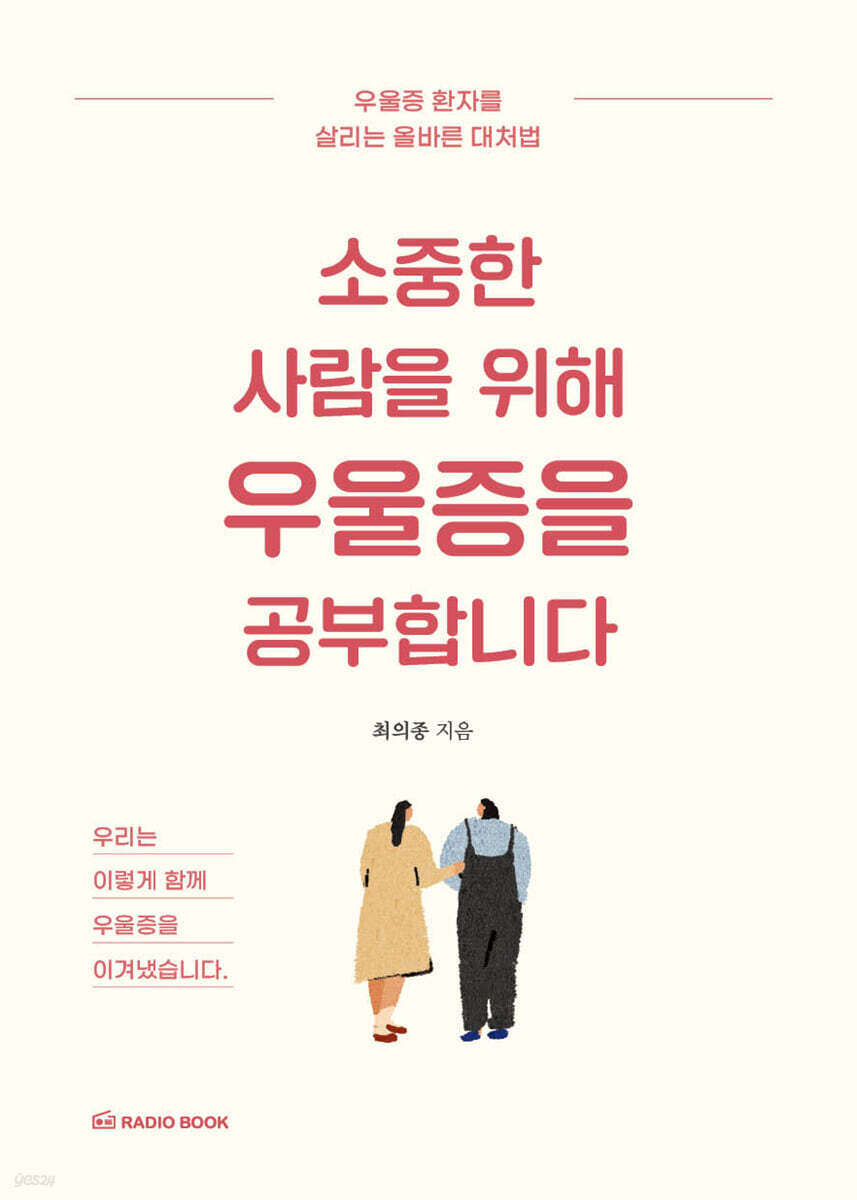
Studying Depression for the People You Love
 |
Description
Book Introduction
Are you saving a loved one from depression?
Or are you making it harder?
Depression can only be cured if you understand it properly and get the right help.
How Families Can Help Patients With Depression That You Can't Hear About in Hospitals
Depression is often called a 'cold of the mind'.
It is true that anyone can get it, but it is a mistake to think of it as a mild illness like a cold.
Patients or their families who have experienced it firsthand know that it is not just a cold.
If not dealt with properly, depression can eat away at loved ones and destroy entire relationships.
In severe cases, it can lead to extreme suicidal impulses that can lead the patient to death.
It is difficult to know why depression occurs or what causes it.
Accurate diagnosis is difficult because treatment is based solely on inaccurate statements from patients suffering from depression.
Even if the cause is known, it usually takes several months to find the right medication for the patient.
In the process, patients who struggle with every minute and second become exhausted and their symptoms worsen.
Because diagnosing and treating depression is difficult, the help of family members living with the person is absolutely necessary.
Family members who are always by the patient's side should understand depression, understand the patient's condition, and help the patient not to become immersed in depression.
This is more difficult than you think and requires a lot of effort.
We need to study depression, observe the condition of family members who are struggling with depression, and consistently improve their environment and speak and act appropriately.
To do this, a high level of understanding of depression is essential.
This book is truly unique in that it offers insights into how to properly help patients with depression from the perspective of their families, rather than the patients themselves.
It is based on the experiences of a husband who cared for his wife who had been receiving treatment for treatment-resistant severe depression for seven years.
It covers almost everything a family needs to do to supplement inadequate hospital care, rather than simply relying on hospital treatment.
Or are you making it harder?
Depression can only be cured if you understand it properly and get the right help.
How Families Can Help Patients With Depression That You Can't Hear About in Hospitals
Depression is often called a 'cold of the mind'.
It is true that anyone can get it, but it is a mistake to think of it as a mild illness like a cold.
Patients or their families who have experienced it firsthand know that it is not just a cold.
If not dealt with properly, depression can eat away at loved ones and destroy entire relationships.
In severe cases, it can lead to extreme suicidal impulses that can lead the patient to death.
It is difficult to know why depression occurs or what causes it.
Accurate diagnosis is difficult because treatment is based solely on inaccurate statements from patients suffering from depression.
Even if the cause is known, it usually takes several months to find the right medication for the patient.
In the process, patients who struggle with every minute and second become exhausted and their symptoms worsen.
Because diagnosing and treating depression is difficult, the help of family members living with the person is absolutely necessary.
Family members who are always by the patient's side should understand depression, understand the patient's condition, and help the patient not to become immersed in depression.
This is more difficult than you think and requires a lot of effort.
We need to study depression, observe the condition of family members who are struggling with depression, and consistently improve their environment and speak and act appropriately.
To do this, a high level of understanding of depression is essential.
This book is truly unique in that it offers insights into how to properly help patients with depression from the perspective of their families, rather than the patients themselves.
It is based on the experiences of a husband who cared for his wife who had been receiving treatment for treatment-resistant severe depression for seven years.
It covers almost everything a family needs to do to supplement inadequate hospital care, rather than simply relying on hospital treatment.
- You can preview some of the book's contents.
Preview
index
Recommendations - A Guide to Saving Your Precious Ones
Prologue - Navigating the Dark Path
Chapter 1: A sudden illness
- Chronic insomnia and pain
- A broken daily life
- It's not a 'cold of the mind'
Chapter 2: Even if you go to the hospital, there is no cure.
- The number of drugs increases and the hospital becomes unreliable.
- Panic and anxiety added to depression
- The desire to live
- Why are you alive?
Chapter 3: Beginning to Study Depression
- Understanding severe depression and treatment-resistant depression
- A scream encountered in the examination room
- Modern medicine also has limitations.
- Hope found in patient testimonials
Chapter 4: Managing Parents' Anxiety
Why Spouses and Families Shouldn't Worry
- Could I be depressed too?
- How to overcome despair and let go of your emotions
- Observe the day and find ways to improve
Chapter 5: Diet and Supplements for Depression
- A sick person should eat like a newborn.
- Try it first instead of your wife
- Boost your energy with vitamins B, D, and L-theanine
- Increase the proportion of protein instead of carbohydrates
Chapter 6: Hope Found Through Exercise
- Benefits and effects of exercising at home
- Amazing benefits of daily exercise
Why a home gym is better than a gym
- Creating a structure to earn money by exercising through annual memberships and long-term registrations.
Chapter 7: Improving the Environment for Patients with Depression
- Criteria for choosing the best hospital
- How to prepare for the summer heat
- Let's look at the weather forecast and see if it's going to rain.
- The battle for quality sleep
- Morning rituals to start a healthy day
- How should we teach children about depression?
How to build positive relationships with children during depression
Chapter 8: What Not to Say and Do to a Depressed Person
- Good words sound like noise
- Words that lead people to death
- How to protect yourself from extreme emotional upset
- Stress caused by bigger news than expected
- The most inappropriate remarks from medical staff
Chapter 9: Panic due to relapse after recovery
- Can I trust a doctor who recommends a pill?
- If it relapses, the disease becomes more severe.
- There is no emergency room for patients with depression.
- Don't stop taking your medication: Antidepressants are a tonic.
Chapter 10: Reviving with tDCS
A fist-sized machine saves a wife's life.
- Features and usage of home transcranial direct current stimulation (tDCS) devices
Chapter 11: Starting Healthy Consumption to Beat Depression
- Characteristics of patients with depression: extreme austerity
- You need to do leisure activities to catch your breath.
- The person who loves me the most is me
How to Reduce Money Worries for People with Depression
Chapter 12: The Preciousness of Life: What I Learned While Fighting Depression
- I'm happy if I'm not sick
- The meaning of couples and family learned through depression
- My wife's words that made my heart ache
Chapter 13: Listening to Your Wife
- What was the most difficult thing about suffering from depression?
- Have you ever had an effect on someone's spouse or family member by their words or actions?
- What method was most effective in the recovery process?
- Is there anything you would like to say to people suffering from depression and their families?
Epilogue - I'm getting happier little by little.
Prologue - Navigating the Dark Path
Chapter 1: A sudden illness
- Chronic insomnia and pain
- A broken daily life
- It's not a 'cold of the mind'
Chapter 2: Even if you go to the hospital, there is no cure.
- The number of drugs increases and the hospital becomes unreliable.
- Panic and anxiety added to depression
- The desire to live
- Why are you alive?
Chapter 3: Beginning to Study Depression
- Understanding severe depression and treatment-resistant depression
- A scream encountered in the examination room
- Modern medicine also has limitations.
- Hope found in patient testimonials
Chapter 4: Managing Parents' Anxiety
Why Spouses and Families Shouldn't Worry
- Could I be depressed too?
- How to overcome despair and let go of your emotions
- Observe the day and find ways to improve
Chapter 5: Diet and Supplements for Depression
- A sick person should eat like a newborn.
- Try it first instead of your wife
- Boost your energy with vitamins B, D, and L-theanine
- Increase the proportion of protein instead of carbohydrates
Chapter 6: Hope Found Through Exercise
- Benefits and effects of exercising at home
- Amazing benefits of daily exercise
Why a home gym is better than a gym
- Creating a structure to earn money by exercising through annual memberships and long-term registrations.
Chapter 7: Improving the Environment for Patients with Depression
- Criteria for choosing the best hospital
- How to prepare for the summer heat
- Let's look at the weather forecast and see if it's going to rain.
- The battle for quality sleep
- Morning rituals to start a healthy day
- How should we teach children about depression?
How to build positive relationships with children during depression
Chapter 8: What Not to Say and Do to a Depressed Person
- Good words sound like noise
- Words that lead people to death
- How to protect yourself from extreme emotional upset
- Stress caused by bigger news than expected
- The most inappropriate remarks from medical staff
Chapter 9: Panic due to relapse after recovery
- Can I trust a doctor who recommends a pill?
- If it relapses, the disease becomes more severe.
- There is no emergency room for patients with depression.
- Don't stop taking your medication: Antidepressants are a tonic.
Chapter 10: Reviving with tDCS
A fist-sized machine saves a wife's life.
- Features and usage of home transcranial direct current stimulation (tDCS) devices
Chapter 11: Starting Healthy Consumption to Beat Depression
- Characteristics of patients with depression: extreme austerity
- You need to do leisure activities to catch your breath.
- The person who loves me the most is me
How to Reduce Money Worries for People with Depression
Chapter 12: The Preciousness of Life: What I Learned While Fighting Depression
- I'm happy if I'm not sick
- The meaning of couples and family learned through depression
- My wife's words that made my heart ache
Chapter 13: Listening to Your Wife
- What was the most difficult thing about suffering from depression?
- Have you ever had an effect on someone's spouse or family member by their words or actions?
- What method was most effective in the recovery process?
- Is there anything you would like to say to people suffering from depression and their families?
Epilogue - I'm getting happier little by little.
Detailed image

Publisher's Review
The husband of a wife with treatment-resistant severe depression for 7 years
I learned it by studying it myself, doing it myself, and eating it myself.
Small but precious details that save lives of people with depression!
The desire to help a loved one suffering from depression, and to do whatever it takes, is common to all families of patients.
However, even if we have the will, there are many cases where we are unable to provide the crucial help that is needed by our loved ones, or perhaps even save our families, because we do not know how or because the circumstances are not right.
Sometimes, they get tired of the long treatment and give up.
In any case, it is not a good thing for a patient who is desperate for appropriate help.
The author, who has been with his wife for seven years in treatment for treatment-resistant severe depression, is remarkable in that he studied depression himself, tried various nutritional supplements and foods, learned exercise methods himself, and developed a diet that is good for people with depression and can be easily prepared every day.
I created the details necessary for guardians of patients with depression, such as setting my own standards for selecting good hospitals and medical staff while attending to my wife's treatment.
Beyond reading hundreds of books on depression on the market, the author also researched overseas papers and research materials for doctors to deepen his understanding of the subject.
I learned several exercises in advance and taught them to my wife to help her treat her depression through exercise.
By attending all possible medical appointments together, we prevented inappropriate medical staff comments and actions, and accurately relayed the patient's condition to the medical staff, enabling them to receive an appropriate diagnosis.
We developed a customized diet plan that is healthy for patients with depression and easy to prepare every day, and provided various ideas to help patients consume healthily.
Additionally, tremendous effort was made to protect the patient from the words and actions of those around him.
Not only for the patient, but also for the extended treatment process, I thought about how to keep myself motivated so as not to get tired, and I also found solutions for raising children so that the mother's depression would not have a negative impact on the children.
Not all efforts yield immediate results.
I went through a lot of trial and error due to the sudden onset of depression, and had to overcome several major crises, to the point of going to the emergency room several times.
After a seemingly cured diagnosis, the patient relapsed and the situation worsened, and the patient suffered further with serious suicidal impulses.
However, the author never gave up hope that things could get better, and as a result of all these efforts, the author's wife has overcome severe depression and is now back to her normal life.
The author says that depression is almost impossible to treat without the help of the family living with the patient.
He confessed that he was frustrated because even after staying up all night for several days to study depression, he only found information on treating patients and was unable to obtain information on how to help families care for patients.
There is no systematic guide for family members on how to view and understand depression, how to speak and act with the patient, and how to cope with various situations.
The author detailed and specified the efforts that those present could make while treating patients, recorded and analyzed the results, and found his own solution.
Rather than simply suggesting a hasty formula that says, "If you do this, depression will be cured," we share the criteria for judging a patient's condition and the empirical wisdom for correctly analyzing and approaching the situation.
This will allow readers to apply the author's experience to the condition of the patient they are caring for, significantly reducing trial and error in the treatment process.
For families struggling with sudden onset depression, the author's experience and advice will be crucial in saving the life of a loved one.
I hope you find in this book a way to save your loved one from depression as soon as possible.
I learned it by studying it myself, doing it myself, and eating it myself.
Small but precious details that save lives of people with depression!
The desire to help a loved one suffering from depression, and to do whatever it takes, is common to all families of patients.
However, even if we have the will, there are many cases where we are unable to provide the crucial help that is needed by our loved ones, or perhaps even save our families, because we do not know how or because the circumstances are not right.
Sometimes, they get tired of the long treatment and give up.
In any case, it is not a good thing for a patient who is desperate for appropriate help.
The author, who has been with his wife for seven years in treatment for treatment-resistant severe depression, is remarkable in that he studied depression himself, tried various nutritional supplements and foods, learned exercise methods himself, and developed a diet that is good for people with depression and can be easily prepared every day.
I created the details necessary for guardians of patients with depression, such as setting my own standards for selecting good hospitals and medical staff while attending to my wife's treatment.
Beyond reading hundreds of books on depression on the market, the author also researched overseas papers and research materials for doctors to deepen his understanding of the subject.
I learned several exercises in advance and taught them to my wife to help her treat her depression through exercise.
By attending all possible medical appointments together, we prevented inappropriate medical staff comments and actions, and accurately relayed the patient's condition to the medical staff, enabling them to receive an appropriate diagnosis.
We developed a customized diet plan that is healthy for patients with depression and easy to prepare every day, and provided various ideas to help patients consume healthily.
Additionally, tremendous effort was made to protect the patient from the words and actions of those around him.
Not only for the patient, but also for the extended treatment process, I thought about how to keep myself motivated so as not to get tired, and I also found solutions for raising children so that the mother's depression would not have a negative impact on the children.
Not all efforts yield immediate results.
I went through a lot of trial and error due to the sudden onset of depression, and had to overcome several major crises, to the point of going to the emergency room several times.
After a seemingly cured diagnosis, the patient relapsed and the situation worsened, and the patient suffered further with serious suicidal impulses.
However, the author never gave up hope that things could get better, and as a result of all these efforts, the author's wife has overcome severe depression and is now back to her normal life.
The author says that depression is almost impossible to treat without the help of the family living with the patient.
He confessed that he was frustrated because even after staying up all night for several days to study depression, he only found information on treating patients and was unable to obtain information on how to help families care for patients.
There is no systematic guide for family members on how to view and understand depression, how to speak and act with the patient, and how to cope with various situations.
The author detailed and specified the efforts that those present could make while treating patients, recorded and analyzed the results, and found his own solution.
Rather than simply suggesting a hasty formula that says, "If you do this, depression will be cured," we share the criteria for judging a patient's condition and the empirical wisdom for correctly analyzing and approaching the situation.
This will allow readers to apply the author's experience to the condition of the patient they are caring for, significantly reducing trial and error in the treatment process.
For families struggling with sudden onset depression, the author's experience and advice will be crucial in saving the life of a loved one.
I hope you find in this book a way to save your loved one from depression as soon as possible.
GOODS SPECIFICS
- Date of issue: January 10, 2024
- Format: Paperback book binding method guide
- Page count, weight, size: 306 pages | 150*210*15mm
- ISBN13: 9791190836890
- ISBN10: 1190836890
You may also like
카테고리
korean


korean

![GQ KOREA Mark (Monthly): December [2025]](http://librairie.coreenne.fr/cdn/shop/files/8ef265dbbfbf186523ed75ba7319009d.jpg?v=1765340328&width=3840)


