

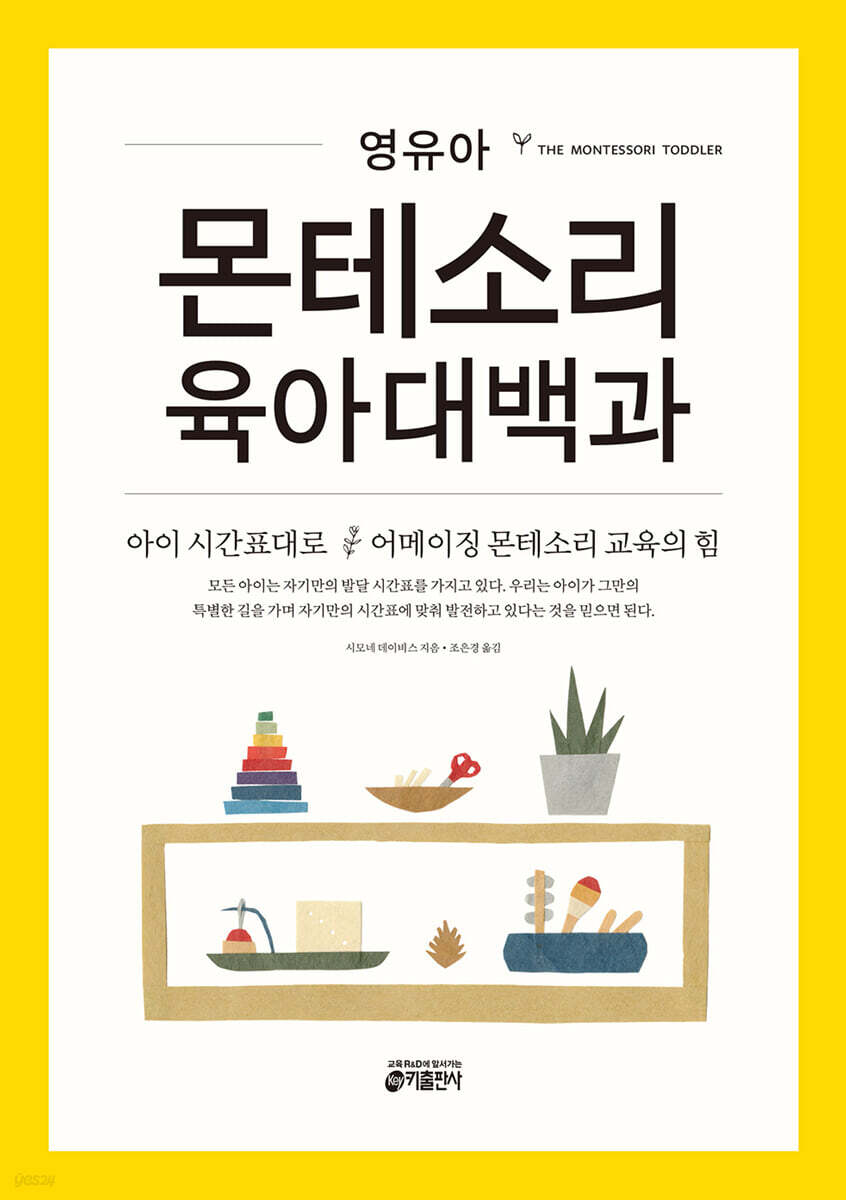
Montessori Encyclopedia of Parenting for Infants and Toddlers
 |
Description
Book Introduction
The Power of Amazing Montessori Education on Your Child's Schedule
“Every child has his or her own developmental timetable.”
Simone Davis, a teacher with the Association Montessori Internationale (AMI), uses the educational principles developed by Dr. Montessori to offer life-changing ways to make life with young children a rewarding and enriching experience for both children and parents, a time for learning that satisfies curiosity, and a time that respects the child.
This book presents practical ideas and shows you how to apply them in every aspect of life with young children.
“Every child has his or her own developmental timetable.”
Simone Davis, a teacher with the Association Montessori Internationale (AMI), uses the educational principles developed by Dr. Montessori to offer life-changing ways to make life with young children a rewarding and enriching experience for both children and parents, a time for learning that satisfies curiosity, and a time that respects the child.
This book presents practical ideas and shows you how to apply them in every aspect of life with young children.
- You can preview some of the book's contents.
Preview
index
CHAPTER 1.
Daily life with toddlers
Let's change our perspective on infants.
Why I Love Toddlers
What we need to know about infants
Montessori's child-rearing method
How to Use This Book
CHAPTER 2.
Introduction to Montessori
A Brief History of Montessori
Traditional Education vs. Montessori Education
Some Montessori principles
CHAPTER 3.
Montessori activities for the holistic development of children
Montessori Activities for Toddlers
Elements of Montessori Activities
How to Show Activities to Your Child
General principles to remember
How to prepare for the activity
Type of activity
- Hand-eye coordination
- Music and movement
- Real-life activities
- Art and Making
- language
How to do Montessori activities outdoors or in nature
Which of these is not a Montessori toy?
CHAPTER 4.
Interior design of a house with a child
Decorating your space in Montessori style
Settings by space
- Entrance
- living room
- Kitchen
- Dining area
- Bedroom
- Bathroom
- Art and Craft Space
- A comfortable space to read books
- Outdoor
How to Create a Home You Want to Stay in
- Dealing with clutter
- Create a comfortable atmosphere
- Creating a home that reduces work
- Shared space
- small space
The importance of home environment
home visits
CHAPTER 5.
Raising a curious child who receives ample attention
PART 1.
Fostering a child's curiosity
5 Factors That Cultivate Curiosity
- Trust in children
- Rich learning environment
- hour
- A safe and secure place
- An environment that fosters imagination
7 Principles for Raising Curious Children
- Let the child take the lead
- It takes the form of hands-on learning.
- Get your child involved in real life
- Don't rush
- Give your child the opportunity to do things on his own.
- It fosters creativity
- Observe
PART 2.
Accepting children as they are
Help your child feel a sense of presence, belonging, and acceptance.
Become a child's interpreter
Emotions allow for any expression, but do not permit any action.
Give your child feedback instead of praise
Roles and Labels
CHAPTER 6.
Raising cooperative and responsible children
PART 1.
Fostering cooperation
Why the Montessori Approach Doesn't Threaten, Reward, or Punish Children
Solving Problems That Arose When Working with Toddlers
How to get your child involved
How to Talk to Your Child to Help Them
Managing Expectations
small bonus
PART 2.
Setting limits
It's okay to set limits
Set clear limits
Maintain a firm yet affectionate posture
Acknowledge negative feelings
Resolve annoying situations
Once the child has calmed down, contact is made again.
Helps correct mistakes
Useful tips for setting limits
Things to check when setting limits
CHAPTER 7.
Practical Parenting
PART 1.
Care in daily life
The rhythm of daily life
Special ceremony
Getting dressed and going out
eating
Sleep
Brushing teeth
PART 2.
Dealing with change
Use the toilet
Weaning off pacifiers
siblings
PART 3.
Useful skills for toddlers to learn
divide
Learning how to engage with adults
Skills for Introverted Toddlers
Hitting, biting, pushing, throwing objects
Developing concentration
Dealing with Discontent
When a child clings and becomes clingy
Time spent using video devices
bilingual
CHAPTER 8.
Prescription for Parents
Preparing to Become a Parent
Taking care of your body
Have a learning mindset
Start and end your day calmly
Stay in the present
Observe
Filling the emotional tanks of parents and children
Take it slow
Become a guide for your child
Make the most of your home
Be honest
Taking responsibility for your life and choices
Learning from mistakes
Feeling full of emotions
Take care of yourself
Keep practicing
CHAPTER 9.
co-parenting
What about other people?
Parents are people too
One-parent preference phenomenon
The Secret to Working with Family
Understand each other's different positions
Grandparents and child caregivers
When conflict arises between family members
There's no reason divorce should be a dirty word.
CHAPTER 1 0.
After infancy
Preparation for school (kindergarten, school)
Until becoming an adult
A Moment When Education Needs Change
Time of Peace
Montessori Case Studies: Visiting Homes Around the World & What Families Who Practicing Montessori Have to Say
Australia: How We Do Montessori
Mongolia: Mininimu
Canada: Our Montessori Life
Montessori in the Midwest
My family: Australian and Dutch
My Classroom: Jacaranda Tree Montessori
References
Acknowledgements
supplement
Instead of saying it like this, let's say it like this
Where can I find Montessori materials and furniture?
About Montessori Schools
- What to look for in a Montessori school
- A typical day at a Montessori school
- Is the Montessori method suitable for all children?
- How will a child who receives Montessori education change when he or she moves on to a regular school?
Emotions and desires
How to make clay
List of Montessori Activities for Toddlers
Daily life with toddlers
Let's change our perspective on infants.
Why I Love Toddlers
What we need to know about infants
Montessori's child-rearing method
How to Use This Book
CHAPTER 2.
Introduction to Montessori
A Brief History of Montessori
Traditional Education vs. Montessori Education
Some Montessori principles
CHAPTER 3.
Montessori activities for the holistic development of children
Montessori Activities for Toddlers
Elements of Montessori Activities
How to Show Activities to Your Child
General principles to remember
How to prepare for the activity
Type of activity
- Hand-eye coordination
- Music and movement
- Real-life activities
- Art and Making
- language
How to do Montessori activities outdoors or in nature
Which of these is not a Montessori toy?
CHAPTER 4.
Interior design of a house with a child
Decorating your space in Montessori style
Settings by space
- Entrance
- living room
- Kitchen
- Dining area
- Bedroom
- Bathroom
- Art and Craft Space
- A comfortable space to read books
- Outdoor
How to Create a Home You Want to Stay in
- Dealing with clutter
- Create a comfortable atmosphere
- Creating a home that reduces work
- Shared space
- small space
The importance of home environment
home visits
CHAPTER 5.
Raising a curious child who receives ample attention
PART 1.
Fostering a child's curiosity
5 Factors That Cultivate Curiosity
- Trust in children
- Rich learning environment
- hour
- A safe and secure place
- An environment that fosters imagination
7 Principles for Raising Curious Children
- Let the child take the lead
- It takes the form of hands-on learning.
- Get your child involved in real life
- Don't rush
- Give your child the opportunity to do things on his own.
- It fosters creativity
- Observe
PART 2.
Accepting children as they are
Help your child feel a sense of presence, belonging, and acceptance.
Become a child's interpreter
Emotions allow for any expression, but do not permit any action.
Give your child feedback instead of praise
Roles and Labels
CHAPTER 6.
Raising cooperative and responsible children
PART 1.
Fostering cooperation
Why the Montessori Approach Doesn't Threaten, Reward, or Punish Children
Solving Problems That Arose When Working with Toddlers
How to get your child involved
How to Talk to Your Child to Help Them
Managing Expectations
small bonus
PART 2.
Setting limits
It's okay to set limits
Set clear limits
Maintain a firm yet affectionate posture
Acknowledge negative feelings
Resolve annoying situations
Once the child has calmed down, contact is made again.
Helps correct mistakes
Useful tips for setting limits
Things to check when setting limits
CHAPTER 7.
Practical Parenting
PART 1.
Care in daily life
The rhythm of daily life
Special ceremony
Getting dressed and going out
eating
Sleep
Brushing teeth
PART 2.
Dealing with change
Use the toilet
Weaning off pacifiers
siblings
PART 3.
Useful skills for toddlers to learn
divide
Learning how to engage with adults
Skills for Introverted Toddlers
Hitting, biting, pushing, throwing objects
Developing concentration
Dealing with Discontent
When a child clings and becomes clingy
Time spent using video devices
bilingual
CHAPTER 8.
Prescription for Parents
Preparing to Become a Parent
Taking care of your body
Have a learning mindset
Start and end your day calmly
Stay in the present
Observe
Filling the emotional tanks of parents and children
Take it slow
Become a guide for your child
Make the most of your home
Be honest
Taking responsibility for your life and choices
Learning from mistakes
Feeling full of emotions
Take care of yourself
Keep practicing
CHAPTER 9.
co-parenting
What about other people?
Parents are people too
One-parent preference phenomenon
The Secret to Working with Family
Understand each other's different positions
Grandparents and child caregivers
When conflict arises between family members
There's no reason divorce should be a dirty word.
CHAPTER 1 0.
After infancy
Preparation for school (kindergarten, school)
Until becoming an adult
A Moment When Education Needs Change
Time of Peace
Montessori Case Studies: Visiting Homes Around the World & What Families Who Practicing Montessori Have to Say
Australia: How We Do Montessori
Mongolia: Mininimu
Canada: Our Montessori Life
Montessori in the Midwest
My family: Australian and Dutch
My Classroom: Jacaranda Tree Montessori
References
Acknowledgements
supplement
Instead of saying it like this, let's say it like this
Where can I find Montessori materials and furniture?
About Montessori Schools
- What to look for in a Montessori school
- A typical day at a Montessori school
- Is the Montessori method suitable for all children?
- How will a child who receives Montessori education change when he or she moves on to a regular school?
Emotions and desires
How to make clay
List of Montessori Activities for Toddlers
Detailed image

Into the book
Every child has his or her own developmental timetable.
Montessori not only respects each child's individual schedule, but also recognizes and respects that each child has different energy levels and abilities to focus on different things.
--- p.32
Children instinctively know what they need to do to develop.
This means that if you provide your child with a rich environment to explore, you don't have to force them to learn and you don't have to worry if they develop differently from other children their age.
We must trust that each child is developing on his or her own unique path, in his or her own way, and on his or her own timetable.
--- p.104
Montessori education teaches children how to develop independence.
It's not about teaching independence so that children can grow up as quickly as possible (children should be children), it's about doing it because children like it.
Children want to be able to do more.
They want to be part of and contribute to their family, class, and society.
Through independence, children learn to take responsible care of themselves, others, and the environment.
--- p.31
Through observation, we learn to watch our children develop in their own way.
It can help children follow their interests and maintain their curiosity about the world around them.
Instead of stifling your child's curiosity and creativity, you learn to wait for opportunities before intervening, and when to calmly intervene to keep them safe.
--- p.32
After several years, I came to realize that Montessori is truly a way of life.
Montessori talks about stimulating a child's curiosity, not criticizing, and seeing and accepting the child as he or she is.
It teaches you how to connect with your child even in situations where you need to control them from doing something they really want to do.
Montessori not only respects each child's individual schedule, but also recognizes and respects that each child has different energy levels and abilities to focus on different things.
--- p.32
Children instinctively know what they need to do to develop.
This means that if you provide your child with a rich environment to explore, you don't have to force them to learn and you don't have to worry if they develop differently from other children their age.
We must trust that each child is developing on his or her own unique path, in his or her own way, and on his or her own timetable.
--- p.104
Montessori education teaches children how to develop independence.
It's not about teaching independence so that children can grow up as quickly as possible (children should be children), it's about doing it because children like it.
Children want to be able to do more.
They want to be part of and contribute to their family, class, and society.
Through independence, children learn to take responsible care of themselves, others, and the environment.
--- p.31
Through observation, we learn to watch our children develop in their own way.
It can help children follow their interests and maintain their curiosity about the world around them.
Instead of stifling your child's curiosity and creativity, you learn to wait for opportunities before intervening, and when to calmly intervene to keep them safe.
--- p.32
After several years, I came to realize that Montessori is truly a way of life.
Montessori talks about stimulating a child's curiosity, not criticizing, and seeing and accepting the child as he or she is.
It teaches you how to connect with your child even in situations where you need to control them from doing something they really want to do.
--- p.20
Publisher's Review
Google founders Larry Page and Sergey Brin
“Montessori education was behind Amazon CEO Jeff Bezos.”
Dr. Montessori developed a holistic educational method based on her observations of young children over many years.
It is a teaching method that helps children learn in a natural way, rather than the traditional way of teaching or the discipline method of tired parents.
The author, a skilled Montessori teacher, has reinterpreted Dr. Montessori's educational methodology into an easy-to-understand parenting program.
“Please let me do it myself.”
Montessori education teaches children how to develop independence.
This book introduces how to set up a Montessori space, including arranging furniture at a child's eye level, keeping all tools for an activity in one place, and adhering to the principle of "less is more."
There are also sections that discuss ways to elicit cooperation from children and set limits.
It contains methods for gradually applying the Montessori method to daily life, such as eating, sleeping, brushing teeth, toilet training, relationships with siblings, and weaning from pacifiers.
You can also explore fun Montessori techniques, such as how to turn a winter coat inside out.
“I think Montessori can become a way of life.
“That’s cool.”
A parenting guide on how to raise curious and responsible children!
It teaches parents how to handle situations when their children are throwing tantrums or causing trouble without threatening or punishing them.
We talk about how to be a parent who encourages your child's cooperation, knows how to set appropriate limits, and guides them, celebrating and rejoicing in every step they take.
The book has a bright, clean design and is filled with colorful illustrations and photographs.
We will give you the value of a truly emotionally moving Montessori classroom.
“Montessori education was behind Amazon CEO Jeff Bezos.”
Dr. Montessori developed a holistic educational method based on her observations of young children over many years.
It is a teaching method that helps children learn in a natural way, rather than the traditional way of teaching or the discipline method of tired parents.
The author, a skilled Montessori teacher, has reinterpreted Dr. Montessori's educational methodology into an easy-to-understand parenting program.
“Please let me do it myself.”
Montessori education teaches children how to develop independence.
This book introduces how to set up a Montessori space, including arranging furniture at a child's eye level, keeping all tools for an activity in one place, and adhering to the principle of "less is more."
There are also sections that discuss ways to elicit cooperation from children and set limits.
It contains methods for gradually applying the Montessori method to daily life, such as eating, sleeping, brushing teeth, toilet training, relationships with siblings, and weaning from pacifiers.
You can also explore fun Montessori techniques, such as how to turn a winter coat inside out.
“I think Montessori can become a way of life.
“That’s cool.”
A parenting guide on how to raise curious and responsible children!
It teaches parents how to handle situations when their children are throwing tantrums or causing trouble without threatening or punishing them.
We talk about how to be a parent who encourages your child's cooperation, knows how to set appropriate limits, and guides them, celebrating and rejoicing in every step they take.
The book has a bright, clean design and is filled with colorful illustrations and photographs.
We will give you the value of a truly emotionally moving Montessori classroom.
GOODS SPECIFICS
- Date of issue: November 22, 2024
- Page count, weight, size: 276 pages | 168*238*20mm
- ISBN13: 9791165269562
- ISBN10: 1165269562
You may also like
카테고리
korean


korean

![ELLE 엘르 스페셜 에디션 A형 : 12월 [2025]](http://librairie.coreenne.fr/cdn/shop/files/b8e27a3de6c9538896439686c6b0e8fb.jpg?v=1766436872&width=3840)


