

Shoe dog
 |
Description
Book Introduction
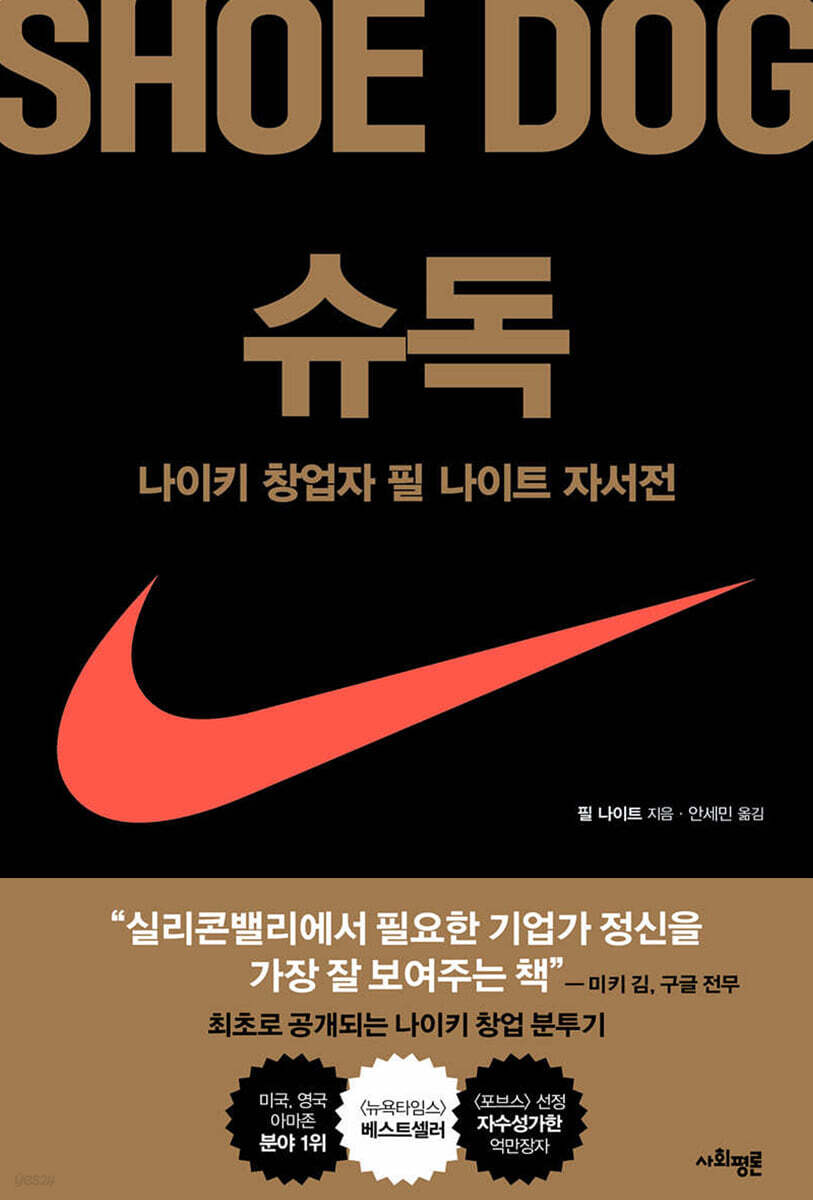
Nike's Founding Struggles Revealed for the First Time * There were no concrete plans, no proper offices, no rosy prospects. The autobiography of Shoe Dog Phil Knight, who built Nike with a borrowed $50 and reckless persistence. * #1 on Amazon in the US and UK, [New York Times] bestseller for 21 consecutive weeks * [Forbes] Self-Made Billionaires There is no one who does not know Nike, the brand that has captured the hearts of people around the world with its logo Swoosh, which symbolizes victory, 'Just Do It'. But little is known about Nike's founding story, which began with just $50, and the reclusive CEO behind it, Phil Knight. 『Shoe Dog』, a slang term for a "shoe research enthusiast," is the first autobiography and a history book of Nike, which tells the story of Phil Knight, a 24-year-old young man who, with nothing but reckless passion and perseverance, turned a small business importing and selling Japanese sneakers into the global brand Nike. In this book, he honestly and meticulously recounts how Nike, a latecomer to the sporting goods industry dominated by Adidas and Puma, became the industry leader, the process of its founding and innovation, and the stories of the "shoe-crazy nerds" who helped make Nike what it is today. |
- You can preview some of the book's contents.
Preview
index
Dawn
Part 1
1962, a crazy idea
1963, can it be successful?
Selling shoes from a car in 1964
1965, the equity dilemma
1966, War with the Marlboro Man
1967, Shoe-crazy nerds
1968, my partner, Pax Knight
1969, Living as a CEO
1970, I need cash, cash, cash
1971, the bankruptcy crisis, and the birth of Nike
1972: "Let's compete with our own methods, ideas, and brands."
1973, Prefontaine Spirit: Run like there's no tomorrow
1974, parting ways with Onitsuka
1975, a life of turning back
Part 2
In 1975, you should be remembered as a rule-breaker.
1976, Buttface: How Nike Solves Problems
1977, Air Cushion, Sports Star, US Retail Price
1978, rapid growth and ups and downs
1979: Internal Enemies and Opportunities in China
1980, there is no finish line
At sunset
Acknowledgements
Translator's Note
Part 1
1962, a crazy idea
1963, can it be successful?
Selling shoes from a car in 1964
1965, the equity dilemma
1966, War with the Marlboro Man
1967, Shoe-crazy nerds
1968, my partner, Pax Knight
1969, Living as a CEO
1970, I need cash, cash, cash
1971, the bankruptcy crisis, and the birth of Nike
1972: "Let's compete with our own methods, ideas, and brands."
1973, Prefontaine Spirit: Run like there's no tomorrow
1974, parting ways with Onitsuka
1975, a life of turning back
Part 2
In 1975, you should be remembered as a rule-breaker.
1976, Buttface: How Nike Solves Problems
1977, Air Cushion, Sports Star, US Retail Price
1978, rapid growth and ups and downs
1979: Internal Enemies and Opportunities in China
1980, there is no finish line
At sunset
Acknowledgements
Translator's Note
Into the book
On that morning in 1962, I declared to myself:
“Don’t worry if people in the world say you’re crazy.
It keeps going without stopping.
Don't even think about stopping until you get there.
And let's not even think too deeply about where that is.
“No matter what happens, let’s not stop.” --- p.11
The art of competition is the art of forgetting.
I learned this fact through track and field.
We must forget our limitations.
We must shake off the doubts we have harbored.
We must forget our pain and our past.
We must ignore the inner cry, the plea, “Enough is enough.”
If we cannot forget, shake off, or ignore these things, we will have to compromise with the world.
During track and field competitions, when what my mind wants and what my body wants don't align, I tell my body this:
'Yeah, that's a really good idea.
But let's keep running anyway.' --- p.95
When you run on the track, you become passionate about numbers.
Because the numbers you write down say everything about you.
There are many reasons for poor performance, including injury, fatigue, and disappointment.
But no one cares about this.
People ultimately only remember the numbers you write down.
I lived in this reality.
--- p.125
President Onitsuka told Coach Bowerman that the inspiration for Tiger's unique sole came to him while eating sushi.
He looked at a large wooden plate and an octopus leg and wondered what would happen if similar suction cups were applied to the soles of shoes worn by runners.
Coach Bowerman learned that inspiration can come from the commonplace.
Inspiration can come from what we eat or from what we have lying around the house.
--- p.131
I went to Pricewaterhouse six days a week and worked at Blue Ribbon early in the morning, late at night, on weekends, and on vacation.
I didn't meet any friends, I didn't exercise, I didn't socialize at all. I was completely content with this lifestyle.
My life was definitely not balanced.
But I didn't care at all.
I wanted a much more extreme imbalance.
I wanted to focus solely on my business and not do anything else.
--- p.174
“We will no longer sell other companies’ brands.
Now we have to face the situation.
We need to have our own way, our own ideas, our own brand to be successful.
We had $2 million in sales last year.
It would not be an exaggeration to say that Onitsuka had no contribution to these achievements.
This is a result of our creativity and hard work.
I see today's work as a liberation, not a crisis.
Let us consider today as the day of our independence.” --- p.301
I've also wondered if the secret to Prefontaine's success in capturing the public's heart lies in his passion.
He literally gave his all and crossed the finish line.
In order to get first place, I was not afraid even of death.
This can sometimes be an unproductive strategy, foolish, or even suicidal.
But the audience was excited to see this.
Whether it's sports or human behavior, truly giving your best wins people's hearts.
--- p.305
We (Nike) are people who cannot tolerate unconventional companies.
We are people who enjoy our work.
What we do must have meaning.
We are trying to catch Goliath.
We are trying to create a culture, not just a brand.
We reject obedience, banality, and monotony.
We are trying to sell not only the product, but also the idea, the spirit.
--- p.360
Don't let the fear of failure paralyze you.
I'm not saying this because I think we won't fail.
Anyone can fail.
When you fail, it is important to quickly shake it off, get back up, learn from your failures, and grow.
--- p.364
Some people believe that the purpose of business is to pursue profit.
However, we believe that just as the purpose of human life is not only to make blood, the purpose of business is not only to make money.
--- p.503
Business is sometimes called war without bullets, and in fact, business is a great defense against war.
Trade is the path to coexistence and cooperation.
Peace feeds on prosperity.
This is precisely why, even though I was still haunted by the Vietnam War, I vowed to one day establish a Nike factory in or near Saigon.
--- p.534
I want to tell young people to take a moment to pause and think deeply about how they want to spend the next 40 years and who they want to spend it with.
I would like to advise young people in their mid-20s not to settle for a job.
Find your calling.
Even if you don't know what it is, keep trying to find it.
When you find your calling, you can endure hardships and quickly shake off discouragement.
When you achieve success, you will feel a completely different feeling than you have ever felt before.
--- p.544
Some people say that entrepreneurs should never give up.
In a word, they are scammers.
Entrepreneurs must know how to give up sometimes.
Sometimes it takes wisdom to know when to give up and when to pursue something else.
Giving up doesn't mean stopping.
An entrepreneur should never stop.
--- p.545
Luck also plays a big role in success.
Yes, that's right.
I openly acknowledge the power of luck.
Athletes, poets, and entrepreneurs need luck.
It's important to work hard, meet good people and build a great team, be smart, and be decisive.
But luck can also determine the outcome.
Some people do not call it luck, but the Way, Logos, Jnana, Dharma, spirit, God.
In other words, the harder you work, the better your Tao becomes.
Since no one has defined this Tao precisely, I now try to cultivate it regularly.
I want to tell people this.
Have faith in yourself.
Have faith in this belief too.
Faith should be defined by you, not by others.
Belief itself is defined in your mind.
“Don’t worry if people in the world say you’re crazy.
It keeps going without stopping.
Don't even think about stopping until you get there.
And let's not even think too deeply about where that is.
“No matter what happens, let’s not stop.” --- p.11
The art of competition is the art of forgetting.
I learned this fact through track and field.
We must forget our limitations.
We must shake off the doubts we have harbored.
We must forget our pain and our past.
We must ignore the inner cry, the plea, “Enough is enough.”
If we cannot forget, shake off, or ignore these things, we will have to compromise with the world.
During track and field competitions, when what my mind wants and what my body wants don't align, I tell my body this:
'Yeah, that's a really good idea.
But let's keep running anyway.' --- p.95
When you run on the track, you become passionate about numbers.
Because the numbers you write down say everything about you.
There are many reasons for poor performance, including injury, fatigue, and disappointment.
But no one cares about this.
People ultimately only remember the numbers you write down.
I lived in this reality.
--- p.125
President Onitsuka told Coach Bowerman that the inspiration for Tiger's unique sole came to him while eating sushi.
He looked at a large wooden plate and an octopus leg and wondered what would happen if similar suction cups were applied to the soles of shoes worn by runners.
Coach Bowerman learned that inspiration can come from the commonplace.
Inspiration can come from what we eat or from what we have lying around the house.
--- p.131
I went to Pricewaterhouse six days a week and worked at Blue Ribbon early in the morning, late at night, on weekends, and on vacation.
I didn't meet any friends, I didn't exercise, I didn't socialize at all. I was completely content with this lifestyle.
My life was definitely not balanced.
But I didn't care at all.
I wanted a much more extreme imbalance.
I wanted to focus solely on my business and not do anything else.
--- p.174
“We will no longer sell other companies’ brands.
Now we have to face the situation.
We need to have our own way, our own ideas, our own brand to be successful.
We had $2 million in sales last year.
It would not be an exaggeration to say that Onitsuka had no contribution to these achievements.
This is a result of our creativity and hard work.
I see today's work as a liberation, not a crisis.
Let us consider today as the day of our independence.” --- p.301
I've also wondered if the secret to Prefontaine's success in capturing the public's heart lies in his passion.
He literally gave his all and crossed the finish line.
In order to get first place, I was not afraid even of death.
This can sometimes be an unproductive strategy, foolish, or even suicidal.
But the audience was excited to see this.
Whether it's sports or human behavior, truly giving your best wins people's hearts.
--- p.305
We (Nike) are people who cannot tolerate unconventional companies.
We are people who enjoy our work.
What we do must have meaning.
We are trying to catch Goliath.
We are trying to create a culture, not just a brand.
We reject obedience, banality, and monotony.
We are trying to sell not only the product, but also the idea, the spirit.
--- p.360
Don't let the fear of failure paralyze you.
I'm not saying this because I think we won't fail.
Anyone can fail.
When you fail, it is important to quickly shake it off, get back up, learn from your failures, and grow.
--- p.364
Some people believe that the purpose of business is to pursue profit.
However, we believe that just as the purpose of human life is not only to make blood, the purpose of business is not only to make money.
--- p.503
Business is sometimes called war without bullets, and in fact, business is a great defense against war.
Trade is the path to coexistence and cooperation.
Peace feeds on prosperity.
This is precisely why, even though I was still haunted by the Vietnam War, I vowed to one day establish a Nike factory in or near Saigon.
--- p.534
I want to tell young people to take a moment to pause and think deeply about how they want to spend the next 40 years and who they want to spend it with.
I would like to advise young people in their mid-20s not to settle for a job.
Find your calling.
Even if you don't know what it is, keep trying to find it.
When you find your calling, you can endure hardships and quickly shake off discouragement.
When you achieve success, you will feel a completely different feeling than you have ever felt before.
--- p.544
Some people say that entrepreneurs should never give up.
In a word, they are scammers.
Entrepreneurs must know how to give up sometimes.
Sometimes it takes wisdom to know when to give up and when to pursue something else.
Giving up doesn't mean stopping.
An entrepreneur should never stop.
--- p.545
Luck also plays a big role in success.
Yes, that's right.
I openly acknowledge the power of luck.
Athletes, poets, and entrepreneurs need luck.
It's important to work hard, meet good people and build a great team, be smart, and be decisive.
But luck can also determine the outcome.
Some people do not call it luck, but the Way, Logos, Jnana, Dharma, spirit, God.
In other words, the harder you work, the better your Tao becomes.
Since no one has defined this Tao precisely, I now try to cultivate it regularly.
I want to tell people this.
Have faith in yourself.
Have faith in this belief too.
Faith should be defined by you, not by others.
Belief itself is defined in your mind.
--- p.545
Publisher's Review
A shoe salesman started with just $50 and a car.
How did Nike become the world's best brand?
Nike founder Phil Knight wanted to be a great athlete, but he was just an average runner who had to watch the backs of top athletes.
Eventually, he gave up on the path of athletics and went on to Stanford Graduate School of Business.
All he had was an interest in sneakers he had acquired as a player and a vague hope of starting his own business.
Like any other 20-something, he was filled with self-distrust and anxiety about the future. In 1962, he set out on a backpacking trip and made this promise to himself.
“Don’t worry if people in the world say you’re crazy.
It keeps going without stopping.
Don't even think about stopping until you get there.
And let's not even think too deeply about where that is.
“No matter what happens, let’s not stop.”
While backpacking, he randomly visits the Japanese sneaker company Onitsuka (now Asics) and persuades them to give him the US sales rights, using a company name that doesn't even exist.
Onitsuka, which was preparing to enter the American market, gave him exclusive sales rights in the western region of the United States.
In 1963, after returning to the United States, he started a business called Blue Ribbon (the predecessor of Nike) in the basement of his father's house.
It was called a business, but all it sold were 300 pairs of shoes imported with borrowed money.
When even the sneakers he imported were refused sale at sporting goods stores, he loaded them into his car and went to track and field competitions to sell them.
Despite his father's objections, who said, "Do you think I sent you to college to sell shoes like this?", he devoted himself to running the business, investing even his salary from the accounting firm he worked at to make a living.
However, after starting his own business, he struggled to the point where he could not even take a single penny of his salary for six years.
Phil Knight, along with his fiery partner Bill Bowerman, passionate about developing sneakers; Jeff Johnson, a fan of sneakers and running; and Bob Woodell, a promising track and field athlete who became paralyzed from the waist down in an accident, actively expanded his business with the idea that "where people pass by is my store."
Finally, Blue Ribbon stands out in the sporting goods industry, which was dominated by Adidas and Puma, by doubling its sales every year.
However, even at this time, Knight suffers from a neurotic facial disorder while trying to secure loans from banks hostile to Blue Ribbon to finance his insufficient business.
Launched its own brand, Nike, in 1971.
The Nike launch was also an inevitable choice when Onitsuka refused to supply shoes anymore.
Afterwards, the company rose to become the industry leader by changing the market paradigm through aggressive marketing using sports stars and product innovations such as waffle soles and air cushions.
In 1976, the company name was changed to Nike.
Nike, which had sales of only $8,000 in its first year of business, has now grown into a company with annual sales of $30 billion.
Nike's logo, the swoosh, has become one of the few icons that people around the world instantly recognize.
The praise poured in for this book
A touching and enjoyable adventure book.
Yet it offers surprising insights into innovation and creativity.
The author tells us all about Nike's revolution through his story of begging for a loan from a bank that refused to support him, gathering together a group of eccentric, yet exceptionally talented individuals who were ostracized by society, and working with them to create a unique company that broke convention.
It's a very inspiring book.
- Michael Spence, Nobel Prize winner in economics
Shoe Dog is a story of great people, filled with the fate, courage, know-how, and magic of a few eccentric individuals who came together to create Nike.
In a country that both praises free enterprise and stifles it, what Nike has accomplished is nothing short of miraculous.
Phil Knight taught us some valuable lessons about what entrepreneurship is and how to overcome the obstacles we face when creating something new.
There were so many stories that touched my heart.
- Abraham Burghese, author of Cutting for Stone
As a tennis player, I proudly wore Nike shoes to tennis matches, but I didn't really know the amazing story of innovation, survival, and victory behind the Nike logo.
Honest, funny, suspenseful, and literary, this is a memoir for sports lovers, but especially for memoir lovers.
- Andre Agassi, New York Times bestselling author of Open
The Story of the Great Man Behind Nike's Innovation - Fox TV
Phil Knight candidly reflects on Nike's setbacks, crises, and the successes it overcame.
It is on a different level from the memoirs of managers so far.
-Forbes
It is full of wisdom that is not easily obtained.
In a nutshell, if I had to recommend this book, it would be: Go to a bookstore right now and read it.
- Portland Business Review
How did Nike become the world's best brand?
Nike founder Phil Knight wanted to be a great athlete, but he was just an average runner who had to watch the backs of top athletes.
Eventually, he gave up on the path of athletics and went on to Stanford Graduate School of Business.
All he had was an interest in sneakers he had acquired as a player and a vague hope of starting his own business.
Like any other 20-something, he was filled with self-distrust and anxiety about the future. In 1962, he set out on a backpacking trip and made this promise to himself.
“Don’t worry if people in the world say you’re crazy.
It keeps going without stopping.
Don't even think about stopping until you get there.
And let's not even think too deeply about where that is.
“No matter what happens, let’s not stop.”
While backpacking, he randomly visits the Japanese sneaker company Onitsuka (now Asics) and persuades them to give him the US sales rights, using a company name that doesn't even exist.
Onitsuka, which was preparing to enter the American market, gave him exclusive sales rights in the western region of the United States.
In 1963, after returning to the United States, he started a business called Blue Ribbon (the predecessor of Nike) in the basement of his father's house.
It was called a business, but all it sold were 300 pairs of shoes imported with borrowed money.
When even the sneakers he imported were refused sale at sporting goods stores, he loaded them into his car and went to track and field competitions to sell them.
Despite his father's objections, who said, "Do you think I sent you to college to sell shoes like this?", he devoted himself to running the business, investing even his salary from the accounting firm he worked at to make a living.
However, after starting his own business, he struggled to the point where he could not even take a single penny of his salary for six years.
Phil Knight, along with his fiery partner Bill Bowerman, passionate about developing sneakers; Jeff Johnson, a fan of sneakers and running; and Bob Woodell, a promising track and field athlete who became paralyzed from the waist down in an accident, actively expanded his business with the idea that "where people pass by is my store."
Finally, Blue Ribbon stands out in the sporting goods industry, which was dominated by Adidas and Puma, by doubling its sales every year.
However, even at this time, Knight suffers from a neurotic facial disorder while trying to secure loans from banks hostile to Blue Ribbon to finance his insufficient business.
Launched its own brand, Nike, in 1971.
The Nike launch was also an inevitable choice when Onitsuka refused to supply shoes anymore.
Afterwards, the company rose to become the industry leader by changing the market paradigm through aggressive marketing using sports stars and product innovations such as waffle soles and air cushions.
In 1976, the company name was changed to Nike.
Nike, which had sales of only $8,000 in its first year of business, has now grown into a company with annual sales of $30 billion.
Nike's logo, the swoosh, has become one of the few icons that people around the world instantly recognize.
The praise poured in for this book
A touching and enjoyable adventure book.
Yet it offers surprising insights into innovation and creativity.
The author tells us all about Nike's revolution through his story of begging for a loan from a bank that refused to support him, gathering together a group of eccentric, yet exceptionally talented individuals who were ostracized by society, and working with them to create a unique company that broke convention.
It's a very inspiring book.
- Michael Spence, Nobel Prize winner in economics
Shoe Dog is a story of great people, filled with the fate, courage, know-how, and magic of a few eccentric individuals who came together to create Nike.
In a country that both praises free enterprise and stifles it, what Nike has accomplished is nothing short of miraculous.
Phil Knight taught us some valuable lessons about what entrepreneurship is and how to overcome the obstacles we face when creating something new.
There were so many stories that touched my heart.
- Abraham Burghese, author of Cutting for Stone
As a tennis player, I proudly wore Nike shoes to tennis matches, but I didn't really know the amazing story of innovation, survival, and victory behind the Nike logo.
Honest, funny, suspenseful, and literary, this is a memoir for sports lovers, but especially for memoir lovers.
- Andre Agassi, New York Times bestselling author of Open
The Story of the Great Man Behind Nike's Innovation - Fox TV
Phil Knight candidly reflects on Nike's setbacks, crises, and the successes it overcame.
It is on a different level from the memoirs of managers so far.
-Forbes
It is full of wisdom that is not easily obtained.
In a nutshell, if I had to recommend this book, it would be: Go to a bookstore right now and read it.
- Portland Business Review
GOODS SPECIFICS
- Date of publication: September 29, 2016
- Format: Hardcover book binding method guide
- Page count, weight, size: 552 pages | 916g | 153*224*35mm
- ISBN13: 9788964359020
- ISBN10: 896435902X
You may also like
카테고리
korean


korean

![ELLE 엘르 스페셜 에디션 A형 : 12월 [2025]](http://librairie.coreenne.fr/cdn/shop/files/b8e27a3de6c9538896439686c6b0e8fb.jpg?v=1766436872&width=3840)


