

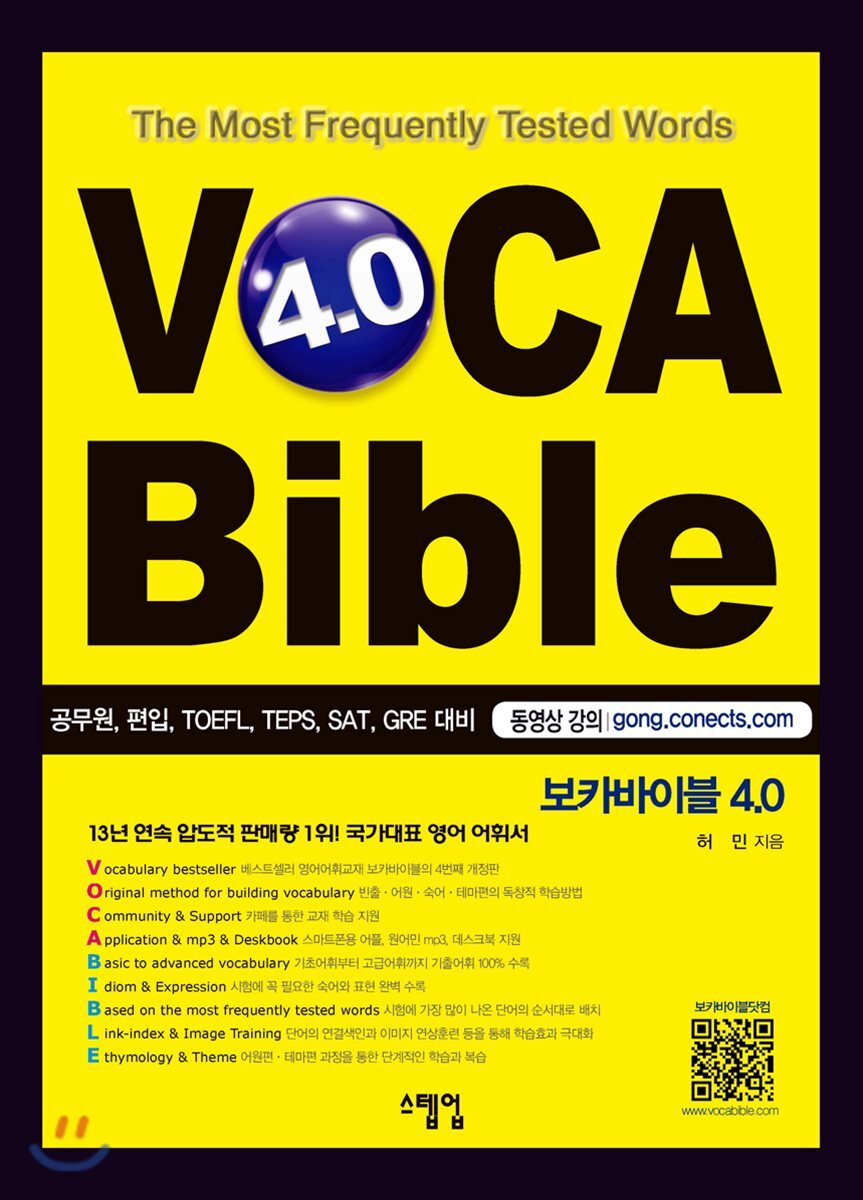
Vocabulary Bible 4.0
 |
Description
Book Introduction
The fourth fully revised edition of 『Vocabulary Bible』, the best-selling English vocabulary book for 13 years.
This is an English vocabulary textbook for domestic English exams such as civil service exams, transfer exams, TOEFL, and TEPS, as well as overseas study exams such as SAT and GRE. It has intensively analyzed the vocabulary from all domestic English exams for over 30 years and arranged them in order of frequency of appearance to maximize test-taking efficiency by considering the possibility of appearing on the exam. In addition, it has maximized memorization efficiency through a step-by-step learning method such as learning etymology/idioms/synonyms.
This revised edition contains two volumes, Volume A and B. Volume A contains PART 1, TOP1000 WORDS (TOP1000 Headwords), which lists the 1,000 most frequently appearing words on English exams in order of frequency of appearance.
In Volume B, first of all, in PART 2. ETYMOLOGY & IDIOMS (Etymology Headings & Idiom Headings), you can learn other vocabulary by studying the etymology (prefixes, suffixes, roots), and at the same time, you can learn idioms by studying prepositions, adverbs, basic verbs, and basic nouns.
Additionally, the TOP1000 words learned previously were organized so that they can be reviewed by grouping them together with the same etymology.
Next, in PART 3. SYNONYM/THEME & WORDS, you can study previously tested words that cannot be accessed through their etymology all at once by grouping them by synonyms or fields, and at the same time, you can review the TOP 1000 headwords and etymological headwords that you learned before by grouping them by synonyms.
This is an organic learning system that allows you to review frequently appearing words on exams up to three times by studying Book A and Book B in order.
This is an English vocabulary textbook for domestic English exams such as civil service exams, transfer exams, TOEFL, and TEPS, as well as overseas study exams such as SAT and GRE. It has intensively analyzed the vocabulary from all domestic English exams for over 30 years and arranged them in order of frequency of appearance to maximize test-taking efficiency by considering the possibility of appearing on the exam. In addition, it has maximized memorization efficiency through a step-by-step learning method such as learning etymology/idioms/synonyms.
This revised edition contains two volumes, Volume A and B. Volume A contains PART 1, TOP1000 WORDS (TOP1000 Headwords), which lists the 1,000 most frequently appearing words on English exams in order of frequency of appearance.
In Volume B, first of all, in PART 2. ETYMOLOGY & IDIOMS (Etymology Headings & Idiom Headings), you can learn other vocabulary by studying the etymology (prefixes, suffixes, roots), and at the same time, you can learn idioms by studying prepositions, adverbs, basic verbs, and basic nouns.
Additionally, the TOP1000 words learned previously were organized so that they can be reviewed by grouping them together with the same etymology.
Next, in PART 3. SYNONYM/THEME & WORDS, you can study previously tested words that cannot be accessed through their etymology all at once by grouping them by synonyms or fields, and at the same time, you can review the TOP 1000 headwords and etymological headwords that you learned before by grouping them by synonyms.
This is an organic learning system that allows you to review frequently appearing words on exams up to three times by studying Book A and Book B in order.
- You can preview some of the book's contents.
Preview
index
[Volume A]
PART 1. TOP 1000 WORDS (TOP1000 Headwords) - 40 days
DAY 01. TOP 0001 ~ 0025 3 ~ 14
DAY 02. TOP 0026 ~ 0050 15 ~ 26
DAY 03. TOP 0051 ~ 1075 27 ~ 38
DAY 04. TOP 0076 ~ 0100 39 ~ 50
DAY 05. TOP 0101 ~ 0125 51 ~ 62
DAY 06. TOP 0126 ~ 0150 63 ~ 74
DAY 07. TOP 0151 ~ 0175 75 ~ 86
DAY 08. TOP 0176 ~ 0200 87 ~ 98
DAY 09. TOP 0201 ~ 0225 99 ~ 110
DAY 10. TOP 0226 ~ 0250 111 ~ 122
DAY 11. TOP 0251 ~ 0275 123 ~ 134
DAY 12. TOP 0276 ~ 0300 135 ~ 146
DAY 13. TOP 0301 ~ 0325 147 ~ 158
DAY 14. TOP 0326 ~ 0350 159 ~ 170
DAY 15. TOP 0351 ~ 0375 171 ~ 182
DAY 16. TOP 0376 ~ 0400 183 ~ 194
DAY 17. TOP 0401 ~ 0425 195 ~ 206
DAY 18. TOP 0426 ~ 0450 207 ~ 218
DAY 19. TOP 0451 ~ 0475 219 ~ 230
DAY 20. TOP 0476 ~ 0500 231 ~ 242
DAY 21. TOP 0501 ~ 0525 243 ~ 254
DAY 22. TOP 0526 ~ 0550 255 ~ 266
DAY 23. TOP 0556 ~ 0575 267 ~ 278
DAY 24. TOP 0576 ~ 0600 279 ~ 290
DAY 25. TOP 0601 ~ 0625 291 ~ 302
DAY 26. TOP 0626 ~ 0650 303 ~ 314
DAY 27. TOP 0651 ~ 0675 315 ~ 326
DAY 28. TOP 0676 ~ 0700 327 ~ 338
DAY 29. TOP 0701 ~ 0725 339 ~ 350
DAY 30. TOP 0726 ~ 0750 351 ~ 362
DAY 31. TOP 0751 ~ 0775 363 ~ 374
DAY 32. TOP 0776 ~ 0800 375 ~ 386
DAY 33. TOP 0801 ~ 0825 r 387 ~ 398
DAY 34. TOP 0826 ~ 0850 399 ~ 410
DAY 35. TOP 0851 ~ 0875 411 ~ 422
DAY 36. TOP 0876 ~ 0900 423 ~ 434
DAY 37. TOP 0901 ~ 0925 435 ~ 446
DAY 38. TOP 0926 ~ 0950 447 ~ 458
DAY 39. TOP 0951 ~ 0975 459 ~ 470
DAY 40. TOP 0976 ~ 1000 471 ~ 482
[Volume B]
PART 2. ETYMOLOGY & IDIOMS - 40 days
■ Essential vocabulary learned through prefixes and suffixes (+ previously used vocabulary learned through prepositions and adverbs)
DAY 01.
Preposition in/into ↔ out, outside Prefix 009 ~ 019
+ Preposition in/into/out expressions
DAY 02.
Prepositions on ↔ off, away, apart Prefixes 020 ~ 028
+ preposition on ↔ off, away expression
DAY 03.
Prepositions up/over/beyond, above prefixes 029 ~ 036
+ preposition up/over/beyond/above expressions)
DAY 04.
Prepositions down/under/below prefixes 037 ~ 040
+ Preposition expressions down/under/below/beneath
DAY 05.
Prepositions to/between/across/through prefixes 041 ~ 048
+ Preposition expressions from/to/at/across/through
DAY 06.
Prepositions by/around/beside/with/together prefixes 049 ~ 057
+ Preposition by/around/about/beside/between/with/without/together/along expression
DAY 07.
Prepositions before/forward ↔ back/again prefixes 058 ~ 066
+ Preposition expressions before/after/behind/of/as
DAY 08.
not/against/bad/good prefixes 067 to 076
+ preposition for ↔ against expression
DAY 09.
Number, quantity prefixes 077 to 088
+ Proverbial expression[1]
DAY 10.
Suffixes for forming verbs/adjectives/nouns 089-106
+ Proverbial expression[2]
■ Learning vocabulary through roots (+ learning idioms through basic verbs and basic nouns)
DAY 11.
Basic verb take root 109-117
+ basic verb take expression
DAY 12.
Basic verbs give/pay roots 118–128
+ Basic verb expressions give/pay/cost
DAY 13.
Basic verbs hold/stick/keep roots 129-138
+ Basic verb keep/hold/have expressions
DAY 14.
Basic verbs put/place/set roots 139–148
+ Basic verb put/set/lay expressions
DAY 15.
Basic verbs stand/sit/stay/last roots 149–156
+ basic verb stand/sit/stay expressions
DAY 16.
Basic verbs leave/hang/join/tie/loose/touch roots 157-170
+ Basic verb expressions leave/hang/join/tie/touch
DAY 17.
Basic verbs come/go/step roots 171-184
+ Basic verb expressions come/go/pass/step
DAY 18.
Basic verbs run/walk/leap/stop roots 185-192
+ Basic verb expressions run/walk/leap/stop
DAY 19.
Basic verbs carry/bear/send/choose roots 193–201
+ Basic verb carry/bear/bring expressions
DAY 20.
Basic verbs turn/change/move/roll roots 202-209
+ Basic verb expressions turn/change/roll
DAY 21.
Basic verbs make/fit/form roots 210–218
+ basic verb make expression
DAY 22.
Basic verbs do/drive/work/play/try roots 219-229
+ Basic verb expressions do/drive/push/work/play/try
DAY 23.
Basic verbs look/see/watch/hear/show/hide roots 230–243
+ Basic verb expressions look/see/watch/hear/show
DAY 24.
Basic verbs say/talk/speak/word roots 244-253
+ basic verbs say/talk/speak/word expressions
DAY 25.
Basic verb write/mark/call/cry/ask/seek/answer root 254 ~ 266
+ Basic verb expressions write/read/word/name/call/ask/answer
DAY 26.
Basic verbs cut/break/gnaw/grind/rub/build roots 267–279
+ Basic verb cut/tear/break/crack expressions
DAY 27.
Basic verbs strike/fight/prick/bite/press roots 280-287
+ Basic verb expressions hit/strike/beat/knock/kick/bite
DAY 28.
Basic verbs throw/fall/pour/drop/bend/stretch expressions 288–301
+ Expressions related to the basic verbs throw/cast/fall/drop/shed
DAY 29.
Basic verbs draw/lead/follow/shut/guard roots 302–316
+ Basic verb expressions pull/draw/pick/let/catch/follow/close/shut/open
DAY 30.
Basic verb know/advise/remember/feel/think Root 317 ~ 328
+ Basic verb expressions know/learn/find/think/feel
DAY 31.
Basic verbs please/fill/empty/eat roots 329-339
+ basic verb expressions lose/add/fill/cover/wear/dress/feed/eat/swallow
DAY 32.
Basic verbs be/marry/live roots 340–351
+ basic verb be/live expression
DAY 33.
Basic verb become/grow/rise/kill/use/blow root 352 ~ 364
+ Basic verbs meet/use/serve/blow/other verb roots
DAY 34.
Basic nouns head/face/body/hand/foot and other body roots 365-379
+ Basic nouns head/face/hand/foot and other body-related expressions
DAY 35.
Basic nouns heart/mind/life/people/god roots 380-392
+ Basic noun heart/mind/stomach/other human expressions
DAY 36.
Basic noun time/day/year/end/new...
Roots 393-405
+ Basic noun time/day/date/way expressions
DAY 37.
Basic nouns (nature/creatures/earth/colors…) roots 406–417
+ Expressions related to other nouns (nature/living things/earth/colors…)
DAY 38.
Basic nouns (number and quantity) roots 418–436
+ Expressions related to evaluating other noun phrases and objects
DAY 39.
Other noun roots (1) ) 437 ~ 449
+ English for daily life: Everyday expressions
DAY 40.
Other noun roots (2) ) 450 ~ 466
+ Everyday English: Situational Expressions by Location
PART 3. SYNONYM/THEME & WORDS - 20 days
DAY 01.
[Theme] Human Body and Abilities 470-475
DAY 02.
[Theme] The Five Senses and the Sixth Sense 476-480
DAY 03.
[Theme] Human Character and Mind 481-491
DAY 04.
[Theme] Human Emotions 482-500
DAY 05.
[Theme] Disease, Medicine, and Death 501-508
DAY 06.
[Theme] Marriage, Family, Children, Education 509-515
DAY 07.
[Theme] Groups, Society, and Ethnicity 516-521
DAY 08.
[Theme] Food, Clothing, and Shelter 522-533
DAY 09.
[Theme] Shopping, Travel, and Leisure 534-539
DAY 10.
[Theme] Work and Work 540-547
DAY 11.
[Theme] Incidents, Accidents, and Disputes 548–555
DAY 12.
[Theme] Mass Media 556-563
DAY 13.
[Theme] Language and Decision-Making 564-570
DAY 14.
[Theme] Literature, Philosophy, Religion, History 571–578
DAY 15.
[Theme] Politics, State, Diplomacy, Military 579-585
DAY 16.
[Theme] Law and Crime 586-596
DAY 17.
[Theme] Economy, Finance, Industry 597-604
DAY 18.
[Theme] Space and Life 605-608
DAY 19.
[Theme] Time, Space, Matter, Form 609–615
DAY 20.
[Theme] Environment, Resources, Weather, Disasters 616-625
PART 1. TOP 1000 WORDS (TOP1000 Headwords) - 40 days
DAY 01. TOP 0001 ~ 0025 3 ~ 14
DAY 02. TOP 0026 ~ 0050 15 ~ 26
DAY 03. TOP 0051 ~ 1075 27 ~ 38
DAY 04. TOP 0076 ~ 0100 39 ~ 50
DAY 05. TOP 0101 ~ 0125 51 ~ 62
DAY 06. TOP 0126 ~ 0150 63 ~ 74
DAY 07. TOP 0151 ~ 0175 75 ~ 86
DAY 08. TOP 0176 ~ 0200 87 ~ 98
DAY 09. TOP 0201 ~ 0225 99 ~ 110
DAY 10. TOP 0226 ~ 0250 111 ~ 122
DAY 11. TOP 0251 ~ 0275 123 ~ 134
DAY 12. TOP 0276 ~ 0300 135 ~ 146
DAY 13. TOP 0301 ~ 0325 147 ~ 158
DAY 14. TOP 0326 ~ 0350 159 ~ 170
DAY 15. TOP 0351 ~ 0375 171 ~ 182
DAY 16. TOP 0376 ~ 0400 183 ~ 194
DAY 17. TOP 0401 ~ 0425 195 ~ 206
DAY 18. TOP 0426 ~ 0450 207 ~ 218
DAY 19. TOP 0451 ~ 0475 219 ~ 230
DAY 20. TOP 0476 ~ 0500 231 ~ 242
DAY 21. TOP 0501 ~ 0525 243 ~ 254
DAY 22. TOP 0526 ~ 0550 255 ~ 266
DAY 23. TOP 0556 ~ 0575 267 ~ 278
DAY 24. TOP 0576 ~ 0600 279 ~ 290
DAY 25. TOP 0601 ~ 0625 291 ~ 302
DAY 26. TOP 0626 ~ 0650 303 ~ 314
DAY 27. TOP 0651 ~ 0675 315 ~ 326
DAY 28. TOP 0676 ~ 0700 327 ~ 338
DAY 29. TOP 0701 ~ 0725 339 ~ 350
DAY 30. TOP 0726 ~ 0750 351 ~ 362
DAY 31. TOP 0751 ~ 0775 363 ~ 374
DAY 32. TOP 0776 ~ 0800 375 ~ 386
DAY 33. TOP 0801 ~ 0825 r 387 ~ 398
DAY 34. TOP 0826 ~ 0850 399 ~ 410
DAY 35. TOP 0851 ~ 0875 411 ~ 422
DAY 36. TOP 0876 ~ 0900 423 ~ 434
DAY 37. TOP 0901 ~ 0925 435 ~ 446
DAY 38. TOP 0926 ~ 0950 447 ~ 458
DAY 39. TOP 0951 ~ 0975 459 ~ 470
DAY 40. TOP 0976 ~ 1000 471 ~ 482
[Volume B]
PART 2. ETYMOLOGY & IDIOMS - 40 days
■ Essential vocabulary learned through prefixes and suffixes (+ previously used vocabulary learned through prepositions and adverbs)
DAY 01.
Preposition in/into ↔ out, outside Prefix 009 ~ 019
+ Preposition in/into/out expressions
DAY 02.
Prepositions on ↔ off, away, apart Prefixes 020 ~ 028
+ preposition on ↔ off, away expression
DAY 03.
Prepositions up/over/beyond, above prefixes 029 ~ 036
+ preposition up/over/beyond/above expressions)
DAY 04.
Prepositions down/under/below prefixes 037 ~ 040
+ Preposition expressions down/under/below/beneath
DAY 05.
Prepositions to/between/across/through prefixes 041 ~ 048
+ Preposition expressions from/to/at/across/through
DAY 06.
Prepositions by/around/beside/with/together prefixes 049 ~ 057
+ Preposition by/around/about/beside/between/with/without/together/along expression
DAY 07.
Prepositions before/forward ↔ back/again prefixes 058 ~ 066
+ Preposition expressions before/after/behind/of/as
DAY 08.
not/against/bad/good prefixes 067 to 076
+ preposition for ↔ against expression
DAY 09.
Number, quantity prefixes 077 to 088
+ Proverbial expression[1]
DAY 10.
Suffixes for forming verbs/adjectives/nouns 089-106
+ Proverbial expression[2]
■ Learning vocabulary through roots (+ learning idioms through basic verbs and basic nouns)
DAY 11.
Basic verb take root 109-117
+ basic verb take expression
DAY 12.
Basic verbs give/pay roots 118–128
+ Basic verb expressions give/pay/cost
DAY 13.
Basic verbs hold/stick/keep roots 129-138
+ Basic verb keep/hold/have expressions
DAY 14.
Basic verbs put/place/set roots 139–148
+ Basic verb put/set/lay expressions
DAY 15.
Basic verbs stand/sit/stay/last roots 149–156
+ basic verb stand/sit/stay expressions
DAY 16.
Basic verbs leave/hang/join/tie/loose/touch roots 157-170
+ Basic verb expressions leave/hang/join/tie/touch
DAY 17.
Basic verbs come/go/step roots 171-184
+ Basic verb expressions come/go/pass/step
DAY 18.
Basic verbs run/walk/leap/stop roots 185-192
+ Basic verb expressions run/walk/leap/stop
DAY 19.
Basic verbs carry/bear/send/choose roots 193–201
+ Basic verb carry/bear/bring expressions
DAY 20.
Basic verbs turn/change/move/roll roots 202-209
+ Basic verb expressions turn/change/roll
DAY 21.
Basic verbs make/fit/form roots 210–218
+ basic verb make expression
DAY 22.
Basic verbs do/drive/work/play/try roots 219-229
+ Basic verb expressions do/drive/push/work/play/try
DAY 23.
Basic verbs look/see/watch/hear/show/hide roots 230–243
+ Basic verb expressions look/see/watch/hear/show
DAY 24.
Basic verbs say/talk/speak/word roots 244-253
+ basic verbs say/talk/speak/word expressions
DAY 25.
Basic verb write/mark/call/cry/ask/seek/answer root 254 ~ 266
+ Basic verb expressions write/read/word/name/call/ask/answer
DAY 26.
Basic verbs cut/break/gnaw/grind/rub/build roots 267–279
+ Basic verb cut/tear/break/crack expressions
DAY 27.
Basic verbs strike/fight/prick/bite/press roots 280-287
+ Basic verb expressions hit/strike/beat/knock/kick/bite
DAY 28.
Basic verbs throw/fall/pour/drop/bend/stretch expressions 288–301
+ Expressions related to the basic verbs throw/cast/fall/drop/shed
DAY 29.
Basic verbs draw/lead/follow/shut/guard roots 302–316
+ Basic verb expressions pull/draw/pick/let/catch/follow/close/shut/open
DAY 30.
Basic verb know/advise/remember/feel/think Root 317 ~ 328
+ Basic verb expressions know/learn/find/think/feel
DAY 31.
Basic verbs please/fill/empty/eat roots 329-339
+ basic verb expressions lose/add/fill/cover/wear/dress/feed/eat/swallow
DAY 32.
Basic verbs be/marry/live roots 340–351
+ basic verb be/live expression
DAY 33.
Basic verb become/grow/rise/kill/use/blow root 352 ~ 364
+ Basic verbs meet/use/serve/blow/other verb roots
DAY 34.
Basic nouns head/face/body/hand/foot and other body roots 365-379
+ Basic nouns head/face/hand/foot and other body-related expressions
DAY 35.
Basic nouns heart/mind/life/people/god roots 380-392
+ Basic noun heart/mind/stomach/other human expressions
DAY 36.
Basic noun time/day/year/end/new...
Roots 393-405
+ Basic noun time/day/date/way expressions
DAY 37.
Basic nouns (nature/creatures/earth/colors…) roots 406–417
+ Expressions related to other nouns (nature/living things/earth/colors…)
DAY 38.
Basic nouns (number and quantity) roots 418–436
+ Expressions related to evaluating other noun phrases and objects
DAY 39.
Other noun roots (1) ) 437 ~ 449
+ English for daily life: Everyday expressions
DAY 40.
Other noun roots (2) ) 450 ~ 466
+ Everyday English: Situational Expressions by Location
PART 3. SYNONYM/THEME & WORDS - 20 days
DAY 01.
[Theme] Human Body and Abilities 470-475
DAY 02.
[Theme] The Five Senses and the Sixth Sense 476-480
DAY 03.
[Theme] Human Character and Mind 481-491
DAY 04.
[Theme] Human Emotions 482-500
DAY 05.
[Theme] Disease, Medicine, and Death 501-508
DAY 06.
[Theme] Marriage, Family, Children, Education 509-515
DAY 07.
[Theme] Groups, Society, and Ethnicity 516-521
DAY 08.
[Theme] Food, Clothing, and Shelter 522-533
DAY 09.
[Theme] Shopping, Travel, and Leisure 534-539
DAY 10.
[Theme] Work and Work 540-547
DAY 11.
[Theme] Incidents, Accidents, and Disputes 548–555
DAY 12.
[Theme] Mass Media 556-563
DAY 13.
[Theme] Language and Decision-Making 564-570
DAY 14.
[Theme] Literature, Philosophy, Religion, History 571–578
DAY 15.
[Theme] Politics, State, Diplomacy, Military 579-585
DAY 16.
[Theme] Law and Crime 586-596
DAY 17.
[Theme] Economy, Finance, Industry 597-604
DAY 18.
[Theme] Space and Life 605-608
DAY 19.
[Theme] Time, Space, Matter, Form 609–615
DAY 20.
[Theme] Environment, Resources, Weather, Disasters 616-625
Detailed image

Publisher's Review
1.
Key Features of Vocabulary Bible 4.0
[1] Let’s start by studying the vocabulary that appears most frequently on the test!
The 1,000 most frequently appearing vocabulary words (4,000 including derivatives) were selected as the TOP 1000 headings of [Volume A] PART 1. TOP 1000 WORDS, and arranged in order of frequency from TOP 0001 to TOP 1000.
These 1,000 key words are the most important words that cover over 90% of civil service vocabulary, over 60% of transfer exam vocabulary, and over 50% of other exam vocabulary.
Vulnerable, the first word in the title, is the most frequently tested English word in all exams, appearing more than 31 times, and is the most important English word that appears in recent exams every year.
[2] Let’s study derivatives, synonyms, antonyms, confusing words, and related words together!
For the TOP1000 headings, we have introduced in as much detail as possible the derivatives that have almost the same meaning but different parts of speech, and we have introduced in detail the various synonyms that the word has (the largest number of synonyms in Korea), and we have explained “antonyms” with opposite meanings, “confusing words” with similar appearances or pronunciations, and other related words as sub-words so that you can learn one word and easily expand it to as many as ten or more words.
[3] Let’s understand the meaning and nuance of the word accurately!
The TOP1000 headings include concise and key English-language definitions and an average of three example sentences for each word, allowing you to accurately learn the meaning and nuance of each word.
A total of 3,000 example sentences are provided in Vocabulary Bible 4.0 A volume.
[4] Let’s maximize the memorization effect through images that allow you to intuitively understand English words!
The “Image Association Training” corner, newly introduced in this Vocabulary 4.0, helps you easily understand the meaning of each word and imprint the words and phrases in your memory at the same time, ensuring a long-lasting memorization effect.
[5] Let’s increase memorization and expand vocabulary through etymological learning!
In Part 2 of [Volume B], ETYMOLOGY & IDIOMS, we have grouped the words that appeared on the exam into prefixes, suffixes, and roots to help you remember English words for a long time and expand your vocabulary. In addition, we have reviewed the TOP 1000 headwords related to the previously studied etymology, and we have organically referenced them through the link index.
[6] Idioms and expressions are also an important part of vocabulary learning!
We have made it easy to learn by explaining the semantics of approximately 3,000 essential idioms that frequently appear in various tests using basic words from middle school curriculum.
The content from the original Vocabulary Bible 3.0 has been included in this Vocabulary Bible 4.0 in accordance with the meaning of each etymology in PART 2. ETYMOLOGY & IDIOMS.
For example, we wanted to maximize efficiency by learning the root word meaning “take” and then learning the phrasal verbs or idioms that consist of “take.”
The example sentences that were previously provided online are now directly supported in the textbook, and the textbook also indicates which exams they were tested on.
[7] Let’s learn by grouping by synonyms and themes!
Part 3 of [Volume B]. SYNONYM/THEME & WORDS allows you to study and organize the words that appeared on the exam by grouping them by synonyms or themes. You can also review the TOP 1000 headwords and etymological headwords you studied previously, and organically reference them through the link index.
[8] Just use difficult words or words of low importance (gray words) as reference!
Difficult words with low frequency of use or advanced vocabulary that is unlikely to appear on the exam are grayed out so that readers who are not preparing to transfer to a top university or wish to study advanced vocabulary can skip them.
[9] Let’s look up words you don’t know in Vocabulary Bible 4.0, which has a groundbreaking index system that makes it easy to find!
The unique indexing system implemented in the Vocabulary Bible series is a very convenient way to find words in the book faster than in any other book, with just a little understanding.
The index of the Vocabulary Bible series breaks away from the index method of other textbooks, which only indicated the location of vocabulary by “page,” requiring a long time to check the corresponding word. Instead, it specifies the location number within the page so that the location of each word can be checked immediately.
Compared to existing indexes, the search time is only 1/4, so you can use Vocabulary Bible 4.0 as a dictionary.
This 4.0 version has enhanced the existing system to display a unique number for each word, making it easier to find.
2.
Composition of Vocabulary Bible 4.0
Boca Bible 4.0 is largely divided into volumes A and B.
《Volume A》 consists of PART 1. TOP 1000 WORDS. PART.
1 TOP 1,000 WORDS covers the 1,000 most frequently appearing English words on tests (TOP 1000 words). These words are the most important words that appear at least 5 times and up to 31 times in various English tests.
The TOP 1000 keywords are arranged in order of frequency of appearance on the exam, and are structured so that you can study 25 keywords per day, for a total of 40 days.
《Volume B》 is organized in a clear and easy-to-understand manner so that you can systematically study the words and idioms not covered in Volume A through etymology (prefixes, suffixes, roots), prepositions, adverbs, basic verbs, and basic nouns in PART 2. ETYMOLOGY & IDIOMS (Etymology Headings & Idiom Headings), and it can be studied for a total of 40 days.
Next, in PART 3. SYNONYM/THEME & WORDS, we have organized the 20-day volume so that you can study the previously uncovered words by synonym and theme, and at the same time review the TOP 1000 headwords and etymological headwords learned previously by grouping them by synonym.
Lastly, an index that allows you to easily find the location of every word in Vocabulary 4.0 is provided as a resource at the textbook support cafe “Vocabible.com (www.vocabible.com).”
Key Features of Vocabulary Bible 4.0
[1] Let’s start by studying the vocabulary that appears most frequently on the test!
The 1,000 most frequently appearing vocabulary words (4,000 including derivatives) were selected as the TOP 1000 headings of [Volume A] PART 1. TOP 1000 WORDS, and arranged in order of frequency from TOP 0001 to TOP 1000.
These 1,000 key words are the most important words that cover over 90% of civil service vocabulary, over 60% of transfer exam vocabulary, and over 50% of other exam vocabulary.
Vulnerable, the first word in the title, is the most frequently tested English word in all exams, appearing more than 31 times, and is the most important English word that appears in recent exams every year.
[2] Let’s study derivatives, synonyms, antonyms, confusing words, and related words together!
For the TOP1000 headings, we have introduced in as much detail as possible the derivatives that have almost the same meaning but different parts of speech, and we have introduced in detail the various synonyms that the word has (the largest number of synonyms in Korea), and we have explained “antonyms” with opposite meanings, “confusing words” with similar appearances or pronunciations, and other related words as sub-words so that you can learn one word and easily expand it to as many as ten or more words.
[3] Let’s understand the meaning and nuance of the word accurately!
The TOP1000 headings include concise and key English-language definitions and an average of three example sentences for each word, allowing you to accurately learn the meaning and nuance of each word.
A total of 3,000 example sentences are provided in Vocabulary Bible 4.0 A volume.
[4] Let’s maximize the memorization effect through images that allow you to intuitively understand English words!
The “Image Association Training” corner, newly introduced in this Vocabulary 4.0, helps you easily understand the meaning of each word and imprint the words and phrases in your memory at the same time, ensuring a long-lasting memorization effect.
[5] Let’s increase memorization and expand vocabulary through etymological learning!
In Part 2 of [Volume B], ETYMOLOGY & IDIOMS, we have grouped the words that appeared on the exam into prefixes, suffixes, and roots to help you remember English words for a long time and expand your vocabulary. In addition, we have reviewed the TOP 1000 headwords related to the previously studied etymology, and we have organically referenced them through the link index.
[6] Idioms and expressions are also an important part of vocabulary learning!
We have made it easy to learn by explaining the semantics of approximately 3,000 essential idioms that frequently appear in various tests using basic words from middle school curriculum.
The content from the original Vocabulary Bible 3.0 has been included in this Vocabulary Bible 4.0 in accordance with the meaning of each etymology in PART 2. ETYMOLOGY & IDIOMS.
For example, we wanted to maximize efficiency by learning the root word meaning “take” and then learning the phrasal verbs or idioms that consist of “take.”
The example sentences that were previously provided online are now directly supported in the textbook, and the textbook also indicates which exams they were tested on.
[7] Let’s learn by grouping by synonyms and themes!
Part 3 of [Volume B]. SYNONYM/THEME & WORDS allows you to study and organize the words that appeared on the exam by grouping them by synonyms or themes. You can also review the TOP 1000 headwords and etymological headwords you studied previously, and organically reference them through the link index.
[8] Just use difficult words or words of low importance (gray words) as reference!
Difficult words with low frequency of use or advanced vocabulary that is unlikely to appear on the exam are grayed out so that readers who are not preparing to transfer to a top university or wish to study advanced vocabulary can skip them.
[9] Let’s look up words you don’t know in Vocabulary Bible 4.0, which has a groundbreaking index system that makes it easy to find!
The unique indexing system implemented in the Vocabulary Bible series is a very convenient way to find words in the book faster than in any other book, with just a little understanding.
The index of the Vocabulary Bible series breaks away from the index method of other textbooks, which only indicated the location of vocabulary by “page,” requiring a long time to check the corresponding word. Instead, it specifies the location number within the page so that the location of each word can be checked immediately.
Compared to existing indexes, the search time is only 1/4, so you can use Vocabulary Bible 4.0 as a dictionary.
This 4.0 version has enhanced the existing system to display a unique number for each word, making it easier to find.
2.
Composition of Vocabulary Bible 4.0
Boca Bible 4.0 is largely divided into volumes A and B.
《Volume A》 consists of PART 1. TOP 1000 WORDS. PART.
1 TOP 1,000 WORDS covers the 1,000 most frequently appearing English words on tests (TOP 1000 words). These words are the most important words that appear at least 5 times and up to 31 times in various English tests.
The TOP 1000 keywords are arranged in order of frequency of appearance on the exam, and are structured so that you can study 25 keywords per day, for a total of 40 days.
《Volume B》 is organized in a clear and easy-to-understand manner so that you can systematically study the words and idioms not covered in Volume A through etymology (prefixes, suffixes, roots), prepositions, adverbs, basic verbs, and basic nouns in PART 2. ETYMOLOGY & IDIOMS (Etymology Headings & Idiom Headings), and it can be studied for a total of 40 days.
Next, in PART 3. SYNONYM/THEME & WORDS, we have organized the 20-day volume so that you can study the previously uncovered words by synonym and theme, and at the same time review the TOP 1000 headwords and etymological headwords learned previously by grouping them by synonym.
Lastly, an index that allows you to easily find the location of every word in Vocabulary 4.0 is provided as a resource at the textbook support cafe “Vocabible.com (www.vocabible.com).”
GOODS SPECIFICS
- Date of publication: June 12, 2018
- Page count, weight, size: 1,110 pages | 2,156g | 188*254*60mm
- ISBN13: 9788994553092
- ISBN10: 8994553096
You may also like
카테고리
korean


korean

![GQ KOREA Mark (Monthly): December [2025]](http://librairie.coreenne.fr/cdn/shop/files/8ef265dbbfbf186523ed75ba7319009d.jpg?v=1765340328&width=3840)


