

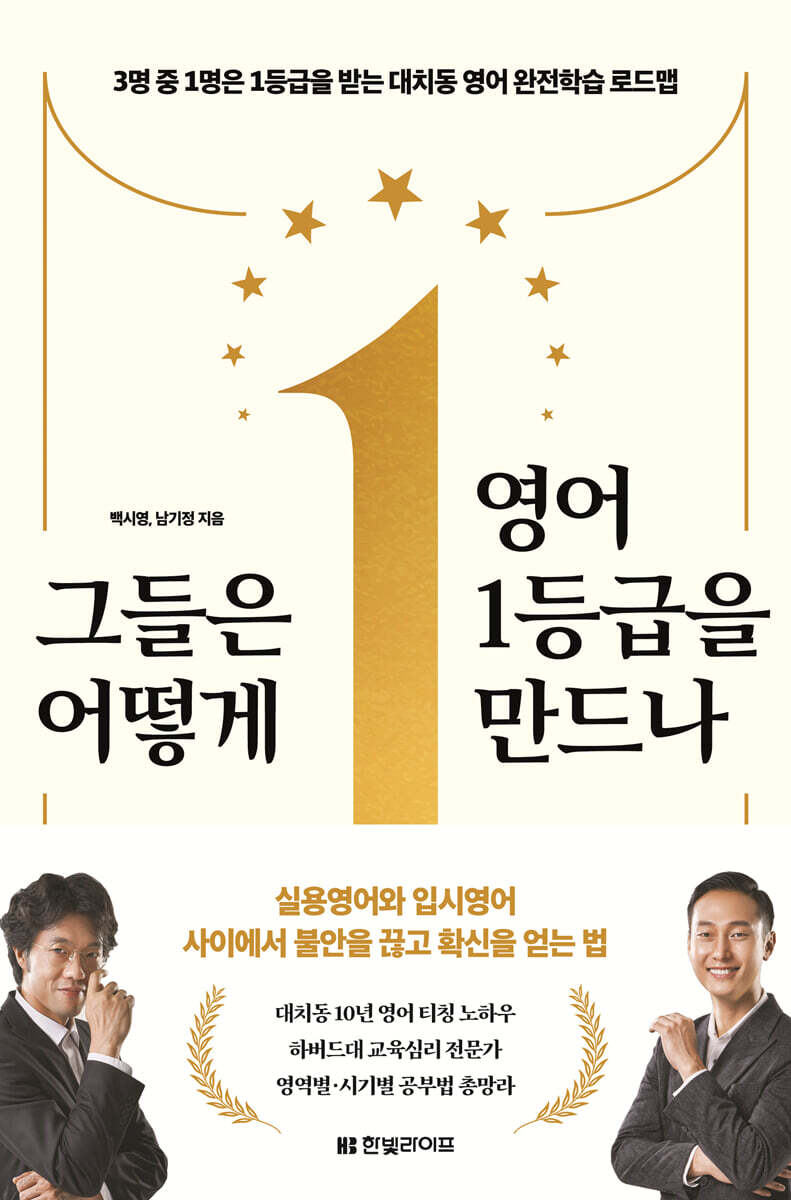
How do they make English level 1?
 |
Description
Book Introduction
How to Break the Anxiety and Gain Confidence Between Practical English and Entrance Exam English A Complete English Learning Roadmap from a Harvard Educational Psychology Expert We'll teach you step-by-step how to build the strength to master English for 12 years. The percentage of students who achieved a grade 1 in English in the 2024 College Scholastic Ability Test is 4.7 percent. However, in Daechi-dong, one out of three people receives a grade 1 in English on the CSAT. How do they achieve such a striking difference? The answer is in this book. First, I'll list down proven and effective English learning methods that have survived in Daechi-dong for decades, and then I'll tell you how to apply them to your child. Next, we will explain one by one how to approach each area: vocabulary, grammar, syntax, reading, writing, listening, and speaking. It contains detailed information on correct and incorrect study methods, recommended textbooks and videos for each area, and effective training methods/evaluation methods/answer correction methods to build and confirm your skills. For parents who are struggling to decide between practical English and English for college entrance exams, we will look at the differences between elementary, middle, and high school English, and what to focus on during preschool, 1st to 4th grade, 5th grade to 2nd grade, 3rd grade, and high school to achieve a top grade in both school grades and the CSAT. We also cover in detail the use of private academies, which can be a concern at any time. We will look at how academies help children learn, when to attend academies, what types of academies are needed at different times, how to choose a really good academy, and what to keep in mind even if attending academies. Finally, we'll explore the study habits that help you become fluent in English, as well as those that hinder you from doing so, based on the latest research. This book, which includes educational psychology and linguistic analysis, will serve as the most reliable guide to English learning for parents. |
- You can preview some of the book's contents.
Preview
index
In Daechi-dong, one in three students receives a grade 1 in English on the CSAT.
Chapter 1: What is different about Daechi-dong?
Parents' study standards are clear
Children study hard, consistently, and every day.
Chapter 2 How should I study by area?
Vocabulary, can I just memorize it?
Grammar, how should I learn it?
Should I learn the syntax separately?
Reading comprehension, is it enough to just read a lot?
When should I start writing in English?
What does it mean to listen and have your ears pierced?
Speaking, do I really need to be good at it?
Chapter 3: What should we focus on at each time period?
What is the difference between practical English and entrance exam English?
Is there a separate roadmap for each period?
Is it possible to finish English in middle school?
How much should I do before entering middle school?
How much should I do before entering high school?
How should I prepare for high school grades and the CSAT?
Chapter 4: How can an academy improve your skills?
How can academies help children study?
Who is a good teacher?
How can I choose a good academy?
Check out recommended academies by period and type.
Spoon-feeding vs. flipped classroom
There is no study in this world that can be done through academy alone.
Why your grades don't improve even when you study
Chapter 5: Studying Beyond English
Studying is difficult and tiring work.
There's a reason why you can't study.
Your skills improve when you solve problems on your own.
You have to study hard and consistently for a long time.
You have to believe that you can study well to do well.
Good posture is the beginning of studying.
If you avoid tests, you can't move forward.
Middle school studies are difficult for everyone.
Sometimes an uncomfortable environment is better
Sleep affects learning
Appendix: Grammar Terminology
8 Parts of Speech | Sentence Elements | Sentence Forms | Phrase Applications | Clause Applications
Chapter 1: What is different about Daechi-dong?
Parents' study standards are clear
Children study hard, consistently, and every day.
Chapter 2 How should I study by area?
Vocabulary, can I just memorize it?
Grammar, how should I learn it?
Should I learn the syntax separately?
Reading comprehension, is it enough to just read a lot?
When should I start writing in English?
What does it mean to listen and have your ears pierced?
Speaking, do I really need to be good at it?
Chapter 3: What should we focus on at each time period?
What is the difference between practical English and entrance exam English?
Is there a separate roadmap for each period?
Is it possible to finish English in middle school?
How much should I do before entering middle school?
How much should I do before entering high school?
How should I prepare for high school grades and the CSAT?
Chapter 4: How can an academy improve your skills?
How can academies help children study?
Who is a good teacher?
How can I choose a good academy?
Check out recommended academies by period and type.
Spoon-feeding vs. flipped classroom
There is no study in this world that can be done through academy alone.
Why your grades don't improve even when you study
Chapter 5: Studying Beyond English
Studying is difficult and tiring work.
There's a reason why you can't study.
Your skills improve when you solve problems on your own.
You have to study hard and consistently for a long time.
You have to believe that you can study well to do well.
Good posture is the beginning of studying.
If you avoid tests, you can't move forward.
Middle school studies are difficult for everyone.
Sometimes an uncomfortable environment is better
Sleep affects learning
Appendix: Grammar Terminology
8 Parts of Speech | Sentence Elements | Sentence Forms | Phrase Applications | Clause Applications
Detailed image

GOODS SPECIFICS
- Date of issue: December 22, 2023
- Page count, weight, size: 306 pages | 456g | 147*223*20mm
- ISBN13: 9791193080153
- ISBN10: 1193080150
You may also like
카테고리
korean


korean

![ELLE 엘르 스페셜 에디션 A형 : 12월 [2025]](http://librairie.coreenne.fr/cdn/shop/files/b8e27a3de6c9538896439686c6b0e8fb.jpg?v=1766436872&width=3840)


