

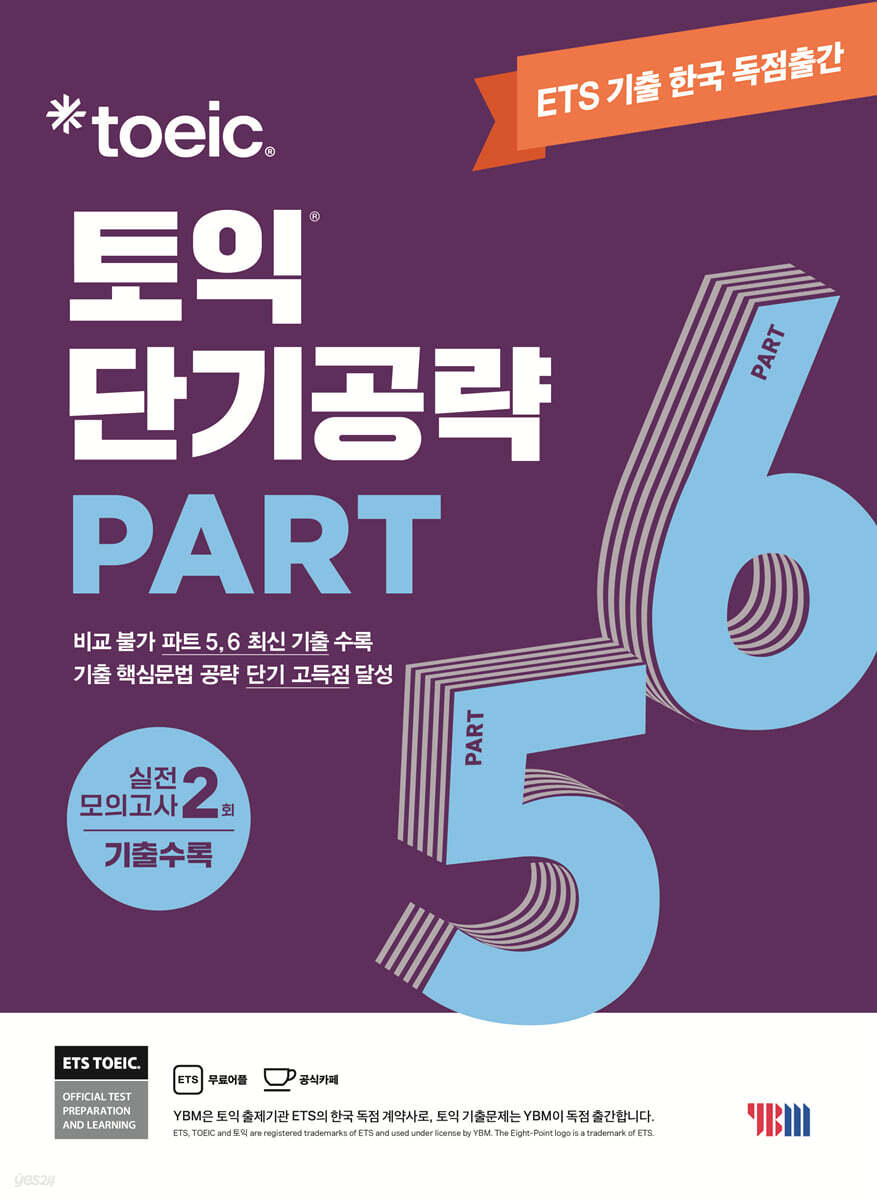
ETS TOEIC Short-Term Strategy Part 5 & 6
 |
Description
Book Introduction
The best TOEIC Part 5 and 6 strategy book in Korea that covers the latest questions in a short period of time!
This book is a strategy book for Parts 5 and 6 of the TOEIC Short-Term Strategy Series exclusively provided by ETS, the testing agency. It is a textbook for learners who want to achieve high scores through quick and accurate problem solving.
We offer a systematic strategy based on analysis of key grammar and vocabulary questions from previous exams, and we also include the latest exam questions and ETS-developed questions to help you prepare for the actual exam.
We also provide two mock exams with the same difficulty and quality as the actual exam, so you can check your skills.
Parts 5 and 6 are key strategies for reducing time and achieving high scores! Now, compete with the latest strategies presented by ETS, the testing agency!
This book is a strategy book for Parts 5 and 6 of the TOEIC Short-Term Strategy Series exclusively provided by ETS, the testing agency. It is a textbook for learners who want to achieve high scores through quick and accurate problem solving.
We offer a systematic strategy based on analysis of key grammar and vocabulary questions from previous exams, and we also include the latest exam questions and ETS-developed questions to help you prepare for the actual exam.
We also provide two mock exams with the same difficulty and quality as the actual exam, so you can check your skills.
Parts 5 and 6 are key strategies for reducing time and achieving high scores! Now, compete with the latest strategies presented by ETS, the testing agency!
- You can preview some of the book's contents.
Preview
index
PART 5 Grammar
UNIT 01 Sentence Structure
01 Nouns are given in the subject and object positions.
02 A sentence must contain a verb.
03 Adjectives are mainly used in the bore position.
04 A question is asked about the distinction between prepositions and conjunctions that lead modifier phrases/clauses.
UNIT 02 Nouns
05 The noun position is after the article, possessive case, and adjective.
06 Countable nouns vs. singular/plural nouns
Uncountable nouns without plural form
07 Choose person nouns and object/abstract nouns according to the context.
08 The position before or after a compound noun consisting of 'noun + noun' is tested.
09 Distinguish between countable and uncountable nouns that are similar in form or meaning.
10 Note noun vocabulary that looks like other parts of speech.
UNIT 03 Pronouns
11 Personal pronouns are nominative before the verb, objective after the verb/preposition, and possessive before the noun.
12 Reflexive pronouns are used when the subject and object are the same or to emphasize the subject.
13 Those who indicate 'people who do ~'
14 that replaces singular nouns, those replaces plural nouns
15 Indefinite pronouns one(s), another/others, the other(s)
16. Indefinite pronouns indicating quantity must be in agreement with number.
UNIT 04 Adjectives and Adverbs
17 Adjectives modify nouns and are modified by adverbs.
18 Quantitative adjectives must agree in number with the noun.
19 Be aware of adjectives whose form and meaning are confusing.
20 Idiomatic expressions in the form of 'be verb + adjective + preposition' are presented.
21 Adverbs modify verbs.
22 Adverbs modify adjectives, adverbs, quasi-verbs, phrases/clauses, and sentences.
23 Time adverbs and number modifier adverbs are tested.
24 Adverbs that are frequently used with specific verbs are tested.
UNIT 05 Prepositions
Prepositions of time must be distinguished according to duration and time.
26 Prepositions of Place/Location and Direction
27 Prepositions of reason, concession, and purpose
28 Prepositions of subject/relation, qualification, means, comparison, and influence
29 Prepositions of addition, exclusion, inclusion, and opposition
30 prepositional and prepositional idiomatic expressions are presented.
UNIT 06 Transitive/Verb, Number Agreement, Voice
31 An intransitive verb without an object is followed by an adverb or a prepositional phrase.
32 After a transitive verb, a noun (phrase) usually comes as the object.
33 Verb problems require you to check whether the subject is singular or plural and choose the verb that matches the number.
34 Pay attention to the agreement of number between the subject and verb in the quantitative expression.
35 If there is an object after a transitive verb, it is active; if not, it is passive.
36 Passive voice of verbs of type 4 and type 5 with an object or complement remaining after the verb
UNIT 07 Tense
37 The present tense is used with time expressions such as always, and the past tense is used with time expressions such as ago.
38 The future tense is used with time expressions such as next, and the present progressive is used with time expressions such as currently.
39 Questions about present perfect tense since and past/future perfect tense by the time are frequently asked.
40 Verb problems comprehensively check 'number agreement + voice + tense'.
In the adverbial clause of time/condition, the present tense indicates the future.
42 The infinitive comes in the that clause after the verb of recommendation/request/suggestion or the adjective of necessity.
UNIT 08 Infinitives and Gerunds
43 Verbs that take an infinitive as their object
44 Verbs that take an infinitive as their object
45 To-infinitive used with specific nouns or adjectives
46 To-infinitives that function as adverbs before/after complete clauses
47 Verbs that take gerunds as objects
48 A gerund that comes in the object position after a preposition is presented.
49 Pay attention to the expression ‘preposition to + gerund/noun’.
50 Problems are given to distinguish between gerunds and nouns.
UNIT 09 Injection
51 When a participle modifies a noun, the active/passive relationship is checked.
52 When a participle modifies a noun, check whether there is an object.
53 If it evokes emotion, use present participle; if it makes you feel emotion, use past participle
54 The participle form of a participle phrase is determined by the presence or absence of an object and the relationship with the subject.
UNIT 10 CONJUNCTIONS
55 hours, adverbial conjunction indicating reason
56 Adverbial conjunctions expressing concessions and conditions
57 Adverbial conjunctions expressing various meanings
58 Adverbial clause conjunction + subject + verb vs.
Preposition + noun (phrase)
59 Coordinating conjunctions connect the same parts of speech or structures equally.
60 Correlative conjunctions are presented as a problem of finding a pair.
61 That leads a noun clause with the meaning of 'that is'.
62 Whether/if leads a noun clause with the meaning of 'whether ~ or not'.
63 Interrogative pronouns can lead noun clauses.
64 'Interrogative word + ever' leads a noun clause or adverbial clause.
UNIT 11 RELATIONSHIPS
65 Choose the appropriate relative pronoun according to the sentence structure of the antecedent and the following verb.
66 Objective relative pronouns and ‘nominative relative pronoun + be verb’ can be omitted.
67 A question is given about objective relative pronouns following prepositions.
68 A question is asked to choose the appropriate relative pronoun after 'quantity expression + of'.
69 Choose the appropriate relative adverb according to the antecedent.
70 Relative Pronoun + Incomplete Clause vs.
Relative adverb + complete clause
UNIT 12 Comparative/Subjunctive/Inversion
71 Comparatives can be followed by than in the form of -er or more ~.
72 The superlative is usually preceded by the in the form of -est or most ~.
73 A question is asked about adverbs that emphasize comparative and superlative degrees.
74 Idiomatic Expressions for the Primary, Comparative, and Superlative Degrees
If there is had pp in the 75 if clause, use 'the past tense of the auxiliary verb + have pp' in the main clause.
76 When a bore, negative word, or only comes before a sentence, it is inverted.
PART 5 VOCABULARY
UNIT 13 Verb Vocabulary
77 Vocabulary questions are given on verbs used with specific prepositions.
78 Look at the context and choose the verb that best fits the meaning.
UNIT 14 Noun Vocabulary
79 Vocabulary questions are given on nouns used with specific words.
80 Look at the context and choose the noun that best fits the meaning.
UNIT 15 ADJECTIVE VOCABULARY
81 Vocabulary questions are given on adjectives used with specific words.
82 Look at the context and choose the adjective that best fits the meaning.
UNIT 16 ADVERB VOCABULARY
83 Vocabulary questions are given on adverbs used with specific words.
84 Look at the context and choose the adverb that best fits the meaning.
PART 6
UNIT 17 Sentence Selection Problem
85 Choose the sentence that is appropriate in context using pronouns/demonstratives, conjunctions, and vocabulary.
UNIT 18 Conjunction Adverbs Problem
86 Identify the logical connection with the sentence before the blank.
UNIT 19 Grammar Questions
87 Pronoun/Demonstrative and Tense Problems: Find clues through the context.
UNIT 20 VOCABULARY QUESTIONS
88 Vocabulary questions ask you to find clues in the entire text or in surrounding sentences.
ETS Practice Test
1 ETS practice test
ETS Practice Test 2 times
UNIT 01 Sentence Structure
01 Nouns are given in the subject and object positions.
02 A sentence must contain a verb.
03 Adjectives are mainly used in the bore position.
04 A question is asked about the distinction between prepositions and conjunctions that lead modifier phrases/clauses.
UNIT 02 Nouns
05 The noun position is after the article, possessive case, and adjective.
06 Countable nouns vs. singular/plural nouns
Uncountable nouns without plural form
07 Choose person nouns and object/abstract nouns according to the context.
08 The position before or after a compound noun consisting of 'noun + noun' is tested.
09 Distinguish between countable and uncountable nouns that are similar in form or meaning.
10 Note noun vocabulary that looks like other parts of speech.
UNIT 03 Pronouns
11 Personal pronouns are nominative before the verb, objective after the verb/preposition, and possessive before the noun.
12 Reflexive pronouns are used when the subject and object are the same or to emphasize the subject.
13 Those who indicate 'people who do ~'
14 that replaces singular nouns, those replaces plural nouns
15 Indefinite pronouns one(s), another/others, the other(s)
16. Indefinite pronouns indicating quantity must be in agreement with number.
UNIT 04 Adjectives and Adverbs
17 Adjectives modify nouns and are modified by adverbs.
18 Quantitative adjectives must agree in number with the noun.
19 Be aware of adjectives whose form and meaning are confusing.
20 Idiomatic expressions in the form of 'be verb + adjective + preposition' are presented.
21 Adverbs modify verbs.
22 Adverbs modify adjectives, adverbs, quasi-verbs, phrases/clauses, and sentences.
23 Time adverbs and number modifier adverbs are tested.
24 Adverbs that are frequently used with specific verbs are tested.
UNIT 05 Prepositions
Prepositions of time must be distinguished according to duration and time.
26 Prepositions of Place/Location and Direction
27 Prepositions of reason, concession, and purpose
28 Prepositions of subject/relation, qualification, means, comparison, and influence
29 Prepositions of addition, exclusion, inclusion, and opposition
30 prepositional and prepositional idiomatic expressions are presented.
UNIT 06 Transitive/Verb, Number Agreement, Voice
31 An intransitive verb without an object is followed by an adverb or a prepositional phrase.
32 After a transitive verb, a noun (phrase) usually comes as the object.
33 Verb problems require you to check whether the subject is singular or plural and choose the verb that matches the number.
34 Pay attention to the agreement of number between the subject and verb in the quantitative expression.
35 If there is an object after a transitive verb, it is active; if not, it is passive.
36 Passive voice of verbs of type 4 and type 5 with an object or complement remaining after the verb
UNIT 07 Tense
37 The present tense is used with time expressions such as always, and the past tense is used with time expressions such as ago.
38 The future tense is used with time expressions such as next, and the present progressive is used with time expressions such as currently.
39 Questions about present perfect tense since and past/future perfect tense by the time are frequently asked.
40 Verb problems comprehensively check 'number agreement + voice + tense'.
In the adverbial clause of time/condition, the present tense indicates the future.
42 The infinitive comes in the that clause after the verb of recommendation/request/suggestion or the adjective of necessity.
UNIT 08 Infinitives and Gerunds
43 Verbs that take an infinitive as their object
44 Verbs that take an infinitive as their object
45 To-infinitive used with specific nouns or adjectives
46 To-infinitives that function as adverbs before/after complete clauses
47 Verbs that take gerunds as objects
48 A gerund that comes in the object position after a preposition is presented.
49 Pay attention to the expression ‘preposition to + gerund/noun’.
50 Problems are given to distinguish between gerunds and nouns.
UNIT 09 Injection
51 When a participle modifies a noun, the active/passive relationship is checked.
52 When a participle modifies a noun, check whether there is an object.
53 If it evokes emotion, use present participle; if it makes you feel emotion, use past participle
54 The participle form of a participle phrase is determined by the presence or absence of an object and the relationship with the subject.
UNIT 10 CONJUNCTIONS
55 hours, adverbial conjunction indicating reason
56 Adverbial conjunctions expressing concessions and conditions
57 Adverbial conjunctions expressing various meanings
58 Adverbial clause conjunction + subject + verb vs.
Preposition + noun (phrase)
59 Coordinating conjunctions connect the same parts of speech or structures equally.
60 Correlative conjunctions are presented as a problem of finding a pair.
61 That leads a noun clause with the meaning of 'that is'.
62 Whether/if leads a noun clause with the meaning of 'whether ~ or not'.
63 Interrogative pronouns can lead noun clauses.
64 'Interrogative word + ever' leads a noun clause or adverbial clause.
UNIT 11 RELATIONSHIPS
65 Choose the appropriate relative pronoun according to the sentence structure of the antecedent and the following verb.
66 Objective relative pronouns and ‘nominative relative pronoun + be verb’ can be omitted.
67 A question is given about objective relative pronouns following prepositions.
68 A question is asked to choose the appropriate relative pronoun after 'quantity expression + of'.
69 Choose the appropriate relative adverb according to the antecedent.
70 Relative Pronoun + Incomplete Clause vs.
Relative adverb + complete clause
UNIT 12 Comparative/Subjunctive/Inversion
71 Comparatives can be followed by than in the form of -er or more ~.
72 The superlative is usually preceded by the in the form of -est or most ~.
73 A question is asked about adverbs that emphasize comparative and superlative degrees.
74 Idiomatic Expressions for the Primary, Comparative, and Superlative Degrees
If there is had pp in the 75 if clause, use 'the past tense of the auxiliary verb + have pp' in the main clause.
76 When a bore, negative word, or only comes before a sentence, it is inverted.
PART 5 VOCABULARY
UNIT 13 Verb Vocabulary
77 Vocabulary questions are given on verbs used with specific prepositions.
78 Look at the context and choose the verb that best fits the meaning.
UNIT 14 Noun Vocabulary
79 Vocabulary questions are given on nouns used with specific words.
80 Look at the context and choose the noun that best fits the meaning.
UNIT 15 ADJECTIVE VOCABULARY
81 Vocabulary questions are given on adjectives used with specific words.
82 Look at the context and choose the adjective that best fits the meaning.
UNIT 16 ADVERB VOCABULARY
83 Vocabulary questions are given on adverbs used with specific words.
84 Look at the context and choose the adverb that best fits the meaning.
PART 6
UNIT 17 Sentence Selection Problem
85 Choose the sentence that is appropriate in context using pronouns/demonstratives, conjunctions, and vocabulary.
UNIT 18 Conjunction Adverbs Problem
86 Identify the logical connection with the sentence before the blank.
UNIT 19 Grammar Questions
87 Pronoun/Demonstrative and Tense Problems: Find clues through the context.
UNIT 20 VOCABULARY QUESTIONS
88 Vocabulary questions ask you to find clues in the entire text or in surrounding sentences.
ETS Practice Test
1 ETS practice test
ETS Practice Test 2 times
Detailed image

Publisher's Review
ㆍ 100% identical question quality to the latest past exam questions and regular exams
It consists of the latest past exam questions and questions developed by ETS, the TOEIC test provider, with the same type and difficulty level as the regular test.
Experience the real TOEIC with the only questions from previous exams and questions developed by the exam preparation agency in Korea.
ㆍ A systematic strategy that only ETS can provide
To help you solve problems quickly and accurately, we have compiled the key grammar and vocabulary that are guaranteed to appear on the TOEIC exam.
Achieve a high score with the systematic strategy presented directly by the exam issuing agency.
ㆍPart 5, 6 mock exams provided
You can fully prepare for the actual exam with two mock exams for Parts 5 and 6, which contain the latest exam questions.
Test your skills with a practice test with the same difficulty as the actual exam. You can use the scoring service in the ETS TOEIC Past Exam Preparation App.
ㆍ Clear analysis and explanation reflecting the latest TOEIC trends
We thoroughly analyze and reflect the latest exam trends to provide accurate exam points and solutions.
We provide detailed and clear explanations to help learners understand.
It consists of the latest past exam questions and questions developed by ETS, the TOEIC test provider, with the same type and difficulty level as the regular test.
Experience the real TOEIC with the only questions from previous exams and questions developed by the exam preparation agency in Korea.
ㆍ A systematic strategy that only ETS can provide
To help you solve problems quickly and accurately, we have compiled the key grammar and vocabulary that are guaranteed to appear on the TOEIC exam.
Achieve a high score with the systematic strategy presented directly by the exam issuing agency.
ㆍPart 5, 6 mock exams provided
You can fully prepare for the actual exam with two mock exams for Parts 5 and 6, which contain the latest exam questions.
Test your skills with a practice test with the same difficulty as the actual exam. You can use the scoring service in the ETS TOEIC Past Exam Preparation App.
ㆍ Clear analysis and explanation reflecting the latest TOEIC trends
We thoroughly analyze and reflect the latest exam trends to provide accurate exam points and solutions.
We provide detailed and clear explanations to help learners understand.
GOODS SPECIFICS
- Date of issue: February 20, 2023
- Page count, weight, size: 280 pages | 650g | 188*257*12mm
- ISBN13: 9788917239089
- ISBN10: 8917239080
You may also like
카테고리
korean


korean

![GQ KOREA Mark (Monthly): December [2025]](http://librairie.coreenne.fr/cdn/shop/files/8ef265dbbfbf186523ed75ba7319009d.jpg?v=1765340328&width=3840)


