

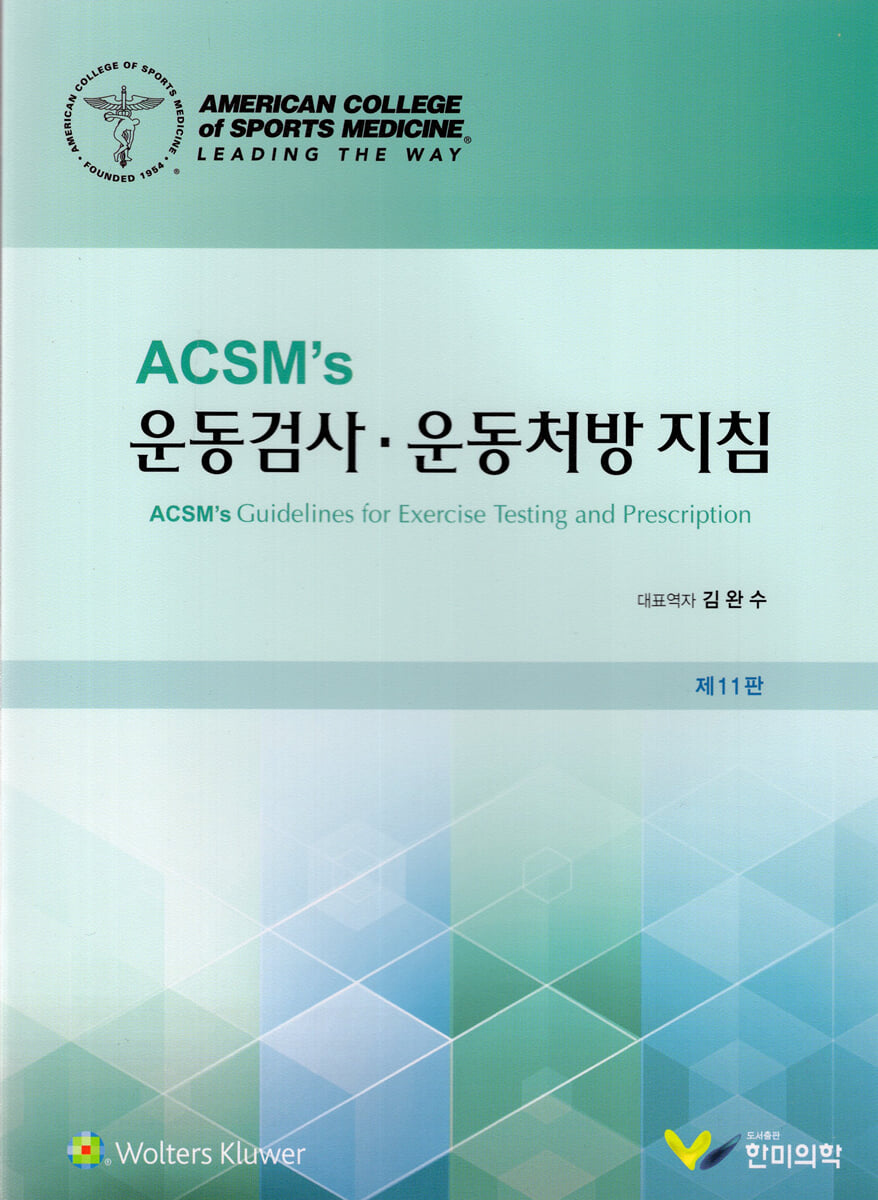
ACSMs Exercise Testing and Exercise Prescription Guidelines
 |
Description
Book Introduction
In 2015, Korea registered “exercise prescription” as an official term in the health and medical field (term code: H00590829).
In addition, major public institutions (National Health Insurance Service, public health centers, Korea Sports Promotion Foundation, etc.) and many general hospitals (clinics) and oriental medicine hospitals (clinics) are recently hiring exercise therapists.
Therefore, exercise prescription is truly a specialized field for health management, and exercise therapists must have the professional knowledge and capabilities to collaborate with medical professionals and other health care providers with pride as professionals.
In this respect, the 11th edition of the translated version of the ACSM's Exercise Testing and Exercise Prescription Guidelines, published by ACSM, the world leader in exercise prescription, will serve as an essential guidebook that not only students and educators majoring in exercise prescription at universities, but also exercise therapists in the field should always keep close by and refer to.
In addition, major public institutions (National Health Insurance Service, public health centers, Korea Sports Promotion Foundation, etc.) and many general hospitals (clinics) and oriental medicine hospitals (clinics) are recently hiring exercise therapists.
Therefore, exercise prescription is truly a specialized field for health management, and exercise therapists must have the professional knowledge and capabilities to collaborate with medical professionals and other health care providers with pride as professionals.
In this respect, the 11th edition of the translated version of the ACSM's Exercise Testing and Exercise Prescription Guidelines, published by ACSM, the world leader in exercise prescription, will serve as an essential guidebook that not only students and educators majoring in exercise prescription at universities, but also exercise therapists in the field should always keep close by and refer to.
index
CHAPTER_01 The Benefits and Risks of Physical Activity --- 1
Benefits and Risks Associated with Physical Activity
CHAPTER_02 Pre-exercise assessment --- 23
Preexercise Evaluation
CHAPTER_03 Health-Related Physical Examinations and Interpretation --- 49
Health-Related Physical Fitness Testing and Interpretation
CHAPTER_04 Clinical Exercise Testing and Interpretation --- 93
Clinical Exercise Testing and Interpretation
CHAPTER_05 General Principles of Exercise Prescription --- 117
General Principles of Exercise Prescription
CHAPTER_06 Exercise Prescriptions for Healthy Populations Requiring Special Considerations --- 137
Exercise Prescription for Healthy Populations with Special Considerations
CHAPTER_07 Environmental Considerations in Exercise Prescription --- 165
Environmental Considerations for Exercise Prescription
CHAPTER_08 Exercise Prescription for Patients with Cardiovascular and Pulmonary Diseases --- 185
Exercise Prescription for Individuals with Cardiovascular and Pulmonary Diseases
CHAPTER_09 Exercise Prescription for People with Metabolic and Cardiovascular Disease Risk Factors --- 223
Exercise Prescription for Individuals with Metabolic Disease and Cardiovascular Disease Risk Factors
CHAPTER 10 Exercise Testing and Prescriptions for People with Other Chronic Diseases and Health Problems --- 247
Exercise Testing and Prescription for Populations with Other Chronic Diseases and Health Conditions
CHAPTER 11 Brain Health and Brain-Related Diseases --- 303
Brain Health and Brain-Related Disorders
CHAPTER 12: Behavioral Theories and Strategies for Enhancing Exercise --- 353
Behavioral Theories and Strategies for Promoting Exercise
Appendix_A Common Drugs --- 377
Common Medications
Appendix_B Electrocardiogram Interpretation --- 384
Electrocardiogram Interpretation
Appendix C: American College of Sports Medicine Certification --- 387
American College of Sports Medicine Certifications
Appendix D: Calculation and Method of Metabolic Rate for Exercise Intensity Prescription --- 391
Metabolic Calculations and Methods for Prescribing Exercise Intensity
Appendix_E Authors of Previous Editions (10th, 9th) --- 398
Contributing Authors to the Previous Two Editions
Search --- 403
Benefits and Risks Associated with Physical Activity
CHAPTER_02 Pre-exercise assessment --- 23
Preexercise Evaluation
CHAPTER_03 Health-Related Physical Examinations and Interpretation --- 49
Health-Related Physical Fitness Testing and Interpretation
CHAPTER_04 Clinical Exercise Testing and Interpretation --- 93
Clinical Exercise Testing and Interpretation
CHAPTER_05 General Principles of Exercise Prescription --- 117
General Principles of Exercise Prescription
CHAPTER_06 Exercise Prescriptions for Healthy Populations Requiring Special Considerations --- 137
Exercise Prescription for Healthy Populations with Special Considerations
CHAPTER_07 Environmental Considerations in Exercise Prescription --- 165
Environmental Considerations for Exercise Prescription
CHAPTER_08 Exercise Prescription for Patients with Cardiovascular and Pulmonary Diseases --- 185
Exercise Prescription for Individuals with Cardiovascular and Pulmonary Diseases
CHAPTER_09 Exercise Prescription for People with Metabolic and Cardiovascular Disease Risk Factors --- 223
Exercise Prescription for Individuals with Metabolic Disease and Cardiovascular Disease Risk Factors
CHAPTER 10 Exercise Testing and Prescriptions for People with Other Chronic Diseases and Health Problems --- 247
Exercise Testing and Prescription for Populations with Other Chronic Diseases and Health Conditions
CHAPTER 11 Brain Health and Brain-Related Diseases --- 303
Brain Health and Brain-Related Disorders
CHAPTER 12: Behavioral Theories and Strategies for Enhancing Exercise --- 353
Behavioral Theories and Strategies for Promoting Exercise
Appendix_A Common Drugs --- 377
Common Medications
Appendix_B Electrocardiogram Interpretation --- 384
Electrocardiogram Interpretation
Appendix C: American College of Sports Medicine Certification --- 387
American College of Sports Medicine Certifications
Appendix D: Calculation and Method of Metabolic Rate for Exercise Intensity Prescription --- 391
Metabolic Calculations and Methods for Prescribing Exercise Intensity
Appendix_E Authors of Previous Editions (10th, 9th) --- 398
Contributing Authors to the Previous Two Editions
Search --- 403
Publisher's Review
Translator's Preface
Exercise prescriptions have been expanding in scope and purpose since the American Heart Association began them in the mid-1970s for the rehabilitation of cardiovascular disease, including the prevention of chronic diseases, improvement of physical fitness, management of chronic diseases, and improvement of function after exercise-related injuries.
In particular, our country has the highest aging rate among OECD countries, and we are facing a serious health care environment with a mortality rate due to chronic diseases of 79.9% and a healthy life expectancy that is approximately 12 years shorter than life expectancy.
As a result, personalized health management tailored to the characteristics of aging and disease is becoming a new paradigm.
So, exercise prescriptions are coming into the spotlight.
The academic foundation of exercise prescription is, firstly, the epidemiology of physical activity. Physical inactivity is a major cause of 35 diseases and the fifth leading cause of death worldwide, and therefore should be prevented through regular physical activity.
Second, in exercise physiology, the human body responds to stress and adapts when exposed to stress for a certain period of time. Exercise, which is a positive stress, is a programmed physical activity aimed at improving health and physical fitness.
Therefore, reducing lack of physical activity in daily life and practicing exercise with an exercise prescription based on individual health and physical fitness level is the most effective health management strategy for extending healthy lifespan, which is the key to functional longevity.
In 2015, Korea registered “exercise prescription” as an official term in the health and medical field (term code: H00590829).
In addition, major public institutions (National Health Insurance Service, public health centers, Korea Sports Promotion Foundation, etc.) and many general hospitals (clinics) and oriental medicine hospitals (clinics) are recently hiring exercise therapists.
Therefore, exercise prescription is truly a specialized field for health management, and exercise therapists must have the professional knowledge and capabilities to collaborate with medical professionals and other health care providers with pride as professionals.
In this respect, the 11th edition of the translated version of the ACSM's Exercise Testing and Exercise Prescription Guidelines, published by ACSM, the world leader in exercise prescription, will serve as an essential guidebook that not only students and educators majoring in exercise prescription at universities, but also exercise therapists in the field should always keep close by and refer to.
Finally, I would like to express my sincere gratitude to the professors who participated in the translation of this 11th edition, to Directors Kim Han-soo and Lee Eun-ah who worked hard as medical reviewers, and to President Lee Kwang-jae, Director Lee Jong-hee, and Manager Oh In-taek of Hanmi Medical Publishing who have made a substantial contribution to the popularization of exercise prescription in Korea since the publication of the 7th edition.
Representative translator Kim Wan-su
American College of Sports Medicine Clinical Exercise Physiologist (ACSM-CEP)
Professor, Department of Rehabilitation and Health Promotion, College of Rehabilitation Science, Daegu University
Exercise prescriptions have been expanding in scope and purpose since the American Heart Association began them in the mid-1970s for the rehabilitation of cardiovascular disease, including the prevention of chronic diseases, improvement of physical fitness, management of chronic diseases, and improvement of function after exercise-related injuries.
In particular, our country has the highest aging rate among OECD countries, and we are facing a serious health care environment with a mortality rate due to chronic diseases of 79.9% and a healthy life expectancy that is approximately 12 years shorter than life expectancy.
As a result, personalized health management tailored to the characteristics of aging and disease is becoming a new paradigm.
So, exercise prescriptions are coming into the spotlight.
The academic foundation of exercise prescription is, firstly, the epidemiology of physical activity. Physical inactivity is a major cause of 35 diseases and the fifth leading cause of death worldwide, and therefore should be prevented through regular physical activity.
Second, in exercise physiology, the human body responds to stress and adapts when exposed to stress for a certain period of time. Exercise, which is a positive stress, is a programmed physical activity aimed at improving health and physical fitness.
Therefore, reducing lack of physical activity in daily life and practicing exercise with an exercise prescription based on individual health and physical fitness level is the most effective health management strategy for extending healthy lifespan, which is the key to functional longevity.
In 2015, Korea registered “exercise prescription” as an official term in the health and medical field (term code: H00590829).
In addition, major public institutions (National Health Insurance Service, public health centers, Korea Sports Promotion Foundation, etc.) and many general hospitals (clinics) and oriental medicine hospitals (clinics) are recently hiring exercise therapists.
Therefore, exercise prescription is truly a specialized field for health management, and exercise therapists must have the professional knowledge and capabilities to collaborate with medical professionals and other health care providers with pride as professionals.
In this respect, the 11th edition of the translated version of the ACSM's Exercise Testing and Exercise Prescription Guidelines, published by ACSM, the world leader in exercise prescription, will serve as an essential guidebook that not only students and educators majoring in exercise prescription at universities, but also exercise therapists in the field should always keep close by and refer to.
Finally, I would like to express my sincere gratitude to the professors who participated in the translation of this 11th edition, to Directors Kim Han-soo and Lee Eun-ah who worked hard as medical reviewers, and to President Lee Kwang-jae, Director Lee Jong-hee, and Manager Oh In-taek of Hanmi Medical Publishing who have made a substantial contribution to the popularization of exercise prescription in Korea since the publication of the 7th edition.
Representative translator Kim Wan-su
American College of Sports Medicine Clinical Exercise Physiologist (ACSM-CEP)
Professor, Department of Rehabilitation and Health Promotion, College of Rehabilitation Science, Daegu University
GOODS SPECIFICS
- Date of issue: January 25, 2022
- Page count, weight, size: 408 pages | Checking size
- ISBN13: 9791190322379
- ISBN10: 1190322374
You may also like
카테고리
korean


korean

![GQ KOREA Mark (Monthly): December [2025]](http://librairie.coreenne.fr/cdn/shop/files/8ef265dbbfbf186523ed75ba7319009d.jpg?v=1765340328&width=3840)


