

Myofascial meridian anatomy
 |
Description
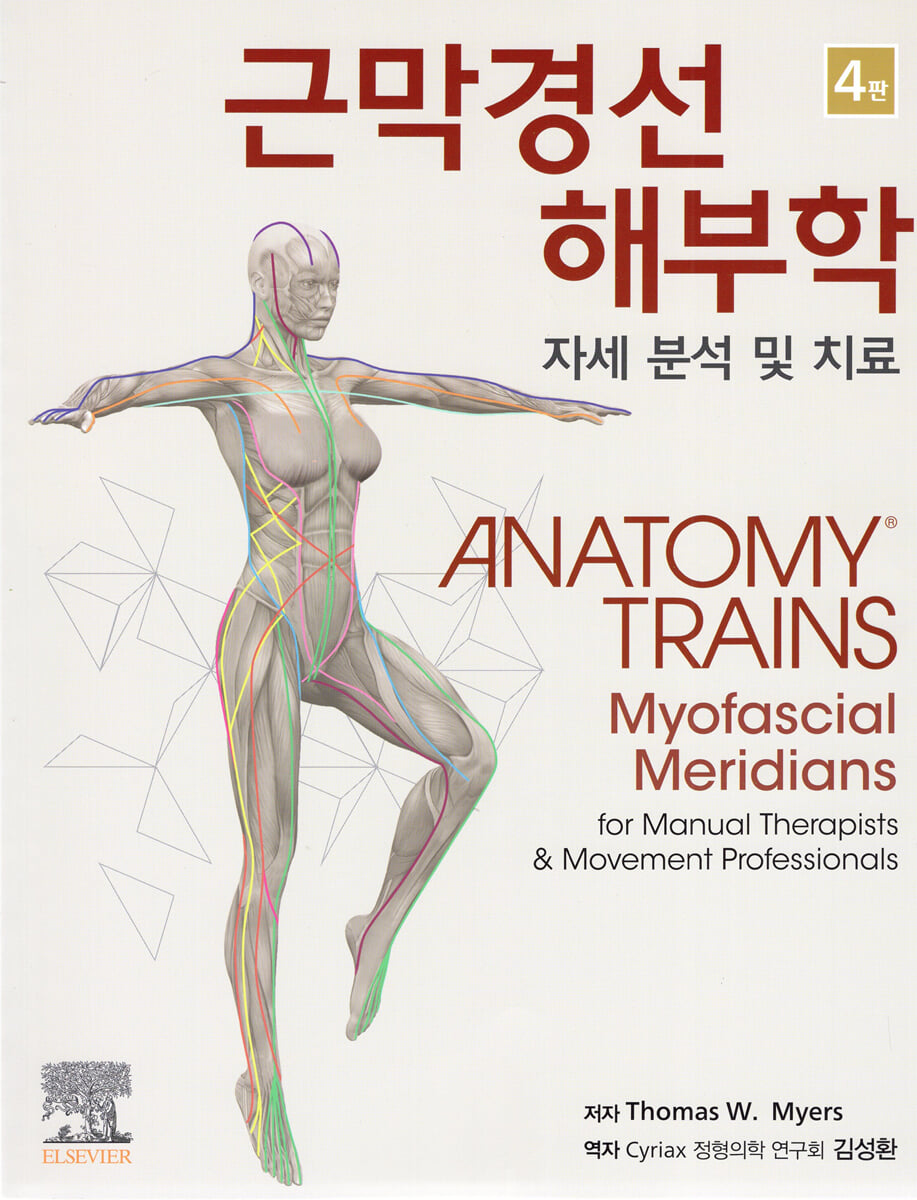
Book Introduction
『Fascial Meridian Anatomy』 is designed to provide a quick understanding of relevant concepts for the casual reader, while allowing for in-depth analysis for the curious reader.
This revised 4th edition is more detailed than the 3rd edition to help readers understand better, and many of the findings from recent research have been added to the appendix.
Additionally, for the first time, data on the myofascial meridians of dogs and horses have been included in the appendix, and the same anatomical photographs and drawings from the 3rd and 4th editions have been explained from slightly different angles, allowing us to indirectly infer the author's thoughts, changes in concepts, and direction.
Additionally, the Pilates section has been summarized and newly added, and the Body Reading section has also been greatly strengthened.
This revised 4th edition is more detailed than the 3rd edition to help readers understand better, and many of the findings from recent research have been added to the appendix.
Additionally, for the first time, data on the myofascial meridians of dogs and horses have been included in the appendix, and the same anatomical photographs and drawings from the 3rd and 4th editions have been explained from slightly different angles, allowing us to indirectly infer the author's thoughts, changes in concepts, and direction.
Additionally, the Pilates section has been summarized and newly added, and the Body Reading section has also been greatly strengthened.
index
Recommendation I v
Recommendation II vi
Translator's Note vii
Preface viii
How to Read This Book ix
Thanks x
1 Establishing the Foundation 1
Rule 21 of the 2nd Path
3 Surface back line 31
4 Surface Front Line 61
5 Outer line 85
6 Spiral Line 107
7 Upper limb line 131
8 Function Line 159
9 Deep Front Line 169
10 Anatomy Trains in Movement
Contributions by JAMES EARLS and KARIN GURTNER 201
11 BodyReading® - Structural Analysis 249
Appendix 1 Fascia Reading 278
Appendix 2 Notes on Latitude Transverse Lines: The Work of Dr. Louis Schultz (1927-2007) 371
Appendix 3 Structural Integration 375
Appendix 4: Myofascial Meridians and Oriental Medicine 387
Appendix 5: Anatomy of Quadrupeds - Initial Survey
*Authors: Rikke Schultz, Tove Due, and Vibeke Elbrønd 397
Glossary 407
Search 409
Recommendation II vi
Translator's Note vii
Preface viii
How to Read This Book ix
Thanks x
1 Establishing the Foundation 1
Rule 21 of the 2nd Path
3 Surface back line 31
4 Surface Front Line 61
5 Outer line 85
6 Spiral Line 107
7 Upper limb line 131
8 Function Line 159
9 Deep Front Line 169
10 Anatomy Trains in Movement
Contributions by JAMES EARLS and KARIN GURTNER 201
11 BodyReading® - Structural Analysis 249
Appendix 1 Fascia Reading 278
Appendix 2 Notes on Latitude Transverse Lines: The Work of Dr. Louis Schultz (1927-2007) 371
Appendix 3 Structural Integration 375
Appendix 4: Myofascial Meridians and Oriental Medicine 387
Appendix 5: Anatomy of Quadrupeds - Initial Survey
*Authors: Rikke Schultz, Tove Due, and Vibeke Elbrønd 397
Glossary 407
Search 409
Publisher's Review
Translator's Note
Since inviting Thomas Myers to Korea for seminars in 2007 and 2008, I have had the opportunity to study Anatomy Trains in depth by translating the 2nd, 3rd, and 4th editions of Anatomy Trains, as well as Body 3, all written by Myers.
When I first encountered the first edition of the Anatomy Trains book, I was struck by its freshness and dazzling impact, and I believe it opened up a new horizon for me in the world of myofascial meridians.
As the edition was revised, more and more information related to myofascia was added and the clinical application area was expanded.
This revised 4th edition is more detailed than the 3rd edition to help readers understand better, and many of the findings from recent research have been added to the appendix.
Additionally, for the first time, data on the myofascial meridians of dogs and horses have been included in the appendix, and the same anatomical photographs and drawings from the 3rd and 4th editions have been explained from slightly different angles, allowing us to indirectly infer the author's thoughts, changes in concepts, and direction.
Additionally, the Pilates section has been summarized and newly added, and the Body Reading section has also been greatly strengthened.
I've put a lot of effort into translating it using simple words that are easy to understand, and while there may be some awkward parts in Korean where I tried to directly translate metaphors or colloquial terms that Meyer uses, I believe there will be little problem with the flow of the context and understanding.
If there are any unwanted mistranslations due to lack of understanding or if the translator's limited Korean language skills do not allow for better expressions, we ask that these be corrected or added in the future reprint.
Several errors in the previous English original 3rd edition were corrected in this 4th edition, but we would like to point out that there are errors in the English original 4th edition as well, and we have translated it after verification and correction.
The academic exchanges with the professors of the Syriax Orthopedic Research Society were very helpful in the translation process, and I would like to take this opportunity to express my gratitude.
Translator: Kim Seong-hwan DC
preface
Since the first edition was published in 2001, the scope of application of the book's ideas has far exceeded the author's expectations.
We have been asked to educate on the ideas and applications of this book by a wide range of professionals, including orthopedic surgeons, rehabilitation physicians, oral surgeons, physical therapists, podiatrists, chiropractors, osteopaths, psychologists, athlete and personal trainers, performance coaches, midwives, yoga teachers, martial artists, massage therapists, dancers, musicians, and all types of body educators working around the world except Antarctica.
This book has already been translated into 15 languages.
Therapists and educators seeking useful applications beyond the concepts in this book have now generated over 13 million Google searches for Anatomy Trains. This fourth edition not only incorporates the foundational evidence from fascial anatomy and several studies on fascial force transmission beyond muscle origins and insertions, but also updates the numerous minor revisions that have occurred during ongoing teaching and practice.
Not only have I been able to correct and fill in facts that were previously unknown, but I have also been able to incorporate several new discoveries about the world of fascia and myofascial fascia since the third edition.
To facilitate the connection between the 3rd and 4th editions, new understandings of fascia are summarized and given significant weight in the appendix at the end.
Readers seeking a more detailed picture of the functioning of the fascial system will find the appendix to be a re-creation of the figures from Chapter 1 of the third edition.
Readers who wish to delve deeper into the material contained in this book may also consult the included appendix.
We are also delighted to include in this fourth edition the exploration of myofascial continuity in quadrupeds (particularly horses and dogs) developed by Danish veterinarians. These appendices summarize our flagship protocol, the 12-part Anatomy Trains structural integration series, and have been expanded to reflect our growing teaching experience as we progress across cultures.
The fourth edition includes revised and updated illustrations with the help of Grameme Chambers, Debbie Maizels, and Philip Wilson.
To convey the allure, complexity, and universality of the fascial system, we have included preliminary photographs from the early Fascial Net Plastination Project (FNPP). The techniques of FNPP are the same ones pioneered by Gunther von Hagens and used in BodyWorlds, and we are pleased to include the photographs that gave birth to this technique.
We look forward to sharing more images and models using this technique in the future.
This book is designed to provide a quick understanding of relevant concepts for the casual reader, while providing in-depth analysis for the curious reader.
It's okay to quickly flip through the book to get the overall concept first.
Next, look at the pictures and read the captions under them to try to understand the story to the extent that you can.
Finally, for a more complete story, take a closer look at the icon-coded text to stimulate readers' various interests.
In line with recent textbook compilation trends, this book is also increasing the use of electronic media.
For readers who require further research, we have included website addresses and are continually updating them on our website, www.anatom-ytrains.com.
Professionally applied examples of the Anatomy Trains concept are available in dozens of video programs for your reference.
Video footage of our techniques, video programs with dissections and visual assessments, computer-generated representations of Anatomy Trains, webinars, patient photos for visual assessment exercises, and other engaging videos are available in ebook format, offering engaging content not available in book format, and on our website and app (www.expertconsult.com). Both our understanding of the role of fascia and the meaning and application of Anatomy Trains are rapidly evolving.
The newly published 4th edition expands the scope and links to the Internet website, ensuring an up-to-date view of fascia and ensuring inclusion of elements that have been widely missing from movement research.
Since inviting Thomas Myers to Korea for seminars in 2007 and 2008, I have had the opportunity to study Anatomy Trains in depth by translating the 2nd, 3rd, and 4th editions of Anatomy Trains, as well as Body 3, all written by Myers.
When I first encountered the first edition of the Anatomy Trains book, I was struck by its freshness and dazzling impact, and I believe it opened up a new horizon for me in the world of myofascial meridians.
As the edition was revised, more and more information related to myofascia was added and the clinical application area was expanded.
This revised 4th edition is more detailed than the 3rd edition to help readers understand better, and many of the findings from recent research have been added to the appendix.
Additionally, for the first time, data on the myofascial meridians of dogs and horses have been included in the appendix, and the same anatomical photographs and drawings from the 3rd and 4th editions have been explained from slightly different angles, allowing us to indirectly infer the author's thoughts, changes in concepts, and direction.
Additionally, the Pilates section has been summarized and newly added, and the Body Reading section has also been greatly strengthened.
I've put a lot of effort into translating it using simple words that are easy to understand, and while there may be some awkward parts in Korean where I tried to directly translate metaphors or colloquial terms that Meyer uses, I believe there will be little problem with the flow of the context and understanding.
If there are any unwanted mistranslations due to lack of understanding or if the translator's limited Korean language skills do not allow for better expressions, we ask that these be corrected or added in the future reprint.
Several errors in the previous English original 3rd edition were corrected in this 4th edition, but we would like to point out that there are errors in the English original 4th edition as well, and we have translated it after verification and correction.
The academic exchanges with the professors of the Syriax Orthopedic Research Society were very helpful in the translation process, and I would like to take this opportunity to express my gratitude.
Translator: Kim Seong-hwan DC
preface
Since the first edition was published in 2001, the scope of application of the book's ideas has far exceeded the author's expectations.
We have been asked to educate on the ideas and applications of this book by a wide range of professionals, including orthopedic surgeons, rehabilitation physicians, oral surgeons, physical therapists, podiatrists, chiropractors, osteopaths, psychologists, athlete and personal trainers, performance coaches, midwives, yoga teachers, martial artists, massage therapists, dancers, musicians, and all types of body educators working around the world except Antarctica.
This book has already been translated into 15 languages.
Therapists and educators seeking useful applications beyond the concepts in this book have now generated over 13 million Google searches for Anatomy Trains. This fourth edition not only incorporates the foundational evidence from fascial anatomy and several studies on fascial force transmission beyond muscle origins and insertions, but also updates the numerous minor revisions that have occurred during ongoing teaching and practice.
Not only have I been able to correct and fill in facts that were previously unknown, but I have also been able to incorporate several new discoveries about the world of fascia and myofascial fascia since the third edition.
To facilitate the connection between the 3rd and 4th editions, new understandings of fascia are summarized and given significant weight in the appendix at the end.
Readers seeking a more detailed picture of the functioning of the fascial system will find the appendix to be a re-creation of the figures from Chapter 1 of the third edition.
Readers who wish to delve deeper into the material contained in this book may also consult the included appendix.
We are also delighted to include in this fourth edition the exploration of myofascial continuity in quadrupeds (particularly horses and dogs) developed by Danish veterinarians. These appendices summarize our flagship protocol, the 12-part Anatomy Trains structural integration series, and have been expanded to reflect our growing teaching experience as we progress across cultures.
The fourth edition includes revised and updated illustrations with the help of Grameme Chambers, Debbie Maizels, and Philip Wilson.
To convey the allure, complexity, and universality of the fascial system, we have included preliminary photographs from the early Fascial Net Plastination Project (FNPP). The techniques of FNPP are the same ones pioneered by Gunther von Hagens and used in BodyWorlds, and we are pleased to include the photographs that gave birth to this technique.
We look forward to sharing more images and models using this technique in the future.
This book is designed to provide a quick understanding of relevant concepts for the casual reader, while providing in-depth analysis for the curious reader.
It's okay to quickly flip through the book to get the overall concept first.
Next, look at the pictures and read the captions under them to try to understand the story to the extent that you can.
Finally, for a more complete story, take a closer look at the icon-coded text to stimulate readers' various interests.
In line with recent textbook compilation trends, this book is also increasing the use of electronic media.
For readers who require further research, we have included website addresses and are continually updating them on our website, www.anatom-ytrains.com.
Professionally applied examples of the Anatomy Trains concept are available in dozens of video programs for your reference.
Video footage of our techniques, video programs with dissections and visual assessments, computer-generated representations of Anatomy Trains, webinars, patient photos for visual assessment exercises, and other engaging videos are available in ebook format, offering engaging content not available in book format, and on our website and app (www.expertconsult.com). Both our understanding of the role of fascia and the meaning and application of Anatomy Trains are rapidly evolving.
The newly published 4th edition expands the scope and links to the Internet website, ensuring an up-to-date view of fascia and ensuring inclusion of elements that have been widely missing from movement research.
GOODS SPECIFICS
- Date of issue: July 1, 2021
- Page count, weight, size: 414 pages | Checking size
- ISBN13: 9791188258345
- ISBN10: 1188258346
You may also like
카테고리
korean


korean

![ELLE 엘르 스페셜 에디션 A형 : 12월 [2025]](http://librairie.coreenne.fr/cdn/shop/files/b8e27a3de6c9538896439686c6b0e8fb.jpg?v=1766436872&width=3840)


