

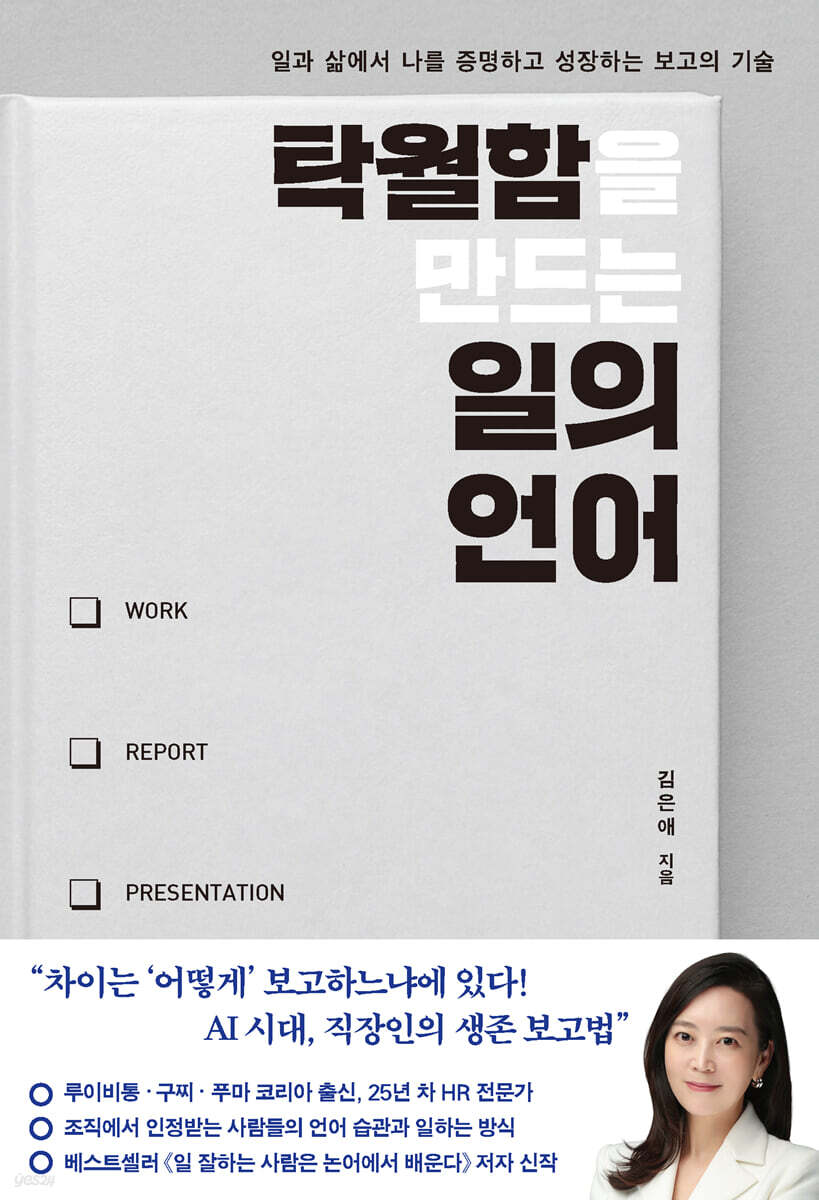
The Language of Creating Excellence
 |
Description
Book Introduction
★ 25 years of experience in human resources, from Louis Vuitton, Gucci, and Puma Korea
★ Author of the best-selling book "Those Who Work Well Learn from the Analects"
“The difference lies in how it is reported.”
Survival Tips for Office Workers in the AI Era
This book contains essential survival tips for anyone who wants to maintain self-esteem and achieve success at work.
Author Eun-ae Kim is an HR (Human Resources) expert with experience in numerous organizations and their members on the global stage.
Having worked my way up from a regular employee to an executive, I realized that the secret to achieving outstanding performance within an organization lies in the language of work, namely reporting. This is why I wrote this book, "The Language of Work: Creating Excellence."
The author says that, based on his 25 years of experience as a human resources manager, people who are good at reporting have an overwhelming advantage in promotions, salaries, and opportunities over people who are simply good at their jobs.
Although we live in an era where AI (artificial intelligence) summarizes data in real time and writes reports on our behalf, the author emphasizes that human reporting skills have become even more important.
This is because organizations now value more than ever the ability of reporters to 'interpret' facts processed by machines quickly and accurately within the context of the organization and to 'propose' strategies.
Anyone can simply convey information, but only those who can think for themselves and report on it to contribute to organizational decision-making will survive in this AI-driven world.
In this book, the author has comprehensively covered everything from the 'standards' of reporting to the 'updated techniques' needed by office workers living in these changing times.
First, it explains why reporting is an essential skill for office workers' survival. It then shows how to incorporate interpretation and judgment into your reports that machines cannot. Finally, it provides specific examples of specific reports that can garner trust and performance in any crisis.
We impart practical and professional communication skills, including psychological strategies and scenario techniques that change the judgment and behavior of leaders and colleagues.
By mastering the details of the reports contained in this book, you'll be able to effectively communicate your thoughts in the language of work, making your work life much easier and ensuring your abilities and value are properly recognized within your organization.
★ Author of the best-selling book "Those Who Work Well Learn from the Analects"
“The difference lies in how it is reported.”
Survival Tips for Office Workers in the AI Era
This book contains essential survival tips for anyone who wants to maintain self-esteem and achieve success at work.
Author Eun-ae Kim is an HR (Human Resources) expert with experience in numerous organizations and their members on the global stage.
Having worked my way up from a regular employee to an executive, I realized that the secret to achieving outstanding performance within an organization lies in the language of work, namely reporting. This is why I wrote this book, "The Language of Work: Creating Excellence."
The author says that, based on his 25 years of experience as a human resources manager, people who are good at reporting have an overwhelming advantage in promotions, salaries, and opportunities over people who are simply good at their jobs.
Although we live in an era where AI (artificial intelligence) summarizes data in real time and writes reports on our behalf, the author emphasizes that human reporting skills have become even more important.
This is because organizations now value more than ever the ability of reporters to 'interpret' facts processed by machines quickly and accurately within the context of the organization and to 'propose' strategies.
Anyone can simply convey information, but only those who can think for themselves and report on it to contribute to organizational decision-making will survive in this AI-driven world.
In this book, the author has comprehensively covered everything from the 'standards' of reporting to the 'updated techniques' needed by office workers living in these changing times.
First, it explains why reporting is an essential skill for office workers' survival. It then shows how to incorporate interpretation and judgment into your reports that machines cannot. Finally, it provides specific examples of specific reports that can garner trust and performance in any crisis.
We impart practical and professional communication skills, including psychological strategies and scenario techniques that change the judgment and behavior of leaders and colleagues.
By mastering the details of the reports contained in this book, you'll be able to effectively communicate your thoughts in the language of work, making your work life much easier and ensuring your abilities and value are properly recognized within your organization.
- You can preview some of the book's contents.
Preview
index
prolog
PART 1.
Definition of Report
Define work
The history of reporting
The language of consensus that determines the success of an organization
There's Nothing Unseen: The Formula for Survival
What will work be like in the AI era?
Why should yesterday's and today's reports be different?
Automated data and human judgment
PART 2.
Report
The core of the report is in the text.
How is the article reported?
Reports Need Design Too: The Power of Designing Thoughts
Reporting is not a technique
Recipe for a Report
Writing a report is like building a building.
Track all data to the end
Archiving is the power of reporting
Writing for Reports: Five Core Skills
The Structure of Reporting Learned from Hospital Charts
PART 3.
Report
You need to learn the language of work to report well.
The Pitfalls of Oral Reporting: Misunderstandings Arising from Contextual Conflicts
The beginning of reporting is thinking ability
The paradigm of thinking has shifted since COVID-19.
Words in reports are different from words in everyday life.
A word of advice on turning a crisis into an opportunity
The Secrets of Leading Companies' Reports
The Socratic Method: The Perfect Report
The Steve Jobs Reporting Method: Simplifying to the Essentials
Beginning the Oral Report: Preliminary Questions
Feedback Skills of Leaders Who Drive Growth
Incorporate insights into every report!
Report so that even elementary school students can understand
Don't report in a double-headed manner
The art of reporting to produce conclusions
Something more important than this report
There is no successful report without prior reporting.
A look speaks louder than words
PART 4.
Reporter
Start of the report
What Type of Reporter Are You?: Reporting Tendency Test
Who reports is more important than what is reported.
There should be no hierarchy in reporting.
Impress the person you are reporting to!
Alignment with all relevant organizations
The Importance of Soft Skills
Trust is persuasiveness
Reporting Insights for Team Leaders
Those receiving reports also need training.
Why are the best people good at reporting?
Technology that moves leaders' hearts beyond data
Even new recruits deserve to be trained: Train from the beginning.
Recipes for Beginner Reporters
Think one more than others
Report in HOW format
Take your own answer
Who reports?
Who the hell is good at reporting?
Reporting is emotional labor: How to manage your emotions
Learn to report: Acting, delivery, and reactions
Epilogue
PART 1.
Definition of Report
Define work
The history of reporting
The language of consensus that determines the success of an organization
There's Nothing Unseen: The Formula for Survival
What will work be like in the AI era?
Why should yesterday's and today's reports be different?
Automated data and human judgment
PART 2.
Report
The core of the report is in the text.
How is the article reported?
Reports Need Design Too: The Power of Designing Thoughts
Reporting is not a technique
Recipe for a Report
Writing a report is like building a building.
Track all data to the end
Archiving is the power of reporting
Writing for Reports: Five Core Skills
The Structure of Reporting Learned from Hospital Charts
PART 3.
Report
You need to learn the language of work to report well.
The Pitfalls of Oral Reporting: Misunderstandings Arising from Contextual Conflicts
The beginning of reporting is thinking ability
The paradigm of thinking has shifted since COVID-19.
Words in reports are different from words in everyday life.
A word of advice on turning a crisis into an opportunity
The Secrets of Leading Companies' Reports
The Socratic Method: The Perfect Report
The Steve Jobs Reporting Method: Simplifying to the Essentials
Beginning the Oral Report: Preliminary Questions
Feedback Skills of Leaders Who Drive Growth
Incorporate insights into every report!
Report so that even elementary school students can understand
Don't report in a double-headed manner
The art of reporting to produce conclusions
Something more important than this report
There is no successful report without prior reporting.
A look speaks louder than words
PART 4.
Reporter
Start of the report
What Type of Reporter Are You?: Reporting Tendency Test
Who reports is more important than what is reported.
There should be no hierarchy in reporting.
Impress the person you are reporting to!
Alignment with all relevant organizations
The Importance of Soft Skills
Trust is persuasiveness
Reporting Insights for Team Leaders
Those receiving reports also need training.
Why are the best people good at reporting?
Technology that moves leaders' hearts beyond data
Even new recruits deserve to be trained: Train from the beginning.
Recipes for Beginner Reporters
Think one more than others
Report in HOW format
Take your own answer
Who reports?
Who the hell is good at reporting?
Reporting is emotional labor: How to manage your emotions
Learn to report: Acting, delivery, and reactions
Epilogue
Detailed image
.jpg)
Into the book
Reporters in the AI era must change.
A summary that is simply a list of numbers or a copy-and-paste (copying and pasting content or format, etc.) is no longer meaningful.
Rather, the ability to provide ‘judgment’ and ‘insight’ that machines cannot do has become very important.
Based on the results presented by automated reporting, you should be able to interpret what drove these results, identify the context and limitations of the data, and suggest future directions for your organization.
Passing on visible data as is is not reporting, it is essentially dereliction of duty.
The act of relaying information without interpretation cannot be considered responsible reporting.
--- "Automated Data and Human Judgment (PART 1.
From “Definition of Reporting”)
This happened when I had to report on a reorganization a while ago.
At the time, the target of the report was the Asia General Manager, and the topic was 'Why should we change the organizational structure now?'
At that time, my colleagues each started creating their own reports, starting with slides.
But, without opening the PPT, I took out a piece of paper first and wrote it like this.
· What exactly is the problem with the organization right now?
· What data and phenomena can confirm this problem?
· What is the solution to this problem?
· Why do you think that solution is the best at this point?
--- 「Reports also require design: The power of designing thoughts (PART 2.
From the report)
Thoughtless reporting is no different from 'forwarding the messenger'.
For example, when your boss says, “Please report on this month’s sales,” a report that simply lists numbers is meaningless.
“This month’s sales are 1 billion won.
end."
This is informational, not a report.
But when the reporter's thoughts enter into this, the report takes on a completely different power.
“This month’s sales are 1 billion won.
It decreased by 15% compared to last month, due to delayed execution of online channel advertising.
“Next month, if we bring forward the execution date, it looks like we will see a recovery.”
This small difference means a lot to your boss.
Simple information leaves us asking, "So what?" But a thoughtful report already suggests the problem, its cause, and a clue to a solution.
--- "Incorporate Insight into Every Report! (PART 3.
From the report)
Reporting is a conversation about judgment rather than emotion, but paradoxically, emotional design is very important in guiding that judgment.
Trust, confidence, urgency.
How a leader combines these three emotions determines his or her response.
That's why, half jokingly and half seriously, when reporting to the CEO, the secretary checks on the CEO's condition and office atmosphere.
Ultimately, the core of reporting is not conveying data, but interpreting and giving meaning to that data to lead leaders to make decisions. Furthermore, organizations can only move when they can move hearts beyond data.
A summary that is simply a list of numbers or a copy-and-paste (copying and pasting content or format, etc.) is no longer meaningful.
Rather, the ability to provide ‘judgment’ and ‘insight’ that machines cannot do has become very important.
Based on the results presented by automated reporting, you should be able to interpret what drove these results, identify the context and limitations of the data, and suggest future directions for your organization.
Passing on visible data as is is not reporting, it is essentially dereliction of duty.
The act of relaying information without interpretation cannot be considered responsible reporting.
--- "Automated Data and Human Judgment (PART 1.
From “Definition of Reporting”)
This happened when I had to report on a reorganization a while ago.
At the time, the target of the report was the Asia General Manager, and the topic was 'Why should we change the organizational structure now?'
At that time, my colleagues each started creating their own reports, starting with slides.
But, without opening the PPT, I took out a piece of paper first and wrote it like this.
· What exactly is the problem with the organization right now?
· What data and phenomena can confirm this problem?
· What is the solution to this problem?
· Why do you think that solution is the best at this point?
--- 「Reports also require design: The power of designing thoughts (PART 2.
From the report)
Thoughtless reporting is no different from 'forwarding the messenger'.
For example, when your boss says, “Please report on this month’s sales,” a report that simply lists numbers is meaningless.
“This month’s sales are 1 billion won.
end."
This is informational, not a report.
But when the reporter's thoughts enter into this, the report takes on a completely different power.
“This month’s sales are 1 billion won.
It decreased by 15% compared to last month, due to delayed execution of online channel advertising.
“Next month, if we bring forward the execution date, it looks like we will see a recovery.”
This small difference means a lot to your boss.
Simple information leaves us asking, "So what?" But a thoughtful report already suggests the problem, its cause, and a clue to a solution.
--- "Incorporate Insight into Every Report! (PART 3.
From the report)
Reporting is a conversation about judgment rather than emotion, but paradoxically, emotional design is very important in guiding that judgment.
Trust, confidence, urgency.
How a leader combines these three emotions determines his or her response.
That's why, half jokingly and half seriously, when reporting to the CEO, the secretary checks on the CEO's condition and office atmosphere.
Ultimately, the core of reporting is not conveying data, but interpreting and giving meaning to that data to lead leaders to make decisions. Furthermore, organizations can only move when they can move hearts beyond data.
--- "Technology that moves the heart of a leader beyond data (PART 4.
Among the people of the report)
Among the people of the report)
Publisher's Review
“Can Your Report Survive in the AI Era?”
"Workplace Survival Tips" from a Global HR Expert
What are the essential skills for corporate survival? In the past, people considered foreign language skills, field expertise, diligence, and report writing skills. But now, with more and more jobs being replaced by AI, it's becoming harder to answer which skills you need to develop.
If you were to ask today's workers the question I posed in the beginning, they would likely answer with skills for effectively utilizing AI, such as ChatGPT, or expert-level knowledge for managing AI.
How should we prepare and live in this age of artificial intelligence versus humans, with even self-deprecating concerns about the uselessness of humans?
The author, an HR expert with decades of experience working with thousands of employees and diverse organizations at global companies such as Louis Vuitton, Gucci, and Puma Korea, emphasizes that in order to survive as an irreplaceable high performer in this uncertain world, you must be good at reporting.
You might wonder why we need to learn how to do reporting well, especially in a world where AI writes reports and data is automatically documented, when it's not just another skill.
However, the author emphasizes that a report is more than just a document submitted to a superior.
This is because, ultimately, it is the ‘human report’ that moves things along and creates results, that is, what guides the leader’s judgment and the organization’s execution.
And in the age of AI, where massive amounts of data can be quickly summarized and organized, the ability to express one's thoughts in a report has become an essential weapon for proving one's presence and excellence in an organization.
The author has compiled in this book all the reporting required of office workers, based on decades of human resources experience ranging from general employees to executives.
It goes beyond fragmentary skills such as report writing and covers the essence of work and communication skills.
"There's a separate language for people who are good at their jobs."
The Art of Reporting: Protecting Self-Esteem and Promoting Performance
This book is divided into four major parts and explains the techniques of reporting.
First, let's explain what work is like in the AI era (PART 1.
(Definition of Reporting), How to Write Your Report with Interpretations and Judgments That Machines Cannot Make (PART 2.
(Part 3 of the Report) and feedback techniques that build trust and performance in any crisis situation.
(Report) is conveyed.
Lastly, it comprehensively provides communication know-how to gain recognition from the organization, that is, how to draw out the potential and recognition of team members and report effectively to decision makers (PART 4.
(person of report).
The author's unique career development and people management strategies, including how to brand yourself and demonstrate your work capabilities through reporting, are fully included.
〈PART 3.
Let's look at an example of a report in "Report's Notes".
In a simple work case of entering customer data into Excel, some people just enter the data, send the file to their boss, and finish the work.
But others report this:
“While entering data this week, I looked at the age distribution of my customers, and the highest percentage of women were in their late 20s.
“I think it can be used as a reference for setting future marketing targets.” Reports that are thoughtful like the latter provide insights that the organization can refer to, and as these reports accumulate, I can gain the trust of my superiors and the organization, take on better projects, and grow my career.
This book, "The Language of Excellence," contains specific reporting situations and example sentences based on the author's 25 years of experience, making it ideal for practical use in the workplace.
I highly recommend this book to everyone: from new employees who want to adapt well to those in the company, to managers who need to be recognized by the company for their achievements with employees of different generations, and even to leaders who receive reports and drive the organization forward.
For those of you who want to develop the skills to survive in this rapidly changing era and excel at work and life, this book will be the most reliable guide to upgrading your career.
"Workplace Survival Tips" from a Global HR Expert
What are the essential skills for corporate survival? In the past, people considered foreign language skills, field expertise, diligence, and report writing skills. But now, with more and more jobs being replaced by AI, it's becoming harder to answer which skills you need to develop.
If you were to ask today's workers the question I posed in the beginning, they would likely answer with skills for effectively utilizing AI, such as ChatGPT, or expert-level knowledge for managing AI.
How should we prepare and live in this age of artificial intelligence versus humans, with even self-deprecating concerns about the uselessness of humans?
The author, an HR expert with decades of experience working with thousands of employees and diverse organizations at global companies such as Louis Vuitton, Gucci, and Puma Korea, emphasizes that in order to survive as an irreplaceable high performer in this uncertain world, you must be good at reporting.
You might wonder why we need to learn how to do reporting well, especially in a world where AI writes reports and data is automatically documented, when it's not just another skill.
However, the author emphasizes that a report is more than just a document submitted to a superior.
This is because, ultimately, it is the ‘human report’ that moves things along and creates results, that is, what guides the leader’s judgment and the organization’s execution.
And in the age of AI, where massive amounts of data can be quickly summarized and organized, the ability to express one's thoughts in a report has become an essential weapon for proving one's presence and excellence in an organization.
The author has compiled in this book all the reporting required of office workers, based on decades of human resources experience ranging from general employees to executives.
It goes beyond fragmentary skills such as report writing and covers the essence of work and communication skills.
"There's a separate language for people who are good at their jobs."
The Art of Reporting: Protecting Self-Esteem and Promoting Performance
This book is divided into four major parts and explains the techniques of reporting.
First, let's explain what work is like in the AI era (PART 1.
(Definition of Reporting), How to Write Your Report with Interpretations and Judgments That Machines Cannot Make (PART 2.
(Part 3 of the Report) and feedback techniques that build trust and performance in any crisis situation.
(Report) is conveyed.
Lastly, it comprehensively provides communication know-how to gain recognition from the organization, that is, how to draw out the potential and recognition of team members and report effectively to decision makers (PART 4.
(person of report).
The author's unique career development and people management strategies, including how to brand yourself and demonstrate your work capabilities through reporting, are fully included.
〈PART 3.
Let's look at an example of a report in "Report's Notes".
In a simple work case of entering customer data into Excel, some people just enter the data, send the file to their boss, and finish the work.
But others report this:
“While entering data this week, I looked at the age distribution of my customers, and the highest percentage of women were in their late 20s.
“I think it can be used as a reference for setting future marketing targets.” Reports that are thoughtful like the latter provide insights that the organization can refer to, and as these reports accumulate, I can gain the trust of my superiors and the organization, take on better projects, and grow my career.
This book, "The Language of Excellence," contains specific reporting situations and example sentences based on the author's 25 years of experience, making it ideal for practical use in the workplace.
I highly recommend this book to everyone: from new employees who want to adapt well to those in the company, to managers who need to be recognized by the company for their achievements with employees of different generations, and even to leaders who receive reports and drive the organization forward.
For those of you who want to develop the skills to survive in this rapidly changing era and excel at work and life, this book will be the most reliable guide to upgrading your career.
GOODS SPECIFICS
- Date of issue: October 14, 2025
- Page count, weight, size: 260 pages | 388g | 140*205*15mm
- ISBN13: 9788968335211
- ISBN10: 8968335214
You may also like
카테고리
korean


korean

![GQ KOREA Mark (Monthly): December [2025]](http://librairie.coreenne.fr/cdn/shop/files/8ef265dbbfbf186523ed75ba7319009d.jpg?v=1765340328&width=3840)


