

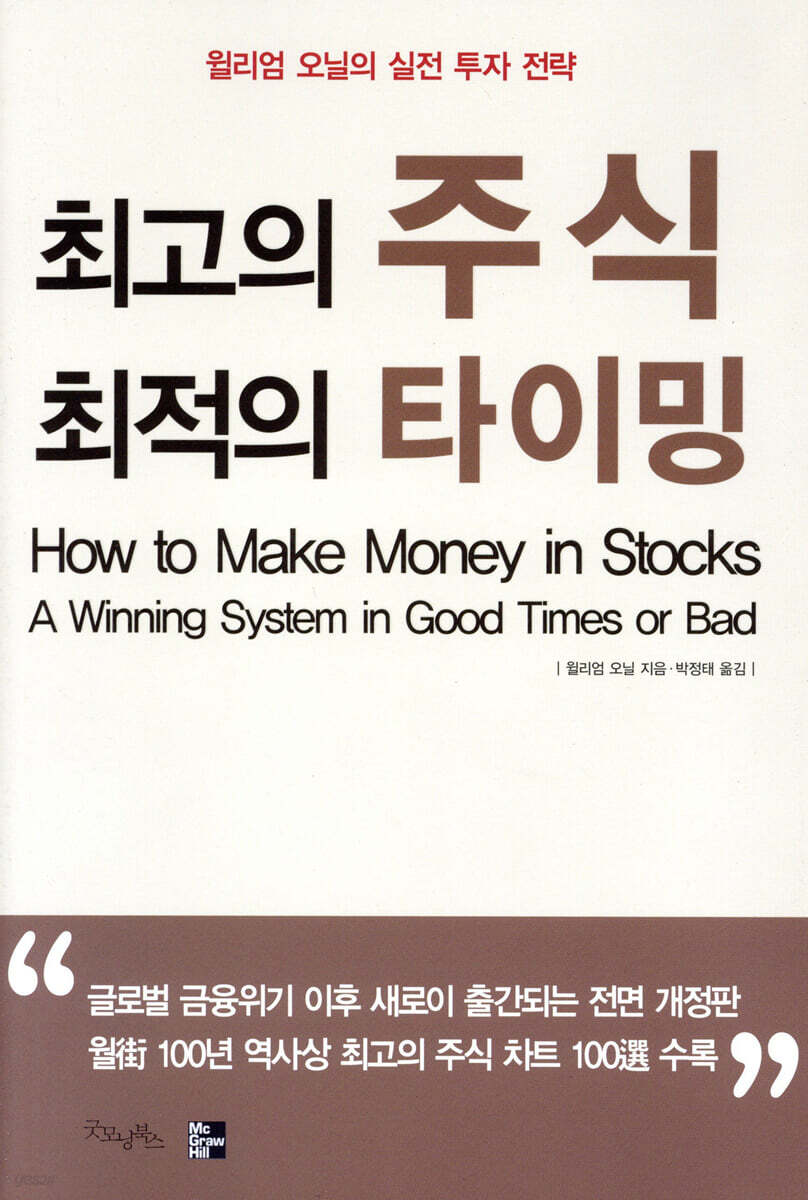
Best stock, best timing
 |
Description
Book Introduction
"The Best Stock, the Best Timing," first published in the United States in 1988, was praised for accurately and coolly pointing out the secrets of successful investing, and became a rare million-seller among stock-related books.
Following the first edition, the second and third editions published in 1995 and 2002 both became million-sellers, and the newly released fourth edition has also maintained its position as a bestseller in the economics and management category on Amazon since its publication.
This book, first published in Korea in January 2003, is a translation of the third edition.
This book lists three keys to successful investing:
(1) Follow an efficient stock selection method such as the CAN SLIM principle, (2) manage risk with the absolute stop-loss principle, and (3) strictly adhere to these two principles.
The author emphasizes that the stock market is not that simple, and that it takes at least two to three years of study to be able to read the market trends.
Following the first edition, the second and third editions published in 1995 and 2002 both became million-sellers, and the newly released fourth edition has also maintained its position as a bestseller in the economics and management category on Amazon since its publication.
This book, first published in Korea in January 2003, is a translation of the third edition.
This book lists three keys to successful investing:
(1) Follow an efficient stock selection method such as the CAN SLIM principle, (2) manage risk with the absolute stop-loss principle, and (3) strictly adhere to these two principles.
The author emphasizes that the stock market is not that simple, and that it takes at least two to three years of study to be able to read the market trends.
- You can preview some of the book's contents.
Preview
index
introduction
Chapter 1: The Secret to Finding the Best Stocks
Chapter 2: Professional Chart Reading for Stock Selection and Timing
Chapter 3 C = Current Quarterly Earnings Per Share: The higher, the faster it grows, the better.
Chapter 4 A = Annual Net Income Growth Rate: Finding the Key to Growth
Chapter 5: N = New Products, New Management, and New Prices: Buy at the Right Time
Chapter 6 S=Demand and Supply: Large-Scale Demand at Critical Points
Chapter 7: L = Leading or Left Behind: Which Stock Is Yours?
Chapter 8 I = Support from Institutional Investors: Follow the Leader's Moves
Chapter 9: M=Market Direction: How to Judge
Chapter 10: When to Cut Your Losses
Chapter 11: When to Sell Profitable Stocks
Chapter 12: Diversification and Long-Term Investment, Credit Investment, and Short Selling
Chapter 13: The 21 Most Common Mistakes Investors Make
Chapter 14: Leverage the Models Shown by the Best Stocks
Chapter 15: Identifying the Best Market Themes and Leading Industries
Chapter 16: Guidelines to Keep in Mind
Translator's Note
Chapter 1: The Secret to Finding the Best Stocks
Chapter 2: Professional Chart Reading for Stock Selection and Timing
Chapter 3 C = Current Quarterly Earnings Per Share: The higher, the faster it grows, the better.
Chapter 4 A = Annual Net Income Growth Rate: Finding the Key to Growth
Chapter 5: N = New Products, New Management, and New Prices: Buy at the Right Time
Chapter 6 S=Demand and Supply: Large-Scale Demand at Critical Points
Chapter 7: L = Leading or Left Behind: Which Stock Is Yours?
Chapter 8 I = Support from Institutional Investors: Follow the Leader's Moves
Chapter 9: M=Market Direction: How to Judge
Chapter 10: When to Cut Your Losses
Chapter 11: When to Sell Profitable Stocks
Chapter 12: Diversification and Long-Term Investment, Credit Investment, and Short Selling
Chapter 13: The 21 Most Common Mistakes Investors Make
Chapter 14: Leverage the Models Shown by the Best Stocks
Chapter 15: Identifying the Best Market Themes and Leading Industries
Chapter 16: Guidelines to Keep in Mind
Translator's Note
Into the book
“You can start small.
If you are an ordinary office worker or a beginner who is just starting to invest in stocks, there is no need to invest a large amount of money from the beginning.
You can start with a small amount, such as $500 or $1,000, and gradually increase your investment amount as your income and savings increase.
“I, too, first started investing in stocks when I was twenty-one, fresh out of college. At the time, the only stock I owned was five shares of Procter & Gamble.” ---p.12
“Most investors just pick their favorite stocks and hope for good luck.
But successful investors pay attention to the market rather than clinging to their opinions or holding false hopes.
Because the market is usually right.”---p.386
“Let go of pride and stubbornness.
The market doesn't care what you think.
No matter how smart you think you are, the market always moves smarter.
Having a high IQ or a PhD does not guarantee success in stock investing.
The more you insist, the greater the loss.
Don't fight the market.
“Don’t try to prove that you are right and the market is wrong.”
If you are an ordinary office worker or a beginner who is just starting to invest in stocks, there is no need to invest a large amount of money from the beginning.
You can start with a small amount, such as $500 or $1,000, and gradually increase your investment amount as your income and savings increase.
“I, too, first started investing in stocks when I was twenty-one, fresh out of college. At the time, the only stock I owned was five shares of Procter & Gamble.” ---p.12
“Most investors just pick their favorite stocks and hope for good luck.
But successful investors pay attention to the market rather than clinging to their opinions or holding false hopes.
Because the market is usually right.”---p.386
“Let go of pride and stubbornness.
The market doesn't care what you think.
No matter how smart you think you are, the market always moves smarter.
Having a high IQ or a PhD does not guarantee success in stock investing.
The more you insist, the greater the loss.
Don't fight the market.
“Don’t try to prove that you are right and the market is wrong.”
---p.427
Publisher's Review
William O'Neil, considered one of the best investment strategists on Wall Street, has released his masterpiece, "The Best Stocks, The Best Timing," after 10 years.
In particular, the newly published, completely revised edition is noteworthy for including a selection of stock charts of the 100 best stocks in the history of the U.S. stock market.
The theme of this book can be summarized in one sentence: "Which stocks do successful investors buy and when do they sell?"
Success in the stock market means accurately selecting the best stocks and buying and selling them at the right time.
"The Best Stock, the Best Timing" presents exactly this stock selection method and buying and selling principles for successful investing.
It is also important that these are methods and principles that have been proven over many years.
This book lists three keys to successful investing:
(1) Follow an efficient stock selection method such as the CAN SLIM principle, (2) manage risk with the absolute stop-loss principle, and (3) strictly adhere to these two principles.
The author emphasizes that the stock market is not that simple, and that it takes at least two to three years of study to be able to read the market trends.
First of all, from the very beginning of Chapter 1, it shows a stock price chart of a railroad company from 1885. It is full of vast data covering over 100 years of stock market history, vivid trading cases from over 50 years of field experience, and sharp yet appropriate metaphors that reflect the inner strength honed over many years. It is enough to elicit admiration and say, “William O’Neill is the real deal.”
Chapters 3 through 9 also present "CAN SLIM," seven principles for picking the best stocks at the optimal timing. While the CAN SLIM principles are based on case studies collected from the US stock market, as the author points out, they are equally applicable in Korea.
This is because the human psychology and logic of capital that permeate the stock market are the same everywhere. Along with the CAN SLIM principles, this book contains a valuable treasure: easy-to-understand chart analysis techniques.
Chapter 2 of this book explains how to read charts for stock selection and timing. It directly models stock price patterns that appear just before explosive price increases and classifies them into “cup-with-handle” and “tall flag” shapes.
It is a valuable gift that anyone can utilize with just a little effort.
Chapters 10 to 16 explain when to sell the stocks purchased this way.
If you can maximize your investment returns and minimize your losses, that's the path to success in stock investing.
It provides a specific example.
Among them, Chapter 13 (21 Most Common Mistakes Investors Make) and Chapter 16 (Guidelines You Must Keep in Mind) contain William O'Neil's investment philosophy in its entirety.
If you just keep the information here in mind, stock investing won't be that difficult.
For example, let's look at the part where it says to be wary of cheap stocks.
He explains that what matters is not “how many stocks you can own,” but “how much money you are investing.”
This is something that amateur investors who feel good about holding a lot of low-priced stocks must keep in mind.
This book was first published in the United States in 1988, and as soon as it was published, it became a million-seller, a rare feat for a stock-related book, with praise for accurately and coolly pointing out the secrets to successful investment.
Following the first edition, the second and third editions, published in 1995 and 2002, both became million-selling books. The newly released fourth edition has also maintained its position as an Amazon bestseller in the economics and management category since its release. (The book "Best Stock, Best Timing," first published in Korea in January 2003, is a translation of the third edition.)
In particular, the newly published, completely revised edition is noteworthy for including a selection of stock charts of the 100 best stocks in the history of the U.S. stock market.
The theme of this book can be summarized in one sentence: "Which stocks do successful investors buy and when do they sell?"
Success in the stock market means accurately selecting the best stocks and buying and selling them at the right time.
"The Best Stock, the Best Timing" presents exactly this stock selection method and buying and selling principles for successful investing.
It is also important that these are methods and principles that have been proven over many years.
This book lists three keys to successful investing:
(1) Follow an efficient stock selection method such as the CAN SLIM principle, (2) manage risk with the absolute stop-loss principle, and (3) strictly adhere to these two principles.
The author emphasizes that the stock market is not that simple, and that it takes at least two to three years of study to be able to read the market trends.
First of all, from the very beginning of Chapter 1, it shows a stock price chart of a railroad company from 1885. It is full of vast data covering over 100 years of stock market history, vivid trading cases from over 50 years of field experience, and sharp yet appropriate metaphors that reflect the inner strength honed over many years. It is enough to elicit admiration and say, “William O’Neill is the real deal.”
Chapters 3 through 9 also present "CAN SLIM," seven principles for picking the best stocks at the optimal timing. While the CAN SLIM principles are based on case studies collected from the US stock market, as the author points out, they are equally applicable in Korea.
This is because the human psychology and logic of capital that permeate the stock market are the same everywhere. Along with the CAN SLIM principles, this book contains a valuable treasure: easy-to-understand chart analysis techniques.
Chapter 2 of this book explains how to read charts for stock selection and timing. It directly models stock price patterns that appear just before explosive price increases and classifies them into “cup-with-handle” and “tall flag” shapes.
It is a valuable gift that anyone can utilize with just a little effort.
Chapters 10 to 16 explain when to sell the stocks purchased this way.
If you can maximize your investment returns and minimize your losses, that's the path to success in stock investing.
It provides a specific example.
Among them, Chapter 13 (21 Most Common Mistakes Investors Make) and Chapter 16 (Guidelines You Must Keep in Mind) contain William O'Neil's investment philosophy in its entirety.
If you just keep the information here in mind, stock investing won't be that difficult.
For example, let's look at the part where it says to be wary of cheap stocks.
He explains that what matters is not “how many stocks you can own,” but “how much money you are investing.”
This is something that amateur investors who feel good about holding a lot of low-priced stocks must keep in mind.
This book was first published in the United States in 1988, and as soon as it was published, it became a million-seller, a rare feat for a stock-related book, with praise for accurately and coolly pointing out the secrets to successful investment.
Following the first edition, the second and third editions, published in 1995 and 2002, both became million-selling books. The newly released fourth edition has also maintained its position as an Amazon bestseller in the economics and management category since its release. (The book "Best Stock, Best Timing," first published in Korea in January 2003, is a translation of the third edition.)
GOODS SPECIFICS
- Date of issue: June 20, 2012
- Page count, weight, size: 432 pages | 780g | 153*224*30mm
- ISBN13: 9788991378261
- ISBN10: 8991378269
You may also like
카테고리
korean


korean

![GQ KOREA Mark (Monthly): December [2025]](http://librairie.coreenne.fr/cdn/shop/files/8ef265dbbfbf186523ed75ba7319009d.jpg?v=1765340328&width=3840)


