

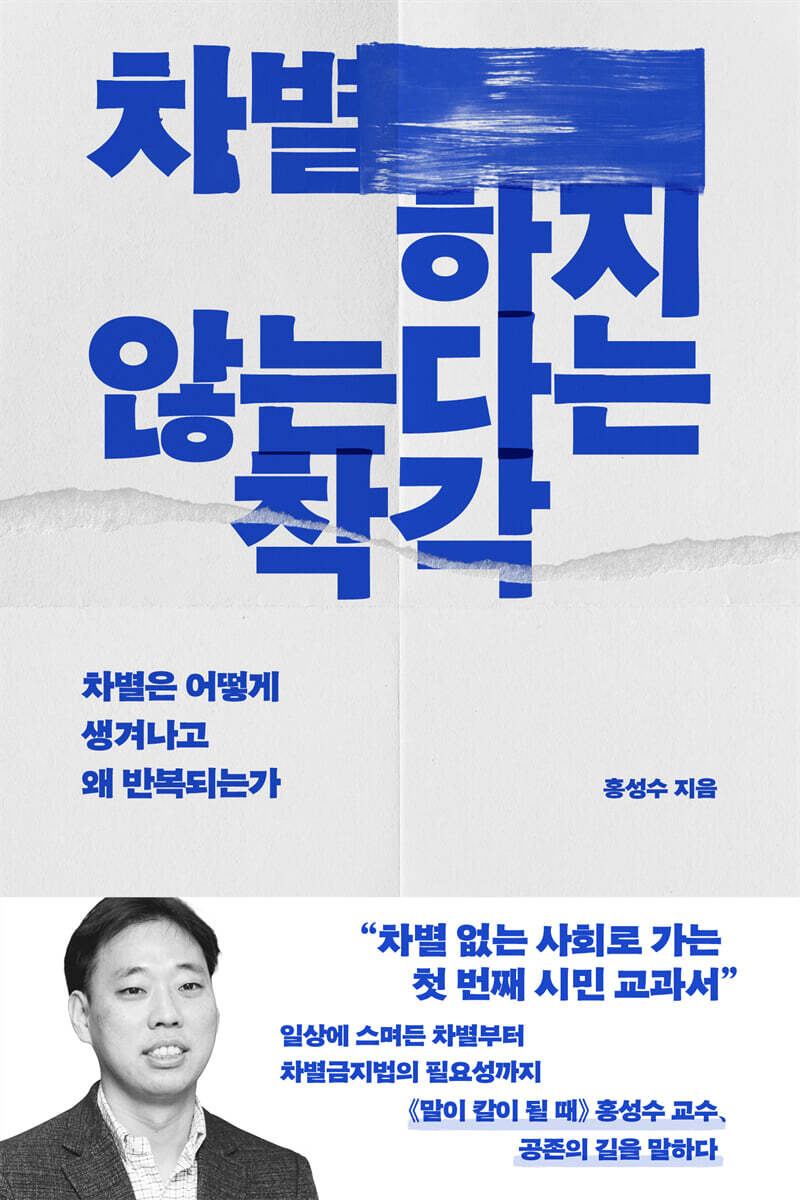
The illusion of non-discrimination
 |
Description
Book Introduction
- A word from MD
-
There is no freedom to hateHumans distinguish between in-group and out-group.
It divides us into groups based on nationality, age, race, gender, etc., and sometimes leads to discrimination.
What makes discrimination bad is that it leads to hatred and violence.
A book that confronts social issues head-on, such as no-kids zones, refugees, and female employment.
November 7, 2025. Social and Political PD Son Min-gyu
"The First Citizens' Textbook on the Path to a Discrimination-Free Society"
From discrimination permeating everyday life to the need for anti-discrimination laws.
Professor Hong Seong-su, "When Words Become Swords," speaks of the path to coexistence.
“The Ministry of Gender Equality and Family discriminates against men,” “Sexual minorities enjoy privileges,” “Disabled people’s protests are a hostage situation using citizens as bait,” “Chinese people, get out of Korea.”
Until recently, extreme hate and discrimination were difficult to express publicly, but now they have penetrated deeply beyond online communities and into everyday life and politics.
Professor Hong Seong-su of Sookmyung Women's University Law School, author of "When Words Become Swords," which caused a stir in our society by preaching what hate speech is and why it is a problem, has returned with a new book, "The Illusion of Not Discriminating," which tackles the issue of "discrimination" head-on.
This book begins with the fundamental question: “How does discrimination arise and why does it persist?”
The author sharply analyzes how hatred and discrimination spread by scapegoating specific groups amidst social crises, and diagnoses the nature of the crisis facing Korean society today.
In particular, it vividly illustrates the issues of exclusion and hatred experienced by social minorities such as women, immigrants, refugees, sexual minorities, and people with disabilities in their daily lives through various domestic and international examples.
Furthermore, the author draws attention to how discrimination is instrumentalized politically.
This article critically illuminates the dangerous mechanism by which politicians pursue political gain by channeling social discontent into hatred against a specific group, as in the case of anti-Chinese sentiment being mobilized to support the December 3, 2024 martial law incident.
It also persuasively argues how the former president's statement that "there is no structural gender discrimination" obscured the reality of discrimination and fueled social regression, and why, in this reality, the enactment of a "comprehensive anti-discrimination law" is an urgent task of our time.
"The Illusion of Non-Discrimination" is a "citizens' textbook" that covers almost all issues surrounding discrimination, from the definition and types of discrimination to the fiction of the reverse discrimination debate, the problem of religion and discrimination, and the specific content and necessity of anti-discrimination laws.
This book asks how the chain of inequality is becoming stronger while we remain complacently under the illusion that we "do not discriminate," and what we need to do to break that illusion and move toward a society of coexistence. It will serve as a guide, offering deep insight and practical direction to all who wish to take the first step toward a society without discrimination.
From discrimination permeating everyday life to the need for anti-discrimination laws.
Professor Hong Seong-su, "When Words Become Swords," speaks of the path to coexistence.
“The Ministry of Gender Equality and Family discriminates against men,” “Sexual minorities enjoy privileges,” “Disabled people’s protests are a hostage situation using citizens as bait,” “Chinese people, get out of Korea.”
Until recently, extreme hate and discrimination were difficult to express publicly, but now they have penetrated deeply beyond online communities and into everyday life and politics.
Professor Hong Seong-su of Sookmyung Women's University Law School, author of "When Words Become Swords," which caused a stir in our society by preaching what hate speech is and why it is a problem, has returned with a new book, "The Illusion of Not Discriminating," which tackles the issue of "discrimination" head-on.
This book begins with the fundamental question: “How does discrimination arise and why does it persist?”
The author sharply analyzes how hatred and discrimination spread by scapegoating specific groups amidst social crises, and diagnoses the nature of the crisis facing Korean society today.
In particular, it vividly illustrates the issues of exclusion and hatred experienced by social minorities such as women, immigrants, refugees, sexual minorities, and people with disabilities in their daily lives through various domestic and international examples.
Furthermore, the author draws attention to how discrimination is instrumentalized politically.
This article critically illuminates the dangerous mechanism by which politicians pursue political gain by channeling social discontent into hatred against a specific group, as in the case of anti-Chinese sentiment being mobilized to support the December 3, 2024 martial law incident.
It also persuasively argues how the former president's statement that "there is no structural gender discrimination" obscured the reality of discrimination and fueled social regression, and why, in this reality, the enactment of a "comprehensive anti-discrimination law" is an urgent task of our time.
"The Illusion of Non-Discrimination" is a "citizens' textbook" that covers almost all issues surrounding discrimination, from the definition and types of discrimination to the fiction of the reverse discrimination debate, the problem of religion and discrimination, and the specific content and necessity of anti-discrimination laws.
This book asks how the chain of inequality is becoming stronger while we remain complacently under the illusion that we "do not discriminate," and what we need to do to break that illusion and move toward a society of coexistence. It will serve as a guide, offering deep insight and practical direction to all who wish to take the first step toward a society without discrimination.
- You can preview some of the book's contents.
Preview
index
At the beginning of the book
Prologue: Why Talk About Discrimination Now?
Part 1: What is Discrimination and Why is It Bad?
Chapter 1: A Story I Want to Share About Discrimination
Chapter 2: Why Discrimination Is Bad
Case: For those who don't see discrimination
Chapter 3: Defining Discrimination
Chapter 4: What kind of discrimination is there?
Issue: Should we specify the target of discrimination or the cause?
Chapter 5 Grounds for Prohibition of Discrimination
Case: Is academic background a personal choice, so is it justifiable discrimination?
Case: Shouldn't criminals whose sentences have expired be discriminated against?
Chapter 6 Areas of Prohibition of Discrimination
Case: The Conflict Between Private Sphere Freedom and Non-Discrimination
Part 2: Discrimination: You Need to Know It to Fight It
Chapter 7 Is Discrimination Allowable?
Issue: The Anti-Discrimination Act for Persons with Disabilities: Why Are There Exceptions?
Chapter 8: Active Approaches to Addressing Discrimination
Case Study: Beyond the Uselessness of Female Police Officers: From Quota System to Integrated Selection of Men and Women
Chapter 9: Does Prohibition of Discrimination Lead to Reverse Discrimination?
Issue: Can Men Be Victims of Sexual Discrimination?
Chapter 10: Religion and Discrimination
Case: Can't a law be enacted that a particular religion opposes?
Part 3: We Need an Anti-Discrimination Act
Chapter 11: History and Current Status of Anti-Discrimination Law
Issue: Are both pros and cons voices "desperate"?
Chapter 12: The Anti-Discrimination Act: The Greatest Umbrella Against Discrimination
Issue: Does anti-discrimination law restrict freedom?
Chapter 13: Recommendations Instead of Punishments
Chapter 14: The Law Opens and Society Completes
Part 4: The Future of Anti-Discrimination and Equality
Chapter 15: Success is achieved without discrimination.
Chapter 16: What if we deny structural discrimination?
Chapter 17: Anti-Discrimination Law and Politics
Epilogue: Towards a Society of Equal Coexistence
Prologue: Why Talk About Discrimination Now?
Part 1: What is Discrimination and Why is It Bad?
Chapter 1: A Story I Want to Share About Discrimination
Chapter 2: Why Discrimination Is Bad
Case: For those who don't see discrimination
Chapter 3: Defining Discrimination
Chapter 4: What kind of discrimination is there?
Issue: Should we specify the target of discrimination or the cause?
Chapter 5 Grounds for Prohibition of Discrimination
Case: Is academic background a personal choice, so is it justifiable discrimination?
Case: Shouldn't criminals whose sentences have expired be discriminated against?
Chapter 6 Areas of Prohibition of Discrimination
Case: The Conflict Between Private Sphere Freedom and Non-Discrimination
Part 2: Discrimination: You Need to Know It to Fight It
Chapter 7 Is Discrimination Allowable?
Issue: The Anti-Discrimination Act for Persons with Disabilities: Why Are There Exceptions?
Chapter 8: Active Approaches to Addressing Discrimination
Case Study: Beyond the Uselessness of Female Police Officers: From Quota System to Integrated Selection of Men and Women
Chapter 9: Does Prohibition of Discrimination Lead to Reverse Discrimination?
Issue: Can Men Be Victims of Sexual Discrimination?
Chapter 10: Religion and Discrimination
Case: Can't a law be enacted that a particular religion opposes?
Part 3: We Need an Anti-Discrimination Act
Chapter 11: History and Current Status of Anti-Discrimination Law
Issue: Are both pros and cons voices "desperate"?
Chapter 12: The Anti-Discrimination Act: The Greatest Umbrella Against Discrimination
Issue: Does anti-discrimination law restrict freedom?
Chapter 13: Recommendations Instead of Punishments
Chapter 14: The Law Opens and Society Completes
Part 4: The Future of Anti-Discrimination and Equality
Chapter 15: Success is achieved without discrimination.
Chapter 16: What if we deny structural discrimination?
Chapter 17: Anti-Discrimination Law and Politics
Epilogue: Towards a Society of Equal Coexistence
Detailed image

Into the book
Complex crises of various dimensions, including the economic crisis and the climate crisis, are threatening society, and personal insecurity is deepening.
In fact, social crises such as natural disasters, epidemics, wars, economic crises, and mass unemployment serve as triggers for the spread of hatred and discrimination.
A crisis is a crisis because it cannot be solved by conventional means.
(...) Rather than joining forces to overcome a crisis, people often find an inappropriate scapegoat and shift the blame.
This is hatred and discrimination.
Will men be happy if the Ministry of Gender Equality and Family, which has become a symbol of reverse discrimination, is abolished? In reality, most of the Ministry's budget is spent on family and youth issues, with only 17 percent devoted to women.
This budget is allocated to preventing sexual harassment, sexual violence, and sex trafficking, protecting victims, protecting children and adolescents from sexual abuse, and supporting women who have taken career breaks.
If we distribute this equally to men, can we have an equal society?
--- From the "Prologue"
If you can reject a child, you can reject someone for any other reason.
If no-kids zones represent freedom of business, can bans on blacks, Muslims, and homosexuals be tolerated? As expected, the expansion of no-kids zones has led to the creation of "No-Ah-Jae-Zones," "No-Ah-Ajumma Zones," and "No-Senior Zones," which prohibit certain adults from entering.
I would like to ask whether a society that allows people belonging to certain groups to be conveniently excluded under the pretext of freedom of business can truly be called a society in which all members of the community are free and equal.
--- From "Chapter 1: What I Want to Share About Discrimination"
Victims of discrimination say that when they experience discrimination, they feel personally humiliated, ashamed, insulted, degraded, or despised.
(...) I feel more anxious and fearful that something like this might happen again in the future.
You become consumed by the anxiety and fear that you might not be welcome anywhere in the world.
--- From "Chapter 2: Why Discrimination is Bad"
The value of freedom is precious, but the world created by the 'freedom to discriminate' is terrible.
It's not just about not being able to enter a certain restaurant or not being able to get a job at a certain company.
You can buy cakes from other bakeries, and it's not like there's only one place to get a job.
But let's imagine a society where discrimination like this is a normal thing.
If the 'freedom of the cake shop owner' is allowed, homosexuals must check whether 'homosexuals are allowed' in all areas of daily life.
--- From “Chapter 6 Areas of Prohibition of Discrimination”
Anti-discrimination laws do not restrict religious freedom, but rather prohibit companies from firing transgender people, universities from discriminating against gay students, and social welfare facilities from harassing sexual minorities.
This freedom cannot be guaranteed under the pretext of religious freedom.
--- From "Chapter 10: Religion and Discrimination"
Legislation that comprehensively stipulates the basic matters for promoting a certain policy, such as the definition of basic terms, the principles and direction of policy promotion, promotion system, and method of securing funds, is called a 'basic law'. The Anti-Discrimination Act is also a basic law on discrimination that acts as an 'umbrella' for the various anti-discrimination-related laws that are scattered all over the place.
The word "comprehensive" is added to the front of the anti-discrimination law, so it is sometimes called a comprehensive anti-discrimination law. Here, "comprehensive" means that the grounds and areas for prohibiting discrimination are comprehensively stipulated.
--- From "Chapter 12: The Anti-Discrimination Act: The Biggest Umbrella to Prevent Discrimination"
Just because explicit discrimination has disappeared doesn't mean it doesn't exist anymore.
As structural discrimination becomes more apparent, interest in proactive legal and institutional measures to address it grows. However, denying the reality of structural discrimination leads to the exact opposite.
Since each person can live independently and solve the problem individually, there is no reason for the government to be interested.
--- From "Chapter 16: Denying Structural Discrimination?"
A person has multiple identities, and identities are not fixed but can change.
This means that even if you live without any particular losses right now, that situation will not last forever.
Most disabilities are acquired.
Anyone can grow old and get sick.
In a world where discrimination against the socially disadvantaged is tolerated, violence can be directed at me at any time.
It may seem like you'll only live in Korea your whole life, but anyone can become an immigrant or a refugee.
What will become of 'my future' if hatred, discrimination, and violence against people of different religions and cultures become rampant?
Creating an environment where no one, no matter what their identity or where they live, is free from discrimination is an investment in my future, regardless of my present, and it is also something I can do for my beloved family and friends.
Preventing discrimination is not only for our common future, but also for myself.
In fact, social crises such as natural disasters, epidemics, wars, economic crises, and mass unemployment serve as triggers for the spread of hatred and discrimination.
A crisis is a crisis because it cannot be solved by conventional means.
(...) Rather than joining forces to overcome a crisis, people often find an inappropriate scapegoat and shift the blame.
This is hatred and discrimination.
Will men be happy if the Ministry of Gender Equality and Family, which has become a symbol of reverse discrimination, is abolished? In reality, most of the Ministry's budget is spent on family and youth issues, with only 17 percent devoted to women.
This budget is allocated to preventing sexual harassment, sexual violence, and sex trafficking, protecting victims, protecting children and adolescents from sexual abuse, and supporting women who have taken career breaks.
If we distribute this equally to men, can we have an equal society?
--- From the "Prologue"
If you can reject a child, you can reject someone for any other reason.
If no-kids zones represent freedom of business, can bans on blacks, Muslims, and homosexuals be tolerated? As expected, the expansion of no-kids zones has led to the creation of "No-Ah-Jae-Zones," "No-Ah-Ajumma Zones," and "No-Senior Zones," which prohibit certain adults from entering.
I would like to ask whether a society that allows people belonging to certain groups to be conveniently excluded under the pretext of freedom of business can truly be called a society in which all members of the community are free and equal.
--- From "Chapter 1: What I Want to Share About Discrimination"
Victims of discrimination say that when they experience discrimination, they feel personally humiliated, ashamed, insulted, degraded, or despised.
(...) I feel more anxious and fearful that something like this might happen again in the future.
You become consumed by the anxiety and fear that you might not be welcome anywhere in the world.
--- From "Chapter 2: Why Discrimination is Bad"
The value of freedom is precious, but the world created by the 'freedom to discriminate' is terrible.
It's not just about not being able to enter a certain restaurant or not being able to get a job at a certain company.
You can buy cakes from other bakeries, and it's not like there's only one place to get a job.
But let's imagine a society where discrimination like this is a normal thing.
If the 'freedom of the cake shop owner' is allowed, homosexuals must check whether 'homosexuals are allowed' in all areas of daily life.
--- From “Chapter 6 Areas of Prohibition of Discrimination”
Anti-discrimination laws do not restrict religious freedom, but rather prohibit companies from firing transgender people, universities from discriminating against gay students, and social welfare facilities from harassing sexual minorities.
This freedom cannot be guaranteed under the pretext of religious freedom.
--- From "Chapter 10: Religion and Discrimination"
Legislation that comprehensively stipulates the basic matters for promoting a certain policy, such as the definition of basic terms, the principles and direction of policy promotion, promotion system, and method of securing funds, is called a 'basic law'. The Anti-Discrimination Act is also a basic law on discrimination that acts as an 'umbrella' for the various anti-discrimination-related laws that are scattered all over the place.
The word "comprehensive" is added to the front of the anti-discrimination law, so it is sometimes called a comprehensive anti-discrimination law. Here, "comprehensive" means that the grounds and areas for prohibiting discrimination are comprehensively stipulated.
--- From "Chapter 12: The Anti-Discrimination Act: The Biggest Umbrella to Prevent Discrimination"
Just because explicit discrimination has disappeared doesn't mean it doesn't exist anymore.
As structural discrimination becomes more apparent, interest in proactive legal and institutional measures to address it grows. However, denying the reality of structural discrimination leads to the exact opposite.
Since each person can live independently and solve the problem individually, there is no reason for the government to be interested.
--- From "Chapter 16: Denying Structural Discrimination?"
A person has multiple identities, and identities are not fixed but can change.
This means that even if you live without any particular losses right now, that situation will not last forever.
Most disabilities are acquired.
Anyone can grow old and get sick.
In a world where discrimination against the socially disadvantaged is tolerated, violence can be directed at me at any time.
It may seem like you'll only live in Korea your whole life, but anyone can become an immigrant or a refugee.
What will become of 'my future' if hatred, discrimination, and violence against people of different religions and cultures become rampant?
Creating an environment where no one, no matter what their identity or where they live, is free from discrimination is an investment in my future, regardless of my present, and it is also something I can do for my beloved family and friends.
Preventing discrimination is not only for our common future, but also for myself.
--- From "Epilogue"
Publisher's Review
“Why are ‘yellow clothes’ and ‘hijab’ different?”
What is Discrimination and Why is It Bad?
So what is "discrimination," and why is it so bad? This book begins its discussion by clearly defining the concept of discrimination.
The author explains the nature of discrimination through an interesting analogy.
While being denied entry to a restaurant because you're "wearing yellow" is unfair, it's more of a personal misfortune that can be solved by wearing different clothes or going to a different restaurant.
But being rejected for 'wearing a hijab' is a whole other matter.
This is not simply a matter of not being able to eat a meal, but an act that denies an individual's identity and deprives them of equal rights as a member of society.
The author points out that it is at this point that the inherent harm of discrimination arises: the risk of causing personal humiliation and fostering social exclusion and greater violence.
This book clearly states that 'discrimination' is an act of treating someone unfavorably in 'areas of prohibited discrimination' such as employment, education, and provision of goods and services, based on specific 'grounds for prohibited discrimination' such as gender, religion, disability, and sexual orientation without reasonable cause.
It also informs readers of not only direct discrimination but also indirect discrimination, bullying, and other types of discrimination that are subtly hidden, helping readers to properly discern discrimination in their daily lives.
“Are there Chinese people behind the election fraud?”
An era of hatred and discrimination fueled by politics
In recent years, Korean society has entered an era of blatant hatred and discrimination.
The 'No Kids Zone' spread to 'No Senior Zone' and 'No Kids Zone', establishing itself as a culture that justifies the exclusion of a specific generation, and protests to secure the right to mobility for the disabled were condemned as 'selfish actions that use citizens as bait.'
Slogans like “The Chinese are coming” and “Foreign workers are taking our jobs” are no longer unfamiliar, and hatred against sexual minorities, combined with certain religious groups, is the biggest obstacle to enacting anti-discrimination laws.
Professor Hong Seong-su points out that this phenomenon is not simply a matter of individual prejudice, but rather a structural problem that is amplified by the socioeconomic crisis.
In the book's prologue, he writes, "A crisis is a crisis because it cannot be solved by conventional means.
(…) People often chose other options instead of this correct answer.
Rather than joining forces to overcome the crisis, they are looking for an inappropriate scapegoat and shifting the blame.
“This is what hate and discrimination are all about,” he says.
In particular, the author sharply criticizes the reality in which hatred and discrimination serve as the 'fuel for far-right politics.'
A representative example is the 'China hatred' that exploded in combination with conspiracy theories about election fraud during the December 3, 2024 martial law and impeachment trial.
The author argues that this is not a problem that suddenly arose, but rather a result of our society's failure to properly respond to hate and discrimination over the past decade.
While the government and the National Assembly hesitated, hate groups grew in strength, and now, in times of political crisis, they are attacking specific groups to solidify their positions.
The author firmly states, “If you believe that far-right insurgent forces must be eradicated or are concerned about the extreme right-wing shift in Korean society, you must fight against hatred and discrimination.”
“Where is there a case where someone is deducted points because they are a woman?”
Beyond the illusion that there is no structural discrimination
At the heart of the 'illusion of non-discrimination', which is also the title of this book, lies a lack of understanding of 'structural discrimination'.
Former President Yoon Seok-yeol said during his candidacy, “There is no longer structural gender discrimination.
The statement that “discrimination is a personal matter” is a clear example of this perception.
The author emphasizes that the core of discrimination today lies in this ‘structural discrimination.’
While laws and systems that blatantly exclude certain groups, as in the past, are disappearing, the reality remains that long-accumulated social systems, cultures, and practices systematically disadvantage minorities.
The author clearly explains how the nature of discrimination has evolved by comparing the blatant discrimination experienced by Hu-nam in the 1992 drama “Sons and Daughters” with the career gap experienced by the protagonist in the 2016 novel “Kim Ji-young, Born 1982.”
Kim Ji-young's resignation may seem like a 'voluntary choice' on the surface, but behind it are the social pressures that put women in charge of childcare and housework, and the invisible structure of the 'glass ceiling' within companies.
To dismiss this structural discrimination as an “individual problem” is to ignore the reality of discrimination and to abdicate the responsibility of the state and society.
The author argues that “denying the reality of structural discrimination has the exact opposite effect.
He criticized, “Since each person can survive and solve the problem individually, there is no reason for the government to be interested,” and emphasized the urgent need to confront structural discrimination and establish legal and institutional mechanisms to resolve it.
“Why is a ‘comprehensive anti-discrimination law’ needed now?”
The "largest umbrella" for comprehensive prevention and relief of discrimination
Parts 3 and 4 of the book propose the enactment of a 'comprehensive anti-discrimination law' as the most fundamental solution to the problem of discrimination.
The author argues that while individual anti-discrimination laws already exist in Korea, such as the Act on Prohibition of Discrimination against Persons with Disabilities and the Act on Equal Employment Opportunities for Men and Women, these are insufficient to prevent all discrimination.
This is because the blind spots of discrimination that current laws do not cover are still wide, and it is difficult to receive effective relief even if you are discriminated against.
Comprehensive anti-discrimination laws serve as the "largest umbrella" to comprehensively prevent and remedy discrimination that can occur in almost all areas of life, including gender, disability, medical history, age, national origin, race, and sexual orientation.
The author emphasizes that this law is not a special privilege for a specific group, but rather “a process of creating the minimum conditions for all people to live freely and equally” and “a law that creates the conditions for coexistence.”
The book also refutes the most common misconceptions and opposing arguments surrounding the anti-discrimination law.
1.
Does freedom of expression infringe on religious freedom? The author draws a clear line, stating that anti-discrimination laws do not punish individual beliefs or opinions.
However, in areas of a public nature such as employment, education, and the provision of goods and services, acts that create a “hostile and insulting environment” by making hateful remarks against a specific group and causing suffering are prohibited as “discriminatory harassment.”
This is not about the 'freedom to bully', but about guaranteeing everyone the right to work and learn equally.
2.
Are men being discriminated against? The author addresses claims that women's quotas and minority support policies constitute "reverse discrimination" against the majority of men, explaining that they are "active equalization measures" aimed at leveling the playing field.
It is an inevitable measure to achieve substantive equality beyond formal equality, and it is said that through this, we can increase the diversity and competitiveness of our entire society.
3.
Anti-discrimination laws lack social consensus? The author dismisses this claim as nothing more than a "deceptive political tactic" by politicians to delay enactment of the law.
Various opinion polls have already shown that a majority of the public supports the enactment of anti-discrimination laws, reminding us that the role of politics is not to hide behind public opinion, but to foster social consensus and protect the human rights of minorities.
In conclusion, "The Illusion of Non-Discrimination" is a book that argues that discrimination is an urgent issue that can no longer be blamed on an individual's character or postponed as a problem to be solved 'later'; it is a matter of the survival and future of our community.
Through this book, readers will face the true face of discrimination and gain the courage to join the path of solidarity toward a society where all coexist equally.
What is Discrimination and Why is It Bad?
So what is "discrimination," and why is it so bad? This book begins its discussion by clearly defining the concept of discrimination.
The author explains the nature of discrimination through an interesting analogy.
While being denied entry to a restaurant because you're "wearing yellow" is unfair, it's more of a personal misfortune that can be solved by wearing different clothes or going to a different restaurant.
But being rejected for 'wearing a hijab' is a whole other matter.
This is not simply a matter of not being able to eat a meal, but an act that denies an individual's identity and deprives them of equal rights as a member of society.
The author points out that it is at this point that the inherent harm of discrimination arises: the risk of causing personal humiliation and fostering social exclusion and greater violence.
This book clearly states that 'discrimination' is an act of treating someone unfavorably in 'areas of prohibited discrimination' such as employment, education, and provision of goods and services, based on specific 'grounds for prohibited discrimination' such as gender, religion, disability, and sexual orientation without reasonable cause.
It also informs readers of not only direct discrimination but also indirect discrimination, bullying, and other types of discrimination that are subtly hidden, helping readers to properly discern discrimination in their daily lives.
“Are there Chinese people behind the election fraud?”
An era of hatred and discrimination fueled by politics
In recent years, Korean society has entered an era of blatant hatred and discrimination.
The 'No Kids Zone' spread to 'No Senior Zone' and 'No Kids Zone', establishing itself as a culture that justifies the exclusion of a specific generation, and protests to secure the right to mobility for the disabled were condemned as 'selfish actions that use citizens as bait.'
Slogans like “The Chinese are coming” and “Foreign workers are taking our jobs” are no longer unfamiliar, and hatred against sexual minorities, combined with certain religious groups, is the biggest obstacle to enacting anti-discrimination laws.
Professor Hong Seong-su points out that this phenomenon is not simply a matter of individual prejudice, but rather a structural problem that is amplified by the socioeconomic crisis.
In the book's prologue, he writes, "A crisis is a crisis because it cannot be solved by conventional means.
(…) People often chose other options instead of this correct answer.
Rather than joining forces to overcome the crisis, they are looking for an inappropriate scapegoat and shifting the blame.
“This is what hate and discrimination are all about,” he says.
In particular, the author sharply criticizes the reality in which hatred and discrimination serve as the 'fuel for far-right politics.'
A representative example is the 'China hatred' that exploded in combination with conspiracy theories about election fraud during the December 3, 2024 martial law and impeachment trial.
The author argues that this is not a problem that suddenly arose, but rather a result of our society's failure to properly respond to hate and discrimination over the past decade.
While the government and the National Assembly hesitated, hate groups grew in strength, and now, in times of political crisis, they are attacking specific groups to solidify their positions.
The author firmly states, “If you believe that far-right insurgent forces must be eradicated or are concerned about the extreme right-wing shift in Korean society, you must fight against hatred and discrimination.”
“Where is there a case where someone is deducted points because they are a woman?”
Beyond the illusion that there is no structural discrimination
At the heart of the 'illusion of non-discrimination', which is also the title of this book, lies a lack of understanding of 'structural discrimination'.
Former President Yoon Seok-yeol said during his candidacy, “There is no longer structural gender discrimination.
The statement that “discrimination is a personal matter” is a clear example of this perception.
The author emphasizes that the core of discrimination today lies in this ‘structural discrimination.’
While laws and systems that blatantly exclude certain groups, as in the past, are disappearing, the reality remains that long-accumulated social systems, cultures, and practices systematically disadvantage minorities.
The author clearly explains how the nature of discrimination has evolved by comparing the blatant discrimination experienced by Hu-nam in the 1992 drama “Sons and Daughters” with the career gap experienced by the protagonist in the 2016 novel “Kim Ji-young, Born 1982.”
Kim Ji-young's resignation may seem like a 'voluntary choice' on the surface, but behind it are the social pressures that put women in charge of childcare and housework, and the invisible structure of the 'glass ceiling' within companies.
To dismiss this structural discrimination as an “individual problem” is to ignore the reality of discrimination and to abdicate the responsibility of the state and society.
The author argues that “denying the reality of structural discrimination has the exact opposite effect.
He criticized, “Since each person can survive and solve the problem individually, there is no reason for the government to be interested,” and emphasized the urgent need to confront structural discrimination and establish legal and institutional mechanisms to resolve it.
“Why is a ‘comprehensive anti-discrimination law’ needed now?”
The "largest umbrella" for comprehensive prevention and relief of discrimination
Parts 3 and 4 of the book propose the enactment of a 'comprehensive anti-discrimination law' as the most fundamental solution to the problem of discrimination.
The author argues that while individual anti-discrimination laws already exist in Korea, such as the Act on Prohibition of Discrimination against Persons with Disabilities and the Act on Equal Employment Opportunities for Men and Women, these are insufficient to prevent all discrimination.
This is because the blind spots of discrimination that current laws do not cover are still wide, and it is difficult to receive effective relief even if you are discriminated against.
Comprehensive anti-discrimination laws serve as the "largest umbrella" to comprehensively prevent and remedy discrimination that can occur in almost all areas of life, including gender, disability, medical history, age, national origin, race, and sexual orientation.
The author emphasizes that this law is not a special privilege for a specific group, but rather “a process of creating the minimum conditions for all people to live freely and equally” and “a law that creates the conditions for coexistence.”
The book also refutes the most common misconceptions and opposing arguments surrounding the anti-discrimination law.
1.
Does freedom of expression infringe on religious freedom? The author draws a clear line, stating that anti-discrimination laws do not punish individual beliefs or opinions.
However, in areas of a public nature such as employment, education, and the provision of goods and services, acts that create a “hostile and insulting environment” by making hateful remarks against a specific group and causing suffering are prohibited as “discriminatory harassment.”
This is not about the 'freedom to bully', but about guaranteeing everyone the right to work and learn equally.
2.
Are men being discriminated against? The author addresses claims that women's quotas and minority support policies constitute "reverse discrimination" against the majority of men, explaining that they are "active equalization measures" aimed at leveling the playing field.
It is an inevitable measure to achieve substantive equality beyond formal equality, and it is said that through this, we can increase the diversity and competitiveness of our entire society.
3.
Anti-discrimination laws lack social consensus? The author dismisses this claim as nothing more than a "deceptive political tactic" by politicians to delay enactment of the law.
Various opinion polls have already shown that a majority of the public supports the enactment of anti-discrimination laws, reminding us that the role of politics is not to hide behind public opinion, but to foster social consensus and protect the human rights of minorities.
In conclusion, "The Illusion of Non-Discrimination" is a book that argues that discrimination is an urgent issue that can no longer be blamed on an individual's character or postponed as a problem to be solved 'later'; it is a matter of the survival and future of our community.
Through this book, readers will face the true face of discrimination and gain the courage to join the path of solidarity toward a society where all coexist equally.
GOODS SPECIFICS
- Date of issue: October 24, 2025
- Page count, weight, size: 292 pages | 388g | 140*210*19mm
- ISBN13: 9791167742469
You may also like
카테고리
korean


korean

![GQ KOREA Mark (Monthly): December [2025]](http://librairie.coreenne.fr/cdn/shop/files/8ef265dbbfbf186523ed75ba7319009d.jpg?v=1765340328&width=3840)


