

Satan Tango
 |
Description
Book Introduction
Winner of the 2015 Man Booker International Prize
The original novel of the movie [Satantango]
“Krusnahorkai is the greatest living apocalyptic writer.”_Susan Sontag
“It’s a monstrous novel.”_The Guardian
"A work like no other in modern literature" - The New York Review of Books
"An artist who reawakened the power of art even amidst the fear of destruction."
Continuing our connection with Korean readers with the new work "Hersheyt 07769."
László Krásznáhorkaj, a master of modern Hungarian literature, has won the 2025 Nobel Prize in Literature.
The Nobel Committee stated that the award was given for “a powerful and visionary work that reawakens the power of art even in the face of the horrors of destruction,” and that he had shown again the possibility of a “prophetic language” that modern literature had lost.
A literary prophet walking the boundaries of language, between destruction and salvation.
Since his literary debut in 1985 with "Satantango," László Krzysztof Krzysztof Krzysztof has been a writer who has depicted the anxieties of human existence and the collapse of the world in his compelling prose. His prose, with its endlessly long sentences and intense narrative tension, immerses readers in a unique style that can be called a "reading exercise."
Alma Publishing has introduced the author's six representative works, "Satan Tango," "Melancholy of Resistance," "The Last Wolf," "The World Goes On," "The Descent of the Queen Mother of the West," and "The Return of Baron Wenkheim," to Korea, and plans to publish a new work, "Herscht 07769," in January 2026.
"Hersht 07769" depicts the journey of "Hersht," a man called by a number instead of a name, as he seeks to rediscover his identity and the meaning of language in a world after the collapse of civilization. In a society where communication is based solely on numbers and symbols, he encounters a world of humans whose names can no longer be called. This work is considered to be the author's later work that most densely embodies the "anxiety of existence" and "human possibilities after the end of language," which the author has consistently explored.
His literary works, which have expanded globally, have long cultivated a deep readership, even amidst a quiet resonance. This Nobel Prize in Literature marks the moment when his endless exploration of the origins of humanity and art is once again resurrected in the languages of the world, and will undoubtedly resonate deeply with readers.
Promotion of screenings of "Reading László Krzysztof ...
To commemorate this award, Alma Publishing will present a booklet titled "Reading László Krasnahorkai" (tentative title), which aims to bring readers closer to the world of literature, which is by no means easy but essential to read. The contributors include Professor Han Kyung-min, poet Jo Won-gyu, film critic Jeong Seong-il, literary critic Jang Eun-soo, critic Geum Jeong-yeon, and poet Kim Yu-tae, who will each interpret the author's world from their own perspectives.
Additionally, in order to expand and illuminate the author's literary world through film, we are promoting the screening of "Werckmeister Harmonies," based on the films "Satantango" and "Resistance Melancholy" by another world-renowned director, Tar Bella.
The original novel of the movie [Satantango]
“Krusnahorkai is the greatest living apocalyptic writer.”_Susan Sontag
“It’s a monstrous novel.”_The Guardian
"A work like no other in modern literature" - The New York Review of Books
"An artist who reawakened the power of art even amidst the fear of destruction."
Continuing our connection with Korean readers with the new work "Hersheyt 07769."
László Krásznáhorkaj, a master of modern Hungarian literature, has won the 2025 Nobel Prize in Literature.
The Nobel Committee stated that the award was given for “a powerful and visionary work that reawakens the power of art even in the face of the horrors of destruction,” and that he had shown again the possibility of a “prophetic language” that modern literature had lost.
A literary prophet walking the boundaries of language, between destruction and salvation.
Since his literary debut in 1985 with "Satantango," László Krzysztof Krzysztof Krzysztof has been a writer who has depicted the anxieties of human existence and the collapse of the world in his compelling prose. His prose, with its endlessly long sentences and intense narrative tension, immerses readers in a unique style that can be called a "reading exercise."
Alma Publishing has introduced the author's six representative works, "Satan Tango," "Melancholy of Resistance," "The Last Wolf," "The World Goes On," "The Descent of the Queen Mother of the West," and "The Return of Baron Wenkheim," to Korea, and plans to publish a new work, "Herscht 07769," in January 2026.
"Hersht 07769" depicts the journey of "Hersht," a man called by a number instead of a name, as he seeks to rediscover his identity and the meaning of language in a world after the collapse of civilization. In a society where communication is based solely on numbers and symbols, he encounters a world of humans whose names can no longer be called. This work is considered to be the author's later work that most densely embodies the "anxiety of existence" and "human possibilities after the end of language," which the author has consistently explored.
His literary works, which have expanded globally, have long cultivated a deep readership, even amidst a quiet resonance. This Nobel Prize in Literature marks the moment when his endless exploration of the origins of humanity and art is once again resurrected in the languages of the world, and will undoubtedly resonate deeply with readers.
Promotion of screenings of "Reading László Krzysztof ...
To commemorate this award, Alma Publishing will present a booklet titled "Reading László Krasnahorkai" (tentative title), which aims to bring readers closer to the world of literature, which is by no means easy but essential to read. The contributors include Professor Han Kyung-min, poet Jo Won-gyu, film critic Jeong Seong-il, literary critic Jang Eun-soo, critic Geum Jeong-yeon, and poet Kim Yu-tae, who will each interpret the author's world from their own perspectives.
Additionally, in order to expand and illuminate the author's literary world through film, we are promoting the screening of "Werckmeister Harmonies," based on the films "Satantango" and "Resistance Melancholy" by another world-renowned director, Tar Bella.
- You can preview some of the book's contents.
Preview
index
(Order of dance)
I
1 News that they are coming
2 We are resurrected
3 Knowing something
4 Spider's Work I
5 The thread unravels
6 Spider's Work II - Devil's Nipple, Satan Tango
II
6 Irimiasi gives a speech
5 Looking back at the scene
4 A Vision of Heaven or an Illusion?
3 Views from different directions
2 Just work and worries
1 won closes
Commentary: Jo Won-gyu
I
1 News that they are coming
2 We are resurrected
3 Knowing something
4 Spider's Work I
5 The thread unravels
6 Spider's Work II - Devil's Nipple, Satan Tango
II
6 Irimiasi gives a speech
5 Looking back at the scene
4 A Vision of Heaven or an Illusion?
3 Views from different directions
2 Just work and worries
1 won closes
Commentary: Jo Won-gyu
Into the book
He gazed sadly at the ominous sky and the remains of last summer, swept away by a swarm of locusts.
Suddenly he saw spring, summer, autumn, and winter passing over the acacia branches like a welcome.
It was as if time was playing in a motionless eternal circle, and as if ghosts were performing tricks in the midst of chaos, trying to make us believe in outrageous fantasies as real… .
--- pp.14-15
“They died a year and a half ago.
It was a year and a half ago! Everyone knows that.
You shouldn't play around with facts like that.
Don't fall for the trick! This is a trap.
"You get it? It's a trap!" Hooters wasn't listening.
I was already so busy buttoning up my coat.
“You’ll see everything return to normal now,” he said with unwavering certainty.
Hooters has already made up his mind.
He said, placing his hand on Schmidt's shoulder.
“Irimiasi is a great magician.
“If you put your mind to it, you could build a castle out of cow dung.”
--- p.35
“They're still sitting on dirty chairs, eating potato dishes every night, wondering why the world is like this.
Full of suspicion, they watch each other and burp loudly in quiet rooms.
And? Waiting.
After waiting and waiting and waiting endlessly, they will surely think that someone has tricked them.
Like a cat that sits on the ground with its belly down waiting for something to fall while slaughtering a pig.
They haven't changed at all since they served in the old castle.
“The owner had already committed suicide by putting a bullet in his head, but these guys are at a loss as to what to do and are just wandering around the body….”
--- p.71
He decided to observe and record everything closely.
No detail, no matter how insignificant, could be overlooked.
To ignore it as unimportant is to confess that we are standing helplessly on a shaky bridge between collapse and order.
Even the smallest things, like a cigarette shaving, the direction a wild goose flew, or the seemingly insignificant actions of people, required relentless tracking and observation of the connection.
Only then can we avoid disappearing without a trace one day and becoming a silent prisoner of that ever-collapsing order.
--- p.88
The night of October, as it was drawing to a close, had its own rhythm, a rhythm that struck the trees, the rain and the muddy roads, the sunset and the slowly descending darkness, the weary muscles, the silence, the winding roads and the landscape, according to an order that could not be expressed in words or imagination.
Hair followed a different rhythm than the body, which was forced to move, and its growth and decline went in different directions.
Yet, the countless knocks and echoes of the midnight sounds had the effect of masking despair.
Behind one scene, another suddenly appears, and beyond the visible boundary, phenomena become unrelated.
There was a gap, a crack, as if it were a door that would never close.
--- p.132
Misfortune had been so persistent in their pursuit that even Hutterki, deep down, could understand Schmidt's unwavering attitude.
I thought that the blind hope that Irimiasi could handle any situation was more valuable than any other possibility.
Because only Irimiasi had the power to salvage what the farm people had abandoned.
It's not much money anyway, so what's the big deal if I don't have it?
--- p.195
To the silky melody of the accordion, the spiders launched their final attack.
Spiders loosely wove webs over bottles, glasses, teacups and ashtrays, and covertly tied table and chair legs with thin threads.
As if the most important thing was to set up a net so that it was invisible and so that even the slightest movement and sound could be detected immediately.
The spiders would spin their webs on the faces, legs, and hands of the sleeping people, then retreat to their hiding places in a flash, waiting for the slightest stir in the web before spinning again.
--- p.228
Tears welled up in his sleepless, worried eyes, blurring his vision, and at the moment he spoke his last words, a sudden, secret, unsettling, yet irrepressible expression of relief appeared on his faces.
Short sighs erupted here and there.
It was like an unbearable sneeze.
Because what they had been waiting for for hours was the liberating words, “Your future is more worthy than your present.”
Irimiasi's eyes, which had once been filled with disappointment, were now filled with trust, hope, faith, passion, and determination, and were gradually radiating a steely will.
--- pp.253-254
He looked around the miserable room.
He suddenly realized what had been keeping him from leaving, but as that moment of clarity faded, he was left with nothing.
Just as I had never had the courage to stay, I now have no courage to leave.
As he packed his bags, he was overcome with a premonition that all possibilities would be robbed, that he would escape from one trap only to be caught in another.
He had been a prisoner in the machine room and the farm, but now he was about to expose himself to unknown dangers.
If until now I was afraid of a day when I didn't even know how to open the door and not a single ray of light came through the window, now I have made myself lose everything I had until now as an eternal prisoner of the unknown--- p. prisoner.
--- p.271
“It’s a net, floppy ears!” Petriner listened with pricked up ears.
“Do you understand now?” The two stopped walking and looked at each other.
Irimiasi leaned forward slightly, as if bending over.
“This is Irimia City’s nationwide network.
"Now, do you understand even with that head? If there's even the slightest movement anywhere, immediately…" Petriner's face lit up.
At first a faint smile appeared on his face, but soon his button-like eyes sparkled, and later his ears turned red with excitement.
His whole body was trembling with some kind of thrill.
“If there’s even the slightest movement… anywhere… I think I’ll know what it is,” he whispered.
“That’s a really fantastic idea.”
--- p.307
As the wind blew around, a blindingly white corpse began to rise into the air.
Then, when it reached the top of the oak tree, it seemed to move sideways, then slowly descended to the ground and landed again in an empty space.
That was the moment.
A disembodied voice burst out in angry resentment.
It was a chorus full of discontent, resigned to innocent misfortune.
Petriner gasped.
(....) “Can I ask you something?” “Go ahead and say it!” “What do you think...” “Huh?” “Is there a hell?” Irimiasi swallowed.
“Who knows?
“Maybe so.”
--- p.317
"What's going on here? Is it a curfew?" "No, that's just how fall is," Irimiasi replied in a sad tone.
“People sit hugging the fireplace and don’t leave until spring comes.
I loiter by the window until the sun sets, then eat and drink, and then cuddle under the down blanket and fall asleep.
Around this time, people feel like their lives are going wrong.
When I feel like I can't live like this anymore, I hit my children or cats to endure it a little longer.
“That’s how they all live, you droopy-eared gentleman!”
--- p.326
It was a sight that would make a ghost cry, how they had all lost their minds and were biting each other like beasts fighting over prey.
After years of seemingly hopeless years, when they could finally breathe the breath of freedom, they could not understand why they ran wild like prisoners in bars, denying and despairing of the new reality, why even in their future havens, they could not turn their gaze from the comfortless ruin and filth to which they had turned, and forgot the promise of a new beginning.
They stood surrounding Irimiasi like people waking up from a nightmare.
Perhaps even more deeply rooted than their sense of liberation was their shame.
--- pp.345-346
He was shocked to realize that his faith in Irimiasi had already begun to waver the moment he saw her standing at the gate of the mansion.
If he hadn't returned, there might still have been hope.
But what if he returned like that? Even from the mansion, he sensed the pain hidden behind Irimia's words.
(....) He suddenly realized.
Irimiasi had no power whatsoever.
Some impulse, some previous spark, has burned out and disappeared.
Whatever he pretended to do, it was just the inertia of something he had been doing until now.
--- p.355
“Yeah, it was a fantastic day, wasn’t it?” said another clerk.
“Yes, it really was.
“Damn it!” “If only you knew how hard we work each day,” one of the clerks grumbled.
“But no one recognizes it, not at all.” “Yes, no one acknowledges it.” The secretary, who had spoken first, shook his head in agreement.
They shook hands again and parted ways.
When they each returned home, they were asked the same question at the front door.
“Have you had a hard day, honey?” they asked, shivering slightly as they entered the warm room, and feeling a pang of fatigue.
“There was nothing special.
“It’s like that every day, you know.”
--- p.376
He continued to spell and spell as if he was excited by the fever.
Not only did he intuitively feel that everything was happening exactly as he had written, but he was also deeply convinced that from now on, what he was writing would actually happen.
The feeling that years of painstaking and persistent work were bearing fruit grew stronger.
He now possesses a unique ability.
This ability not only allowed him to depict a world that was constantly progressing in one direction, but also, to a certain extent, to interfere with the mechanisms behind chaotic events.
Suddenly he saw spring, summer, autumn, and winter passing over the acacia branches like a welcome.
It was as if time was playing in a motionless eternal circle, and as if ghosts were performing tricks in the midst of chaos, trying to make us believe in outrageous fantasies as real… .
--- pp.14-15
“They died a year and a half ago.
It was a year and a half ago! Everyone knows that.
You shouldn't play around with facts like that.
Don't fall for the trick! This is a trap.
"You get it? It's a trap!" Hooters wasn't listening.
I was already so busy buttoning up my coat.
“You’ll see everything return to normal now,” he said with unwavering certainty.
Hooters has already made up his mind.
He said, placing his hand on Schmidt's shoulder.
“Irimiasi is a great magician.
“If you put your mind to it, you could build a castle out of cow dung.”
--- p.35
“They're still sitting on dirty chairs, eating potato dishes every night, wondering why the world is like this.
Full of suspicion, they watch each other and burp loudly in quiet rooms.
And? Waiting.
After waiting and waiting and waiting endlessly, they will surely think that someone has tricked them.
Like a cat that sits on the ground with its belly down waiting for something to fall while slaughtering a pig.
They haven't changed at all since they served in the old castle.
“The owner had already committed suicide by putting a bullet in his head, but these guys are at a loss as to what to do and are just wandering around the body….”
--- p.71
He decided to observe and record everything closely.
No detail, no matter how insignificant, could be overlooked.
To ignore it as unimportant is to confess that we are standing helplessly on a shaky bridge between collapse and order.
Even the smallest things, like a cigarette shaving, the direction a wild goose flew, or the seemingly insignificant actions of people, required relentless tracking and observation of the connection.
Only then can we avoid disappearing without a trace one day and becoming a silent prisoner of that ever-collapsing order.
--- p.88
The night of October, as it was drawing to a close, had its own rhythm, a rhythm that struck the trees, the rain and the muddy roads, the sunset and the slowly descending darkness, the weary muscles, the silence, the winding roads and the landscape, according to an order that could not be expressed in words or imagination.
Hair followed a different rhythm than the body, which was forced to move, and its growth and decline went in different directions.
Yet, the countless knocks and echoes of the midnight sounds had the effect of masking despair.
Behind one scene, another suddenly appears, and beyond the visible boundary, phenomena become unrelated.
There was a gap, a crack, as if it were a door that would never close.
--- p.132
Misfortune had been so persistent in their pursuit that even Hutterki, deep down, could understand Schmidt's unwavering attitude.
I thought that the blind hope that Irimiasi could handle any situation was more valuable than any other possibility.
Because only Irimiasi had the power to salvage what the farm people had abandoned.
It's not much money anyway, so what's the big deal if I don't have it?
--- p.195
To the silky melody of the accordion, the spiders launched their final attack.
Spiders loosely wove webs over bottles, glasses, teacups and ashtrays, and covertly tied table and chair legs with thin threads.
As if the most important thing was to set up a net so that it was invisible and so that even the slightest movement and sound could be detected immediately.
The spiders would spin their webs on the faces, legs, and hands of the sleeping people, then retreat to their hiding places in a flash, waiting for the slightest stir in the web before spinning again.
--- p.228
Tears welled up in his sleepless, worried eyes, blurring his vision, and at the moment he spoke his last words, a sudden, secret, unsettling, yet irrepressible expression of relief appeared on his faces.
Short sighs erupted here and there.
It was like an unbearable sneeze.
Because what they had been waiting for for hours was the liberating words, “Your future is more worthy than your present.”
Irimiasi's eyes, which had once been filled with disappointment, were now filled with trust, hope, faith, passion, and determination, and were gradually radiating a steely will.
--- pp.253-254
He looked around the miserable room.
He suddenly realized what had been keeping him from leaving, but as that moment of clarity faded, he was left with nothing.
Just as I had never had the courage to stay, I now have no courage to leave.
As he packed his bags, he was overcome with a premonition that all possibilities would be robbed, that he would escape from one trap only to be caught in another.
He had been a prisoner in the machine room and the farm, but now he was about to expose himself to unknown dangers.
If until now I was afraid of a day when I didn't even know how to open the door and not a single ray of light came through the window, now I have made myself lose everything I had until now as an eternal prisoner of the unknown--- p. prisoner.
--- p.271
“It’s a net, floppy ears!” Petriner listened with pricked up ears.
“Do you understand now?” The two stopped walking and looked at each other.
Irimiasi leaned forward slightly, as if bending over.
“This is Irimia City’s nationwide network.
"Now, do you understand even with that head? If there's even the slightest movement anywhere, immediately…" Petriner's face lit up.
At first a faint smile appeared on his face, but soon his button-like eyes sparkled, and later his ears turned red with excitement.
His whole body was trembling with some kind of thrill.
“If there’s even the slightest movement… anywhere… I think I’ll know what it is,” he whispered.
“That’s a really fantastic idea.”
--- p.307
As the wind blew around, a blindingly white corpse began to rise into the air.
Then, when it reached the top of the oak tree, it seemed to move sideways, then slowly descended to the ground and landed again in an empty space.
That was the moment.
A disembodied voice burst out in angry resentment.
It was a chorus full of discontent, resigned to innocent misfortune.
Petriner gasped.
(....) “Can I ask you something?” “Go ahead and say it!” “What do you think...” “Huh?” “Is there a hell?” Irimiasi swallowed.
“Who knows?
“Maybe so.”
--- p.317
"What's going on here? Is it a curfew?" "No, that's just how fall is," Irimiasi replied in a sad tone.
“People sit hugging the fireplace and don’t leave until spring comes.
I loiter by the window until the sun sets, then eat and drink, and then cuddle under the down blanket and fall asleep.
Around this time, people feel like their lives are going wrong.
When I feel like I can't live like this anymore, I hit my children or cats to endure it a little longer.
“That’s how they all live, you droopy-eared gentleman!”
--- p.326
It was a sight that would make a ghost cry, how they had all lost their minds and were biting each other like beasts fighting over prey.
After years of seemingly hopeless years, when they could finally breathe the breath of freedom, they could not understand why they ran wild like prisoners in bars, denying and despairing of the new reality, why even in their future havens, they could not turn their gaze from the comfortless ruin and filth to which they had turned, and forgot the promise of a new beginning.
They stood surrounding Irimiasi like people waking up from a nightmare.
Perhaps even more deeply rooted than their sense of liberation was their shame.
--- pp.345-346
He was shocked to realize that his faith in Irimiasi had already begun to waver the moment he saw her standing at the gate of the mansion.
If he hadn't returned, there might still have been hope.
But what if he returned like that? Even from the mansion, he sensed the pain hidden behind Irimia's words.
(....) He suddenly realized.
Irimiasi had no power whatsoever.
Some impulse, some previous spark, has burned out and disappeared.
Whatever he pretended to do, it was just the inertia of something he had been doing until now.
--- p.355
“Yeah, it was a fantastic day, wasn’t it?” said another clerk.
“Yes, it really was.
“Damn it!” “If only you knew how hard we work each day,” one of the clerks grumbled.
“But no one recognizes it, not at all.” “Yes, no one acknowledges it.” The secretary, who had spoken first, shook his head in agreement.
They shook hands again and parted ways.
When they each returned home, they were asked the same question at the front door.
“Have you had a hard day, honey?” they asked, shivering slightly as they entered the warm room, and feeling a pang of fatigue.
“There was nothing special.
“It’s like that every day, you know.”
--- p.376
He continued to spell and spell as if he was excited by the fever.
Not only did he intuitively feel that everything was happening exactly as he had written, but he was also deeply convinced that from now on, what he was writing would actually happen.
The feeling that years of painstaking and persistent work were bearing fruit grew stronger.
He now possesses a unique ability.
This ability not only allowed him to depict a world that was constantly progressing in one direction, but also, to a certain extent, to interfere with the mechanisms behind chaotic events.
--- pp.386-387
Publisher's Review
Winner of the 2015 Man Booker International Prize
A legendary work written by a master of modern Hungarian literature
Instead of writing it as 'László Krasznahorkai', which is known in Korea, it is written anew according to the National Institute of the Korean Language's foreign language transcription rules and the Hungarian surname-first name transcription method.
His full-length novel, “Satan Tango,” was published by Alma.
Krusnahorkai is often compared to great writers such as Gogol and Melville, and is mentioned as a strong candidate for the Nobel Prize every year.
"Satantango" is the most widely known of his representative works, and was made into a film of the same name in 1994 by Bela Tarr, a Hungarian auteur film director and a master who is respected and loved by filmmakers around the world. It has also become a masterpiece that will remain in the history of film.
Hungary in the 1980s, when communism was collapsing.
Rumors begin to spread among those who remain in the village of the disbanded collective farm, living a life of helplessness, mired in poverty and distrust.
It is said that Irimiasi, who was thought to have died a year and a half ago, returns to the village.
The news that he, with his overwhelming charisma, will return with the start of the autumn rainy season fills the villagers with sweet dreams of escaping their desperate lives, but at the same time, they are plagued by an inexplicable fear and anxiety.
The sound of bells ringing without a sound and the webs of invisible spiders fuel the fear of the world's downfall.
"Satan Tango" depicts the process of all efforts to escape the shackles of a ruined life ending in failure and ultimately being trapped in the vicious cycle again, creating an eternal vicious cycle, as an apocalyptic painting of despair.
The publication of "Satan Tango" will not only be a welcome relief to Korean readers who have longed for Krusnahorkai's work, but will also bring tremendous shock and joy to the cultural world as a whole.
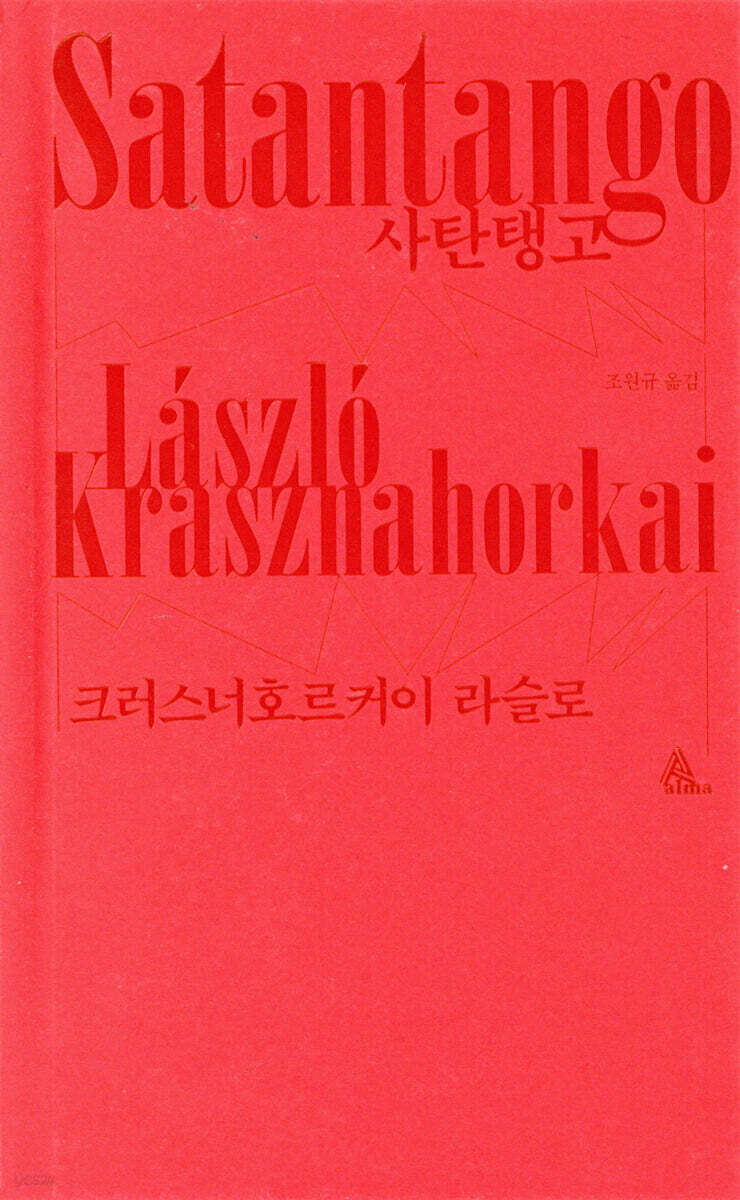
For readers who have long awaited the publication of the translated version of Satantango, Alma presents two special covers in red and black.
The greatest living master of apocalyptic literature
And the artist of artists
László Krásznáhorkay, who may be unfamiliar in Korea, is a novelist who represents modern Hungarian literature.
He is considered a writer with inimitable talent and advanced capabilities, and his works, which contain apocalyptic themes and emotions in a unique, eccentric style and format, have garnered enthusiastic support from readers around the world.
In recognition of his unique world and artistic quality, he has received various Hungarian and international literary awards, and in 2015 he won the Man Booker International Prize.
This was a year before Han Kang won the same award for “The Vegetarian.”
“Krusnahorkai is a visionary writer with a powerful and unique vocal range,” said Murray Warner, who was the chair of the jury at the time.
He creates scenes that are scary, strange, and creepy and funny at the same time,” he said.
Regarding the apocalyptic tendencies that are always mentioned when describing his world of work, Krusnahorkai said in his Man Booker Prize acceptance speech, “Perhaps I am a writer for readers who seek beauty in hell.”
Susan Sontag also called Krusnahorkai “the greatest living apocalyptic writer.”
Susan Sontag also became a topic of conversation when she praised the film "Satantango," of which Krusnahorkai was the original author, saying, "I will definitely watch it once a year for the rest of my life."
Krusnahorkai, who has long been the subject of praise from critics and artists, continues to expand his unique worldview, including by participating in the entire works of film director Bela Tarr, as is well known.
In 2018, he was once again shortlisted for the Man Booker International Prize, along with Korean author Han Kang.
“Claude Simon, Thomas Bernhard, José Saramago, W.
“If you think of G. Sebald, Roberto Bolaño, and David Foster Wallace, Krusnahorkai is probably the strangest writer.” —The New Yorker
“A natural storyteller, following in the footsteps of Kafka”_The Washington Post
Tango with the devil,
Take six steps forward and six steps back.
Form a tightly closed eternal circle
One October morning, as the first drops of autumn rain began to fall, Hooters woke up to the sound of a bell.
The sound of a bell ringing in a place where there is no church or bell has an ominous and supernatural atmosphere.
It feels like a sign that something is about to happen.
The series of antics that follow, though at first glance comical, are in fact a sordid plot by some to embezzle the common wages received by the collective farm community for their work and then run away.
Those left behind in the village of a failed collective farm distrust one another, and, tainted to the very core of their souls by a world that has already fallen, they struggle helplessly to escape it, even through despicable means.
Then, when a rumor spreads that the dead have returned to life, the town begins to take on a strange liveliness, contrary to the ominous atmosphere that the news carries.
Irimiasi, who was thought to have died a year and a half ago, possesses the mystical ability to build a castle out of cow dung if he so desires, and absolute charisma.
The villagers, in despair, believe he is the Messiah who will save them and give up on fleeing, waiting for his return.
They would give anything for him to revive the village.
However, the novel blatantly shows that Irimiasi can never be a savior through the absurdity of the first half, which is reminiscent of Kafka's novel.
While waiting for him, people are filled with anticipation and hope, finally unleashing their hidden desires that were suppressed by poverty and anxiety, and dancing the tango intoxicated by them. However, what awaits them is not a rosy future, but rather their downfall as vicious tools devised by a failed system and the ensuing corruption of the world.
The bell sound and spider webs that appear symbolically throughout the work may be novelistic devices that show that the townspeople are ultimately bound together and entangled.
But like a species barely existing in the ruins, their community has lost its very origins and meaning of existence. However, no matter how much they try to erase it, it silently appears like a spider web that covers everything, and they are destined to never escape. It exists as a translucent ghost above their lives, singing of a descending world.
In this way, the author, true to his reputation as a master of gloomy apocalyptic literature, has depicted, with a captivating and merciless intensity, the process by which people, struggling between despair and hope in an abandoned collective farm village in southeastern Hungary, are trampled by the system and ultimately trapped in a circle of suffering.
In particular, in line with the steps of the 'tango' that are even included in the title of the work, that is, six steps forward and six steps backward, Part 1 starts from Chapter 1 and ends with Chapter 6, and Part 2 starts in reverse order from Chapter 6 and ends with Chapter 1, taking on a unique cyclical structure that forms a circle, and through formal experiments such as changing the character's point of view in each chapter, the vicious cycle of suffering is wonderfully depicted.
One thing that stands out about the work is that “Satantango” was published in 1985, before the collapse of the Eastern Bloc communist regime.
Regarding this, Won-gyu Cho, the translator and poet of “Satan Tango,” says in his commentary that the downfall predicted by the author, whose works have an apocalyptic and apocalyptic tendency, was probably an expression of political resistance, and yet, he says that what “Satan Tango” ultimately wanted to portray was a human being with hope.
It is important to remember that "Satantango" was released in 1985, before the collapse of the Eastern Bloc communist regime.
The 'downfall' depicted by the author while the system was still in place would have been nothing other than an expression of political resistance.
(...) This work can be said to have gone beyond the criticism of a period's system and remained as literature that embodies a more permanent theme of a human being who hopes.
(From the commentary)
In addition to Satantango, László Krzysztof Krzysztof Krzysztof F ...
Alma plans to sequentially introduce his representative works to the domestic market.
Series Introduction
Alma Incognita series
Embark on a special adventure into an unknown world through literature.
Toshiki Okada
The End of the Special Time Granted to Us (by Toshiki Okada, translated by Sanghong Lee, August 2016)
A Relatively Optimistic Case (by Toshiki Okada, translated by Hongi Lee, July 2017)
Hervé Guibert
Ghost Images (by Hervé Guibert, translated by An Bo-ok, March 2017)
The Man in the Red Hat (by Hervé Guibert, translated by An Bo-ok, June 2018)
To the Friend Who Couldn't Save My Life (Hervé Gibet, November 2018)
The Record of Compassion (by Hervé Guibert, translated by Shin Yu-jin, March 2022)
Mathieu Langdon
Erberino (by Mathieu Lindon, translated by Shin Yu-jin, December 2022)
Uming
Elephant on the Sunlit Road (Written by Wuming, translated by Heo Yu-yeong, March 2018)
Laszlo Krusnahorkay
Satan Tango (by László Krzysztof ...
The Melancholy of Resistance (by László Krzysztof ...
The Last Wolf (by László Krzysztof ...
The Descent of the Queen Mother of the West (by László Krzysztof ...
The World Goes On (by László Krzysztof ...
The Return of Baron Wenckheim (by László Krzysztof ...
David Foster Wallace
Oblivion (by David Foster Wallace, translated by Shin Ji-young, October 2019)
String Theory (by David Foster Wallace, translated by Noh Seung-young, November 2019)
A Univus Pluram: Television and the American Novel (by David Foster Wallace, translated by Noh Seung-young, February 2022)
Olivia Rosenthal
Survival Mechanisms in Hostile Situations (by Olivia Rosenthal, translated by Hankookhwa, January 2020)
Kim Sa-gwa
Outside is a Burning Swamp/Trapped in a Mental Hospital (by Kim Sa-gwa, November 2020)
Laurie Frankel
Claude and Poppy (by Laurie Frankl, translated by Kim Hee-jung, May 2023)
John Jeremiah Sullivan
Pulphead (by John Jeremiah Sullivan, translated by Go Young-beom, August 2023)
Norman Erickson Passaribu
Mostly Happy Stories (by Norman Erickson Passaribu, translated by Go Young-beom, November 2023)
Guillaume Laurent
My Body Disappeared (by Guillaume Laurent, translated by Kim Do-yeon, March 2024)
Ludovic Escand
Dreamers of the Night (by Ludovic Escand, translated by Kim Nam-joo, January 2025)
* Will continue to be published.
A legendary work written by a master of modern Hungarian literature
Instead of writing it as 'László Krasznahorkai', which is known in Korea, it is written anew according to the National Institute of the Korean Language's foreign language transcription rules and the Hungarian surname-first name transcription method.
His full-length novel, “Satan Tango,” was published by Alma.
Krusnahorkai is often compared to great writers such as Gogol and Melville, and is mentioned as a strong candidate for the Nobel Prize every year.
"Satantango" is the most widely known of his representative works, and was made into a film of the same name in 1994 by Bela Tarr, a Hungarian auteur film director and a master who is respected and loved by filmmakers around the world. It has also become a masterpiece that will remain in the history of film.
Hungary in the 1980s, when communism was collapsing.
Rumors begin to spread among those who remain in the village of the disbanded collective farm, living a life of helplessness, mired in poverty and distrust.
It is said that Irimiasi, who was thought to have died a year and a half ago, returns to the village.
The news that he, with his overwhelming charisma, will return with the start of the autumn rainy season fills the villagers with sweet dreams of escaping their desperate lives, but at the same time, they are plagued by an inexplicable fear and anxiety.
The sound of bells ringing without a sound and the webs of invisible spiders fuel the fear of the world's downfall.
"Satan Tango" depicts the process of all efforts to escape the shackles of a ruined life ending in failure and ultimately being trapped in the vicious cycle again, creating an eternal vicious cycle, as an apocalyptic painting of despair.
The publication of "Satan Tango" will not only be a welcome relief to Korean readers who have longed for Krusnahorkai's work, but will also bring tremendous shock and joy to the cultural world as a whole.
For readers who have long awaited the publication of the translated version of Satantango, Alma presents two special covers in red and black.
The greatest living master of apocalyptic literature
And the artist of artists
László Krásznáhorkay, who may be unfamiliar in Korea, is a novelist who represents modern Hungarian literature.
He is considered a writer with inimitable talent and advanced capabilities, and his works, which contain apocalyptic themes and emotions in a unique, eccentric style and format, have garnered enthusiastic support from readers around the world.
In recognition of his unique world and artistic quality, he has received various Hungarian and international literary awards, and in 2015 he won the Man Booker International Prize.
This was a year before Han Kang won the same award for “The Vegetarian.”
“Krusnahorkai is a visionary writer with a powerful and unique vocal range,” said Murray Warner, who was the chair of the jury at the time.
He creates scenes that are scary, strange, and creepy and funny at the same time,” he said.
Regarding the apocalyptic tendencies that are always mentioned when describing his world of work, Krusnahorkai said in his Man Booker Prize acceptance speech, “Perhaps I am a writer for readers who seek beauty in hell.”
Susan Sontag also called Krusnahorkai “the greatest living apocalyptic writer.”
Susan Sontag also became a topic of conversation when she praised the film "Satantango," of which Krusnahorkai was the original author, saying, "I will definitely watch it once a year for the rest of my life."
Krusnahorkai, who has long been the subject of praise from critics and artists, continues to expand his unique worldview, including by participating in the entire works of film director Bela Tarr, as is well known.
In 2018, he was once again shortlisted for the Man Booker International Prize, along with Korean author Han Kang.
“Claude Simon, Thomas Bernhard, José Saramago, W.
“If you think of G. Sebald, Roberto Bolaño, and David Foster Wallace, Krusnahorkai is probably the strangest writer.” —The New Yorker
“A natural storyteller, following in the footsteps of Kafka”_The Washington Post
Tango with the devil,
Take six steps forward and six steps back.
Form a tightly closed eternal circle
One October morning, as the first drops of autumn rain began to fall, Hooters woke up to the sound of a bell.
The sound of a bell ringing in a place where there is no church or bell has an ominous and supernatural atmosphere.
It feels like a sign that something is about to happen.
The series of antics that follow, though at first glance comical, are in fact a sordid plot by some to embezzle the common wages received by the collective farm community for their work and then run away.
Those left behind in the village of a failed collective farm distrust one another, and, tainted to the very core of their souls by a world that has already fallen, they struggle helplessly to escape it, even through despicable means.
Then, when a rumor spreads that the dead have returned to life, the town begins to take on a strange liveliness, contrary to the ominous atmosphere that the news carries.
Irimiasi, who was thought to have died a year and a half ago, possesses the mystical ability to build a castle out of cow dung if he so desires, and absolute charisma.
The villagers, in despair, believe he is the Messiah who will save them and give up on fleeing, waiting for his return.
They would give anything for him to revive the village.
However, the novel blatantly shows that Irimiasi can never be a savior through the absurdity of the first half, which is reminiscent of Kafka's novel.
While waiting for him, people are filled with anticipation and hope, finally unleashing their hidden desires that were suppressed by poverty and anxiety, and dancing the tango intoxicated by them. However, what awaits them is not a rosy future, but rather their downfall as vicious tools devised by a failed system and the ensuing corruption of the world.
The bell sound and spider webs that appear symbolically throughout the work may be novelistic devices that show that the townspeople are ultimately bound together and entangled.
But like a species barely existing in the ruins, their community has lost its very origins and meaning of existence. However, no matter how much they try to erase it, it silently appears like a spider web that covers everything, and they are destined to never escape. It exists as a translucent ghost above their lives, singing of a descending world.
In this way, the author, true to his reputation as a master of gloomy apocalyptic literature, has depicted, with a captivating and merciless intensity, the process by which people, struggling between despair and hope in an abandoned collective farm village in southeastern Hungary, are trampled by the system and ultimately trapped in a circle of suffering.
In particular, in line with the steps of the 'tango' that are even included in the title of the work, that is, six steps forward and six steps backward, Part 1 starts from Chapter 1 and ends with Chapter 6, and Part 2 starts in reverse order from Chapter 6 and ends with Chapter 1, taking on a unique cyclical structure that forms a circle, and through formal experiments such as changing the character's point of view in each chapter, the vicious cycle of suffering is wonderfully depicted.
One thing that stands out about the work is that “Satantango” was published in 1985, before the collapse of the Eastern Bloc communist regime.
Regarding this, Won-gyu Cho, the translator and poet of “Satan Tango,” says in his commentary that the downfall predicted by the author, whose works have an apocalyptic and apocalyptic tendency, was probably an expression of political resistance, and yet, he says that what “Satan Tango” ultimately wanted to portray was a human being with hope.
It is important to remember that "Satantango" was released in 1985, before the collapse of the Eastern Bloc communist regime.
The 'downfall' depicted by the author while the system was still in place would have been nothing other than an expression of political resistance.
(...) This work can be said to have gone beyond the criticism of a period's system and remained as literature that embodies a more permanent theme of a human being who hopes.
(From the commentary)
In addition to Satantango, László Krzysztof Krzysztof Krzysztof F ...
Alma plans to sequentially introduce his representative works to the domestic market.
Series Introduction
Alma Incognita series
Embark on a special adventure into an unknown world through literature.
Toshiki Okada
The End of the Special Time Granted to Us (by Toshiki Okada, translated by Sanghong Lee, August 2016)
A Relatively Optimistic Case (by Toshiki Okada, translated by Hongi Lee, July 2017)
Hervé Guibert
Ghost Images (by Hervé Guibert, translated by An Bo-ok, March 2017)
The Man in the Red Hat (by Hervé Guibert, translated by An Bo-ok, June 2018)
To the Friend Who Couldn't Save My Life (Hervé Gibet, November 2018)
The Record of Compassion (by Hervé Guibert, translated by Shin Yu-jin, March 2022)
Mathieu Langdon
Erberino (by Mathieu Lindon, translated by Shin Yu-jin, December 2022)
Uming
Elephant on the Sunlit Road (Written by Wuming, translated by Heo Yu-yeong, March 2018)
Laszlo Krusnahorkay
Satan Tango (by László Krzysztof ...
The Melancholy of Resistance (by László Krzysztof ...
The Last Wolf (by László Krzysztof ...
The Descent of the Queen Mother of the West (by László Krzysztof ...
The World Goes On (by László Krzysztof ...
The Return of Baron Wenckheim (by László Krzysztof ...
David Foster Wallace
Oblivion (by David Foster Wallace, translated by Shin Ji-young, October 2019)
String Theory (by David Foster Wallace, translated by Noh Seung-young, November 2019)
A Univus Pluram: Television and the American Novel (by David Foster Wallace, translated by Noh Seung-young, February 2022)
Olivia Rosenthal
Survival Mechanisms in Hostile Situations (by Olivia Rosenthal, translated by Hankookhwa, January 2020)
Kim Sa-gwa
Outside is a Burning Swamp/Trapped in a Mental Hospital (by Kim Sa-gwa, November 2020)
Laurie Frankel
Claude and Poppy (by Laurie Frankl, translated by Kim Hee-jung, May 2023)
John Jeremiah Sullivan
Pulphead (by John Jeremiah Sullivan, translated by Go Young-beom, August 2023)
Norman Erickson Passaribu
Mostly Happy Stories (by Norman Erickson Passaribu, translated by Go Young-beom, November 2023)
Guillaume Laurent
My Body Disappeared (by Guillaume Laurent, translated by Kim Do-yeon, March 2024)
Ludovic Escand
Dreamers of the Night (by Ludovic Escand, translated by Kim Nam-joo, January 2025)
* Will continue to be published.
GOODS SPECIFICS
- Date of issue: May 9, 2018
- Page count, weight, size: 412 pages | 130*213*30mm
- ISBN13: 9791159921445
- ISBN10: 115992144X
You may also like
카테고리
korean


korean

![GQ KOREA Mark (Monthly): December [2025]](http://librairie.coreenne.fr/cdn/shop/files/8ef265dbbfbf186523ed75ba7319009d.jpg?v=1765340328&width=3840)


