

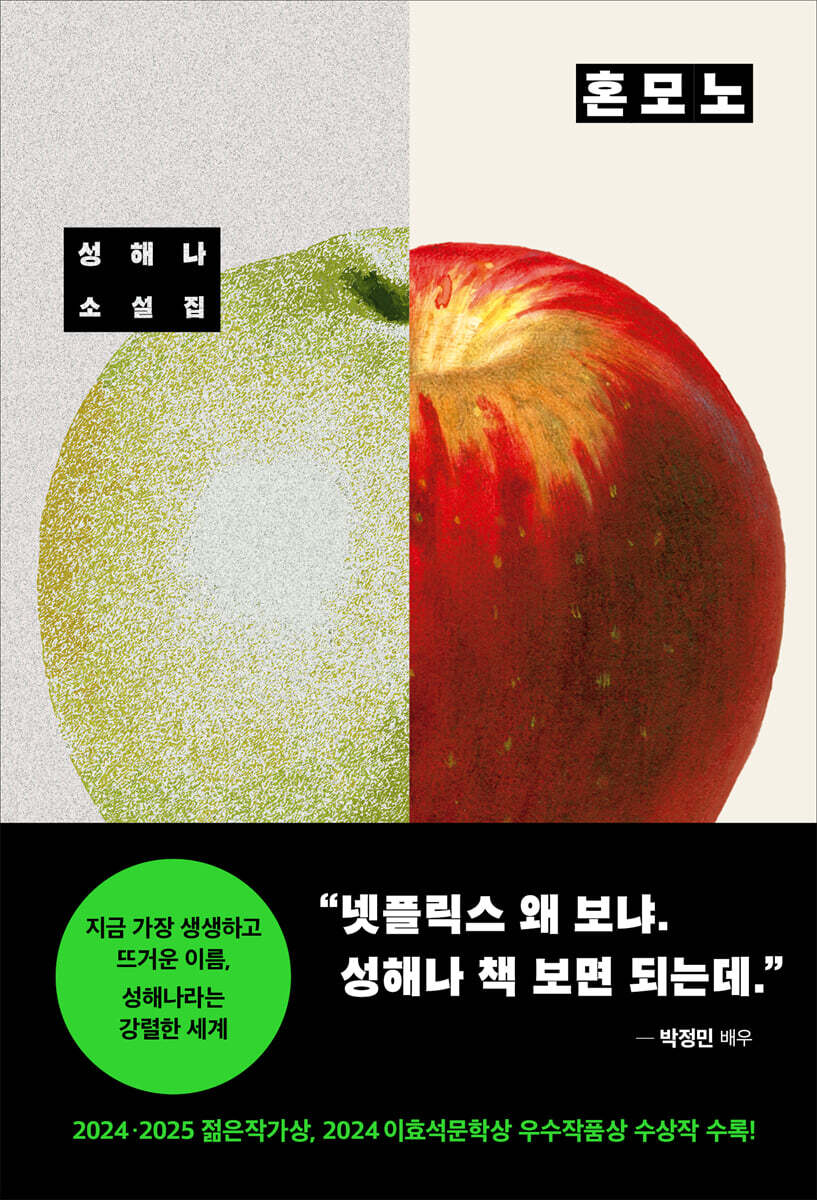
Honmono
 |
Description
Book Introduction
- A word from MD
-
The future of Korean literature has finally arrived: Seong Hae-na's new work.A new work by novelist Seong Hae-na, chosen by Yes24 readers as the "No. 1 young writer who will become the future of Korean literature" in 2024.
From the title piece depicting a life on the border between the real and the fake to the story of a family struggling with the conflict of giving birth abroad, it contains a variety of narratives and social situations.
A collection of short stories that proves what a true 'novel that shows' is, rather than one that explains.
March 28, 2025. Novel/Poetry PD Kim Yu-ri
“It’s a party of ‘immersion.’
“It’s full of works I want to make into movies.” - Actor Park Jung-min
Selected as the #1 Young Writer of the Future of Korean Literature in 2024!
The most vivid and hot name right now,
The intense world of Seonghae
Includes the 2024/2025 Young Writer's Award and the 2024 Lee Hyo-seok Literary Award for Excellence.
Author Seong Hae-na, who is praised for ushering in a new generation of realism with her unique characters and intense yet cool narratives based on meticulous research and elaborate composition in each work, presents her second collection of short stories, 『Honmono』.
Seong Hae-na has already proven her popularity by winning numerous literary awards in succession, including the 2024·2025 Young Writer Award, the 2024 Lee Hyo-seok Literary Award for Excellence in Works, and the 2024 Kim Man-jung Literary Award for New Writers, and by being selected as first place in a poll for the '2024 Young Writers Who Will Be the Future of Korean Literature' by the online bookstore Yes24.
In his first short story collection, 『When You Walk Away from the Light』 (Munhakdongne 2022), he portrayed attempts to understand others with a soft and warm gaze, and in his first full-length novel, 『The Summer We Left Behind』 (Changbi 2023), he tried to say a heartbreaking farewell to a past stained with misunderstandings and separation. In 『Honmono』, he vividly depicts the landscape of the world by looking into the various boundaries that divide us, such as regions, politics, and generations, with a sharper sense of problem and an engaging narrative.
In particular, this collection of short stories attracts even more attention as it includes the title work "Honmono," which was constantly called out and swept the literary world last year, as well as "Guilty Club: Touching the Tiger," which won the author the Young Writer's Award for two consecutive years, and "Smooth," which was selected as the Novel of the Season and Problem Novel of the Year.
『Honmono』, which shines with “jealous talent” (recommendation, Park Jeong-min) as much as it is “called the author’s ‘spirit’” (recommendation, Lee Ki-ho), the future of Korean literature that we have long awaited has arrived right before us.
“It’s full of works I want to make into movies.” - Actor Park Jung-min
Selected as the #1 Young Writer of the Future of Korean Literature in 2024!
The most vivid and hot name right now,
The intense world of Seonghae
Includes the 2024/2025 Young Writer's Award and the 2024 Lee Hyo-seok Literary Award for Excellence.
Author Seong Hae-na, who is praised for ushering in a new generation of realism with her unique characters and intense yet cool narratives based on meticulous research and elaborate composition in each work, presents her second collection of short stories, 『Honmono』.
Seong Hae-na has already proven her popularity by winning numerous literary awards in succession, including the 2024·2025 Young Writer Award, the 2024 Lee Hyo-seok Literary Award for Excellence in Works, and the 2024 Kim Man-jung Literary Award for New Writers, and by being selected as first place in a poll for the '2024 Young Writers Who Will Be the Future of Korean Literature' by the online bookstore Yes24.
In his first short story collection, 『When You Walk Away from the Light』 (Munhakdongne 2022), he portrayed attempts to understand others with a soft and warm gaze, and in his first full-length novel, 『The Summer We Left Behind』 (Changbi 2023), he tried to say a heartbreaking farewell to a past stained with misunderstandings and separation. In 『Honmono』, he vividly depicts the landscape of the world by looking into the various boundaries that divide us, such as regions, politics, and generations, with a sharper sense of problem and an engaging narrative.
In particular, this collection of short stories attracts even more attention as it includes the title work "Honmono," which was constantly called out and swept the literary world last year, as well as "Guilty Club: Touching the Tiger," which won the author the Young Writer's Award for two consecutive years, and "Smooth," which was selected as the Novel of the Season and Problem Novel of the Year.
『Honmono』, which shines with “jealous talent” (recommendation, Park Jeong-min) as much as it is “called the author’s ‘spirit’” (recommendation, Lee Ki-ho), the future of Korean literature that we have long awaited has arrived right before us.
- You can preview some of the book's contents.
Preview
index
Guilty Club: Tiger Petting
Smooth
Honmono
Gu's House: 98 Galwol-dong
friendly feelings
gestation period
Metal
Commentary | Yang Gyeong-eon
Recommendation | Lee Ki-ho and Park Jeong-min
Author's Note
Announcement page of included works
Smooth
Honmono
Gu's House: 98 Galwol-dong
friendly feelings
gestation period
Metal
Commentary | Yang Gyeong-eon
Recommendation | Lee Ki-ho and Park Jeong-min
Author's Note
Announcement page of included works
Detailed image

Into the book
The tiger, having lost its wild instincts, was helplessly giving up its body.
There were moments when it grumbled faintly, but it quickly quieted down when the zookeeper hit its front paw with a rubber mallet.
(…)
I felt strangely excited, even though I felt like I was committing a sin.
It was a feeling I had felt before.
A tingling pleasure accompanied by guilt.
It didn't take long to realize what that feeling of discomfort was.
A certain morality that is vicious, hot, seditious, and therefore all the more vain.
I wanted to shake it off, but I couldn't.
As someone whose face I can no longer remember said, what has already happened cannot be undone.
--- pp.64-65 From "Guilty Club: Touching the Tiger"
The man's portrait was on numerous badges.
A man wearing a military uniform and pointing into the air with a solemn expression.
When I asked Mr. Kim who this man was, he shouted with a bright smile.
This is my president!
His expression was by far the brightest I've seen all day.
He even poured out words like respect and affection in an excited tone, as if his heart was ahead of his words.
He is the greatest person in Korea.
I looked closely at the badge with the portrait of the President of Korea.
The 'Tai Keuk' pattern fluttering behind the portrait seemed to explain the president's great achievements.
Is he like Korea's Lincoln?
--- p.105 From "Smooth"
Dear Sir, if your mouth is bitter, would you like some candy?
Children can't help but be captivated by something sweet.
As I was opening the cupboard with the intention of biting into some candy, I heard mumbling behind me.
The old woman who lived a long life gave me the map.
I told you to go into the house in front.
That was the beginning.
The beginning of a wicked relationship.
I thought I might have misheard, so I turned to Shin Ae-gi and asked again.
What did you say…?
Shin Ae-gi sneered.
They said it was all red, but it seems it's true.
I didn't even know that my grandmother had come to me.
He looked straight at me with murderous eyes and said.
Well, what would a guy who just imitates know?
--- p.120 From "Honmono"
This is my board and mine.
It is a shaman's world where no interference or manipulation is permitted.
(…) Now it’s my turn.
The blade, sharpened overnight enough to cut through a watermelon, touches my skin and cuts my nerves.
Shin Ae-gi's expression as she looks at me becomes distorted.
Blood must be flowing.
Because the pungent smell of blood already vibrates in my mouth.
But it doesn't matter.
I feel no pain or suffering.
--- p.150 From "Honmono"
Has there ever been a moment like this in Park Soo's thirty-year life?
It is no longer important for whom one sacrifices one's life and prays for salvation.
Fame, youth, envy, strife, even the real and the fake.
It gets lighter.
As if free from everything.
Now it really seems fake.
--- p.153 From "Honmono"
I didn't quite catch what the teacher meant.
That light can bring humans not only hope, but also fear and helplessness.
So that's why I needed a window... ...because I thought the complete opposite.
Yeo Jae-hwa couldn't believe her ears.
What the hell does this mean?
Gu Bo-seung continued speaking with a bright smile.
The light will reveal the shape of space, instilling fear in the investigator and making them feel the passage of time, leaving them feeling helpless.
Did you know, sir, that hope is the most dangerous torture that can consume a human being?
--- pp.191-192 From "Gu's House: 98 Galwol-dong"
I mingled with people, chatted about trivial things, and then put some dim sum in my mouth.
A thin stream of blood burst inside his mouth, and hot juice flowed out.
I was startled and looked around.
Everyone was laughing out loud, serving food to each other and filling each other's glasses.
In that place overflowing with warmth and a friendly atmosphere, I couldn't bring myself to swallow or spit out the hot dim sum, but just drank it.
--- p.240 From “Friendly Feelings”
As my father-in-law said, I really am not crazy.
I wonder if he was crazy and used venom that should not have been used on his superiors.
I wonder if I have acted against the Tao.
As he said, I wonder if I have burdened my child with a burden that even I cannot bear.
But… …if I’m crazy, if I’m really crazy, what made me crazy?
--- p.286 From "The Conception"
Rammstein, Motorhead, Judas Priest… … Layers of memories that I wanted to forget, but remained deep inside.
The intense heat that flowed into my ears, swept through my entire body, and didn't go away.
Boys who ran down the same road without fear of what lay in the dark, dreaming the same dream… …
There were moments when it grumbled faintly, but it quickly quieted down when the zookeeper hit its front paw with a rubber mallet.
(…)
I felt strangely excited, even though I felt like I was committing a sin.
It was a feeling I had felt before.
A tingling pleasure accompanied by guilt.
It didn't take long to realize what that feeling of discomfort was.
A certain morality that is vicious, hot, seditious, and therefore all the more vain.
I wanted to shake it off, but I couldn't.
As someone whose face I can no longer remember said, what has already happened cannot be undone.
--- pp.64-65 From "Guilty Club: Touching the Tiger"
The man's portrait was on numerous badges.
A man wearing a military uniform and pointing into the air with a solemn expression.
When I asked Mr. Kim who this man was, he shouted with a bright smile.
This is my president!
His expression was by far the brightest I've seen all day.
He even poured out words like respect and affection in an excited tone, as if his heart was ahead of his words.
He is the greatest person in Korea.
I looked closely at the badge with the portrait of the President of Korea.
The 'Tai Keuk' pattern fluttering behind the portrait seemed to explain the president's great achievements.
Is he like Korea's Lincoln?
--- p.105 From "Smooth"
Dear Sir, if your mouth is bitter, would you like some candy?
Children can't help but be captivated by something sweet.
As I was opening the cupboard with the intention of biting into some candy, I heard mumbling behind me.
The old woman who lived a long life gave me the map.
I told you to go into the house in front.
That was the beginning.
The beginning of a wicked relationship.
I thought I might have misheard, so I turned to Shin Ae-gi and asked again.
What did you say…?
Shin Ae-gi sneered.
They said it was all red, but it seems it's true.
I didn't even know that my grandmother had come to me.
He looked straight at me with murderous eyes and said.
Well, what would a guy who just imitates know?
--- p.120 From "Honmono"
This is my board and mine.
It is a shaman's world where no interference or manipulation is permitted.
(…) Now it’s my turn.
The blade, sharpened overnight enough to cut through a watermelon, touches my skin and cuts my nerves.
Shin Ae-gi's expression as she looks at me becomes distorted.
Blood must be flowing.
Because the pungent smell of blood already vibrates in my mouth.
But it doesn't matter.
I feel no pain or suffering.
--- p.150 From "Honmono"
Has there ever been a moment like this in Park Soo's thirty-year life?
It is no longer important for whom one sacrifices one's life and prays for salvation.
Fame, youth, envy, strife, even the real and the fake.
It gets lighter.
As if free from everything.
Now it really seems fake.
--- p.153 From "Honmono"
I didn't quite catch what the teacher meant.
That light can bring humans not only hope, but also fear and helplessness.
So that's why I needed a window... ...because I thought the complete opposite.
Yeo Jae-hwa couldn't believe her ears.
What the hell does this mean?
Gu Bo-seung continued speaking with a bright smile.
The light will reveal the shape of space, instilling fear in the investigator and making them feel the passage of time, leaving them feeling helpless.
Did you know, sir, that hope is the most dangerous torture that can consume a human being?
--- pp.191-192 From "Gu's House: 98 Galwol-dong"
I mingled with people, chatted about trivial things, and then put some dim sum in my mouth.
A thin stream of blood burst inside his mouth, and hot juice flowed out.
I was startled and looked around.
Everyone was laughing out loud, serving food to each other and filling each other's glasses.
In that place overflowing with warmth and a friendly atmosphere, I couldn't bring myself to swallow or spit out the hot dim sum, but just drank it.
--- p.240 From “Friendly Feelings”
As my father-in-law said, I really am not crazy.
I wonder if he was crazy and used venom that should not have been used on his superiors.
I wonder if I have acted against the Tao.
As he said, I wonder if I have burdened my child with a burden that even I cannot bear.
But… …if I’m crazy, if I’m really crazy, what made me crazy?
--- p.286 From "The Conception"
Rammstein, Motorhead, Judas Priest… … Layers of memories that I wanted to forget, but remained deep inside.
The intense heat that flowed into my ears, swept through my entire body, and didn't go away.
Boys who ran down the same road without fear of what lay in the dark, dreaming the same dream… …
--- p.334 From "Metal"
Publisher's Review
What is real and what is fake
Asking about 'honmono' at that border
The first thing that catches the eye in 『Honmono』 is the title, which is difficult to understand at first glance.
'Honmono' is a phonetic transcription of the Japanese word '本物' (ほんもの), which means 'real'. It was once widely known as a new word used online to mock 'truth' and 'otaku'.
As the author said in an interview, he wanted to talk about the current state of affairs where even a lie becomes true if many people believe it, just as this word, which originally has a positive meaning, is being used in a distorted sense. This collection of short stories is comprised of works that explore the boundary between “real” and “fake” while simultaneously asking the fundamental question of what “real” is.
The narrator of the title piece, "Honmono," a 30-year veteran shaman named "Munsu," realizes one day that the "long-lived grandmother" he had worshipped as a spirit had left him.
At that time, a twenty-year-old girl named Shin Ae-gi, who had moved into the house across the street, came to him and said, “Grandma said you were too old” (page 145). This became an incident that shook the foundation of faith for Munsu, who had believed that his faith was ‘true.’
Munsu struggles to live as a 'fake' shaman, pretending to be 'real', but even while looking for a model shaman, he refuses to take on the 'fortune of the day' that "someone does for a shaman" (page 122), and while he despises Shin Aegi who ridicules him, saying, "What would a guy who just imitates know?" (page 120), he is concerned about the shouting coming from that house, and he keeps asking himself, "What is real, and does it really exist in a separate place from the fake?" (Commentary, Yang Gyeong-eon).
Meanwhile, the conflict between the middle-aged Munsu, who has been worshipping the grandmother in a traditional way, and the young shaman Shin Ae-gi, who appears to be “equal to the grandmother” (p. 144), clearly reveals the conflict between the old and new generations that is commonly encountered in modern society today. In this way, “Honmono” is a provocative work that does not stop at looking into the desires and worries of individuals, but also raises questions about social issues such as generational conflict and the conflict between tradition and modernity.
An overwhelming narrative that delves into you without leaving a moment to breathe.
The future of Korean literature shines with talents worthy of stealing.
Another work that deals with these issues in a timely and concrete manner is "Smooth," a black comedy that depicts the experiences of Dewey, a third-generation Korean-American and agent of world-renowned artist Jeff, during his first-ever visit to Korea.
He was so ignorant that he regarded Korea as “a sleazy place full of shops selling snake wine and dog meat” (p. 69), and he was “more American” than any “real” American (p. 69). While wandering around Korea to visit Jeff’s art exhibition, he stumbled into a procession of people “carrying the American flag and the ‘Thai flag’” (p. 84).
Encountering the warm and friendly elderly people at the “festival” (page 86), he begins to feel a sense of connection and belonging to Korea. However, the moment the elderly man who shared unconditional warmth calls Gwanghwamun Square “Syngman Rhee Square,” “anxiety and deficiency are smoothly shaved away” (page 82), and we, who were enjoying the novel, feel a chill in our hearts, just like Jeff’s spherical art piece.
The narrator of the novel "Guilty Club: Touching the Tiger", which opens the door to the collection of short stories, is a member of the "Guilty Club," a group of so-called "real" (12 pages) fans of the world-renowned film director "Kim Gon."
Kim Gon is facing public moral condemnation for an incident he committed in the past, but the members of the Guilty Club believe that covering up the incident and keeping it quiet is the role of a "true" fan.
'I' also deny the incident because of my desire to become 'real', but when Kim Gon admits his mistake and apologizes, I feel something inside me bursting.
And later, while experiencing 'touching a tiger' at a zoo in Chiang Mai, he realizes what it is.
In this way, "Guilty Club: Tiger Petting" vividly deals with the paradoxical desire called "guilty pleasure" through the fandom culture that we are familiar with, while making us think again about what truth is hidden behind the things that we easily consider "real" and what distinguishes the real from the fake.
The other works that follow are also each unique and leave a strong impression.
Based on the 'Namyeong-dong Anti-Communist Investigation Office', the faction "Gu's House: 98 Galwol-dong" deals with the question of who designed such a brutal building like a kind of investigative documentary; "Pregnancy Record" is a novel about a daughter-in-law and her father-in-law having a naked fight of desires before giving birth abroad; "Friendly Feelings" is about people working at a local regeneration startup meeting people who have returned to the countryside with "idealistic" (page 211) intentions and seeing each other's true colors; and "Metal" is a poignant story about three friends who were in a metal band in high school facing reality. Each of the included works is accompanied by a line from actor Park Jung-min's "Why do you watch Netflix?
As the recommendation says, “You can just read the book” (Seonghae-na), each page is vivid and clear as if it were a corner of reality, allowing the reader to fully experience the world within the novel.
The overwhelming narrative that you can't stop reading once you start will give you the thrill of reading a thick collection of novels in one sitting.
“It doesn’t matter anymore.
Neither fame, nor youth, nor envy, nor strife,
“Even the real and the fake.”
Seong Hae-na, who endlessly goes back and forth between 'real' and 'fake' and asks the question of what 'honmono' is, never comes up with a smooth and soft spherical answer.
The place where 『Honmono』 stops is on the rough and precarious edge of the boundary that divides the real from the fake.
In front of this polyhedral answer that “cannot be swallowed or spit out” (p. 240), where there is no perfect right or wrong answer, no perfect good or bad person, no grand separation or easy closure, what we can do is “to explore the ‘truth,’ but never lose strength from the task of walking forward truthfully” (commentary), and to continue to walk and re-walk that ambiguous boundary, following the trustworthy footsteps of Seong Hae-na, who will open up the future of Korean literature.
Author's Note (excerpt)
Owls don't fly in a hurry.
Before flapping your wings, look around carefully and decide on a direction before landing.
I, too, want to fish for sentences with sharp claws, capture the pain of society with a broad perspective, and listen to the stories of those far away with open ears.
Until I exhale a deeper breath than I do now.
I hope you will watch over me from near and far.
Spring 2025
Seong Hae-na
Asking about 'honmono' at that border
The first thing that catches the eye in 『Honmono』 is the title, which is difficult to understand at first glance.
'Honmono' is a phonetic transcription of the Japanese word '本物' (ほんもの), which means 'real'. It was once widely known as a new word used online to mock 'truth' and 'otaku'.
As the author said in an interview, he wanted to talk about the current state of affairs where even a lie becomes true if many people believe it, just as this word, which originally has a positive meaning, is being used in a distorted sense. This collection of short stories is comprised of works that explore the boundary between “real” and “fake” while simultaneously asking the fundamental question of what “real” is.
The narrator of the title piece, "Honmono," a 30-year veteran shaman named "Munsu," realizes one day that the "long-lived grandmother" he had worshipped as a spirit had left him.
At that time, a twenty-year-old girl named Shin Ae-gi, who had moved into the house across the street, came to him and said, “Grandma said you were too old” (page 145). This became an incident that shook the foundation of faith for Munsu, who had believed that his faith was ‘true.’
Munsu struggles to live as a 'fake' shaman, pretending to be 'real', but even while looking for a model shaman, he refuses to take on the 'fortune of the day' that "someone does for a shaman" (page 122), and while he despises Shin Aegi who ridicules him, saying, "What would a guy who just imitates know?" (page 120), he is concerned about the shouting coming from that house, and he keeps asking himself, "What is real, and does it really exist in a separate place from the fake?" (Commentary, Yang Gyeong-eon).
Meanwhile, the conflict between the middle-aged Munsu, who has been worshipping the grandmother in a traditional way, and the young shaman Shin Ae-gi, who appears to be “equal to the grandmother” (p. 144), clearly reveals the conflict between the old and new generations that is commonly encountered in modern society today. In this way, “Honmono” is a provocative work that does not stop at looking into the desires and worries of individuals, but also raises questions about social issues such as generational conflict and the conflict between tradition and modernity.
An overwhelming narrative that delves into you without leaving a moment to breathe.
The future of Korean literature shines with talents worthy of stealing.
Another work that deals with these issues in a timely and concrete manner is "Smooth," a black comedy that depicts the experiences of Dewey, a third-generation Korean-American and agent of world-renowned artist Jeff, during his first-ever visit to Korea.
He was so ignorant that he regarded Korea as “a sleazy place full of shops selling snake wine and dog meat” (p. 69), and he was “more American” than any “real” American (p. 69). While wandering around Korea to visit Jeff’s art exhibition, he stumbled into a procession of people “carrying the American flag and the ‘Thai flag’” (p. 84).
Encountering the warm and friendly elderly people at the “festival” (page 86), he begins to feel a sense of connection and belonging to Korea. However, the moment the elderly man who shared unconditional warmth calls Gwanghwamun Square “Syngman Rhee Square,” “anxiety and deficiency are smoothly shaved away” (page 82), and we, who were enjoying the novel, feel a chill in our hearts, just like Jeff’s spherical art piece.
The narrator of the novel "Guilty Club: Touching the Tiger", which opens the door to the collection of short stories, is a member of the "Guilty Club," a group of so-called "real" (12 pages) fans of the world-renowned film director "Kim Gon."
Kim Gon is facing public moral condemnation for an incident he committed in the past, but the members of the Guilty Club believe that covering up the incident and keeping it quiet is the role of a "true" fan.
'I' also deny the incident because of my desire to become 'real', but when Kim Gon admits his mistake and apologizes, I feel something inside me bursting.
And later, while experiencing 'touching a tiger' at a zoo in Chiang Mai, he realizes what it is.
In this way, "Guilty Club: Tiger Petting" vividly deals with the paradoxical desire called "guilty pleasure" through the fandom culture that we are familiar with, while making us think again about what truth is hidden behind the things that we easily consider "real" and what distinguishes the real from the fake.
The other works that follow are also each unique and leave a strong impression.
Based on the 'Namyeong-dong Anti-Communist Investigation Office', the faction "Gu's House: 98 Galwol-dong" deals with the question of who designed such a brutal building like a kind of investigative documentary; "Pregnancy Record" is a novel about a daughter-in-law and her father-in-law having a naked fight of desires before giving birth abroad; "Friendly Feelings" is about people working at a local regeneration startup meeting people who have returned to the countryside with "idealistic" (page 211) intentions and seeing each other's true colors; and "Metal" is a poignant story about three friends who were in a metal band in high school facing reality. Each of the included works is accompanied by a line from actor Park Jung-min's "Why do you watch Netflix?
As the recommendation says, “You can just read the book” (Seonghae-na), each page is vivid and clear as if it were a corner of reality, allowing the reader to fully experience the world within the novel.
The overwhelming narrative that you can't stop reading once you start will give you the thrill of reading a thick collection of novels in one sitting.
“It doesn’t matter anymore.
Neither fame, nor youth, nor envy, nor strife,
“Even the real and the fake.”
Seong Hae-na, who endlessly goes back and forth between 'real' and 'fake' and asks the question of what 'honmono' is, never comes up with a smooth and soft spherical answer.
The place where 『Honmono』 stops is on the rough and precarious edge of the boundary that divides the real from the fake.
In front of this polyhedral answer that “cannot be swallowed or spit out” (p. 240), where there is no perfect right or wrong answer, no perfect good or bad person, no grand separation or easy closure, what we can do is “to explore the ‘truth,’ but never lose strength from the task of walking forward truthfully” (commentary), and to continue to walk and re-walk that ambiguous boundary, following the trustworthy footsteps of Seong Hae-na, who will open up the future of Korean literature.
Author's Note (excerpt)
Owls don't fly in a hurry.
Before flapping your wings, look around carefully and decide on a direction before landing.
I, too, want to fish for sentences with sharp claws, capture the pain of society with a broad perspective, and listen to the stories of those far away with open ears.
Until I exhale a deeper breath than I do now.
I hope you will watch over me from near and far.
Spring 2025
Seong Hae-na
GOODS SPECIFICS
- Date of issue: March 28, 2025
- Page count, weight, size: 368 pages | 392g | 128*188*22mm
- ISBN13: 9788936439743
You may also like
카테고리
korean


korean

![GQ KOREA Mark (Monthly): December [2025]](http://librairie.coreenne.fr/cdn/shop/files/8ef265dbbfbf186523ed75ba7319009d.jpg?v=1765340328&width=3840)


