

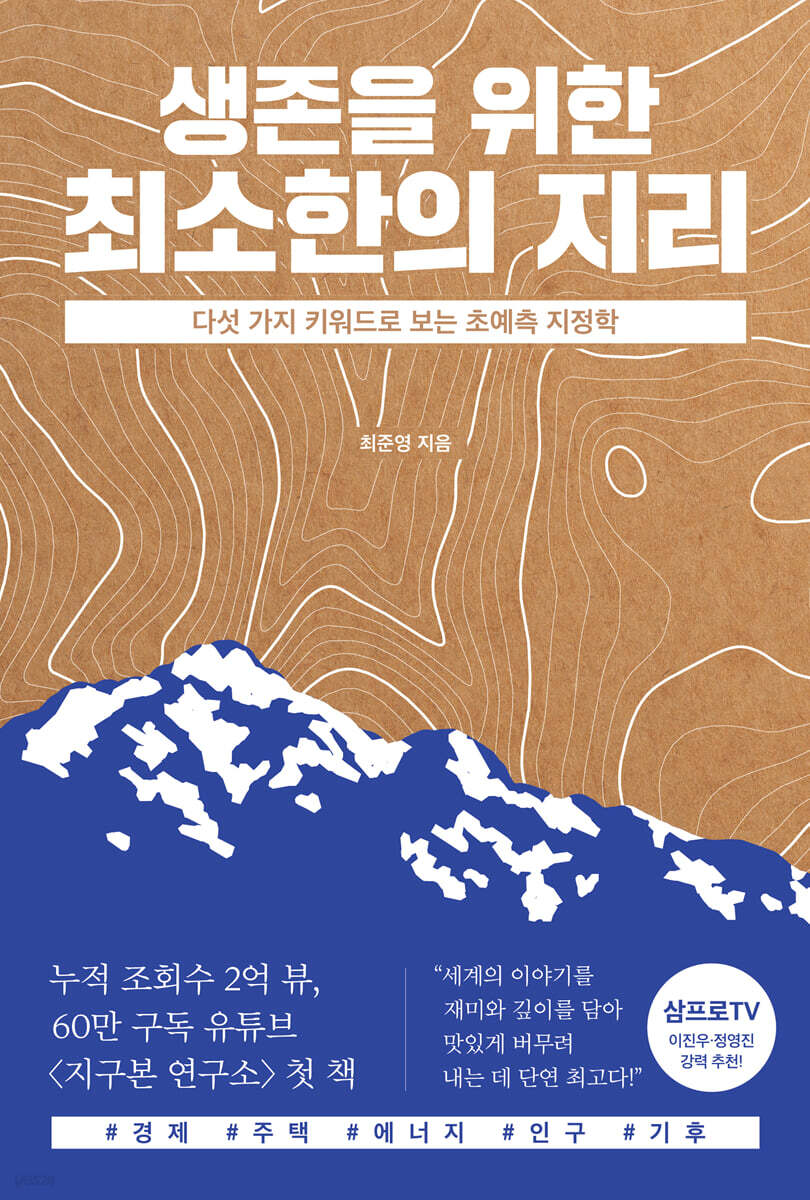
Minimum geography for survival
 |
Description
Book Introduction
The first book from the Earth Research Institute, with 200 million cumulative views and 600,000 subscribers!
In an era of fierce competition, geography provides the answer to how to survive.
“The stories of the world are told with fun and depth.
“It’s the best at mixing things together deliciously!”
- Strongly recommended by Lee Jin-woo and Jeong Yeong-jin of 〈Sampro TV〉!
The saying 'right person in the right place' doesn't only apply to people.
Numerous countries across the six continents of the Earth are adapting to and utilizing their own unique geographical conditions and environments.
Just as people are born with unique appearances and talents, countries also have unique appearances and talents, much of which are determined by geography.
Dr. Choi Jun-young's YouTube channel, "Global Research Institute," which is widely loved for its geography-based stories of countless countries around the world that are easy and fun to understand for everyone, has finally been published as a book.
With 600,000 subscribers and 200 million cumulative views, this channel is so popular that each episode averages hundreds of thousands of views.
This book introduces 15 regions under five keywords (economy, housing, energy, population, and climate) to prepare for the future survival that lies before us, focusing on the most beloved content among the numerous popular contents accumulated so far.
Part 1 examines the economic and housing situations of several countries we can learn from or learn from, including why housing prices in Austria, home to some of the world's most livable cities, remain stable, and why Sweden, a welfare state, has no minimum wage, retirement benefits, or inheritance tax.
In Part 2, we examine the relationships among various countries surrounding five of the most notable energy resources: hydrogen, shale, nickel, rare earth elements, and natural gas, and consider the direction in which Korea, an energy-poor country, should move forward.
The final three parts address both population and climate issues, providing a glimpse into the changing social landscape of India, the world's most populous country, examining Florida's strategies for attracting an aging population, and raising awareness through natural warnings about climate change.
Today, no country is free from threats to its future survival.
If we pursue only our own interests, the threat may come sooner.
The most important thing now is for each person to find something they are good at and do it well.
To do that, we need to know each other well.
This book will be your survival guide.
In an era of fierce competition, geography provides the answer to how to survive.
“The stories of the world are told with fun and depth.
“It’s the best at mixing things together deliciously!”
- Strongly recommended by Lee Jin-woo and Jeong Yeong-jin of 〈Sampro TV〉!
The saying 'right person in the right place' doesn't only apply to people.
Numerous countries across the six continents of the Earth are adapting to and utilizing their own unique geographical conditions and environments.
Just as people are born with unique appearances and talents, countries also have unique appearances and talents, much of which are determined by geography.
Dr. Choi Jun-young's YouTube channel, "Global Research Institute," which is widely loved for its geography-based stories of countless countries around the world that are easy and fun to understand for everyone, has finally been published as a book.
With 600,000 subscribers and 200 million cumulative views, this channel is so popular that each episode averages hundreds of thousands of views.
This book introduces 15 regions under five keywords (economy, housing, energy, population, and climate) to prepare for the future survival that lies before us, focusing on the most beloved content among the numerous popular contents accumulated so far.
Part 1 examines the economic and housing situations of several countries we can learn from or learn from, including why housing prices in Austria, home to some of the world's most livable cities, remain stable, and why Sweden, a welfare state, has no minimum wage, retirement benefits, or inheritance tax.
In Part 2, we examine the relationships among various countries surrounding five of the most notable energy resources: hydrogen, shale, nickel, rare earth elements, and natural gas, and consider the direction in which Korea, an energy-poor country, should move forward.
The final three parts address both population and climate issues, providing a glimpse into the changing social landscape of India, the world's most populous country, examining Florida's strategies for attracting an aging population, and raising awareness through natural warnings about climate change.
Today, no country is free from threats to its future survival.
If we pursue only our own interests, the threat may come sooner.
The most important thing now is for each person to find something they are good at and do it well.
To do that, we need to know each other well.
This book will be your survival guide.
- You can preview some of the book's contents.
Preview
index
introduction
Part 1: Economy and Housing
Chapter 1: Austria, a country without housing worries
Chapter 2: Sweden: A Welfare State with No Minimum Wage or Retirement Benefits
Chapter 3: Norway: A Rich Country in Need of Stimulation in Daily Life
Chapter 4: The Fall of Southeast Asia's Richest Country: Myanmar
Chapter 5: Growth inversely proportional to rising prices: Canada
Part 2 Energy
Chapter 6: The Age of White Hydrogen, Mali
Chapter 7: Shale Resurgence in the United States
Chapter 8: Cuba: The Land of Sugar, Cigars, and Nickels
Chapter 9: Ukraine, a treasure trove of rare earth minerals
Chapter 10: The Power of Natural Gas, Russia
Part 3: Population and Climate
Chapter 11: Living with a Small Population in a Vast Land: Kazakhstan
Chapter 12: The Most Populous Country, India
Chapter 13: Florida, USA: A Population Surge in an Era of Low Birth Rates
russia
World's largest area: 17.1 million km2
2nd place: Canada 9.98 km2
3rd place China 9.6km2
Chapter 14: China Struggles with Drought and Floods
Chapter 15: Wildfires Threaten Australia and the World
References
Part 1: Economy and Housing
Chapter 1: Austria, a country without housing worries
Chapter 2: Sweden: A Welfare State with No Minimum Wage or Retirement Benefits
Chapter 3: Norway: A Rich Country in Need of Stimulation in Daily Life
Chapter 4: The Fall of Southeast Asia's Richest Country: Myanmar
Chapter 5: Growth inversely proportional to rising prices: Canada
Part 2 Energy
Chapter 6: The Age of White Hydrogen, Mali
Chapter 7: Shale Resurgence in the United States
Chapter 8: Cuba: The Land of Sugar, Cigars, and Nickels
Chapter 9: Ukraine, a treasure trove of rare earth minerals
Chapter 10: The Power of Natural Gas, Russia
Part 3: Population and Climate
Chapter 11: Living with a Small Population in a Vast Land: Kazakhstan
Chapter 12: The Most Populous Country, India
Chapter 13: Florida, USA: A Population Surge in an Era of Low Birth Rates
russia
World's largest area: 17.1 million km2
2nd place: Canada 9.98 km2
3rd place China 9.6km2
Chapter 14: China Struggles with Drought and Floods
Chapter 15: Wildfires Threaten Australia and the World
References
Detailed image

Into the book
Once the problem of making a living became imminent, anyone with a piece of land became a garden and a farm.
They farmed and raised livestock without any restrictions.
Through this process, which was carried out in a chaotic but clear manner, Vienna became a city with about 60,000 gardens, or allotments.
The spaces between the beautiful, magnificent, and grand stone buildings have all been transformed into vegetable gardens.
Surprisingly, these gardens were a great help in solving the food shortage.
The government, which was very nervous that there would be a surge of starvation victims, breathed a sigh of relief upon seeing these people.
--- From "Page 40, Chapter 1: Austria, a country without housing worries"
Cooperative housing was built in the form of a cooperative.
It was a construction project where union members actually held shovels and hammers.
Only after building my public facilities first were I eligible to build and move into my own home, which typically required more than 2,000 hours of community service.
The concept was not to have my own home first, but to create a space for us and then have my own home.
Most people were not dissatisfied with this.
I believe that these efforts can lead society in a better and happier direction.
--- From "Page 43, Chapter 1: Austria, a country without housing worries"
The Swedish government's policy is simple.
"A company that cannot guarantee wages and working conditions for its employees is not worthy of survival." Therefore, it is difficult for anyone other than a large corporation to survive.
--- From "Page 57, Chapter 2, Sweden: A Welfare State Without Minimum Wage or Retirement Benefits"
There is no retirement pension in Sweden.
There is no need for the company to take care of it separately because there are unemployment benefits and pensions.
Our country emphasizes the company's welfare system, but in Sweden, companies rarely have their own separate welfare system.
There are even companies that occasionally provide Chinese food at a low price.
Sweden believes that individual welfare is the responsibility of the state, not companies.
A company's responsibility ends with paying a social contribution equivalent to 31.6 percent of its employees' salaries when hiring them.
--- From "Page 62, Chapter 2, Sweden: A Welfare State with No Minimum Wage or Retirement Benefits"
In 1997, the Swedish parliament abolished the wealth tax on shareholders who owned more than 25 percent of the shares in listed companies.
This was due to opposition from large corporation owners who threatened to move to other countries if the wealth tax continued to be imposed.
In 2003, the dividend income tax imposed on major shareholders holding more than 10 percent of the stock was abolished.
It was to prevent wealthy people from selling their stocks and moving overseas.
In 2004, inheritance tax and gift tax were abolished.
As a result, the wealth tax, which was only a shell, was abolished in 2007.
There is no longer Sweden, which taxes the rich so high that they start from the same starting point by blocking inheritance of wealth.
--- From "Chapter 2: Sweden: A Welfare State Without Minimum Wage or Retirement Benefits," pages 70-71
While America's shale fields are on flat land, China's are on slopes.
As a result, it is an unfavorable environment as it is not easy to access equipment and there are difficulties in the development process.
Even in the case of the geological structure beneath the stratum, the United States is simple and uniform, whereas Sichuan Province in China has differences, with some areas being thin and others thick, due to folding and other processes over a long period of time.
So, every time, we are faced with new know-how and challenges.
--- From "Page 176, Chapter 7: Shale Resurgence, America"
Of course, India's population is also declining.
Then, it is obvious that the existing pyramid shape will gradually change to a jar shape.
When it is a pyramid shape, there is no money to be spent on economic development because it is too busy supporting childcare and schooling for the children who are born.
However, when it becomes a jar shape, the working population increases, but the amount of money going up and down decreases, so there is room for domestic economic activation, increased consumption levels, and higher education.
In other words, India is finally in a position to expect a demographic dividend effect.
--- From "Page 256, Chapter 12: The Most Populous Country, India"
In agriculture, a 30 percent reduction is not impossible.
Argentina's corn harvest was reduced by 33 percent in 2022 due to drought.
If this happens in China, 20 percent of the world's corn trade and 13 percent of the world's wheat trade will have to be sourced from elsewhere.
China could import, but that would inevitably lead to chaos in the Middle East and South America.
Water shortage is directly linked to food problems.
--- From "Page 280, Chapter 14: China's Troubles with Drought and Flood"
In the case of forest fires in Korea, many are caused by human negligence, such as carelessly discarding cigarette butts, burning rice fields, or fires that start at home spreading to the mountains.
However, large areas like Australia and the United States often experience natural forest fires.
There are various opinions about the cause of the 2019 Australian bushfires, but climate change is considered the most important cause.
One of the most prominent features of climate change in Australia is drought, where dry trees collide with each other and are prone to spontaneous combustion.
And it seems that the dry leaves that fell from the dead trees and piled up in the forest acted almost like kindling, rapidly spreading the forest fire.
They farmed and raised livestock without any restrictions.
Through this process, which was carried out in a chaotic but clear manner, Vienna became a city with about 60,000 gardens, or allotments.
The spaces between the beautiful, magnificent, and grand stone buildings have all been transformed into vegetable gardens.
Surprisingly, these gardens were a great help in solving the food shortage.
The government, which was very nervous that there would be a surge of starvation victims, breathed a sigh of relief upon seeing these people.
--- From "Page 40, Chapter 1: Austria, a country without housing worries"
Cooperative housing was built in the form of a cooperative.
It was a construction project where union members actually held shovels and hammers.
Only after building my public facilities first were I eligible to build and move into my own home, which typically required more than 2,000 hours of community service.
The concept was not to have my own home first, but to create a space for us and then have my own home.
Most people were not dissatisfied with this.
I believe that these efforts can lead society in a better and happier direction.
--- From "Page 43, Chapter 1: Austria, a country without housing worries"
The Swedish government's policy is simple.
"A company that cannot guarantee wages and working conditions for its employees is not worthy of survival." Therefore, it is difficult for anyone other than a large corporation to survive.
--- From "Page 57, Chapter 2, Sweden: A Welfare State Without Minimum Wage or Retirement Benefits"
There is no retirement pension in Sweden.
There is no need for the company to take care of it separately because there are unemployment benefits and pensions.
Our country emphasizes the company's welfare system, but in Sweden, companies rarely have their own separate welfare system.
There are even companies that occasionally provide Chinese food at a low price.
Sweden believes that individual welfare is the responsibility of the state, not companies.
A company's responsibility ends with paying a social contribution equivalent to 31.6 percent of its employees' salaries when hiring them.
--- From "Page 62, Chapter 2, Sweden: A Welfare State with No Minimum Wage or Retirement Benefits"
In 1997, the Swedish parliament abolished the wealth tax on shareholders who owned more than 25 percent of the shares in listed companies.
This was due to opposition from large corporation owners who threatened to move to other countries if the wealth tax continued to be imposed.
In 2003, the dividend income tax imposed on major shareholders holding more than 10 percent of the stock was abolished.
It was to prevent wealthy people from selling their stocks and moving overseas.
In 2004, inheritance tax and gift tax were abolished.
As a result, the wealth tax, which was only a shell, was abolished in 2007.
There is no longer Sweden, which taxes the rich so high that they start from the same starting point by blocking inheritance of wealth.
--- From "Chapter 2: Sweden: A Welfare State Without Minimum Wage or Retirement Benefits," pages 70-71
While America's shale fields are on flat land, China's are on slopes.
As a result, it is an unfavorable environment as it is not easy to access equipment and there are difficulties in the development process.
Even in the case of the geological structure beneath the stratum, the United States is simple and uniform, whereas Sichuan Province in China has differences, with some areas being thin and others thick, due to folding and other processes over a long period of time.
So, every time, we are faced with new know-how and challenges.
--- From "Page 176, Chapter 7: Shale Resurgence, America"
Of course, India's population is also declining.
Then, it is obvious that the existing pyramid shape will gradually change to a jar shape.
When it is a pyramid shape, there is no money to be spent on economic development because it is too busy supporting childcare and schooling for the children who are born.
However, when it becomes a jar shape, the working population increases, but the amount of money going up and down decreases, so there is room for domestic economic activation, increased consumption levels, and higher education.
In other words, India is finally in a position to expect a demographic dividend effect.
--- From "Page 256, Chapter 12: The Most Populous Country, India"
In agriculture, a 30 percent reduction is not impossible.
Argentina's corn harvest was reduced by 33 percent in 2022 due to drought.
If this happens in China, 20 percent of the world's corn trade and 13 percent of the world's wheat trade will have to be sourced from elsewhere.
China could import, but that would inevitably lead to chaos in the Middle East and South America.
Water shortage is directly linked to food problems.
--- From "Page 280, Chapter 14: China's Troubles with Drought and Flood"
In the case of forest fires in Korea, many are caused by human negligence, such as carelessly discarding cigarette butts, burning rice fields, or fires that start at home spreading to the mountains.
However, large areas like Australia and the United States often experience natural forest fires.
There are various opinions about the cause of the 2019 Australian bushfires, but climate change is considered the most important cause.
One of the most prominent features of climate change in Australia is drought, where dry trees collide with each other and are prone to spontaneous combustion.
And it seems that the dry leaves that fell from the dead trees and piled up in the forest acted almost like kindling, rapidly spreading the forest fire.
--- From "Pages 289-290, Chapter 15: Australia and the Wildfires That Threaten the Survival of the World"
Publisher's Review
Sharp eyes! Solid research!
Storytelling that stimulates curiosity!
Geographic Insights Selected by 600,000 Subscribers
Survival Strategies for Tomorrow: Finding Yourself on the Map
South Korea is located on the lower right side of the East Asian continent and is a peninsula surrounded by the sea on three sides.
The country's geographical environment and the various resources inherent within it are largely innate.
It's like the temperament and talent that a person is born with.
Such geographical environment naturally affects the people who live there.
People in warm countries tend to have easygoing personalities, while people in cold countries tend to enjoy sweet foods.
Humans are animals that adapt to their environment.
Ultimately, geography means not only the land but everything that the land contains.
In other words, knowing the land allows you to better understand the country and its people.
The international situation has become more complex, and the need to look to the future has become more urgent.
In times like these, the most fundamental and powerful lens through which we view the world is ‘geography.’
Armed with Dr. Choi Jun-young's keen eye, solid research, and consistently intriguing storytelling, the YouTube channel "Globe Research Institute" is beloved by many for its ability to explain geography and geopolitics, which can be difficult to understand, in a way that anyone can easily understand.
This book focuses on the most beloved content among the hundreds of contents of the Earth Research Institute, and provides survival strategies and insights to prepare for the future by organizing them into five survival keywords that are necessary for our lives right now: 'economy,' 'housing,' 'energy,' 'population,' and 'climate.'
Carefully selected from the public eye
Five Keywords for Survival
#economy #housing #energy #population #climate
Human survival is not only a pressing need in a starving African land or amidst the devastation of war where gunfire erupts day and night.
Even in seemingly affluent homes in Seoul, someone is on the brink of death, and the anxiety about the impending future, which approaches equally for all, trembles humanity.
With so many stories happening around the world, the author pondered which would resonate most with the public, and decided to leverage the power of collective intelligence.
So, when I looked through the content accumulated at the Earth Research Institute and found that the information that people want to know right now is contained within five keywords: economy, housing, energy, population, and climate.
We've compiled the content that received the most views and the content that we hope will be remembered based on the five keywords found in the public eye.
A total of 15 regions are included, and each chapter begins with a map of the region, along with an introduction to the area, population, and GDP. This is included in the form of a comparative graph with Korea to allow a more intuitive understanding of the size of the region.
Tax reform, housing prices, and inflation
Energy mix, aging society, climate crisis, etc.
An issue that is currently attracting the world's attention
The challenges we face
In Part 1, which focuses on the economy and housing, we will look at how Austria, considered the world's most livable country, stabilized housing prices; why the welfare state of Sweden has no minimum wage, retirement benefits, or inheritance tax; what shadow is cast over Norway, a seemingly happy, wealthy country; how Myanmar, once the wealthiest country in Southeast Asia, fell; and why Canada, once on par with the United States, is gradually sinking. We will apply these insights to our current situation and consider what direction we should take to stabilize the economic crisis, inflation, and housing prices.
Part 2 is about energy, a topic that people living in energy-poor countries are more curious about.
Energy is an essential resource not only for industry but also for life.
This is why the energy resources of a particular country become its power.
Accordingly, we have included stories about five of the most noteworthy energy resources in the world today.
The story of Mali in Africa, which rose to prominence after white hydrogen was discovered in a wasteland; the United States, which revived shale that was thought to be coming to an end; Cuba, which was thought to only have sugar and cigars but has nickel, a mineral that is emerging as a secondary battery; Ukraine, a land coveted by all because it contains all kinds of minerals including rare earth elements; and Russia, which possessed the power of natural gas that even during the harsh Cold War era forced countries around the world to love it. This story is essential information for us, who need an energy mix more than any other country, to prepare for the future.
The last three parts are organized around the keywords population and climate.
Here, you can find answers to your concerns and questions about population, such as why the outlook is bright for India, which has surpassed China to become the world's most populous country for several years; how Kazakhstan, with its vast land and small population, is doing well with its small population; and what the atmosphere is like in Florida, USA, which is gaining attention as a retirement city and has recently seen a surge in the elderly and immigrant population.
Looking at the cases of China, which is suffering from a severe water shortage, and Australia, which has suffered significant damage from wildfires, we can think about the climate crisis that threatens the entire world and the direction that our country, which is not free from it, should take.
By introducing essential and diverse stories from around the world on easy-to-understand maps, along with concise graphs and realistic photos, we have made it as easy and fun to understand as the Globe Institute.
This book is not just a book of knowledge.
First and foremost, it's a guidebook for exploring the world based on my interests. Second, it analyzes each country's unique conditions, strengths, and weaknesses in a complex international society, and provides a strategic guide for considering the strategies South Korea should pursue going forward.
In an era where survival depends on finding a role that suits each individual, this book will point the way.
Storytelling that stimulates curiosity!
Geographic Insights Selected by 600,000 Subscribers
Survival Strategies for Tomorrow: Finding Yourself on the Map
South Korea is located on the lower right side of the East Asian continent and is a peninsula surrounded by the sea on three sides.
The country's geographical environment and the various resources inherent within it are largely innate.
It's like the temperament and talent that a person is born with.
Such geographical environment naturally affects the people who live there.
People in warm countries tend to have easygoing personalities, while people in cold countries tend to enjoy sweet foods.
Humans are animals that adapt to their environment.
Ultimately, geography means not only the land but everything that the land contains.
In other words, knowing the land allows you to better understand the country and its people.
The international situation has become more complex, and the need to look to the future has become more urgent.
In times like these, the most fundamental and powerful lens through which we view the world is ‘geography.’
Armed with Dr. Choi Jun-young's keen eye, solid research, and consistently intriguing storytelling, the YouTube channel "Globe Research Institute" is beloved by many for its ability to explain geography and geopolitics, which can be difficult to understand, in a way that anyone can easily understand.
This book focuses on the most beloved content among the hundreds of contents of the Earth Research Institute, and provides survival strategies and insights to prepare for the future by organizing them into five survival keywords that are necessary for our lives right now: 'economy,' 'housing,' 'energy,' 'population,' and 'climate.'
Carefully selected from the public eye
Five Keywords for Survival
#economy #housing #energy #population #climate
Human survival is not only a pressing need in a starving African land or amidst the devastation of war where gunfire erupts day and night.
Even in seemingly affluent homes in Seoul, someone is on the brink of death, and the anxiety about the impending future, which approaches equally for all, trembles humanity.
With so many stories happening around the world, the author pondered which would resonate most with the public, and decided to leverage the power of collective intelligence.
So, when I looked through the content accumulated at the Earth Research Institute and found that the information that people want to know right now is contained within five keywords: economy, housing, energy, population, and climate.
We've compiled the content that received the most views and the content that we hope will be remembered based on the five keywords found in the public eye.
A total of 15 regions are included, and each chapter begins with a map of the region, along with an introduction to the area, population, and GDP. This is included in the form of a comparative graph with Korea to allow a more intuitive understanding of the size of the region.
Tax reform, housing prices, and inflation
Energy mix, aging society, climate crisis, etc.
An issue that is currently attracting the world's attention
The challenges we face
In Part 1, which focuses on the economy and housing, we will look at how Austria, considered the world's most livable country, stabilized housing prices; why the welfare state of Sweden has no minimum wage, retirement benefits, or inheritance tax; what shadow is cast over Norway, a seemingly happy, wealthy country; how Myanmar, once the wealthiest country in Southeast Asia, fell; and why Canada, once on par with the United States, is gradually sinking. We will apply these insights to our current situation and consider what direction we should take to stabilize the economic crisis, inflation, and housing prices.
Part 2 is about energy, a topic that people living in energy-poor countries are more curious about.
Energy is an essential resource not only for industry but also for life.
This is why the energy resources of a particular country become its power.
Accordingly, we have included stories about five of the most noteworthy energy resources in the world today.
The story of Mali in Africa, which rose to prominence after white hydrogen was discovered in a wasteland; the United States, which revived shale that was thought to be coming to an end; Cuba, which was thought to only have sugar and cigars but has nickel, a mineral that is emerging as a secondary battery; Ukraine, a land coveted by all because it contains all kinds of minerals including rare earth elements; and Russia, which possessed the power of natural gas that even during the harsh Cold War era forced countries around the world to love it. This story is essential information for us, who need an energy mix more than any other country, to prepare for the future.
The last three parts are organized around the keywords population and climate.
Here, you can find answers to your concerns and questions about population, such as why the outlook is bright for India, which has surpassed China to become the world's most populous country for several years; how Kazakhstan, with its vast land and small population, is doing well with its small population; and what the atmosphere is like in Florida, USA, which is gaining attention as a retirement city and has recently seen a surge in the elderly and immigrant population.
Looking at the cases of China, which is suffering from a severe water shortage, and Australia, which has suffered significant damage from wildfires, we can think about the climate crisis that threatens the entire world and the direction that our country, which is not free from it, should take.
By introducing essential and diverse stories from around the world on easy-to-understand maps, along with concise graphs and realistic photos, we have made it as easy and fun to understand as the Globe Institute.
This book is not just a book of knowledge.
First and foremost, it's a guidebook for exploring the world based on my interests. Second, it analyzes each country's unique conditions, strengths, and weaknesses in a complex international society, and provides a strategic guide for considering the strategies South Korea should pursue going forward.
In an era where survival depends on finding a role that suits each individual, this book will point the way.
GOODS SPECIFICS
- Date of issue: September 1, 2025
- Page count, weight, size: 304 pages | 558g | 153*225*18mm
- ISBN13: 9791170613053
- ISBN10: 1170613055
You may also like
카테고리
korean


korean

![GQ KOREA Mark (Monthly): December [2025]](http://librairie.coreenne.fr/cdn/shop/files/8ef265dbbfbf186523ed75ba7319009d.jpg?v=1765340328&width=3840)


