

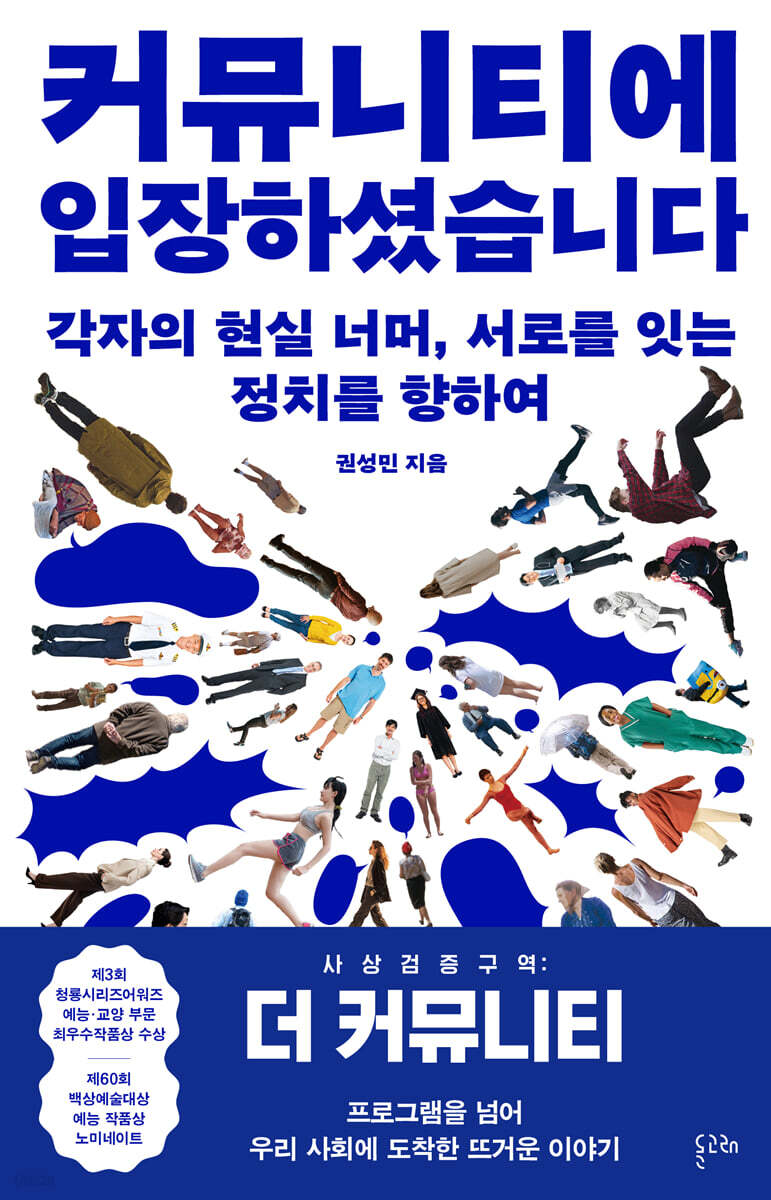
You have entered the community
 |
Description
Book Introduction
- A word from MD
-
Is coexistence possible in a divided society?The world is divided into my side and your side.
"Thought Verification Zone: The Community" was a variety show that encouraged people to talk instead of fighting.
In this book, producer Kwon Seong-min reveals the planning intentions and behind-the-scenes stories, as well as the author's own story as a contemporary living in the same era.
If we actually meet, we're all better people than we think. Let's talk.
June 27, 2025. Social and Political PD Son Min-gyu
In an age of extremes, how can we coexist?
PD Kwon Seong-min, who planned and directed "The Thought Verification Zone: The Community," which was recognized for both topicality and artistic quality, including winning the Best Variety Show Award in the Entertainment/Culture category at the 3rd Blue Dragon Series Awards and being nominated for the Best Variety Show Award at the 60th Baeksang Arts Awards, expands on that story through his new book, "You Have Entered the Community."
This program, which received praise for “creating a microcosm of real society, illuminating the multifaceted nature of human beings, and opening up a new horizon for reality,” and “suggesting the possibility that coexistence is possible even with different opinions,” deals with the issues surrounding politics, gender, class, and social ethics, which are the axes of conflict in Korean society, and presents the context of different ideologies and values with a balanced perspective, starting from the problem awareness that served as the basis for planning.
By encompassing the author's personal experiences, the devices and scenes within the program, which is also a kind of social experiment, the viewers' reactions to them, and political and social theories and discourses, the book paints a three-dimensional picture of the diverse opinions in Korean society.
For the past 14 years, producer Kwon Seong-min has been communicating with the public by incorporating various social messages into his entertainment programs.
This ability is also evident in "You Have Entered the Community."
It vividly conveys political and social concepts through everyday examples and specific social scenes, helping readers understand them within the context of life.
Thanks to its humorous yet sincere guidance, this book establishes itself as a political and social education book that anyone can read without difficulty.
"You Have Entered the Community" is not a book that attempts to determine which position is right or wrong.
The author proposes that we shift our focus away from the extreme opinions that are prominent online and instead understand the context in which people form their opinions and the instincts at work within them.
Because everyone has their own history and trajectory, and cannot be reduced to a flat, simple opinion.
Now that the new administration has emerged, ending the civil war and uniting the nation have become crucial tasks. Can we truly end the long-standing conflict and move toward a society of unity and coexistence? This book will spark open dialogue and inquiry among people.
If our goal isn't simply to confirm our own legitimacy and integrity where differing opinions collide, if we want to find common ground on the ground we walk on together and realize, even if only a little, the society we each dream of, then we need to understand each other's language and examine where they stand.
[… … ] even if it is just to better get my opinion across.
(Page 11)
PD Kwon Seong-min, who planned and directed "The Thought Verification Zone: The Community," which was recognized for both topicality and artistic quality, including winning the Best Variety Show Award in the Entertainment/Culture category at the 3rd Blue Dragon Series Awards and being nominated for the Best Variety Show Award at the 60th Baeksang Arts Awards, expands on that story through his new book, "You Have Entered the Community."
This program, which received praise for “creating a microcosm of real society, illuminating the multifaceted nature of human beings, and opening up a new horizon for reality,” and “suggesting the possibility that coexistence is possible even with different opinions,” deals with the issues surrounding politics, gender, class, and social ethics, which are the axes of conflict in Korean society, and presents the context of different ideologies and values with a balanced perspective, starting from the problem awareness that served as the basis for planning.
By encompassing the author's personal experiences, the devices and scenes within the program, which is also a kind of social experiment, the viewers' reactions to them, and political and social theories and discourses, the book paints a three-dimensional picture of the diverse opinions in Korean society.
For the past 14 years, producer Kwon Seong-min has been communicating with the public by incorporating various social messages into his entertainment programs.
This ability is also evident in "You Have Entered the Community."
It vividly conveys political and social concepts through everyday examples and specific social scenes, helping readers understand them within the context of life.
Thanks to its humorous yet sincere guidance, this book establishes itself as a political and social education book that anyone can read without difficulty.
"You Have Entered the Community" is not a book that attempts to determine which position is right or wrong.
The author proposes that we shift our focus away from the extreme opinions that are prominent online and instead understand the context in which people form their opinions and the instincts at work within them.
Because everyone has their own history and trajectory, and cannot be reduced to a flat, simple opinion.
Now that the new administration has emerged, ending the civil war and uniting the nation have become crucial tasks. Can we truly end the long-standing conflict and move toward a society of unity and coexistence? This book will spark open dialogue and inquiry among people.
If our goal isn't simply to confirm our own legitimacy and integrity where differing opinions collide, if we want to find common ground on the ground we walk on together and realize, even if only a little, the society we each dream of, then we need to understand each other's language and examine where they stand.
[… … ] even if it is just to better get my opinion across.
(Page 11)
- You can preview some of the book's contents.
Preview
index
Recommendation
Entering and speaking to the listener
Part 1: A World Where We Never Meet
Chapter 1: An Uncomfortable Encounter That Expands the World
Chapter 2: Entertainment, a Playful Public Sphere
Chapter 3: A closer look at the conflict
Chapter 4 Dimensions and Spectra
Part 2: Checking each person's position
Chapter 1: Politics: Beyond Freedom vs. Equality
Chapter 2 Tilted Blue
Chapter 3: To you who achieved success through class, skill, and effort
Chapter 4: Why am I rich?
Chapter 5: Gender: The World of 'Equalism'
Part 3: Coexistence without a correct answer
Chapter 1: Openness: When Your Problems Become Our Problems
Chapter 2: When the Veil of Ignorance Rises
Chapter 3: Everyone Needs Recognition
Chapter 4: A Society Where 'Hypocrisy' Works
main
Entering and speaking to the listener
Part 1: A World Where We Never Meet
Chapter 1: An Uncomfortable Encounter That Expands the World
Chapter 2: Entertainment, a Playful Public Sphere
Chapter 3: A closer look at the conflict
Chapter 4 Dimensions and Spectra
Part 2: Checking each person's position
Chapter 1: Politics: Beyond Freedom vs. Equality
Chapter 2 Tilted Blue
Chapter 3: To you who achieved success through class, skill, and effort
Chapter 4: Why am I rich?
Chapter 5: Gender: The World of 'Equalism'
Part 3: Coexistence without a correct answer
Chapter 1: Openness: When Your Problems Become Our Problems
Chapter 2: When the Veil of Ignorance Rises
Chapter 3: Everyone Needs Recognition
Chapter 4: A Society Where 'Hypocrisy' Works
main
Detailed image
.jpg)
Into the book
The biggest problem with looking down on others is that it's not true.
There is no such thing as a person formed by only one standard.
I'm not trying to say, 'Even Hitler was a good man to his subordinates.'
I am not trying to advocate relativism, which says that all positions are important and that there is no right position in the world.
It's dangerous to assert absolute goodness beyond context and time, but I still believe there are better choices at every moment.
[… … ] I also feel a sense of crisis when I find people in similar situations to me looking flatly over the fence.
While ridicule directed at the outside may strengthen the bonds within, it is unlikely that sound choices will be made based on a perspective detached from the truth.
--- p.33~34
The nature of online spaces that promote public issues and act as a forum for public opinion is similar.
Like many people who call customer service, those who show up to the space are usually already angry.
Their position is set, and it is unlikely that they will listen to other opinions and change their own opinion even partially.
On the other hand, the action of supplementation and reinforcement to destroy the opponent's logic occurs frequently.
There are countless sources of ambiguous evidence online to support your position.
--- p.41~42
In 18th-century Europe, political power was formed in the salons of the bourgeoisie, but the public opinion of the common people was probably formed in the marketplace and the laundromat.
(“Did you hear that?”, “Oh my, what’s going on!”) In those days, the common people in the markets and laundries could not have political power, but in the democratic era, people who go to the markets and laundries have equal sovereignty.
That is why the countless spaces in our daily lives where we just wander around without any intention of public discussion can all become public forums of their own.
The more unexpected encounters there are, the more meaningful stories can begin.
--- p.56
The more a person decides on one side of the issue first and then bases their judgment on that position, the more distinct their political views become.
That is the 'party line' that professional politicians follow.
A party line is an opinion that prioritizes the party's position over the individual judgments of each politician and is formed accordingly.
But most of us are not professional politicians.
In every matter, we have to have a complex position.
Even if opinions are divided on some issues, we may be in agreement on other issues.
--- p.84~85
Normal distribution curve shape.
A bell-shaped curve that is high in the middle and tapers towards both ends.
The media is full of people making extreme and blatant claims, but this is what our reality looks like most of the time.
The people who scored the highest on the test did not even make up 10 percent of the total.
This means that most of the over a million people who took this test online were clustered around 1 and 2 points.
It would probably be impossible for the red three dots and the blue three dots to convince each other.
It wouldn't be easy to become friends by meeting in private, and I don't think it's necessary.
And sometimes, extreme claims can become a driving force that broadens the horizon of discussion.
But the vast majority of people are hovering around points 1 and 2.
Good politics would be politics that meets on top of this great peak.
--- p.123
I wasn't lucky enough to be born into a wealthy family, but I was fortunate enough to have parents who were loyal and supportive.
Parents who try not to place emotional burden on their children even when there are no seriously ill family members and financial difficulties, and who try to keep promised rewards at all costs, foster in their children many abilities and a sense of stability, including the ability to delay gratification.
Being born with a love of reading and writing is a fortunate thing that can be very beneficial in Korean society.
--- p.163~164
My personal impression is that, although social conflict is intensifying, we hear less and less about class than before.
The 'spoon' debate now feels somewhat outdated.
Acceptance and helplessness play an important role in cooling down the conflict.
In the face of a reality that seems unlikely to change, it may be much easier to give up and yearn than to try to overcome class inequality.
It is also interesting that influencers and characters in works that are rapidly gaining popularity among the younger generation are focusing on "people who are like friends with cultured parents who look young enough to be unable to guess their age, and who have been loved and raised since childhood without any flaws" rather than "self-made people who fiercely cross class lines."
This description is actually close to the habitus of the 'perfectly wealthy class, with no trace of other classes whatsoever.'
Why does this spectacle sparkle so brightly?
--- p.196
In fact, the atmosphere in which boys are often seen as troublemakers in the classroom is part of the "crisis of masculinity," a phenomenon that many recent social studies have pointed out.
Thanks to the efforts of feminism over many years, leadership, assertiveness, and rationality, which were traditionally considered positive values of masculinity, are now universal concepts in mainstream discourse that transcend gender characteristics and are naturally used to describe women as well.
Gender has disappeared from masculine values.
[… … ] There is little left as a positive value in the realm of masculinity.
Nowadays, the means by which men express their masculinity are mainly intentional childishness, irrational boldness, aggression, and norm-violating play.
--- p.209~210
Many scholars interpret young men's hostility toward feminism as the "anger of men who have lost their vested rights."
They are dissatisfied with the reality that they have to compete with women, unlike in the past, and they want to restore the patriarchal authority that the industrialized generation enjoyed.
But this is the frame of the industrialization generation.
The young men who shout 'equalism' have never felt like they were vested interests.
Nor do they identify themselves with the patriarchal males of the industrialized generation.
The world I experienced throughout my teens and twenties was not one that favored men, but feminism continued to say that women were discriminated against, which was just disheartening.
I cannot understand why they hold us responsible for the discrimination that previous generations committed against us.
--- p.222
Let's go back to the story of my goshiwon, which was the beginning of this article.
If you're a man reading this, you'll probably take it as a cute and cheerful sitcom episode, just as I described.
However, female readers would have found it difficult to simply pass over the phrase, “After that, I continued to live with the window open.”
Let's reverse the gender of this experience.
No woman would want to live in a room with a single, soundless wall between them, and the knowledge that a drunken man could burst in through a window she thought was impenetrable.
If I had a choice, I would pack up and leave right away, but if not, I would have to spend the summer in anxiety with the windows tightly locked.
Women must also consider safety when choosing a place to live, and the more things to consider, the higher the cost, of course.
--- p.225
As this is a strategy that capitalizes on the long-standing affection the original work has received, respect for the original work is usually also important.
Naturally, the casting of characters with drastically different appearances leaves something to be desired.
But, as a fan of the original work, if the moment I express my regret and the response I get is, "You're racist!", my regret and sense of loss quickly turn into anger.
No matter how much I explain that that's not the point, it's no use.
Just because the cast of the actor is black, any criticism is seen as an attack on black people.
The complex emotions of fans of the original work are lost.
--- p.302
That's true.
Logic alone cannot persuade people.
No, to be precise, the logic of trying to subdue the other person does not persuade people.
It just makes you shut up.
What's important is not the logic itself, but the attitude underlying it.
Instead of immediately accusing those who expressed regret over the unconventional casting of "The Little Mermaid" of being racist, if we had truly understood their affection for the original work and shared the meaning of the new casting, wouldn't there have been far fewer people who would openly criticize them?
--- p.304
This is the scene that impressed me.
The question, “I am proud to be white,” again moves in the direction of disagreement with the majority of the participants.
The white woman who barely moved one space to “I’m proud” is already crying.
Other people start to scold him.
It's one thing for a black person to be proud of themselves, and another thing for a white person to say that.
They say they cannot agree with that statement because historically the people who said that were the Nazis and the KKK.
Being proud is something you can say about your own accomplishments, but skin color is not one of your accomplishments.
Amidst the torrent of harsh words, the woman standing alone in the opposite direction speaks with a face that looks like she is about to cry.
“Shouldn’t I be proud of just being me…? I like being me, and even if I were given the choice to live as a different race, I’d still want to live my life as I am now.
Isn’t that something to be proud of… …?”
--- p.321~322
As Hama said in an interview, in everyday life, people are not persuaded by logic alone.
Only when we are in a relationship where we feel that the other person understands and respects us do their words truly resonate with us.
Even if they say the same thing, some people have more persuasive power.
It depends more on how much they acknowledge my heart and experiences and what kind of relationship we have than on what logic the person uses.
Ultimately, it is not logic that persuades people, but the way they live their lives.
--- p.329
But it is for that very reason that hypocrisy is necessary.
It is hypocritical for a person who is so messy at home that he doesn't even bother to take care of his own wife, but then leaves the pregnant woman's seat empty outside because he is concerned about what others think.
In a world where everyone is genuinely good and kind, there is no need for hypocrisy.
But the more messed up people are, the more desperately they need even a fake line.
Humanity has seen countless times how messed up and terrible its true colors are.
Each time, the hypocrisy was nailed down even more blatantly.
It is sometimes called civilization, sometimes law, the separation of powers, the Declaration of the Rights of Man, religion, etiquette, and virtue.
--- p.334
This small community of thirteen very special people is a structure that has already involved a lot of interpretation and planning, rather than being a representation of reality.
However, I hope that it can serve as a reference, as the thoughts and words of each person contained within it, as well as their three-dimensionality, are certainly true.
That's what I think this program is about.
I wish I could recall the faces of the performers and the unexpected words they left behind, in front of labels like right-wing or left-wing, feminist or anti-feminist, wealthy or old-fashioned.
--- p.340
Certainly, some people are born with a more evil nature, while others are born with a more good soul.
Some people develop that temperament more steeply as they live, while others certainly take a turn in a completely different direction at some point in their lives.
My emphasis on the power of environment is not because I believe that nature necessarily changes when conditions change.
What matters is how much of a certain nature society allows.
Because there are societies that encourage evil tendencies, and there are societies that guarantee a minimum level of goodness so generously that good tendencies are no longer necessary.
There is no such thing as a person formed by only one standard.
I'm not trying to say, 'Even Hitler was a good man to his subordinates.'
I am not trying to advocate relativism, which says that all positions are important and that there is no right position in the world.
It's dangerous to assert absolute goodness beyond context and time, but I still believe there are better choices at every moment.
[… … ] I also feel a sense of crisis when I find people in similar situations to me looking flatly over the fence.
While ridicule directed at the outside may strengthen the bonds within, it is unlikely that sound choices will be made based on a perspective detached from the truth.
--- p.33~34
The nature of online spaces that promote public issues and act as a forum for public opinion is similar.
Like many people who call customer service, those who show up to the space are usually already angry.
Their position is set, and it is unlikely that they will listen to other opinions and change their own opinion even partially.
On the other hand, the action of supplementation and reinforcement to destroy the opponent's logic occurs frequently.
There are countless sources of ambiguous evidence online to support your position.
--- p.41~42
In 18th-century Europe, political power was formed in the salons of the bourgeoisie, but the public opinion of the common people was probably formed in the marketplace and the laundromat.
(“Did you hear that?”, “Oh my, what’s going on!”) In those days, the common people in the markets and laundries could not have political power, but in the democratic era, people who go to the markets and laundries have equal sovereignty.
That is why the countless spaces in our daily lives where we just wander around without any intention of public discussion can all become public forums of their own.
The more unexpected encounters there are, the more meaningful stories can begin.
--- p.56
The more a person decides on one side of the issue first and then bases their judgment on that position, the more distinct their political views become.
That is the 'party line' that professional politicians follow.
A party line is an opinion that prioritizes the party's position over the individual judgments of each politician and is formed accordingly.
But most of us are not professional politicians.
In every matter, we have to have a complex position.
Even if opinions are divided on some issues, we may be in agreement on other issues.
--- p.84~85
Normal distribution curve shape.
A bell-shaped curve that is high in the middle and tapers towards both ends.
The media is full of people making extreme and blatant claims, but this is what our reality looks like most of the time.
The people who scored the highest on the test did not even make up 10 percent of the total.
This means that most of the over a million people who took this test online were clustered around 1 and 2 points.
It would probably be impossible for the red three dots and the blue three dots to convince each other.
It wouldn't be easy to become friends by meeting in private, and I don't think it's necessary.
And sometimes, extreme claims can become a driving force that broadens the horizon of discussion.
But the vast majority of people are hovering around points 1 and 2.
Good politics would be politics that meets on top of this great peak.
--- p.123
I wasn't lucky enough to be born into a wealthy family, but I was fortunate enough to have parents who were loyal and supportive.
Parents who try not to place emotional burden on their children even when there are no seriously ill family members and financial difficulties, and who try to keep promised rewards at all costs, foster in their children many abilities and a sense of stability, including the ability to delay gratification.
Being born with a love of reading and writing is a fortunate thing that can be very beneficial in Korean society.
--- p.163~164
My personal impression is that, although social conflict is intensifying, we hear less and less about class than before.
The 'spoon' debate now feels somewhat outdated.
Acceptance and helplessness play an important role in cooling down the conflict.
In the face of a reality that seems unlikely to change, it may be much easier to give up and yearn than to try to overcome class inequality.
It is also interesting that influencers and characters in works that are rapidly gaining popularity among the younger generation are focusing on "people who are like friends with cultured parents who look young enough to be unable to guess their age, and who have been loved and raised since childhood without any flaws" rather than "self-made people who fiercely cross class lines."
This description is actually close to the habitus of the 'perfectly wealthy class, with no trace of other classes whatsoever.'
Why does this spectacle sparkle so brightly?
--- p.196
In fact, the atmosphere in which boys are often seen as troublemakers in the classroom is part of the "crisis of masculinity," a phenomenon that many recent social studies have pointed out.
Thanks to the efforts of feminism over many years, leadership, assertiveness, and rationality, which were traditionally considered positive values of masculinity, are now universal concepts in mainstream discourse that transcend gender characteristics and are naturally used to describe women as well.
Gender has disappeared from masculine values.
[… … ] There is little left as a positive value in the realm of masculinity.
Nowadays, the means by which men express their masculinity are mainly intentional childishness, irrational boldness, aggression, and norm-violating play.
--- p.209~210
Many scholars interpret young men's hostility toward feminism as the "anger of men who have lost their vested rights."
They are dissatisfied with the reality that they have to compete with women, unlike in the past, and they want to restore the patriarchal authority that the industrialized generation enjoyed.
But this is the frame of the industrialization generation.
The young men who shout 'equalism' have never felt like they were vested interests.
Nor do they identify themselves with the patriarchal males of the industrialized generation.
The world I experienced throughout my teens and twenties was not one that favored men, but feminism continued to say that women were discriminated against, which was just disheartening.
I cannot understand why they hold us responsible for the discrimination that previous generations committed against us.
--- p.222
Let's go back to the story of my goshiwon, which was the beginning of this article.
If you're a man reading this, you'll probably take it as a cute and cheerful sitcom episode, just as I described.
However, female readers would have found it difficult to simply pass over the phrase, “After that, I continued to live with the window open.”
Let's reverse the gender of this experience.
No woman would want to live in a room with a single, soundless wall between them, and the knowledge that a drunken man could burst in through a window she thought was impenetrable.
If I had a choice, I would pack up and leave right away, but if not, I would have to spend the summer in anxiety with the windows tightly locked.
Women must also consider safety when choosing a place to live, and the more things to consider, the higher the cost, of course.
--- p.225
As this is a strategy that capitalizes on the long-standing affection the original work has received, respect for the original work is usually also important.
Naturally, the casting of characters with drastically different appearances leaves something to be desired.
But, as a fan of the original work, if the moment I express my regret and the response I get is, "You're racist!", my regret and sense of loss quickly turn into anger.
No matter how much I explain that that's not the point, it's no use.
Just because the cast of the actor is black, any criticism is seen as an attack on black people.
The complex emotions of fans of the original work are lost.
--- p.302
That's true.
Logic alone cannot persuade people.
No, to be precise, the logic of trying to subdue the other person does not persuade people.
It just makes you shut up.
What's important is not the logic itself, but the attitude underlying it.
Instead of immediately accusing those who expressed regret over the unconventional casting of "The Little Mermaid" of being racist, if we had truly understood their affection for the original work and shared the meaning of the new casting, wouldn't there have been far fewer people who would openly criticize them?
--- p.304
This is the scene that impressed me.
The question, “I am proud to be white,” again moves in the direction of disagreement with the majority of the participants.
The white woman who barely moved one space to “I’m proud” is already crying.
Other people start to scold him.
It's one thing for a black person to be proud of themselves, and another thing for a white person to say that.
They say they cannot agree with that statement because historically the people who said that were the Nazis and the KKK.
Being proud is something you can say about your own accomplishments, but skin color is not one of your accomplishments.
Amidst the torrent of harsh words, the woman standing alone in the opposite direction speaks with a face that looks like she is about to cry.
“Shouldn’t I be proud of just being me…? I like being me, and even if I were given the choice to live as a different race, I’d still want to live my life as I am now.
Isn’t that something to be proud of… …?”
--- p.321~322
As Hama said in an interview, in everyday life, people are not persuaded by logic alone.
Only when we are in a relationship where we feel that the other person understands and respects us do their words truly resonate with us.
Even if they say the same thing, some people have more persuasive power.
It depends more on how much they acknowledge my heart and experiences and what kind of relationship we have than on what logic the person uses.
Ultimately, it is not logic that persuades people, but the way they live their lives.
--- p.329
But it is for that very reason that hypocrisy is necessary.
It is hypocritical for a person who is so messy at home that he doesn't even bother to take care of his own wife, but then leaves the pregnant woman's seat empty outside because he is concerned about what others think.
In a world where everyone is genuinely good and kind, there is no need for hypocrisy.
But the more messed up people are, the more desperately they need even a fake line.
Humanity has seen countless times how messed up and terrible its true colors are.
Each time, the hypocrisy was nailed down even more blatantly.
It is sometimes called civilization, sometimes law, the separation of powers, the Declaration of the Rights of Man, religion, etiquette, and virtue.
--- p.334
This small community of thirteen very special people is a structure that has already involved a lot of interpretation and planning, rather than being a representation of reality.
However, I hope that it can serve as a reference, as the thoughts and words of each person contained within it, as well as their three-dimensionality, are certainly true.
That's what I think this program is about.
I wish I could recall the faces of the performers and the unexpected words they left behind, in front of labels like right-wing or left-wing, feminist or anti-feminist, wealthy or old-fashioned.
--- p.340
Certainly, some people are born with a more evil nature, while others are born with a more good soul.
Some people develop that temperament more steeply as they live, while others certainly take a turn in a completely different direction at some point in their lives.
My emphasis on the power of environment is not because I believe that nature necessarily changes when conditions change.
What matters is how much of a certain nature society allows.
Because there are societies that encourage evil tendencies, and there are societies that guarantee a minimum level of goodness so generously that good tendencies are no longer necessary.
--- p.344~345
Publisher's Review
How did the playful public forum called "The Community" become successful?
In an era where we don't meet each other, in search of a lost public forum
The audience's response to "The Community," which aired in January 2024, was enthusiastic.
It gained traction across gender, age, and country, with word-of-mouth spreading not only among those who are interested in politics but also among the younger generation, and even overseas viewers sharing their various thoughts.
"At first, he was a character I frowned upon, but as I watched, I came to understand his history." "I realized that the words of someone I once found charming were actually empty, and I was embarrassed to find someone I would have considered an enemy if I had met them elsewhere cute." In today's world, where social media has become the central stage for communication and public opinion formation, the fact that existing beliefs are reinforced through confirmation bias is something everyone feels, and it's a problem that experts also point out.
The scholars' diagnosis that increasing face-to-face communication is crucial for the restoration of democracy was also the main basis for planning "The Community."
As an entertainment producer, I have personally experienced how online public forums have hindered communication between people and brought about a major crisis in democracy.
Part 1 of the book, “A World Where We Don’t Meet Each Other,” contains the concerns that producer Kwon Seong-min had while planning the program.
In online communication environments, extreme opinions armed with simple logic stand out, and above all, the diverse contexts and history that formed an individual's opinion are erased.
The author argues that when people begin to "dehumanize" each other, the chances of forming healthy public opinion and reaching better agreements through communication and compromise diminish.
How closely do online comments reflect real-world public opinion? Do people in real life engage in such fierce conflict and discord as they do online? How different is the information curated and presented on my social media from that of the person sitting next to me? This book illuminates the patterns of conflict and communication within the media, making us realize how, in a world interconnected across time and space, we are often confined within narrow and fragile boundaries.
So what kind of public sphere do we need? The possibility the author focuses on is a "playful" public sphere.
Just as the 18th-century European salons and cafés, which Habermas presented as models for the public sphere, were spaces where people chatted about culture and art without any specific purpose, wouldn't entertainment programs also allow for public exchange and communication? A space where people of all ages could gather and engage in a variety of issues, regardless of their interests.
A space where unexpected encounters and conversations take place.
In an era of fragmented channels based on gender, age, and political leanings, this book asks what kind of forum for dialogue we need.
The combination of entertainment broadcasts as a playful public forum and books as an introduction to politics and society will spark countless conversations and questions among people.
This book will make politics a living experience, beyond simply choosing a position and worshipping or hating a particular politician.
_Ha Mina (author)
Beyond the dichotomies of left-right, rich-poor, feminism-antifeminism, tradition-openness
A spectrum of politics where questions and conversations arise
The program's biggest topic of conversation was the 'ideological verification test', a tool to check the political leanings of the cast members.
This test, which was open to the public so that viewers could also participate directly, has had approximately 1.2 million participants over the past year, accumulating a vast amount of data.
Although the results were not published separately as this was an unofficial survey, this book approaches the four key issues that make up the ideological verification test: politics (left and right), class (rich and poor), gender (feminism and anti-feminism), and openness (tradition and openness) based on the facts and insights confirmed by the meaningful data.
Part 2 of the book, "Examining Each Person's Position," begins with an easy-to-understand and friendly explanation of the history of the concepts of left and right, examining discussions on the 18th-century French Revolution, political scientist Norberto Bobbio's classification of left and right, and moral psychologist Jonathan Haidt's six moral foundations that divide progressives and conservatives.
It allows us to break free from partisan stereotypes and imagine concretely the numerous positions that exist under the flat categories of “progressive” and “conservative.”
Many people who participated in the ideological verification test received the result of “rich” in terms of class and responded, “Why am I rich?”
The author notes this reaction, arguing that poverty has become increasingly invisible in Korean society today, with the possibility of class mobility virtually disappearing, and wealth being displayed and flaunted, producing more wealth.
By emphasizing the power of 'class' to influence a person's political and social stance in various ways, it calls for a broader imagination about poverty, which is rarely visible and is often flatly viewed as an object of disgust.
While honestly confessing the poverty he experienced, he objectively reflects on the 'meritocracy' assumed in the discourse of fairness and ability.
Gender was also a major topic of discussion on the program, with the most extreme values submitted in the 1.2 million ideological verification test data.
It is also the axis of extreme conflict in modern society.
The author provides a comprehensive explanation of the use of the expression "equalism," which caused controversy at the time of its broadcast.
He argues that the conversation must begin by acknowledging the gap between the reality experienced by young women and the reality perceived by young men, and provides a detailed diagnosis of the reality experienced by men in their teens and twenties from the perspectives of education and relationships.
The explanation is that the absence of positive role models for men, the patriarchal culture that remains strong in heterosexual norms even in a reality where structural gender discrimination is gradually easing, and the mandatory military service that begins in the early 20s can become walls that block men and women from recognizing reality.
Of course, among all drivers, not just those driving large trucks, there is a certain percentage of those who are inexperienced drivers, fall asleep due to overwork, or drive maliciously and recklessly.
But if that car happens to be a large truck, I, who am sitting next to it, will die without being able to do anything.
This is because of the overwhelming physical differences in the body.
[… … ] So, even if it is a truck that is driving safely and steadily, the principle of defensive driving is to first stay away from it.
Because from my perspective right now, I have no way of knowing the actual driver's condition or intentions.
Heavy truck drivers are also aware of this fact and are trained to follow much stricter safety driving rules.
Potential 'potential for harm' does not imply inherent malice in someone.
(Pages 226-227)
"You've Entered the Community" attempts to offer a broader perspective on issues at the center of this conflict.
In the midst of all this complexity, we hope to create a space where we can understand each other's lives, even if only a little.
Reading these articles is meaningful not only because it provides an opportunity to consider the other person's position, but also because it provides an opportunity for readers to reflect on the background and context in which their own political stances were formed.
Where does the resentment and anger of men in their 20s and 30s come from?
On the current state of modern politics and better democracy
As cynicism, disgust, and anger toward politics grow among young men in South Korea, various interpretations pour in every election.
This trend was also clearly revealed in the results of the exit polls by age and gender for the recently held 21st presidential election.
Part 3 of the book, “Coexisting Without a Correct Answer,” addresses the hottest issue in modern politics:
It covers major topics such as identity politics, the conservatism of the working class, and resentment and distrust of progressive governments.
In particular, this book closely examines the background of growing resentment toward the progressive regime led by high-income, highly educated cultural elites.
The author explains that the progressive camp has been promoting moral messages and the language of enlightenment, ridiculing or caricaturing those who disagree with it and excluding them from the public sphere.
This strategy has, instead, fostered widespread resentment and distrust toward established powers, leading to a range of negative consequences across society today.
Another truth this book emphasizes is that humans are not beings who can be judged and persuaded solely by logic and reason.
For example, the hypothesis that the influx of immigrants has made the lives of existing workers more difficult has not been objectively proven, but the anxiety and pressure felt by the parties in a situation where economic growth is slowing and life is becoming more difficult
It is difficult to communicate with them by refuting the claim that it is 'not true'.
Everyone needs a place where their lives are recognized, and those who don't feel their social role is recognized within the system are more likely to be drawn to extreme voices.
"The Community," a community and small society established by the author, faithfully follows the survival format, allowing many contestants to survive until the end and become the ultimate winner.
In fact, the cast members were completely absent until the middle of the program.
The circle actively agreed to create a society in which people can survive and be safe.
Even though the majority of the contestants were politically 'right-wing' and class-wise 'wealthy', in the final leader election, they made a choice that was different from their previous stance, casting 11 out of 13 votes to 'Baekgom' (played by Park Sung-min), who had pledged to protect the weak and manage community crises.
"You've Entered the Community" conveys the possibility of hope through symbolic scenes where the program's cast and viewers broaden their understanding of one another.
It may not be a grand or clear-cut answer, but it may be the most realistic and effective method.
It is about establishing a minimum standard for a system where everyone can coexist, rather than an environment where everyone must push each other out to survive.
Meeting diverse people in it sincerely.
Repeating vicarious experiences through art allows me to look beyond the stories that are comfortable and familiar to me.
Sometimes it's about facing someone's life as it is, without any right answers.
As we cultivate our imaginations toward one another across the spectrum of political stances and lifestyles, wouldn't our community gradually improve?
In an era where we don't meet each other, in search of a lost public forum
The audience's response to "The Community," which aired in January 2024, was enthusiastic.
It gained traction across gender, age, and country, with word-of-mouth spreading not only among those who are interested in politics but also among the younger generation, and even overseas viewers sharing their various thoughts.
"At first, he was a character I frowned upon, but as I watched, I came to understand his history." "I realized that the words of someone I once found charming were actually empty, and I was embarrassed to find someone I would have considered an enemy if I had met them elsewhere cute." In today's world, where social media has become the central stage for communication and public opinion formation, the fact that existing beliefs are reinforced through confirmation bias is something everyone feels, and it's a problem that experts also point out.
The scholars' diagnosis that increasing face-to-face communication is crucial for the restoration of democracy was also the main basis for planning "The Community."
As an entertainment producer, I have personally experienced how online public forums have hindered communication between people and brought about a major crisis in democracy.
Part 1 of the book, “A World Where We Don’t Meet Each Other,” contains the concerns that producer Kwon Seong-min had while planning the program.
In online communication environments, extreme opinions armed with simple logic stand out, and above all, the diverse contexts and history that formed an individual's opinion are erased.
The author argues that when people begin to "dehumanize" each other, the chances of forming healthy public opinion and reaching better agreements through communication and compromise diminish.
How closely do online comments reflect real-world public opinion? Do people in real life engage in such fierce conflict and discord as they do online? How different is the information curated and presented on my social media from that of the person sitting next to me? This book illuminates the patterns of conflict and communication within the media, making us realize how, in a world interconnected across time and space, we are often confined within narrow and fragile boundaries.
So what kind of public sphere do we need? The possibility the author focuses on is a "playful" public sphere.
Just as the 18th-century European salons and cafés, which Habermas presented as models for the public sphere, were spaces where people chatted about culture and art without any specific purpose, wouldn't entertainment programs also allow for public exchange and communication? A space where people of all ages could gather and engage in a variety of issues, regardless of their interests.
A space where unexpected encounters and conversations take place.
In an era of fragmented channels based on gender, age, and political leanings, this book asks what kind of forum for dialogue we need.
The combination of entertainment broadcasts as a playful public forum and books as an introduction to politics and society will spark countless conversations and questions among people.
This book will make politics a living experience, beyond simply choosing a position and worshipping or hating a particular politician.
_Ha Mina (author)
Beyond the dichotomies of left-right, rich-poor, feminism-antifeminism, tradition-openness
A spectrum of politics where questions and conversations arise
The program's biggest topic of conversation was the 'ideological verification test', a tool to check the political leanings of the cast members.
This test, which was open to the public so that viewers could also participate directly, has had approximately 1.2 million participants over the past year, accumulating a vast amount of data.
Although the results were not published separately as this was an unofficial survey, this book approaches the four key issues that make up the ideological verification test: politics (left and right), class (rich and poor), gender (feminism and anti-feminism), and openness (tradition and openness) based on the facts and insights confirmed by the meaningful data.
Part 2 of the book, "Examining Each Person's Position," begins with an easy-to-understand and friendly explanation of the history of the concepts of left and right, examining discussions on the 18th-century French Revolution, political scientist Norberto Bobbio's classification of left and right, and moral psychologist Jonathan Haidt's six moral foundations that divide progressives and conservatives.
It allows us to break free from partisan stereotypes and imagine concretely the numerous positions that exist under the flat categories of “progressive” and “conservative.”
Many people who participated in the ideological verification test received the result of “rich” in terms of class and responded, “Why am I rich?”
The author notes this reaction, arguing that poverty has become increasingly invisible in Korean society today, with the possibility of class mobility virtually disappearing, and wealth being displayed and flaunted, producing more wealth.
By emphasizing the power of 'class' to influence a person's political and social stance in various ways, it calls for a broader imagination about poverty, which is rarely visible and is often flatly viewed as an object of disgust.
While honestly confessing the poverty he experienced, he objectively reflects on the 'meritocracy' assumed in the discourse of fairness and ability.
Gender was also a major topic of discussion on the program, with the most extreme values submitted in the 1.2 million ideological verification test data.
It is also the axis of extreme conflict in modern society.
The author provides a comprehensive explanation of the use of the expression "equalism," which caused controversy at the time of its broadcast.
He argues that the conversation must begin by acknowledging the gap between the reality experienced by young women and the reality perceived by young men, and provides a detailed diagnosis of the reality experienced by men in their teens and twenties from the perspectives of education and relationships.
The explanation is that the absence of positive role models for men, the patriarchal culture that remains strong in heterosexual norms even in a reality where structural gender discrimination is gradually easing, and the mandatory military service that begins in the early 20s can become walls that block men and women from recognizing reality.
Of course, among all drivers, not just those driving large trucks, there is a certain percentage of those who are inexperienced drivers, fall asleep due to overwork, or drive maliciously and recklessly.
But if that car happens to be a large truck, I, who am sitting next to it, will die without being able to do anything.
This is because of the overwhelming physical differences in the body.
[… … ] So, even if it is a truck that is driving safely and steadily, the principle of defensive driving is to first stay away from it.
Because from my perspective right now, I have no way of knowing the actual driver's condition or intentions.
Heavy truck drivers are also aware of this fact and are trained to follow much stricter safety driving rules.
Potential 'potential for harm' does not imply inherent malice in someone.
(Pages 226-227)
"You've Entered the Community" attempts to offer a broader perspective on issues at the center of this conflict.
In the midst of all this complexity, we hope to create a space where we can understand each other's lives, even if only a little.
Reading these articles is meaningful not only because it provides an opportunity to consider the other person's position, but also because it provides an opportunity for readers to reflect on the background and context in which their own political stances were formed.
Where does the resentment and anger of men in their 20s and 30s come from?
On the current state of modern politics and better democracy
As cynicism, disgust, and anger toward politics grow among young men in South Korea, various interpretations pour in every election.
This trend was also clearly revealed in the results of the exit polls by age and gender for the recently held 21st presidential election.
Part 3 of the book, “Coexisting Without a Correct Answer,” addresses the hottest issue in modern politics:
It covers major topics such as identity politics, the conservatism of the working class, and resentment and distrust of progressive governments.
In particular, this book closely examines the background of growing resentment toward the progressive regime led by high-income, highly educated cultural elites.
The author explains that the progressive camp has been promoting moral messages and the language of enlightenment, ridiculing or caricaturing those who disagree with it and excluding them from the public sphere.
This strategy has, instead, fostered widespread resentment and distrust toward established powers, leading to a range of negative consequences across society today.
Another truth this book emphasizes is that humans are not beings who can be judged and persuaded solely by logic and reason.
For example, the hypothesis that the influx of immigrants has made the lives of existing workers more difficult has not been objectively proven, but the anxiety and pressure felt by the parties in a situation where economic growth is slowing and life is becoming more difficult
It is difficult to communicate with them by refuting the claim that it is 'not true'.
Everyone needs a place where their lives are recognized, and those who don't feel their social role is recognized within the system are more likely to be drawn to extreme voices.
"The Community," a community and small society established by the author, faithfully follows the survival format, allowing many contestants to survive until the end and become the ultimate winner.
In fact, the cast members were completely absent until the middle of the program.
The circle actively agreed to create a society in which people can survive and be safe.
Even though the majority of the contestants were politically 'right-wing' and class-wise 'wealthy', in the final leader election, they made a choice that was different from their previous stance, casting 11 out of 13 votes to 'Baekgom' (played by Park Sung-min), who had pledged to protect the weak and manage community crises.
"You've Entered the Community" conveys the possibility of hope through symbolic scenes where the program's cast and viewers broaden their understanding of one another.
It may not be a grand or clear-cut answer, but it may be the most realistic and effective method.
It is about establishing a minimum standard for a system where everyone can coexist, rather than an environment where everyone must push each other out to survive.
Meeting diverse people in it sincerely.
Repeating vicarious experiences through art allows me to look beyond the stories that are comfortable and familiar to me.
Sometimes it's about facing someone's life as it is, without any right answers.
As we cultivate our imaginations toward one another across the spectrum of political stances and lifestyles, wouldn't our community gradually improve?
GOODS SPECIFICS
- Date of issue: June 25, 2025
- Page count, weight, size: 356 pages | 456g | 135*210*23mm
- ISBN13: 9791198850263
- ISBN10: 1198850264
You may also like
카테고리
korean


korean

![GQ KOREA Mark (Monthly): December [2025]](http://librairie.coreenne.fr/cdn/shop/files/8ef265dbbfbf186523ed75ba7319009d.jpg?v=1765340328&width=3840)


