

tilted equality
 |
Description
Book Introduction
- A word from MD
-
Piketty and Sandel Discuss InequalityA life where you work hard but can't see a future.
It is a common sight today.
There are several signs that inequality is deepening.
Economist Thomas Piketty and political scientist Michael Sandel analyzed the history and present of inequality.
It's too early to give up.
Thomas Piketty says:
We have done well and we will do well.
May 20, 2025. Social and Political PD Son Min-gyu
“Who stole our future?”
Two world-renowned experts on inequality have met!
Michael Sandel × Thomas Piketty
Progressive tax, college entrance lottery, decommodification…
Two scholars offer bold suggestions for a more equal social structure.
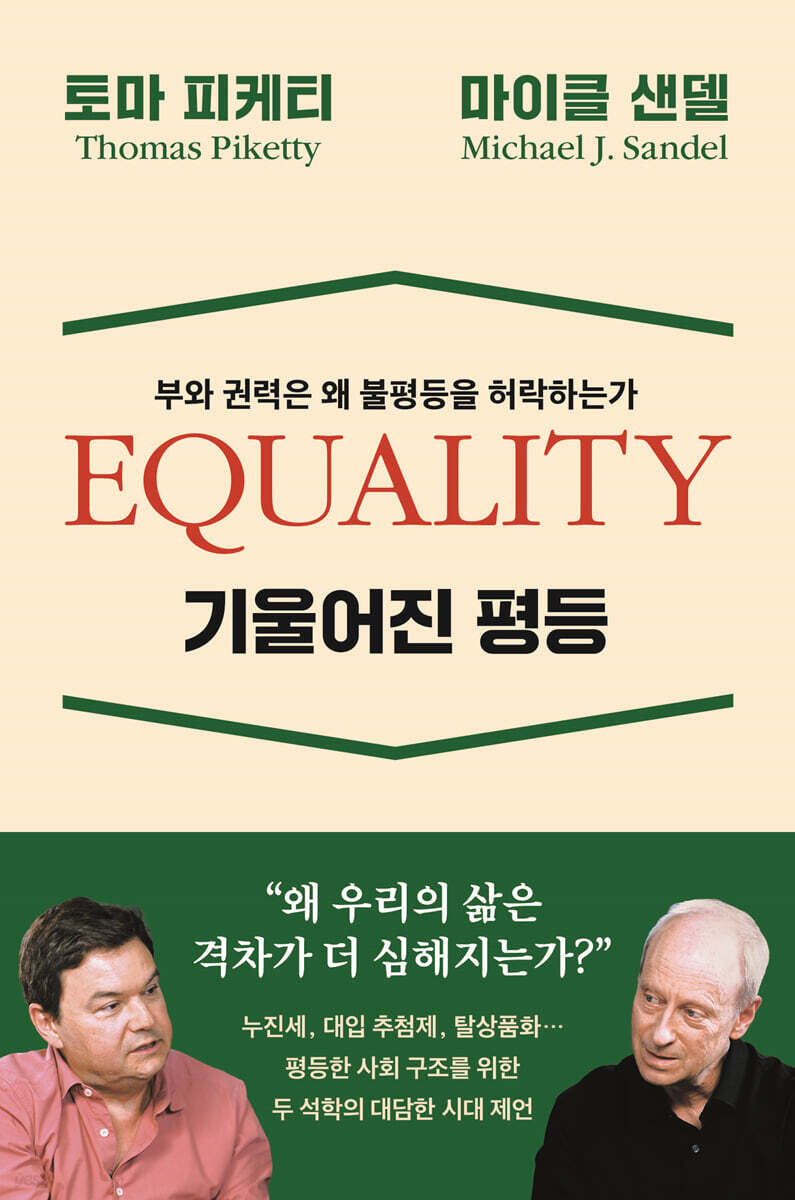
In May 2024, two world-renowned thinkers, Thomas Piketty and Michael Sandel, met at the Paris School of Economics.
The meeting itself attracted attention as the two men were intellectuals and popular thinkers representing France and the United States, respectively.
At this event, the two reflected on the value of equality with the keywords of "equality, inequality, and progress," and discussed why inequality is a problem, how the various gaps surrounding us arose, and what we must do now to reduce these gaps.
And in the spring of 2025, this discussion was published as a book.
It is 『Skewing Equality: Why Wealth and Power Permit Inequality』.
Piketty and Sandel delve into the three dimensions of inequality—economic inequality, political inequality, and social inequality—from various angles, delving deeply into various issues surrounding us today, such as globalization and meritocracy, unequal access to basic goods, skewed political participation, and the disappearance of the dignity of labor.
To address these issues, they propose several alternatives, including more comprehensive investment in basic goods, including education and healthcare, a progressive tax system with higher tax rates, restraint on excessive market expansion, and the use of lotteries for college admissions and elections.
Kirkus Reviews commented, “This is a meeting between a political economist and a political philosopher who are experts on inequality,” and “the solutions they propose are surprising, interesting, and worth trying.”
Amazon readers also praised the book, saying it was “an intelligent attempt” and “will be a good gift for the generations that follow us.”
Two world-renowned experts on inequality have met!
Michael Sandel × Thomas Piketty
Progressive tax, college entrance lottery, decommodification…
Two scholars offer bold suggestions for a more equal social structure.
In May 2024, two world-renowned thinkers, Thomas Piketty and Michael Sandel, met at the Paris School of Economics.
The meeting itself attracted attention as the two men were intellectuals and popular thinkers representing France and the United States, respectively.
At this event, the two reflected on the value of equality with the keywords of "equality, inequality, and progress," and discussed why inequality is a problem, how the various gaps surrounding us arose, and what we must do now to reduce these gaps.
And in the spring of 2025, this discussion was published as a book.
It is 『Skewing Equality: Why Wealth and Power Permit Inequality』.
Piketty and Sandel delve into the three dimensions of inequality—economic inequality, political inequality, and social inequality—from various angles, delving deeply into various issues surrounding us today, such as globalization and meritocracy, unequal access to basic goods, skewed political participation, and the disappearance of the dignity of labor.
To address these issues, they propose several alternatives, including more comprehensive investment in basic goods, including education and healthcare, a progressive tax system with higher tax rates, restraint on excessive market expansion, and the use of lotteries for college admissions and elections.
Kirkus Reviews commented, “This is a meeting between a political economist and a political philosopher who are experts on inequality,” and “the solutions they propose are surprising, interesting, and worth trying.”
Amazon readers also praised the book, saying it was “an intelligent attempt” and “will be a good gift for the generations that follow us.”
- You can preview some of the book's contents.
Preview
index
1.
Why worry about inequality?
2.
Should we move towards a society where money is less important?
3.
The moral limits of the market
4.
Globalization and Populism
5.
Why is meritocracy dangerous?
6.
Should we use a lottery system for college admissions and elections?
7.
Progressive tax system and community
8.
Can the imbalance between the North and South be resolved?
9.
The Future of Economics and Politics
Why worry about inequality?
2.
Should we move towards a society where money is less important?
3.
The moral limits of the market
4.
Globalization and Populism
5.
Why is meritocracy dangerous?
6.
Should we use a lottery system for college admissions and elections?
7.
Progressive tax system and community
8.
Can the imbalance between the North and South be resolved?
9.
The Future of Economics and Politics
Detailed image

Publisher's Review
About our lives and contemporary issues surrounding equality and inequality
Hear the vivid voices of Michael Sandel and Thomas Piketty firsthand!
Why are our lives becoming more and more disparate?
Why inequality matters now
A piece of news was delivered at the London Book Fair in March 2024.
It was announced that two world-renowned thinkers, Michael Sandel and Thomas Piketty, would be writing a book together on the topic of 'equality.'
In May 2024, Sandel and Piketty met at the Paris School of Economics to discuss equality and inequality.
This discussion was compiled into a book and published in Europe and the United States in early 2025.
And in April 2025, the Korean version was finally published.
The Korean title is "Skewing Equality: Why Wealth and Power Permit Inequality."
Through their discussion, Sandel and Piketty agreed that various social movements for equality 100 or 200 years ago brought about social progress, but they also concluded that the market economic system based on free trade and the excessive commodification of life have further deepened inequality in wealth and income.
Ironically, the movement toward equality has given rise to a more unequal social structure.
Why did this happen?
Three Aspects of Inequality
economic inequality, political inequality, social inequality
Sandel and Piketty examine inequality across three dimensions: economic, political, and social, and delve deeply into the various problems that surround us today.
Why is donation-based admissions problematic? Why is meritocracy dangerous? How do income and wage gaps create social disparities? What enables the wealthy and large corporations to avoid taxes? Where do anti-immigrant and xenophobic sentiments come from? Can we truly succeed if we work hard? According to Sandel and Piketty, education and healthcare should be universally accessible basic goods.
However, as these things have become overly commercialized, it has become difficult for anyone to easily access them.
The same goes for housing and public services.
In political circles, they recommend overcoming this situation through meritocracy, that is, seeking upward personal mobility by increasing one's academic ability.
The logic is that then you will win the competition and get what you need.
The era of hanging out together is over.
Social disparities caused by economic and political disparities
But can a college degree truly guarantee us all a prosperous life and a fair assessment of our abilities? The saying "a dragon rises from a ditch" has become a thing of the past.
Far from being a "dog-in-the-sky" proposition, as Sandel and Piketty point out, we no longer hesitate to label those without degrees as lazy and incompetent.
The two people say.
In today's world, it is difficult to recognize the 'dignity of labor,' and the concept of solidarity that has supported our society is disappearing.
In reality, institutions that mix the various social classes are decreasing, and the rich and poor encounter each other less and less in their daily lives.
Therefore, Sandel and Piketty diagnose that social disparity is the biggest problem, rather than economic or political disparity.
Because I believe that the loss of the "dignity of labor" and the lack of recognition, honor, and respect that should be given to those who make valuable contributions to the common good without a college degree are what divides us.
Of course, in order to resolve social disparities, it is also important to resolve the economic and political disparities that have already existed.
So how can we address this gap?
Progressive taxation, college admissions lottery, decommodification, and eradicating identity politics…
Two scholars offer bold suggestions for a more equal social structure.
Sandel and Piketty propose several alternatives, including more comprehensive investment in basic goods including education and health care, a more progressive tax system, controlling the political power of the wealthy, expanding the role of unions in corporations, using lotteries for college admissions and elections, and curbing excessive market expansion.
But can we truly embrace these solutions? And how far and how quickly can we push them forward? Indeed, the alternatives these two propose are bold, even radical.
But as readers who have already read this book have said, this is 'a must for the generations that follow us.'
So even if it's a bold and radical idea, we'll eventually find a way to implement it.
Because history proves it.
Sandel and Piketty are not entirely pessimistic about the current situation.
These two people address why inequality is a problem right now and why equality is important and meaningful, in order to suggest new possibilities for the future.
These two men's bold proposals for the times will enable us to redesign the economic and political structures we need now.
Hear the vivid voices of Michael Sandel and Thomas Piketty firsthand!
Why are our lives becoming more and more disparate?
Why inequality matters now
A piece of news was delivered at the London Book Fair in March 2024.
It was announced that two world-renowned thinkers, Michael Sandel and Thomas Piketty, would be writing a book together on the topic of 'equality.'
In May 2024, Sandel and Piketty met at the Paris School of Economics to discuss equality and inequality.
This discussion was compiled into a book and published in Europe and the United States in early 2025.
And in April 2025, the Korean version was finally published.
The Korean title is "Skewing Equality: Why Wealth and Power Permit Inequality."
Through their discussion, Sandel and Piketty agreed that various social movements for equality 100 or 200 years ago brought about social progress, but they also concluded that the market economic system based on free trade and the excessive commodification of life have further deepened inequality in wealth and income.
Ironically, the movement toward equality has given rise to a more unequal social structure.
Why did this happen?
Three Aspects of Inequality
economic inequality, political inequality, social inequality
Sandel and Piketty examine inequality across three dimensions: economic, political, and social, and delve deeply into the various problems that surround us today.
Why is donation-based admissions problematic? Why is meritocracy dangerous? How do income and wage gaps create social disparities? What enables the wealthy and large corporations to avoid taxes? Where do anti-immigrant and xenophobic sentiments come from? Can we truly succeed if we work hard? According to Sandel and Piketty, education and healthcare should be universally accessible basic goods.
However, as these things have become overly commercialized, it has become difficult for anyone to easily access them.
The same goes for housing and public services.
In political circles, they recommend overcoming this situation through meritocracy, that is, seeking upward personal mobility by increasing one's academic ability.
The logic is that then you will win the competition and get what you need.
The era of hanging out together is over.
Social disparities caused by economic and political disparities
But can a college degree truly guarantee us all a prosperous life and a fair assessment of our abilities? The saying "a dragon rises from a ditch" has become a thing of the past.
Far from being a "dog-in-the-sky" proposition, as Sandel and Piketty point out, we no longer hesitate to label those without degrees as lazy and incompetent.
The two people say.
In today's world, it is difficult to recognize the 'dignity of labor,' and the concept of solidarity that has supported our society is disappearing.
In reality, institutions that mix the various social classes are decreasing, and the rich and poor encounter each other less and less in their daily lives.
Therefore, Sandel and Piketty diagnose that social disparity is the biggest problem, rather than economic or political disparity.
Because I believe that the loss of the "dignity of labor" and the lack of recognition, honor, and respect that should be given to those who make valuable contributions to the common good without a college degree are what divides us.
Of course, in order to resolve social disparities, it is also important to resolve the economic and political disparities that have already existed.
So how can we address this gap?
Progressive taxation, college admissions lottery, decommodification, and eradicating identity politics…
Two scholars offer bold suggestions for a more equal social structure.
Sandel and Piketty propose several alternatives, including more comprehensive investment in basic goods including education and health care, a more progressive tax system, controlling the political power of the wealthy, expanding the role of unions in corporations, using lotteries for college admissions and elections, and curbing excessive market expansion.
But can we truly embrace these solutions? And how far and how quickly can we push them forward? Indeed, the alternatives these two propose are bold, even radical.
But as readers who have already read this book have said, this is 'a must for the generations that follow us.'
So even if it's a bold and radical idea, we'll eventually find a way to implement it.
Because history proves it.
Sandel and Piketty are not entirely pessimistic about the current situation.
These two people address why inequality is a problem right now and why equality is important and meaningful, in order to suggest new possibilities for the future.
These two men's bold proposals for the times will enable us to redesign the economic and political structures we need now.
GOODS SPECIFICS
- Date of issue: May 2, 2025
- Page count, weight, size: 152 pages | 520g | 130*188*15mm
- ISBN13: 9791173475535
- ISBN10: 1173475532
You may also like
카테고리
korean


korean

![GQ KOREA Mark (Monthly): December [2025]](http://librairie.coreenne.fr/cdn/shop/files/8ef265dbbfbf186523ed75ba7319009d.jpg?v=1765340328&width=3840)


