

You have to look at the map to see it
 |
Description
Book Introduction
- A word from MD
-
Why is the world fighting now?Ukraine and Russia, Israel and Hamas, Taiwan and China, North Korea and South Korea.
It is an area where war is ongoing or there is a high possibility of war.
What causes conflict? This book provides the answer.
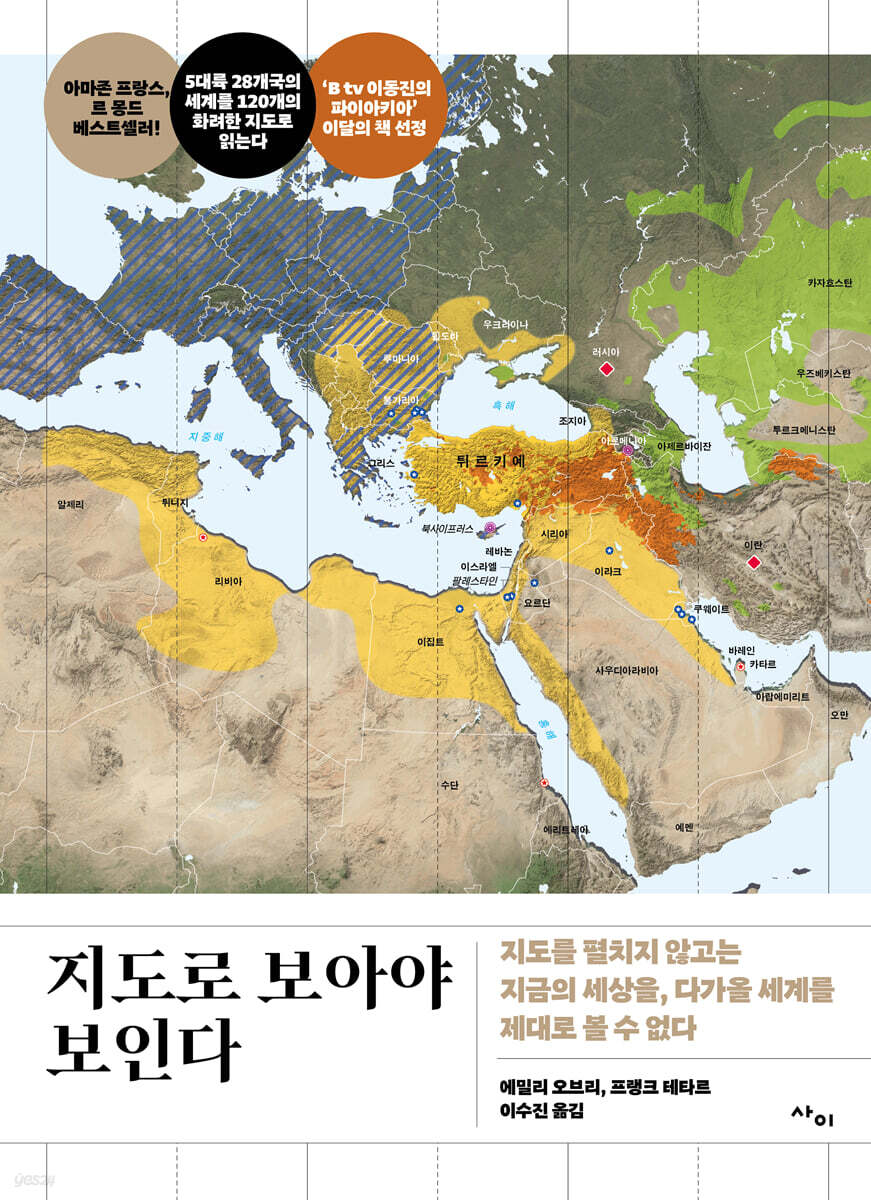
It presents 120 maps showing geopolitical issues in 28 countries across five continents.
If you know geopolitics, you can see the modern history of the 21st century.
August 20, 2024. Social and Political PD Son Min-gyu
Seeing the world on a map is different from seeing it in a photograph or with a drone.
Maps tell countless stories of geopolitical upheaval.
So the world becomes clearer when viewed on a map.
Read the geopolitical situation of 28 countries across five continents, including Asia, Europe, the Middle East, America, and Africa, through 120 gorgeous maps.
Maps tell countless stories of geopolitical upheaval.
So the world becomes clearer when viewed on a map.
Read the geopolitical situation of 28 countries across five continents, including Asia, Europe, the Middle East, America, and Africa, through 120 gorgeous maps.
- You can preview some of the book's contents.
Preview
index
Preface: No one can ignore the rest of the world.
I.
europe
Russia: Is Putin's Obsession with Ukraine Really His Last War?
Germany: Became the center of Europe, against its will.
Sweden: Fears of Russia: We Could Be Next
Poland: Self-Made or a Success Story Created by the EU?
The European Union: War is back in their own homeland.
II.
America
America: We must rebuild lost trust with the world.
Brazil: A weak-willed giant that has yet to leap to developed status.
Mexico: Stuck in the grip of drug cartels and violence
Venezuela: Oil determines the nation's fate.
III.
Asia
China: Testing how far it can expand its territory.
Japan: Why It's Not Becoming a True Leader in Asia
North Korea: It will never give up its nuclear weapons, its ultimate insurance policy.
Hong Kong: Economically under pressure from China, politically subservient
India: Failing to Become a Global Power, Remaining a Regional Power
Australia: “China is our customer, and the United States is our friend!”
IV.
Middle East
Iran: Sanctions are all that remains between it and the US.
Saudi Arabia: A country where religion dominates politics, at a crossroads of reform.
Syria: A civil war in one country, with all sorts of countries involved.
Turkey: Skilled at exploiting its own interests through opportunism.
Israel: Domestic politics are unstable, and externally, it has lost a staunch ally in Trump.
V.
Africa
Algeria: Misrule and the Aftereffects
Tunisia: Where the Arab Spring began, but spring hasn't come yet.
Ethiopia: Economically Rising, But Internally Disunited
Mali: A Comprehensive Look at the Suffering in the Sahel
VI.
From the previous world to the next world
Epidemics: New infectious diseases continue to plague humanity.
Transportation: What will be the primary mode of transportation in the future?
Climate Crisis: We're Already Experiencing Extreme Weather
Digital: A new battlefield has emerged.
References
Photo source
I.
europe
Russia: Is Putin's Obsession with Ukraine Really His Last War?
Germany: Became the center of Europe, against its will.
Sweden: Fears of Russia: We Could Be Next
Poland: Self-Made or a Success Story Created by the EU?
The European Union: War is back in their own homeland.
II.
America
America: We must rebuild lost trust with the world.
Brazil: A weak-willed giant that has yet to leap to developed status.
Mexico: Stuck in the grip of drug cartels and violence
Venezuela: Oil determines the nation's fate.
III.
Asia
China: Testing how far it can expand its territory.
Japan: Why It's Not Becoming a True Leader in Asia
North Korea: It will never give up its nuclear weapons, its ultimate insurance policy.
Hong Kong: Economically under pressure from China, politically subservient
India: Failing to Become a Global Power, Remaining a Regional Power
Australia: “China is our customer, and the United States is our friend!”
IV.
Middle East
Iran: Sanctions are all that remains between it and the US.
Saudi Arabia: A country where religion dominates politics, at a crossroads of reform.
Syria: A civil war in one country, with all sorts of countries involved.
Turkey: Skilled at exploiting its own interests through opportunism.
Israel: Domestic politics are unstable, and externally, it has lost a staunch ally in Trump.
V.
Africa
Algeria: Misrule and the Aftereffects
Tunisia: Where the Arab Spring began, but spring hasn't come yet.
Ethiopia: Economically Rising, But Internally Disunited
Mali: A Comprehensive Look at the Suffering in the Sahel
VI.
From the previous world to the next world
Epidemics: New infectious diseases continue to plague humanity.
Transportation: What will be the primary mode of transportation in the future?
Climate Crisis: We're Already Experiencing Extreme Weather
Digital: A new battlefield has emerged.
References
Photo source
Detailed image
.jpg)
Into the book
From the COVID-19 pandemic to the Russo-Ukrainian war and accelerating climate change, geopolitics has become deeply ingrained in our daily lives, and the current series of crises has served as a reminder that in the 21st century, no one can ignore the rest of the world.
This is the trend of the times.
--- p.6
To understand Russia's foreign policy logic, we must first remember that it considers itself a "great power" as the successor to the Soviet Union, which dissolved in 1991.
--- p.13
The annexation of Crimea boosted Putin's popularity in Russia because it allowed him to forget the "humiliation" that the collapse of the Soviet Union and the turbulent times of the 1990s had inflicted on the Russian people.
--- p.16
Outside of Europe, Germany does not receive recognition commensurate with its economic power on the international stage.
Because the past, stained by the crimes committed by the Nazi regime, still weighs heavily on Germany and prevents it from fully existing as a "normal great power."
However, until the Russo-Ukrainian War, Germany remained essentially an "opportunistic power" unwilling to take responsibility outside the European or multilateral framework.
--- p.26
When NATO was created in 1949 to protect Europe from the Soviet threat, Sweden, along with its neighbor Finland, decided to remain neutral.
It tried to avoid offending its powerful neighbor, the Soviet Union, and still kept its distance from NATO expansion.
--- p.31~32
In fact, Poland and Hungary have had similar ambivalent feelings toward the European Union until now.
While doing the bare minimum to benefit from the EU's support, some of its values were often ignored.
--- p.38
Trump's presidency has accelerated the decline of the United States as a global power.
Joe Biden, who succeeded Trump as president, has been working to “de-Trumpize” the country by promoting “America is back” as a replacement for Trump’s slogan “America first.”
--- p.57
Mexico has emerged as a hub for selling cocaine from Colombia to the United States.
A kilogram of cocaine purchased for $1,500 in Colombia is sold for $15,000 in the Rio Grande River region, which borders the United States, and a whopping $97,000 in major U.S. cities.
Drug trafficking brings in at least $20 billion annually to the Mexican drug empire, an amount comparable to the revenue generated by Mexico's tourism industry.
--- p.82
Above all, China is taking a pragmatic attitude.
Politically, they are ready to support their ally Russia at any time, but economically, they are not willing to help Russia if their own interests are not prioritized.
--- p.100
With massive national debt, alarming population decline, and questions about the identity of Japan's power today, the phrase "economic giant, political puppet" is no longer taken for granted.
--- p.110
North Korean leader Kim Jong-un believed that during Trump's term, he was beginning to gain international recognition.
In June 2019, a US president actually set foot on North Korean soil for the first time in history.
--- p.120
North Korea “failed to respond properly” to the new global economic order that followed the collapse of the Soviet Union and the end of the Cold War.
While South Korea emerged as Asia's dragon and one of the most developed nations, North Korea had no major partners or allies.
Russia no longer kept its promises, and China jumped into globalization by transitioning to a market economy.
--- p.122
Armed with extraordinary economic growth, a remarkable response and management of the COVID-19 pandemic, and a distinct political identity, the rebellious "Little China" of Taiwan still stands against the giant that is China.
In conclusion, Taiwan is still “standing up” to China, and Hong Kong is “surrendering.”
--- p.127
Few people know that the ruling class of India, the world's sixth-largest economy, has a deep aversion to the Taj Mahal, a jewel of Islamic art with its beautiful minarets and Quranic inscriptions carved into stone.
--- p.134
Crucially, the dominant role of China, an economic and strategic competitor, is hindering India's emergence as an international power.
Although diplomatic relations with China have become closer for political reasons, India remains “fearful” of China’s coercive power and maintains some distance from China’s Belt and Road Initiative.
--- p.142
Australia finds itself in a paradoxical situation: it benefits economically from its geographic proximity to China, but at the same time faces security threats from China's geopolitical ambitions.
--- p.147
Now, all that remains between the two countries is sanctions.
From 1984, there was a ban on arms exports to Iran, in 1995 an embargo on Iranian oil, in 1996 a ban on all forms of investment exceeding $40 million, and in 2004, all cooperation in the scientific field was banned.
--- p.156
2020 proved to be a year that poured cold water on bin Salman's enthusiasm for reform.
Crashing oil prices, conflict in the Middle East, the COVID-19 pandemic, an economic downturn, and then, of course, Donald Trump's crushing defeat in the November 2020 presidential election.
--- p.166
The Syrian civil war has killed nearly half a million people.
Additionally, 7 million Syrians have fled the country.
This represents one-third of the total population.
The United Nations estimates that nearly 8 million Syrians are suffering from food shortages, nearly half of the remaining population.
--- p.183
With its arsenal of military weapons, economic assets, and a population of 83 million, Turkey has established itself as a force to be reckoned with in the Middle East and, despite its "low trust rating," a country with which the EU must engage.
Erdogan, as he has often done, has displayed an “opportunistic attitude,” entrenching himself within Western allies while pursuing an independent foreign policy.
--- p.193~194
The economic boom has not solved Israel's social and political problems.
Political instability is chronic.
Israel has once again reached a stalemate despite holding four general elections in two years.
--- p.199
Experts in the region say there is currently no other scenario than a "two-state solution" (where Israel and Palestine exist as independent states and coexist peacefully), but no one on either side of the issue seems to believe this anymore.
--- p.203
Africa, facing a crisis, remains precariously caught between real-world disasters (political instability, terrorism, corruption, famine, etc.) and favorable indicators (economic growth rate, natural resources, population, foreign capital investment, etc.).
--- p.205
In December 2010, Bouazizi, a young street vendor, attempted self-immolation to resist police who were trying to confiscate his goods.
His self-immolation signaled the beginning of Tunisia's democratic revolution, the Jasmine Revolution, and Tunisia became the birthplace of the Arab Spring, which spread throughout the Middle East.
--- p.213
Above all, it is urgent to “create jobs.”
Young people in the Sahel, seeing no future and no alternative, are joining jihadist groups in large numbers, much like young people in Afghanistan.
Because they offer very attractive compensation, and because people are being lured into believing that becoming a "jihadist" is the only way to rise socially.
This is the trend of the times.
--- p.6
To understand Russia's foreign policy logic, we must first remember that it considers itself a "great power" as the successor to the Soviet Union, which dissolved in 1991.
--- p.13
The annexation of Crimea boosted Putin's popularity in Russia because it allowed him to forget the "humiliation" that the collapse of the Soviet Union and the turbulent times of the 1990s had inflicted on the Russian people.
--- p.16
Outside of Europe, Germany does not receive recognition commensurate with its economic power on the international stage.
Because the past, stained by the crimes committed by the Nazi regime, still weighs heavily on Germany and prevents it from fully existing as a "normal great power."
However, until the Russo-Ukrainian War, Germany remained essentially an "opportunistic power" unwilling to take responsibility outside the European or multilateral framework.
--- p.26
When NATO was created in 1949 to protect Europe from the Soviet threat, Sweden, along with its neighbor Finland, decided to remain neutral.
It tried to avoid offending its powerful neighbor, the Soviet Union, and still kept its distance from NATO expansion.
--- p.31~32
In fact, Poland and Hungary have had similar ambivalent feelings toward the European Union until now.
While doing the bare minimum to benefit from the EU's support, some of its values were often ignored.
--- p.38
Trump's presidency has accelerated the decline of the United States as a global power.
Joe Biden, who succeeded Trump as president, has been working to “de-Trumpize” the country by promoting “America is back” as a replacement for Trump’s slogan “America first.”
--- p.57
Mexico has emerged as a hub for selling cocaine from Colombia to the United States.
A kilogram of cocaine purchased for $1,500 in Colombia is sold for $15,000 in the Rio Grande River region, which borders the United States, and a whopping $97,000 in major U.S. cities.
Drug trafficking brings in at least $20 billion annually to the Mexican drug empire, an amount comparable to the revenue generated by Mexico's tourism industry.
--- p.82
Above all, China is taking a pragmatic attitude.
Politically, they are ready to support their ally Russia at any time, but economically, they are not willing to help Russia if their own interests are not prioritized.
--- p.100
With massive national debt, alarming population decline, and questions about the identity of Japan's power today, the phrase "economic giant, political puppet" is no longer taken for granted.
--- p.110
North Korean leader Kim Jong-un believed that during Trump's term, he was beginning to gain international recognition.
In June 2019, a US president actually set foot on North Korean soil for the first time in history.
--- p.120
North Korea “failed to respond properly” to the new global economic order that followed the collapse of the Soviet Union and the end of the Cold War.
While South Korea emerged as Asia's dragon and one of the most developed nations, North Korea had no major partners or allies.
Russia no longer kept its promises, and China jumped into globalization by transitioning to a market economy.
--- p.122
Armed with extraordinary economic growth, a remarkable response and management of the COVID-19 pandemic, and a distinct political identity, the rebellious "Little China" of Taiwan still stands against the giant that is China.
In conclusion, Taiwan is still “standing up” to China, and Hong Kong is “surrendering.”
--- p.127
Few people know that the ruling class of India, the world's sixth-largest economy, has a deep aversion to the Taj Mahal, a jewel of Islamic art with its beautiful minarets and Quranic inscriptions carved into stone.
--- p.134
Crucially, the dominant role of China, an economic and strategic competitor, is hindering India's emergence as an international power.
Although diplomatic relations with China have become closer for political reasons, India remains “fearful” of China’s coercive power and maintains some distance from China’s Belt and Road Initiative.
--- p.142
Australia finds itself in a paradoxical situation: it benefits economically from its geographic proximity to China, but at the same time faces security threats from China's geopolitical ambitions.
--- p.147
Now, all that remains between the two countries is sanctions.
From 1984, there was a ban on arms exports to Iran, in 1995 an embargo on Iranian oil, in 1996 a ban on all forms of investment exceeding $40 million, and in 2004, all cooperation in the scientific field was banned.
--- p.156
2020 proved to be a year that poured cold water on bin Salman's enthusiasm for reform.
Crashing oil prices, conflict in the Middle East, the COVID-19 pandemic, an economic downturn, and then, of course, Donald Trump's crushing defeat in the November 2020 presidential election.
--- p.166
The Syrian civil war has killed nearly half a million people.
Additionally, 7 million Syrians have fled the country.
This represents one-third of the total population.
The United Nations estimates that nearly 8 million Syrians are suffering from food shortages, nearly half of the remaining population.
--- p.183
With its arsenal of military weapons, economic assets, and a population of 83 million, Turkey has established itself as a force to be reckoned with in the Middle East and, despite its "low trust rating," a country with which the EU must engage.
Erdogan, as he has often done, has displayed an “opportunistic attitude,” entrenching himself within Western allies while pursuing an independent foreign policy.
--- p.193~194
The economic boom has not solved Israel's social and political problems.
Political instability is chronic.
Israel has once again reached a stalemate despite holding four general elections in two years.
--- p.199
Experts in the region say there is currently no other scenario than a "two-state solution" (where Israel and Palestine exist as independent states and coexist peacefully), but no one on either side of the issue seems to believe this anymore.
--- p.203
Africa, facing a crisis, remains precariously caught between real-world disasters (political instability, terrorism, corruption, famine, etc.) and favorable indicators (economic growth rate, natural resources, population, foreign capital investment, etc.).
--- p.205
In December 2010, Bouazizi, a young street vendor, attempted self-immolation to resist police who were trying to confiscate his goods.
His self-immolation signaled the beginning of Tunisia's democratic revolution, the Jasmine Revolution, and Tunisia became the birthplace of the Arab Spring, which spread throughout the Middle East.
--- p.213
Above all, it is urgent to “create jobs.”
Young people in the Sahel, seeing no future and no alternative, are joining jihadist groups in large numbers, much like young people in Afghanistan.
Because they offer very attractive compensation, and because people are being lured into believing that becoming a "jihadist" is the only way to rise socially.
--- p.232
Publisher's Review
"The Combination of Geopolitics and 21st-Century Modern History" is a book that helps you understand current global trends!
This book explains the 21st century geopolitical situation of 28 countries across five continents, including Asia, Europe, America, the Middle East, and Africa, with 120 vivid and spectacular maps. The author is a journalist who has been in charge of hosting and general management of the geopolitical program "Le Dessous des cartes (Behind the Map)", which has been aired every Saturday evening on Arte TV in France for seven years.
People's interest in geopolitics is a global trend, as evidenced by the 800,000 subscribers to the YouTube channel of the same name.
This book, which unfolds numerous "feasts of maps," explains 21st-century modern history through the lens of academia and journalism, grafting it onto geopolitics. It also covers the changing circumstances that have occurred since Russia's invasion of Ukraine on February 24, 2022, and tells the story of the great geopolitical upheavals of our rapidly changing times.
From Russia to the African island of Mali, we explore 28 countries across five continents.
This book covers geopolitical conflicts and issues in countries around the world, starting from European countries including Russia, Germany, Poland, and Sweden; countries in the Americas including the United States, Brazil, Mexico, and Venezuela; Asian countries including China, India, Australia, Hong Kong, North Korea, and Japan; five countries in the Middle East including Iran, Syria, Turkey, Saudi Arabia, and Israel; four countries in Africa including Tunisia, Algeria, Mali, and Ethiopia; and even the European Union.
“The world becomes clearer when viewed on a map.”
Russia's invasion of Ukraine in 2022 put the world map back in the headlines of global media.
The map reminded people around the world of Ukraine's geographic location at the crossroads of the two worlds of the European Union and Russia, while also allowing them to speculate about the reasons for the war.
So we were drawn into a war of territory and values.
For us living in the 2020s, “maps” allow us to understand the world more clearly than any photograph or drone.
“To understand geopolitics, you need to open a map.”
Why is Putin (Russia) so obsessed with Ukraine? Why is China, which already possesses a vast territory, so obsessed with territorial expansion that it even causes territorial disputes with neighboring countries? Why is Sweden so afraid of Russia and worried that it will be the next target after Ukraine? Why is Australia being put to a 'harsh test' between the United States and China? Why has Poland, which became a problem country for not adhering to European values, changed its position to a 'valuable partner' of Europe in 2022? Why has Mali had to bear all the suffering of the Sahel region? Why did Turkey and Russia get involved in the civil war in Syria? Why does North Korea consider nuclear weapons as its 'last insurance'? Why did the 'Arab Spring' first break out in a small inland city in Tunisia? Why has Mexico inevitably become a major drug supplier to the United States? Why did the United States, the most powerful country that served as the “policeman of the world,” lose moral trust from the world? Why is Japan “not becoming a true leader in Asia?” Why are Iran and Saudi Arabia fighting so fiercely for regional hegemony? Why was Turkey so opposed to Sweden and Poland joining NATO? Why is Israel’s domestic politics chronically unstable despite its economic prosperity? Why is India, with its numerous strengths, unable to become a global power but remains a “regional power?” These are all things that can be understood at a glance by unfolding a map.
This book provides answers to these questions through maps.
“Geopolitics is now everyone’s business.”
The world has experienced the COVID-19 pandemic in 2020 more keenly than ever before, from Chinese-made masks that were the only defense against the virus in the early weeks to Indian-made antipyretics, demonstrating the interdependence of nations in ways never before seen.
Moreover, from the Russo-Ukrainian War that erupted in February 2022 right in the middle of people's daily lives, to increasingly frequent extreme weather events, to the digital realm becoming a new battleground, we have come to realize that the world is more interconnected than ever before.
Geopolitics has now become deeply ingrained in our daily lives, and the current series of crises has reminded us that in the 2020s, no one can afford to ignore the rest of the world.
So geopolitics has now become everyone's business.
21st Century Situation in 28 Countries Around the World
This book divides the world into five continents and covers the major countries on each continent.
Europe
Russia, where no one is sure whether its obsession with Ukraine will be Putin's last war; Germany, which has become the center of Europe against its will; Sweden, which once declared neutrality to avoid offending the Soviet Union, but now abandoned it out of fear of Russia and ended up joining NATO; Poland, which shares a 526-kilometer border with Ukraine and became a "valuable partner" of Europe after the Russo-Ukrainian War, but still does not adhere to European values and is trying to create a success story with subsidies from the European Union.
ㆍAmerica
During the term of Donald Trump, who accelerated the decline of the United States by shouting “America first” more than anything else, the United States shook the foundation of the international order based on multilateralism by arbitrarily withdrawing from various international organizations and unilaterally destroying international treaties; Brazil, a large but weak country that has always been evaluated as a potential emerging country but has yet to leap forward as a developed country; Mexico, where the amount of marijuana produced is 7,000 to 10,000 tons annually and the profits from drug trafficking are equivalent to the country’s tourism industry, and drug cartels have filled the “power vacuum” and corrupted the country; Venezuela, which is overly dependent on oil, which accounts for 95% of total exports and a quarter of its GDP, resulting in little development in other economic sectors.
ㆍAsia
China, which is testing its territorial hegemony to see how far it can expand while causing conflicts and disputes with many neighboring countries in the East China Sea, the South China Sea, the South Pacific, Taiwan, and the Senkaku Islands; Japan, which has grown to become the world's second-largest economy but has yet to become a true leader in Asia, leaving its security to the US military; North Korea, which has failed to properly respond to the new global economic order but will never give up its nuclear weapons, which are the insurance that guarantees the regime's survival and its last bargaining chip; Hong Kong, an aging country where Taiwan is still opposing China while being pushed back economically and yielding politically to China; India, which has numerous strengths but is held back by one major weakness; Australia, which claims that "China is our customer and the US is our friend" and seeks a third, independent path.
ㆍMiddle East
Iran, which has only 40 years of sanctions between it and the United States because of its nuclear weapons; Saudi Arabia, which is at a crossroads of reform but still has religion dominating its politics; Syria, which has shown how a movement longing for freedom can escalate into civil war and even international conflict, with not only Tunisia, Libya, Turkey, and Saudi Arabia, but also European countries such as France, Belgium, and Germany, and even ISIS participating; Turkey, which wants to be a great power but is unable to do so and is adept at opportunistically taking advantage of its own interests; Israel, which has not only problems with Palestine and Hamas, but also very unstable domestic politics, holding four general elections in two years.
ㆍAfrica
Algeria, which suffers from the aftereffects of misgovernance despite its abundant hydrocarbon reserves that account for 60% of the national income; Tunisia, where the Arab Spring began with the self-immolation of a street vendor in a small, isolated inland city, but spring has yet to arrive; Ethiopia, which has risen economically but is held back by internal divisions; and Mali, where young people are joining jihadist groups because they see no other alternatives due to lack of jobs and a future.
In these times of upheaval, no one can ignore the rest of the world.
From global powers to regional powers, countries experiencing extreme conflict and division, countries suffering from chronic political instability, countries grappling with religious conflicts, including territorial disputes, tribal conflicts, resource issues, including energy supplies, and countries plagued by dictatorships and corruption, we examine 28 countries on each continent currently experiencing various periods of upheaval.
This book explains the 21st century geopolitical situation of 28 countries across five continents, including Asia, Europe, America, the Middle East, and Africa, with 120 vivid and spectacular maps. The author is a journalist who has been in charge of hosting and general management of the geopolitical program "Le Dessous des cartes (Behind the Map)", which has been aired every Saturday evening on Arte TV in France for seven years.
People's interest in geopolitics is a global trend, as evidenced by the 800,000 subscribers to the YouTube channel of the same name.
This book, which unfolds numerous "feasts of maps," explains 21st-century modern history through the lens of academia and journalism, grafting it onto geopolitics. It also covers the changing circumstances that have occurred since Russia's invasion of Ukraine on February 24, 2022, and tells the story of the great geopolitical upheavals of our rapidly changing times.
From Russia to the African island of Mali, we explore 28 countries across five continents.
This book covers geopolitical conflicts and issues in countries around the world, starting from European countries including Russia, Germany, Poland, and Sweden; countries in the Americas including the United States, Brazil, Mexico, and Venezuela; Asian countries including China, India, Australia, Hong Kong, North Korea, and Japan; five countries in the Middle East including Iran, Syria, Turkey, Saudi Arabia, and Israel; four countries in Africa including Tunisia, Algeria, Mali, and Ethiopia; and even the European Union.
“The world becomes clearer when viewed on a map.”
Russia's invasion of Ukraine in 2022 put the world map back in the headlines of global media.
The map reminded people around the world of Ukraine's geographic location at the crossroads of the two worlds of the European Union and Russia, while also allowing them to speculate about the reasons for the war.
So we were drawn into a war of territory and values.
For us living in the 2020s, “maps” allow us to understand the world more clearly than any photograph or drone.
“To understand geopolitics, you need to open a map.”
Why is Putin (Russia) so obsessed with Ukraine? Why is China, which already possesses a vast territory, so obsessed with territorial expansion that it even causes territorial disputes with neighboring countries? Why is Sweden so afraid of Russia and worried that it will be the next target after Ukraine? Why is Australia being put to a 'harsh test' between the United States and China? Why has Poland, which became a problem country for not adhering to European values, changed its position to a 'valuable partner' of Europe in 2022? Why has Mali had to bear all the suffering of the Sahel region? Why did Turkey and Russia get involved in the civil war in Syria? Why does North Korea consider nuclear weapons as its 'last insurance'? Why did the 'Arab Spring' first break out in a small inland city in Tunisia? Why has Mexico inevitably become a major drug supplier to the United States? Why did the United States, the most powerful country that served as the “policeman of the world,” lose moral trust from the world? Why is Japan “not becoming a true leader in Asia?” Why are Iran and Saudi Arabia fighting so fiercely for regional hegemony? Why was Turkey so opposed to Sweden and Poland joining NATO? Why is Israel’s domestic politics chronically unstable despite its economic prosperity? Why is India, with its numerous strengths, unable to become a global power but remains a “regional power?” These are all things that can be understood at a glance by unfolding a map.
This book provides answers to these questions through maps.
“Geopolitics is now everyone’s business.”
The world has experienced the COVID-19 pandemic in 2020 more keenly than ever before, from Chinese-made masks that were the only defense against the virus in the early weeks to Indian-made antipyretics, demonstrating the interdependence of nations in ways never before seen.
Moreover, from the Russo-Ukrainian War that erupted in February 2022 right in the middle of people's daily lives, to increasingly frequent extreme weather events, to the digital realm becoming a new battleground, we have come to realize that the world is more interconnected than ever before.
Geopolitics has now become deeply ingrained in our daily lives, and the current series of crises has reminded us that in the 2020s, no one can afford to ignore the rest of the world.
So geopolitics has now become everyone's business.
21st Century Situation in 28 Countries Around the World
This book divides the world into five continents and covers the major countries on each continent.
Europe
Russia, where no one is sure whether its obsession with Ukraine will be Putin's last war; Germany, which has become the center of Europe against its will; Sweden, which once declared neutrality to avoid offending the Soviet Union, but now abandoned it out of fear of Russia and ended up joining NATO; Poland, which shares a 526-kilometer border with Ukraine and became a "valuable partner" of Europe after the Russo-Ukrainian War, but still does not adhere to European values and is trying to create a success story with subsidies from the European Union.
ㆍAmerica
During the term of Donald Trump, who accelerated the decline of the United States by shouting “America first” more than anything else, the United States shook the foundation of the international order based on multilateralism by arbitrarily withdrawing from various international organizations and unilaterally destroying international treaties; Brazil, a large but weak country that has always been evaluated as a potential emerging country but has yet to leap forward as a developed country; Mexico, where the amount of marijuana produced is 7,000 to 10,000 tons annually and the profits from drug trafficking are equivalent to the country’s tourism industry, and drug cartels have filled the “power vacuum” and corrupted the country; Venezuela, which is overly dependent on oil, which accounts for 95% of total exports and a quarter of its GDP, resulting in little development in other economic sectors.
ㆍAsia
China, which is testing its territorial hegemony to see how far it can expand while causing conflicts and disputes with many neighboring countries in the East China Sea, the South China Sea, the South Pacific, Taiwan, and the Senkaku Islands; Japan, which has grown to become the world's second-largest economy but has yet to become a true leader in Asia, leaving its security to the US military; North Korea, which has failed to properly respond to the new global economic order but will never give up its nuclear weapons, which are the insurance that guarantees the regime's survival and its last bargaining chip; Hong Kong, an aging country where Taiwan is still opposing China while being pushed back economically and yielding politically to China; India, which has numerous strengths but is held back by one major weakness; Australia, which claims that "China is our customer and the US is our friend" and seeks a third, independent path.
ㆍMiddle East
Iran, which has only 40 years of sanctions between it and the United States because of its nuclear weapons; Saudi Arabia, which is at a crossroads of reform but still has religion dominating its politics; Syria, which has shown how a movement longing for freedom can escalate into civil war and even international conflict, with not only Tunisia, Libya, Turkey, and Saudi Arabia, but also European countries such as France, Belgium, and Germany, and even ISIS participating; Turkey, which wants to be a great power but is unable to do so and is adept at opportunistically taking advantage of its own interests; Israel, which has not only problems with Palestine and Hamas, but also very unstable domestic politics, holding four general elections in two years.
ㆍAfrica
Algeria, which suffers from the aftereffects of misgovernance despite its abundant hydrocarbon reserves that account for 60% of the national income; Tunisia, where the Arab Spring began with the self-immolation of a street vendor in a small, isolated inland city, but spring has yet to arrive; Ethiopia, which has risen economically but is held back by internal divisions; and Mali, where young people are joining jihadist groups because they see no other alternatives due to lack of jobs and a future.
In these times of upheaval, no one can ignore the rest of the world.
From global powers to regional powers, countries experiencing extreme conflict and division, countries suffering from chronic political instability, countries grappling with religious conflicts, including territorial disputes, tribal conflicts, resource issues, including energy supplies, and countries plagued by dictatorships and corruption, we examine 28 countries on each continent currently experiencing various periods of upheaval.
GOODS SPECIFICS
- Date of issue: July 30, 2024
- Page count, weight, size: 274 pages | 856g | 186*256*20mm
- ISBN13: 9788993178302
- ISBN10: 8993178305
You may also like
카테고리
korean


korean

![GQ KOREA Mark (Monthly): December [2025]](http://librairie.coreenne.fr/cdn/shop/files/8ef265dbbfbf186523ed75ba7319009d.jpg?v=1765340328&width=3840)


