

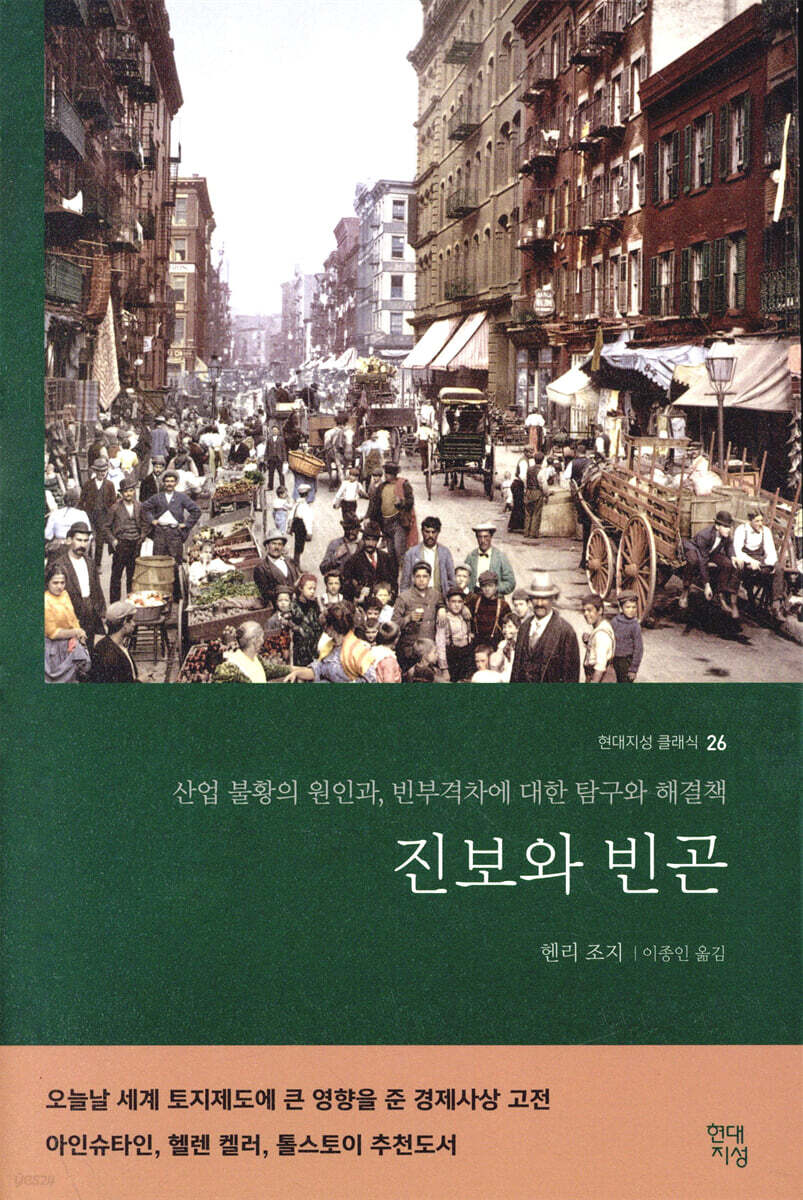
Progress and Poverty
 |
Description
Book Introduction
A classic of economic thought that has had a significant impact on the world's land system today.
Recommended reading by Einstein, Helen Keller, and Tolstoy
This is the 26th volume of 'Modern Intellectual Classics', a complete translation of Henry George's masterpiece, 'Progress and Poverty'.
Henry George was called an outsider economist because he had economic ideas that were different from those of the classical economic giants such as Adam Smith, David Ricardo, Thomas Malthus, and John Stuart Mill.
In "Progress and Poverty," he explored the causes of the industrial depression and the gap between the rich and the poor, and proposed solutions. Among them, his argument that the government should directly collect land rent and implement a single tax system, the land value tax, was particularly well-received by most people who were suffering greatly from the skyrocketing real estate prices at the time.
However, as Marx's ideology and Adam Smith's economic ideology, which emphasized only labor and capital, became dominant, Henry George's land ideology gradually lost its luster and it became difficult to even find its name in textbooks.
As real estate speculation and the gap between the rich and the poor become increasingly serious problems, Henry George's ideas are being re-examined.
Henry George's ideas, which ultimately sought to eliminate the gap between the rich and the poor and create a society where everyone can prosper together, can still provide appropriate solutions to many people today.
Recommended reading by Einstein, Helen Keller, and Tolstoy
This is the 26th volume of 'Modern Intellectual Classics', a complete translation of Henry George's masterpiece, 'Progress and Poverty'.
Henry George was called an outsider economist because he had economic ideas that were different from those of the classical economic giants such as Adam Smith, David Ricardo, Thomas Malthus, and John Stuart Mill.
In "Progress and Poverty," he explored the causes of the industrial depression and the gap between the rich and the poor, and proposed solutions. Among them, his argument that the government should directly collect land rent and implement a single tax system, the land value tax, was particularly well-received by most people who were suffering greatly from the skyrocketing real estate prices at the time.
However, as Marx's ideology and Adam Smith's economic ideology, which emphasized only labor and capital, became dominant, Henry George's land ideology gradually lost its luster and it became difficult to even find its name in textbooks.
As real estate speculation and the gap between the rich and the poor become increasingly serious problems, Henry George's ideas are being re-examined.
Henry George's ideas, which ultimately sought to eliminate the gap between the rich and the poor and create a society where everyone can prosper together, can still provide appropriate solutions to many people today.
- You can preview some of the book's contents.
Preview
index
Author's Preface to the Fourth Edition 11
Preface by Henry George II to the 25th Anniversary Edition 18
Introduction: Statement of the Problem 23
[Volume 1: Wages and Capital] 35
Chapter 1: Current Wage Theory Is Invalid 36
Chapter 2: Meaning of Terms 49
Chapter 3 Wages are produced by labor, not by capital. 6 8
Chapter 4: A Worker's Livelihood Does Not Come from Capital 88
Chapter 5: The True Function of Capital 97
[Volume 2: Population and Food] 107
Chapter 1: The Origins and Supporters of Malthus's Theory 108
Chapter 2 Inference from Objective Facts 120
Chapter 3: Reasoning by Analogy 148
Chapter 4: Refutation of Malthus's Theory 159
[Volume 3, The Law of Distribution] 171
Chapter 1: The Laws of Distribution and the Necessary Relationships Between Laws 172
Chapter 2: Land and the Law of Land 183
Chapter 3: Interest and Its Causes 191
Chapter 4: Fake Capital and Profit Often Mistaken for Interest 207
Chapter 5: The Law of Interest 213
Chapter 6: Wages and the Law of Wages 221
Chapter 7: Interrelation and Cooperation of the Laws of Wealth Distribution 235
[Volume 4: The Effects of Material Progress on the Distribution of Wealth] 241
Chapter 1: Exploring the Dynamic Aspects of the Problem 242
Chapter 2: The Effects of Population Growth on Wealth Distribution 245
Chapter 3: The Effects of Technological Improvements on Wealth Distribution 260
Chapter 4: The Effects of Expectations from Material Progress 271
[Book 5 Problem Solving] 277
Chapter 1: The Root Causes of Recurring Industrial Recessions 278
Chapter 2: Poverty Persists Despite Rising Wealth 296
[Volume 6, Solution] 313
Chapter 1: Current Supported Solutions Are Inadequate 314
Chapter 2: The Real Solution 342
[Volume 7: The Legitimacy of the Solution] 345
Chapter 1: Land Private Equity Is Unjust 346
Chapter 2: Land Privateation Turns Workers into Slaves 361
Chapter 3 Landowners' Compensation Claims 372
Chapter 4: Historical Cases of Land Private Ownership 382
Chapter 5: Land Privateation in America 399
[Volume 8: Applying the Solution] 411
Chapter 1: Land ownership hinders the good use of land 412
Chapter 2: Claiming and Securing Equal Land Rights 418
Chapter 3: Land Value Tax Verification Based on the Standards of Tax Justice 424
Chapter 4: Pros and Cons of a Land Value Tax 438
[Volume 9: The Effect of Solutions] 447
Chapter 1: The Effects of Solutions on Wealth Production 448
Chapter 2: Effects on Distribution and Production 455
Chapter 3: Effects on Individuals and Classes 462
Chapter 4: Changes in Social Organization and Social Life 469
[Volume 10: The Laws of Human Progress] 489
Chapter 1: Current Progressive Theory Is Insufficient 490
Chapter 2: What Causes Differences in Civilizations? 504
Chapter 3: The Laws of Human Progress 520
Chapter 4: The Possible Decline of Modern Civilization 541
Chapter 5: The Essential Truth 560
Conclusion: Personal Life Issues 571
Henry George Chronology 584
Translator's Note: The Courageous Moral Economist 593
Preface by Henry George II to the 25th Anniversary Edition 18
Introduction: Statement of the Problem 23
[Volume 1: Wages and Capital] 35
Chapter 1: Current Wage Theory Is Invalid 36
Chapter 2: Meaning of Terms 49
Chapter 3 Wages are produced by labor, not by capital. 6 8
Chapter 4: A Worker's Livelihood Does Not Come from Capital 88
Chapter 5: The True Function of Capital 97
[Volume 2: Population and Food] 107
Chapter 1: The Origins and Supporters of Malthus's Theory 108
Chapter 2 Inference from Objective Facts 120
Chapter 3: Reasoning by Analogy 148
Chapter 4: Refutation of Malthus's Theory 159
[Volume 3, The Law of Distribution] 171
Chapter 1: The Laws of Distribution and the Necessary Relationships Between Laws 172
Chapter 2: Land and the Law of Land 183
Chapter 3: Interest and Its Causes 191
Chapter 4: Fake Capital and Profit Often Mistaken for Interest 207
Chapter 5: The Law of Interest 213
Chapter 6: Wages and the Law of Wages 221
Chapter 7: Interrelation and Cooperation of the Laws of Wealth Distribution 235
[Volume 4: The Effects of Material Progress on the Distribution of Wealth] 241
Chapter 1: Exploring the Dynamic Aspects of the Problem 242
Chapter 2: The Effects of Population Growth on Wealth Distribution 245
Chapter 3: The Effects of Technological Improvements on Wealth Distribution 260
Chapter 4: The Effects of Expectations from Material Progress 271
[Book 5 Problem Solving] 277
Chapter 1: The Root Causes of Recurring Industrial Recessions 278
Chapter 2: Poverty Persists Despite Rising Wealth 296
[Volume 6, Solution] 313
Chapter 1: Current Supported Solutions Are Inadequate 314
Chapter 2: The Real Solution 342
[Volume 7: The Legitimacy of the Solution] 345
Chapter 1: Land Private Equity Is Unjust 346
Chapter 2: Land Privateation Turns Workers into Slaves 361
Chapter 3 Landowners' Compensation Claims 372
Chapter 4: Historical Cases of Land Private Ownership 382
Chapter 5: Land Privateation in America 399
[Volume 8: Applying the Solution] 411
Chapter 1: Land ownership hinders the good use of land 412
Chapter 2: Claiming and Securing Equal Land Rights 418
Chapter 3: Land Value Tax Verification Based on the Standards of Tax Justice 424
Chapter 4: Pros and Cons of a Land Value Tax 438
[Volume 9: The Effect of Solutions] 447
Chapter 1: The Effects of Solutions on Wealth Production 448
Chapter 2: Effects on Distribution and Production 455
Chapter 3: Effects on Individuals and Classes 462
Chapter 4: Changes in Social Organization and Social Life 469
[Volume 10: The Laws of Human Progress] 489
Chapter 1: Current Progressive Theory Is Insufficient 490
Chapter 2: What Causes Differences in Civilizations? 504
Chapter 3: The Laws of Human Progress 520
Chapter 4: The Possible Decline of Modern Civilization 541
Chapter 5: The Essential Truth 560
Conclusion: Personal Life Issues 571
Henry George Chronology 584
Translator's Note: The Courageous Moral Economist 593
Detailed image

Into the book
This is the mystery that plagues the civilized world.
Why does poverty occur in places where productivity is highest and wealth production is largest? We now seek to unravel this mystery.
Malthus's theory, which attributes poverty to a decline in productivity, fails to explain this phenomenon.
The theory does not agree with all objective facts.
Even from the review conducted so far, it is clear that this poverty is a result of the instability of the institutions of human society, and it is an absurd claim to attribute it to divine providence, as Malthus did.
We will now proceed to further substantiate our reasoning.
In the process, the reasons why poverty exists even as wealth continues to accumulate will naturally become apparent.
--- p.168
However, if we look at the origin and natural chronological order of things, this (prioritizing capital) is the reverse order.
Capital doesn't come first, it comes last.
Capital is not the employer of labor; it is actually employed by labor.
Before labor can be invested, there must first be land, and only after labor is invested can capital be created.
Capital is the result of labor and is used to help labor produce more.
Labor is the first active force and therefore the user of capital.
Labor can only be applied to land, and extracting materials that can be transformed into wealth is only possible with land.
Therefore, land is a prerequisite, a field where labor is invested, and a material.
The natural order should be land, labor, and capital.
We must not start our discussion with capital, but with land.
--- p.182
In pointing out the speculative rise in land values as the fundamental and primary cause of the industrial depression, I left out one fact.
It is that the action of these causes is gradual, although rapid.
It is more appropriate to call it a subtle pressure rather than a powerful blow.
These industrial downturns seem to come suddenly.
At first it has the characteristics of a seizure, but soon it reaches a state of lethargy similar to exhaustion.
Everything is going back to normal, commerce and industry are expanding briskly, and then suddenly a shock strikes like a bolt from the blue.
Failure follows failure as banks fail, large manufacturers and merchants go bankrupt, and the shock spreads through all industries, workers are laid off everywhere, and capital is reduced to unprofitable securities.
--- p.291
We are born from the earth, we live from the earth, and we return to the earth.
Like the grass and flowers of the field, we are truly children of the earth.
If you take away from man everything that belongs to the earth, he is nothing more than a spirit without a body.
Material progress does not change the fact that we must live off the land.
Material progress only increases the ability of the land to produce wealth.
Therefore, if land is monopolized, it will not raise wages or improve the living conditions of those who have nothing but labor, and such monopoly will continue indefinitely.
It will continue to increase the value of land and strengthen the power of landowners.
In all times, among all peoples, and in all places, land ownership has been the foundation of aristocracy, the basis of great wealth, and the source of power.
Long ago, the Brahmins (the highest caste in India) already said this:
“At any time, the fruit of the land goes to the owner.
“The white parasols and the elephants trotting along are the essence of land ownership.” --- p.311
There is only one way to eliminate this social evil, and that is to eliminate its cause at its source.
As wealth increases, poverty deepens, and as productivity increases, wages decrease.
The reason is that land, the source of all wealth and the foundation of all labor, is monopolized.
To eradicate poverty, ensure fair wages, and ensure workers receive a full share of their income, land ownership must be abolished and replaced by land ownership.
This is the only way to eliminate the cause of social evil (poverty), and there is no other way.
This is the solution to the blatant unfair and unequal distribution of wealth in modern civilization.
Because all social evils arise from this unfair distribution of wealth.
Land must be made common property.
--- p.342
Why does the unequal distribution of wealth persist in civilized nations, and why does inequality worsen as material progress continues? It's because a small number of individuals have concentrated land ownership in their hands, further concentrating their power to seize the wealth produced by labor and capital.
Therefore, freeing labor and capital from all direct and indirect taxes and shifting the public burden onto landowners will curb this tendency toward inequality; and furthermore, if the state absorbs all landowners through taxes, the cause of inequality will disappear completely.
In that case, land would promote equality rather than being a cause of inequality as it is now.
Why does poverty occur in places where productivity is highest and wealth production is largest? We now seek to unravel this mystery.
Malthus's theory, which attributes poverty to a decline in productivity, fails to explain this phenomenon.
The theory does not agree with all objective facts.
Even from the review conducted so far, it is clear that this poverty is a result of the instability of the institutions of human society, and it is an absurd claim to attribute it to divine providence, as Malthus did.
We will now proceed to further substantiate our reasoning.
In the process, the reasons why poverty exists even as wealth continues to accumulate will naturally become apparent.
--- p.168
However, if we look at the origin and natural chronological order of things, this (prioritizing capital) is the reverse order.
Capital doesn't come first, it comes last.
Capital is not the employer of labor; it is actually employed by labor.
Before labor can be invested, there must first be land, and only after labor is invested can capital be created.
Capital is the result of labor and is used to help labor produce more.
Labor is the first active force and therefore the user of capital.
Labor can only be applied to land, and extracting materials that can be transformed into wealth is only possible with land.
Therefore, land is a prerequisite, a field where labor is invested, and a material.
The natural order should be land, labor, and capital.
We must not start our discussion with capital, but with land.
--- p.182
In pointing out the speculative rise in land values as the fundamental and primary cause of the industrial depression, I left out one fact.
It is that the action of these causes is gradual, although rapid.
It is more appropriate to call it a subtle pressure rather than a powerful blow.
These industrial downturns seem to come suddenly.
At first it has the characteristics of a seizure, but soon it reaches a state of lethargy similar to exhaustion.
Everything is going back to normal, commerce and industry are expanding briskly, and then suddenly a shock strikes like a bolt from the blue.
Failure follows failure as banks fail, large manufacturers and merchants go bankrupt, and the shock spreads through all industries, workers are laid off everywhere, and capital is reduced to unprofitable securities.
--- p.291
We are born from the earth, we live from the earth, and we return to the earth.
Like the grass and flowers of the field, we are truly children of the earth.
If you take away from man everything that belongs to the earth, he is nothing more than a spirit without a body.
Material progress does not change the fact that we must live off the land.
Material progress only increases the ability of the land to produce wealth.
Therefore, if land is monopolized, it will not raise wages or improve the living conditions of those who have nothing but labor, and such monopoly will continue indefinitely.
It will continue to increase the value of land and strengthen the power of landowners.
In all times, among all peoples, and in all places, land ownership has been the foundation of aristocracy, the basis of great wealth, and the source of power.
Long ago, the Brahmins (the highest caste in India) already said this:
“At any time, the fruit of the land goes to the owner.
“The white parasols and the elephants trotting along are the essence of land ownership.” --- p.311
There is only one way to eliminate this social evil, and that is to eliminate its cause at its source.
As wealth increases, poverty deepens, and as productivity increases, wages decrease.
The reason is that land, the source of all wealth and the foundation of all labor, is monopolized.
To eradicate poverty, ensure fair wages, and ensure workers receive a full share of their income, land ownership must be abolished and replaced by land ownership.
This is the only way to eliminate the cause of social evil (poverty), and there is no other way.
This is the solution to the blatant unfair and unequal distribution of wealth in modern civilization.
Because all social evils arise from this unfair distribution of wealth.
Land must be made common property.
--- p.342
Why does the unequal distribution of wealth persist in civilized nations, and why does inequality worsen as material progress continues? It's because a small number of individuals have concentrated land ownership in their hands, further concentrating their power to seize the wealth produced by labor and capital.
Therefore, freeing labor and capital from all direct and indirect taxes and shifting the public burden onto landowners will curb this tendency toward inequality; and furthermore, if the state absorbs all landowners through taxes, the cause of inequality will disappear completely.
In that case, land would promote equality rather than being a cause of inequality as it is now.
--- p.455
Publisher's Review
Henry George's writing history
Henry George worked as a typesetter, and he met an old typesetter at the printing shop and heard him lament, “The city is growing every day, but why do we workers always live in such poverty?” This thought struck him.
I began to wonder, 'If everyone suffered from poverty together, it would be less painful, but why do some people live so well, while others, no matter how hard they work, remain so poor?'
Henry George initially believed that the teachings of classical economics were correct.
For example, since wages come from capital, I believed the explanation that as the number of workers increases, the share that goes back to wages is bound to decrease.
So in the 1870s, he opposed the importation of large numbers of Chinese workers to build railroads in the western United States.
But later George changed his mind.
This is because it was believed that the more workers there were, the more wealth there would be.
This was the occasion for refuting Ricardo and Mill's wage theory.
He then points out that the reason the poor cannot help but remain poor is because the rich who own a lot of land take a significant portion of the produce as rent.
Finally, George makes the very radical claim that all land should be returned to the state as tax money.
Henry George worried that his book might not gain traction during his lifetime because its claims were so radical.
Still, I encouraged myself that I could wait as long as I wanted, believing that the truth would always prevail.
Reactions to Progress and Poverty
The Civil War and the emancipation of slaves were events that had a decisive influence on the formation of Henry George's thoughts.
In Progress and Poverty, Henry George argues that the evils of land ownership are no less harmful than those of slavery, and that it is the greatest social evil that creates modern-day slavery.
Henry George's ideas had a tremendous influence on his time.
His ideas gave rise to an economic philosophy known as Georgism, and those who adhere to his ideas are called Georgists.
His representative work, Progress and Poverty, is said to be the trumpet sound announcing the beginning of the progressive era.
The Progressive Era was the period from 1889 to 1920 when progressivism spread widely in the United States, an era that corresponded to the economic ideology of Henry George.
John Peter Altgeld, a representative intellectual of our time, said this:
“If Darwin had a tremendous impact on the world of science, Henry George had an equally significant impact on the world of economic thought.”
Edward McGlynn, a Catholic priest in New York City who supported Henry George and was excommunicated by the Vatican, said:
“Henry George is one of the greatest geniuses this world has ever produced.
His empathetic emotional intelligence is matched only by his tremendous intellectual talent.
He is a social thinker whose presence in the fields of literature and science is more prominent than any other person today.”
George Bernard Shaw, a member of the British Fabian Society and renowned playwright, said:
“Henry George was the inspiration for five of the six leading social reformers in Britain in the 1880s.
These people eventually formed social reform organizations like the Fabian Society.”
But the person most deeply influenced by Henry George's thought was the great Russian novelist Leo Tolstoy.
Tolstoy suffered a profound mental crisis around 1879, when Progress and Poverty was published.
He grew up in an Orthodox family, but became skeptical of religion in his teens and left it. By the age of 50, he had developed a strong desire to end his life religiously.
In his view, the core idea of Christianity was the ethics of universal thought and the complete abandonment of violence (his religious journey is well described in Tolstoy's Confessions).
Based on these religious ideas, Tolstoy criticized the corrupt political and economic systems.
During this period, Tolstoy read Progress and Poverty and developed a great affinity for Henry George.
Tolstoy was also deeply interested in the land problem in Ireland, and was deeply moved by the solution he found in Progress and Poverty.
Tolstoy also mentions Henry George's thoughts and writings in his book "The Reader of Life" and his novel "Resurrection".
In Resurrection, Tolstoy directly adopted Henry George's ideas on land sharing, national recovery of rent revenue, and eradication of unearned income through the protagonist's mouth.
The core of Henry George's thought
Henry George reviewed the distribution theory widely accepted in political economy of his time.
It is a theory that explains how products are distributed among the three factors of production: labor, capital, and land.
As a result, George diagnoses that the conventional wisdom about wages, profits, and rents is not only inadequate but also disconnected.
First, let's look at wages. There is the wage fund theory, which was advocated by Adam Smith and accepted by later economists.
It is a theory that emerged in the British economic world for about 50 years from the 1820s to the 1870s, and it goes back to Ricardo and JS.
It is a theory of the classical school that was completed by Mill.
In a word, wages come from capital.
Because capitalists pay wages to workers, workers can live by producing.
The capitalist then recovers his investment in labor by converting it into a product and selling it to make a profit.
According to this doctrine, if a worker wants to raise his own wages, he must either increase the wage fund or reduce the number of workers.
But the population continues to grow.
So, in the end, it is a theory that demands burden and sacrifice from workers, and it is a theory that unilaterally favors only the capitalists.
George believes that these classical economics claims do not correspond to the facts.
He argues that wages do not come from capital, but actually from the product of labor.
Furthermore, George points out that the wage fund theory was made more plausible by Malthus's Essay on the Principle of Population.
Malthus argued that since food supplies increase arithmetically while population increases geometrically, unless this population is controlled through means such as war or birth control, human society will inevitably suffer from poverty and misery.
Therefore, Malthusian theory holds that wages will always remain at the minimum subsistence level.
Because population growth always creates a shortage of food supply.
However, George argues that Malthus's theory does not correspond to what we know about population conditions or the objective facts about production.
Henry George fiercely attacked Malthus's Essay on the Principle of Population, calling it a truly evil doctrine that supported the status quo of the wealthy.
So, in the first half of Progress and Poverty, he devotes a lot of space to the wage fund theory of classical economics and Malthus's Essay on the Principle of Population.
Henry George examined the causes of poverty and came to the conclusion that rent payment was the cause of poverty.
Henry George says that it is very clear in America that land speculation is the cause of industrial depressions.
In each period of industrial activity, land values steadily rose, eventually leading to speculation, which in turn caused land prices to soar.
This led to a partial halt in production, and as a necessary consequence, a halt in efficient demand.
This leads to a period of relatively stagnant recession, and if we endure this period with difficulty, we will gradually reach equilibrium again, enjoy a period of prosperity, and then speculation will begin again, and thus the recession will repeat itself.
So, George thinks that in order to eliminate these evils, it would be a good idea to make all land in the country public property.
But he hesitates about radical and revolutionary measures such as land confiscation.
So, the idea is to acknowledge private land ownership and allow landowners to sell it at will, but absorb all the rent from that land into national taxes.
In any case, Henry George believes that the revenue from this land is so enormous that it can more than cover all the costs of national administration.
Therefore, the idea is to abolish all other taxes except for the land value tax (single tax).
Henry George and Karl Marx
Henry George's economic ideas posed a groundbreaking challenge to the current economic system.
It has some similarities with the ideas of Karl Marx in that it seeks to dramatically improve workers' rights.
Marx argued that private ownership of capital should be abolished.
Capitalists keep the cost of labor below the actual value of labor and accumulate the difference as capital.
Since the capitalists have actually purchased machinery and buildings that increase the productivity of labor, taking the share that should have gone to the workers, the capitalists cannot claim that such machinery and buildings are their own.
Marx ultimately believes that capital is nothing more than the exploitation of labor.
But Marx's argument also has flaws.
He completely ignored the possibility that the expansion of production technology could lead to huge profits that could be satisfactorily distributed to both capitalists and workers.
Western capitalist societies have evolved to suppress the unilateral exploitation of capitalists by allowing strong labor unions, and to achieve this distribution to a certain extent.
What Henry George differs from Marx is that he argues for the abolition of only the rent that comes from private land ownership, rather than the full expropriation of the means of production.
He did not place importance on capital like Marx did, viewing capital as a subordinate concept to labor among the three elements of labor: labor, capital, and land.
Rather, he saw land monopoly as a fundamental element of social evil.
Because Henry George identified land as a social evil, his ideas are sometimes called land socialism.
George also opposed Marx's ideas and believed that if they were put into practice, a dictatorship would eventually take hold.
Marxist thought was practiced in Russia for 70 years, from 1917 to 1989, but as we all know, many economic experiments under the one-party communist dictatorship ultimately failed and collapsed with the dissolution of the Soviet Union.
Pros and Cons of Henry George's Thoughts
Critics of Henry George's ideas argue that the single tax argument has little appeal.
A single tax could be argued as a reaction to the chaotic tax system of the past, but it has had little practical effect today.
A single tax alone cannot fully capture national income, nor can it achieve fairness in tax burdens. Therefore, all countries today adopt a tax system that captures tax sources through taxes on various items.
George's single-tax argument, based on observations of the environment around California and San Francisco and a few assumptions, is not in line with today's reality.
He also refutes George's argument that while land ownership and sale are recognized, only the rent should be recovered from the landowner, saying that while this nominally maintains the land ownership system, in reality it deprives the system of its underlying motivation and effectiveness.
On the other hand, Georgists who support his ideas make this argument.
Just because it has been revealed that a single tax alone cannot cover all national administrative costs, it does not mean that attempts to address the phenomenon that George pointed out as the primary cause, namely unearned income from real estate speculation, are wrong.
George's argument that unearned income from real estate should be recovered through taxes has gained even greater appeal today.
If you are a reader who is new to economics, it may be difficult to readily take a side when confronted with these pros and cons, as both sides seem plausible.
In any case, looking at the current state of Korean society, Henry George's argument that the biggest cause of the gap between the rich and the poor is unearned income from real estate speculation and that unless this is resolved, the realization of social justice is far off remains valid and reasonable.
In the contemporary intellectual 『Progress and Poverty』, this vast content is easy to find and, to increase the readability of the book, subheadings are provided at appropriate intervals to aid understanding.
Henry George worked as a typesetter, and he met an old typesetter at the printing shop and heard him lament, “The city is growing every day, but why do we workers always live in such poverty?” This thought struck him.
I began to wonder, 'If everyone suffered from poverty together, it would be less painful, but why do some people live so well, while others, no matter how hard they work, remain so poor?'
Henry George initially believed that the teachings of classical economics were correct.
For example, since wages come from capital, I believed the explanation that as the number of workers increases, the share that goes back to wages is bound to decrease.
So in the 1870s, he opposed the importation of large numbers of Chinese workers to build railroads in the western United States.
But later George changed his mind.
This is because it was believed that the more workers there were, the more wealth there would be.
This was the occasion for refuting Ricardo and Mill's wage theory.
He then points out that the reason the poor cannot help but remain poor is because the rich who own a lot of land take a significant portion of the produce as rent.
Finally, George makes the very radical claim that all land should be returned to the state as tax money.
Henry George worried that his book might not gain traction during his lifetime because its claims were so radical.
Still, I encouraged myself that I could wait as long as I wanted, believing that the truth would always prevail.
Reactions to Progress and Poverty
The Civil War and the emancipation of slaves were events that had a decisive influence on the formation of Henry George's thoughts.
In Progress and Poverty, Henry George argues that the evils of land ownership are no less harmful than those of slavery, and that it is the greatest social evil that creates modern-day slavery.
Henry George's ideas had a tremendous influence on his time.
His ideas gave rise to an economic philosophy known as Georgism, and those who adhere to his ideas are called Georgists.
His representative work, Progress and Poverty, is said to be the trumpet sound announcing the beginning of the progressive era.
The Progressive Era was the period from 1889 to 1920 when progressivism spread widely in the United States, an era that corresponded to the economic ideology of Henry George.
John Peter Altgeld, a representative intellectual of our time, said this:
“If Darwin had a tremendous impact on the world of science, Henry George had an equally significant impact on the world of economic thought.”
Edward McGlynn, a Catholic priest in New York City who supported Henry George and was excommunicated by the Vatican, said:
“Henry George is one of the greatest geniuses this world has ever produced.
His empathetic emotional intelligence is matched only by his tremendous intellectual talent.
He is a social thinker whose presence in the fields of literature and science is more prominent than any other person today.”
George Bernard Shaw, a member of the British Fabian Society and renowned playwright, said:
“Henry George was the inspiration for five of the six leading social reformers in Britain in the 1880s.
These people eventually formed social reform organizations like the Fabian Society.”
But the person most deeply influenced by Henry George's thought was the great Russian novelist Leo Tolstoy.
Tolstoy suffered a profound mental crisis around 1879, when Progress and Poverty was published.
He grew up in an Orthodox family, but became skeptical of religion in his teens and left it. By the age of 50, he had developed a strong desire to end his life religiously.
In his view, the core idea of Christianity was the ethics of universal thought and the complete abandonment of violence (his religious journey is well described in Tolstoy's Confessions).
Based on these religious ideas, Tolstoy criticized the corrupt political and economic systems.
During this period, Tolstoy read Progress and Poverty and developed a great affinity for Henry George.
Tolstoy was also deeply interested in the land problem in Ireland, and was deeply moved by the solution he found in Progress and Poverty.
Tolstoy also mentions Henry George's thoughts and writings in his book "The Reader of Life" and his novel "Resurrection".
In Resurrection, Tolstoy directly adopted Henry George's ideas on land sharing, national recovery of rent revenue, and eradication of unearned income through the protagonist's mouth.
The core of Henry George's thought
Henry George reviewed the distribution theory widely accepted in political economy of his time.
It is a theory that explains how products are distributed among the three factors of production: labor, capital, and land.
As a result, George diagnoses that the conventional wisdom about wages, profits, and rents is not only inadequate but also disconnected.
First, let's look at wages. There is the wage fund theory, which was advocated by Adam Smith and accepted by later economists.
It is a theory that emerged in the British economic world for about 50 years from the 1820s to the 1870s, and it goes back to Ricardo and JS.
It is a theory of the classical school that was completed by Mill.
In a word, wages come from capital.
Because capitalists pay wages to workers, workers can live by producing.
The capitalist then recovers his investment in labor by converting it into a product and selling it to make a profit.
According to this doctrine, if a worker wants to raise his own wages, he must either increase the wage fund or reduce the number of workers.
But the population continues to grow.
So, in the end, it is a theory that demands burden and sacrifice from workers, and it is a theory that unilaterally favors only the capitalists.
George believes that these classical economics claims do not correspond to the facts.
He argues that wages do not come from capital, but actually from the product of labor.
Furthermore, George points out that the wage fund theory was made more plausible by Malthus's Essay on the Principle of Population.
Malthus argued that since food supplies increase arithmetically while population increases geometrically, unless this population is controlled through means such as war or birth control, human society will inevitably suffer from poverty and misery.
Therefore, Malthusian theory holds that wages will always remain at the minimum subsistence level.
Because population growth always creates a shortage of food supply.
However, George argues that Malthus's theory does not correspond to what we know about population conditions or the objective facts about production.
Henry George fiercely attacked Malthus's Essay on the Principle of Population, calling it a truly evil doctrine that supported the status quo of the wealthy.
So, in the first half of Progress and Poverty, he devotes a lot of space to the wage fund theory of classical economics and Malthus's Essay on the Principle of Population.
Henry George examined the causes of poverty and came to the conclusion that rent payment was the cause of poverty.
Henry George says that it is very clear in America that land speculation is the cause of industrial depressions.
In each period of industrial activity, land values steadily rose, eventually leading to speculation, which in turn caused land prices to soar.
This led to a partial halt in production, and as a necessary consequence, a halt in efficient demand.
This leads to a period of relatively stagnant recession, and if we endure this period with difficulty, we will gradually reach equilibrium again, enjoy a period of prosperity, and then speculation will begin again, and thus the recession will repeat itself.
So, George thinks that in order to eliminate these evils, it would be a good idea to make all land in the country public property.
But he hesitates about radical and revolutionary measures such as land confiscation.
So, the idea is to acknowledge private land ownership and allow landowners to sell it at will, but absorb all the rent from that land into national taxes.
In any case, Henry George believes that the revenue from this land is so enormous that it can more than cover all the costs of national administration.
Therefore, the idea is to abolish all other taxes except for the land value tax (single tax).
Henry George and Karl Marx
Henry George's economic ideas posed a groundbreaking challenge to the current economic system.
It has some similarities with the ideas of Karl Marx in that it seeks to dramatically improve workers' rights.
Marx argued that private ownership of capital should be abolished.
Capitalists keep the cost of labor below the actual value of labor and accumulate the difference as capital.
Since the capitalists have actually purchased machinery and buildings that increase the productivity of labor, taking the share that should have gone to the workers, the capitalists cannot claim that such machinery and buildings are their own.
Marx ultimately believes that capital is nothing more than the exploitation of labor.
But Marx's argument also has flaws.
He completely ignored the possibility that the expansion of production technology could lead to huge profits that could be satisfactorily distributed to both capitalists and workers.
Western capitalist societies have evolved to suppress the unilateral exploitation of capitalists by allowing strong labor unions, and to achieve this distribution to a certain extent.
What Henry George differs from Marx is that he argues for the abolition of only the rent that comes from private land ownership, rather than the full expropriation of the means of production.
He did not place importance on capital like Marx did, viewing capital as a subordinate concept to labor among the three elements of labor: labor, capital, and land.
Rather, he saw land monopoly as a fundamental element of social evil.
Because Henry George identified land as a social evil, his ideas are sometimes called land socialism.
George also opposed Marx's ideas and believed that if they were put into practice, a dictatorship would eventually take hold.
Marxist thought was practiced in Russia for 70 years, from 1917 to 1989, but as we all know, many economic experiments under the one-party communist dictatorship ultimately failed and collapsed with the dissolution of the Soviet Union.
Pros and Cons of Henry George's Thoughts
Critics of Henry George's ideas argue that the single tax argument has little appeal.
A single tax could be argued as a reaction to the chaotic tax system of the past, but it has had little practical effect today.
A single tax alone cannot fully capture national income, nor can it achieve fairness in tax burdens. Therefore, all countries today adopt a tax system that captures tax sources through taxes on various items.
George's single-tax argument, based on observations of the environment around California and San Francisco and a few assumptions, is not in line with today's reality.
He also refutes George's argument that while land ownership and sale are recognized, only the rent should be recovered from the landowner, saying that while this nominally maintains the land ownership system, in reality it deprives the system of its underlying motivation and effectiveness.
On the other hand, Georgists who support his ideas make this argument.
Just because it has been revealed that a single tax alone cannot cover all national administrative costs, it does not mean that attempts to address the phenomenon that George pointed out as the primary cause, namely unearned income from real estate speculation, are wrong.
George's argument that unearned income from real estate should be recovered through taxes has gained even greater appeal today.
If you are a reader who is new to economics, it may be difficult to readily take a side when confronted with these pros and cons, as both sides seem plausible.
In any case, looking at the current state of Korean society, Henry George's argument that the biggest cause of the gap between the rich and the poor is unearned income from real estate speculation and that unless this is resolved, the realization of social justice is far off remains valid and reasonable.
In the contemporary intellectual 『Progress and Poverty』, this vast content is easy to find and, to increase the readability of the book, subheadings are provided at appropriate intervals to aid understanding.
GOODS SPECIFICS
- Date of issue: May 23, 2019
- Page count, weight, size: 640 pages | 803g | 150*225*34mm
- ISBN13: 9791187142867
- ISBN10: 1187142867
You may also like
카테고리
korean


korean

![GQ KOREA Mark (Monthly): December [2025]](http://librairie.coreenne.fr/cdn/shop/files/8ef265dbbfbf186523ed75ba7319009d.jpg?v=1765340328&width=3840)


