

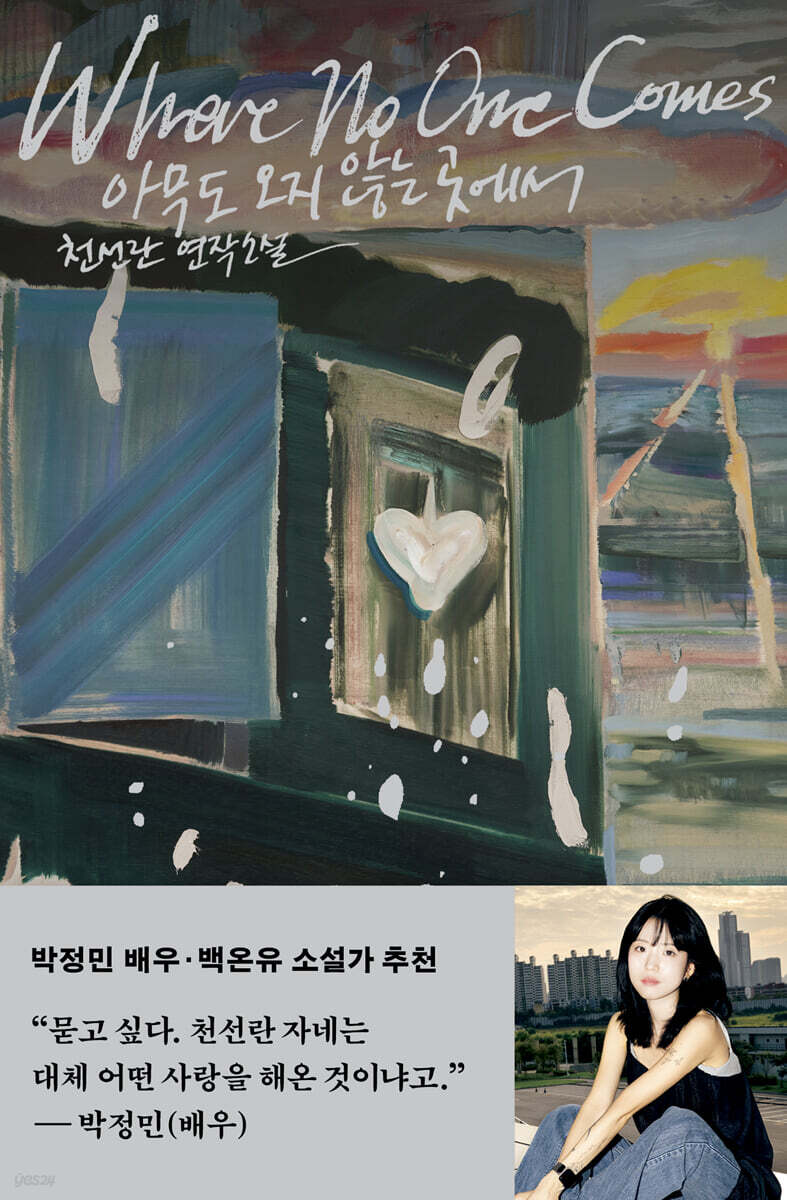
In a place where no one comes
 |
Description
Book Introduction
- A word from MD
-
The most beautiful and strong zombie apocalypseA new work by Cheon Seon-ran, a representative Korean SF artist.
The world of the zombie apocalypse, which the author has long cherished, unfolds with a beautiful and delicate sensibility.
Zombies, which were consumed as tools of fear, were portrayed as beings more human than humans, imbued with emotions and warmth that humans could never let go of.
October 14, 2025. Novel/Poetry PD Kim Yu-ri
“I began to ponder the meaning of the pale hand that could not be let go until the very end.
“Why are zombies so terribly human?”
- Baek On-yu (novelist)
A new series of novels by Cheon Seon-ran: "A Thousand Blues," "Moss Forest," and "Mower."
Since winning the grand prize for long fiction at the 2019 Korea Science Literature Award for “A Thousand Blues,” Cheon Seon-ran has received widespread reader support for every work she publishes.
His works have been adapted into plays and musicals, published in English-speaking countries by Penguin Random House, and have even been adapted into films by Warner Bros. Pictures.
Cheon Seon-ran has now established herself as a writer who is receiving worldwide attention.
His second novel, Where No One Comes, was published by Hubble.
Cheon Seon-ran has consistently explored the ethics of human and non-human, loss and survival, salvation and care through her novels 『The Savior Who Comes at Night』 and 『Nine』, her short story collections 『Love of a Certain Material』, 『Noland』, and 『Mower』, her series 『Moss Forest』, and her short story 『Rang and My Desert』.
"Where No One Comes" is an extension of that journey, and is a work that pushes those emotions and sensations to the extreme on the stage of the "zombie apocalypse," which he has long loved.
This series originated from the short story "Do You Know Us" (2025, included in "Holding the Fragmented Universe"), which expanded the worldview of the short stories "Do You Hear My Voice" (2019) and "Do You Remember My Breath" (2020), which Cheon Seon-ran published early in her career.
Based on "Do You Know Us," the two existing short stories were completely expanded and revised, and rewritten as a medium-length novel, thus completing a three-part narrative over the course of six years.
In this series, Cheon Seon-ran uses zombies not simply as symbols of fear, but as a mirror that reflects the deepest loneliness of human existence, and goes one step further than the ethics of “living in a way that saves you” (Jeong Woo-ju, “From the Place of Loss - Cheon Seon-ran Theory”).
Each of the three stories faces a zombie apocalypse in a different time and space.
Part 1 depicts the disaster that began at the beginning of infection and collapse, spreading to the colony spaceship, and the moment of choice about what to save and what to kill.
Part 2 shows how those who were unable to escape Earth care for each other and how they can live with a mindset that goes beyond survival to continue living.
Part 3 depicts the story of beings who are neither human nor zombie on a planet where humanity has disappeared, remembering and continuing love even after destruction.
All three stories are firmly connected by the theme of 'the heart that cannot let go of the one you love' and 'the heart that wants to live in a way that saves you.'
As actor Park Jung-min asked in his recommendation, “What kind of love have you had, Cheon Seon-ran?”, this series depicts the story of people who cannot let go of their loved ones and who try not to forget each other.
People who live while embracing death and loss, the warmth left in their fingertips creates a world of celestial orchids.
Also, as novelist Baek On-yu commented, “Why are zombies so terribly human?”, this work delicately captures the form of emotions that humans cannot let go of through the existence of ‘zombies.’
In a world where life and death, humans and zombies, ruins and paradise are intertwined, Cheon Seon-ran gazes upon a love that continues even after destruction.
“Why are zombies so terribly human?”
- Baek On-yu (novelist)
A new series of novels by Cheon Seon-ran: "A Thousand Blues," "Moss Forest," and "Mower."
Since winning the grand prize for long fiction at the 2019 Korea Science Literature Award for “A Thousand Blues,” Cheon Seon-ran has received widespread reader support for every work she publishes.
His works have been adapted into plays and musicals, published in English-speaking countries by Penguin Random House, and have even been adapted into films by Warner Bros. Pictures.
Cheon Seon-ran has now established herself as a writer who is receiving worldwide attention.
His second novel, Where No One Comes, was published by Hubble.
Cheon Seon-ran has consistently explored the ethics of human and non-human, loss and survival, salvation and care through her novels 『The Savior Who Comes at Night』 and 『Nine』, her short story collections 『Love of a Certain Material』, 『Noland』, and 『Mower』, her series 『Moss Forest』, and her short story 『Rang and My Desert』.
"Where No One Comes" is an extension of that journey, and is a work that pushes those emotions and sensations to the extreme on the stage of the "zombie apocalypse," which he has long loved.
This series originated from the short story "Do You Know Us" (2025, included in "Holding the Fragmented Universe"), which expanded the worldview of the short stories "Do You Hear My Voice" (2019) and "Do You Remember My Breath" (2020), which Cheon Seon-ran published early in her career.
Based on "Do You Know Us," the two existing short stories were completely expanded and revised, and rewritten as a medium-length novel, thus completing a three-part narrative over the course of six years.
In this series, Cheon Seon-ran uses zombies not simply as symbols of fear, but as a mirror that reflects the deepest loneliness of human existence, and goes one step further than the ethics of “living in a way that saves you” (Jeong Woo-ju, “From the Place of Loss - Cheon Seon-ran Theory”).
Each of the three stories faces a zombie apocalypse in a different time and space.
Part 1 depicts the disaster that began at the beginning of infection and collapse, spreading to the colony spaceship, and the moment of choice about what to save and what to kill.
Part 2 shows how those who were unable to escape Earth care for each other and how they can live with a mindset that goes beyond survival to continue living.
Part 3 depicts the story of beings who are neither human nor zombie on a planet where humanity has disappeared, remembering and continuing love even after destruction.
All three stories are firmly connected by the theme of 'the heart that cannot let go of the one you love' and 'the heart that wants to live in a way that saves you.'
As actor Park Jung-min asked in his recommendation, “What kind of love have you had, Cheon Seon-ran?”, this series depicts the story of people who cannot let go of their loved ones and who try not to forget each other.
People who live while embracing death and loss, the warmth left in their fingertips creates a world of celestial orchids.
Also, as novelist Baek On-yu commented, “Why are zombies so terribly human?”, this work delicately captures the form of emotions that humans cannot let go of through the existence of ‘zombies.’
In a world where life and death, humans and zombies, ruins and paradise are intertwined, Cheon Seon-ran gazes upon a love that continues even after destruction.
- You can preview some of the book's contents.
Preview
index
Part 1
Can you hear my voice?
- 9
Part 2
Do you remember the sound of my breathing?
- 119
Part 3
Do you know us?
- 225
Author's Note
- 295
Can you hear my voice?
- 9
Part 2
Do you remember the sound of my breathing?
- 119
Part 3
Do you know us?
- 225
Author's Note
- 295
Detailed image

Into the book
The silence that made me hate myself because I am not an alien.
But thanks to that, whenever I felt like I was out of breath, I could remind myself that I was an alien, that there was a planet where I could really breathe, and that thought helped me calm down.
I still feel the same way.
This is not my place.
This is not where I was born.
This is a place to stay for a while.
It's a place to escape.
It's natural to feel out of breath.
--- From "Part 1 - Can You Hear My Voice"
It was okay for the dying Mukho, but why can't I give up on the already dead Mukho?
Death was the end, and it seemed like an impossible realm that I could not reach, but perhaps it was because Mukho, who was dead and by my side, was reachable.
Now that we've passed the end, it seems like eternity is possible.
--- From "Part 1 - Can You Hear My Voice"
Lay down the body of the fallen Mukho upright.
There is white foam at the corner of the mouth.
Hug the silent one.
Since I can't think of a good way to block the air, I cover Mukho's face with my whole body.
He tells me not to breathe, to hold my breath for a little while.
To the already dead Mukho, don't die again, or any more.
--- From "Part 1 - Can You Hear My Voice"
Sometimes it feels like I'm going to die, and sometimes it feels like I'm already dead, but even a body that looks like it's going to collapse at any moment has such strong bones.
It won't collapse.
I'm not weak.
You're alive.
You shouldn't kill what's alive in your heart.
You shouldn't kill someone while they're still alive.
You just have to think about being alive.
--- From "Part 2 - Do You Remember the Sound of My Breath"
'It was humans who defined the universe.
Let's call the space out there the universe.
There is space over there.
Because the truth is that the smaller things are contained in the bigger things.
The universe expands without even knowing that there is a human inside it, but humans know the universe, name the universe, and try to measure the universe.
People think we belong to the universe, but it's the opposite.
The universe is contained within our brains.'
--- From "Part 2 - Do You Remember the Sound of My Breath"
Did I really die before my wife in my past life? The cycle of life is nothing more than two tenacious bonds competing for each other's lives.
If all sinners truly go to hell and those who die young live longer in the next life, then one day the Earth will resemble heaven.
Good people do not die unjustly but live a life that is like eternal life.
So is heaven in the future?
It does not exist in any dimension of this world right now.
--- From "Part 3 - Do You Know Us"
I hope that God will be so grateful for all the hard work I've done in praying and donating that He will allow us to meet in the afterlife.
We are not greedy.
I never asked for much.
I don't even want heaven.
I just wish we could be together in whatever land remains of the afterlife.
Then we can make that place a paradise.
But thanks to that, whenever I felt like I was out of breath, I could remind myself that I was an alien, that there was a planet where I could really breathe, and that thought helped me calm down.
I still feel the same way.
This is not my place.
This is not where I was born.
This is a place to stay for a while.
It's a place to escape.
It's natural to feel out of breath.
--- From "Part 1 - Can You Hear My Voice"
It was okay for the dying Mukho, but why can't I give up on the already dead Mukho?
Death was the end, and it seemed like an impossible realm that I could not reach, but perhaps it was because Mukho, who was dead and by my side, was reachable.
Now that we've passed the end, it seems like eternity is possible.
--- From "Part 1 - Can You Hear My Voice"
Lay down the body of the fallen Mukho upright.
There is white foam at the corner of the mouth.
Hug the silent one.
Since I can't think of a good way to block the air, I cover Mukho's face with my whole body.
He tells me not to breathe, to hold my breath for a little while.
To the already dead Mukho, don't die again, or any more.
--- From "Part 1 - Can You Hear My Voice"
Sometimes it feels like I'm going to die, and sometimes it feels like I'm already dead, but even a body that looks like it's going to collapse at any moment has such strong bones.
It won't collapse.
I'm not weak.
You're alive.
You shouldn't kill what's alive in your heart.
You shouldn't kill someone while they're still alive.
You just have to think about being alive.
--- From "Part 2 - Do You Remember the Sound of My Breath"
'It was humans who defined the universe.
Let's call the space out there the universe.
There is space over there.
Because the truth is that the smaller things are contained in the bigger things.
The universe expands without even knowing that there is a human inside it, but humans know the universe, name the universe, and try to measure the universe.
People think we belong to the universe, but it's the opposite.
The universe is contained within our brains.'
--- From "Part 2 - Do You Remember the Sound of My Breath"
Did I really die before my wife in my past life? The cycle of life is nothing more than two tenacious bonds competing for each other's lives.
If all sinners truly go to hell and those who die young live longer in the next life, then one day the Earth will resemble heaven.
Good people do not die unjustly but live a life that is like eternal life.
So is heaven in the future?
It does not exist in any dimension of this world right now.
--- From "Part 3 - Do You Know Us"
I hope that God will be so grateful for all the hard work I've done in praying and donating that He will allow us to meet in the afterlife.
We are not greedy.
I never asked for much.
I don't even want heaven.
I just wish we could be together in whatever land remains of the afterlife.
Then we can make that place a paradise.
--- From "Part 3 - Do You Know Us"
Publisher's Review
“You know what makes a zombie apocalypse more terrifying than other apocalypses? (…) You forget the people you love, you rush to kill the people you love, and you shoot at people who don’t remember you.
Instead of seeing the beautiful final appearance, we have to see the miserable state of a corpse.
This is the most terrible end. “_ From Part 1 “Can You Hear My Voice”
“The most tragic apocalypse is a zombie.” With this sentence, Cheon Seon-ran opens her trilogy, portraying zombies not as familiar symbols of fear, but as beings that cling to love even in oblivion.
The tragedy of zombies he speaks of is by no means a distant story.
In real life, too, violence, loss, illness, and disability can cause people to forget their loved ones.
Cheon Seon-ran summons those who bear the wound as zombies.
Having lived in ruins since before the world collapsed, they are the only ones who hold on to their memories even when most humans cannot remember their loved ones.
Try your best not to harm anyone.
In this way, Cheon Seon-ran's zombie shows the last gesture of humanity that does not want to be forgotten even in a world that is being forgotten.
Part 1, "Can You Hear My Voice," is the starting point for the trilogy's core emotion: the desire to protect loved ones even if they become zombies, and "I can only live if I save you."
Set in a colony ship that left Earth for a new planet before humanity could even sense the coming catastrophe, Ok-ju awakens from hibernation only to discover that an infection has broken out on Earth, causing the collapse of civilization.
But tragedy repeats itself on the spaceship.
The zombie-turned-companion killed most of the crew, and only Mukho, whom Okju loves, remained alive as a zombie.
Ok-ju and Muk-ho are characters who grew up in abusive domestic violence and have depended on each other to survive in the ruins since an early age.
Even after becoming a zombie, Mukho does not bite Okju and tries to protect her until the end, and Okju feels his feelings.
“It feels like I’m going to die at any moment, and sometimes it feels like I’m already dead, but even a body that looks like it could collapse at any moment has such strong bones.
It won't collapse.
You're not weak.
You're alive.
You shouldn't kill what's alive in your heart.
You shouldn't kill someone while they're still alive.
“You just have to think about being alive.”
_ From Part 2, “Do you remember the sound of my breathing?”
Part 2, "Do You Remember My Breath," tells the story of the people still alive in the ruins of a post-apocalyptic Earth.
Most humans have either fled to other planets or become zombies, and those who remain are left to survive with their zombified family members by their side.
'Swallow' takes care of her mother, who is not even conscious, and after her father 'Pigeon', who protected her and her mother, disappears, she becomes the head of the household and survives on her own.
And as time passes, he meets Eun-mi, who lives with her daughter No-yoon, having lost one of her legs.
Eun-mi takes care of No-yoon, who has a mental developmental disability, and continues to live in the ruins. Je-bi saves Eun-mi's life, and this is how their relationship begins.
Those who remain on Earth to protect their loved ones show the last will of humanity to not kill them, not to lose them, even in their hearts.
“I don’t even want heaven.
I just wish we could be together in whatever land remains of the afterlife.
Then we can make that place a paradise.”
_ From Part 3, “Do You Know Us?”
Part 3, "Do You Know Us?", depicts a journey by a narrator who has been infected with a zombie virus but retains his memories and consciousness on Earth, where all of humanity has either left or died, leaving only zombies and plants and animals. He heads out to the sea with his zombie-turned-wife on a linen cart.
He uses the recordings his wife left behind while he was in a coma as a guide as he tries to return Jangpung, the turtle they were caring for together, to its home in the sea.
This final journey is not a struggle for escape or survival, but rather a process taken by a being who has already entered the world of death to live the 'life after that.'
Through his wife's voice in the recording and the fragmented memories remaining in his head, the speaker recalls the humanity that his wife tried to protect, and realizes that being alive comes not from pulse or temperature, but from the desire to not forget each other.
And you come to understand that that heart is the only force that can turn a world where everything is falling apart into heaven.
“I have been killing the living in my heart for too long.
A person who wanted to live, but I killed him inside of me.
A person who is alive but dead.
“A person who has to prove that he is alive with great difficulty.”
_ From the author's note
This series reveals a new twist in Cheon Seon-ran's writing style.
He reconstructs the zombie narrative by juxtaposing fragments of the senses and lingering emotions rather than a solid narrative.
Cross-sections of memory and the ruins of the present intersect and connect like a montage, and the characters perceive the world through the afterglow of their breaths, tremors, and gazes that come before words.
The sentences are closer to rhythm than logic, and the reader perceives events through sensation rather than understanding them.
This rhythm is the result of Cheon Seon-ran's sentences pushing to the point where emotion and ethics, narrative and sense intersect.
This work borrows the appearance of the zombie genre, but within it, it captures the inner rhythms and subtle tremors of human emotions.
The silence in the ruins, the boundary between love and loss, and the subtle tension created by the fact that one is alive dominate the entire film.
The sentences trace the emotional spectrum and meticulously record the temperature difference between death and survival.
Thus, Cheon Seon-ran progresses from being a writer who asks questions to a writer who provides answers through her senses.
Even where the world has collapsed, sentences continue to breathe, and within those breaths, human existence is rewritten.
Instead of seeing the beautiful final appearance, we have to see the miserable state of a corpse.
This is the most terrible end. “_ From Part 1 “Can You Hear My Voice”
“The most tragic apocalypse is a zombie.” With this sentence, Cheon Seon-ran opens her trilogy, portraying zombies not as familiar symbols of fear, but as beings that cling to love even in oblivion.
The tragedy of zombies he speaks of is by no means a distant story.
In real life, too, violence, loss, illness, and disability can cause people to forget their loved ones.
Cheon Seon-ran summons those who bear the wound as zombies.
Having lived in ruins since before the world collapsed, they are the only ones who hold on to their memories even when most humans cannot remember their loved ones.
Try your best not to harm anyone.
In this way, Cheon Seon-ran's zombie shows the last gesture of humanity that does not want to be forgotten even in a world that is being forgotten.
Part 1, "Can You Hear My Voice," is the starting point for the trilogy's core emotion: the desire to protect loved ones even if they become zombies, and "I can only live if I save you."
Set in a colony ship that left Earth for a new planet before humanity could even sense the coming catastrophe, Ok-ju awakens from hibernation only to discover that an infection has broken out on Earth, causing the collapse of civilization.
But tragedy repeats itself on the spaceship.
The zombie-turned-companion killed most of the crew, and only Mukho, whom Okju loves, remained alive as a zombie.
Ok-ju and Muk-ho are characters who grew up in abusive domestic violence and have depended on each other to survive in the ruins since an early age.
Even after becoming a zombie, Mukho does not bite Okju and tries to protect her until the end, and Okju feels his feelings.
“It feels like I’m going to die at any moment, and sometimes it feels like I’m already dead, but even a body that looks like it could collapse at any moment has such strong bones.
It won't collapse.
You're not weak.
You're alive.
You shouldn't kill what's alive in your heart.
You shouldn't kill someone while they're still alive.
“You just have to think about being alive.”
_ From Part 2, “Do you remember the sound of my breathing?”
Part 2, "Do You Remember My Breath," tells the story of the people still alive in the ruins of a post-apocalyptic Earth.
Most humans have either fled to other planets or become zombies, and those who remain are left to survive with their zombified family members by their side.
'Swallow' takes care of her mother, who is not even conscious, and after her father 'Pigeon', who protected her and her mother, disappears, she becomes the head of the household and survives on her own.
And as time passes, he meets Eun-mi, who lives with her daughter No-yoon, having lost one of her legs.
Eun-mi takes care of No-yoon, who has a mental developmental disability, and continues to live in the ruins. Je-bi saves Eun-mi's life, and this is how their relationship begins.
Those who remain on Earth to protect their loved ones show the last will of humanity to not kill them, not to lose them, even in their hearts.
“I don’t even want heaven.
I just wish we could be together in whatever land remains of the afterlife.
Then we can make that place a paradise.”
_ From Part 3, “Do You Know Us?”
Part 3, "Do You Know Us?", depicts a journey by a narrator who has been infected with a zombie virus but retains his memories and consciousness on Earth, where all of humanity has either left or died, leaving only zombies and plants and animals. He heads out to the sea with his zombie-turned-wife on a linen cart.
He uses the recordings his wife left behind while he was in a coma as a guide as he tries to return Jangpung, the turtle they were caring for together, to its home in the sea.
This final journey is not a struggle for escape or survival, but rather a process taken by a being who has already entered the world of death to live the 'life after that.'
Through his wife's voice in the recording and the fragmented memories remaining in his head, the speaker recalls the humanity that his wife tried to protect, and realizes that being alive comes not from pulse or temperature, but from the desire to not forget each other.
And you come to understand that that heart is the only force that can turn a world where everything is falling apart into heaven.
“I have been killing the living in my heart for too long.
A person who wanted to live, but I killed him inside of me.
A person who is alive but dead.
“A person who has to prove that he is alive with great difficulty.”
_ From the author's note
This series reveals a new twist in Cheon Seon-ran's writing style.
He reconstructs the zombie narrative by juxtaposing fragments of the senses and lingering emotions rather than a solid narrative.
Cross-sections of memory and the ruins of the present intersect and connect like a montage, and the characters perceive the world through the afterglow of their breaths, tremors, and gazes that come before words.
The sentences are closer to rhythm than logic, and the reader perceives events through sensation rather than understanding them.
This rhythm is the result of Cheon Seon-ran's sentences pushing to the point where emotion and ethics, narrative and sense intersect.
This work borrows the appearance of the zombie genre, but within it, it captures the inner rhythms and subtle tremors of human emotions.
The silence in the ruins, the boundary between love and loss, and the subtle tension created by the fact that one is alive dominate the entire film.
The sentences trace the emotional spectrum and meticulously record the temperature difference between death and survival.
Thus, Cheon Seon-ran progresses from being a writer who asks questions to a writer who provides answers through her senses.
Even where the world has collapsed, sentences continue to breathe, and within those breaths, human existence is rewritten.
GOODS SPECIFICS
- Date of issue: October 27, 2025
- Page count, weight, size: 300 pages | 364g | 130*198*20mm
- ISBN13: 9791193078709
- ISBN10: 1193078709
You may also like
카테고리
korean


korean

![GQ KOREA Mark (Monthly): December [2025]](http://librairie.coreenne.fr/cdn/shop/files/8ef265dbbfbf186523ed75ba7319009d.jpg?v=1765340328&width=3840)


