

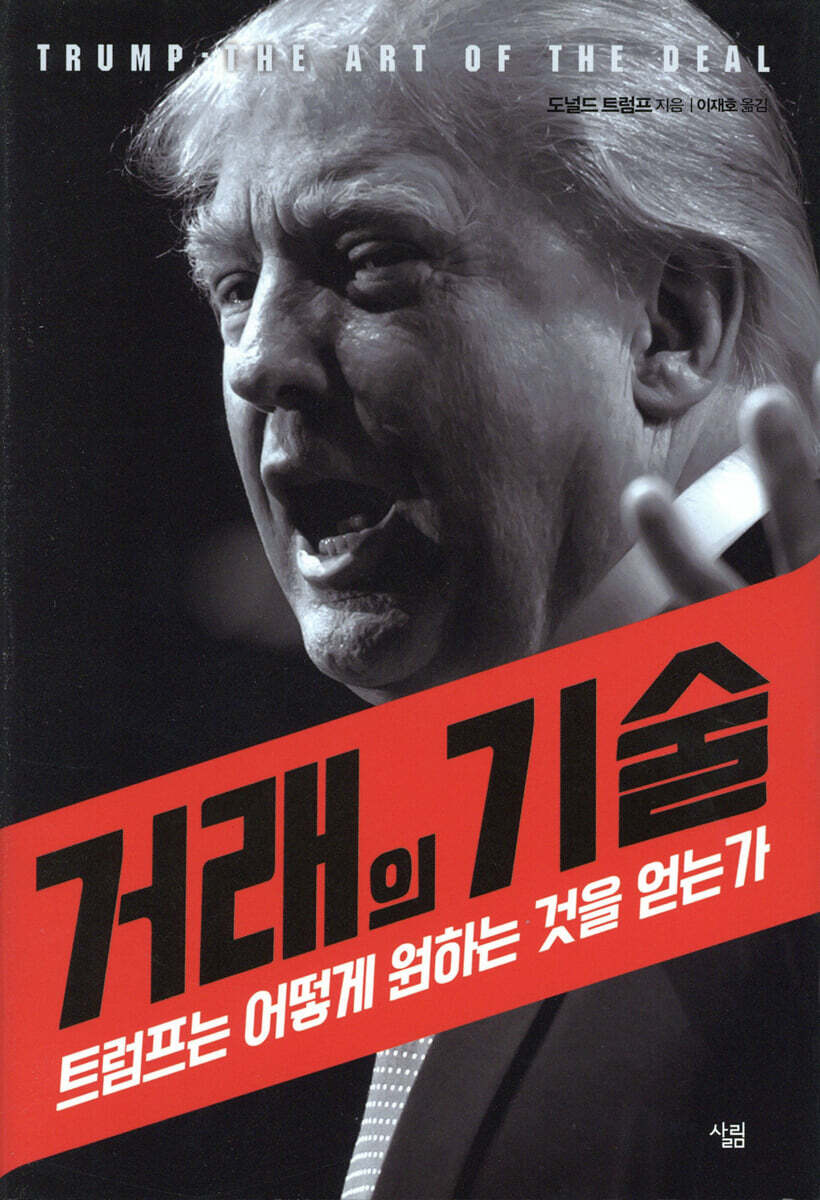
The Art of the Deal
 |
Description
Book Introduction
The world is now going through a difficult time called 'Trump'.
I have to solve an unfamiliar homework problem.
This book is the only book that can help you understand 'Trump'!
The Wall Street Journal recently said that The Art of the Deal is one way to understand Trump, saying, “This book reveals the motivations behind his erratic behavior.
He is using this book as a blueprint for his election strategy,” the report said.
The New York Times, which is highly critical of Trump, also commented that “Trump has long known that spectacle can make a deep impression on people,” and that “of all the lessons in ‘The Art of the Deal,’ this may be the one that speaks most directly to his campaign strategy.”
As if to support this, Trump claims that "The Art of the Deal" is the best-selling business book of all time, and openly states that his favorite book is "The Bible," followed by "The Art of the Deal."
His son further testified that “many of the principles contained in ‘The Art of the Deal’ are being used in the election campaign.”
This book provides a detailed account of Trump's activities, including how he runs his business and lives his life.
He meets people, chats with family and friends, fights his opponents, and changes the skyline of New York City.
But behind this self-righteous behavior, there is a hidden principle.
Trump creates and implements 11 guidelines for success.
He breaks down common elements and myths in the great trading rules.
All of this can be seen in Trump's words.
I have to solve an unfamiliar homework problem.
This book is the only book that can help you understand 'Trump'!
The Wall Street Journal recently said that The Art of the Deal is one way to understand Trump, saying, “This book reveals the motivations behind his erratic behavior.
He is using this book as a blueprint for his election strategy,” the report said.
The New York Times, which is highly critical of Trump, also commented that “Trump has long known that spectacle can make a deep impression on people,” and that “of all the lessons in ‘The Art of the Deal,’ this may be the one that speaks most directly to his campaign strategy.”
As if to support this, Trump claims that "The Art of the Deal" is the best-selling business book of all time, and openly states that his favorite book is "The Bible," followed by "The Art of the Deal."
His son further testified that “many of the principles contained in ‘The Art of the Deal’ are being used in the election campaign.”
This book provides a detailed account of Trump's activities, including how he runs his business and lives his life.
He meets people, chats with family and friends, fights his opponents, and changes the skyline of New York City.
But behind this self-righteous behavior, there is a hidden principle.
Trump creates and implements 11 guidelines for success.
He breaks down common elements and myths in the great trading rules.
All of this can be seen in Trump's words.
- You can preview some of the book's contents.
Preview
index
To those who helped with this book
Trump with a bare face
Chapter 1: Trading is an Art: My Week
Chapter 2: My Business Style: 11 Principles
Chapter 3 Growth
Chapter 4: Cincinnati Country Boy: Awakening to Real Estate
Chapter 5: West Side Story
Chapter 6: The Grand Hyatt Hotel: Reviving Downtown New York
Chapter 7: Trump Tower: We're Selling a Fantasy
Chapter 8: Starting a Casino Business: Trump Plaza
Chapter 9: The Hilton Casino Battle
Chapter 10: Trump Park: The Ultra-Luxury Condominium That Captured the World's Attention
Chapter 11: Spring and Fall of the USFL
Chapter 12: Rebuilding the Ice Rink
Chapter 13: The 'Television City' Project
Chapter 14 What Next?
Translator's Note
Trump with a bare face
Chapter 1: Trading is an Art: My Week
Chapter 2: My Business Style: 11 Principles
Chapter 3 Growth
Chapter 4: Cincinnati Country Boy: Awakening to Real Estate
Chapter 5: West Side Story
Chapter 6: The Grand Hyatt Hotel: Reviving Downtown New York
Chapter 7: Trump Tower: We're Selling a Fantasy
Chapter 8: Starting a Casino Business: Trump Plaza
Chapter 9: The Hilton Casino Battle
Chapter 10: Trump Park: The Ultra-Luxury Condominium That Captured the World's Attention
Chapter 11: Spring and Fall of the USFL
Chapter 12: Rebuilding the Ice Rink
Chapter 13: The 'Television City' Project
Chapter 14 What Next?
Translator's Note
Into the book
I don't trade for money.
There is plenty of money.
It's much more than I need.
I trade for the sake of trading.
Trading is a kind of art to me.
Some people paint beautiful pictures on canvas and write great poetry.
But I like to make some deals.
The bigger the deal, the better.
I find joy in life through trading.
Trading is an art to me.
--- p.17
Why do people ask me to host charity dinners or speak at charity events? I want to be honest.
It's not because I'm a great person.
Because people know I have a lot of rich friends.
When I go out to dinner parties, my rich friends come and buy tables and stuff.
I understand the game.
Even if you don't like it, there is no way to get out of it in a cool and wonderful way.
--- pp.34-35
I like to think big.
People tend to think small when they have to make a decision because they are afraid of getting things done.
That's a huge advantage for someone like me.
My father built low-income housing in Brooklyn and Queens, but even then I was drawn to better places.
When I was working in Queens, I thought Forest Hills was a promising area, but as I got older, I realized that Fifth Avenue was a much more advantageous location than Forest Hills.
So I started targeting Manhattan early on, and judging by this, I think I have a good sense of purpose.
I wasn't satisfied with living a somewhat comfortable life.
I wanted to build something monumental, something worth putting a lot of effort into.
--- pp.72-73
I don't trust any fancy market research that other people have created.
Always do your own research and come to your own conclusions.
I like to ask people for their opinions before I come to a conclusion.
If you're thinking about buying land, ask people living nearby about the schools, whether there are any thieves, and whether it's convenient to go shopping.
If it's not the area I live in, I sometimes ask the drivers questions after getting in a taxi.
You have to ask and ask again to resolve your doubts before you can come to a conclusion.
It's always been more useful to ask anyone directly than to consult with a consulting firm.
The consulting firm sends its staff from Boston to rent a room in New York and charges them $100,000 to conduct an investigation, but not only do they not produce any significant results, but by the time the investigation is over, our business is often already closed.
I also don't find critics very interesting.
Critics are just people who poke fun at each other to influence each other, and they are so easily influenced by trends.
They are fickle people who one day praise a soaring glass tower, and the next week they dig up an old building and appreciate its details and decorations.
They have little idea what the public wants.
--- pp.77-78
Even if you have the best thing in the world, it's useless if no one knows about it.
The point is, if a singer with a great voice like Frank Sinatra only sings in his garage every day, it's of no use.
It must arouse the interest of others and create a stir.
One option might be to hire a publicist and pay them a lot of money to sell your property.
However, that method is like hiring a researcher to do market research and will never be as effective as doing it yourself.
I've learned from experience that the media is always hungry for good stories, and the better the material, the more likely it is to get a headline.
If you are a little bit different, or brave, or do something daring and controversial, the newspapers will write about you.
So I did things a little differently, I wasn't afraid to be controversial, and because of that, the deals I was involved in seemed a little fanciful.
Thanks to this personality, I showed considerable business acumen from a very young age.
I was so anxious to get my article published that the newspapers started paying attention to me.
That's not to say the media always likes me.
Sometimes we write positive articles, but sometimes we write disparaging articles.
But from a purely business perspective, getting an article published always does more good than bad.
It is clear from the numbers.
It costs $40,000 to place a full-page ad in the New York Times.
Still, readers tend to be skeptical of advertising content.
But if the New York Times wrote even one line about my business that was even slightly favorable, it didn't cost me a penny, but the effect was worth more than $40,000.
What's interesting is that even critical articles that are personally damaging can be very helpful from a business perspective.
There is plenty of money.
It's much more than I need.
I trade for the sake of trading.
Trading is a kind of art to me.
Some people paint beautiful pictures on canvas and write great poetry.
But I like to make some deals.
The bigger the deal, the better.
I find joy in life through trading.
Trading is an art to me.
--- p.17
Why do people ask me to host charity dinners or speak at charity events? I want to be honest.
It's not because I'm a great person.
Because people know I have a lot of rich friends.
When I go out to dinner parties, my rich friends come and buy tables and stuff.
I understand the game.
Even if you don't like it, there is no way to get out of it in a cool and wonderful way.
--- pp.34-35
I like to think big.
People tend to think small when they have to make a decision because they are afraid of getting things done.
That's a huge advantage for someone like me.
My father built low-income housing in Brooklyn and Queens, but even then I was drawn to better places.
When I was working in Queens, I thought Forest Hills was a promising area, but as I got older, I realized that Fifth Avenue was a much more advantageous location than Forest Hills.
So I started targeting Manhattan early on, and judging by this, I think I have a good sense of purpose.
I wasn't satisfied with living a somewhat comfortable life.
I wanted to build something monumental, something worth putting a lot of effort into.
--- pp.72-73
I don't trust any fancy market research that other people have created.
Always do your own research and come to your own conclusions.
I like to ask people for their opinions before I come to a conclusion.
If you're thinking about buying land, ask people living nearby about the schools, whether there are any thieves, and whether it's convenient to go shopping.
If it's not the area I live in, I sometimes ask the drivers questions after getting in a taxi.
You have to ask and ask again to resolve your doubts before you can come to a conclusion.
It's always been more useful to ask anyone directly than to consult with a consulting firm.
The consulting firm sends its staff from Boston to rent a room in New York and charges them $100,000 to conduct an investigation, but not only do they not produce any significant results, but by the time the investigation is over, our business is often already closed.
I also don't find critics very interesting.
Critics are just people who poke fun at each other to influence each other, and they are so easily influenced by trends.
They are fickle people who one day praise a soaring glass tower, and the next week they dig up an old building and appreciate its details and decorations.
They have little idea what the public wants.
--- pp.77-78
Even if you have the best thing in the world, it's useless if no one knows about it.
The point is, if a singer with a great voice like Frank Sinatra only sings in his garage every day, it's of no use.
It must arouse the interest of others and create a stir.
One option might be to hire a publicist and pay them a lot of money to sell your property.
However, that method is like hiring a researcher to do market research and will never be as effective as doing it yourself.
I've learned from experience that the media is always hungry for good stories, and the better the material, the more likely it is to get a headline.
If you are a little bit different, or brave, or do something daring and controversial, the newspapers will write about you.
So I did things a little differently, I wasn't afraid to be controversial, and because of that, the deals I was involved in seemed a little fanciful.
Thanks to this personality, I showed considerable business acumen from a very young age.
I was so anxious to get my article published that the newspapers started paying attention to me.
That's not to say the media always likes me.
Sometimes we write positive articles, but sometimes we write disparaging articles.
But from a purely business perspective, getting an article published always does more good than bad.
It is clear from the numbers.
It costs $40,000 to place a full-page ad in the New York Times.
Still, readers tend to be skeptical of advertising content.
But if the New York Times wrote even one line about my business that was even slightly favorable, it didn't cost me a penny, but the effect was worth more than $40,000.
What's interesting is that even critical articles that are personally damaging can be very helpful from a business perspective.
--- pp.81-82
Publisher's Review
The world is now facing a difficult situation called 'Trump'.
I have to solve an unfamiliar homework problem.
This is the only book that can help you understand 'Trump'!
The hottest yet most mysterious figure: Donald Trump
One person is shaking up the whole world right now.
His every word becomes a topic of intense interest, causing a huge stir, and his every move becomes the center of controversy.
Donald Trump, who captivated people with the words “You’re fired!” on the reality show “The Apprentice,” is back.
And not in the industry or on a reality show, but in the position of the United States, the most powerful nation.
“I will completely control Muslim entry.” “I will build a wall along the border to keep Mexican immigrants out.” “China is sexually assaulting the United States.” “We can pay off the national debt by printing dollars.” “South Korea should shoulder 100% of the defense cost.” “I will completely reconsider the Korea-US free trade agreement.” After making these bombshell statements, he coolly reverses them by saying, “Those are just proposals.”
No one knows which side is true.
It's to the point where even Trump himself might know.
On the one hand, voices are continuously being raised criticizing and denouncing him as nothing more than a “swindler” who manipulates the even more ignorant public with “abusive language” and “ignorance.”
But on the other hand, he is evaluated as someone who accurately represents the reality of white American society and is even as progressive as Sanders.
Amid all the controversy surrounding the so-called "Trump phenomenon," one thing seems certain.
That is precisely the point at which the world has reached the point where it must somehow resolve this difficult and unfamiliar task called 'Trump.'
Although negative evaluations still seem high, it cannot be denied that the general trend is gradually leaning towards acknowledging him.
The important thing now is to know him.
That way, you can do it properly, whether you support or oppose.
Trump, who is he?
The Art of the Deal: The Best Way to Understand Trump
The best way to get to know Trump, surprisingly, has already been prepared by Trump himself.
This is the book, “The Art of the Deal.”
The Art of the Deal, a memoir of sorts co-written with journalist Tony Schwartz in 1987, became a sensation upon its publication, topping the New York Times nonfiction bestseller list for 32 weeks.
The book is now back on the bestseller list, riding the wave of the Trump syndrome.
Why is a book published nearly 30 years ago attracting so much attention?
The Wall Street Journal recently said that The Art of the Deal is one way to understand Trump, saying, “This book reveals the motivations behind his erratic behavior.
He is using this book as a blueprint for his election strategy,” the report said.
The New York Times, which is highly critical of Trump, also commented that “Trump has long known that spectacle can make a deep impression on people,” and that “of all the lessons in ‘The Art of the Deal,’ this may be the one that speaks most directly to his campaign strategy.”
As if to support this, Trump claims that "The Art of the Deal" is the best-selling business book of all time, and openly states that his favorite book is "The Bible," followed by "The Art of the Deal."
His son further testified that “many of the principles contained in ‘The Art of the Deal’ are being used in the election campaign.”
This book provides a detailed account of Trump's activities, including how he runs his business and lives his life.
He meets people, chats with family and friends, fights his opponents, and changes the skyline of New York City.
But behind this self-righteous behavior, there is a hidden principle.
Trump creates and implements 11 guidelines for success.
He breaks down common elements and myths in the great trading rules.
All of this can be seen in Trump's words.
11 Principles That Drive the Trump Myth
In "The Art of the Deal," we encounter a Trump who is quite different from the one we superficially knew.
The man we discover in this book is not a braggart who uses foul language, but rather a very meticulous and persistent negotiator, a true 'master of the deal'.
As the translator stated in the introduction, he is “a person who reads the changes in the world faster than others, and is not picky about the means and methods to succeed… in a word, a strong, meticulous, and cold-blooded person to the point of vulgarity.”
In Chapter 2 of this book, he presents the following 11 principles that he uses as a guide for his life and business.
"Think big." "Always expect the worst." "Expand your options." "Survey the market by doing your research." "Use leverage." "Focus on strategy, not location." "Use the media." "Resist for what you believe in." "Build the best product." "Hope big, spend modestly." "Make business a fun game."
Trump repeatedly emphasizes that he has always thought bigger than others.
The business he had been running was to be as large as possible, with the best facilities, and as extravagant as possible.
He knows full well that people are overwhelmed by the spectacle, and in that sense, he asserts, “We are selling an illusion.”
“One of the fundamental elements of thinking big is focus.
These skills are commonly found in fairly successful entrepreneurs.
They are focused, impulsive, single-minded, and sometimes almost paranoid.
But all these characteristics are concentrated in their business.”
This principle is clearly evident in Trump's recent actions.
His so-called outrageous remarks are invariably related to “huge” issues.
Of course, it doesn't have to be just huge.
It must be in touch with the demands of reality.
Perhaps Trump is deliberately highlighting only the biggest—that is, the most sensitive and pressing—issues of the day.
And here people are overwhelmed and excited.
The world may be misjudging him.
However, Trump confesses that he is “known to believe in the power of positive thinking, but in reality, I believe in the power of negative thinking.”
He is always thinking about the worst case scenario and is therefore conservative.
It's a very unfamiliar side of him, different from his appearance.
In fact, he always personally investigates the scene in his dealings, prepares thoroughly, and waits patiently until the moment the opportunity arises, then he seizes his prey.
And while he never gives up and persuades until the end for negotiation, he throws his cards away without hesitation when he has to give up.
This passage clearly shows that he is not a gambler who blindly accepts everything and chases after vain dreams, but rather an excellent strategist who makes dreams achievable through thorough calculation and preparation.
Another principle to note is 'use of the media'.
“I have learned from experience that the media is always hungry for good stories, and the better the material, the more likely it is to be featured.
If you are a little bit different, or brave, or do something daring and controversial, the newspapers will write about you.
So I did things a little differently, I wasn't afraid to be controversial, and because of that, the deals I was involved in seemed a little fanciful.
Thanks to this personality, I showed considerable business acumen from a very young age.
“I was so anxious that the newspapers couldn’t write about me because they were paying attention to me.” Given that the media was practically flooded with Trump articles, to the point where his competitors were complaining that they were being treated unfairly by the press, it appears that this strategy has worked.
"The Art of the Deal" captures the unprecedented success habits of the author, a genius businessman and master trader.
Therefore, above all, this book is the most comprehensive management book on worldly affairs and a candid life guide for those who want to succeed.
But now, this book is even more valuable as an optimal means of understanding Donald Trump, a politician who has emerged as a key figure in American politics and the international community.
"The Art of the Deal" will provide us with a key to understanding the essence of the "Trump Syndrome," beyond the negative and positive.
I have to solve an unfamiliar homework problem.
This is the only book that can help you understand 'Trump'!
The hottest yet most mysterious figure: Donald Trump
One person is shaking up the whole world right now.
His every word becomes a topic of intense interest, causing a huge stir, and his every move becomes the center of controversy.
Donald Trump, who captivated people with the words “You’re fired!” on the reality show “The Apprentice,” is back.
And not in the industry or on a reality show, but in the position of the United States, the most powerful nation.
“I will completely control Muslim entry.” “I will build a wall along the border to keep Mexican immigrants out.” “China is sexually assaulting the United States.” “We can pay off the national debt by printing dollars.” “South Korea should shoulder 100% of the defense cost.” “I will completely reconsider the Korea-US free trade agreement.” After making these bombshell statements, he coolly reverses them by saying, “Those are just proposals.”
No one knows which side is true.
It's to the point where even Trump himself might know.
On the one hand, voices are continuously being raised criticizing and denouncing him as nothing more than a “swindler” who manipulates the even more ignorant public with “abusive language” and “ignorance.”
But on the other hand, he is evaluated as someone who accurately represents the reality of white American society and is even as progressive as Sanders.
Amid all the controversy surrounding the so-called "Trump phenomenon," one thing seems certain.
That is precisely the point at which the world has reached the point where it must somehow resolve this difficult and unfamiliar task called 'Trump.'
Although negative evaluations still seem high, it cannot be denied that the general trend is gradually leaning towards acknowledging him.
The important thing now is to know him.
That way, you can do it properly, whether you support or oppose.
Trump, who is he?
The Art of the Deal: The Best Way to Understand Trump
The best way to get to know Trump, surprisingly, has already been prepared by Trump himself.
This is the book, “The Art of the Deal.”
The Art of the Deal, a memoir of sorts co-written with journalist Tony Schwartz in 1987, became a sensation upon its publication, topping the New York Times nonfiction bestseller list for 32 weeks.
The book is now back on the bestseller list, riding the wave of the Trump syndrome.
Why is a book published nearly 30 years ago attracting so much attention?
The Wall Street Journal recently said that The Art of the Deal is one way to understand Trump, saying, “This book reveals the motivations behind his erratic behavior.
He is using this book as a blueprint for his election strategy,” the report said.
The New York Times, which is highly critical of Trump, also commented that “Trump has long known that spectacle can make a deep impression on people,” and that “of all the lessons in ‘The Art of the Deal,’ this may be the one that speaks most directly to his campaign strategy.”
As if to support this, Trump claims that "The Art of the Deal" is the best-selling business book of all time, and openly states that his favorite book is "The Bible," followed by "The Art of the Deal."
His son further testified that “many of the principles contained in ‘The Art of the Deal’ are being used in the election campaign.”
This book provides a detailed account of Trump's activities, including how he runs his business and lives his life.
He meets people, chats with family and friends, fights his opponents, and changes the skyline of New York City.
But behind this self-righteous behavior, there is a hidden principle.
Trump creates and implements 11 guidelines for success.
He breaks down common elements and myths in the great trading rules.
All of this can be seen in Trump's words.
11 Principles That Drive the Trump Myth
In "The Art of the Deal," we encounter a Trump who is quite different from the one we superficially knew.
The man we discover in this book is not a braggart who uses foul language, but rather a very meticulous and persistent negotiator, a true 'master of the deal'.
As the translator stated in the introduction, he is “a person who reads the changes in the world faster than others, and is not picky about the means and methods to succeed… in a word, a strong, meticulous, and cold-blooded person to the point of vulgarity.”
In Chapter 2 of this book, he presents the following 11 principles that he uses as a guide for his life and business.
"Think big." "Always expect the worst." "Expand your options." "Survey the market by doing your research." "Use leverage." "Focus on strategy, not location." "Use the media." "Resist for what you believe in." "Build the best product." "Hope big, spend modestly." "Make business a fun game."
Trump repeatedly emphasizes that he has always thought bigger than others.
The business he had been running was to be as large as possible, with the best facilities, and as extravagant as possible.
He knows full well that people are overwhelmed by the spectacle, and in that sense, he asserts, “We are selling an illusion.”
“One of the fundamental elements of thinking big is focus.
These skills are commonly found in fairly successful entrepreneurs.
They are focused, impulsive, single-minded, and sometimes almost paranoid.
But all these characteristics are concentrated in their business.”
This principle is clearly evident in Trump's recent actions.
His so-called outrageous remarks are invariably related to “huge” issues.
Of course, it doesn't have to be just huge.
It must be in touch with the demands of reality.
Perhaps Trump is deliberately highlighting only the biggest—that is, the most sensitive and pressing—issues of the day.
And here people are overwhelmed and excited.
The world may be misjudging him.
However, Trump confesses that he is “known to believe in the power of positive thinking, but in reality, I believe in the power of negative thinking.”
He is always thinking about the worst case scenario and is therefore conservative.
It's a very unfamiliar side of him, different from his appearance.
In fact, he always personally investigates the scene in his dealings, prepares thoroughly, and waits patiently until the moment the opportunity arises, then he seizes his prey.
And while he never gives up and persuades until the end for negotiation, he throws his cards away without hesitation when he has to give up.
This passage clearly shows that he is not a gambler who blindly accepts everything and chases after vain dreams, but rather an excellent strategist who makes dreams achievable through thorough calculation and preparation.
Another principle to note is 'use of the media'.
“I have learned from experience that the media is always hungry for good stories, and the better the material, the more likely it is to be featured.
If you are a little bit different, or brave, or do something daring and controversial, the newspapers will write about you.
So I did things a little differently, I wasn't afraid to be controversial, and because of that, the deals I was involved in seemed a little fanciful.
Thanks to this personality, I showed considerable business acumen from a very young age.
“I was so anxious that the newspapers couldn’t write about me because they were paying attention to me.” Given that the media was practically flooded with Trump articles, to the point where his competitors were complaining that they were being treated unfairly by the press, it appears that this strategy has worked.
"The Art of the Deal" captures the unprecedented success habits of the author, a genius businessman and master trader.
Therefore, above all, this book is the most comprehensive management book on worldly affairs and a candid life guide for those who want to succeed.
But now, this book is even more valuable as an optimal means of understanding Donald Trump, a politician who has emerged as a key figure in American politics and the international community.
"The Art of the Deal" will provide us with a key to understanding the essence of the "Trump Syndrome," beyond the negative and positive.
GOODS SPECIFICS
- Date of issue: May 25, 2016
- Format: Hardcover book binding method guide
- Page count, weight, size: 448 pages | 772g | 152*225*30mm
- ISBN13: 9788952234087
- ISBN10: 8952234081
You may also like
카테고리
korean


korean

![GQ KOREA Mark (Monthly): December [2025]](http://librairie.coreenne.fr/cdn/shop/files/8ef265dbbfbf186523ed75ba7319009d.jpg?v=1765340328&width=3840)


