

About the favor
 |
Description
Book Introduction
- A word from MD
-
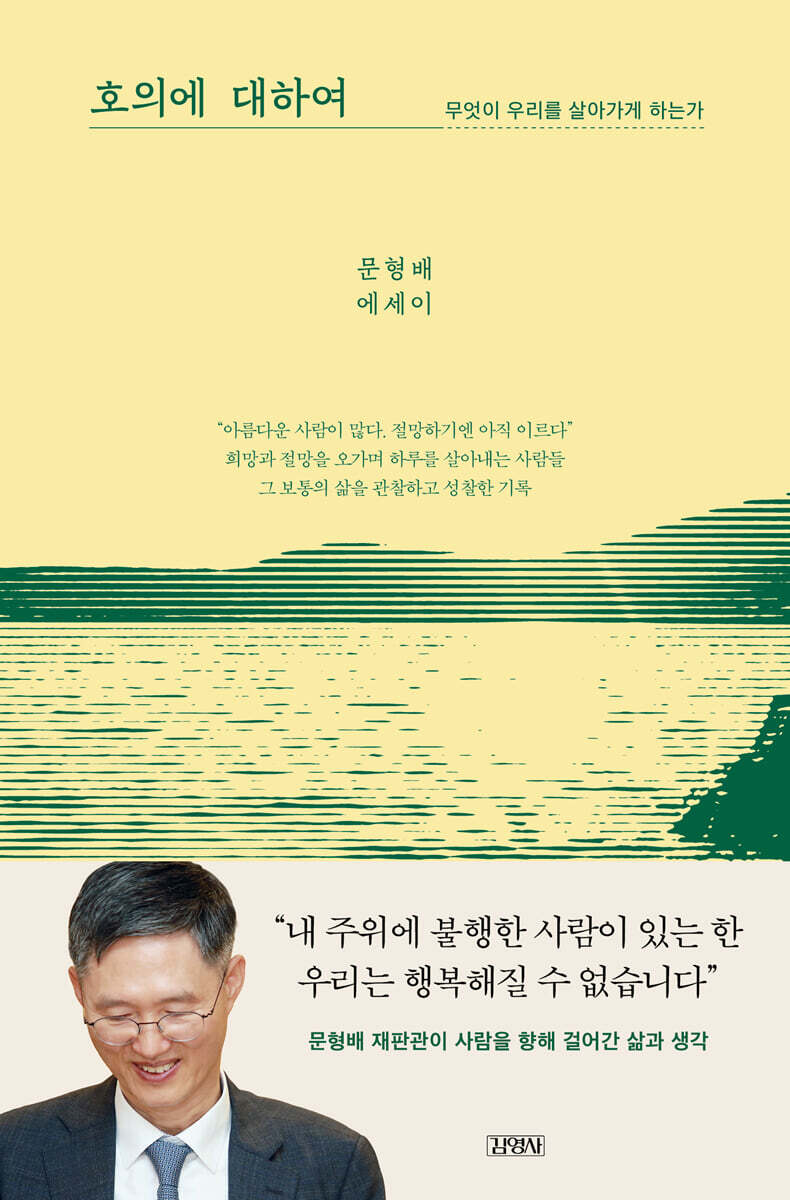
There is goodwill between you and meAn essay by former Constitutional Court Justice Moon Hyung-bae.
I have selected 120 of the articles I have written so far.
In the time he spent learning and reflecting on ordinary life, including daily life, trees, reading, society, and law, the word he discovered was 'favor.'
A book filled with the power that keeps us alive, imagination for a slightly better path, and sincerity for beautiful people.
August 26, 2025. Essay PD Lee Ju-eun
Judge Moon Hyung-bae does not fall into prejudice or self-righteousness.
To protect the small, ordinary, and normal life
120 articles written through learning and reflection.
What does it mean to enrich my daily life? Can I fully understand the lives of others? Can people and society change?
From birch trees to Jirisan, from Dostoevsky to Montesquieu, from everyday life to trial.
How kindness changes people and the world.
Memories of Mr. Kim Jang-ha, who urged us to give back to society what we have received; a heart that considers those who suffer losses due to ignorance of the law; a gift that made a prisoner who attempted suicide resolve to live; tears shed helplessly as he misses a loved one; and sincere advice for a healthy court and society…
A simple vision of a better way and a warm sincerity for the beautiful.
About what Moon Hyung-bae says can never be impeached.
To protect the small, ordinary, and normal life
120 articles written through learning and reflection.
What does it mean to enrich my daily life? Can I fully understand the lives of others? Can people and society change?
From birch trees to Jirisan, from Dostoevsky to Montesquieu, from everyday life to trial.
How kindness changes people and the world.
Memories of Mr. Kim Jang-ha, who urged us to give back to society what we have received; a heart that considers those who suffer losses due to ignorance of the law; a gift that made a prisoner who attempted suicide resolve to live; tears shed helplessly as he misses a loved one; and sincere advice for a healthy court and society…
A simple vision of a better way and a warm sincerity for the beautiful.
About what Moon Hyung-bae says can never be impeached.
- You can preview some of the book's contents.
Preview
index
Opening remarks
1.
Everyday life is precious
No one told me to go this way - The law for good people - Not guilty verdict - Visiting the charnel house - After the verdict - The law of negotiation, the law of mediation - The judiciary can also create emotion - A trip to a Swiss court - How to successfully pass a criminal trial - The work of a judge - Sentencing standards for white-collar crimes - A good lawyer - How to govern criminals - Contracts instead of words - Witness appearance - Judge Han Ki-taek - How to successfully pass a civil trial - Renunciation of inheritance - People in their 40s - Mediation and umbrellas - The power of a cup of green tea - Kim Chang-wan - Reconciliation that divides cause and benefit - Jo Sam-mo-sa - A community of virtuous cycles - A small world is the alternative - A boy I met at Isaac's House - Embarrassing college life - Birch tree - Seeing harmony - The joys and sorrows of growing older - Three reasons to read books - Recording 100,000 blog visitors - Three hobbies - Creating a warm world - Nonviolent communication methods learned at the hospital - Criteria for selecting books - Visiting a memorial service - Visiting Hokkaido - Macadamia - Climbing Mangjinsan Mountain - Things to be careful of when taking an intercity bus - Fireflies in Upo Swamp - Sunrise in Jirisan Mountain - Peace in Yeongchuksan Mountain - Ahn Chi-hwan Weekly - Looking at Korea - Magnolia - Ginger Tree - Zelkova - Crape Myrtle - Korean Fir - That Pine Tree - Yew - Principle of Evidence Trial - Looking at the Gift in Room 7 - Cypress Tree - How to refrain from abusive language - Attitude in court - What judges live on - Things to keep in mind when starting a career as a civil servant - Quince Tree - Looking at a Wish - Ginkgo Tree - Pine Tree - Camphor Tree - Fir Tree - 48 Hours in Prague - Bark Tree - Horse Chestnut Tree
2.
I recommend reading it
Rereading Tree, Tree - Rereading The Pleasure of Study - Rereading The Spirit of the Laws - Rereading The Metamorphosis and The Country Doctor - Rereading Pensées - Rereading The Tao Te Ching - Rereading Thus Spoke Zarathustra - Rereading Discipline and Punish - Rereading Notre Dame de Paris - Rereading The Catcher in the Rye - Rereading What Is Justice? - Rereading On Liberty - Rereading The 25 Hours - Rereading Emile - Rereading The Art of War - Rereading The Fatigued Society - Rereading On Duty - Rereading Madame Bovary - Rereading The War Diary - Rereading The Death of Ivan Ilyich - Rereading Anna Karenina - Rereading A Woman's Life - Rereading The Judge's Diaries - Rereading The Merchant of Venice - Rereading The Adventures of Huckleberry Finn - Rereading A Streetcar Named Desire - Rereading The Scarlet Letter - Trial in Literature, Literature in Trial - Rereading The Plague - Rereading Resurrection - Rereading The Brothers Karamazov - Rereading Crime and Punishment - Rereading Les Misérables - Rereading War and Peace - Rereading The Red and the Black - Reading Open Society and Its Enemies
3.
Wishes for society
Criminal case redistribution and sentencing standards - Trial-centered system and its enemies - How to live as a judge in an era of change - It is not a judiciary without independence - King Solomon's judgment - Inaugural address of the head of Jinju Branch - Address at the appointment ceremony of the mediation committee - Farewell address of the head of Jinju Branch - Farewell address of the Busan High Court - Inaugural address of the head of Busan Family Court - Keynote speech at the Busan Women Lawyers' Conference - Welcome remarks by candidates for Constitutional Court Justices - Inaugural address of Constitutional Court Justices - Retirement address of Constitutional Court Justices
Acknowledgements
1.
Everyday life is precious
No one told me to go this way - The law for good people - Not guilty verdict - Visiting the charnel house - After the verdict - The law of negotiation, the law of mediation - The judiciary can also create emotion - A trip to a Swiss court - How to successfully pass a criminal trial - The work of a judge - Sentencing standards for white-collar crimes - A good lawyer - How to govern criminals - Contracts instead of words - Witness appearance - Judge Han Ki-taek - How to successfully pass a civil trial - Renunciation of inheritance - People in their 40s - Mediation and umbrellas - The power of a cup of green tea - Kim Chang-wan - Reconciliation that divides cause and benefit - Jo Sam-mo-sa - A community of virtuous cycles - A small world is the alternative - A boy I met at Isaac's House - Embarrassing college life - Birch tree - Seeing harmony - The joys and sorrows of growing older - Three reasons to read books - Recording 100,000 blog visitors - Three hobbies - Creating a warm world - Nonviolent communication methods learned at the hospital - Criteria for selecting books - Visiting a memorial service - Visiting Hokkaido - Macadamia - Climbing Mangjinsan Mountain - Things to be careful of when taking an intercity bus - Fireflies in Upo Swamp - Sunrise in Jirisan Mountain - Peace in Yeongchuksan Mountain - Ahn Chi-hwan Weekly - Looking at Korea - Magnolia - Ginger Tree - Zelkova - Crape Myrtle - Korean Fir - That Pine Tree - Yew - Principle of Evidence Trial - Looking at the Gift in Room 7 - Cypress Tree - How to refrain from abusive language - Attitude in court - What judges live on - Things to keep in mind when starting a career as a civil servant - Quince Tree - Looking at a Wish - Ginkgo Tree - Pine Tree - Camphor Tree - Fir Tree - 48 Hours in Prague - Bark Tree - Horse Chestnut Tree
2.
I recommend reading it
Rereading Tree, Tree - Rereading The Pleasure of Study - Rereading The Spirit of the Laws - Rereading The Metamorphosis and The Country Doctor - Rereading Pensées - Rereading The Tao Te Ching - Rereading Thus Spoke Zarathustra - Rereading Discipline and Punish - Rereading Notre Dame de Paris - Rereading The Catcher in the Rye - Rereading What Is Justice? - Rereading On Liberty - Rereading The 25 Hours - Rereading Emile - Rereading The Art of War - Rereading The Fatigued Society - Rereading On Duty - Rereading Madame Bovary - Rereading The War Diary - Rereading The Death of Ivan Ilyich - Rereading Anna Karenina - Rereading A Woman's Life - Rereading The Judge's Diaries - Rereading The Merchant of Venice - Rereading The Adventures of Huckleberry Finn - Rereading A Streetcar Named Desire - Rereading The Scarlet Letter - Trial in Literature, Literature in Trial - Rereading The Plague - Rereading Resurrection - Rereading The Brothers Karamazov - Rereading Crime and Punishment - Rereading Les Misérables - Rereading War and Peace - Rereading The Red and the Black - Reading Open Society and Its Enemies
3.
Wishes for society
Criminal case redistribution and sentencing standards - Trial-centered system and its enemies - How to live as a judge in an era of change - It is not a judiciary without independence - King Solomon's judgment - Inaugural address of the head of Jinju Branch - Address at the appointment ceremony of the mediation committee - Farewell address of the head of Jinju Branch - Farewell address of the Busan High Court - Inaugural address of the head of Busan Family Court - Keynote speech at the Busan Women Lawyers' Conference - Welcome remarks by candidates for Constitutional Court Justices - Inaugural address of Constitutional Court Justices - Retirement address of Constitutional Court Justices
Acknowledgements
Detailed image

Into the book
Herb Cohen asserts that 80% of the world is negotiation.
As someone who specializes in damage compensation cases, I aim to resolve 80% of disputes through mediation.
Since 50% of the damage compensation cases over the past nine months have been resolved through mediation, the goal of 80% is not an empty dream.
--- p.32
A judge is someone who intervenes in other people's lives, especially at dramatic moments.
Without a sufficient understanding of conflict and a wealth of life experience, they may easily make mistakes that can burden their lives.
As time goes by, I become more and more afraid of being a judge.
--- p.79
If I say reading is a hobby, I might say it's like eating, but I'll just say that there are many interesting books, and when I can't sleep, if I pick up a difficult book, I'll fall asleep quickly.
--- p.116
One thing I love most about him and me is that we both love trees.
After climbing Mt. Gayasan, a friend came down to Haeinsa Temple and introduced me to the jujube tree that is said to live for a thousand years and live for a thousand years after death. I was deeply moved and still can't forget it.
--- p.163
Although it is a low mountain, there are difficult moments when going up and down.
Then a pine tree catches my eye.
The pine tree is always silent, but in that silence I gain depth of words.
I don't have the confidence to be a good judge, but I sometimes remind myself that I shouldn't be a bad judge.
--- p.175
It is important not to be defeated on the long journey of life.
However, you should not show the appearance of a loser just because it seems like you cannot win.
There are draws, so we need to hold on and then we can look forward to the future.
--- p.194
Even those who do not contribute to institutionalizing democracy enjoy democracy.
Because that's democracy.
I don't have the confidence to become a maple tree.
But I want to be someone who protects the pine trees.
Because that would be the duty of someone who has benefited from the oak tree.
--- p.212
I know how easily poverty can shake a life.
So, if the country's situation has improved since the old days, I hope that the impact of poverty on individuals will be reduced to a manageable level.
--- p.225
It could be said that 'good judgment grows like a plant.'
The deeper one's understanding of humanity and society, the stronger one's ability to withstand public pressure while persuading others, and the more one possesses both truth and validity, the better one's judgment can be considered.
--- p.299
Judges should have a lot of experience, but due to various circumstances, their experience is limited.
Literature can be an alternative.
Literature seeks universal truth, and judicial practice seeks specific truth, and the two require each other.
--- p.305
The fire did not spread widely and no one was injured.
On the day of sentencing, the defendant was made to shout "suicide" ten times.
“Suicide suicide suicide suicide….
If you do this ten times, you will say 'commit suicide', but to the listener it will sound like 'live'.
It depends on how you think about it.
Not all failures are bad.
“Didn’t you live because you failed to commit suicide?”
--- p.306
I pronounced the criminal sentence yesterday.
When the defendant's appeal was dismissed, several people in the audience cried.
I realized anew that what I do is something that makes others cry.
As someone who specializes in damage compensation cases, I aim to resolve 80% of disputes through mediation.
Since 50% of the damage compensation cases over the past nine months have been resolved through mediation, the goal of 80% is not an empty dream.
--- p.32
A judge is someone who intervenes in other people's lives, especially at dramatic moments.
Without a sufficient understanding of conflict and a wealth of life experience, they may easily make mistakes that can burden their lives.
As time goes by, I become more and more afraid of being a judge.
--- p.79
If I say reading is a hobby, I might say it's like eating, but I'll just say that there are many interesting books, and when I can't sleep, if I pick up a difficult book, I'll fall asleep quickly.
--- p.116
One thing I love most about him and me is that we both love trees.
After climbing Mt. Gayasan, a friend came down to Haeinsa Temple and introduced me to the jujube tree that is said to live for a thousand years and live for a thousand years after death. I was deeply moved and still can't forget it.
--- p.163
Although it is a low mountain, there are difficult moments when going up and down.
Then a pine tree catches my eye.
The pine tree is always silent, but in that silence I gain depth of words.
I don't have the confidence to be a good judge, but I sometimes remind myself that I shouldn't be a bad judge.
--- p.175
It is important not to be defeated on the long journey of life.
However, you should not show the appearance of a loser just because it seems like you cannot win.
There are draws, so we need to hold on and then we can look forward to the future.
--- p.194
Even those who do not contribute to institutionalizing democracy enjoy democracy.
Because that's democracy.
I don't have the confidence to become a maple tree.
But I want to be someone who protects the pine trees.
Because that would be the duty of someone who has benefited from the oak tree.
--- p.212
I know how easily poverty can shake a life.
So, if the country's situation has improved since the old days, I hope that the impact of poverty on individuals will be reduced to a manageable level.
--- p.225
It could be said that 'good judgment grows like a plant.'
The deeper one's understanding of humanity and society, the stronger one's ability to withstand public pressure while persuading others, and the more one possesses both truth and validity, the better one's judgment can be considered.
--- p.299
Judges should have a lot of experience, but due to various circumstances, their experience is limited.
Literature can be an alternative.
Literature seeks universal truth, and judicial practice seeks specific truth, and the two require each other.
--- p.305
The fire did not spread widely and no one was injured.
On the day of sentencing, the defendant was made to shout "suicide" ten times.
“Suicide suicide suicide suicide….
If you do this ten times, you will say 'commit suicide', but to the listener it will sound like 'live'.
It depends on how you think about it.
Not all failures are bad.
“Didn’t you live because you failed to commit suicide?”
--- p.306
I pronounced the criminal sentence yesterday.
When the defendant's appeal was dismissed, several people in the audience cried.
I realized anew that what I do is something that makes others cry.
--- p.379
Publisher's Review
★★★Judge Moon Hyung-bae's Essay Published★★★
There is goodwill between you and me
A simple imagination of a better way
Warm sincerity towards these beautiful people
Justice Moon Hyung-bae on what can never be impeached
At 11:22 AM on April 4, 2025, the last sentence of the verdict remains in our memory.
The calm expression and firm voice of a judge reading the summary of the sentence.
Justice Moon Hyung-bae began his term as a Constitutional Court Justice on April 19, 2019, and retired on April 18, 2025.
A person who feared completing his term without sentencing rather than a delayed sentencing, a person who spent most of his public service as a local judge in Busan and Gyeongnam, a person who strengthened sentencing standards to strictly sentence public corruption and irregularities, while also implementing counseling and treatment programs for the socially disadvantaged and reflecting the results in sentencing.
What led him down this path, what was he heading towards?
A book titled “On Kindness” (published by Kim Young-sa) that provides a glimpse into his thoughts has been published.
A tree that resembles a person found on a walking or hiking trail, a book read to overcome inexperience, memories of Mr. Kim Jang-ha who told us to give back to society what we have received, a heart that considers those who are harmed by not knowing the law, a gift that made a prisoner who attempted 'suicide' promise to 'live', tears shed helplessly as he misses a loved one, and sincere advice for a healthy court and society...
From birch trees to Jirisan, from Dostoevsky to Montesquieu, from everyday life to trial, Judge Moon Hyung-bae has selected 120 pieces from over 1,500 pieces written since 1998, including his attitude toward everyday life (Part 1), his impressions of books he has read two or three times (Part 2), and his hopes for the court and society (Part 3).
What does it mean to enrich my daily life? Can we fully understand the lives of others? Can people and society change?
And how does kindness change people and the world?
“There are many beautiful people.
“It is still too early to despair.” The word he discovered after nearly 30 years of constant study and reflection was ‘favor.’
This book is “a record of a judge who tried not to deviate from the life of an average person” and is the story of his journey toward becoming a beautiful and ordinary person.
It is also a record of my concerns as a “citizen of the Republic of Korea living in the same era” rather than as a judge, and my reflections in hopes of a slightly better society.
The author says he has never regretted becoming a judge.
A letter he received from a convicted felon (“I will do my best to live a life that will not disappoint your honor”) left him “permanently unable to leave” the court.
Judge Moon Hyung-bae's first book, a book filled with simple imagination for a better way and warm sincerity for beautiful people, begins with a story about things that can never be impeached.
The path toward an average life
People who resemble trees and our ordinary and precious daily lives
“A friend introduced me to the yew tree, which is said to live for a thousand years and die for another thousand years, and I was deeply moved.
I took a picture of the juniper tree and sent it to my respected senior, Park.
There was also an explanation that it was sent because it resembled a senior.
“That senior seemed to think of hundreds of years as a unit of life.”
If this society is “supported by ordinary people,” then our lives are a collection of ordinary days.
Only after we become ill or after we are involved in a lawsuit do we realize that the ordinary happiness of everyday life is true happiness.
This is why I wrote in detail about climbing mountains with friends, memorizing the names of trees along the trail, and cheering on my favorite baseball team.
His love for trees is so extreme that he uses birch as his pen name.
When I arrived at my hometown after a long walk from the station during my college days, I found solace in the zelkova tree that greeted me. As I drank the sap from the maple tree, I thought of a system that would benefit everyone. As I was intoxicated by the beauty of cherry blossoms and white magnolias, I thought of people even more beautiful than these.
The author advises not to sacrifice the present for great success, but to be faithful to the small, everyday things of the present.
That is how one “does not lose in the long journey of life.”
“There are draws, so we need to hold on and then we can look forward to the future.”
The force that keeps us alive
A friendly dialogue that transforms conflict into reconciliation and "suicide" into "live."
“Suicide suicide suicide suicide….
If you do this ten times, you will say 'commit suicide', but to the listener it will sound like 'live'.
It depends on how you think about it.
Not all failures are bad.
“Didn’t you live because you failed to commit suicide?”
The author emphasized the importance of a mediation process in which the plaintiff and defendant make appropriate concessions to each other in damages cases, and actually demonstrated his negotiation skills.
While listening to the defendant's difficult circumstances, the plaintiff is suggested to pursue practical gains, that is, methods that are more likely to result in receiving money, rather than the nominal benefit of a winning judgment.
In a case where there was no sign of compromise, the power of a cup of green tea and an old umbrella offered to the interested parties was great.
We know that a kind word can sometimes melt a heart and solve or prevent a problem, more than any great financial gain.
We also know that anger has the opposite effect.
For those fighting in the mediation room or courtroom, I advise, “Once you get angry, it’s hard to control your anger, so slow down before you get angry.”
Because the greatest damage will be incurred when the case is not resolved.
This advice isn't just for stakeholders.
The author even asks the associate judges to “pull up their robe sleeves” when he feels like losing his temper in court.
The author's most famous judgment, still remembered today, was also based on goodwill.
In a case where a defendant set fire to an inn in an attempt to commit suicide, the author made the defendant shout "suicide" ten times on the day of sentencing.
Before this incident, I saw a post on Twitter saying that someone had already threatened suicide, and I asked them to shout "Live" ten times.
“After you leave, there may be people who will cry for days because they regret not being able to hold you.
I might cry again because I miss you.
“Your suicide is an unbearable wound for those left behind.”
How to understand other people's lives
Reading to overcome inexperience and lack of conviction
“A judge is someone who intervenes in other people’s lives, especially at dramatic moments.
Without a sufficient understanding of conflict and a wealth of life experience, they may make misjudgments that will burden their lives greatly.
(…) literature can be an alternative.
“Because literature seeks universal truth, and trials seek specific truth, and the two need each other.”
The author confesses that he only began reading in earnest after entering university.
During my early days as a judge, I realized that I lacked the experience to understand cases and people, and wondered why I kept repeating things that would obviously lead to punishment if caught, why I made large transactions without a contract, and so on. So, I started reading more books as a way to broaden my indirect experience.
The author said, “It was thanks to books that I was able to survive in times of chaos.”
Nearly 40 years of reading have helped me organize my thoughts and develop unwavering convictions on each issue.
From books gifted to books picked up by chance at a bookstore, from Dostoevsky's Crime and Punishment to Montesquieu's The Spirit of the Laws, the author's reading history spans a wide range of genres.
Among them, I included reviews of books that helped broaden my horizons and books I have read multiple times.
Readers can discover another kind of enjoyment in reading through analysis of the protagonist's motive for the crime in literary works ("The first motive is not convincing because he did not use any of the stolen property") and evaluation of the trial process and verdict ("The principle that guilt is found only when there is proof strict enough to exclude a reasonable doubt was not presented" "I was once surprised by Dostoevsky's sentencing sense").
The society we dream of
Thoughts on a slightly better way based on goodwill
“The teacher has done me good.
I will repay the kindness I received from my teacher to others.
I hope that this virtuous cycle will build up and make this society much stronger and more beautiful.
“I hope this will lay the foundation for new achievements.”
The author has been strict in sentencing white-collar crimes.
Changwon District Court participated in strengthening sentencing standards for public corruption and bribery and reflected those standards in the trial process.
Even before that, there was a suggestion to fully expand the sentencing standards system in order to resolve the controversy over preferential treatment.
The reason he made such public statements on the court bulletin board was also to apply strict standards to himself during the trial.
This is because the social experiences of those who commit white-collar crimes and judges are similar, and it is acknowledged that the reasons for their crimes “affect the judge emotionally.”
However, for crimes committed by socially disadvantaged people, priority was given to supporting them to improve the difficult environments they face.
The process of having defendants in violent crimes undergo counseling and treatment programs and reflecting the results in sentencing was recorded in detail.
He also does not hide his opinion on the abolition of the death penalty.
He compares the anti-death penalty movement that arose when a murderer who took dozens of lives was sentenced to death with the statement of a defendant who committed murder after suffering from spousal violence, saying that he killed an animal, not a human being, and asks who has the right to decide the weight of a life.
The author then considers it fortunate that no death sentence was imposed during the criminal trials.
The author, who has personally proven and witnessed how someone's small favor can change a person's life, says that we should be the first to show kindness, and that we cannot be happy as long as there are unhappy people around us.
《On Favor》 is just the beginning.
“There is no grand slogan about how to live in the future.
I will put into practice what I have told you, and I will examine my own life by the same standards I used to criticize others.”
There is goodwill between you and me
A simple imagination of a better way
Warm sincerity towards these beautiful people
Justice Moon Hyung-bae on what can never be impeached
At 11:22 AM on April 4, 2025, the last sentence of the verdict remains in our memory.
The calm expression and firm voice of a judge reading the summary of the sentence.
Justice Moon Hyung-bae began his term as a Constitutional Court Justice on April 19, 2019, and retired on April 18, 2025.
A person who feared completing his term without sentencing rather than a delayed sentencing, a person who spent most of his public service as a local judge in Busan and Gyeongnam, a person who strengthened sentencing standards to strictly sentence public corruption and irregularities, while also implementing counseling and treatment programs for the socially disadvantaged and reflecting the results in sentencing.
What led him down this path, what was he heading towards?
A book titled “On Kindness” (published by Kim Young-sa) that provides a glimpse into his thoughts has been published.
A tree that resembles a person found on a walking or hiking trail, a book read to overcome inexperience, memories of Mr. Kim Jang-ha who told us to give back to society what we have received, a heart that considers those who are harmed by not knowing the law, a gift that made a prisoner who attempted 'suicide' promise to 'live', tears shed helplessly as he misses a loved one, and sincere advice for a healthy court and society...
From birch trees to Jirisan, from Dostoevsky to Montesquieu, from everyday life to trial, Judge Moon Hyung-bae has selected 120 pieces from over 1,500 pieces written since 1998, including his attitude toward everyday life (Part 1), his impressions of books he has read two or three times (Part 2), and his hopes for the court and society (Part 3).
What does it mean to enrich my daily life? Can we fully understand the lives of others? Can people and society change?
And how does kindness change people and the world?
“There are many beautiful people.
“It is still too early to despair.” The word he discovered after nearly 30 years of constant study and reflection was ‘favor.’
This book is “a record of a judge who tried not to deviate from the life of an average person” and is the story of his journey toward becoming a beautiful and ordinary person.
It is also a record of my concerns as a “citizen of the Republic of Korea living in the same era” rather than as a judge, and my reflections in hopes of a slightly better society.
The author says he has never regretted becoming a judge.
A letter he received from a convicted felon (“I will do my best to live a life that will not disappoint your honor”) left him “permanently unable to leave” the court.
Judge Moon Hyung-bae's first book, a book filled with simple imagination for a better way and warm sincerity for beautiful people, begins with a story about things that can never be impeached.
The path toward an average life
People who resemble trees and our ordinary and precious daily lives
“A friend introduced me to the yew tree, which is said to live for a thousand years and die for another thousand years, and I was deeply moved.
I took a picture of the juniper tree and sent it to my respected senior, Park.
There was also an explanation that it was sent because it resembled a senior.
“That senior seemed to think of hundreds of years as a unit of life.”
If this society is “supported by ordinary people,” then our lives are a collection of ordinary days.
Only after we become ill or after we are involved in a lawsuit do we realize that the ordinary happiness of everyday life is true happiness.
This is why I wrote in detail about climbing mountains with friends, memorizing the names of trees along the trail, and cheering on my favorite baseball team.
His love for trees is so extreme that he uses birch as his pen name.
When I arrived at my hometown after a long walk from the station during my college days, I found solace in the zelkova tree that greeted me. As I drank the sap from the maple tree, I thought of a system that would benefit everyone. As I was intoxicated by the beauty of cherry blossoms and white magnolias, I thought of people even more beautiful than these.
The author advises not to sacrifice the present for great success, but to be faithful to the small, everyday things of the present.
That is how one “does not lose in the long journey of life.”
“There are draws, so we need to hold on and then we can look forward to the future.”
The force that keeps us alive
A friendly dialogue that transforms conflict into reconciliation and "suicide" into "live."
“Suicide suicide suicide suicide….
If you do this ten times, you will say 'commit suicide', but to the listener it will sound like 'live'.
It depends on how you think about it.
Not all failures are bad.
“Didn’t you live because you failed to commit suicide?”
The author emphasized the importance of a mediation process in which the plaintiff and defendant make appropriate concessions to each other in damages cases, and actually demonstrated his negotiation skills.
While listening to the defendant's difficult circumstances, the plaintiff is suggested to pursue practical gains, that is, methods that are more likely to result in receiving money, rather than the nominal benefit of a winning judgment.
In a case where there was no sign of compromise, the power of a cup of green tea and an old umbrella offered to the interested parties was great.
We know that a kind word can sometimes melt a heart and solve or prevent a problem, more than any great financial gain.
We also know that anger has the opposite effect.
For those fighting in the mediation room or courtroom, I advise, “Once you get angry, it’s hard to control your anger, so slow down before you get angry.”
Because the greatest damage will be incurred when the case is not resolved.
This advice isn't just for stakeholders.
The author even asks the associate judges to “pull up their robe sleeves” when he feels like losing his temper in court.
The author's most famous judgment, still remembered today, was also based on goodwill.
In a case where a defendant set fire to an inn in an attempt to commit suicide, the author made the defendant shout "suicide" ten times on the day of sentencing.
Before this incident, I saw a post on Twitter saying that someone had already threatened suicide, and I asked them to shout "Live" ten times.
“After you leave, there may be people who will cry for days because they regret not being able to hold you.
I might cry again because I miss you.
“Your suicide is an unbearable wound for those left behind.”
How to understand other people's lives
Reading to overcome inexperience and lack of conviction
“A judge is someone who intervenes in other people’s lives, especially at dramatic moments.
Without a sufficient understanding of conflict and a wealth of life experience, they may make misjudgments that will burden their lives greatly.
(…) literature can be an alternative.
“Because literature seeks universal truth, and trials seek specific truth, and the two need each other.”
The author confesses that he only began reading in earnest after entering university.
During my early days as a judge, I realized that I lacked the experience to understand cases and people, and wondered why I kept repeating things that would obviously lead to punishment if caught, why I made large transactions without a contract, and so on. So, I started reading more books as a way to broaden my indirect experience.
The author said, “It was thanks to books that I was able to survive in times of chaos.”
Nearly 40 years of reading have helped me organize my thoughts and develop unwavering convictions on each issue.
From books gifted to books picked up by chance at a bookstore, from Dostoevsky's Crime and Punishment to Montesquieu's The Spirit of the Laws, the author's reading history spans a wide range of genres.
Among them, I included reviews of books that helped broaden my horizons and books I have read multiple times.
Readers can discover another kind of enjoyment in reading through analysis of the protagonist's motive for the crime in literary works ("The first motive is not convincing because he did not use any of the stolen property") and evaluation of the trial process and verdict ("The principle that guilt is found only when there is proof strict enough to exclude a reasonable doubt was not presented" "I was once surprised by Dostoevsky's sentencing sense").
The society we dream of
Thoughts on a slightly better way based on goodwill
“The teacher has done me good.
I will repay the kindness I received from my teacher to others.
I hope that this virtuous cycle will build up and make this society much stronger and more beautiful.
“I hope this will lay the foundation for new achievements.”
The author has been strict in sentencing white-collar crimes.
Changwon District Court participated in strengthening sentencing standards for public corruption and bribery and reflected those standards in the trial process.
Even before that, there was a suggestion to fully expand the sentencing standards system in order to resolve the controversy over preferential treatment.
The reason he made such public statements on the court bulletin board was also to apply strict standards to himself during the trial.
This is because the social experiences of those who commit white-collar crimes and judges are similar, and it is acknowledged that the reasons for their crimes “affect the judge emotionally.”
However, for crimes committed by socially disadvantaged people, priority was given to supporting them to improve the difficult environments they face.
The process of having defendants in violent crimes undergo counseling and treatment programs and reflecting the results in sentencing was recorded in detail.
He also does not hide his opinion on the abolition of the death penalty.
He compares the anti-death penalty movement that arose when a murderer who took dozens of lives was sentenced to death with the statement of a defendant who committed murder after suffering from spousal violence, saying that he killed an animal, not a human being, and asks who has the right to decide the weight of a life.
The author then considers it fortunate that no death sentence was imposed during the criminal trials.
The author, who has personally proven and witnessed how someone's small favor can change a person's life, says that we should be the first to show kindness, and that we cannot be happy as long as there are unhappy people around us.
《On Favor》 is just the beginning.
“There is no grand slogan about how to live in the future.
I will put into practice what I have told you, and I will examine my own life by the same standards I used to criticize others.”
GOODS SPECIFICS
- Date of issue: August 28, 2025
- Page count, weight, size: 408 pages | 538g | 135*205*23mm
- ISBN13: 9791173323027
- ISBN10: 1173323023
You may also like
카테고리
korean


korean

![GQ KOREA Mark (Monthly): December [2025]](http://librairie.coreenne.fr/cdn/shop/files/8ef265dbbfbf186523ed75ba7319009d.jpg?v=1765340328&width=3840)


