

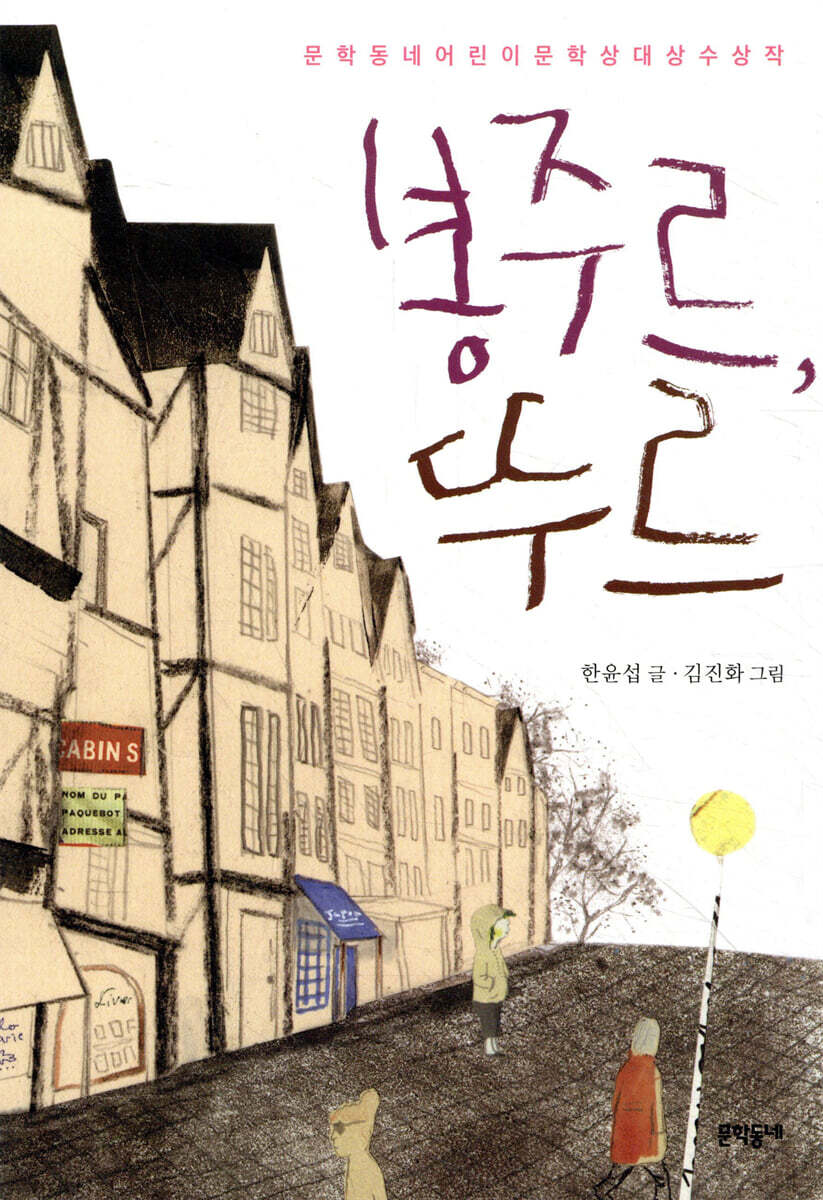
Bonjour, tour
 |
Description
Book Introduction
The 11th Munhakdongne Children's Literature Award Grand Prize Winner
Facing the reality of division between North and South Korea in Tours, France!
"Bonjour, Tour" won the grand prize at the 11th Munhakdongne Children's Literature Award, receiving praise for its delicate portrayal of how a boy who lived without regard for division or unification comes face to face with the sharpest contradictions in our society.
Set in Tours, France, it is the story of a Korean boy, Bong-ju, who pursues a secret.
Bong-ju finds the words "My beloved country, my beloved family" and "I must live" written in Korean on the desk in his new home.
Bong-ju, who discovered a meaningful Korean graffiti in a foreign land, sets out to find the owner of the graffiti based on a series of questions.
In the process, he meets Toshi, a boy shrouded in mystery, and is thrust into the midst of our tragic reality: the division of the country.
Through the eyes of a twelve-year-old boy named Bong-ju, the author earnestly argues that the division of North and South Korea is not just a painful story from the past, but a real problem that can be faced anytime, anywhere.
Rather than a normative unification theory that says, "Unification must be achieved," it is taking hold of our current reality and instilling new perspectives and imagination into the issue of division.
The scene transitions and sophisticated writing style, reminiscent of a detective film, also shine.
Facing the reality of division between North and South Korea in Tours, France!
"Bonjour, Tour" won the grand prize at the 11th Munhakdongne Children's Literature Award, receiving praise for its delicate portrayal of how a boy who lived without regard for division or unification comes face to face with the sharpest contradictions in our society.
Set in Tours, France, it is the story of a Korean boy, Bong-ju, who pursues a secret.
Bong-ju finds the words "My beloved country, my beloved family" and "I must live" written in Korean on the desk in his new home.
Bong-ju, who discovered a meaningful Korean graffiti in a foreign land, sets out to find the owner of the graffiti based on a series of questions.
In the process, he meets Toshi, a boy shrouded in mystery, and is thrust into the midst of our tragic reality: the division of the country.
Through the eyes of a twelve-year-old boy named Bong-ju, the author earnestly argues that the division of North and South Korea is not just a painful story from the past, but a real problem that can be faced anytime, anywhere.
Rather than a normative unification theory that says, "Unification must be achieved," it is taking hold of our current reality and instilling new perspectives and imagination into the issue of division.
The scene transitions and sophisticated writing style, reminiscent of a detective film, also shine.
- You can preview some of the book's contents.
Preview
index
1.
The new city of Tours
2.
Grandpa Durand
3.
yellow-haired child
4.
evidence
5.
swimming competition
6.
History class
7.
Arab store
8.
New clue
9.
Japanese restaurant 'Japone'
10.
Dark eyebrows and children
11.
distorted face
12.
Park in Prevando at night
13.
Two friends
14.
Summer in Tours
Review comments
The new city of Tours
2.
Grandpa Durand
3.
yellow-haired child
4.
evidence
5.
swimming competition
6.
History class
7.
Arab store
8.
New clue
9.
Japanese restaurant 'Japone'
10.
Dark eyebrows and children
11.
distorted face
12.
Park in Prevando at night
13.
Two friends
14.
Summer in Tours
Review comments
Detailed image

Publisher's Review
The 11th Munhakdongne Children's Literature Award Grand Prize Winner
Another masterpiece following "The House of Books" and "The School of Lies."
Facing the reality of division between North and South Korea in Tours, France!
The 'Munhakdongne Children's Literature Award', which is built on the passion and enthusiasm of new writers, has now published its 11th award-winning work.
Meanwhile, 『The Boy King』 (7th winner) that weaves a dynamic narrative structure between the fantasy world and the real world, 『A Seahorse Lives in My Heart』 (8th winner) that presents the issue of adoptive families as a universal problem for families in our time, 『The House Where Books and Play』 (9th winner) that shows the essence of historical fairy tales, and 『The School of Lies』 (10th winner) that illuminates the blind spots of our fairy tales, have been selected as award winners each time, creating a huge buzz as soon as they were published.
Until now, the Munhakdongne Children's Literature Award has broadened the depth and breadth of children's literature by choosing a new, rough path rather than a well-trodden, stable path.
The 11th award-winning work, 『Bonjour, Tour』, published this time, is also a problematic work that is enough to leave a mark on our children's literature.
The judges unanimously selected the grand prize winner, saying it was a masterpiece that “delicately shows how a boy who lived without any regard for division or unification comes face to face with the sharpest contradictions of our society.”
The virtue of this work does not simply lie in its use of the division issue as a ‘subject’.
The greatest virtue is that the narrative progresses without being swayed by the adult's will to enlighten, but rather by capturing the thoughts and perspectives of real children.
This is completed through the creation and separation of ‘friendship,’ one of the main codes of the work.
Another virtue of this work is that it neither inserts friendship to discuss the issue of division, nor does it place division as a backdrop behind friendship.
The friendship between Bongju and Toshi and the division that stands between them are interwoven like warp and weft, building up the narrative layer by layer. _From the "Reviews"
『Bonjour, Tour』 is a story about a Korean boy, Bongju, who pursues a secret in Tours, France.
Bong-ju finds the words "My beloved country, my beloved family" and "I must live" written in Korean on the desk in his new home.
Bong-ju, who discovered a meaningful Korean graffiti in a foreign land, sets out to find the owner of the graffiti based on a series of questions.
In the process, he meets Toshi, a boy shrouded in mystery, and furthermore, he is placed in the midst of the tragic reality of our division.
The subject of division can easily be dismissed as old and clichéd.
However, this work avoids such pitfalls and develops the story with a novel composition.
It is not the normative unification theory that says, "We must unify," seen in other fairy tales about division, but rather, it is taking control of our current reality and instilling new perspectives and imagination into the issue of division.
Also, the scene transitions that make you feel like you're watching a detective film with a literary flavor and the power of the refined writing style are elements that make this work shine.
At twelve, my first month in France was moving.
Bongeun, who had been living in France due to her father's work assignment, moves from Paris to Tours.
Like any other house in France, Tours' new house is furnished with a decent amount of furniture and household items.
Bongju's family decides to keep them and starts packing up.
Bongju likes his room on the second floor.
Late at night, moonlight streams into the room like light from a movie theater projector.
Curiously, Bongju doesn't remember seeing the moon during the years he lived in France.
The first day I moved to Tours, I saw my first month in France.
But the moment the moonlight hits the side of the desk, sentences written in Korean appear clearly.
Just a few inches away from 'my beloved country, my beloved family'
I found 'I have to live' again.
I love my family and I love my country, but
I have never used such words before.
What bothered me more was the phrase, 'I have to live.'
So does that mean the people who lived here are dying? Or are they dead?
That remark stuck in my mind._From the text
Before he knew it, the moonlight was streaming through the window, and Bongju couldn't sleep easily.
The moment I set out to find the graffiti's owner, the secret began to unravel.
Bong-ju, who discovered mysterious Korean graffiti in a foreign land called France, becomes more curious as time passes.
Because it is not something that anyone can easily say, Bongju's heart beats even faster.
I also meet the landlord, Grandpa Durang, wondering if the previous occupant might be Korean.
But I hear that no Korean has ever lived in Bongju's house.
Bongju tries to come up with several hypotheses, but the key to the secret is not easily found.
Meanwhile, Bong-ju gradually begins to adapt to his new school, Tour.
Fortunately, Tour's children are kind to Bongju.
But with one person, Toshi, there is an uncomfortable situation where they are like oil and water.
Is it because Toshi is Japanese? Bongju keeps worrying about Toshi.
Then, I found out that the main character of the Korean graffiti and Toshi were related...
As the Arab man said, did I do any harm to Toshi?
Was it so sad that what I said to Toshi in Korean was enough to make him cry?
Did Toshi really not understand what I was saying?
My chest felt so stuffy while I was running._From the text
A spirited work that expands the space and time of our fairy tales.
Author Han Yun-seop is said to have studied abroad in Tours, France 10 years ago.
He said that while living in Tours, he walked along the Loire River, looked at the sky from the Place Plumereau, met his landlord, Grandfather Durand, and met an Arab who ran a restaurant.
It can be said that the people and moments that remain vivid in that memory became the basis for this work.
Even after ten years, the events of Tours still feel like yesterday.
I'm so glad I can bring up that tour story again.
Until now, I have written works intended for performance, like plays or musicals.
It was after my child was born that I decided to write fairy tales.
That opportunity came when I encountered the memories of Tour. _From “Introduction”
Through the eyes of a twelve-year-old boy named Bong-ju, the author earnestly argues that the division of North and South Korea is not just a painful story of the past, but a real problem that can be faced anytime, anywhere.
It is also a refreshing shock to deal with the issue of division, which is our pressing problem, and bring in France, which seems completely unrelated, as the background.
The author's meticulous compositional skills are evident in the story's depiction of the North-South problem set in France, the country of tolerance, and the inclusion of several French and Arab characters.
These devices serve as the driving force that allows 『Bonjour, Tour』 to discuss the issue of division without being confined by common sense and convention.
Two boys, Bongju and Toshi, cautiously approach each other in a precarious relationship.
Two boys who wanted to be friends without any conditions or prejudice, but couldn't easily express their feelings in the face of the current reality.
Their sad and affectionate friendship will leave our hearts choked for a long time.
The time when simply 'talking' about national issues had meaning has already passed.
For a generation that accepts this division system as if it were air, the romantic approach of “division is evil, unification is good” has no meaning.
Now is the time to renew our imagination by recalling our traditional realist currents.
The appearance of 『Bonjour, Tour』 cannot help but have a special meaning in this reality. _From the "Reviews"
We still often encounter similar materials and backgrounds in our fairy tales.
We desperately need artists who can present large-scale works that expand space and time to break the old, outdated conventions.
In that respect, 『Bonjour, Tour』 is an attractive work that opens a new horizon for our fairy tales and also announces the beginning of a passionate new writer.
I read a lot of fairy tales like crazy for a while in an attempt to write one.
And I crouched down and waited for it to digest.
While it was digesting, I picked up the pen and fiddled with it.
The results were good.
I think it's really nice that I can try it again.
_From the acceptance speech
Another masterpiece following "The House of Books" and "The School of Lies."
Facing the reality of division between North and South Korea in Tours, France!
The 'Munhakdongne Children's Literature Award', which is built on the passion and enthusiasm of new writers, has now published its 11th award-winning work.
Meanwhile, 『The Boy King』 (7th winner) that weaves a dynamic narrative structure between the fantasy world and the real world, 『A Seahorse Lives in My Heart』 (8th winner) that presents the issue of adoptive families as a universal problem for families in our time, 『The House Where Books and Play』 (9th winner) that shows the essence of historical fairy tales, and 『The School of Lies』 (10th winner) that illuminates the blind spots of our fairy tales, have been selected as award winners each time, creating a huge buzz as soon as they were published.
Until now, the Munhakdongne Children's Literature Award has broadened the depth and breadth of children's literature by choosing a new, rough path rather than a well-trodden, stable path.
The 11th award-winning work, 『Bonjour, Tour』, published this time, is also a problematic work that is enough to leave a mark on our children's literature.
The judges unanimously selected the grand prize winner, saying it was a masterpiece that “delicately shows how a boy who lived without any regard for division or unification comes face to face with the sharpest contradictions of our society.”
The virtue of this work does not simply lie in its use of the division issue as a ‘subject’.
The greatest virtue is that the narrative progresses without being swayed by the adult's will to enlighten, but rather by capturing the thoughts and perspectives of real children.
This is completed through the creation and separation of ‘friendship,’ one of the main codes of the work.
Another virtue of this work is that it neither inserts friendship to discuss the issue of division, nor does it place division as a backdrop behind friendship.
The friendship between Bongju and Toshi and the division that stands between them are interwoven like warp and weft, building up the narrative layer by layer. _From the "Reviews"
『Bonjour, Tour』 is a story about a Korean boy, Bongju, who pursues a secret in Tours, France.
Bong-ju finds the words "My beloved country, my beloved family" and "I must live" written in Korean on the desk in his new home.
Bong-ju, who discovered a meaningful Korean graffiti in a foreign land, sets out to find the owner of the graffiti based on a series of questions.
In the process, he meets Toshi, a boy shrouded in mystery, and furthermore, he is placed in the midst of the tragic reality of our division.
The subject of division can easily be dismissed as old and clichéd.
However, this work avoids such pitfalls and develops the story with a novel composition.
It is not the normative unification theory that says, "We must unify," seen in other fairy tales about division, but rather, it is taking control of our current reality and instilling new perspectives and imagination into the issue of division.
Also, the scene transitions that make you feel like you're watching a detective film with a literary flavor and the power of the refined writing style are elements that make this work shine.
At twelve, my first month in France was moving.
Bongeun, who had been living in France due to her father's work assignment, moves from Paris to Tours.
Like any other house in France, Tours' new house is furnished with a decent amount of furniture and household items.
Bongju's family decides to keep them and starts packing up.
Bongju likes his room on the second floor.
Late at night, moonlight streams into the room like light from a movie theater projector.
Curiously, Bongju doesn't remember seeing the moon during the years he lived in France.
The first day I moved to Tours, I saw my first month in France.
But the moment the moonlight hits the side of the desk, sentences written in Korean appear clearly.
Just a few inches away from 'my beloved country, my beloved family'
I found 'I have to live' again.
I love my family and I love my country, but
I have never used such words before.
What bothered me more was the phrase, 'I have to live.'
So does that mean the people who lived here are dying? Or are they dead?
That remark stuck in my mind._From the text
Before he knew it, the moonlight was streaming through the window, and Bongju couldn't sleep easily.
The moment I set out to find the graffiti's owner, the secret began to unravel.
Bong-ju, who discovered mysterious Korean graffiti in a foreign land called France, becomes more curious as time passes.
Because it is not something that anyone can easily say, Bongju's heart beats even faster.
I also meet the landlord, Grandpa Durang, wondering if the previous occupant might be Korean.
But I hear that no Korean has ever lived in Bongju's house.
Bongju tries to come up with several hypotheses, but the key to the secret is not easily found.
Meanwhile, Bong-ju gradually begins to adapt to his new school, Tour.
Fortunately, Tour's children are kind to Bongju.
But with one person, Toshi, there is an uncomfortable situation where they are like oil and water.
Is it because Toshi is Japanese? Bongju keeps worrying about Toshi.
Then, I found out that the main character of the Korean graffiti and Toshi were related...
As the Arab man said, did I do any harm to Toshi?
Was it so sad that what I said to Toshi in Korean was enough to make him cry?
Did Toshi really not understand what I was saying?
My chest felt so stuffy while I was running._From the text
A spirited work that expands the space and time of our fairy tales.
Author Han Yun-seop is said to have studied abroad in Tours, France 10 years ago.
He said that while living in Tours, he walked along the Loire River, looked at the sky from the Place Plumereau, met his landlord, Grandfather Durand, and met an Arab who ran a restaurant.
It can be said that the people and moments that remain vivid in that memory became the basis for this work.
Even after ten years, the events of Tours still feel like yesterday.
I'm so glad I can bring up that tour story again.
Until now, I have written works intended for performance, like plays or musicals.
It was after my child was born that I decided to write fairy tales.
That opportunity came when I encountered the memories of Tour. _From “Introduction”
Through the eyes of a twelve-year-old boy named Bong-ju, the author earnestly argues that the division of North and South Korea is not just a painful story of the past, but a real problem that can be faced anytime, anywhere.
It is also a refreshing shock to deal with the issue of division, which is our pressing problem, and bring in France, which seems completely unrelated, as the background.
The author's meticulous compositional skills are evident in the story's depiction of the North-South problem set in France, the country of tolerance, and the inclusion of several French and Arab characters.
These devices serve as the driving force that allows 『Bonjour, Tour』 to discuss the issue of division without being confined by common sense and convention.
Two boys, Bongju and Toshi, cautiously approach each other in a precarious relationship.
Two boys who wanted to be friends without any conditions or prejudice, but couldn't easily express their feelings in the face of the current reality.
Their sad and affectionate friendship will leave our hearts choked for a long time.
The time when simply 'talking' about national issues had meaning has already passed.
For a generation that accepts this division system as if it were air, the romantic approach of “division is evil, unification is good” has no meaning.
Now is the time to renew our imagination by recalling our traditional realist currents.
The appearance of 『Bonjour, Tour』 cannot help but have a special meaning in this reality. _From the "Reviews"
We still often encounter similar materials and backgrounds in our fairy tales.
We desperately need artists who can present large-scale works that expand space and time to break the old, outdated conventions.
In that respect, 『Bonjour, Tour』 is an attractive work that opens a new horizon for our fairy tales and also announces the beginning of a passionate new writer.
I read a lot of fairy tales like crazy for a while in an attempt to write one.
And I crouched down and waited for it to digest.
While it was digesting, I picked up the pen and fiddled with it.
The results were good.
I think it's really nice that I can try it again.
_From the acceptance speech
GOODS SPECIFICS
- Date of issue: October 8, 2010
- Page count, weight, size: 216 pages | 422g | 153*220*20mm
- ISBN13: 9788954612883
- ISBN10: 8954612881
You may also like
카테고리
korean


korean

![ELLE 엘르 스페셜 에디션 A형 : 12월 [2025]](http://librairie.coreenne.fr/cdn/shop/files/b8e27a3de6c9538896439686c6b0e8fb.jpg?v=1766436872&width=3840)


