

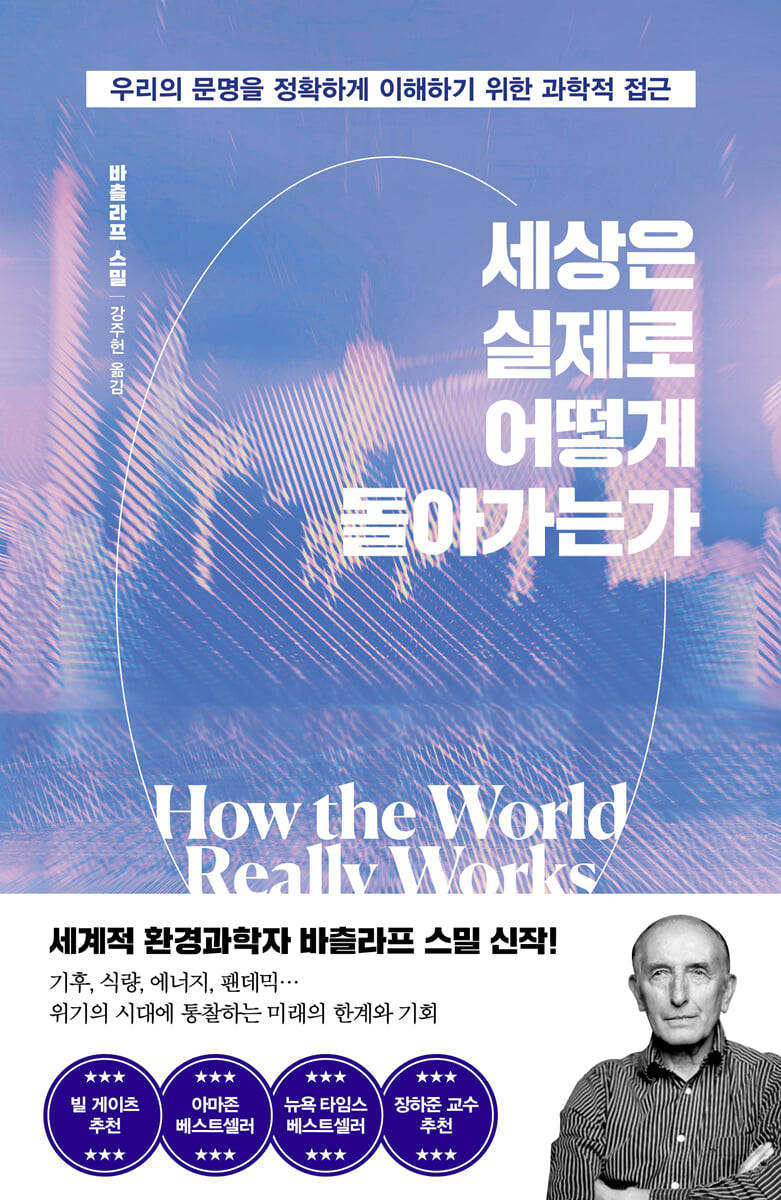
How the world really works
 |
Description
Book Introduction
A new work by world-renowned environmental scientist Vaclav Smil!
Climate change, food, energy, and even pandemics
A must-read for preparing for the limitations and opportunities of the future.
How does the world work? What sustains modern civilization? Vaclav Smil, Bill Gates' most trusted omniscient thinker, explores humanity's past, drawing on objective statistics and mathematical data on everything from food and the environment to energy, viruses, and climate change, exposing both misconceptions and truths about modern civilization.
A scientific approach to accurately understanding our civilization allows us to understand how the world really works and to perceive the limitations and opportunities of the future with greater soberness and rigor.
Climate change, food, energy, and even pandemics
A must-read for preparing for the limitations and opportunities of the future.
How does the world work? What sustains modern civilization? Vaclav Smil, Bill Gates' most trusted omniscient thinker, explores humanity's past, drawing on objective statistics and mathematical data on everything from food and the environment to energy, viruses, and climate change, exposing both misconceptions and truths about modern civilization.
A scientific approach to accurately understanding our civilization allows us to understand how the world really works and to perceive the limitations and opportunities of the future with greater soberness and rigor.
- You can preview some of the book's contents.
Preview
index
Preface: Why is this book needed now?
1.
About Energy - Fuel and Electricity
fundamental change
Modern and contemporary energy use
What is energy?
Increased use and relative decline of crude oil
The many benefits of electricity
Before turning on the switch
Decarbonization: Speed and Scale
2.
On food production - eating fossil fuels
Three valleys, two centuries apart
What was invested?
Energy cost of bread, chicken, and tomatoes
Diesel oil behind seafood
fuel and food
Can we go back to the past?
Use less… and ultimately, zero!
3.
On the Material World - The Four Pillars of Modern Civilization
Ammonia: The Gas That Feeds the World
Plastic: Versatile and Useful, But a Problem
Steel: The ubiquitous and recyclable material
Concrete: A World Created by Cement
Outlook on Materials: Present and Future
4.
On Globalization - Engines, Microchips, and Beyond
The distant origins of globalization
Wind-powered globalization
Steam engine and telegraph
The first diesel engine, flight and radio
Large diesel engines and turbines, containers and microchips
The emergence of China, Russia, and India
Globalization in various fields
Moore's Law
Inevitability, retreat, and greed
5.
About Risks - From Viruses to Diet and Solar Flares
Eat like you would in Kyoto or Barcelona
Risk tolerance and perception
Quantifying the risks encountered in everyday life
Voluntary and involuntary risks
Natural disasters: Less dangerous than they appear on TV
Is our civilization coming to an end?
persistent mindset
6.
About the environment - the only biosphere we have
Oxygen is not at a dangerous level
Will there be enough water and food in the future?
Why isn't the Earth permanently frozen?
Who discovered global warming?
Oxygen, water, and food in a hotter world
Uncertainty, Promise, and Reality
Wish list
Models, Doubts, and Reality
7.
About the Future - Between the End and the Singularity
Failed predictions
Inertia, scale and mass
Ignorance, repetition of conventions, and humility
Unprecedented Efforts, Delayed Rewards
Appendix_ About numbers: Digits
Acknowledgements
Translator's Note_ We must think realistically and scientifically.
main
Search
1.
About Energy - Fuel and Electricity
fundamental change
Modern and contemporary energy use
What is energy?
Increased use and relative decline of crude oil
The many benefits of electricity
Before turning on the switch
Decarbonization: Speed and Scale
2.
On food production - eating fossil fuels
Three valleys, two centuries apart
What was invested?
Energy cost of bread, chicken, and tomatoes
Diesel oil behind seafood
fuel and food
Can we go back to the past?
Use less… and ultimately, zero!
3.
On the Material World - The Four Pillars of Modern Civilization
Ammonia: The Gas That Feeds the World
Plastic: Versatile and Useful, But a Problem
Steel: The ubiquitous and recyclable material
Concrete: A World Created by Cement
Outlook on Materials: Present and Future
4.
On Globalization - Engines, Microchips, and Beyond
The distant origins of globalization
Wind-powered globalization
Steam engine and telegraph
The first diesel engine, flight and radio
Large diesel engines and turbines, containers and microchips
The emergence of China, Russia, and India
Globalization in various fields
Moore's Law
Inevitability, retreat, and greed
5.
About Risks - From Viruses to Diet and Solar Flares
Eat like you would in Kyoto or Barcelona
Risk tolerance and perception
Quantifying the risks encountered in everyday life
Voluntary and involuntary risks
Natural disasters: Less dangerous than they appear on TV
Is our civilization coming to an end?
persistent mindset
6.
About the environment - the only biosphere we have
Oxygen is not at a dangerous level
Will there be enough water and food in the future?
Why isn't the Earth permanently frozen?
Who discovered global warming?
Oxygen, water, and food in a hotter world
Uncertainty, Promise, and Reality
Wish list
Models, Doubts, and Reality
7.
About the Future - Between the End and the Singularity
Failed predictions
Inertia, scale and mass
Ignorance, repetition of conventions, and humility
Unprecedented Efforts, Delayed Rewards
Appendix_ About numbers: Digits
Acknowledgements
Translator's Note_ We must think realistically and scientifically.
main
Search
Detailed image

Into the book
To truly understand how the world actually works, you need to have at least some 'energy literacy'.
(…) Our civilization is so dependent on fossil fuels that the transition to the next stage will take much longer than most people think.
---From "Pages 41-42, Chapter 1: On Energy"
Many people today are quick to praise the efficiency of modern computers ('absolutely massive amounts of data') and telecommunications ('absolutely cheap').
But what about crop yields? In just two centuries, the time it takes to produce one kilogram of wheat has dropped from ten minutes to less than two seconds.
(…) If 80 percent of the population had to make bread every day (83 percent of the American population in 1800 was farmers) or cook rice every day (90 percent of Japan's population lived in villages in 1800), most of the technological innovations that revolutionized industrial activity, transportation and communication, and the way we live our daily lives would not have been possible.
The road to the modern world began with cheap steel plows and mineral fertilizers.
---From "Pages 93-94, Chapter 2, On Food Production"
Doubts and criticisms of globalization have gone beyond narrow ideological debates.
The COVID-19 pandemic has added a powerful argument to the concerns about the fundamental role of the state in protecting the lives of its citizens.
If 70 percent of the world's rubber gloves are made in one factory, and a similar proportion of personal protective equipment and even general medicines are made in a few factories in China and India, it will be difficult for the country to fulfill its role in protecting the lives of its citizens.
It is unclear whether this reliance will enable us to realize the economist's dream of mass production at the lowest unit cost.
But if doctors and nurses are forced to fight a pandemic without adequate personal protective equipment, and if countries that rely on overseas production are forced to compete desperately for limited supplies, this reliance is, if not criminal, an incredibly irresponsible management approach.
---From "Page 238, Chapter 4, On Globalization"
The widespread fear of nuclear power is a classic example of misperception of risk.
Despite the fact that nuclear power has significantly prevented air pollution-related deaths, public opinion polls show that distrust of nuclear power generation continues unabated.
Deaths from air pollution are closely linked to the burning of fossil fuels, yet in 2020, three-fifths of the world's electricity was still generated from fossil fuels, while nuclear fission accounted for only 10 percent.
Even when including estimates of potential fatalities from the two accidents at Chernobyl in 1985 and Fukushima in 2011, the overall risk from nuclear and fossil fuel power generation remains unchanged.
---From "Pages 254-255, Chapter 5, On Risk"
Much like seasonal flu, COVID-19 deaths have been concentrated heavily in people aged 65 and older, particularly those with serious underlying medical conditions, with little impact on young children.
As we all know, excess deaths among the elderly are not preventable.
This is the price we pay for the success of our efforts to increase life expectancy.
In many wealthy countries, life expectancy has increased by more than 15 years since 1950.
The death certificate will likely list COVID-19 or viral pneumonia, but that diagnosis is only an approximation.
The real reason is that as life expectancy continues to rise, most of us are left with potential health problems.
---From "Pages 289-290, Chapter 5, On Risk"
In 2020, the average SUV emitted about 25 percent more carbon dioxide annually than the average passenger car.
Multiply that by the 250 million SUVs on the road, and you can see that SUVs have already eclipsed the global decarbonization effect of electric vehicles (which only reached 10 million in 2020) by several orders of magnitude.
In the 2010s, SUVs were the second-largest source of carbon dioxide emissions, after electric power generation.
This means that they emitted more carbon dioxide than heavy industry, trucking, and aviation. If SUV sales continue at their current pace, by 2040, there will likely be 100 million electric vehicles on the road, more than enough to offset the carbon savings.
(…) If we were to list the things we can do but don’t do, it would be endless.
(…) Our civilization is so dependent on fossil fuels that the transition to the next stage will take much longer than most people think.
---From "Pages 41-42, Chapter 1: On Energy"
Many people today are quick to praise the efficiency of modern computers ('absolutely massive amounts of data') and telecommunications ('absolutely cheap').
But what about crop yields? In just two centuries, the time it takes to produce one kilogram of wheat has dropped from ten minutes to less than two seconds.
(…) If 80 percent of the population had to make bread every day (83 percent of the American population in 1800 was farmers) or cook rice every day (90 percent of Japan's population lived in villages in 1800), most of the technological innovations that revolutionized industrial activity, transportation and communication, and the way we live our daily lives would not have been possible.
The road to the modern world began with cheap steel plows and mineral fertilizers.
---From "Pages 93-94, Chapter 2, On Food Production"
Doubts and criticisms of globalization have gone beyond narrow ideological debates.
The COVID-19 pandemic has added a powerful argument to the concerns about the fundamental role of the state in protecting the lives of its citizens.
If 70 percent of the world's rubber gloves are made in one factory, and a similar proportion of personal protective equipment and even general medicines are made in a few factories in China and India, it will be difficult for the country to fulfill its role in protecting the lives of its citizens.
It is unclear whether this reliance will enable us to realize the economist's dream of mass production at the lowest unit cost.
But if doctors and nurses are forced to fight a pandemic without adequate personal protective equipment, and if countries that rely on overseas production are forced to compete desperately for limited supplies, this reliance is, if not criminal, an incredibly irresponsible management approach.
---From "Page 238, Chapter 4, On Globalization"
The widespread fear of nuclear power is a classic example of misperception of risk.
Despite the fact that nuclear power has significantly prevented air pollution-related deaths, public opinion polls show that distrust of nuclear power generation continues unabated.
Deaths from air pollution are closely linked to the burning of fossil fuels, yet in 2020, three-fifths of the world's electricity was still generated from fossil fuels, while nuclear fission accounted for only 10 percent.
Even when including estimates of potential fatalities from the two accidents at Chernobyl in 1985 and Fukushima in 2011, the overall risk from nuclear and fossil fuel power generation remains unchanged.
---From "Pages 254-255, Chapter 5, On Risk"
Much like seasonal flu, COVID-19 deaths have been concentrated heavily in people aged 65 and older, particularly those with serious underlying medical conditions, with little impact on young children.
As we all know, excess deaths among the elderly are not preventable.
This is the price we pay for the success of our efforts to increase life expectancy.
In many wealthy countries, life expectancy has increased by more than 15 years since 1950.
The death certificate will likely list COVID-19 or viral pneumonia, but that diagnosis is only an approximation.
The real reason is that as life expectancy continues to rise, most of us are left with potential health problems.
---From "Pages 289-290, Chapter 5, On Risk"
In 2020, the average SUV emitted about 25 percent more carbon dioxide annually than the average passenger car.
Multiply that by the 250 million SUVs on the road, and you can see that SUVs have already eclipsed the global decarbonization effect of electric vehicles (which only reached 10 million in 2020) by several orders of magnitude.
In the 2010s, SUVs were the second-largest source of carbon dioxide emissions, after electric power generation.
This means that they emitted more carbon dioxide than heavy industry, trucking, and aviation. If SUV sales continue at their current pace, by 2040, there will likely be 100 million electric vehicles on the road, more than enough to offset the carbon savings.
(…) If we were to list the things we can do but don’t do, it would be endless.
---From "Pages 339-340, Chapter 6: About the Environment"
Publisher's Review
★★★ Amazon Bestseller ★★★ New York Times Bestseller
★★★ Recommended by Bill Gates ★★★ Recommended by Professor Ha-Joon Chang
★★★ Recommended by The Washington Post, The Wall Street Journal, and The Financial Times
★★★ Selected as one of Foreign Policy's 100 World's Greatest Thinkers
More precisely, more coolly, more thoroughly
How to understand our world
Vaclav Smil, a world-renowned environmental scientist, economic historian, and all-round thinker most trusted by Bill Gates, has published his new book, How the World Really Works.
How does the world work? What sustains modern civilization? This book explores humanity's past, drawing on objective statistics and mathematical data on topics ranging from food and the environment to energy, viruses, and climate change, and illuminates both misconceptions and truths about modern civilization.
A scientific approach to accurately understanding our civilization allows us to understand how the world really works and to perceive the limitations and opportunities of the future with greater soberness and rigor.
Author Vaclav Smil, a leading expert in statistical analysis, is a leading scholar who crosses academic boundaries and leads research in a wide range of fields, including energy, environment, food, population, economics, history, and public policy.
Bill Gates, a long-time fan of Smil, expressed his trust in him, saying, “Wenceslas’ book is definitely the one that has taught me the most about the impact of energy on society.”
“This book contains a tremendous amount of knowledge that Smil has accumulated over a long period of time.
If you want to understand the fundamental forces that influence human life in simple numbers, but thoroughly, you must read this book.
It's factually accurate and correct, yet never boring.
“This book will help you solve the world’s most challenging problems.” ─ Bill Gates
Diagnosing the problems of the current world with scientific insight and macroscopic perspective
A compilation of 50 years of research by world-renowned scholar Vaclav Smil.
Modern people have access to more information than ever before, but because of urbanization and mechanization, most people are unaware of how the food, raw materials, and goods that form the foundation of our society are produced and transported.
Because of this lack of understanding, people are often swayed by rosy expectations about chat-based AI, which is a hot topic every day, or by dire predictions that the world will end due to the climate crisis.
To be realistic, one must be scientific.
Vaclav Smil's characteristic narrative style, meticulously and doggedly pursuing clear, fact-based data and statistics, is perfectly suited to explaining how the modern world works.
This book provides a sobering diagnosis of the problems facing the world today, enabling us to avoid being fooled by absurd predictions and prepare for future crises and opportunities.
“I am neither a pessimist nor an optimist.
I'm just a scientist trying to explain how the world actually works.
“I hope that the rational and objective approach presented in this book will help us find ways to pass on a better world to future generations.” ─ Vaclav Smil
30 years until carbon neutrality by 2050,
Is carbon neutrality through renewable energy a feasible goal?
A Scientific Approach to Future Crises and Opportunities
This book, which condenses the results of over 50 years of research by Vaclav Smil, demonstrates how much humanity today relies on fossil fuels for the entire social and economic system, and points out in detail why a short-term energy transition for decarbonization is unrealistic.
The seven fundamental and crucial themes of this book, which determine the survival and prosperity of humanity—energy, food, materials, globalization, and risk—all boil down to environmental issues.
You can gain practical and credible knowledge in the author's specialty, energy and environment.
■Every time I eat a tomato, I consume five spoonfuls of diesel fuel.
Which has a greater environmental cost: chicken or tomatoes? Vaclav Smil meticulously calculates the energy required to grow and distribute a single tomato, calculating the environmental cost of tomatoes.
Tomatoes are the most fertilizer-intensive crop in the world.
Natural gas is required to synthesize ammonia, a raw material for nitrogen fertilizer.
If you grow it in a greenhouse or vinyl house, a surprising amount of energy is used not only for heating, but also for transportation, storage, and packaging.
Adding all this up, it turns out that one medium-sized tomato weighing 125 grams uses the energy equivalent of five tablespoons, or 75 milliliters, of diesel fuel.
No one can deny that we are heavily dependent on fossil fuels for food production.
■Is it possible to feed the world's population without synthetic fertilizers?
Vaclav Smil considers ammonia one of the most important substances supporting modern civilization.
If we didn't use ammonia as fertilizer to mass-produce crops, more than 40 percent of today's 8 billion people would starve.
In China, thanks to the active use of fertilizers, the food rationing system was abolished in urban areas in 1984, and by 2000, the average daily food supply per capita was greater than that of Japan.
Fertilizers sprayed in this way are also a cause of water pollution.
However, the author's analysis suggests that reducing fertilizer use will not be easy.
Because Africa, a continent with a rapidly growing population, needs more fertilizer to improve the quality and quantity of its food supply.
As the world's population grows, ammonia-based fertilizers will continue to be essential.
■Can we reduce plastic, which is identified as a major cause of environmental pollution?
First created in the late 19th century, global production of plastics was just 20,000 tons in 1925, but soared to 2 million tons in 1950, 150 million tons in 2000, and 370 million tons in 2019.
The role of plastics, which combine lightness and durability, is particularly prominent in the medical field.
It is no exaggeration to say that modern life begins with plastic in the delivery room and ends with plastic in the intensive care unit.
The COVID-19 pandemic has highlighted the usefulness of plastics, including disposable gloves and masks.
In this way, plastic has become a basic material necessary for our lives.
What could replace plastic? Vaclav Smil concludes that artificial intelligence and applications won't be able to bring about this transformation.
Carbon Neutrality by 2050: Renewable Energy Isn't the Only Problem
A closer look at the reality of the modern world reveals that even if we decarbonize electricity generation through renewable energy, it will be difficult to achieve carbon neutrality.
Electricity currently accounts for only 18 percent of global energy consumption.
To reduce overall fossil fuel use, all modes of transportation, including automobiles, ships, and aircraft, must be electrified. Furthermore, new processes must be developed to enable the mass production of concrete, plastics, steel, and ammonia, which together consume approximately 17 percent of the world's primary energy, using only electricity.
In 2019, fossil fuels accounted for 80 percent of total global energy demand.
Vaclav Smil asserts that it is impossible to give up fossil fuels overnight.
For decades to come, the burning of fossil fuels will remain the primary culprit in global warming.
■When is the break-even point for policies to mitigate climate change?
Tackling the challenge of climate change requires a global effort.
But even if we adopt specific, binding international agreements and implement global decarbonization policies, temperature increases will persist for 25 to 30 years.
According to climate-economic model calculations, even if greenhouse gas reduction policies are initiated in 2020, the break-even point for achieving net economic benefits will be around 2080.
That is, the generation born in the mid-21st century will be the first to enjoy net benefits.
So, can today's young generation value distant benefits over immediate gains? And while low-income countries are increasing their fossil fuel use for survival, will wealthy nations be willing to accept the cost of saving for over half a century? However, Vaclav Smil argues that while success cannot be guaranteed, there's no need to fear failure in advance.
The shape of the future depends on how we act now.
“It is a sharp and bitter rebuke to the irresponsible claims of self-proclaimed experts, especially those who cannot read numbers and only offer wishful thinking.”
- [The New York Times]
“Whether or not you agree with Smil’s claims, or whether or not you accept his stance of speaking only ‘facts,’ you cannot ignore him.
“It presents a provocative yet insightful perspective.”
- [Washington Post]
“The wonders of digital technology are fleeting.
Our world is made of steel, plastic, concrete, and ammonia anyway.
This book covers academic topics in a way that is accessible to the general public.
Smil looks humbly and calmly into the future, predicting a future “mixed with progress and retreat, with seemingly insurmountable difficulties and near-miraculous developments.”
- [Wall Street Journal]
“Our present and future have been studied clearly and fairly from a scientific perspective.
“This book perfectly achieves its goal of explaining the fundamental and central issues that determine human survival and prosperity.”
- [Kirkus Review]
★★★ Recommended by Bill Gates ★★★ Recommended by Professor Ha-Joon Chang
★★★ Recommended by The Washington Post, The Wall Street Journal, and The Financial Times
★★★ Selected as one of Foreign Policy's 100 World's Greatest Thinkers
More precisely, more coolly, more thoroughly
How to understand our world
Vaclav Smil, a world-renowned environmental scientist, economic historian, and all-round thinker most trusted by Bill Gates, has published his new book, How the World Really Works.
How does the world work? What sustains modern civilization? This book explores humanity's past, drawing on objective statistics and mathematical data on topics ranging from food and the environment to energy, viruses, and climate change, and illuminates both misconceptions and truths about modern civilization.
A scientific approach to accurately understanding our civilization allows us to understand how the world really works and to perceive the limitations and opportunities of the future with greater soberness and rigor.
Author Vaclav Smil, a leading expert in statistical analysis, is a leading scholar who crosses academic boundaries and leads research in a wide range of fields, including energy, environment, food, population, economics, history, and public policy.
Bill Gates, a long-time fan of Smil, expressed his trust in him, saying, “Wenceslas’ book is definitely the one that has taught me the most about the impact of energy on society.”
“This book contains a tremendous amount of knowledge that Smil has accumulated over a long period of time.
If you want to understand the fundamental forces that influence human life in simple numbers, but thoroughly, you must read this book.
It's factually accurate and correct, yet never boring.
“This book will help you solve the world’s most challenging problems.” ─ Bill Gates
Diagnosing the problems of the current world with scientific insight and macroscopic perspective
A compilation of 50 years of research by world-renowned scholar Vaclav Smil.
Modern people have access to more information than ever before, but because of urbanization and mechanization, most people are unaware of how the food, raw materials, and goods that form the foundation of our society are produced and transported.
Because of this lack of understanding, people are often swayed by rosy expectations about chat-based AI, which is a hot topic every day, or by dire predictions that the world will end due to the climate crisis.
To be realistic, one must be scientific.
Vaclav Smil's characteristic narrative style, meticulously and doggedly pursuing clear, fact-based data and statistics, is perfectly suited to explaining how the modern world works.
This book provides a sobering diagnosis of the problems facing the world today, enabling us to avoid being fooled by absurd predictions and prepare for future crises and opportunities.
“I am neither a pessimist nor an optimist.
I'm just a scientist trying to explain how the world actually works.
“I hope that the rational and objective approach presented in this book will help us find ways to pass on a better world to future generations.” ─ Vaclav Smil
30 years until carbon neutrality by 2050,
Is carbon neutrality through renewable energy a feasible goal?
A Scientific Approach to Future Crises and Opportunities
This book, which condenses the results of over 50 years of research by Vaclav Smil, demonstrates how much humanity today relies on fossil fuels for the entire social and economic system, and points out in detail why a short-term energy transition for decarbonization is unrealistic.
The seven fundamental and crucial themes of this book, which determine the survival and prosperity of humanity—energy, food, materials, globalization, and risk—all boil down to environmental issues.
You can gain practical and credible knowledge in the author's specialty, energy and environment.
■Every time I eat a tomato, I consume five spoonfuls of diesel fuel.
Which has a greater environmental cost: chicken or tomatoes? Vaclav Smil meticulously calculates the energy required to grow and distribute a single tomato, calculating the environmental cost of tomatoes.
Tomatoes are the most fertilizer-intensive crop in the world.
Natural gas is required to synthesize ammonia, a raw material for nitrogen fertilizer.
If you grow it in a greenhouse or vinyl house, a surprising amount of energy is used not only for heating, but also for transportation, storage, and packaging.
Adding all this up, it turns out that one medium-sized tomato weighing 125 grams uses the energy equivalent of five tablespoons, or 75 milliliters, of diesel fuel.
No one can deny that we are heavily dependent on fossil fuels for food production.
■Is it possible to feed the world's population without synthetic fertilizers?
Vaclav Smil considers ammonia one of the most important substances supporting modern civilization.
If we didn't use ammonia as fertilizer to mass-produce crops, more than 40 percent of today's 8 billion people would starve.
In China, thanks to the active use of fertilizers, the food rationing system was abolished in urban areas in 1984, and by 2000, the average daily food supply per capita was greater than that of Japan.
Fertilizers sprayed in this way are also a cause of water pollution.
However, the author's analysis suggests that reducing fertilizer use will not be easy.
Because Africa, a continent with a rapidly growing population, needs more fertilizer to improve the quality and quantity of its food supply.
As the world's population grows, ammonia-based fertilizers will continue to be essential.
■Can we reduce plastic, which is identified as a major cause of environmental pollution?
First created in the late 19th century, global production of plastics was just 20,000 tons in 1925, but soared to 2 million tons in 1950, 150 million tons in 2000, and 370 million tons in 2019.
The role of plastics, which combine lightness and durability, is particularly prominent in the medical field.
It is no exaggeration to say that modern life begins with plastic in the delivery room and ends with plastic in the intensive care unit.
The COVID-19 pandemic has highlighted the usefulness of plastics, including disposable gloves and masks.
In this way, plastic has become a basic material necessary for our lives.
What could replace plastic? Vaclav Smil concludes that artificial intelligence and applications won't be able to bring about this transformation.
Carbon Neutrality by 2050: Renewable Energy Isn't the Only Problem
A closer look at the reality of the modern world reveals that even if we decarbonize electricity generation through renewable energy, it will be difficult to achieve carbon neutrality.
Electricity currently accounts for only 18 percent of global energy consumption.
To reduce overall fossil fuel use, all modes of transportation, including automobiles, ships, and aircraft, must be electrified. Furthermore, new processes must be developed to enable the mass production of concrete, plastics, steel, and ammonia, which together consume approximately 17 percent of the world's primary energy, using only electricity.
In 2019, fossil fuels accounted for 80 percent of total global energy demand.
Vaclav Smil asserts that it is impossible to give up fossil fuels overnight.
For decades to come, the burning of fossil fuels will remain the primary culprit in global warming.
■When is the break-even point for policies to mitigate climate change?
Tackling the challenge of climate change requires a global effort.
But even if we adopt specific, binding international agreements and implement global decarbonization policies, temperature increases will persist for 25 to 30 years.
According to climate-economic model calculations, even if greenhouse gas reduction policies are initiated in 2020, the break-even point for achieving net economic benefits will be around 2080.
That is, the generation born in the mid-21st century will be the first to enjoy net benefits.
So, can today's young generation value distant benefits over immediate gains? And while low-income countries are increasing their fossil fuel use for survival, will wealthy nations be willing to accept the cost of saving for over half a century? However, Vaclav Smil argues that while success cannot be guaranteed, there's no need to fear failure in advance.
The shape of the future depends on how we act now.
“It is a sharp and bitter rebuke to the irresponsible claims of self-proclaimed experts, especially those who cannot read numbers and only offer wishful thinking.”
- [The New York Times]
“Whether or not you agree with Smil’s claims, or whether or not you accept his stance of speaking only ‘facts,’ you cannot ignore him.
“It presents a provocative yet insightful perspective.”
- [Washington Post]
“The wonders of digital technology are fleeting.
Our world is made of steel, plastic, concrete, and ammonia anyway.
This book covers academic topics in a way that is accessible to the general public.
Smil looks humbly and calmly into the future, predicting a future “mixed with progress and retreat, with seemingly insurmountable difficulties and near-miraculous developments.”
- [Wall Street Journal]
“Our present and future have been studied clearly and fairly from a scientific perspective.
“This book perfectly achieves its goal of explaining the fundamental and central issues that determine human survival and prosperity.”
- [Kirkus Review]
GOODS SPECIFICS
- Date of issue: March 9, 2023
- Page count, weight, size: 492 pages | 634g | 140*215*24mm
- ISBN13: 9788934950967
- ISBN10: 893495096X
You may also like
카테고리
korean


korean

![GQ KOREA Mark (Monthly): December [2025]](http://librairie.coreenne.fr/cdn/shop/files/8ef265dbbfbf186523ed75ba7319009d.jpg?v=1765340328&width=3840)


