

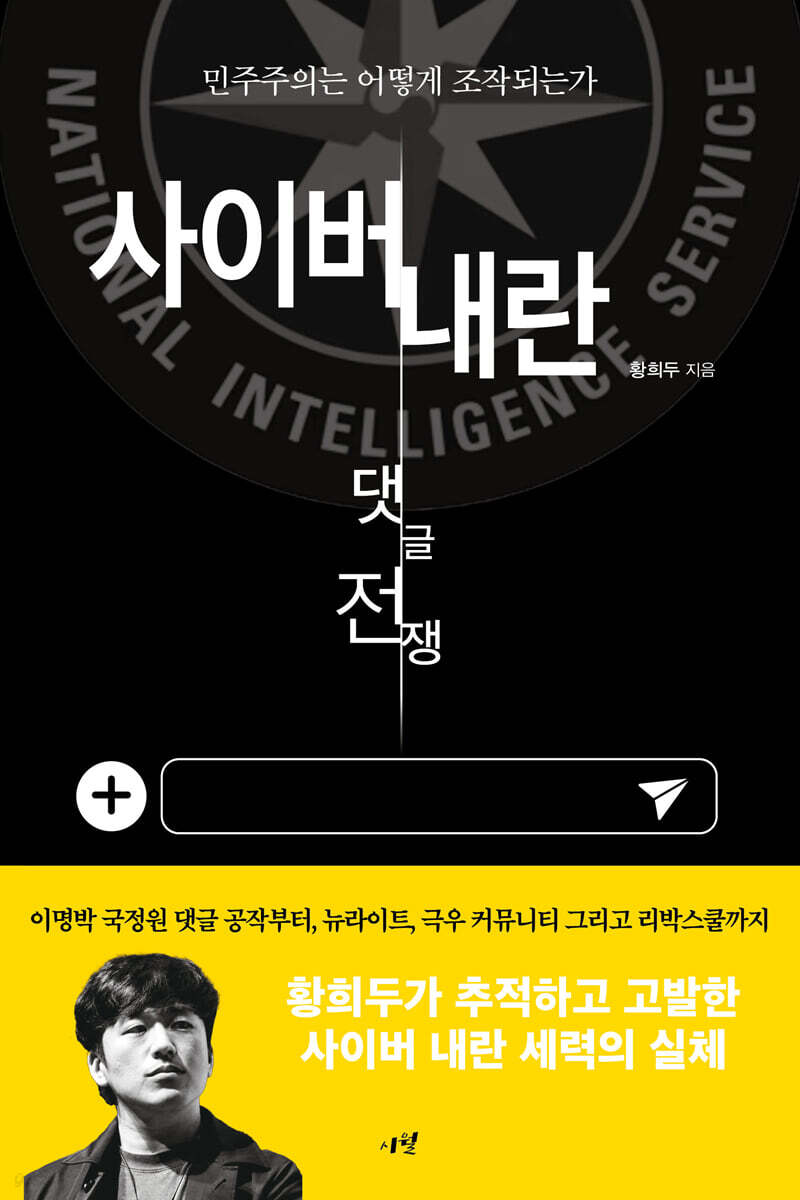
Cyber Civil War: Comment Wars
 |
Description
Book Introduction
From the Lee Myung-bak administration's National Intelligence Service's manipulation of public opinion to the harm caused by far-right communities,
The Lee Dae-nam phenomenon, Lee Jun-seok, and even Lee Box School
It documents the collapse of the online public sphere by cyber-insurgent forces and suggests solutions for its restoration.
"Cyber Civil War - Comment War" traces the interplay of state agencies, external organizations, platforms, and communities, from the Lee Myung-bak administration's manipulation of public opinion by the National Intelligence Service and the Military Cyber Command to the Yoon Seok-yeol administration, to distort Korea's online public sphere.
Based on data and field records accumulated over 10 years by Hwang Hee-doo, a director of the Roh Moo-hyun Foundation and chairman of the Democratic Party's Game Special Committee, this book provides specific examples of how frames created online spread and intertwine with real-world power, including the growth of far-right communities, a conservative ecosystem, the so-called "Lee Dae-nam" phenomenon, and the symbolic politics surrounding Lee Jun-seok.
The starting point of this problem is that it was an intentional manipulation of public opinion using state power.
Since then, hate has become a habit, a game, and a profit model that propagates without directives, and has been translated into everyday language through communities and platforms.
Yet, the political world and civil society still reduce this to a 'handful of deviations.'
The moment we dismiss Ilbe as a "small minority, an extremist minority," we lose sight of the continuous infrastructure that connects elections, policy, education, and the media, and the public sphere is eroded 24 hours a day, 365 days a year.
This book corrects that misjudgment.
By revealing the national origins of the peacock and presenting the circuits of self-generated hatred as reality, it makes clear what must be broken here and now, and why it can no longer be called a "handful."
Ultimately, "Cyber Civil War - Comment War" dissects the links between cyber civil wars with verifiable records and context, and sets the direction for where and what to cut off.
We must realign the standards and coordinates of responsibility across the civic, political, platform, and educational sectors, transforming indignation into action and fragmented revelations into sustainable change.
Cyber insurgents undermine public opinion 24 hours a day, 365 days a year.
The first step to confronting the unending destruction is to see it clearly.
This book provides that perspective and language, and offers solutions to cut through these deep and massive roots at the level of individual citizens, society, politics, and institutions.
The Lee Dae-nam phenomenon, Lee Jun-seok, and even Lee Box School
It documents the collapse of the online public sphere by cyber-insurgent forces and suggests solutions for its restoration.
"Cyber Civil War - Comment War" traces the interplay of state agencies, external organizations, platforms, and communities, from the Lee Myung-bak administration's manipulation of public opinion by the National Intelligence Service and the Military Cyber Command to the Yoon Seok-yeol administration, to distort Korea's online public sphere.
Based on data and field records accumulated over 10 years by Hwang Hee-doo, a director of the Roh Moo-hyun Foundation and chairman of the Democratic Party's Game Special Committee, this book provides specific examples of how frames created online spread and intertwine with real-world power, including the growth of far-right communities, a conservative ecosystem, the so-called "Lee Dae-nam" phenomenon, and the symbolic politics surrounding Lee Jun-seok.
The starting point of this problem is that it was an intentional manipulation of public opinion using state power.
Since then, hate has become a habit, a game, and a profit model that propagates without directives, and has been translated into everyday language through communities and platforms.
Yet, the political world and civil society still reduce this to a 'handful of deviations.'
The moment we dismiss Ilbe as a "small minority, an extremist minority," we lose sight of the continuous infrastructure that connects elections, policy, education, and the media, and the public sphere is eroded 24 hours a day, 365 days a year.
This book corrects that misjudgment.
By revealing the national origins of the peacock and presenting the circuits of self-generated hatred as reality, it makes clear what must be broken here and now, and why it can no longer be called a "handful."
Ultimately, "Cyber Civil War - Comment War" dissects the links between cyber civil wars with verifiable records and context, and sets the direction for where and what to cut off.
We must realign the standards and coordinates of responsibility across the civic, political, platform, and educational sectors, transforming indignation into action and fragmented revelations into sustainable change.
Cyber insurgents undermine public opinion 24 hours a day, 365 days a year.
The first step to confronting the unending destruction is to see it clearly.
This book provides that perspective and language, and offers solutions to cut through these deep and massive roots at the level of individual citizens, society, politics, and institutions.
- You can preview some of the book's contents.
Preview
index
Preface: A Decade of Exploring Cyber Insurgency
Timeline of Major Cyber Insurgency Events
Part 1.
The Connected Worldviews of Lee Myung-bak and Yoon Seok-yeol
1 Before we begin - What is psychological warfare?
2. The Origins and Aspects of Digital Political Operations
3 The never-ending chain of tragedy
4. Leebak School's plan to take control of education
5. The manipulation of public opinion is not over.
Part 2.
Dissecting the Structure of Far-Right Communities
1. The emergence of Ilbe and the management of state organizations
2 Internet Broadcasting and the Spread of Hate
3 Pemco, Selling Hatred
4 Freedom without responsibility becomes violence.
Part 3.
The phenomenon called 'Lee Dae-nam'
1 What is the cause?
2 Digging into psychology
3 Radicalized Youth: Is Change Possible?
Part 4.
Lee Jun-seok: The Limits of Keyboard Warrior Politicians
1. There is no fairness, no justice, no ability, and no reform.
2 How I Deal with Lee Jun-seok
3. It's time to break the frame and establish a role model.
Part 5.
Presidential election podium
1 Why Did We Lose Then? - The 20th Presidential Election
2 How We Won? - The 21st Presidential Election
3 It's not over yet
4 Standing on the battlefield again
Part 6.
To end cyber war
1 Ten Characteristics of the New Media Era
2. The Art of Online Combat
3. Enactment of the Special Act on Cyber Insurrection and Reform of the National Intelligence Service
4 Civil society movements
5. Approach from a welfare perspective
Conclusion
Timeline of Major Cyber Insurgency Events
Part 1.
The Connected Worldviews of Lee Myung-bak and Yoon Seok-yeol
1 Before we begin - What is psychological warfare?
2. The Origins and Aspects of Digital Political Operations
3 The never-ending chain of tragedy
4. Leebak School's plan to take control of education
5. The manipulation of public opinion is not over.
Part 2.
Dissecting the Structure of Far-Right Communities
1. The emergence of Ilbe and the management of state organizations
2 Internet Broadcasting and the Spread of Hate
3 Pemco, Selling Hatred
4 Freedom without responsibility becomes violence.
Part 3.
The phenomenon called 'Lee Dae-nam'
1 What is the cause?
2 Digging into psychology
3 Radicalized Youth: Is Change Possible?
Part 4.
Lee Jun-seok: The Limits of Keyboard Warrior Politicians
1. There is no fairness, no justice, no ability, and no reform.
2 How I Deal with Lee Jun-seok
3. It's time to break the frame and establish a role model.
Part 5.
Presidential election podium
1 Why Did We Lose Then? - The 20th Presidential Election
2 How We Won? - The 21st Presidential Election
3 It's not over yet
4 Standing on the battlefield again
Part 6.
To end cyber war
1 Ten Characteristics of the New Media Era
2. The Art of Online Combat
3. Enactment of the Special Act on Cyber Insurrection and Reform of the National Intelligence Service
4 Civil society movements
5. Approach from a welfare perspective
Conclusion
Detailed image
Into the book
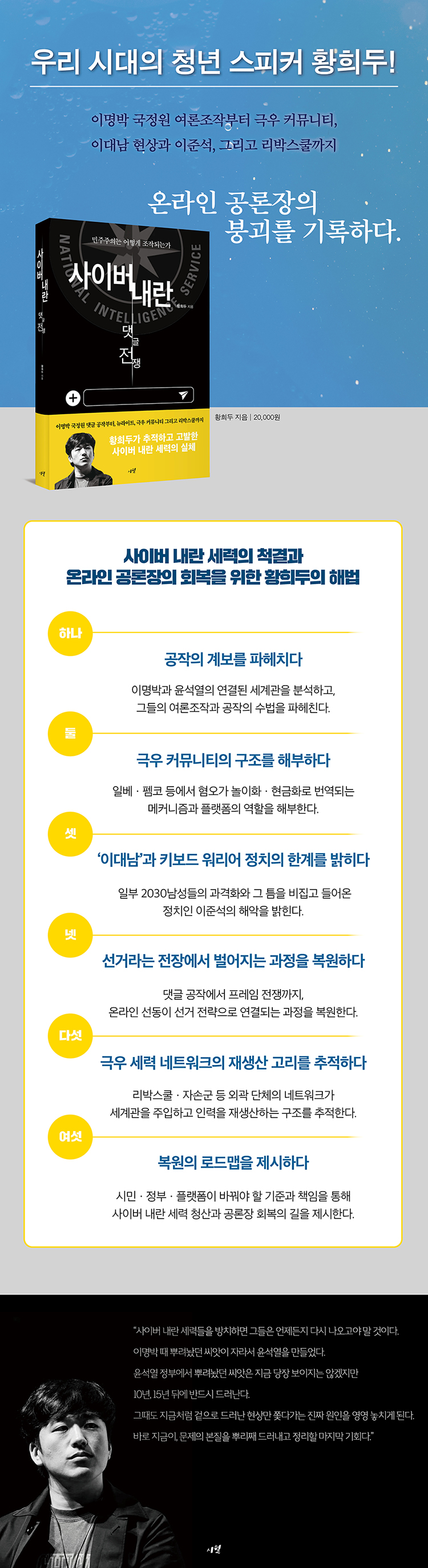
I was once a keyboard warrior.
He wielded indiscriminate violence against others, using insults and ridicule as weapons.
No matter how much you reflect, past mistakes will not disappear.
This book is a confession and reflection on those mistakes, and at the same time, it is a report on the truth I missed at that time.
And at the same time, this book is the greatest attack I can make right now.
The fight will continue with you, who is reading this sentence right now.
--- From "Foreword - Towards an End to Cyber Civil War"
President Roh Moo-hyun has passed away, but his spirit still lives on throughout our society.
That's exactly why they haven't finished this fight yet.
Because in order to achieve complete victory, even that spirit must be destroyed.
For this reason, the first name that the Lee Myung-bak administration targeted through the National Intelligence Service had to be 'Roh Moo-hyun.'
--- From "The Origins and Aspects of Digital Political Operations"
Kim Tae-hyo is a New Right figure who was in charge of foreign affairs and security during the Lee Myung-bak administration.
Despite the leak of military secrets, the paper arguing for the Self-Defense Forces' intervention in the event of a Korean War, and the controversy over pro-Japanese activities, Yoon Seok-yeol willingly appointed him as First Vice Director of the National Security Office.
The person who carried out psychological warfare and public opinion manipulation under the pretext of diplomacy and security was reappointed to the most important position.
Moreover, key positions in history, education, security, and broadcasting, which are the central axes of South Korea's policies and values, were filled by New Right figures, including Lee Bae-yong of the National Education Commission, Kim Young-ho of the Ministry of Unification, Kim Gwang-dong of the Truth and Reconciliation Commission, Han Oh-seop, Director of the National Situation Room, and Lee Dong-kwan, Chairman of the Korea Communications Commission.
--- From "The Worldview Shared by Yoon Seok-yeol and Lee Myung-bak"
In 2019, one user confessed, "I came across Pemco in middle school and became addicted to Toto, which I started playing for fun."
He also said, 'I don't drink or smoke, but I'm addicted to gambling.'
This proves that Pemco's current system is closely related to the problem of youth internet gambling addiction.
Gambling that starts with points can potentially lead to gambling with real money offline.
Pemco is positioning itself as an entry point and incubator for gambling.
--- From "Pemco, Selling Hatred"
The self-confidence that the lives of socially influential people are swayed by just a few malicious comments, the illusion that you have influenced the world, completely changes a person.
What if, in this situation, the National Intelligence Service invited me to an event or even handed me a souvenir like an "Absolute Zero Watch"? The moment I, a mere malicious commenter, was recognized by the state as a "patriot," I would gain a sense of legitimacy that was almost religious.
--- From "Psychological Anatomy of Right-Wing Men"
Back when I was a keyboard warrior, I also admired Lee Jun-seok.
But when I came out of that world and looked back, his words and actions and political style were no different from the way I experienced the community.
At that time, I was convinced that our politics should not give space to people like Lee Jun-seok.
Because I knew better than anyone how destructive that method was, having been in that world.
In fact, if you look at Lee Jun-seok's actions so far, his politics lack national unity, national development, trust-building among citizens, and a vision for the future.
All that remains is to stimulate the public's peripheral nerves and use ridicule as a weapon to amplify division.
--- From "Lee Jun-seok, The Limits of Keyboard Warrior Politicians"
A rational and ideal politics that transcends partisan logic is only possible after eliminating this abnormality.
The process doesn't happen by shouting into the air.
We must break the unjust collusion between the powerful and the pseudo-religious, dismantle manipulated public opinion, and drive out the ghost of the National Intelligence Service.
But even now, People Power Party politicians are talking about “national unity” and chanting “Yoon Seok-yeol again.”
People like Jeon Han-gil are exerting influence even in the elections for the People Power Party's leader and supreme council members.
These are the people we have to deal with.
Remember the reality and decide not to let yourself get distracted.
I steel myself and return to the battlefield.
He wielded indiscriminate violence against others, using insults and ridicule as weapons.
No matter how much you reflect, past mistakes will not disappear.
This book is a confession and reflection on those mistakes, and at the same time, it is a report on the truth I missed at that time.
And at the same time, this book is the greatest attack I can make right now.
The fight will continue with you, who is reading this sentence right now.
--- From "Foreword - Towards an End to Cyber Civil War"
President Roh Moo-hyun has passed away, but his spirit still lives on throughout our society.
That's exactly why they haven't finished this fight yet.
Because in order to achieve complete victory, even that spirit must be destroyed.
For this reason, the first name that the Lee Myung-bak administration targeted through the National Intelligence Service had to be 'Roh Moo-hyun.'
--- From "The Origins and Aspects of Digital Political Operations"
Kim Tae-hyo is a New Right figure who was in charge of foreign affairs and security during the Lee Myung-bak administration.
Despite the leak of military secrets, the paper arguing for the Self-Defense Forces' intervention in the event of a Korean War, and the controversy over pro-Japanese activities, Yoon Seok-yeol willingly appointed him as First Vice Director of the National Security Office.
The person who carried out psychological warfare and public opinion manipulation under the pretext of diplomacy and security was reappointed to the most important position.
Moreover, key positions in history, education, security, and broadcasting, which are the central axes of South Korea's policies and values, were filled by New Right figures, including Lee Bae-yong of the National Education Commission, Kim Young-ho of the Ministry of Unification, Kim Gwang-dong of the Truth and Reconciliation Commission, Han Oh-seop, Director of the National Situation Room, and Lee Dong-kwan, Chairman of the Korea Communications Commission.
--- From "The Worldview Shared by Yoon Seok-yeol and Lee Myung-bak"
In 2019, one user confessed, "I came across Pemco in middle school and became addicted to Toto, which I started playing for fun."
He also said, 'I don't drink or smoke, but I'm addicted to gambling.'
This proves that Pemco's current system is closely related to the problem of youth internet gambling addiction.
Gambling that starts with points can potentially lead to gambling with real money offline.
Pemco is positioning itself as an entry point and incubator for gambling.
--- From "Pemco, Selling Hatred"
The self-confidence that the lives of socially influential people are swayed by just a few malicious comments, the illusion that you have influenced the world, completely changes a person.
What if, in this situation, the National Intelligence Service invited me to an event or even handed me a souvenir like an "Absolute Zero Watch"? The moment I, a mere malicious commenter, was recognized by the state as a "patriot," I would gain a sense of legitimacy that was almost religious.
--- From "Psychological Anatomy of Right-Wing Men"
Back when I was a keyboard warrior, I also admired Lee Jun-seok.
But when I came out of that world and looked back, his words and actions and political style were no different from the way I experienced the community.
At that time, I was convinced that our politics should not give space to people like Lee Jun-seok.
Because I knew better than anyone how destructive that method was, having been in that world.
In fact, if you look at Lee Jun-seok's actions so far, his politics lack national unity, national development, trust-building among citizens, and a vision for the future.
All that remains is to stimulate the public's peripheral nerves and use ridicule as a weapon to amplify division.
--- From "Lee Jun-seok, The Limits of Keyboard Warrior Politicians"
A rational and ideal politics that transcends partisan logic is only possible after eliminating this abnormality.
The process doesn't happen by shouting into the air.
We must break the unjust collusion between the powerful and the pseudo-religious, dismantle manipulated public opinion, and drive out the ghost of the National Intelligence Service.
But even now, People Power Party politicians are talking about “national unity” and chanting “Yoon Seok-yeol again.”
People like Jeon Han-gil are exerting influence even in the elections for the People Power Party's leader and supreme council members.
These are the people we have to deal with.
Remember the reality and decide not to let yourself get distracted.
I steel myself and return to the battlefield.
--- From "Standing on the Battlefield Again"
GOODS SPECIFICS
- Date of issue: September 20, 2025
- Page count, weight, size: 344 pages | 534g | 141*210*22mm
- ISBN13: 9791191975307
- ISBN10: 1191975304
You may also like
카테고리
korean


korean

![GQ KOREA Mark (Monthly): December [2025]](http://librairie.coreenne.fr/cdn/shop/files/8ef265dbbfbf186523ed75ba7319009d.jpg?v=1765340328&width=3840)


