

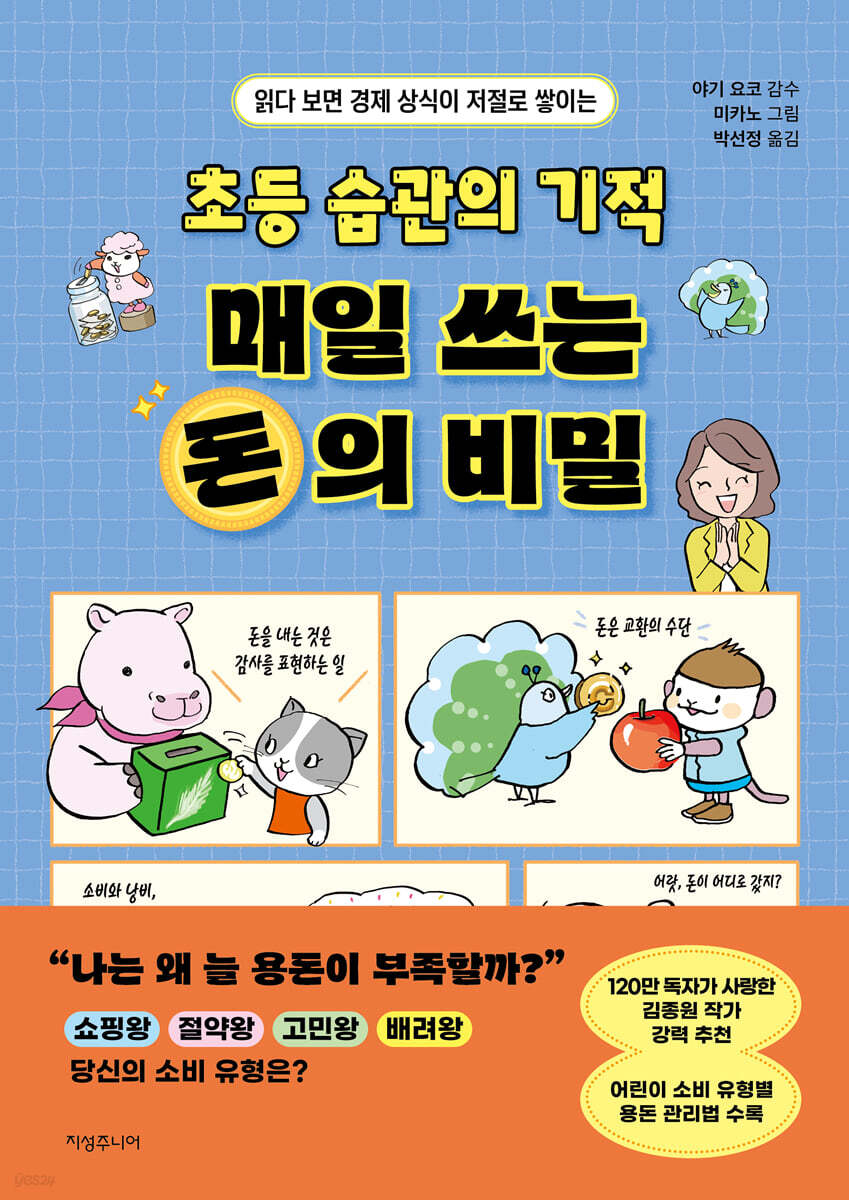
The Miracle of Elementary Habits: The Secret to Spending Money Every Day
 |
Description
Book Introduction
"Still young? Elementary school habits last a lifetime."
From the confusing principles of money and investing to tips for renegotiating allowances.
A Smart Money Guide for Kids
The Miracle of Elementary Habits series, with the slogan “Small habits accumulate and change a child’s life,” has been published by Jiseong Junior.
The first book covers how to manage your child's daily allowance.
The purpose of this book is to correct bad money-related habits that elementary school children unconsciously develop while buying snacks at convenience stores or stickers or school supplies at Daiso, and to develop financial literacy.
It contains realistic and vivid examples of money-related issues that any elementary school student and parent would have experienced at least once, such as a child who is obsessed with claw machines without realizing that money is being lost, a child who spends money like water thanks to the easy payment system, and a child who naturally reaches out to their mother when a large amount of money is needed, such as for a friend's birthday.
Rather than a one-size-fits-all method that can be applied to everyone, it holds children's interest until the end by providing them with a customized allowance management method that fits their spending style, just like the MBTI.
This book, which dispels the prejudice that economic common sense is boring and difficult, will be useful not only for children who are just starting to receive an allowance, but also for parents who are unsure of how to give it.
From the confusing principles of money and investing to tips for renegotiating allowances.
A Smart Money Guide for Kids
The Miracle of Elementary Habits series, with the slogan “Small habits accumulate and change a child’s life,” has been published by Jiseong Junior.
The first book covers how to manage your child's daily allowance.
The purpose of this book is to correct bad money-related habits that elementary school children unconsciously develop while buying snacks at convenience stores or stickers or school supplies at Daiso, and to develop financial literacy.
It contains realistic and vivid examples of money-related issues that any elementary school student and parent would have experienced at least once, such as a child who is obsessed with claw machines without realizing that money is being lost, a child who spends money like water thanks to the easy payment system, and a child who naturally reaches out to their mother when a large amount of money is needed, such as for a friend's birthday.
Rather than a one-size-fits-all method that can be applied to everyone, it holds children's interest until the end by providing them with a customized allowance management method that fits their spending style, just like the MBTI.
This book, which dispels the prejudice that economic common sense is boring and difficult, will be useful not only for children who are just starting to receive an allowance, but also for parents who are unsure of how to give it.
- You can preview some of the book's contents.
Preview
index
To become a happy adult who does what he truly loves
Chapter 1: Money, Why Should I Know?
What on earth is money?
Money is a medium of exchange | Money is a feeling of gratitude
What are the benefits of learning how to manage money?
More opportunities arise | Find out what you truly want | Gain the strength you need to survive | Learn how to manage your money in a way that's right for you
How will the money be used?
Write | Collect | Prepare | Roll | Borrow | Earn
::: Learn more: Where is money made?
Chapter 2: How should I spend money?
When your parents give you money
Is it true that you want it? | Let's find out the approximate price of the item in advance | There are also things that require payment. How is the price determined?
When you have to make an unexpected purchase
Think about whether it is worth it to me | What is the difference between consumption and waste?
When you suddenly come into a lot of money
Distinguish between what you need and what you want | Understanding the confusing consumer desires
When buying something with an allowance card
Beware of Cashless Payments | When will money be withdrawn from cashless payments?
Buying and selling things on social media?
Always consult with your parents before making any financial transactions. | Why is money management important? | You also need to learn the right values regarding money.
Problems that arise when you don't know much about money
A bombshell hit by a bluff | Personal information leaked after being lured by the promise of free money | Cell phone payments don't cost money? | Can I resell found items that have no owner?
:::Learn More: Ethical Consumption? What is Ethical Consumption?
Chapter 3: Let's manage money wisely!
How do I get my allowance?
3 Ways to Get an Allowance | How Much Should You Get? | Writing an Allowance Agreement
How to manage your allowance?
First, let's make money visible at a glance. | Always check after spending money. | Manage irregularly generated money separately.
Operation Allowance Renegotiation
Let's summarize the changed situation | Let's present the allowance increase.
Elementary school real-life case study
If you keep failing at the doll grabber game | If you want to give a gift to a friend | If you break the allowance rule | If a friend asks you to borrow money | If you break a borrowed item | If you want to trade items with a friend | If you thought it was free but it wasn't
:::Learn more: Spending money on other people?
Chapter 4: Money, Learn in Advance!
Work and earn money
The most basic way to earn money: labor | What are the different ways to work? | What kind of work is right for me?
:::Learn More: Earning Pocket Money Even Kids Can Do
Make money through investing
How to Grow Your Money: Investing in Your Favorite Companies
Borrowing money
Is Debt Bad? | When Should You Borrow Money?
:::Learn More: Become a Balanced King with Smart Spending Habits
Chapter 5: Economic Common Sense You Must Know to Become Rich
What does a bank do?
What does it mean when the economy is good or when the economy is bad?
What does a strong or weak won mean?
I'm curious about taxes!
I'm curious about the social security system!
I'm curious about pensions!
Appendix: Setting Savings Goals & Allowance Recording Journal
Chapter 1: Money, Why Should I Know?
What on earth is money?
Money is a medium of exchange | Money is a feeling of gratitude
What are the benefits of learning how to manage money?
More opportunities arise | Find out what you truly want | Gain the strength you need to survive | Learn how to manage your money in a way that's right for you
How will the money be used?
Write | Collect | Prepare | Roll | Borrow | Earn
::: Learn more: Where is money made?
Chapter 2: How should I spend money?
When your parents give you money
Is it true that you want it? | Let's find out the approximate price of the item in advance | There are also things that require payment. How is the price determined?
When you have to make an unexpected purchase
Think about whether it is worth it to me | What is the difference between consumption and waste?
When you suddenly come into a lot of money
Distinguish between what you need and what you want | Understanding the confusing consumer desires
When buying something with an allowance card
Beware of Cashless Payments | When will money be withdrawn from cashless payments?
Buying and selling things on social media?
Always consult with your parents before making any financial transactions. | Why is money management important? | You also need to learn the right values regarding money.
Problems that arise when you don't know much about money
A bombshell hit by a bluff | Personal information leaked after being lured by the promise of free money | Cell phone payments don't cost money? | Can I resell found items that have no owner?
:::Learn More: Ethical Consumption? What is Ethical Consumption?
Chapter 3: Let's manage money wisely!
How do I get my allowance?
3 Ways to Get an Allowance | How Much Should You Get? | Writing an Allowance Agreement
How to manage your allowance?
First, let's make money visible at a glance. | Always check after spending money. | Manage irregularly generated money separately.
Operation Allowance Renegotiation
Let's summarize the changed situation | Let's present the allowance increase.
Elementary school real-life case study
If you keep failing at the doll grabber game | If you want to give a gift to a friend | If you break the allowance rule | If a friend asks you to borrow money | If you break a borrowed item | If you want to trade items with a friend | If you thought it was free but it wasn't
:::Learn more: Spending money on other people?
Chapter 4: Money, Learn in Advance!
Work and earn money
The most basic way to earn money: labor | What are the different ways to work? | What kind of work is right for me?
:::Learn More: Earning Pocket Money Even Kids Can Do
Make money through investing
How to Grow Your Money: Investing in Your Favorite Companies
Borrowing money
Is Debt Bad? | When Should You Borrow Money?
:::Learn More: Become a Balanced King with Smart Spending Habits
Chapter 5: Economic Common Sense You Must Know to Become Rich
What does a bank do?
What does it mean when the economy is good or when the economy is bad?
What does a strong or weak won mean?
I'm curious about taxes!
I'm curious about the social security system!
I'm curious about pensions!
Appendix: Setting Savings Goals & Allowance Recording Journal
Detailed image

Publisher's Review
In a cashless era,
How to develop a child's understanding of money?
It's been a long time since the stationery stores in front of schools disappeared, and Daiso and convenience stores have become sparrow mills for children.
At the same time, as children prefer simpler payment systems, their spending is becoming increasingly less thoughtful.
The same goes for claw machines, a favorite game for children.
Since you can play the game by simply touching the card without inserting coins or bills, it is easy to get lost without realizing that money is being lost.
In fact, according to a survey on the economic literacy of elementary, middle, and high school students conducted by the Ministry of Strategy and Finance last year, our children's economic literacy was found to be an average of only 55 points out of 100.
This is an average of 5 points lower than two years ago.
The reason for this can be attributed, above all, to the blurred concept of money as we enter a 'cashless era'.
Economic common sense is difficult, but for children who want to become rich
A fun way to manage your allowance based on your MBTI type
Parents have been putting in more effort, such as opening stock or fund accounts for their children in the hope that they will become wealthy in the future.
But before catching fish like this, what needs to happen first is teaching people how to catch fish, that is, teaching them how to develop good consumption habits.
To develop my child's economic sense, knowledge that connects to real-world situations is most important.
"The Miracle of Elementary Habits: The Secret of Everyday Money" goes beyond the superficial knowledge found in dictionaries and vividly conveys economic knowledge by addressing children's real-life consumption concerns.
“What if a friend asks to buy an unexpected friendship item?”, “If it’s a buy one get one free, isn’t it a loss if I don’t buy it?”, “Why can’t I buy everything I want?”, “What if I break something I borrowed?”, etc. It addresses questions from a child’s perspective and helps them take the first step toward becoming rich from their daily allowance.
Rather than simply using standard methods like 'write down your allowance in a ledger' or 'receive your allowance in cash', it suggests an allowance management method tailored to the child's personality and spending style, much like MBTI.
Let's follow the four types of money management methods presented: shopping king, saving king, worry king, and considerate king.
Your child will grow up to be a person who can control money, rather than being driven by it.
From how to spend, earn, and manage allowance to everyday spending concerns related to elementary school life.
As you read, your economic literacy and financial independence will grow!
This book provides essential economic and financial concepts, including the origins and history of money, the meaning of credit and check cards, the pros and cons of smart pay, price comparison, and the role of banks, all in the right places.
In particular, it shows situations in a humorous cartoon format and explains related knowledge, so it holds the interest of children who think economic common sense is difficult and boring.
It also provides specific information on how to receive an allowance, how to write an allowance contract, how to renegotiate when the allowance is low, and even how to earn allowance that even children can do, so that children can apply it directly to their daily lives.
This book, which perfectly develops children's economic literacy and financial independence, can be called a "smart money manual" for children.
How to develop a child's understanding of money?
It's been a long time since the stationery stores in front of schools disappeared, and Daiso and convenience stores have become sparrow mills for children.
At the same time, as children prefer simpler payment systems, their spending is becoming increasingly less thoughtful.
The same goes for claw machines, a favorite game for children.
Since you can play the game by simply touching the card without inserting coins or bills, it is easy to get lost without realizing that money is being lost.
In fact, according to a survey on the economic literacy of elementary, middle, and high school students conducted by the Ministry of Strategy and Finance last year, our children's economic literacy was found to be an average of only 55 points out of 100.
This is an average of 5 points lower than two years ago.
The reason for this can be attributed, above all, to the blurred concept of money as we enter a 'cashless era'.
Economic common sense is difficult, but for children who want to become rich
A fun way to manage your allowance based on your MBTI type
Parents have been putting in more effort, such as opening stock or fund accounts for their children in the hope that they will become wealthy in the future.
But before catching fish like this, what needs to happen first is teaching people how to catch fish, that is, teaching them how to develop good consumption habits.
To develop my child's economic sense, knowledge that connects to real-world situations is most important.
"The Miracle of Elementary Habits: The Secret of Everyday Money" goes beyond the superficial knowledge found in dictionaries and vividly conveys economic knowledge by addressing children's real-life consumption concerns.
“What if a friend asks to buy an unexpected friendship item?”, “If it’s a buy one get one free, isn’t it a loss if I don’t buy it?”, “Why can’t I buy everything I want?”, “What if I break something I borrowed?”, etc. It addresses questions from a child’s perspective and helps them take the first step toward becoming rich from their daily allowance.
Rather than simply using standard methods like 'write down your allowance in a ledger' or 'receive your allowance in cash', it suggests an allowance management method tailored to the child's personality and spending style, much like MBTI.
Let's follow the four types of money management methods presented: shopping king, saving king, worry king, and considerate king.
Your child will grow up to be a person who can control money, rather than being driven by it.
From how to spend, earn, and manage allowance to everyday spending concerns related to elementary school life.
As you read, your economic literacy and financial independence will grow!
This book provides essential economic and financial concepts, including the origins and history of money, the meaning of credit and check cards, the pros and cons of smart pay, price comparison, and the role of banks, all in the right places.
In particular, it shows situations in a humorous cartoon format and explains related knowledge, so it holds the interest of children who think economic common sense is difficult and boring.
It also provides specific information on how to receive an allowance, how to write an allowance contract, how to renegotiate when the allowance is low, and even how to earn allowance that even children can do, so that children can apply it directly to their daily lives.
This book, which perfectly develops children's economic literacy and financial independence, can be called a "smart money manual" for children.
GOODS SPECIFICS
- Date of issue: October 15, 2025
- Page count, weight, size: 136 pages | 376g | 170*240*10mm
- ISBN13: 9791139727760
- ISBN10: 1139727761
- KC Certification: Certification Type: Conformity Confirmation
You may also like
카테고리
korean


korean

![ELLE 엘르 스페셜 에디션 A형 : 12월 [2025]](http://librairie.coreenne.fr/cdn/shop/files/b8e27a3de6c9538896439686c6b0e8fb.jpg?v=1766436872&width=3840)


