

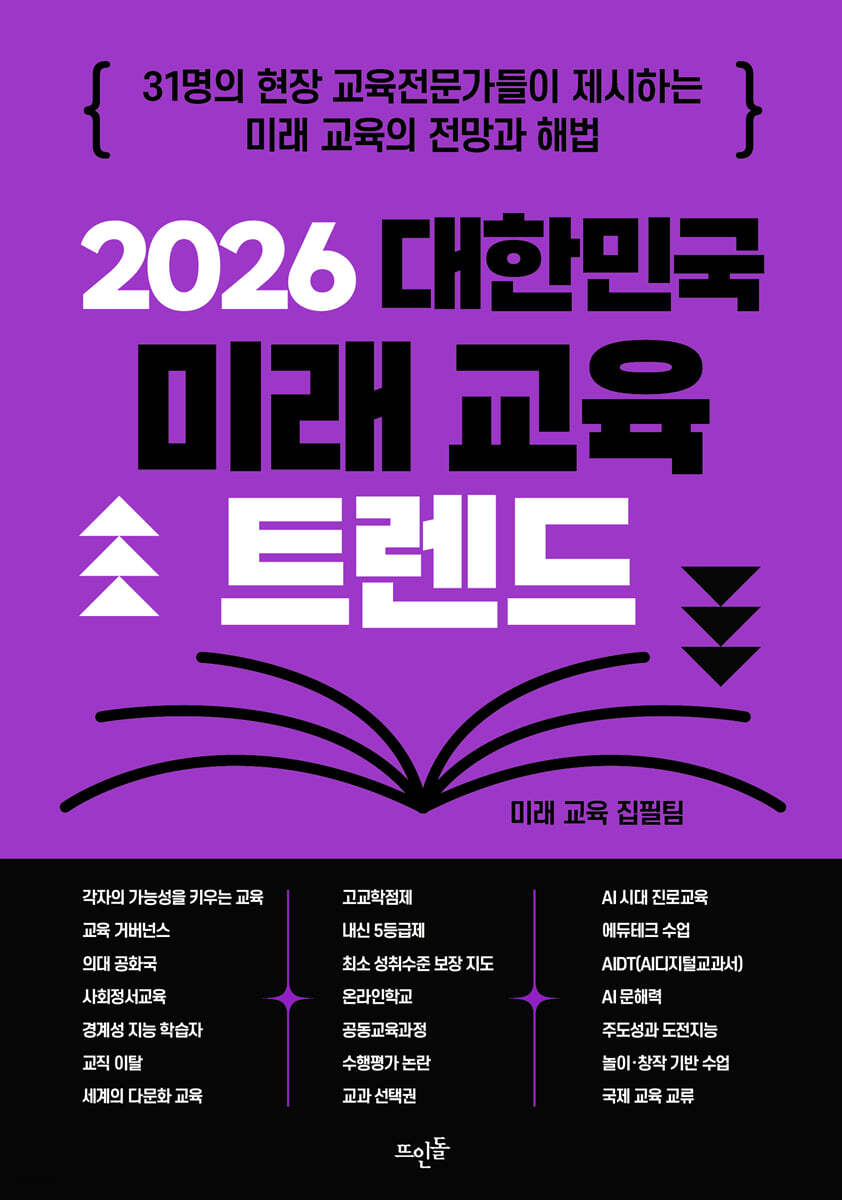
Future Education Trends in Korea in 2026
 |
Description
Book Introduction
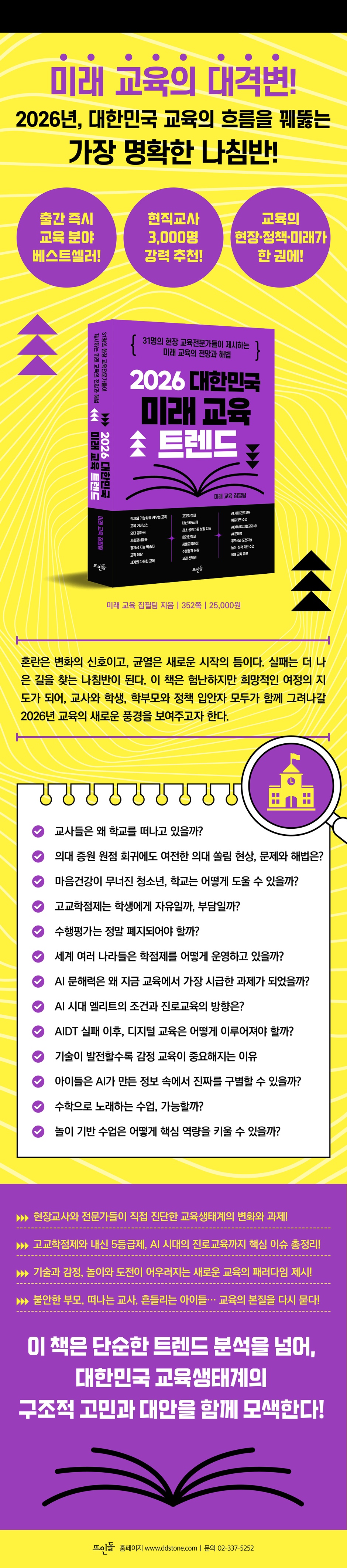
The clearest compass guiding the flow of education in Korea in 2026!
Where is South Korean education headed in 2026?
From the quiet retirement of teachers, the return to the starting point of increasing medical school enrollment, the introduction of the high school credit system and the five-grade system, the proliferation of AI and edtech, and the societal demand for students' emotional recovery, the educational field is currently in the midst of a massive transformation.
Published amidst this changing landscape, "2026 Future Education Trends in Korea" is a book for those who question the essence of education, identify the gap between systems and practice, and seek the direction of education for the next generation.
Chapter 1 diagnoses the crisis in the educational ecosystem, focusing on cracks in the classroom, teacher departure, and students' mental health issues. Chapter 2 deeply analyzes the issues of selection and evaluation surrounding the high school credit system and the five-grade internal grade system.
Chapter 3 examines the impact of the advent of the AI era on education, and Chapter 4 introduces various attempts and possibilities for future education, including play, edutech, and international educational exchange.
This book is not simply a prospectus.
It is the result of practical reflection that provides parents with a direction for their children's education, teachers with the meaning of education, and policymakers with insight into system design.
Where is South Korean education headed in 2026?
From the quiet retirement of teachers, the return to the starting point of increasing medical school enrollment, the introduction of the high school credit system and the five-grade system, the proliferation of AI and edtech, and the societal demand for students' emotional recovery, the educational field is currently in the midst of a massive transformation.
Published amidst this changing landscape, "2026 Future Education Trends in Korea" is a book for those who question the essence of education, identify the gap between systems and practice, and seek the direction of education for the next generation.
Chapter 1 diagnoses the crisis in the educational ecosystem, focusing on cracks in the classroom, teacher departure, and students' mental health issues. Chapter 2 deeply analyzes the issues of selection and evaluation surrounding the high school credit system and the five-grade internal grade system.
Chapter 3 examines the impact of the advent of the AI era on education, and Chapter 4 introduces various attempts and possibilities for future education, including play, edutech, and international educational exchange.
This book is not simply a prospectus.
It is the result of practical reflection that provides parents with a direction for their children's education, teachers with the meaning of education, and policymakers with insight into system design.
- You can preview some of the book's contents.
Preview
index
Opening remarks: A teacher's "quiet retirement" and the classrooms we must protect_ Lee Jun-kwon
Part 1: The Shaking Classroom: Rethinking the Essence of Education
01 2025 National Policy Tasks of the Republic of Korea: Education that Fosters Each Person's Potential_Ji-seon Yoon
02 The Age of Speed: The Essence and Direction of Education - From Reflection to the Future_ Seongho Yoon
03 Redefining a Talented Nation in the Republic of Medical Schools_ Ha Yu-jeong
04 The Education Ecosystem Created by Parental Anxiety_ Kim Seong-gon
05 Why Teachers Leave School_ Ryu Seong-chang
06 'Different Faces' in the Classroom: Imagining a New Education for Coexistence_ Park Min-jae
07 Children of the Borderline_ Kim Sang-hyun
08 Can Korean-Style Social-Emotional Education Solve Students' Mental Health Problems?_ Kim Tae-hoon
Part 2: The High School Credit System and the 5-Grade Grade System: The Light and Dark Side of Choice
01 Is Choice Free or Burdensome? - How the High School Credit System Changes School Landscapes_ Seungwoo Lee
02 The Hot Potato of the High School Credit System: Guidance on Guaranteeing Minimum Achievement Levels_Bae Hye-rim
03 Examining the Evaluation Criteria for the High School 5-Level Grade System_ Lee Do-young
04 Performance Evaluation Controversy: What's the Solution? _ Jeong Tae-jin
05 Asking the Direction of the High School Credit System in Canada_ Ma Young-sil
06 Gyeonggi Eum-on School, Expanding Learning Beyond Time and Space_ Lim Hyeon-woo
Part 3: Changing the Direction of Education in the AI Era
01 'SKY Castle' Collapsed - AI Rewrites the Conditions of the Elite_ Kang Kyung-wook
02 AI Literacy, the Sail of the Future_ Kim Yong-wook
03 Career Education in the AI Era: Designing the Future_ Kim Won-bae
04 Learning the Language of Emotions in the Age of Technology_ Kang Bo-ram
05 AIDT, Overcoming Failure to Become a Next-Generation Education Platform_ Jaebeom Cho
06 Beyond Digital Literacy to AI Literacy_ Minji Son
07 In the age of AI, will our children be able to distinguish between fake and real?_ Park Han-sol
Part 4: The Laboratory of Future Education: Designing a New Paradigm
01 The End of Correct Answer Education, Future Education that Fosters Initiative and Challenge Intelligence_ Seo Ji-ye
02 Establishment of a new physical education (focused on physical activity) curriculum for grades 1 and 2 and the direction to take_ Kook Seung-ok
03 How to Make EdTech Classes More Valuable, TPACK_ Yoo Il-hwan
04 Future Core Competencies Developed Through Play_ Seo Eun-cheol
05 From Walkman to Suno, Children Singing with Math_ Kim Seong-moon
06 Overseas Education Exchange Opportunities! The more you know, the closer you become_ Kwon Ki-jung
07 Japan's Vision for the Future of Education: Free-Language Learning and Teacher Work Reform_Usui Yuta, Lee Gyeong-bae
References
Part 1: The Shaking Classroom: Rethinking the Essence of Education
01 2025 National Policy Tasks of the Republic of Korea: Education that Fosters Each Person's Potential_Ji-seon Yoon
02 The Age of Speed: The Essence and Direction of Education - From Reflection to the Future_ Seongho Yoon
03 Redefining a Talented Nation in the Republic of Medical Schools_ Ha Yu-jeong
04 The Education Ecosystem Created by Parental Anxiety_ Kim Seong-gon
05 Why Teachers Leave School_ Ryu Seong-chang
06 'Different Faces' in the Classroom: Imagining a New Education for Coexistence_ Park Min-jae
07 Children of the Borderline_ Kim Sang-hyun
08 Can Korean-Style Social-Emotional Education Solve Students' Mental Health Problems?_ Kim Tae-hoon
Part 2: The High School Credit System and the 5-Grade Grade System: The Light and Dark Side of Choice
01 Is Choice Free or Burdensome? - How the High School Credit System Changes School Landscapes_ Seungwoo Lee
02 The Hot Potato of the High School Credit System: Guidance on Guaranteeing Minimum Achievement Levels_Bae Hye-rim
03 Examining the Evaluation Criteria for the High School 5-Level Grade System_ Lee Do-young
04 Performance Evaluation Controversy: What's the Solution? _ Jeong Tae-jin
05 Asking the Direction of the High School Credit System in Canada_ Ma Young-sil
06 Gyeonggi Eum-on School, Expanding Learning Beyond Time and Space_ Lim Hyeon-woo
Part 3: Changing the Direction of Education in the AI Era
01 'SKY Castle' Collapsed - AI Rewrites the Conditions of the Elite_ Kang Kyung-wook
02 AI Literacy, the Sail of the Future_ Kim Yong-wook
03 Career Education in the AI Era: Designing the Future_ Kim Won-bae
04 Learning the Language of Emotions in the Age of Technology_ Kang Bo-ram
05 AIDT, Overcoming Failure to Become a Next-Generation Education Platform_ Jaebeom Cho
06 Beyond Digital Literacy to AI Literacy_ Minji Son
07 In the age of AI, will our children be able to distinguish between fake and real?_ Park Han-sol
Part 4: The Laboratory of Future Education: Designing a New Paradigm
01 The End of Correct Answer Education, Future Education that Fosters Initiative and Challenge Intelligence_ Seo Ji-ye
02 Establishment of a new physical education (focused on physical activity) curriculum for grades 1 and 2 and the direction to take_ Kook Seung-ok
03 How to Make EdTech Classes More Valuable, TPACK_ Yoo Il-hwan
04 Future Core Competencies Developed Through Play_ Seo Eun-cheol
05 From Walkman to Suno, Children Singing with Math_ Kim Seong-moon
06 Overseas Education Exchange Opportunities! The more you know, the closer you become_ Kwon Ki-jung
07 Japan's Vision for the Future of Education: Free-Language Learning and Teacher Work Reform_Usui Yuta, Lee Gyeong-bae
References
Detailed image
Into the book
To break the social stereotype that medical school is the only safe choice, science and engineering must become a truly safe and attractive alternative.
To achieve this, a research environment with full support and the creation of stable jobs must come first.
In particular, graduate students and young researchers need a systematic, national program that provides long-term research funding and clear career paths.
--- p.48
The talent needed in the AI era is not simply someone who knows the right answer, but someone who can redefine problems and gain insight into their context.
Those competencies include emotional stability, self-understanding, and the talent needed in the AI era is not simply someone who knows the right answer, but someone who can redefine the problem and gain insight into the context.
This capacity comes from emotional stability, self-understanding, and critical thinking.
--- p.58
This suggests that our country's multicultural education policy is fundamentally based on the 'deficit model.'
Policy terms like “support,” “strengthening,” and “resolution” assume that multicultural students are outside the norm, lacking something and needing to be “fixed.”
Program designs that separate students into separate classes to keep up with the curriculum can physically and psychologically divide them and stigmatize their differences.
--- p.76
We need to shift to fostering what the OECD calls “transformative competencies.”
This helps all students develop the capacity to endure the ambiguity of a complex world, to reconcile the tensions of diverse values, to take responsibility for common problems, and to co-create new values.
It is not simply a matter of social justice, but rather of building core capabilities that will ensure innovation and global citizenship in the Republic of Korea.
--- p.83
No matter how quickly technology evolves, if the children sitting in the classroom, or even some groups of members of society, are excluded, it cannot be considered true future education.
In fact, as technology advances, the challenge of ensuring its benefits reach more children equitably becomes more pressing.
Ultimately, the true value of future education lies in how we can bring together diverse learners, including children on the borderline.
--- p.86
Policymakers must boldly reform the outdated evaluation system.
We must initiate a social discussion to shift the college entrance exam-centered system to one that focuses on competency and portfolios, and create a framework to properly evaluate and reward the competencies needed in the AI era.
--- p.195
For teachers, AI literacy goes beyond simply utilizing technology; it's about instilling the power to question, criticize, and collaborate in the classroom.
With the edtech market rapidly growing, policies should not stop at 'device distribution' or 'platform expansion.'
We need educational policies that enable teachers to understand AI and explain its limitations, and help students treat AI as a "thinking partner."
The starting point is ultimately the strengthening of literacy education.
To achieve this, a research environment with full support and the creation of stable jobs must come first.
In particular, graduate students and young researchers need a systematic, national program that provides long-term research funding and clear career paths.
--- p.48
The talent needed in the AI era is not simply someone who knows the right answer, but someone who can redefine problems and gain insight into their context.
Those competencies include emotional stability, self-understanding, and the talent needed in the AI era is not simply someone who knows the right answer, but someone who can redefine the problem and gain insight into the context.
This capacity comes from emotional stability, self-understanding, and critical thinking.
--- p.58
This suggests that our country's multicultural education policy is fundamentally based on the 'deficit model.'
Policy terms like “support,” “strengthening,” and “resolution” assume that multicultural students are outside the norm, lacking something and needing to be “fixed.”
Program designs that separate students into separate classes to keep up with the curriculum can physically and psychologically divide them and stigmatize their differences.
--- p.76
We need to shift to fostering what the OECD calls “transformative competencies.”
This helps all students develop the capacity to endure the ambiguity of a complex world, to reconcile the tensions of diverse values, to take responsibility for common problems, and to co-create new values.
It is not simply a matter of social justice, but rather of building core capabilities that will ensure innovation and global citizenship in the Republic of Korea.
--- p.83
No matter how quickly technology evolves, if the children sitting in the classroom, or even some groups of members of society, are excluded, it cannot be considered true future education.
In fact, as technology advances, the challenge of ensuring its benefits reach more children equitably becomes more pressing.
Ultimately, the true value of future education lies in how we can bring together diverse learners, including children on the borderline.
--- p.86
Policymakers must boldly reform the outdated evaluation system.
We must initiate a social discussion to shift the college entrance exam-centered system to one that focuses on competency and portfolios, and create a framework to properly evaluate and reward the competencies needed in the AI era.
--- p.195
For teachers, AI literacy goes beyond simply utilizing technology; it's about instilling the power to question, criticize, and collaborate in the classroom.
With the edtech market rapidly growing, policies should not stop at 'device distribution' or 'platform expansion.'
We need educational policies that enable teachers to understand AI and explain its limitations, and help students treat AI as a "thinking partner."
The starting point is ultimately the strengthening of literacy education.
--- p.207
Publisher's Review
A solid guide for those seeking educational hope in uncertain times.
Education in South Korea is at the center of chaos and transition.
Teachers' quiet retirements and departures from the profession are rapidly increasing, students' mental health is at risk, and parental anxiety is fueling excessive competition, disrupting the educational ecosystem.
Although the increase in medical school enrollment has been restored to its original state, the "Medical School Republic" has become even more solid, and the high school credit system, an education system centered on choice, continues to spark debate over the freedom and burden of choice and the fairness of evaluation.
"2026 Future Education Trends in Korea" confronts these cracks in the educational ecosystem and deeply analyzes the key issues that teachers, parents, and policymakers must consider together in 2026.
Written by 31 field education experts, this book goes beyond a simple list of trends and becomes an intellectual journey that questions the essence of education and seeks practical alternatives for the next generation.
We analyze key educational issues and trends for 2026 and propose future education!
The Teacher Creators Association (TCA), an organization formed by current teachers to develop educational digital content, has selected the key educational issues and trends that teachers and parents should be most concerned about and focused on in 2026, following last year's.
This report analyzes and forecasts education in 2026 through keywords such as key education policies in the 2025 national agenda, creation of 10 Seoul National Universities, the Republic of Medical Schools, social and emotional education, learners with borderline intelligence, leaving the teaching profession, quiet retirement, youth mental health, global multicultural education, high school credit system, 5-grade school grade system, guaranteed minimum achievement level guidance, online schools, joint curriculum, performance assessment controversy, subject choice, global credit system, lifelong career education, edutech classes, AIDT (AI digital textbook), AI literacy, initiative and challenging intelligence, play and creation-based classes, and international educational exchange.
As it carefully selects topics and content that must be addressed in current education, it will serve as an important resource for assessing changes in the education sector as well as future society.
Structure of this book
『2026 Future Education Trends in Korea』 is composed of four parts.
Part 1, “Shaking Classrooms: Re-Questioning the Essence of Education,” examines the current state of education.
We examine the key educational policies contained in the 2025 South Korean national agenda and examine the repercussions of the return to the original medical school enrollment quota and the social structural problems that led to the concentration of medical school students.
Furthermore, through the case studies of multicultural students and learners with borderline intelligence in the classroom, we reflect on the direction of diversity and inclusiveness that our education should pursue, and explore the educational philosophies of countries around the world that practice coexistence.
In particular, Part 1 diagnoses the structural problems of the educational ecosystem through serious signs in the educational field, such as excessive competition caused by parental anxiety, deteriorating mental health of adolescents, and rapid increase in teacher attrition, and seeks alternatives to resolve these problems.
Part 2, “High School Credit System and 5-Grade Internal Grade System: The Light and Darkness of Choice,” provides an in-depth analysis of the key issues surrounding the high school credit system and 5-grade internal grade system, which will begin for first-year high school students in the 2025 school year.
It covers a wide range of topics, including the school landscape changed to the high school credit system, the systematic support for establishing the system, the background to the introduction of the five-grade school grade system and the redesign of evaluation criteria, and the controversy over performance evaluation and its solutions.
We will also explore the direction in which Korea's credit system should advance by examining overseas examples of successful elective-centered education systems.
Part 3, "Changing the Direction of Education in the AI Era," presents new standards for learning and career planning as AI technology transforms learning. It explores the concept and necessity of AI literacy and presents various classroom examples of effective ways to cultivate it in schools and at home. It explores specifically how education must change, focusing on the core competencies required in the AI era.
Part 4, "Laboratory of Future Education: Designing a New Paradigm," presents a variety of examples from the field experimenting with future education. Through educational methods that transcend existing frameworks, such as TPACK-based edutech classes, creative learning combining music apps and math, and classes that strengthen core competencies through play, the book declares the end of answer-centered education and proposes a new paradigm that redesigns the structure of instruction and assessment.
Education in South Korea is at the center of chaos and transition.
Teachers' quiet retirements and departures from the profession are rapidly increasing, students' mental health is at risk, and parental anxiety is fueling excessive competition, disrupting the educational ecosystem.
Although the increase in medical school enrollment has been restored to its original state, the "Medical School Republic" has become even more solid, and the high school credit system, an education system centered on choice, continues to spark debate over the freedom and burden of choice and the fairness of evaluation.
"2026 Future Education Trends in Korea" confronts these cracks in the educational ecosystem and deeply analyzes the key issues that teachers, parents, and policymakers must consider together in 2026.
Written by 31 field education experts, this book goes beyond a simple list of trends and becomes an intellectual journey that questions the essence of education and seeks practical alternatives for the next generation.
We analyze key educational issues and trends for 2026 and propose future education!
The Teacher Creators Association (TCA), an organization formed by current teachers to develop educational digital content, has selected the key educational issues and trends that teachers and parents should be most concerned about and focused on in 2026, following last year's.
This report analyzes and forecasts education in 2026 through keywords such as key education policies in the 2025 national agenda, creation of 10 Seoul National Universities, the Republic of Medical Schools, social and emotional education, learners with borderline intelligence, leaving the teaching profession, quiet retirement, youth mental health, global multicultural education, high school credit system, 5-grade school grade system, guaranteed minimum achievement level guidance, online schools, joint curriculum, performance assessment controversy, subject choice, global credit system, lifelong career education, edutech classes, AIDT (AI digital textbook), AI literacy, initiative and challenging intelligence, play and creation-based classes, and international educational exchange.
As it carefully selects topics and content that must be addressed in current education, it will serve as an important resource for assessing changes in the education sector as well as future society.
Structure of this book
『2026 Future Education Trends in Korea』 is composed of four parts.
Part 1, “Shaking Classrooms: Re-Questioning the Essence of Education,” examines the current state of education.
We examine the key educational policies contained in the 2025 South Korean national agenda and examine the repercussions of the return to the original medical school enrollment quota and the social structural problems that led to the concentration of medical school students.
Furthermore, through the case studies of multicultural students and learners with borderline intelligence in the classroom, we reflect on the direction of diversity and inclusiveness that our education should pursue, and explore the educational philosophies of countries around the world that practice coexistence.
In particular, Part 1 diagnoses the structural problems of the educational ecosystem through serious signs in the educational field, such as excessive competition caused by parental anxiety, deteriorating mental health of adolescents, and rapid increase in teacher attrition, and seeks alternatives to resolve these problems.
Part 2, “High School Credit System and 5-Grade Internal Grade System: The Light and Darkness of Choice,” provides an in-depth analysis of the key issues surrounding the high school credit system and 5-grade internal grade system, which will begin for first-year high school students in the 2025 school year.
It covers a wide range of topics, including the school landscape changed to the high school credit system, the systematic support for establishing the system, the background to the introduction of the five-grade school grade system and the redesign of evaluation criteria, and the controversy over performance evaluation and its solutions.
We will also explore the direction in which Korea's credit system should advance by examining overseas examples of successful elective-centered education systems.
Part 3, "Changing the Direction of Education in the AI Era," presents new standards for learning and career planning as AI technology transforms learning. It explores the concept and necessity of AI literacy and presents various classroom examples of effective ways to cultivate it in schools and at home. It explores specifically how education must change, focusing on the core competencies required in the AI era.
Part 4, "Laboratory of Future Education: Designing a New Paradigm," presents a variety of examples from the field experimenting with future education. Through educational methods that transcend existing frameworks, such as TPACK-based edutech classes, creative learning combining music apps and math, and classes that strengthen core competencies through play, the book declares the end of answer-centered education and proposes a new paradigm that redesigns the structure of instruction and assessment.
GOODS SPECIFICS
- Date of issue: October 30, 2025
- Page count, weight, size: 352 pages | 614g | 165*235*22mm
- ISBN13: 9788958070962
- ISBN10: 895807096X
You may also like
카테고리
korean


korean

![GQ KOREA Mark (Monthly): December [2025]](http://librairie.coreenne.fr/cdn/shop/files/8ef265dbbfbf186523ed75ba7319009d.jpg?v=1765340328&width=3840)


