

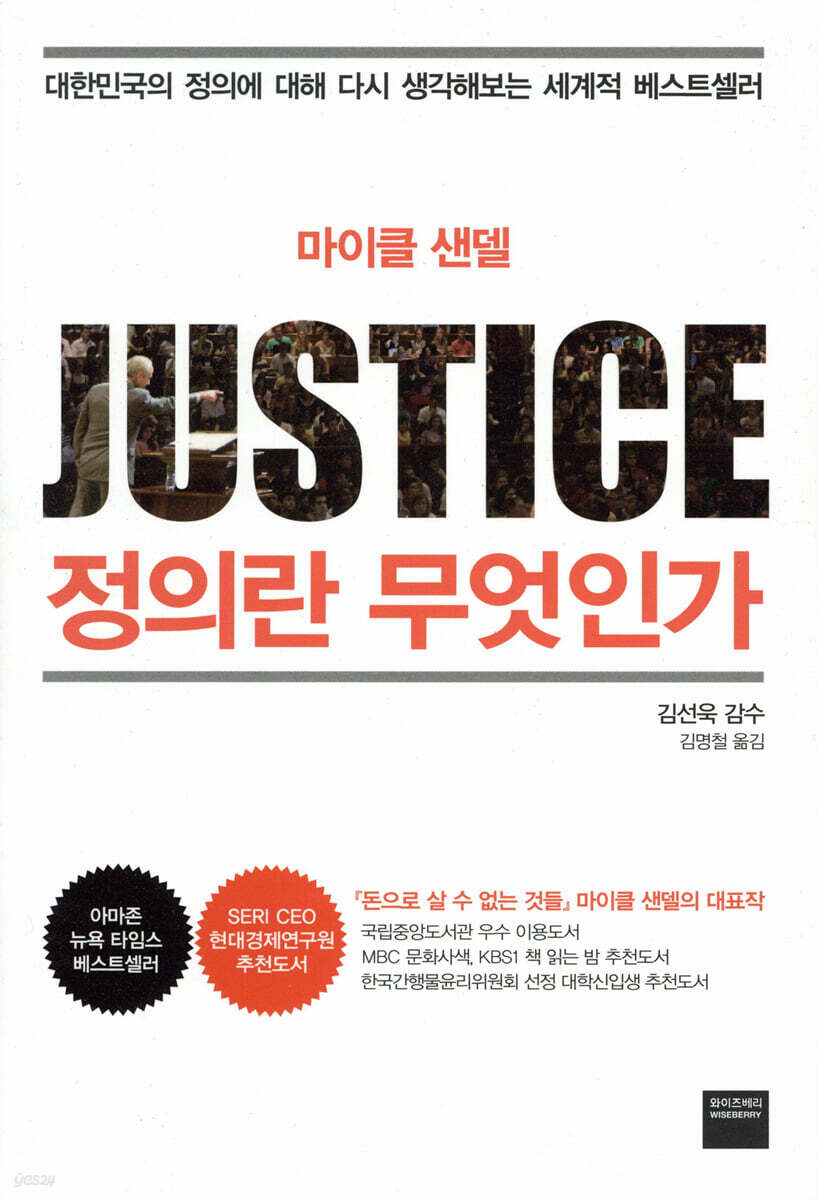
What is justice?
 |
Description
Book Introduction
Michael Sandel, who sparked a "justice" craze in Korea, explored the question of "what is just" through issues we commonly face in modern society, such as bailouts, surrogacy, same-sex marriage, and public apologies for past wrongdoings.
This book presents timeless philosophical questions from prominent political philosophers in an accessible manner. This provides a foundation for establishing one's own views on justice and solidifying their logical foundation in the public discourse and debate where arguments surrounding right and wrong, justice and injustice, equality and inequality, individual rights and the common good compete. This book shows the intellectual exploration process of political philosophers who diagnose the problems of modern society and find new alternatives. |
- You can preview some of the book's contents.
Preview
index
Praise for this book / Preface to the Korean edition
Chapter 1: Is justice a matter of judging right and wrong?
Chapter 2: The Greatest Happiness Principle: Utilitarianism
Chapter 3: Do We Own Ourselves?: Libertarianism
Chapter 4: Hiring Agents: The Morality of Market Logic
Chapter 5: A Motive-Esteeming Perspective: Immanuel Kant
Chapter 6: A Perspective Emphasizing Equality: John Rawls
Chapter 7 The Affirmative Action Debate: Rights vs.
qualifications
Chapter 8: Justice and Moral Qualification: Aristotle
Chapter 9: What Obligations Do We Have to Each Other?: The Dilemma of Loyalty
Chapter 10 Justice and the Common Good
Home / Release / Browse
Chapter 1: Is justice a matter of judging right and wrong?
Chapter 2: The Greatest Happiness Principle: Utilitarianism
Chapter 3: Do We Own Ourselves?: Libertarianism
Chapter 4: Hiring Agents: The Morality of Market Logic
Chapter 5: A Motive-Esteeming Perspective: Immanuel Kant
Chapter 6: A Perspective Emphasizing Equality: John Rawls
Chapter 7 The Affirmative Action Debate: Rights vs.
qualifications
Chapter 8: Justice and Moral Qualification: Aristotle
Chapter 9: What Obligations Do We Have to Each Other?: The Dilemma of Loyalty
Chapter 10 Justice and the Common Good
Home / Release / Browse
Praise for this book / Preface to the Korean edition
Chapter 1: Is justice a matter of judging right and wrong?
Chapter 2: The Greatest Happiness Principle: Utilitarianism
Chapter 3: Do We Own Ourselves?: Libertarianism
Chapter 4: Hiring Agents: The Morality of Market Logic
Chapter 5: A Perspective on Motives: Immanuel Kant
Chapter 6: A Perspective Emphasizing Equality: John Rawls
Chapter 7: The Affirmative Action Debate: Rights vs.
qualifications
Chapter 8: Justice and Moral Qualification: Aristotle
Chapter 9: What Obligations Do We Have to Each Other?: The Dilemma of Loyalty
Chapter 10: Justice and the Common Good
Preface to the Korean edition / ...
Chapter 1: Is justice a matter of judging right and wrong?
Chapter 2: The Greatest Happiness Principle: Utilitarianism
Chapter 3: Do We Own Ourselves?: Libertarianism
Chapter 4: Hiring Agents: The Morality of Market Logic
Chapter 5: A Perspective on Motives: Immanuel Kant
Chapter 6: A Perspective Emphasizing Equality: John Rawls
Chapter 7: The Affirmative Action Debate: Rights vs.
qualifications
Chapter 8: Justice and Moral Qualification: Aristotle
Chapter 9: What Obligations Do We Have to Each Other?: The Dilemma of Loyalty
Chapter 10: Justice and the Common Good
Home / Release / Browse
Chapter 1: Is justice a matter of judging right and wrong?
Chapter 2: The Greatest Happiness Principle: Utilitarianism
Chapter 3: Do We Own Ourselves?: Libertarianism
Chapter 4: Hiring Agents: The Morality of Market Logic
Chapter 5: A Perspective on Motives: Immanuel Kant
Chapter 6: A Perspective Emphasizing Equality: John Rawls
Chapter 7: The Affirmative Action Debate: Rights vs.
qualifications
Chapter 8: Justice and Moral Qualification: Aristotle
Chapter 9: What Obligations Do We Have to Each Other?: The Dilemma of Loyalty
Chapter 10: Justice and the Common Good
Preface to the Korean edition / ...
Chapter 1: Is justice a matter of judging right and wrong?
Chapter 2: The Greatest Happiness Principle: Utilitarianism
Chapter 3: Do We Own Ourselves?: Libertarianism
Chapter 4: Hiring Agents: The Morality of Market Logic
Chapter 5: A Perspective on Motives: Immanuel Kant
Chapter 6: A Perspective Emphasizing Equality: John Rawls
Chapter 7: The Affirmative Action Debate: Rights vs.
qualifications
Chapter 8: Justice and Moral Qualification: Aristotle
Chapter 9: What Obligations Do We Have to Each Other?: The Dilemma of Loyalty
Chapter 10: Justice and the Common Good
Home / Release / Browse
Detailed image
.jpg)
Into the book
This book does not deal with the history of ideas, but rather travels through various moral and philosophical thoughts.
The purpose of this book is not to provide a history of political thought that tells us who influenced whom, but to enable readers to formulate and critically examine their own views on justice, so that they know what they think and why.
--- From "Chapter 1: Is Justice a Matter of Judging Right and Wrong?"
What about Michael Jordan's enormous income or Bill Gates's enormous wealth? Do such inequalities conform to the difference principle? Of course, Rawls's theory is not intended to assess the fairness of individual incomes.
Rawls's theory is about the basic structure of society, how rights and obligations, income and wealth, power and opportunity are distributed.
The question Rawls wants to ask is whether, overall, Bill Gates's wealth came from a social system that benefited the poorest.
--- From "Chapter 6: A Perspective Emphasizing Equality: John Rawls"
The citizen that Aristotle thinks of is a being of a more noble and stricter meaning than the citizen that we think of.
For Aristotle, politics differs from economics in several ways.
The purpose of politics goes beyond maximizing public good or providing fair rules for the pursuit of individual interests.
It is to express our nature, to unfold the essence of a good life and human capabilities.
--- From "Chapter 8 Justice and Moral Qualification: Aristotle"
Japan has been lukewarm in apologizing for the atrocities it committed during the war.
Since the 1990s, Japan has faced increasing pressure from around the world to issue a formal apology and provide compensation to the so-called "comfort women."
In the 1990s, private funds paid some compensation to victims, and Japanese leaders offered limited apologies.
But later, in 2007, Japanese Prime Minister Shinzo Abe claimed that the Japanese military was not responsible for forcing women into sexual slavery.
In response, the U.S. Congress passed a resolution urging the Japanese government to acknowledge and apologize for the Japanese military's role in enslaving comfort women.
(…) In the United States, too, the debate over public apologies and compensation has become prominent in recent decades.
In 1988, President Ronald Reagan signed a law formally apologizing for the internment of Japanese Americans in West Coast internment camps during World War II.
In 1993, Congress apologized for an earlier wrongdoing (the overthrow of the independent Hawaiian Kingdom a century earlier).
The purpose of this book is not to provide a history of political thought that tells us who influenced whom, but to enable readers to formulate and critically examine their own views on justice, so that they know what they think and why.
--- From "Chapter 1: Is Justice a Matter of Judging Right and Wrong?"
What about Michael Jordan's enormous income or Bill Gates's enormous wealth? Do such inequalities conform to the difference principle? Of course, Rawls's theory is not intended to assess the fairness of individual incomes.
Rawls's theory is about the basic structure of society, how rights and obligations, income and wealth, power and opportunity are distributed.
The question Rawls wants to ask is whether, overall, Bill Gates's wealth came from a social system that benefited the poorest.
--- From "Chapter 6: A Perspective Emphasizing Equality: John Rawls"
The citizen that Aristotle thinks of is a being of a more noble and stricter meaning than the citizen that we think of.
For Aristotle, politics differs from economics in several ways.
The purpose of politics goes beyond maximizing public good or providing fair rules for the pursuit of individual interests.
It is to express our nature, to unfold the essence of a good life and human capabilities.
--- From "Chapter 8 Justice and Moral Qualification: Aristotle"
Japan has been lukewarm in apologizing for the atrocities it committed during the war.
Since the 1990s, Japan has faced increasing pressure from around the world to issue a formal apology and provide compensation to the so-called "comfort women."
In the 1990s, private funds paid some compensation to victims, and Japanese leaders offered limited apologies.
But later, in 2007, Japanese Prime Minister Shinzo Abe claimed that the Japanese military was not responsible for forcing women into sexual slavery.
In response, the U.S. Congress passed a resolution urging the Japanese government to acknowledge and apologize for the Japanese military's role in enslaving comfort women.
(…) In the United States, too, the debate over public apologies and compensation has become prominent in recent decades.
In 1988, President Ronald Reagan signed a law formally apologizing for the internment of Japanese Americans in West Coast internment camps during World War II.
In 1993, Congress apologized for an earlier wrongdoing (the overthrow of the independent Hawaiian Kingdom a century earlier).
--- From “Chapter 9: What Obligations Do We Have to Each Other?: Community Obligations”
Publisher's Review
A Conversation with Great Philosophers on Justice
An article said the number of billionaires has more than doubled since the global financial crisis, and that the richest 85 people now own half of all global wealth.
In 2014, a debate over the rightness and wrongness of the radical alternative called the "capital tax" to resolve extreme economic inequality has ignited in South Korean society, and a wave of justice is once again sweeping the nation.
Market fundamentalism is pointed out as the cause of inequality, and some argue that it is fair to collect taxes from the rich to help the poor.
However, some people believe that it is unfair to take away money that individuals have earned through hard work through taxes.
What is the right decision?
Now, with problems like economic inequality and the loss of publicness threatening Korean society, it is time to examine the morality necessary to practice the justice of a democratic society and, furthermore, to explore sound alternatives that can overcome social problems.
Even in the history of political philosophy, thinkers like Bentham, Kant, and Rawls grappled with the problems of their time and sought alternatives, and their theories allow us to reflect on the present day.
Harvard University professor Michael Sandel discusses real-world issues such as bailouts, conscription, surrogacy, outsourced pregnancy, same-sex marriage, immigration reform, and public apologies for past wrongdoings, as well as thought experiments such as a runaway trolley and a test that measures the cost of suffering. He guides readers to stand shoulder to shoulder with great thinkers and consider what "justice" means in our society.
He is convinced that “debate is the symbol of a healthy society.”
In this book, author Michael Sandel explores what morality and justice are in this era, with topics such as capitalism, happiness, equality, freedom, and virtue.
Michael Sandel, a political philosopher, became a professor at Harvard University at the age of 27 and gained recognition as a world-renowned scholar after publishing "The Limits of Liberalism and Justice," a critique of John Rawls' theory of justice.
In particular, through a public lecture at Yonsei University attended by 15,000 people, he provided an opportunity for Korean intellectuals to reconsider the concept of justice.
His masterpiece, "What is Justice?", explores the philosophical foundation for establishing right behavior and a desirable way of life in a time of rampant injustice and inequality and deepening social conflict.
This book critically examines how the thinkers who have made outstanding achievements in the history of political philosophy have thought about justice.
The author argues that while Jeremy Bentham and John Stuart Mill's utilitarianism supports decisions that benefit the majority, it has moral limits when it comes to issues of human dignity, such as torture and surrogacy.
Furthermore, although Immanuel Kant's concept of freedom and morality is persuasive, it is evaluated that it may lead to results that are difficult to accept as categorical imperatives, such as the case where it is morally wrong to lie to a murderer for the sake of a friend.
John Rawls's argument that the principles of justice must be agreed upon behind a veil of ignorance where specific interests disappear seems perfect, but he points out that, no matter how neutral and objective one tries to think, it is ultimately impossible to fundamentally eliminate the interests or customs of the community, as in the past U.S. Constitution that recognized slavery.
This book reaffirms the fundamental raison d'être of political philosophy—to revise and correct our understanding of justice through critical thinking—and instills hope that it can provide a desirable philosophical foundation for how we can live toward a society that is good for all.
A global frenzy for justice: "Think for yourself how to live as a citizen."
In June 2005, U.S. Navy SEALs conducted covert reconnaissance operations in Afghanistan to find Taliban leaders.
They encountered two unarmed goat herders and a boy of about fourteen years old.
The goat herders were supposed to be let go because they appeared to be civilians, but on the other hand, there was a risk that they would reveal the whereabouts of the special forces to the Taliban.
One unit member said, “We are on a mission.
He argued that they should be killed, saying, “It is wrong to let them go.”
Luttrell, the unit's commander, hesitated.
He raised his hand in favor of releasing them amidst a sharp divide in opinion.
It was a decision I would soon regret.
After freeing the goat herders, the special forces were surrounded by Taliban fighters.
A fierce gunfight ensued, killing three of the men.
Sixteen soldiers lost their lives when an American helicopter that came to rescue them was shot down.
Luttrell was seriously injured and barely survived, but he regretted his actions.
Michael Sandel, author of "Justice: What's the Right Thing to Do?", says the dilemma faced by special forces soldiers stemmed from their uncertainty about what would happen next.
He let the shepherds go free, thinking that he should not kill innocent people.
However, it appears to have been a wrong decision as the released herdsmen collaborated with the Taliban, ultimately leading to the death of the unit members.
So, what if the shepherds, under pressure from the Taliban, revealed the location of American troops? This raises the moral question of whether innocent people should have been killed to prevent further casualties among their own troops.
Also, these perspectives may vary depending on what community we live in.
The author says that thinking about dilemmas helps us understand how to develop moral arguments for right action and a desirable life.
The author says, “Living in a democratic society, we encounter many differences of opinion about justice and injustice.”
This book is based on dilemmatic cases in which claims about right and wrong, equality and inequality, individual rights and the common good compete.
When we find ourselves in a dilemma, it is crucial to recognize the situation we are in and find a moral principle to rely on.
It is also necessary to recognize the differences in positions and perspectives of different people.
The principles surrounding justice discussed by thinkers such as Aristotle, Kant, Mill, and Rawls in this book serve as good material for laying the foundation for our philosophical foundation.
The true purpose of this book is to enable readers to formulate and critically examine their own views on justice, so that they can understand what they believe and why.
The author does not stop there.
Political philosophy is a struggle to live correctly in the world.
The debate surrounding justice recur countless times, urging us to engage in dialogue together to find common ground between our judgments and principles and to avoid remaining trapped in the tangle of prejudice.
The author emphasizes that “the turning of the mind from the world of action to the realm of reason, and then from the realm of reason to the world of action, forms the basis of moral thinking.”
The author says that justice is not the exclusive domain of some thinkers or politicians.
It shows that both students attending lectures at Harvard University and readers of this book can develop their own logic while standing shoulder to shoulder with great thinkers.
Michael Sandel is also a philosopher who points out the strengths and weaknesses of Rawls's theory of justice, supplements it, and explores new alternatives.
While accepting Rawls's strengths from a liberal communitarian standpoint, it systematically constructs a position that goes beyond the limitations of Rawls' liberalism.
He is wary of communitarian thinking that ignores the morality of other communities.
In this respect, the author holds a position of communitarianism that is not simply communitarianism, but one that accepts and synthesizes the strengths of liberalism.
This is why the author does not include a definitive answer to the question of justice in this book.
This book offers a groundbreaking framework for readers who are refining their thinking to become future philosophers, humanists, and politicians, by creating time for deep reflection on justice.
Recommendation
Through discussion and reflection, you come to know who you are, and through this, you come to recognize the strengths and limitations of your own position.
Furthermore, you come to understand other people.
This book provides crucial help to citizens who are making these efforts.
Kim Seon-wook, Professor of Philosophy at Soongsil University
It is worth reflecting on what kind of democracy we should create and what is needed to achieve it.
I hope we can share Sandel's republican and public philosophy concerns more seriously.
Lee Hyun-woo, humanist, blogger, "Roja's Low-Altitude Flight"
Michael Sandel boldly tackles the most politically challenging moral issues, clearly demonstrating the differences in political views.
- Michael Gerson, The Washington Post
Michael Sandel, drawing on his years of teaching experience, explains theories of justice in a clear and accessible way.
No book has ever explained the views of philosophers so easily.
- Jonathan Rauch, The New York Times
It is a fascinating and entertaining collection of episodes from history, international topics, literary examples, legal battles, and the teachings of great philosophers.
This is the excellent commentary we've always wanted from our professors.
- Circus Reviews
An article said the number of billionaires has more than doubled since the global financial crisis, and that the richest 85 people now own half of all global wealth.
In 2014, a debate over the rightness and wrongness of the radical alternative called the "capital tax" to resolve extreme economic inequality has ignited in South Korean society, and a wave of justice is once again sweeping the nation.
Market fundamentalism is pointed out as the cause of inequality, and some argue that it is fair to collect taxes from the rich to help the poor.
However, some people believe that it is unfair to take away money that individuals have earned through hard work through taxes.
What is the right decision?
Now, with problems like economic inequality and the loss of publicness threatening Korean society, it is time to examine the morality necessary to practice the justice of a democratic society and, furthermore, to explore sound alternatives that can overcome social problems.
Even in the history of political philosophy, thinkers like Bentham, Kant, and Rawls grappled with the problems of their time and sought alternatives, and their theories allow us to reflect on the present day.
Harvard University professor Michael Sandel discusses real-world issues such as bailouts, conscription, surrogacy, outsourced pregnancy, same-sex marriage, immigration reform, and public apologies for past wrongdoings, as well as thought experiments such as a runaway trolley and a test that measures the cost of suffering. He guides readers to stand shoulder to shoulder with great thinkers and consider what "justice" means in our society.
He is convinced that “debate is the symbol of a healthy society.”
In this book, author Michael Sandel explores what morality and justice are in this era, with topics such as capitalism, happiness, equality, freedom, and virtue.
Michael Sandel, a political philosopher, became a professor at Harvard University at the age of 27 and gained recognition as a world-renowned scholar after publishing "The Limits of Liberalism and Justice," a critique of John Rawls' theory of justice.
In particular, through a public lecture at Yonsei University attended by 15,000 people, he provided an opportunity for Korean intellectuals to reconsider the concept of justice.
His masterpiece, "What is Justice?", explores the philosophical foundation for establishing right behavior and a desirable way of life in a time of rampant injustice and inequality and deepening social conflict.
This book critically examines how the thinkers who have made outstanding achievements in the history of political philosophy have thought about justice.
The author argues that while Jeremy Bentham and John Stuart Mill's utilitarianism supports decisions that benefit the majority, it has moral limits when it comes to issues of human dignity, such as torture and surrogacy.
Furthermore, although Immanuel Kant's concept of freedom and morality is persuasive, it is evaluated that it may lead to results that are difficult to accept as categorical imperatives, such as the case where it is morally wrong to lie to a murderer for the sake of a friend.
John Rawls's argument that the principles of justice must be agreed upon behind a veil of ignorance where specific interests disappear seems perfect, but he points out that, no matter how neutral and objective one tries to think, it is ultimately impossible to fundamentally eliminate the interests or customs of the community, as in the past U.S. Constitution that recognized slavery.
This book reaffirms the fundamental raison d'être of political philosophy—to revise and correct our understanding of justice through critical thinking—and instills hope that it can provide a desirable philosophical foundation for how we can live toward a society that is good for all.
A global frenzy for justice: "Think for yourself how to live as a citizen."
In June 2005, U.S. Navy SEALs conducted covert reconnaissance operations in Afghanistan to find Taliban leaders.
They encountered two unarmed goat herders and a boy of about fourteen years old.
The goat herders were supposed to be let go because they appeared to be civilians, but on the other hand, there was a risk that they would reveal the whereabouts of the special forces to the Taliban.
One unit member said, “We are on a mission.
He argued that they should be killed, saying, “It is wrong to let them go.”
Luttrell, the unit's commander, hesitated.
He raised his hand in favor of releasing them amidst a sharp divide in opinion.
It was a decision I would soon regret.
After freeing the goat herders, the special forces were surrounded by Taliban fighters.
A fierce gunfight ensued, killing three of the men.
Sixteen soldiers lost their lives when an American helicopter that came to rescue them was shot down.
Luttrell was seriously injured and barely survived, but he regretted his actions.
Michael Sandel, author of "Justice: What's the Right Thing to Do?", says the dilemma faced by special forces soldiers stemmed from their uncertainty about what would happen next.
He let the shepherds go free, thinking that he should not kill innocent people.
However, it appears to have been a wrong decision as the released herdsmen collaborated with the Taliban, ultimately leading to the death of the unit members.
So, what if the shepherds, under pressure from the Taliban, revealed the location of American troops? This raises the moral question of whether innocent people should have been killed to prevent further casualties among their own troops.
Also, these perspectives may vary depending on what community we live in.
The author says that thinking about dilemmas helps us understand how to develop moral arguments for right action and a desirable life.
The author says, “Living in a democratic society, we encounter many differences of opinion about justice and injustice.”
This book is based on dilemmatic cases in which claims about right and wrong, equality and inequality, individual rights and the common good compete.
When we find ourselves in a dilemma, it is crucial to recognize the situation we are in and find a moral principle to rely on.
It is also necessary to recognize the differences in positions and perspectives of different people.
The principles surrounding justice discussed by thinkers such as Aristotle, Kant, Mill, and Rawls in this book serve as good material for laying the foundation for our philosophical foundation.
The true purpose of this book is to enable readers to formulate and critically examine their own views on justice, so that they can understand what they believe and why.
The author does not stop there.
Political philosophy is a struggle to live correctly in the world.
The debate surrounding justice recur countless times, urging us to engage in dialogue together to find common ground between our judgments and principles and to avoid remaining trapped in the tangle of prejudice.
The author emphasizes that “the turning of the mind from the world of action to the realm of reason, and then from the realm of reason to the world of action, forms the basis of moral thinking.”
The author says that justice is not the exclusive domain of some thinkers or politicians.
It shows that both students attending lectures at Harvard University and readers of this book can develop their own logic while standing shoulder to shoulder with great thinkers.
Michael Sandel is also a philosopher who points out the strengths and weaknesses of Rawls's theory of justice, supplements it, and explores new alternatives.
While accepting Rawls's strengths from a liberal communitarian standpoint, it systematically constructs a position that goes beyond the limitations of Rawls' liberalism.
He is wary of communitarian thinking that ignores the morality of other communities.
In this respect, the author holds a position of communitarianism that is not simply communitarianism, but one that accepts and synthesizes the strengths of liberalism.
This is why the author does not include a definitive answer to the question of justice in this book.
This book offers a groundbreaking framework for readers who are refining their thinking to become future philosophers, humanists, and politicians, by creating time for deep reflection on justice.
Recommendation
Through discussion and reflection, you come to know who you are, and through this, you come to recognize the strengths and limitations of your own position.
Furthermore, you come to understand other people.
This book provides crucial help to citizens who are making these efforts.
Kim Seon-wook, Professor of Philosophy at Soongsil University
It is worth reflecting on what kind of democracy we should create and what is needed to achieve it.
I hope we can share Sandel's republican and public philosophy concerns more seriously.
Lee Hyun-woo, humanist, blogger, "Roja's Low-Altitude Flight"
Michael Sandel boldly tackles the most politically challenging moral issues, clearly demonstrating the differences in political views.
- Michael Gerson, The Washington Post
Michael Sandel, drawing on his years of teaching experience, explains theories of justice in a clear and accessible way.
No book has ever explained the views of philosophers so easily.
- Jonathan Rauch, The New York Times
It is a fascinating and entertaining collection of episodes from history, international topics, literary examples, legal battles, and the teachings of great philosophers.
This is the excellent commentary we've always wanted from our professors.
- Circus Reviews
GOODS SPECIFICS
- Date of publication: November 20, 2014
- Page count, weight, size: 444 pages | 872g | 152*224*30mm
- ISBN13: 9788937834790
- ISBN10: 8937834790
You may also like
카테고리
korean


korean

![GQ KOREA Mark (Monthly): December [2025]](http://librairie.coreenne.fr/cdn/shop/files/8ef265dbbfbf186523ed75ba7319009d.jpg?v=1765340328&width=3840)


