

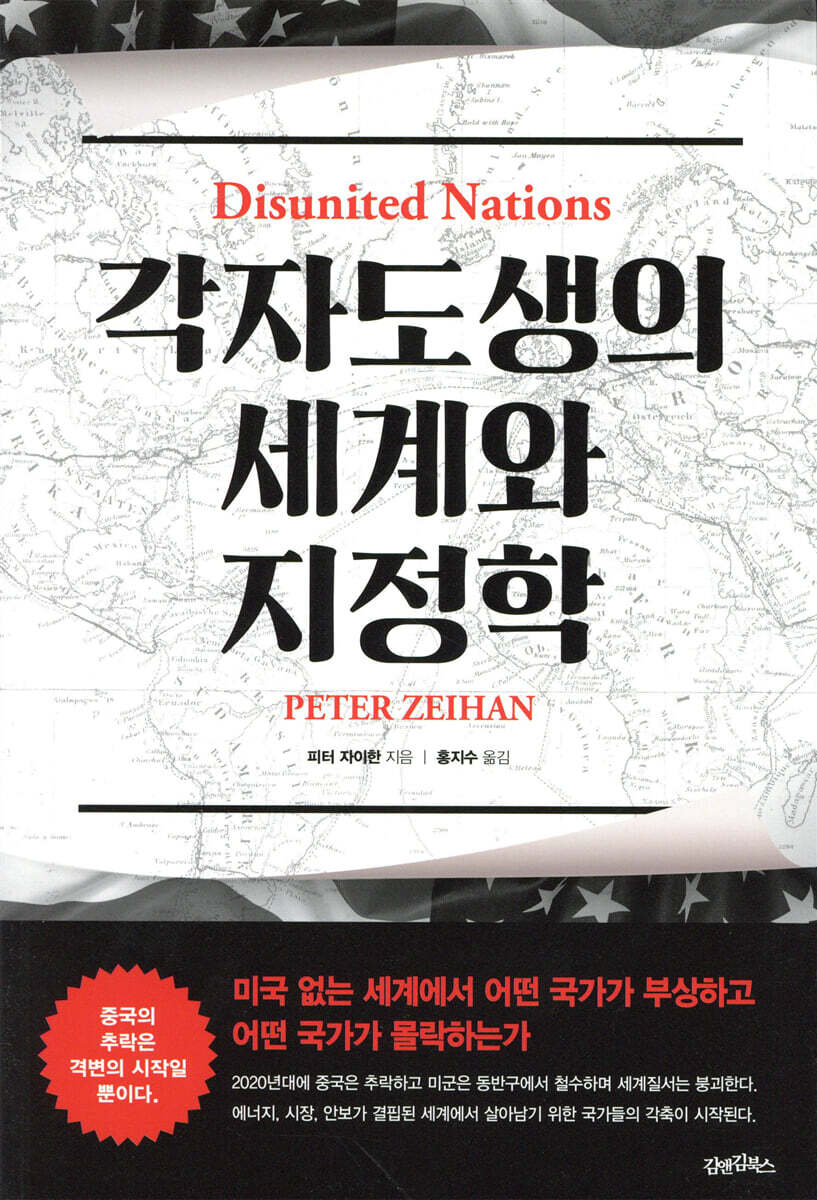
The world of each for himself and geopolitics
 |
Description
Book Introduction
Each for himself: A scenario or an imminent future?
The Biden Era: Is America Back?
In January 2021, US President Biden declared in his inaugural address that “America is back.”
There are predictions that the Biden administration will abandon Trump's America First policy, restore multilateralism, and re-lead the alliance system.
However, this book argues that the US-led alliance system, a legacy of the Cold War, is disintegrating and the world order that the US has built and is responsible for is soon to come to an end.
Furthermore, he says that China, far from replacing the United States, is on the verge of decline and collapse.
They say the collapse will begin not in a generation, but in the 2020s, and by the 2030s the world will no longer be the world we knew.
Peter Zeihan, an expert in geopolitics, energy, and demographics, unfolds these astonishing predictions in his third book, Disunited Nations.
Zaihan, author of “American Hegemony and Geopolitics in the 21st Century” and “The Shale Revolution and a World Without America,” has analyzed the flow of international affairs and predicted the rise and fall of nations based on geopolitics and demographics.
Peter Zeihan has consistently argued that the United States is withdrawing from the world order.
In fact, he says that rather than just letting go, they will actively destroy the world order.
This book deals specifically with what would happen if the United States were to withdraw, what would happen in a world without the United States, what countries would rise and which would fall.
Peter Zeihan says Russia has already entered a phase of national decline, and China will soon follow suit.
In a world without strategic threats, the US-led alliance system would be weakened or dismantled.
American troops will withdraw from Europe, the Middle East, and eventually East Asia.
Market access permitted to support that alliance system will be restricted, and access to energy and resources and safe maritime transport will not be guaranteed.
Meanwhile, demographic problems and capital shortages hit countries like a tsunami.
The world is divided into a relatively stable and vibrant American world and a world without America, where nations must compete for power and survival.
A world without America would soon become a world of each for himself.
During the era of order, some countries that had been overshadowed by the United States rose to become regional powers, while others that had benefited from the order fell into decline.
To what extent does geopolitics determine international affairs and the fate of nations? How will demographic issues destabilize the global economy? If the world is soon divided into an American world and a world without the United States, where will Korea fit in? Readers face intellectual challenges as immense as those in Peter Zeihan's previous works in this book.
The Biden Era: Is America Back?
In January 2021, US President Biden declared in his inaugural address that “America is back.”
There are predictions that the Biden administration will abandon Trump's America First policy, restore multilateralism, and re-lead the alliance system.
However, this book argues that the US-led alliance system, a legacy of the Cold War, is disintegrating and the world order that the US has built and is responsible for is soon to come to an end.
Furthermore, he says that China, far from replacing the United States, is on the verge of decline and collapse.
They say the collapse will begin not in a generation, but in the 2020s, and by the 2030s the world will no longer be the world we knew.
Peter Zeihan, an expert in geopolitics, energy, and demographics, unfolds these astonishing predictions in his third book, Disunited Nations.
Zaihan, author of “American Hegemony and Geopolitics in the 21st Century” and “The Shale Revolution and a World Without America,” has analyzed the flow of international affairs and predicted the rise and fall of nations based on geopolitics and demographics.
Peter Zeihan has consistently argued that the United States is withdrawing from the world order.
In fact, he says that rather than just letting go, they will actively destroy the world order.
This book deals specifically with what would happen if the United States were to withdraw, what would happen in a world without the United States, what countries would rise and which would fall.
Peter Zeihan says Russia has already entered a phase of national decline, and China will soon follow suit.
In a world without strategic threats, the US-led alliance system would be weakened or dismantled.
American troops will withdraw from Europe, the Middle East, and eventually East Asia.
Market access permitted to support that alliance system will be restricted, and access to energy and resources and safe maritime transport will not be guaranteed.
Meanwhile, demographic problems and capital shortages hit countries like a tsunami.
The world is divided into a relatively stable and vibrant American world and a world without America, where nations must compete for power and survival.
A world without America would soon become a world of each for himself.
During the era of order, some countries that had been overshadowed by the United States rose to become regional powers, while others that had benefited from the order fell into decline.
To what extent does geopolitics determine international affairs and the fate of nations? How will demographic issues destabilize the global economy? If the world is soon divided into an American world and a world without the United States, where will Korea fit in? Readers face intellectual challenges as immense as those in Peter Zeihan's previous works in this book.
- You can preview some of the book's contents.
Preview
index
Preface to the Korean edition
Introduction: A Moment of Transformation
01 The road we have traveled so far
First Age: Empire
Second Age: Order
The Third Era: Borderless Order
America in the Third Age
02 How to Rule the World Part 1: The American Model
Appeal 1: Guarantee physical security for all.
Appeasement Policy 2: Guarantee maritime safety for all countries.
Appeasement 3: Allow unrestricted market access.
Appeasement 4: Maintaining the Reserve Currency
Beyond the border
03 How to Rule the World Part 2: The British Model
Threat 1: Invincible Strategic Position
Threat 2: A powerful and flexible naval force
Threat 3: Massive technological superiority
China's reality
04 China: The End of the Success Myth
1.
The possibility of territorial survival
2.
agricultural capacity
3.
population structure
4.
Energy Access
The end of the world as we know it
China's report card
05 Japan: Chronic waiting
Ascension of the Rising Sun
Japan under the current world order
Superpower Reactivated
Turning a weakness into a strength once again
Dealing with China
Asia after China
A few words of warning
Japan's report card
06 Russia: The Failed Superpower
cursed land
tyranny
Failure of leadership
But there is another really serious problem.
Russia, where fulfilling wishes becomes a headache
A Look Around Russia: Current Russian Borders
Russia's report card
07 Germany: A Superpower Faces Backlash
The Curse of Perfection
Last remaining German, when you go out, turn off the lights and go out?
A house of cards
Last attempt
Germany's report card
08 France: Struggling to Become a Leader
French power
Geopolitics of the Margins, Part 1: Nationalism
Geopolitics of the Margins, Part 2: Industrialization
France under the current world order, Part 1: Those were the good times.
France under the current world order, Part 2: The Worst of Times
Problem 1: Staying away from Britain
Problem 2: Identity Issues
Problem 3: Southern Adjacent Areas
French report card
09 Iran: The Ancient Superpower
The power of water
That alone is not enough
Overthrowing the world order
Iran's report card
10 Saudi Arabia: Destroying the Middle East Against Iran
Incredible origins
politics of cruelty
however...
The world order is holding on tight.
Option 1: Find a new country to provide security.
Option 2: Build a more indigenous defense capability.
Option 3: Burn it
The geopolitics of arson
Saudi Arabia's report card
11 Türkiye: The Awakening Superpower
Marmara on land, Marmara on water
Reset history
Return to the Future
Front Yard: Bulgaria and Romania
Targeting the Vital Spot: Ukraine and Beyond
Backyard: Iraq and Syria
Reliving the Past: The Eastern Mediterranean
Going for the big one: Iran's Azerbaijanis
Other countries have a say
Türkiye's report card
12 Brazil: The sun is setting
Brazil's geographical constraints
Force it to work
There are sunrises in Brazil too
fear of falling
Okay, now here's some good news.
Brazil's report card
13 Argentina: The Politics of Self-Destruction
Independence and the Future
Come to one's senses
Disconnected superpower
Defining success
Argentina's report card
14 The Coming Chaos: The Future of American Foreign Policy
Context 1: Escape from the Global War on Terror
Context 2: The Remnants of World Order
Context 3: Strategic Reduction
Context 4: Cross-Border Profits
Context 5: Desperately Seeking Instability
15 The United States: A Superpower That Distances Itself from the World
Category 1: Coalitions of the Will (also called alliances)
Category 2: Countries competing for America's favor
Third Class: Hired Allies
America's Report Card
16 The Present on the Brink of Destruction: The Dawn of the Fourth Age
Acknowledgements
NOTES
Introduction: A Moment of Transformation
01 The road we have traveled so far
First Age: Empire
Second Age: Order
The Third Era: Borderless Order
America in the Third Age
02 How to Rule the World Part 1: The American Model
Appeal 1: Guarantee physical security for all.
Appeasement Policy 2: Guarantee maritime safety for all countries.
Appeasement 3: Allow unrestricted market access.
Appeasement 4: Maintaining the Reserve Currency
Beyond the border
03 How to Rule the World Part 2: The British Model
Threat 1: Invincible Strategic Position
Threat 2: A powerful and flexible naval force
Threat 3: Massive technological superiority
China's reality
04 China: The End of the Success Myth
1.
The possibility of territorial survival
2.
agricultural capacity
3.
population structure
4.
Energy Access
The end of the world as we know it
China's report card
05 Japan: Chronic waiting
Ascension of the Rising Sun
Japan under the current world order
Superpower Reactivated
Turning a weakness into a strength once again
Dealing with China
Asia after China
A few words of warning
Japan's report card
06 Russia: The Failed Superpower
cursed land
tyranny
Failure of leadership
But there is another really serious problem.
Russia, where fulfilling wishes becomes a headache
A Look Around Russia: Current Russian Borders
Russia's report card
07 Germany: A Superpower Faces Backlash
The Curse of Perfection
Last remaining German, when you go out, turn off the lights and go out?
A house of cards
Last attempt
Germany's report card
08 France: Struggling to Become a Leader
French power
Geopolitics of the Margins, Part 1: Nationalism
Geopolitics of the Margins, Part 2: Industrialization
France under the current world order, Part 1: Those were the good times.
France under the current world order, Part 2: The Worst of Times
Problem 1: Staying away from Britain
Problem 2: Identity Issues
Problem 3: Southern Adjacent Areas
French report card
09 Iran: The Ancient Superpower
The power of water
That alone is not enough
Overthrowing the world order
Iran's report card
10 Saudi Arabia: Destroying the Middle East Against Iran
Incredible origins
politics of cruelty
however...
The world order is holding on tight.
Option 1: Find a new country to provide security.
Option 2: Build a more indigenous defense capability.
Option 3: Burn it
The geopolitics of arson
Saudi Arabia's report card
11 Türkiye: The Awakening Superpower
Marmara on land, Marmara on water
Reset history
Return to the Future
Front Yard: Bulgaria and Romania
Targeting the Vital Spot: Ukraine and Beyond
Backyard: Iraq and Syria
Reliving the Past: The Eastern Mediterranean
Going for the big one: Iran's Azerbaijanis
Other countries have a say
Türkiye's report card
12 Brazil: The sun is setting
Brazil's geographical constraints
Force it to work
There are sunrises in Brazil too
fear of falling
Okay, now here's some good news.
Brazil's report card
13 Argentina: The Politics of Self-Destruction
Independence and the Future
Come to one's senses
Disconnected superpower
Defining success
Argentina's report card
14 The Coming Chaos: The Future of American Foreign Policy
Context 1: Escape from the Global War on Terror
Context 2: The Remnants of World Order
Context 3: Strategic Reduction
Context 4: Cross-Border Profits
Context 5: Desperately Seeking Instability
15 The United States: A Superpower That Distances Itself from the World
Category 1: Coalitions of the Will (also called alliances)
Category 2: Countries competing for America's favor
Third Class: Hired Allies
America's Report Card
16 The Present on the Brink of Destruction: The Dawn of the Fourth Age
Acknowledgements
NOTES
Publisher's Review
Biden's America: Grappling with the Strategic Remnants of the Old Order
Why America Is Withdrawing from the World
Will Biden's America return to the pre-Trump era, or can it? Will it strengthen NATO in Europe against Russia, keep US aircraft carriers patrolling the Persian Gulf and the South China Sea, and continue to allow free access to its own markets while upholding WTO rules?
Peter Zeihan argues that the current world order originated in the aftermath of World War II when the United States built an alliance system to counter the strategic threat posed by the Soviet Union.
The United States, bordered by two oceans, is so secure that it does not need allies.
However, the United States stationed troops in Europe and Asia and opened its markets to its allies in order to build an alliance system against the communist Soviet empire.
In this way, Europe was revived, East Asian countries joined the ranks of wealthy nations, and even China joined the American camp, experiencing remarkable economic growth.
But the Soviet Union collapsed long ago, and Russia is in such a precarious position that it has to worry about its own national existence.
Although China has risen economically and militarily today, Peter Zeihan argues that it cannot pose the same strategic threat as the Soviet Union.
China's success was built on the foundation of the world order provided by the United States.
Because of this order, China was able to maintain unity and not be divided despite its extreme geographical conditions.
If China is excluded from that order or if that order itself collapses, China will also collapse.
In order to destroy China, we must destroy that order.
Within the United States, “America First” cuts across both the left and the right.
There is widespread resentment and fatigue with America's involvement and responsibility in world affairs.
This is why Joe Biden's victory cannot be a defeat for 'America First.'
Joe Biden's America will grapple with the strategic remnants of the old order.
A post-Biden America may break away from the world even more radically than Trump's America.
This book analyzes in detail the five contexts in which American foreign policy operates today and which context it will ultimately fall into.
The United States struggles with the strategic remnants of the Cold War, but ultimately distances itself from the world.
The only question is whether we will gradually move away or radically move away.
Why the world is falling into chaos and China is falling
The seizure of the Korean chemical tanker, the Armenian-Azerbaijani war, and the China-India border dispute
The core of the world order established by the United States after World War II is security based on a global alliance system, the openness of the US market to support that alliance system, and safe maritime transportation and stable energy distribution.
The collapse of the world order means the weakening or disappearance of all four elements.
In January 2020, a Korean chemical tanker was seized by Iran in the Persian Gulf, but the United States has no will to respond, and South Korea has no means to respond.
The Armenia-Azerbaijan war that broke out in 2020 effectively ended in Azerbaijan's victory.
It heralds the rise of Türkiye in the Middle East and the Caucasus region.
The China-India border dispute continues.
China and India are locked in a standoff over control of each other's strategic strongholds.
In all three cases, the United States took a step back.
There is no will to intervene, and no need to intervene.
All you have to do is pretend not to know or slightly favor one side.
In effect, a world without America, a world of chaos, has already begun.
And this reality will become clearer with the coming fall of China.
NATO is already a dead letter.
French President Macron has said that NATO is brain dead.
It is difficult to imagine the United States intervening in a European war against a weakened but still nuclear power, Russia.
If Russia attempts to annex its neighbors as a last resort to survive as a nation, it will be a problem not for the United States but for Europe, or even for Germany.
To avoid being drawn into such a war, American troops in Europe will be withdrawn.
Ironically, if the US military withdraws from Europe, Russia will be in trouble.
Because the safety net that had been preventing Germany from becoming a military power, the United States, was removed.
Europe's long-standing geopolitics come into play again.
The US military continues to withdraw from the Middle East and today has a limited presence in strategic locations such as Qatar.
American aircraft carriers do not patrol the Persian Gulf.
If the United States no longer takes responsibility for world order, it will have no need to take responsibility for the alliance system, nor will it have any reason to take responsibility for the energy distribution that is the foundation of the alliance system.
Besides, America has shale.
Saudi Arabia will stop at nothing to stop Iran's hegemony.
It would not be surprising if the two countries engage in armed conflict immediately.
If the two countries clash, there will be a huge disruption in oil supplies.
The American sail industry thrives, but China and East Asia face a serious energy crisis.
Finally, US troops will also withdraw from East Asia.
Because it will soon become clear that China cannot be a strategic threat to the United States.
The United States will not intervene in regional conflicts in the future.
There is no will to intervene, and no need to intervene.
Geopolitical conflicts, big and small, occur all over the world.
There are incidents where cargo ships are suddenly seized on the high seas.
It's not just energy distribution that's being disrupted.
It's not just market access that's becoming more difficult.
Food supplies are at risk.
China's large population does not make it strong, but rather puts it in difficult situations.
A starving people is far more frightening than a foreign army.
The geographical conditions that divide China are coming into play again.
The economic crisis that China's aging population and demographic reversal will bring has not yet been factored in.
What will happen if the US military withdraws from Asia and Japan's suppressed military instincts are rekindled? China will be forced to worry not about Asian hegemony, but about its own survival.
What would happen in a world without America?
The world after 2030, similar to the world of 1900
This book is about the geopolitics of nations.
We learn about the geopolitical strengths and weaknesses of the world's major countries that we were unaware of.
We learn how advantageous or disadvantageous geographic conditions are for each country, and how effective the world order established by the United States has been in overcoming such geographical constraints.
Whether it was World War I or World War II, the issues were ultimately security, resources, and markets.
Whether it was Germany or Japan, in order to survive as a nation, they had to secure security, resources, and markets.
The reason the two countries remained peaceful after World War II was because the United States resolved it.
The rise of East Asia's emerging economies and China's rise to become the world's second-largest economy stemmed from the American-created world order, which gave them access to energy and markets, particularly the American market.
The mass production of soybeans and meat in Brazil's barren land was made possible by the availability of safe sea routes, massive capital movement, and market access.
What would happen if the United States were to withdraw from the global order? Is there even a slight chance that another country could fill that role? Peter Zeihan argues that no country capable of such a role will emerge in the near future.
Eventually, the global order will collapse and break up into regional units.
The struggle between nations to dominate their own regions begins.
The era of disorder, not order, is coming.
The regional lords return and the era of new imperialism begins.
Global supply chains are collapsing.
Maritime transport is no longer safe, and energy is becoming scarce and expensive.
Brazil's food production declines, leading to a global food crisis.
Survival, not growth, becomes the national task.
When the age of chaos arrives, some nations will inevitably fall, but some nations that have been overshadowed by the United States will prosper.
Russia, facing a horrific population decline, is already in decline.
China, the country most dependent on the world order, will suffer the most from the disconnect.
Even national unity is threatened.
Germany is about to experience the nightmare of the past again.
It will become a country that has neither a proper market, resources, nor security.
Brazil, now short of capital, falls back into the curse of land and climate.
France, which has benefited the least from world order, becomes the country that benefits the most from a world of disorder.
Turkey will not only be a power in the Middle East, but will also bring into its sphere of influence such helpless Eastern European countries as Romania and Bulgaria.
And if the United States withdraws from East Asia, Japan's geopolitical position at a strategic point in the Western Pacific will once again be in play.
The country that will have Southeast Asia under its sphere of influence and dominate the South China Sea will be Japan, not China.
Peter Zeihan says the world after 2030 will resemble the world in 1900, before World War I.
Even at this time, the United States was already the world's largest economy, but it did not intervene in world affairs.
As the nations of Europe competed and fought among themselves, they focused on their internal affairs and consolidated their dominance over the Western Hemisphere.
America, with no major security, market, resources, food, or even population problems, enjoys a splendid solitude by distancing itself from the world.
The American world is not disappearing.
It just gets smaller
Countries that achieve what they want but lose something bigger
As Peter Zeihan puts it, the United States will have to step down from its role as the world's security and order-keeping power, even though it has been meddlesome.
With the long war in the Middle East coming to an end, the process may have already begun.
The period of inertia that has persisted since the collapse of the Soviet Union is coming to an end.
The United States will come to perceive that its security will not be threatened in any way by the withdrawal of its troops from Europe, the Middle East, and East Asia.
Rather, there will be no need to be drawn into the war of an ally.
There is no need to bear the enormous costs of maintaining an alliance system.
Above all, there is no need to buy off allies or grant them generous access to their domestic markets in the name of alliances.
America will withdraw from the world, but it will become safer and relatively stronger.
Outside the Western Hemisphere, major powers compete for regional hegemony, but are careful not to displease the United States.
The world is divided into a world without America and a world with America.
The United States will have a much smaller alliance system than it has today.
Canada and Mexico are increasingly tied to a single economic bloc with the United States.
Even now, excluding Canada and Mexico, U.S. exports account for only 3% of GDP, while imports account for only about 4%.
Alliances with some like-minded countries, such as the UK, continue.
We will generally maintain close relations with countries in South America, Australia, and Southeast Asia.
There will be no such connection with Germany.
We will maintain friendly relations with Japan as long as Japan does not become too greedy about Southeast Asia.
Ironically, a world without the United States would leave the countries that desperately wanted it in an awkward position.
Russia, Iran, and China are such countries.
If the United States withdraws, a power vacuum will be created, stability will disappear, and instability will take hold.
Instability triggers security competition and returns us to the pre-World Order era.
Russia, Iran, and China want the United States to leave their region.
North Korea is the same.
But the moment the United States leaves, these countries face an unintended situation.
Russia faces an unstable Germany, Iran faces a deranged Saudi Arabia and a frighteningly rising Turkey.
China faces internal divisions and a militarized Japan.
North Korea has become a real nuisance to China.
So what kind of reality awaits Korea?
Why Japan Is Rising Again in a World Without America
The biggest challenge facing Korea: Japan
In the preface to the Korean edition, Peter Zeihan argues that the biggest challenge facing South Korea in a world of disorder without America is not North Korea, but Japan.
He says that Japan, “the only country that can help Korea solve its structural economic problems, the only country that can help Korea maintain access to overseas markets, and yet the only country that most Koreans do not want to associate with,” will eventually mediate all affairs in Northeast Asia on the high seas based on its powerful maritime power.
In an age of chaos, Korea needs Japan more than any other country, but the problem is that it is more likely to confront Japan than cooperate with it.
Japan's population is 126 million, 2.5 times that of Korea, and its economy is three times that of Korea.
Japan's overseas net assets exceeded 400 trillion as of 2019.
But Japan's true strength lies not in its population or economic scale, but in its geographic location.
In some ways, Japan is the second safest country after the United States.
Historically, Japan has never been properly attacked from the continent.
Compared to the English Channel, an impregnable barrier, the East China Sea and the Korea Strait are indescribably vast.
And Japan's core is strategically isolated and safe from attack from the continent.
Above all, Japan can reach the world's resources and markets via sea routes without interference from any major power.
The only country that can restrain Japan is the United States, which can attack Japan's core from the eastern sea and cut off Japan's lifeline.
If the United States withdraws from East Asia, Japan's militaristic instincts will come alive.
They use security concerns as an excuse to justify their own aggressive actions.
In order to avoid repeating the mistakes of the Pacific War, the US is reassured by the appearance of dealing with China on its behalf.
China has difficulty concentrating on its naval power because it has to fight against land enemies and internal divisions.
This becomes even more so in times of chaos.
There is no need to ask which side Southeast Asia and Taiwan will take, China or Japan.
It goes without saying how dire South Korea's options would be if the United States were to leave East Asia.
Peter Zeihan says that if Korea sides with China, it will be swept away along with China.
Even if the Chinese economy survives the chaos, they say, it has nothing to gain from this mercantilist state.
Ultimately, Korea's only way out is to maintain ties with the United States, the only country capable of containing Japan and maintaining economic vitality even in times of chaos.
The End of the World as We Know It
How Will South Korea Control Its Geopolitical Destiny?
Predicting the future is difficult.
One might question whether a world without the United States will ever become a reality.
Even in the past, it was not easy to predict that the world of empires would end and the world of America would come.
But no state's rule is eternal, and no order is eternal.
The Cold War ended long ago, and the alliance system built on the premise of the Cold War cannot last forever.
During the Cold War, China and the United States were de facto allies, but now their relationship has turned hostile.
France is desperate to become the hegemon of Europe, and it is difficult to predict how Germany will react if it is put in a corner.
Turkey is already anticipating a Middle East without the United States, and it would not be surprising if Saudi Arabia allied itself with Israel instead of the United States against Iran.
If the United States no longer perceives a declining China as a threat, its alliances with Japan and South Korea will become meaningless.
With the US military out of East Asia, Japan will have more freedom of action.
China also gains freedom of action.
South Korea must seriously consider what an East Asia without the United States would mean.
South Korea desperately needs the United States as a strategic lever to deal with China and Japan.
But regardless of South Korea's will, the United States could leave, and according to Zaihan's prediction, that moment could come much sooner than expected.
Even if the US military leaves Korea, it is possible that Korea will belong to an American world rather than a world without the US, but Zaihan is somewhat pessimistic about it.
Because they believe the costs to be paid will be greater than the benefits the United States will gain.
Peter Zeihan said that Korea is a country with little room for error.
But Koreans may not even be aware that they are misjudging the international situation and making mistakes.
“The World of Each for Himself and Geopolitics” is a greater intellectual challenge than “American Hegemony and Geopolitics in the 21st Century” and “The Sail Revolution and a World Without America.”
It is the end of the world order of the past 75 years, the end of globalization, and a warning of the great chaos to come.
It is an agony about Korea's geopolitical fate.
But Korea's fate is not already decided.
Peter Zeihan says in the preface to the Korean edition:
“For most countries, any single change in circumstances—whether the economic model runs out, the demographics collapse, or a sudden shift in geopolitics—can destroy any hope of maintaining national unity.
But the Korean people's mentality is different.
Surrounded by three militarily superior countries, North Korea, China, and Japan, Koreans have not been crushed by them, but rather have grown into a world-class industrial nation.
Koreans have the tenacity to overcome difficulties.
Korea's very existence defies all economic theory and geopolitics.
“To survive in the era to come, Korea must not lose this uniqueness.”
Geopolitics doesn't tell the whole story, but without understanding geopolitics, neither proper analysis nor proper predictions can be made.
Naturally, there is no proper strategy.
I recommend this book to readers contemplating Korea's national strategy in the coming era of chaos.
Why America Is Withdrawing from the World
Will Biden's America return to the pre-Trump era, or can it? Will it strengthen NATO in Europe against Russia, keep US aircraft carriers patrolling the Persian Gulf and the South China Sea, and continue to allow free access to its own markets while upholding WTO rules?
Peter Zeihan argues that the current world order originated in the aftermath of World War II when the United States built an alliance system to counter the strategic threat posed by the Soviet Union.
The United States, bordered by two oceans, is so secure that it does not need allies.
However, the United States stationed troops in Europe and Asia and opened its markets to its allies in order to build an alliance system against the communist Soviet empire.
In this way, Europe was revived, East Asian countries joined the ranks of wealthy nations, and even China joined the American camp, experiencing remarkable economic growth.
But the Soviet Union collapsed long ago, and Russia is in such a precarious position that it has to worry about its own national existence.
Although China has risen economically and militarily today, Peter Zeihan argues that it cannot pose the same strategic threat as the Soviet Union.
China's success was built on the foundation of the world order provided by the United States.
Because of this order, China was able to maintain unity and not be divided despite its extreme geographical conditions.
If China is excluded from that order or if that order itself collapses, China will also collapse.
In order to destroy China, we must destroy that order.
Within the United States, “America First” cuts across both the left and the right.
There is widespread resentment and fatigue with America's involvement and responsibility in world affairs.
This is why Joe Biden's victory cannot be a defeat for 'America First.'
Joe Biden's America will grapple with the strategic remnants of the old order.
A post-Biden America may break away from the world even more radically than Trump's America.
This book analyzes in detail the five contexts in which American foreign policy operates today and which context it will ultimately fall into.
The United States struggles with the strategic remnants of the Cold War, but ultimately distances itself from the world.
The only question is whether we will gradually move away or radically move away.
Why the world is falling into chaos and China is falling
The seizure of the Korean chemical tanker, the Armenian-Azerbaijani war, and the China-India border dispute
The core of the world order established by the United States after World War II is security based on a global alliance system, the openness of the US market to support that alliance system, and safe maritime transportation and stable energy distribution.
The collapse of the world order means the weakening or disappearance of all four elements.
In January 2020, a Korean chemical tanker was seized by Iran in the Persian Gulf, but the United States has no will to respond, and South Korea has no means to respond.
The Armenia-Azerbaijan war that broke out in 2020 effectively ended in Azerbaijan's victory.
It heralds the rise of Türkiye in the Middle East and the Caucasus region.
The China-India border dispute continues.
China and India are locked in a standoff over control of each other's strategic strongholds.
In all three cases, the United States took a step back.
There is no will to intervene, and no need to intervene.
All you have to do is pretend not to know or slightly favor one side.
In effect, a world without America, a world of chaos, has already begun.
And this reality will become clearer with the coming fall of China.
NATO is already a dead letter.
French President Macron has said that NATO is brain dead.
It is difficult to imagine the United States intervening in a European war against a weakened but still nuclear power, Russia.
If Russia attempts to annex its neighbors as a last resort to survive as a nation, it will be a problem not for the United States but for Europe, or even for Germany.
To avoid being drawn into such a war, American troops in Europe will be withdrawn.
Ironically, if the US military withdraws from Europe, Russia will be in trouble.
Because the safety net that had been preventing Germany from becoming a military power, the United States, was removed.
Europe's long-standing geopolitics come into play again.
The US military continues to withdraw from the Middle East and today has a limited presence in strategic locations such as Qatar.
American aircraft carriers do not patrol the Persian Gulf.
If the United States no longer takes responsibility for world order, it will have no need to take responsibility for the alliance system, nor will it have any reason to take responsibility for the energy distribution that is the foundation of the alliance system.
Besides, America has shale.
Saudi Arabia will stop at nothing to stop Iran's hegemony.
It would not be surprising if the two countries engage in armed conflict immediately.
If the two countries clash, there will be a huge disruption in oil supplies.
The American sail industry thrives, but China and East Asia face a serious energy crisis.
Finally, US troops will also withdraw from East Asia.
Because it will soon become clear that China cannot be a strategic threat to the United States.
The United States will not intervene in regional conflicts in the future.
There is no will to intervene, and no need to intervene.
Geopolitical conflicts, big and small, occur all over the world.
There are incidents where cargo ships are suddenly seized on the high seas.
It's not just energy distribution that's being disrupted.
It's not just market access that's becoming more difficult.
Food supplies are at risk.
China's large population does not make it strong, but rather puts it in difficult situations.
A starving people is far more frightening than a foreign army.
The geographical conditions that divide China are coming into play again.
The economic crisis that China's aging population and demographic reversal will bring has not yet been factored in.
What will happen if the US military withdraws from Asia and Japan's suppressed military instincts are rekindled? China will be forced to worry not about Asian hegemony, but about its own survival.
What would happen in a world without America?
The world after 2030, similar to the world of 1900
This book is about the geopolitics of nations.
We learn about the geopolitical strengths and weaknesses of the world's major countries that we were unaware of.
We learn how advantageous or disadvantageous geographic conditions are for each country, and how effective the world order established by the United States has been in overcoming such geographical constraints.
Whether it was World War I or World War II, the issues were ultimately security, resources, and markets.
Whether it was Germany or Japan, in order to survive as a nation, they had to secure security, resources, and markets.
The reason the two countries remained peaceful after World War II was because the United States resolved it.
The rise of East Asia's emerging economies and China's rise to become the world's second-largest economy stemmed from the American-created world order, which gave them access to energy and markets, particularly the American market.
The mass production of soybeans and meat in Brazil's barren land was made possible by the availability of safe sea routes, massive capital movement, and market access.
What would happen if the United States were to withdraw from the global order? Is there even a slight chance that another country could fill that role? Peter Zeihan argues that no country capable of such a role will emerge in the near future.
Eventually, the global order will collapse and break up into regional units.
The struggle between nations to dominate their own regions begins.
The era of disorder, not order, is coming.
The regional lords return and the era of new imperialism begins.
Global supply chains are collapsing.
Maritime transport is no longer safe, and energy is becoming scarce and expensive.
Brazil's food production declines, leading to a global food crisis.
Survival, not growth, becomes the national task.
When the age of chaos arrives, some nations will inevitably fall, but some nations that have been overshadowed by the United States will prosper.
Russia, facing a horrific population decline, is already in decline.
China, the country most dependent on the world order, will suffer the most from the disconnect.
Even national unity is threatened.
Germany is about to experience the nightmare of the past again.
It will become a country that has neither a proper market, resources, nor security.
Brazil, now short of capital, falls back into the curse of land and climate.
France, which has benefited the least from world order, becomes the country that benefits the most from a world of disorder.
Turkey will not only be a power in the Middle East, but will also bring into its sphere of influence such helpless Eastern European countries as Romania and Bulgaria.
And if the United States withdraws from East Asia, Japan's geopolitical position at a strategic point in the Western Pacific will once again be in play.
The country that will have Southeast Asia under its sphere of influence and dominate the South China Sea will be Japan, not China.
Peter Zeihan says the world after 2030 will resemble the world in 1900, before World War I.
Even at this time, the United States was already the world's largest economy, but it did not intervene in world affairs.
As the nations of Europe competed and fought among themselves, they focused on their internal affairs and consolidated their dominance over the Western Hemisphere.
America, with no major security, market, resources, food, or even population problems, enjoys a splendid solitude by distancing itself from the world.
The American world is not disappearing.
It just gets smaller
Countries that achieve what they want but lose something bigger
As Peter Zeihan puts it, the United States will have to step down from its role as the world's security and order-keeping power, even though it has been meddlesome.
With the long war in the Middle East coming to an end, the process may have already begun.
The period of inertia that has persisted since the collapse of the Soviet Union is coming to an end.
The United States will come to perceive that its security will not be threatened in any way by the withdrawal of its troops from Europe, the Middle East, and East Asia.
Rather, there will be no need to be drawn into the war of an ally.
There is no need to bear the enormous costs of maintaining an alliance system.
Above all, there is no need to buy off allies or grant them generous access to their domestic markets in the name of alliances.
America will withdraw from the world, but it will become safer and relatively stronger.
Outside the Western Hemisphere, major powers compete for regional hegemony, but are careful not to displease the United States.
The world is divided into a world without America and a world with America.
The United States will have a much smaller alliance system than it has today.
Canada and Mexico are increasingly tied to a single economic bloc with the United States.
Even now, excluding Canada and Mexico, U.S. exports account for only 3% of GDP, while imports account for only about 4%.
Alliances with some like-minded countries, such as the UK, continue.
We will generally maintain close relations with countries in South America, Australia, and Southeast Asia.
There will be no such connection with Germany.
We will maintain friendly relations with Japan as long as Japan does not become too greedy about Southeast Asia.
Ironically, a world without the United States would leave the countries that desperately wanted it in an awkward position.
Russia, Iran, and China are such countries.
If the United States withdraws, a power vacuum will be created, stability will disappear, and instability will take hold.
Instability triggers security competition and returns us to the pre-World Order era.
Russia, Iran, and China want the United States to leave their region.
North Korea is the same.
But the moment the United States leaves, these countries face an unintended situation.
Russia faces an unstable Germany, Iran faces a deranged Saudi Arabia and a frighteningly rising Turkey.
China faces internal divisions and a militarized Japan.
North Korea has become a real nuisance to China.
So what kind of reality awaits Korea?
Why Japan Is Rising Again in a World Without America
The biggest challenge facing Korea: Japan
In the preface to the Korean edition, Peter Zeihan argues that the biggest challenge facing South Korea in a world of disorder without America is not North Korea, but Japan.
He says that Japan, “the only country that can help Korea solve its structural economic problems, the only country that can help Korea maintain access to overseas markets, and yet the only country that most Koreans do not want to associate with,” will eventually mediate all affairs in Northeast Asia on the high seas based on its powerful maritime power.
In an age of chaos, Korea needs Japan more than any other country, but the problem is that it is more likely to confront Japan than cooperate with it.
Japan's population is 126 million, 2.5 times that of Korea, and its economy is three times that of Korea.
Japan's overseas net assets exceeded 400 trillion as of 2019.
But Japan's true strength lies not in its population or economic scale, but in its geographic location.
In some ways, Japan is the second safest country after the United States.
Historically, Japan has never been properly attacked from the continent.
Compared to the English Channel, an impregnable barrier, the East China Sea and the Korea Strait are indescribably vast.
And Japan's core is strategically isolated and safe from attack from the continent.
Above all, Japan can reach the world's resources and markets via sea routes without interference from any major power.
The only country that can restrain Japan is the United States, which can attack Japan's core from the eastern sea and cut off Japan's lifeline.
If the United States withdraws from East Asia, Japan's militaristic instincts will come alive.
They use security concerns as an excuse to justify their own aggressive actions.
In order to avoid repeating the mistakes of the Pacific War, the US is reassured by the appearance of dealing with China on its behalf.
China has difficulty concentrating on its naval power because it has to fight against land enemies and internal divisions.
This becomes even more so in times of chaos.
There is no need to ask which side Southeast Asia and Taiwan will take, China or Japan.
It goes without saying how dire South Korea's options would be if the United States were to leave East Asia.
Peter Zeihan says that if Korea sides with China, it will be swept away along with China.
Even if the Chinese economy survives the chaos, they say, it has nothing to gain from this mercantilist state.
Ultimately, Korea's only way out is to maintain ties with the United States, the only country capable of containing Japan and maintaining economic vitality even in times of chaos.
The End of the World as We Know It
How Will South Korea Control Its Geopolitical Destiny?
Predicting the future is difficult.
One might question whether a world without the United States will ever become a reality.
Even in the past, it was not easy to predict that the world of empires would end and the world of America would come.
But no state's rule is eternal, and no order is eternal.
The Cold War ended long ago, and the alliance system built on the premise of the Cold War cannot last forever.
During the Cold War, China and the United States were de facto allies, but now their relationship has turned hostile.
France is desperate to become the hegemon of Europe, and it is difficult to predict how Germany will react if it is put in a corner.
Turkey is already anticipating a Middle East without the United States, and it would not be surprising if Saudi Arabia allied itself with Israel instead of the United States against Iran.
If the United States no longer perceives a declining China as a threat, its alliances with Japan and South Korea will become meaningless.
With the US military out of East Asia, Japan will have more freedom of action.
China also gains freedom of action.
South Korea must seriously consider what an East Asia without the United States would mean.
South Korea desperately needs the United States as a strategic lever to deal with China and Japan.
But regardless of South Korea's will, the United States could leave, and according to Zaihan's prediction, that moment could come much sooner than expected.
Even if the US military leaves Korea, it is possible that Korea will belong to an American world rather than a world without the US, but Zaihan is somewhat pessimistic about it.
Because they believe the costs to be paid will be greater than the benefits the United States will gain.
Peter Zeihan said that Korea is a country with little room for error.
But Koreans may not even be aware that they are misjudging the international situation and making mistakes.
“The World of Each for Himself and Geopolitics” is a greater intellectual challenge than “American Hegemony and Geopolitics in the 21st Century” and “The Sail Revolution and a World Without America.”
It is the end of the world order of the past 75 years, the end of globalization, and a warning of the great chaos to come.
It is an agony about Korea's geopolitical fate.
But Korea's fate is not already decided.
Peter Zeihan says in the preface to the Korean edition:
“For most countries, any single change in circumstances—whether the economic model runs out, the demographics collapse, or a sudden shift in geopolitics—can destroy any hope of maintaining national unity.
But the Korean people's mentality is different.
Surrounded by three militarily superior countries, North Korea, China, and Japan, Koreans have not been crushed by them, but rather have grown into a world-class industrial nation.
Koreans have the tenacity to overcome difficulties.
Korea's very existence defies all economic theory and geopolitics.
“To survive in the era to come, Korea must not lose this uniqueness.”
Geopolitics doesn't tell the whole story, but without understanding geopolitics, neither proper analysis nor proper predictions can be made.
Naturally, there is no proper strategy.
I recommend this book to readers contemplating Korea's national strategy in the coming era of chaos.
GOODS SPECIFICS
- Date of issue: February 1, 2021
- Page count, weight, size: 496 pages | 718g | 152*225*24mm
- ISBN13: 9788989566823
- ISBN10: 8989566827
You may also like
카테고리
korean


korean

![GQ KOREA Mark (Monthly): December [2025]](http://librairie.coreenne.fr/cdn/shop/files/8ef265dbbfbf186523ed75ba7319009d.jpg?v=1765340328&width=3840)


