

entropy
 |
Description
Book Introduction
Will you be the Earth Destroyer or the Earth Guardian!
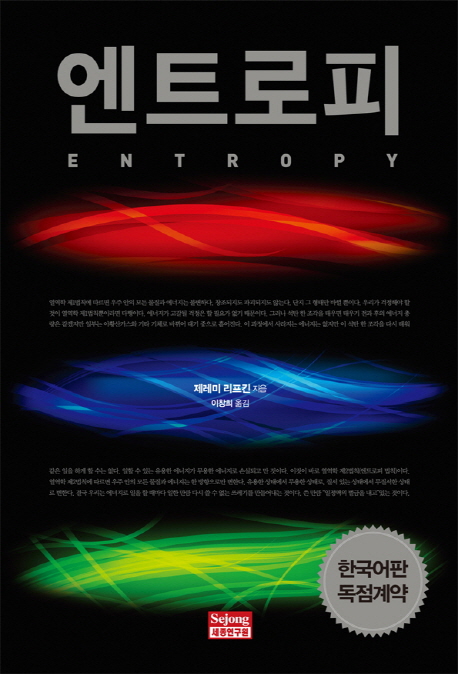
Entropy, which means 'the energy that becomes unusable when a substance undergoes a thermodynamic change, divided by the amount of heat,' is a book that contains a warning about situations where available energy is exceeded.
This shatters the view that history is a path of progress and makes us reconsider the illusion that science and technology will create a more orderly society.
From fossil fuels to oil, then from electricity to solar energy...
We have argued that this is humanity's step toward order, the development of science, and the process of progressing history.
Is that really true? According to the law of entropy, creating order anywhere, on Earth or in the universe, requires creating even greater disorder.
What happened to all the energy used to create order? Some of it must have created order.
But some of it has become an energy that can never be used again, and has only brought chaos to humanity in the name of environmental pollution, inflation, unemployment, and cancer.
And what about the Earth's resources? Are they so infinite that we can recklessly mine and use them up, leaving us with nothing left? Are we now stealing the plows of our descendants to make swords? Above all, we must recognize the limitations of the Earth's resources and embrace a low-entropy worldview that sets limits on the technologies we use.
Even if we do that, we will not be able to pass on to our descendants as much as we have inherited from our ancestors.
But if we don't do that, human history may end in our generation.
Entropy, which means 'the energy that becomes unusable when a substance undergoes a thermodynamic change, divided by the amount of heat,' is a book that contains a warning about situations where available energy is exceeded.
This shatters the view that history is a path of progress and makes us reconsider the illusion that science and technology will create a more orderly society.
From fossil fuels to oil, then from electricity to solar energy...
We have argued that this is humanity's step toward order, the development of science, and the process of progressing history.
Is that really true? According to the law of entropy, creating order anywhere, on Earth or in the universe, requires creating even greater disorder.
What happened to all the energy used to create order? Some of it must have created order.
But some of it has become an energy that can never be used again, and has only brought chaos to humanity in the name of environmental pollution, inflation, unemployment, and cancer.
And what about the Earth's resources? Are they so infinite that we can recklessly mine and use them up, leaving us with nothing left? Are we now stealing the plows of our descendants to make swords? Above all, we must recognize the limitations of the Earth's resources and embrace a low-entropy worldview that sets limits on the technologies we use.
Even if we do that, we will not be able to pass on to our descendants as much as we have inherited from our ancestors.
But if we don't do that, human history may end in our generation.
index
prolog
As you go in
Part 1: Changes in Worldview
Worldview
The Greeks and the Five Stages of History: Cycles and Declines
Christian worldview
Modern worldview
The Age of Machines
Founders of the mechanistic worldview
Part 2: The Law of Entropy
Law of Entropy
Cosmology and the Second Law
Time, Metaphysics, and Entropy
Life and the Second Law
External tools and energy
Part 3: The Framework of a New View of History - Entropy
The Watershed of History and Entropy
The final energy watershed
technology
external costs
Diminishing returns on technology
Development of the system
specialization
Worldview and Energy Environment
Part 4: Non-Renewable Energy and the Coming Entropy Watershed
energy crisis
synthetic fuel
nuclear fission energy
nuclear fusion
mineral
Replacement, Regeneration, and Conservation
Part 5: Entropy and the Industrial Age
economics
agriculture
transport
urbanization
army
education
Health
Part 6: A New Worldview - Entropy
Towards a New Economic Theory
Development of the Third World
wealth redistribution
New Infrastructure for the Solar Energy Era
Values and Institutions in an Entropic Society
Reform of science
Education reform
Second Reformation
Entropy crisis
From despair to hope
Reviews
Translator's Note
As you go in
Part 1: Changes in Worldview
Worldview
The Greeks and the Five Stages of History: Cycles and Declines
Christian worldview
Modern worldview
The Age of Machines
Founders of the mechanistic worldview
Part 2: The Law of Entropy
Law of Entropy
Cosmology and the Second Law
Time, Metaphysics, and Entropy
Life and the Second Law
External tools and energy
Part 3: The Framework of a New View of History - Entropy
The Watershed of History and Entropy
The final energy watershed
technology
external costs
Diminishing returns on technology
Development of the system
specialization
Worldview and Energy Environment
Part 4: Non-Renewable Energy and the Coming Entropy Watershed
energy crisis
synthetic fuel
nuclear fission energy
nuclear fusion
mineral
Replacement, Regeneration, and Conservation
Part 5: Entropy and the Industrial Age
economics
agriculture
transport
urbanization
army
education
Health
Part 6: A New Worldview - Entropy
Towards a New Economic Theory
Development of the Third World
wealth redistribution
New Infrastructure for the Solar Energy Era
Values and Institutions in an Entropic Society
Reform of science
Education reform
Second Reformation
Entropy crisis
From despair to hope
Reviews
Translator's Note
Into the book
If all we had to worry about was the first law of thermodynamics, we wouldn't have to worry about running out of energy.
But the world is not like that.
For example, if you burn a piece of coal, the total amount of energy before and after burning will be the same, but some of it will be converted into sulfur dioxide and other gases and dispersed into the atmosphere.
We know that no energy is lost in this process, but we cannot burn that one piece of coal again to do the same work.
An explanation for this can be found in the second law of thermodynamics.
The second law says:
Every time energy moves from one state to another, it “pays a penalty.” This penalty takes the form of a loss of useful energy that could otherwise do work.
There is a term for this.
That term is entropy.
Entropy is a measure of the amount of energy that can no longer be converted into work.
The person who first coined this term was Rudolf Clausius of Germany.
However, the law related to this was first discovered 41 years earlier by a young French army officer, Sadi Carnot.
While struggling to better understand the principles of the steam engine, Carnot discovered that the steam engine does work because one side is very hot and the other side is very cold.
In other words, for energy to be converted into work, there must be a difference in the concentration of energy (i.e., a temperature difference) in each part of the system.
Expand Close
--- p.
51
In the problem, whether it is a fan or a refrigerator, the device can be operated by receiving electric energy, and in the process, entropy increases, and ultimately, the indoor temperature increases due to the heat energy generated during the energy conversion process.
The reason we feel cool when we are hit by the wind from an electric fan is because the moisture released from our body evaporates and takes away the heat from our body.
Below I would like to quote CP Snow's famous book:
There are many gentlemen in this world who, if asked the question, "Do you know Shakespeare?" would blush and make an unpleasant expression at the person who asked them, and who would think that they had been greatly insulted for daring to ask them if they knew Shakespeare, and if asked, "Do you know the second law of thermodynamics?" would not blush at all and would calmly and shamelessly answer, "I don't know," as if it were natural not to know.
In a sense, living in this day and age, you don't need to know Shakespeare to know the second law of thermodynamics, and we can see this type of gentleman all around us today.
--- p.57
Due to our high-energy culture, the human mind has become so fragmented that it is no longer in harmony with the source of life.
Because we are isolated from nature, we have no opportunity to attain enlightenment (in the sense in which this word has been understood by many throughout history).
It is true that our ancestors were unable to scientifically understand and explain the phenomena occurring around us.
But they knew better than we did, through intuition, what was truly important in life.
Our ancestors were at least self-sufficient.
They knew how to satisfy their needs.
But we cannot produce food, we have to rely on others for entertainment, and we cannot make clothes.
We are like poor children who have to be taken care of by adults for everything.
But the world is not like that.
For example, if you burn a piece of coal, the total amount of energy before and after burning will be the same, but some of it will be converted into sulfur dioxide and other gases and dispersed into the atmosphere.
We know that no energy is lost in this process, but we cannot burn that one piece of coal again to do the same work.
An explanation for this can be found in the second law of thermodynamics.
The second law says:
Every time energy moves from one state to another, it “pays a penalty.” This penalty takes the form of a loss of useful energy that could otherwise do work.
There is a term for this.
That term is entropy.
Entropy is a measure of the amount of energy that can no longer be converted into work.
The person who first coined this term was Rudolf Clausius of Germany.
However, the law related to this was first discovered 41 years earlier by a young French army officer, Sadi Carnot.
While struggling to better understand the principles of the steam engine, Carnot discovered that the steam engine does work because one side is very hot and the other side is very cold.
In other words, for energy to be converted into work, there must be a difference in the concentration of energy (i.e., a temperature difference) in each part of the system.
Expand Close
--- p.
51
In the problem, whether it is a fan or a refrigerator, the device can be operated by receiving electric energy, and in the process, entropy increases, and ultimately, the indoor temperature increases due to the heat energy generated during the energy conversion process.
The reason we feel cool when we are hit by the wind from an electric fan is because the moisture released from our body evaporates and takes away the heat from our body.
Below I would like to quote CP Snow's famous book:
There are many gentlemen in this world who, if asked the question, "Do you know Shakespeare?" would blush and make an unpleasant expression at the person who asked them, and who would think that they had been greatly insulted for daring to ask them if they knew Shakespeare, and if asked, "Do you know the second law of thermodynamics?" would not blush at all and would calmly and shamelessly answer, "I don't know," as if it were natural not to know.
In a sense, living in this day and age, you don't need to know Shakespeare to know the second law of thermodynamics, and we can see this type of gentleman all around us today.
--- p.57
Due to our high-energy culture, the human mind has become so fragmented that it is no longer in harmony with the source of life.
Because we are isolated from nature, we have no opportunity to attain enlightenment (in the sense in which this word has been understood by many throughout history).
It is true that our ancestors were unable to scientifically understand and explain the phenomena occurring around us.
But they knew better than we did, through intuition, what was truly important in life.
Our ancestors were at least self-sufficient.
They knew how to satisfy their needs.
But we cannot produce food, we have to rely on others for entertainment, and we cannot make clothes.
We are like poor children who have to be taken care of by adults for everything.
--- p.296
GOODS SPECIFICS
- Date of issue: April 1, 2015
- Format: Hardcover book binding method guide
- Page count, weight, size: 352 pages | 638g | 152*225*22mm
- ISBN13: 9788986698824
- ISBN10: 898669882X
You may also like
카테고리
korean


korean

![GQ KOREA Mark (Monthly): December [2025]](http://librairie.coreenne.fr/cdn/shop/files/8ef265dbbfbf186523ed75ba7319009d.jpg?v=1765340328&width=3840)


