

1984
 |
Description
Book Introduction
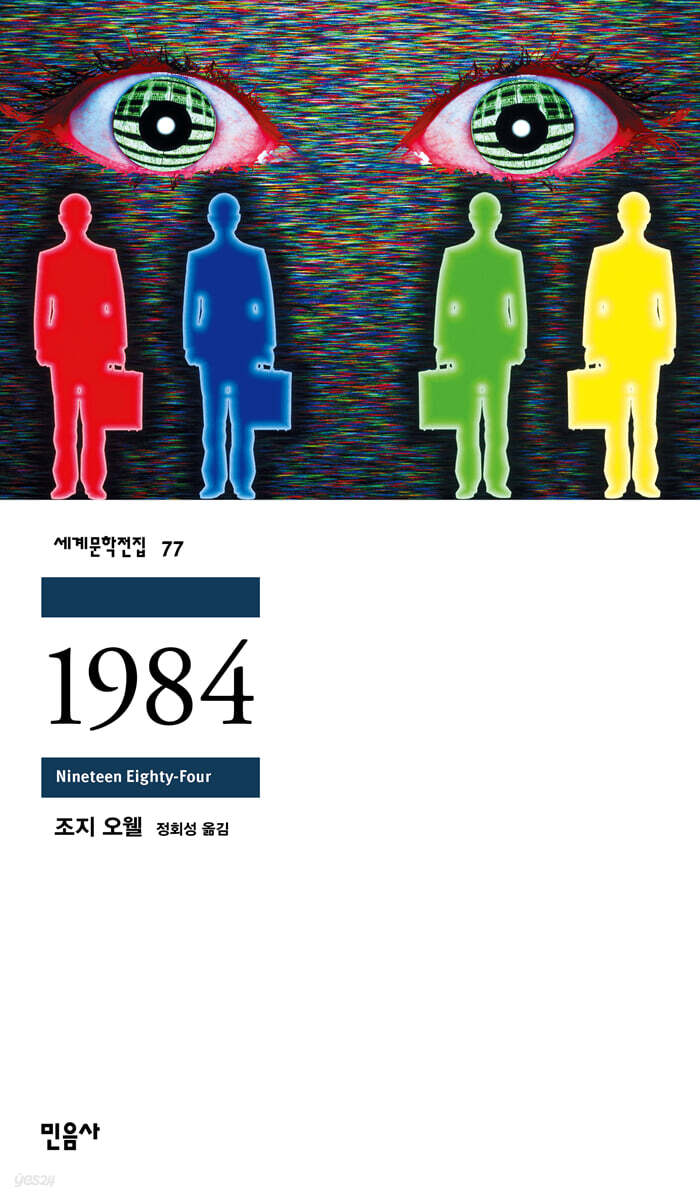
George Orwell's warning to the 21st century, an advanced information society. How do individuals resist and are destroyed by the system under a massive ruling system? A brilliant insight that suggests the direction the world should take. “He who controls the past controls the future. “He who controls the present controls the past.” George Orwell's 100th Birthday: Reflecting on Today Through His Work George Orwell's masterpiece, "1984," is a dystopian novel published in 1949 and, along with "Animal Farm," has been translated into over 60 languages. Critics at the time praised the work as a novel that criticized Soviet totalitarianism and prophesied about the future. The work's topical implications were so clear that the New York Times on June 12, 1949, wrote that "of all the works published this year, '1984' is the most contemporary." So, now that the Soviet Union has collapsed, does that mean the work no longer holds any meaning? Of course not. As social psychologist Erich Fromm said, it would be truly unfortunate to interpret 1984 only as a description of the brutality of Stalinism and not understand its meaning for Western society, and the message of his work, which is titled "1984" (Orwell completed this work in 1948, and the title "1984" is said to be a reversal of "48"), is still sufficiently meaningful for our society today, nearly 20 years later. |
- You can preview some of the book's contents.
Preview
index
Part 1
Part 2
Part 3
Appendix: Principles of New Words
Part 2
Part 3
Appendix: Principles of New Words
Into the book
Winston dreamed of his mother.
His mother disappeared when he was ten or eleven years old.
My mother was a tall, sculptural woman with luscious hair, a quiet demeanor, and a calm demeanor.
And as he vaguely remembered, his father was dark-skinned and thin, always neatly dressed in a black suit and wearing glasses.
However, these two people must have been victims of the first great purge in the 1950s.
In his dream, his mother was sitting deep below where he was, hugging his little sister.
All I remember about my younger sister is that she was a small, frail child, always silent and blinking her big eyes.
His mother and sister were looking up at him.
The place where the two people were was underground.
To be precise, it was like the bottom of a well or a deep grave.
But even though it was far below him, he kept going down further.
The two sat in the first-class cabin of the sinking ship, looking up at him through the dark water.
His mother disappeared when he was ten or eleven years old.
My mother was a tall, sculptural woman with luscious hair, a quiet demeanor, and a calm demeanor.
And as he vaguely remembered, his father was dark-skinned and thin, always neatly dressed in a black suit and wearing glasses.
However, these two people must have been victims of the first great purge in the 1950s.
In his dream, his mother was sitting deep below where he was, hugging his little sister.
All I remember about my younger sister is that she was a small, frail child, always silent and blinking her big eyes.
His mother and sister were looking up at him.
The place where the two people were was underground.
To be precise, it was like the bottom of a well or a deep grave.
But even though it was far below him, he kept going down further.
The two sat in the first-class cabin of the sinking ship, looking up at him through the dark water.
--- pp.45~46
Publisher's Review
A warning to the 21st century, a highly information-driven society where privacy violations are a growing concern.
In "1984," a device called the telescreen is used to maintain the dictatorship of a figure called Big Brother.
The telescreen was designed to receive and transmit simultaneously, allowing it to capture every single sound or movement.
The Thought Police monitor individuals through telescreens, and after living like that for so long, people become accustomed to that kind of life.
The protagonist of the work, Winston Smith, also lives under the surveillance of a telescreen all day long.
This situation was just a fantasy of the future when George Orwell wrote his work.
But today it is quite possible.
In fact, for several years now, hidden cameras have been installed in places like banks, department stores, and government offices, and we live with our every move being monitored.
How much cash we withdraw, when we withdraw it, what we buy, what documents we obtain are all exposed to someone we don't know.
Even the high-precision cameras on satellites orbiting the Earth can capture what we do in our own homes.
Additionally, phone conversations can be intercepted through wiretapping devices, and if our phones are turned on, others can determine our location.
Our personal information may be leaked to people we don't know through Internet sites.
Thus, today, with the advancement of information technology making it easier for individuals' private lives and personal information to be exposed, the warning sent by Orwell's work is taken even more seriously than in 1949 when the work was published.
Political novels aimed at awakening readers' critical consciousness
George Orwell began writing this work in 1946 and completed it in 1948.
George Orwell is famous not only for his novels but also for his essays. If you look at his essay “Why I Write” written in 1947, you can see more clearly what George Orwell was trying to say through his work.
In times of peace, I would undoubtedly have written either a flashy book or a book of simple description, and I would have lived without even knowing where my political allegiance lay.
(……) The Spanish War and other events of 1936-1937 changed the situation decisively and I have since found out where I stand.
Every single line of my serious writing since 1936 has been written, directly or indirectly, 'against' totalitarianism and 'in support of' democratic socialism as I know it.
It is nonsense to think that we can avoid these problems in such tumultuous times as ours.
(……) Animal Farm was the first novel I wrote with full awareness of what I was doing, in which I attempted to fuse political and artistic purposes.
I haven't written a novel in several years, but I'm thinking of writing one soon.
Of course it will be a failure, all books are failures, but I know exactly what kind of book I want to write.
As Erich Fromm noted, Orwell was not simply trying to predict a bleak future.
As can be seen from his essays, Orwell's '1984' is clearly political.
He brilliantly portrays his thoughts on the direction the world should take through the figure of a man who attempts resistance under a massive ruling system but ultimately fails to overcome the system's walls and is destroyed, thereby awakening the critical consciousness of readers.
In "1984," a device called the telescreen is used to maintain the dictatorship of a figure called Big Brother.
The telescreen was designed to receive and transmit simultaneously, allowing it to capture every single sound or movement.
The Thought Police monitor individuals through telescreens, and after living like that for so long, people become accustomed to that kind of life.
The protagonist of the work, Winston Smith, also lives under the surveillance of a telescreen all day long.
This situation was just a fantasy of the future when George Orwell wrote his work.
But today it is quite possible.
In fact, for several years now, hidden cameras have been installed in places like banks, department stores, and government offices, and we live with our every move being monitored.
How much cash we withdraw, when we withdraw it, what we buy, what documents we obtain are all exposed to someone we don't know.
Even the high-precision cameras on satellites orbiting the Earth can capture what we do in our own homes.
Additionally, phone conversations can be intercepted through wiretapping devices, and if our phones are turned on, others can determine our location.
Our personal information may be leaked to people we don't know through Internet sites.
Thus, today, with the advancement of information technology making it easier for individuals' private lives and personal information to be exposed, the warning sent by Orwell's work is taken even more seriously than in 1949 when the work was published.
Political novels aimed at awakening readers' critical consciousness
George Orwell began writing this work in 1946 and completed it in 1948.
George Orwell is famous not only for his novels but also for his essays. If you look at his essay “Why I Write” written in 1947, you can see more clearly what George Orwell was trying to say through his work.
In times of peace, I would undoubtedly have written either a flashy book or a book of simple description, and I would have lived without even knowing where my political allegiance lay.
(……) The Spanish War and other events of 1936-1937 changed the situation decisively and I have since found out where I stand.
Every single line of my serious writing since 1936 has been written, directly or indirectly, 'against' totalitarianism and 'in support of' democratic socialism as I know it.
It is nonsense to think that we can avoid these problems in such tumultuous times as ours.
(……) Animal Farm was the first novel I wrote with full awareness of what I was doing, in which I attempted to fuse political and artistic purposes.
I haven't written a novel in several years, but I'm thinking of writing one soon.
Of course it will be a failure, all books are failures, but I know exactly what kind of book I want to write.
As Erich Fromm noted, Orwell was not simply trying to predict a bleak future.
As can be seen from his essays, Orwell's '1984' is clearly political.
He brilliantly portrays his thoughts on the direction the world should take through the figure of a man who attempts resistance under a massive ruling system but ultimately fails to overcome the system's walls and is destroyed, thereby awakening the critical consciousness of readers.
GOODS SPECIFICS
- Date of issue: June 16, 2003
- Page count, weight, size: 444 pages | 581g | 132*225*30mm
- ISBN13: 9788937460777
- ISBN10: 8937460777
You may also like
카테고리
korean


korean

![GQ KOREA Mark (Monthly): December [2025]](http://librairie.coreenne.fr/cdn/shop/files/8ef265dbbfbf186523ed75ba7319009d.jpg?v=1765340328&width=3840)


