

Silent Spring
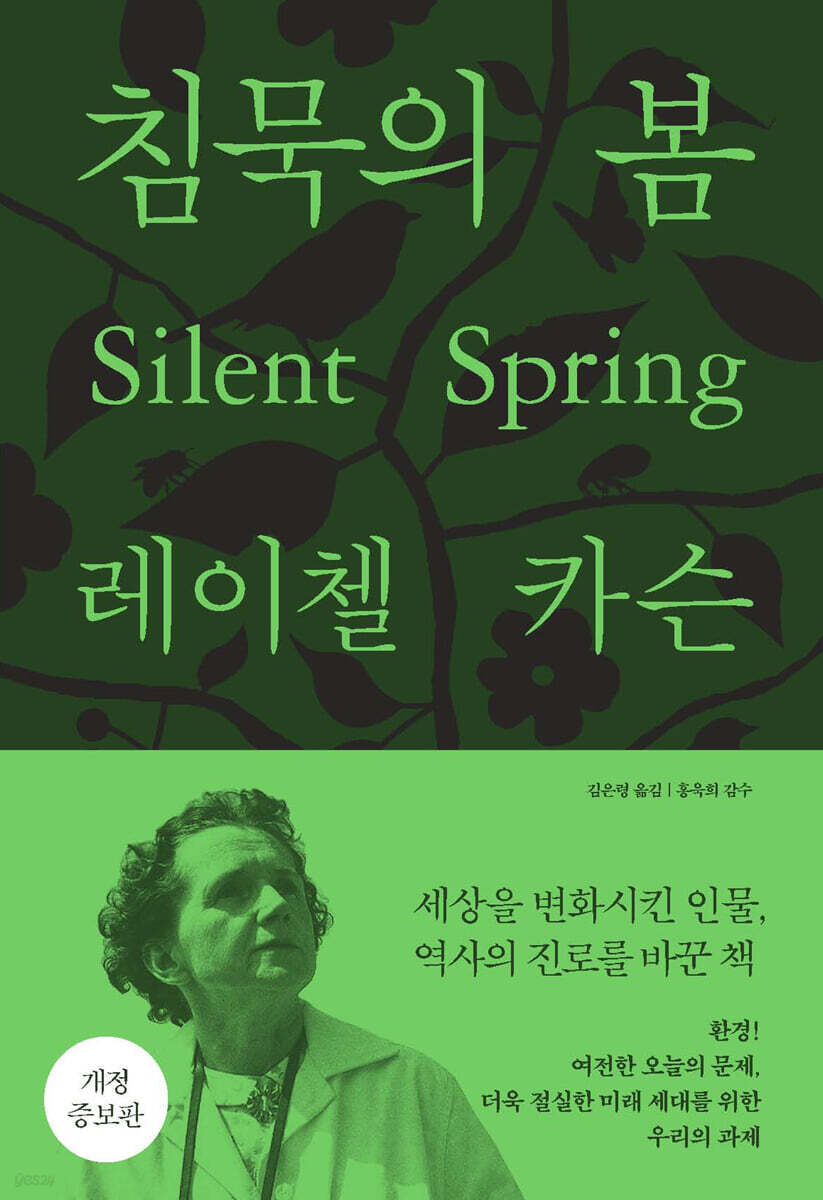 |
Description
Book Introduction
The people who changed the world, the books that changed the course of history
The ultimate classic in environmental studies that needs no further explanation.
Revised and expanded edition to be published in 2024
2024 marks the 60th anniversary of Rachel Carson's death.
The 'environment' remains a pressing issue for today, and it is also a pressing task for future generations.
This is a time when Carson's vibrant voice is desperately needed.
Many people say, “The risks of environmental problems tend to be exaggerated” or “We hear too much about the climate crisis.”
But the whole world is suffering from climate change.
Heavy rains pour down in the desert and glaciers melt.
Our country is no different, with temperatures already reaching 30 degrees Celsius in April.
The Earth is not just 'global warming'; it is 'global boiling'.
Once again, I can't help but think about the environment.
We need to consider whether we are only thinking about convenience and whether we are blindly trusting science and technology.
It is time for each of us to deeply reflect on what we are doing, how we are living, and what we should do in our own place.
We are only borrowing the Earth for a short time, so it is our duty as a generation to use it well and return it to future generations.
Future generations have the right to inherit a sustainable planet.
The revised and expanded edition includes a foreword by Sandra Steingraber, who is considered the "next Rachel Carson," as well as articles on the environment and a chronology from the publication of Silent Spring.
It will be an opportunity to understand 《Silent Spring》 more deeply and get to know Carson better.
The ultimate classic in environmental studies that needs no further explanation.
Revised and expanded edition to be published in 2024
2024 marks the 60th anniversary of Rachel Carson's death.
The 'environment' remains a pressing issue for today, and it is also a pressing task for future generations.
This is a time when Carson's vibrant voice is desperately needed.
Many people say, “The risks of environmental problems tend to be exaggerated” or “We hear too much about the climate crisis.”
But the whole world is suffering from climate change.
Heavy rains pour down in the desert and glaciers melt.
Our country is no different, with temperatures already reaching 30 degrees Celsius in April.
The Earth is not just 'global warming'; it is 'global boiling'.
Once again, I can't help but think about the environment.
We need to consider whether we are only thinking about convenience and whether we are blindly trusting science and technology.
It is time for each of us to deeply reflect on what we are doing, how we are living, and what we should do in our own place.
We are only borrowing the Earth for a short time, so it is our duty as a generation to use it well and return it to future generations.
Future generations have the right to inherit a sustainable planet.
The revised and expanded edition includes a foreword by Sandra Steingraber, who is considered the "next Rachel Carson," as well as articles on the environment and a chronology from the publication of Silent Spring.
It will be an opportunity to understand 《Silent Spring》 more deeply and get to know Carson better.
- You can preview some of the book's contents.
Preview
index
Foreword: Sandra Steingraber
Foreword: Linda Lear
Acknowledgements
01 Fable for Tomorrow
02 Duty to endure
03 The Art of Death
04 Surface water and groundwater
05 The World of Soil
06 Earth's Green Coat
07 Unnecessary destruction
08 The bird no longer sings
09 River of Death
10 Indiscriminately in the air
11 Beyond the Borgia family's dreams
12 The price humans must pay
13 Through a small window
14 One in four people
15 Nature's Counterattack
16 The coming emergency
17 Roads Not Taken
References
Review: Edward O.
Wilson
Environmental writings since the publication of Silent Spring
Attached to the publication of Silent Spring
Speech at the National Association of Women Journalists
Schweitzer Medal acceptance speech
American Garden Club Speech
Environmental Hazards: Controlling Pesticides and Other Chemical Toxins
Pollution of our environment
Audubon Medal Acceptance Speech
annual report
Translator's Note
Foreword: Linda Lear
Acknowledgements
01 Fable for Tomorrow
02 Duty to endure
03 The Art of Death
04 Surface water and groundwater
05 The World of Soil
06 Earth's Green Coat
07 Unnecessary destruction
08 The bird no longer sings
09 River of Death
10 Indiscriminately in the air
11 Beyond the Borgia family's dreams
12 The price humans must pay
13 Through a small window
14 One in four people
15 Nature's Counterattack
16 The coming emergency
17 Roads Not Taken
References
Review: Edward O.
Wilson
Environmental writings since the publication of Silent Spring
Attached to the publication of Silent Spring
Speech at the National Association of Women Journalists
Schweitzer Medal acceptance speech
American Garden Club Speech
Environmental Hazards: Controlling Pesticides and Other Chemical Toxins
Pollution of our environment
Audubon Medal Acceptance Speech
annual report
Translator's Note
Publisher's Review
The significance of this book
One of the most influential environmental classics of the 20th century, and still a must-read!
The book was serialized in a condensed version in The New Yorker in June 1962 before its publication, generating an unprecedented reader response.
The New York Times published an article titled “‘Silent Spring’ Is Now Noisy Summer.”
Supreme Court Justice William Douglas, who published the book on September 27, called Silent Spring “the most revolutionary book since Uncle Tom’s Cabin.”
Professor Noh Yong-hee, former dean of Seoul National University's Graduate School of Environmental Studies, evaluated Silent Spring as follows:
“When Charles Darwin published ‘The Origin of Species’ in the past, he received as much attack from the American chemical industry as he did from the theological community, and it is said that Mrs. Stowe brought about as much social change as the emancipation of slaves by writing ‘Uncle Tom’s Cabin’, but while Mrs. Stowe appealed to the national conscience by raising the issue of slavery, which was already a public issue, Mrs. Carson received greater praise for bringing about national opinion and transforming the social system by exposing the harmful effects of chemicals that no one knew about and therefore had no one to testify about.”
Linda Lear, a leading authority on Rachel Carson studies, says, “There aren’t many books that have changed history.
“Silent Spring is one of them,” he says in his book, Rachel Carson: Nature’s Witness.
The trigger that sparked a full-scale social movement on the issue of the environment!
This book, which starkly revealed the destruction of wildlife caused by the indiscriminate use of pesticides, brought new public awareness of environmental issues, despite criticism from the media at the time and strong obstruction from the chemical industry that attempted to block its publication, and triggered changes in government policy and the modern environmental movement.
In 1963, President Kennedy appointed an advisory committee to address environmental issues, and in 1969, the U.S. Congress passed the National Environmental Policy Act, and the National Cancer Institute presented evidence that DDT caused cancer, leading to state bans on its use.
And after reading Silent Spring, a senator suggested to President Kennedy that he conduct a national pilgrimage to protect nature, which led to the establishment of Earth Day (April 22).
Former U.S. Vice President Al Gore said that the day this book was published marked the beginning of the modern environmental movement, and former Minister of Environment Kim Myung-ja said, “In the history of the Western environment, the publication of this book is evaluated as a decisive blow that triggered a full-scale social movement on the issue of the environment.”
Rachel Carson, one of the 100 people who changed the 20th century selected by Time magazine!
Rachel Carson, who first raised awareness of the seriousness and importance of environmental issues through this book, was selected as one of the 100 people who changed the 20th century.
However, the initial disparagement of him by the media and the chemical industry was indescribable.
Pesticide manufacturers argued that pesticides were a great help to human life and did not cause any significant harm to American agriculture, and emphasized that “Rachel Carson’s false claims are taking civilization back to the Dark Ages.”
Journalists and critics also described Carson as a "hysterical woman" who used "emotional language" and had an overly sensitive nature, and said her books were "more toxic than the pesticides she cursed."
However, this book, published on September 27, 1962, garnered a national response, and 40,000 copies were pre-ordered even before publication.
And in October of that year, it was selected as the 'Book of the Month Club' and became a super bestseller, selling 600,000 copies in the fall alone.
In 1992, a panel of 22 prominent Americans, including former presidents, Supreme Court justices, and senators, selected Silent Spring as the most influential book of the past 50 years.
It also proved its worth by being selected as 4th among the '10 books that influenced the 20th century selected by 100 world-renowned scholars' and 5th among the '100 best non-fiction books of the 20th century' selected by Random House in the United States.
Motivation for writing this book
Rachel Carson's immediate inspiration for writing Silent Spring was a letter she received in January 1958 from a friend named Harkins, who lived in Massachusetts.
The letter said that a government plane had sprayed DDT into the forest to control mosquitoes, and that many of the birds he was raising had died because of it.
The friend protested to the authorities about the use of DDT, but the authorities ignored him, saying that DDT was harmless.
In response, the friend sent a letter of protest to the newspaper and sent a copy to Carson.
This prompted Carson to write a book to inform people about the reality and dangers of pesticide use, a topic he had been neglecting despite extensive research and investigation.
“I found out what I had to do.
“If I remain silent, I don’t think there will be any future peace for me,” Carson wrote to his friend Dorothy in June 1958.
He devoted himself to researching and writing for Silent Spring for four years, from 1958 to 1962.
It was fortunate that the publication was delayed.
The book was originally intended for publication in 1960 under the title “Man Against the Earth.”
However, the publication was delayed and was finally published on September 27, 1962.
He believed that it would be much better if the publication schedule was delayed.
President Kennedy, who took office in January 1961, emerged as a champion of Silent Spring.
In August 1962, the president mentioned Carson's book to a reporter asking about the potential harm of pesticides, sparking a full-scale investigation by the President's Council of Advisors on Science into the life sciences debate.
The final report substantiated the core arguments of Silent Spring and supported Carson's call for public health attention.
Based on this recommendation, congressional hearings were held in earnest in June 1963, and Carson appeared as a witness.
Around the same time, the international arms race intensified, leading to heightened social unrest and heightened concern about the threat posed to public health and the well-being of people by radioactive fallout from continued nuclear weapons testing.
In 1961, a group of Boston doctors founded the organization Physicians for Social Responsibility.
Meanwhile, in St. Louis, researchers at the Nuclear Information Committee (CNI) documented radioactive strontium in children's baby teeth.
These figures soared sharply with the advent of the atomic age and fluctuated with the timing of ongoing atomic bomb testing.
People were concerned that radioactive contamination from a nuclear explosion could spread across the continent, seep into the food chain, and penetrate the bones and teeth of children.
The fear of global destruction from nuclear war further amplified such anxieties.
The folly and horror of the arms race were significant factors that led Carson to develop a strong social consciousness in Silent Spring, a development that went beyond his pious early writings and led him to engage in public statements later in life.
Carson employed an investigative strategy.
By clearly illustrating the parallels between radioactive fallout and pesticides floating in the atmosphere, he made readers feel a sense of urgency and anger at the recklessness and urgency of the pesticide crisis, just as they did with the nuclear crisis.
He wrote in Silent Spring:
“If we are concerned about how serious the genetic problems caused by radiation are, why are we indifferent to chemicals that are similar in severity?”
Important facts this book tells us
Consisting of 17 chapters, Silent Spring tells us four important facts.
First, we are all inherently contaminated with toxic chemicals in the form of pesticides, even though no one has ever given permission for this.
These chemicals emerged primarily as weapons of war in the 1940s, but were later used for unintended purposes, Carson points out.
The most famous story about this is that a typhus epidemic among American troops stationed in Italy was stopped by controlling the disease-carrying louse [?] with DDT.
Immediately after the war, pesticide research was declassified, and with the help of advertising agencies lining New York's Madison Avenue, "economic poisons" began to be marketed to ordinary citizens, from housewives to farmers.
Not because of the demand to solve the insect and weed problem, but because the sudden increase in production capacity due to the war required a domestic market.
In this way, DDT and its sibling chemicals were redeployed for peacetime missions without any prior investigation into their long-term safety or efficacy.
The availability of older aircraft that could be converted for chemical spraying at little cost and the availability of a pool of former pilots willing to fly them also contributed to this transition.
Second, pesticides are not very effective in solving pest problems.
Whether you're spraying all over Long Island to eradicate cicada moths or adding them to your kitchen floor wax to catch houseflies, pesticides tend to make the problem worse in the long run.
Just as the indiscriminate use of antibiotics has led to the spread of resistant bacteria, the routine use of pesticides only increases resistance in weed and pest populations.
More and more chemicals are needed to combat the problem.
Additionally, pesticides kill natural enemies of target insects such as spiders, birds, frogs, and wasps, and the absence of these natural enemies allows pests to re-emerge.
“Therefore, chemical warfare can never be won, and all life will be swept up in a violent barrage,” Carson explains.
Third, in cases of non-consensual exposure to toxic substances, the public has a right to at least know the risks they face.
You need to be aware of the exposure that begins at implantation in the uterus and continues throughout your life.
We must be especially aware of the risks to wildlife, including birds, eagles, and fish, from pesticide residues on food crops, contamination of surface and groundwater, and unexpected disasters caused by large-scale pesticide distribution.
Only when we are guaranteed the fundamental right to know about all these issues can we speak out on real issues and take action in accordance with our moral obligations.
Fourth, there is no need to put the health of humans and other species at risk.
With the right vision and research and development funding, elegant, non-toxic pest control methods are readily available.
There are a number of alternative biological approaches to chemical treatments, including the use of sexually attractive substances to lure pests into traps, hormones to prevent larval-to-adult metamorphosis, sterilization, and the use of habitats for natural enemies.
For inspiration on solutions, it's better to look to nature rather than petrochemical engineering.
Carson's achievements as confirmed by this book
At that time, national cancer registries (1970–1990) did not yet exist, nor did the two theories that explain how toxic chemicals disrupt DNA activity in the absence of mutations or other genetic damage—the endocrine disruption model (circa 1996) and the epigenetic model (circa 2008)—have yet to emerge.
Yet, Carson has documented the link between pesticide exposure and cancer risk.
When he wrote the first draft of this book, the insight of toxicology that the timing of exposure to toxic substances was important, and that exposure during pregnancy, infancy, and childhood was particularly problematic, had not yet been accepted.
Carson also had no access to geographic information systems (GIS), computer mapping programs that create interesting pictures of potential cancer clusters, or spatiotemporal patterns for statistical analysis.
But through careful and painstaking investigation, he became convinced that he was witnessing the early signs of cancer spreading.
He was particularly concerned about the apparent increase in childhood chemical exposure and childhood cancer.
Silent Spring begins not with data or structural formulas of organochlorine compounds, but with lyrical allegory and a masterful narrative.
Carson knew that if he was going to keep readers turning the pages of what he called "the toxicology book," he needed to weave magic into the science, to make readers focus as much on the beauty of ecosystems as on the assaults of chemicals on them.
To show how harmful chemicals seep into our groundwater, food chain, bloodstream, cells and chromosomes, Carson relies on imagery and metaphor.
The River of Death, the toxic secret potion, the silent testimony of a dead squirrel.
As a writer, Carson's eye has captured the vast landscape of entire ecosystems, descending into underground aquifers, ascending with crop-dusting planes, and peering inside the human body to identify damage at the subcellular level.
Before becoming interested in biology, Carson in his youth aspired to be a poet or novelist, and perhaps this explains why his books are filled with scientific insight and a powerful literary imagination.
Carson's narrative is peppered with allusions to classical tragedy, mythology, and Romantic poetry.
To conclude Silent Spring, he drew on Robert Frost's famous poem "The Road Not Taken" to portray the horrific and complex situation of nationwide pest control, using a memorable image that resonated with audiences.
Carson's most important literary achievement in this book lies in his way of telling the story, particularly his deliberate paraphrasing.
After the war, chemicals returned to the world as heroes and entered people's daily lives.
It was welcomed in kitchens, schools, hospitals, and workplaces, and citizens were convinced that the chemical would make everyone's life better.
DDT in particular saved Allied lives in Europe and the Pacific, and its inventor received the Nobel Prize in Medicine.
Along with other modern technologies, it was also promoted as a miracle worker. DDT was a lethal killer of unwanted pests and a safe enough ally to be used in baby blankets to repel moths.
By challenging these positive associations, Carson revised and subverted powerful cultural narratives that have explained science, nature, and humanity's relationship to them.
He argued that command-and-control activities targeting nature are neither civilized nor progressive, but rather cruel, ignorant, arrogant, and regressive, countering the values and vague assumptions that are considered important in today's technology-driven society.
One of the most influential environmental classics of the 20th century, and still a must-read!
The book was serialized in a condensed version in The New Yorker in June 1962 before its publication, generating an unprecedented reader response.
The New York Times published an article titled “‘Silent Spring’ Is Now Noisy Summer.”
Supreme Court Justice William Douglas, who published the book on September 27, called Silent Spring “the most revolutionary book since Uncle Tom’s Cabin.”
Professor Noh Yong-hee, former dean of Seoul National University's Graduate School of Environmental Studies, evaluated Silent Spring as follows:
“When Charles Darwin published ‘The Origin of Species’ in the past, he received as much attack from the American chemical industry as he did from the theological community, and it is said that Mrs. Stowe brought about as much social change as the emancipation of slaves by writing ‘Uncle Tom’s Cabin’, but while Mrs. Stowe appealed to the national conscience by raising the issue of slavery, which was already a public issue, Mrs. Carson received greater praise for bringing about national opinion and transforming the social system by exposing the harmful effects of chemicals that no one knew about and therefore had no one to testify about.”
Linda Lear, a leading authority on Rachel Carson studies, says, “There aren’t many books that have changed history.
“Silent Spring is one of them,” he says in his book, Rachel Carson: Nature’s Witness.
The trigger that sparked a full-scale social movement on the issue of the environment!
This book, which starkly revealed the destruction of wildlife caused by the indiscriminate use of pesticides, brought new public awareness of environmental issues, despite criticism from the media at the time and strong obstruction from the chemical industry that attempted to block its publication, and triggered changes in government policy and the modern environmental movement.
In 1963, President Kennedy appointed an advisory committee to address environmental issues, and in 1969, the U.S. Congress passed the National Environmental Policy Act, and the National Cancer Institute presented evidence that DDT caused cancer, leading to state bans on its use.
And after reading Silent Spring, a senator suggested to President Kennedy that he conduct a national pilgrimage to protect nature, which led to the establishment of Earth Day (April 22).
Former U.S. Vice President Al Gore said that the day this book was published marked the beginning of the modern environmental movement, and former Minister of Environment Kim Myung-ja said, “In the history of the Western environment, the publication of this book is evaluated as a decisive blow that triggered a full-scale social movement on the issue of the environment.”
Rachel Carson, one of the 100 people who changed the 20th century selected by Time magazine!
Rachel Carson, who first raised awareness of the seriousness and importance of environmental issues through this book, was selected as one of the 100 people who changed the 20th century.
However, the initial disparagement of him by the media and the chemical industry was indescribable.
Pesticide manufacturers argued that pesticides were a great help to human life and did not cause any significant harm to American agriculture, and emphasized that “Rachel Carson’s false claims are taking civilization back to the Dark Ages.”
Journalists and critics also described Carson as a "hysterical woman" who used "emotional language" and had an overly sensitive nature, and said her books were "more toxic than the pesticides she cursed."
However, this book, published on September 27, 1962, garnered a national response, and 40,000 copies were pre-ordered even before publication.
And in October of that year, it was selected as the 'Book of the Month Club' and became a super bestseller, selling 600,000 copies in the fall alone.
In 1992, a panel of 22 prominent Americans, including former presidents, Supreme Court justices, and senators, selected Silent Spring as the most influential book of the past 50 years.
It also proved its worth by being selected as 4th among the '10 books that influenced the 20th century selected by 100 world-renowned scholars' and 5th among the '100 best non-fiction books of the 20th century' selected by Random House in the United States.
Motivation for writing this book
Rachel Carson's immediate inspiration for writing Silent Spring was a letter she received in January 1958 from a friend named Harkins, who lived in Massachusetts.
The letter said that a government plane had sprayed DDT into the forest to control mosquitoes, and that many of the birds he was raising had died because of it.
The friend protested to the authorities about the use of DDT, but the authorities ignored him, saying that DDT was harmless.
In response, the friend sent a letter of protest to the newspaper and sent a copy to Carson.
This prompted Carson to write a book to inform people about the reality and dangers of pesticide use, a topic he had been neglecting despite extensive research and investigation.
“I found out what I had to do.
“If I remain silent, I don’t think there will be any future peace for me,” Carson wrote to his friend Dorothy in June 1958.
He devoted himself to researching and writing for Silent Spring for four years, from 1958 to 1962.
It was fortunate that the publication was delayed.
The book was originally intended for publication in 1960 under the title “Man Against the Earth.”
However, the publication was delayed and was finally published on September 27, 1962.
He believed that it would be much better if the publication schedule was delayed.
President Kennedy, who took office in January 1961, emerged as a champion of Silent Spring.
In August 1962, the president mentioned Carson's book to a reporter asking about the potential harm of pesticides, sparking a full-scale investigation by the President's Council of Advisors on Science into the life sciences debate.
The final report substantiated the core arguments of Silent Spring and supported Carson's call for public health attention.
Based on this recommendation, congressional hearings were held in earnest in June 1963, and Carson appeared as a witness.
Around the same time, the international arms race intensified, leading to heightened social unrest and heightened concern about the threat posed to public health and the well-being of people by radioactive fallout from continued nuclear weapons testing.
In 1961, a group of Boston doctors founded the organization Physicians for Social Responsibility.
Meanwhile, in St. Louis, researchers at the Nuclear Information Committee (CNI) documented radioactive strontium in children's baby teeth.
These figures soared sharply with the advent of the atomic age and fluctuated with the timing of ongoing atomic bomb testing.
People were concerned that radioactive contamination from a nuclear explosion could spread across the continent, seep into the food chain, and penetrate the bones and teeth of children.
The fear of global destruction from nuclear war further amplified such anxieties.
The folly and horror of the arms race were significant factors that led Carson to develop a strong social consciousness in Silent Spring, a development that went beyond his pious early writings and led him to engage in public statements later in life.
Carson employed an investigative strategy.
By clearly illustrating the parallels between radioactive fallout and pesticides floating in the atmosphere, he made readers feel a sense of urgency and anger at the recklessness and urgency of the pesticide crisis, just as they did with the nuclear crisis.
He wrote in Silent Spring:
“If we are concerned about how serious the genetic problems caused by radiation are, why are we indifferent to chemicals that are similar in severity?”
Important facts this book tells us
Consisting of 17 chapters, Silent Spring tells us four important facts.
First, we are all inherently contaminated with toxic chemicals in the form of pesticides, even though no one has ever given permission for this.
These chemicals emerged primarily as weapons of war in the 1940s, but were later used for unintended purposes, Carson points out.
The most famous story about this is that a typhus epidemic among American troops stationed in Italy was stopped by controlling the disease-carrying louse [?] with DDT.
Immediately after the war, pesticide research was declassified, and with the help of advertising agencies lining New York's Madison Avenue, "economic poisons" began to be marketed to ordinary citizens, from housewives to farmers.
Not because of the demand to solve the insect and weed problem, but because the sudden increase in production capacity due to the war required a domestic market.
In this way, DDT and its sibling chemicals were redeployed for peacetime missions without any prior investigation into their long-term safety or efficacy.
The availability of older aircraft that could be converted for chemical spraying at little cost and the availability of a pool of former pilots willing to fly them also contributed to this transition.
Second, pesticides are not very effective in solving pest problems.
Whether you're spraying all over Long Island to eradicate cicada moths or adding them to your kitchen floor wax to catch houseflies, pesticides tend to make the problem worse in the long run.
Just as the indiscriminate use of antibiotics has led to the spread of resistant bacteria, the routine use of pesticides only increases resistance in weed and pest populations.
More and more chemicals are needed to combat the problem.
Additionally, pesticides kill natural enemies of target insects such as spiders, birds, frogs, and wasps, and the absence of these natural enemies allows pests to re-emerge.
“Therefore, chemical warfare can never be won, and all life will be swept up in a violent barrage,” Carson explains.
Third, in cases of non-consensual exposure to toxic substances, the public has a right to at least know the risks they face.
You need to be aware of the exposure that begins at implantation in the uterus and continues throughout your life.
We must be especially aware of the risks to wildlife, including birds, eagles, and fish, from pesticide residues on food crops, contamination of surface and groundwater, and unexpected disasters caused by large-scale pesticide distribution.
Only when we are guaranteed the fundamental right to know about all these issues can we speak out on real issues and take action in accordance with our moral obligations.
Fourth, there is no need to put the health of humans and other species at risk.
With the right vision and research and development funding, elegant, non-toxic pest control methods are readily available.
There are a number of alternative biological approaches to chemical treatments, including the use of sexually attractive substances to lure pests into traps, hormones to prevent larval-to-adult metamorphosis, sterilization, and the use of habitats for natural enemies.
For inspiration on solutions, it's better to look to nature rather than petrochemical engineering.
Carson's achievements as confirmed by this book
At that time, national cancer registries (1970–1990) did not yet exist, nor did the two theories that explain how toxic chemicals disrupt DNA activity in the absence of mutations or other genetic damage—the endocrine disruption model (circa 1996) and the epigenetic model (circa 2008)—have yet to emerge.
Yet, Carson has documented the link between pesticide exposure and cancer risk.
When he wrote the first draft of this book, the insight of toxicology that the timing of exposure to toxic substances was important, and that exposure during pregnancy, infancy, and childhood was particularly problematic, had not yet been accepted.
Carson also had no access to geographic information systems (GIS), computer mapping programs that create interesting pictures of potential cancer clusters, or spatiotemporal patterns for statistical analysis.
But through careful and painstaking investigation, he became convinced that he was witnessing the early signs of cancer spreading.
He was particularly concerned about the apparent increase in childhood chemical exposure and childhood cancer.
Silent Spring begins not with data or structural formulas of organochlorine compounds, but with lyrical allegory and a masterful narrative.
Carson knew that if he was going to keep readers turning the pages of what he called "the toxicology book," he needed to weave magic into the science, to make readers focus as much on the beauty of ecosystems as on the assaults of chemicals on them.
To show how harmful chemicals seep into our groundwater, food chain, bloodstream, cells and chromosomes, Carson relies on imagery and metaphor.
The River of Death, the toxic secret potion, the silent testimony of a dead squirrel.
As a writer, Carson's eye has captured the vast landscape of entire ecosystems, descending into underground aquifers, ascending with crop-dusting planes, and peering inside the human body to identify damage at the subcellular level.
Before becoming interested in biology, Carson in his youth aspired to be a poet or novelist, and perhaps this explains why his books are filled with scientific insight and a powerful literary imagination.
Carson's narrative is peppered with allusions to classical tragedy, mythology, and Romantic poetry.
To conclude Silent Spring, he drew on Robert Frost's famous poem "The Road Not Taken" to portray the horrific and complex situation of nationwide pest control, using a memorable image that resonated with audiences.
Carson's most important literary achievement in this book lies in his way of telling the story, particularly his deliberate paraphrasing.
After the war, chemicals returned to the world as heroes and entered people's daily lives.
It was welcomed in kitchens, schools, hospitals, and workplaces, and citizens were convinced that the chemical would make everyone's life better.
DDT in particular saved Allied lives in Europe and the Pacific, and its inventor received the Nobel Prize in Medicine.
Along with other modern technologies, it was also promoted as a miracle worker. DDT was a lethal killer of unwanted pests and a safe enough ally to be used in baby blankets to repel moths.
By challenging these positive associations, Carson revised and subverted powerful cultural narratives that have explained science, nature, and humanity's relationship to them.
He argued that command-and-control activities targeting nature are neither civilized nor progressive, but rather cruel, ignorant, arrogant, and regressive, countering the values and vague assumptions that are considered important in today's technology-driven society.
GOODS SPECIFICS
- Date of issue: April 30, 2024
- Page count, weight, size: 504 pages | 688g | 148*215*25mm
- ISBN13: 9788962632729
- ISBN10: 8962632721
You may also like
카테고리
korean


korean

![GQ KOREA Mark (Monthly): December [2025]](http://librairie.coreenne.fr/cdn/shop/files/8ef265dbbfbf186523ed75ba7319009d.jpg?v=1765340328&width=3840)


