

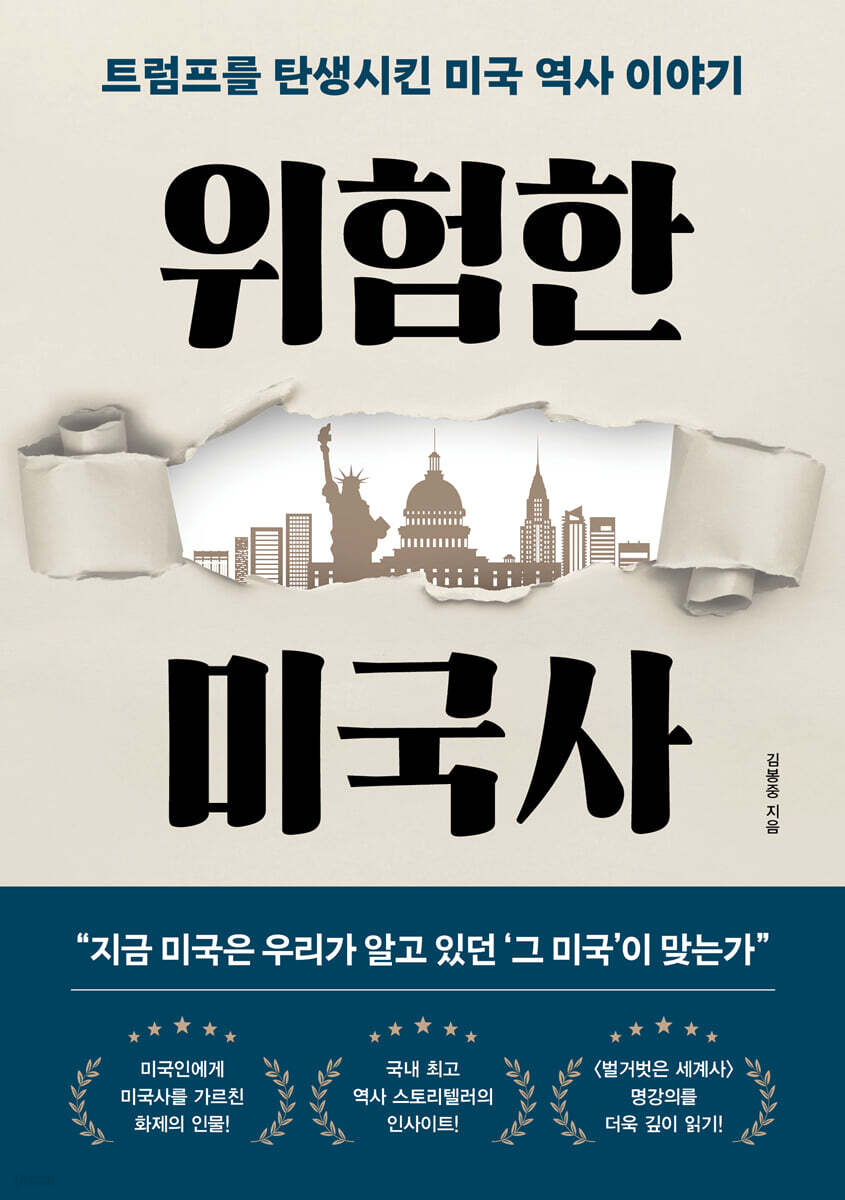
Dangerous American History
 |
Description
Book Introduction
- A word from MD
-
Reading the Real America Beyond TrumpHigh tariffs, immigration controls, Trumpism… Where is America headed? Could it be that we haven't truly grasped the true face of America? Professor Kim Bong-joong, an authority on American history, examines the political, economic, and cultural landscapes in detail, tracing the grand historical trends that underpin understanding America in the Trump era.
September 23, 2025. Producer Hyunjae Ahn of History
★ Most frequent speaker on tvN's "Naked World History" ★
★ The highest authority on American history who taught American history to Americans ★
★ Winner of the 'Professor of the Year' Award, selected by American college students ★
A new work by Professor Kim Bong-joong, Korea's leading historical storyteller!
A masterful lecture on American history that cuts through an unpredictable era!
There are three major misconceptions about America.
These misconceptions are as follows:
First, the United States is a “just nation” that protects the world order.
Second, the United States has been imposing 'reasonable tariffs' on other countries.
Third, America is a 'nation of immigrants.'
The United States has advocated isolationism since its independence.
Economically, they interacted with other countries, but politically and militarily, they tried to avoid alliances.
This blatant prioritization of national interests led to the "America First" policy after Trump's election in 2016.
The same goes for the 'high tariff policy' that makes headlines every day.
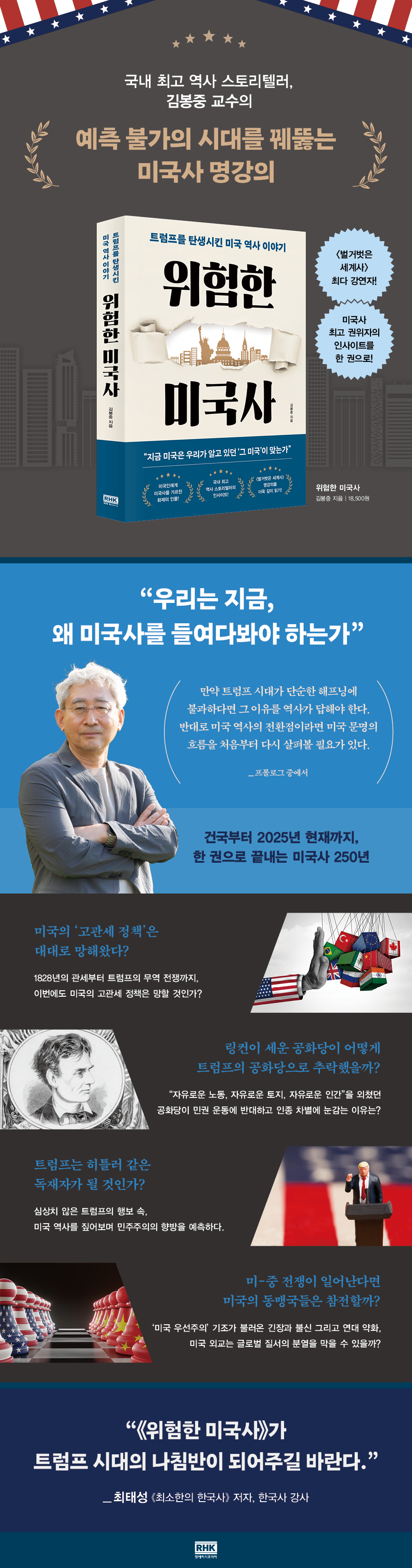
The United States has implemented a trade policy of imposing high tariffs several times, starting with the tariff of 1828, to protect its domestic industries.
What about the anti-immigration policies that come to mind when you think of the "Mexican Wall"? In the late 19th and early 20th centuries, a movement to restrict immigration, driven by the question "who set foot on American soil first?", was actively underway, and in 1924, strict immigration control laws were enacted.
Professor Bong-Joong Kim, Korea's top historical storyteller who captivated the public with his easy and engaging lectures on "Naked World History" and a leading authority on American history who taught American history to Americans, has revealed the other side of American history in "Dangerous American History," revealing even the somewhat dangerous facts one by one.
By examining the historical flow of American politics, economy, diplomacy, society, and culture, we dissect the mystery that led to the "result" known as Trump.
Through American history, we examine the causes that gave birth to the United States of today, and offer insights that will help us navigate these turbulent times as we face unprecedented chaos and uncertainty.
★ The highest authority on American history who taught American history to Americans ★
★ Winner of the 'Professor of the Year' Award, selected by American college students ★
A new work by Professor Kim Bong-joong, Korea's leading historical storyteller!
A masterful lecture on American history that cuts through an unpredictable era!
There are three major misconceptions about America.
These misconceptions are as follows:
First, the United States is a “just nation” that protects the world order.
Second, the United States has been imposing 'reasonable tariffs' on other countries.
Third, America is a 'nation of immigrants.'
The United States has advocated isolationism since its independence.
Economically, they interacted with other countries, but politically and militarily, they tried to avoid alliances.
This blatant prioritization of national interests led to the "America First" policy after Trump's election in 2016.
The same goes for the 'high tariff policy' that makes headlines every day.
The United States has implemented a trade policy of imposing high tariffs several times, starting with the tariff of 1828, to protect its domestic industries.
What about the anti-immigration policies that come to mind when you think of the "Mexican Wall"? In the late 19th and early 20th centuries, a movement to restrict immigration, driven by the question "who set foot on American soil first?", was actively underway, and in 1924, strict immigration control laws were enacted.
Professor Bong-Joong Kim, Korea's top historical storyteller who captivated the public with his easy and engaging lectures on "Naked World History" and a leading authority on American history who taught American history to Americans, has revealed the other side of American history in "Dangerous American History," revealing even the somewhat dangerous facts one by one.
By examining the historical flow of American politics, economy, diplomacy, society, and culture, we dissect the mystery that led to the "result" known as Trump.
Through American history, we examine the causes that gave birth to the United States of today, and offer insights that will help us navigate these turbulent times as we face unprecedented chaos and uncertainty.
- You can preview some of the book's contents.
Preview
index
Prologue: The Trump phenomenon began 250 years ago, at the founding of the United States.
Chapter 1.
The Background and History of Trump's Second Term
1.
The miracle of a heretic in American politics
How Trump Won Again
- The polarization deeply engraved in the background of victory
2.
Who supported Trump and why?
- A history of tightly knit white conservatives
- Swing states that determine the presidential election
- New social media and changes in the information ecosystem
3.
A Look at America Today: Economy and Society
- Fears of inflation and economic slowdown
- Curbing soaring inflation with high tariffs?
High tariff policies in American history that led to negative consequences
- If we stop illegal immigration, almost all problems will be solved?
4.
A Look at America Today: Democracy
- An untimely debate on left-wing Marxist ideology
- Unresolved conflicts and regionalism that began since the nation's founding
5.
How should we view Trump's first term?
- Economic policies that accelerated the gap between the rich and the poor and led to trade deficits
- Domestic policies that deepen division and conflict
- A foreign policy that has cast doubt on America's leadership.
Chapter 2.
A Crisis for Democracy or a New Turning Point?
1.
The principle of 'checks and balances' that has been strictly in operation since the founding of the country
- The Inevitable Fight, Federal Government v.
State government
- The two entrenched spires of American politics: the two-party system
2.
Lincoln's Republican Party's Fall to Trump's
- The history of the founding of the Republican Party and Lincoln's election
The Republican Party at a Crossroads
- The Republican Party's transformation during the Great Depression
3.
New Deal and New Democracy
- The laissez-faire tradition that began with the founding of the nation
- The New Deal, a pillar of American progressive democracy
Conservative counterattack and Trump's counterattack
4.
The Evolution of the Democratic Party and Obama's America
- The Democratic Party from Franklin Roosevelt to Bill Clinton
Obama pursued acceptance and inclusion of differences.
- The legacy of the Obama administration
5.
Is Trump the heretic of American democracy?
Donald Trump, who emerged like a whirlwind into the political world
- A heresy born of capitalism and social media
Chapter 3.
Trump destroys American diplomatic traditions
1.
America's traditional foreign policy: isolationism
- A model treaty that became the first foreign policy and example
- The Monroe Doctrine declared independence from the Old World.
- Go west, young man!
2.
World War II ushered in the American Century
- Declining isolationism, rising imperialism
World War I, the moment that brought America to the world stage
- The signal flare that opened the American century, World War II
3.
The Cold War and the Post-Cold War: Leading World Order Through Ideological Conflict
The Cold War gave birth to a new American diplomatic principle.
- From the Vietnam War to the Reagan era
- The role of the United States changed after the end of the Cold War
4.
The new order triggered by the 9/11 terrorist attacks
A war with only a pretext, a war that ended in failure.
Obama Redefines America's Role
- Trump's first term and Biden's diplomacy
5.
A Return to the Cold War: The Rise of a New Cold War Between the US and China
- China, a new power that has emerged rapidly since the end of the Cold War
- Changes in Relations Brought About by China's Accession to the World Trade Organization
- Is Trump a destroyer of American diplomatic traditions?
Chapter 4.
Is a second civil war inevitable?
1.
Traditions and Characteristics of American Multiculturalism
- Which path should America choose: the melting pot or the salad bowl?
- Who first set foot on American soil?
- What is true American multiculturalism?
2.
multiculturalism v.
regionalism
- The multicultural wave of the West Coast brought about by the Gold Rush
- Conservatism in the mountainous western region and the political divide between urban and rural areas
The nature of deep-rooted regionalism and the division between the South and the North
3.
The Beginning of Equality and the Conservative Counterattack
Angry conservatives turn to the Republican Party.
From Reagan to Gingrich, the Age of Conservative Reaction
- Republican hero, George W.
Bush's Dilemma
4.
The Culture War Over Human Rights Protection and the Right to Discriminate
- Marriage defense law that recognizes only unions between a man and a woman
- Is gun control realistically possible?
No more 'American Dream', the problem of illegal immigration
5.
Polarization reaching extremes
The increasingly intensifying dichotomy of "us" and "them"
The 2016 election, a time of anxiety and anger
- The January 6th Capitol Incident: A Day of Crisis for American Democracy
Chapter 5.
Where will Trump's America go?
1.
The illusions and delusions surrounding Trump
- A heretic who broke American diplomatic traditions
- A heretic who broke the tradition of free trade
2.
The undying flame: How will the conflict between the camps unfold?
- A history of crisis, heroes, and recurring factional conflicts.
Trump at the center of an emotional battle between factions
3.
Will Trump become America's Hitler?
- The First Amendment to the Constitution, the barrier to "freedom of expression"
- The solid pillar of 'checks and balances'
- The tradition of 'whistleblowers' who resist injustice
- What is the last bastion of democracy in the Trump era?
4.
Will World War III happen?
- Where will the new US-China Cold War lead?
- What if the new Cold War leads to armed conflict?
5.
The Future and Our Attitude in the Trump Era
- An era of extremes, marked by division and conflict
- How should South Korea overcome this crisis?
Chapter 1.
The Background and History of Trump's Second Term
1.
The miracle of a heretic in American politics
How Trump Won Again
- The polarization deeply engraved in the background of victory
2.
Who supported Trump and why?
- A history of tightly knit white conservatives
- Swing states that determine the presidential election
- New social media and changes in the information ecosystem
3.
A Look at America Today: Economy and Society
- Fears of inflation and economic slowdown
- Curbing soaring inflation with high tariffs?
High tariff policies in American history that led to negative consequences
- If we stop illegal immigration, almost all problems will be solved?
4.
A Look at America Today: Democracy
- An untimely debate on left-wing Marxist ideology
- Unresolved conflicts and regionalism that began since the nation's founding
5.
How should we view Trump's first term?
- Economic policies that accelerated the gap between the rich and the poor and led to trade deficits
- Domestic policies that deepen division and conflict
- A foreign policy that has cast doubt on America's leadership.
Chapter 2.
A Crisis for Democracy or a New Turning Point?
1.
The principle of 'checks and balances' that has been strictly in operation since the founding of the country
- The Inevitable Fight, Federal Government v.
State government
- The two entrenched spires of American politics: the two-party system
2.
Lincoln's Republican Party's Fall to Trump's
- The history of the founding of the Republican Party and Lincoln's election
The Republican Party at a Crossroads
- The Republican Party's transformation during the Great Depression
3.
New Deal and New Democracy
- The laissez-faire tradition that began with the founding of the nation
- The New Deal, a pillar of American progressive democracy
Conservative counterattack and Trump's counterattack
4.
The Evolution of the Democratic Party and Obama's America
- The Democratic Party from Franklin Roosevelt to Bill Clinton
Obama pursued acceptance and inclusion of differences.
- The legacy of the Obama administration
5.
Is Trump the heretic of American democracy?
Donald Trump, who emerged like a whirlwind into the political world
- A heresy born of capitalism and social media
Chapter 3.
Trump destroys American diplomatic traditions
1.
America's traditional foreign policy: isolationism
- A model treaty that became the first foreign policy and example
- The Monroe Doctrine declared independence from the Old World.
- Go west, young man!
2.
World War II ushered in the American Century
- Declining isolationism, rising imperialism
World War I, the moment that brought America to the world stage
- The signal flare that opened the American century, World War II
3.
The Cold War and the Post-Cold War: Leading World Order Through Ideological Conflict
The Cold War gave birth to a new American diplomatic principle.
- From the Vietnam War to the Reagan era
- The role of the United States changed after the end of the Cold War
4.
The new order triggered by the 9/11 terrorist attacks
A war with only a pretext, a war that ended in failure.
Obama Redefines America's Role
- Trump's first term and Biden's diplomacy
5.
A Return to the Cold War: The Rise of a New Cold War Between the US and China
- China, a new power that has emerged rapidly since the end of the Cold War
- Changes in Relations Brought About by China's Accession to the World Trade Organization
- Is Trump a destroyer of American diplomatic traditions?
Chapter 4.
Is a second civil war inevitable?
1.
Traditions and Characteristics of American Multiculturalism
- Which path should America choose: the melting pot or the salad bowl?
- Who first set foot on American soil?
- What is true American multiculturalism?
2.
multiculturalism v.
regionalism
- The multicultural wave of the West Coast brought about by the Gold Rush
- Conservatism in the mountainous western region and the political divide between urban and rural areas
The nature of deep-rooted regionalism and the division between the South and the North
3.
The Beginning of Equality and the Conservative Counterattack
Angry conservatives turn to the Republican Party.
From Reagan to Gingrich, the Age of Conservative Reaction
- Republican hero, George W.
Bush's Dilemma
4.
The Culture War Over Human Rights Protection and the Right to Discriminate
- Marriage defense law that recognizes only unions between a man and a woman
- Is gun control realistically possible?
No more 'American Dream', the problem of illegal immigration
5.
Polarization reaching extremes
The increasingly intensifying dichotomy of "us" and "them"
The 2016 election, a time of anxiety and anger
- The January 6th Capitol Incident: A Day of Crisis for American Democracy
Chapter 5.
Where will Trump's America go?
1.
The illusions and delusions surrounding Trump
- A heretic who broke American diplomatic traditions
- A heretic who broke the tradition of free trade
2.
The undying flame: How will the conflict between the camps unfold?
- A history of crisis, heroes, and recurring factional conflicts.
Trump at the center of an emotional battle between factions
3.
Will Trump become America's Hitler?
- The First Amendment to the Constitution, the barrier to "freedom of expression"
- The solid pillar of 'checks and balances'
- The tradition of 'whistleblowers' who resist injustice
- What is the last bastion of democracy in the Trump era?
4.
Will World War III happen?
- Where will the new US-China Cold War lead?
- What if the new Cold War leads to armed conflict?
5.
The Future and Our Attitude in the Trump Era
- An era of extremes, marked by division and conflict
- How should South Korea overcome this crisis?
Detailed image
Into the book
Trump's emergence was a storm that shook the world.
Even America's top presidential election historians couldn't accurately predict the outcome of the 2024 election.
Everyone was confused.
No one can predict whether Trump will plunge America and the world into irreversible chaos or bring about unexpected change.
We now stand in the midst of unprecedented chaos and uncertainty.
--- p.4
President Obama helped overcome the economic crisis through stimulus measures and emergency aid programs.
Unemployment rates gradually declined, many jobs were created, and the economy gradually stabilized.
Nevertheless, public discontent with the established political forces and elites persisted and deepened.
This is the question.
Regardless of the Obama administration's achievements, why has polarization not diminished but rather intensified?
--- p.23
There is a complex relationship between inflation and tariffs.
Of course, there is a possibility that Trump's high tariff policy will reduce the trade deficit, revitalize domestic industries, and create jobs, but this remains a hypothesis.
Today, the U.S. economy is deeply interconnected with the global economy, so expecting a recovery solely through tariff policies is an oversimplification.
--- p.36
Finally, in 1860, Abraham Lincoln, the first Republican presidential candidate, was elected.
His election, like a sword of fate, split America in two.
The South immediately reacted to Lincoln's victory, and their discontent soon ignited the flames of war.
The Civil War was brutal.
Brother turned against brother and the land was stained with blood.
Families were divided into North and South, pointing their swords at each other, and even President Lincoln's two brothers-in-law joined the Confederate Army and fought against Lincoln.
As many as 600,000 people died.
At that time, one in four soldiers who participated in the war lost their lives.
It was a very fierce and brutal war.
--- p.77
The New Deal wasn't just about economic salvation.
It was a policy that aroused pride in the system in the hearts of Americans.
It was an effort to restore national trust, protect the environment, defend labor rights, and build social welfare.
In particular, the Social Security Act established a safety net for the elderly, the unemployed, and the poor, introducing unemployment insurance, old-age pensions, and support systems for the disabled and the poor.
This law strengthened the government's role in social welfare and laid the foundation for modern welfare democracy.
American democracy is largely divided into before and after Roosevelt's New Deal policies.
--- p.88~89
Less than a year after the outbreak of war, France was occupied by Hitler.
Britain was in a precarious position in the war with Germany.
British Prime Minister Churchill desperately appealed for America's participation in the war, but America's isolationism remained unshaken.
As the "America First" movement spread nationwide, Americans once again cried out for non-intervention in the European war.
--- p.137~138
Even before the 9/11 attacks, neoconservatives were considering the possibility of military action against Iraq.
They argued that without removing the Hussein regime, instability in the Middle East would continue, which would be fatal to American interests.
Some have argued that a catastrophic event like a "new Pearl Harbor" might be necessary to support these policies.
The 9/11 terrorist attacks were an opportunity for them.
They believed that America had to show the world its power.
--- p.150
Meanwhile, on the West Coast, another spark of hatred was burning.
As westward expansion brought abundant jobs, Chinese workers came to America to work in gold mines and build railroads.
The Chinese, who earned lower wages than whites, were a thorn in the side even to new immigrants like the Irish.
They were branded as stealing white people's jobs, driving down their wages, being immoral, unsanitary, and unfit to integrate into American society.
Ultimately, in 1882, the first law restricting immigration in American history was passed, banning Chinese laborers from entering the United States.
--- p.178~179
Accordingly, Trump put forward 'America First' and 'overcoming trade unfairness' in 2016.
It was a calculated strategy to stoke wariness toward China and exploit domestic anxiety and discontent as political capital.
From the beginning of his first term, Trump has pressured China by imposing tariffs so strong that it has been called a trade war.
The policy reflected anti-China sentiment and economic discontent in the United States, while also containing the intention to reorganize the global trade order.
In the 2024 presidential election, Trump consolidated his support base by fanning Americans' anxiety, distrust, and anger.
American politics is now driven by emotion, especially hatred toward certain groups, rather than logic and policy.
--- p.242
Still, it's difficult to completely shake off worries, as war isn't always predictable through logic.
The possibility that the hot powder keg of Taiwan and the South China Sea could explode due to a momentary miscalculation cannot be completely ruled out.
What would happen if this powder keg exploded and a localized war broke out between the US and China? Would America's aforementioned allies intervene and support the US as expected? Until Trump came to power, few experts questioned this prediction.
But things have changed.
Even America's top presidential election historians couldn't accurately predict the outcome of the 2024 election.
Everyone was confused.
No one can predict whether Trump will plunge America and the world into irreversible chaos or bring about unexpected change.
We now stand in the midst of unprecedented chaos and uncertainty.
--- p.4
President Obama helped overcome the economic crisis through stimulus measures and emergency aid programs.
Unemployment rates gradually declined, many jobs were created, and the economy gradually stabilized.
Nevertheless, public discontent with the established political forces and elites persisted and deepened.
This is the question.
Regardless of the Obama administration's achievements, why has polarization not diminished but rather intensified?
--- p.23
There is a complex relationship between inflation and tariffs.
Of course, there is a possibility that Trump's high tariff policy will reduce the trade deficit, revitalize domestic industries, and create jobs, but this remains a hypothesis.
Today, the U.S. economy is deeply interconnected with the global economy, so expecting a recovery solely through tariff policies is an oversimplification.
--- p.36
Finally, in 1860, Abraham Lincoln, the first Republican presidential candidate, was elected.
His election, like a sword of fate, split America in two.
The South immediately reacted to Lincoln's victory, and their discontent soon ignited the flames of war.
The Civil War was brutal.
Brother turned against brother and the land was stained with blood.
Families were divided into North and South, pointing their swords at each other, and even President Lincoln's two brothers-in-law joined the Confederate Army and fought against Lincoln.
As many as 600,000 people died.
At that time, one in four soldiers who participated in the war lost their lives.
It was a very fierce and brutal war.
--- p.77
The New Deal wasn't just about economic salvation.
It was a policy that aroused pride in the system in the hearts of Americans.
It was an effort to restore national trust, protect the environment, defend labor rights, and build social welfare.
In particular, the Social Security Act established a safety net for the elderly, the unemployed, and the poor, introducing unemployment insurance, old-age pensions, and support systems for the disabled and the poor.
This law strengthened the government's role in social welfare and laid the foundation for modern welfare democracy.
American democracy is largely divided into before and after Roosevelt's New Deal policies.
--- p.88~89
Less than a year after the outbreak of war, France was occupied by Hitler.
Britain was in a precarious position in the war with Germany.
British Prime Minister Churchill desperately appealed for America's participation in the war, but America's isolationism remained unshaken.
As the "America First" movement spread nationwide, Americans once again cried out for non-intervention in the European war.
--- p.137~138
Even before the 9/11 attacks, neoconservatives were considering the possibility of military action against Iraq.
They argued that without removing the Hussein regime, instability in the Middle East would continue, which would be fatal to American interests.
Some have argued that a catastrophic event like a "new Pearl Harbor" might be necessary to support these policies.
The 9/11 terrorist attacks were an opportunity for them.
They believed that America had to show the world its power.
--- p.150
Meanwhile, on the West Coast, another spark of hatred was burning.
As westward expansion brought abundant jobs, Chinese workers came to America to work in gold mines and build railroads.
The Chinese, who earned lower wages than whites, were a thorn in the side even to new immigrants like the Irish.
They were branded as stealing white people's jobs, driving down their wages, being immoral, unsanitary, and unfit to integrate into American society.
Ultimately, in 1882, the first law restricting immigration in American history was passed, banning Chinese laborers from entering the United States.
--- p.178~179
Accordingly, Trump put forward 'America First' and 'overcoming trade unfairness' in 2016.
It was a calculated strategy to stoke wariness toward China and exploit domestic anxiety and discontent as political capital.
From the beginning of his first term, Trump has pressured China by imposing tariffs so strong that it has been called a trade war.
The policy reflected anti-China sentiment and economic discontent in the United States, while also containing the intention to reorganize the global trade order.
In the 2024 presidential election, Trump consolidated his support base by fanning Americans' anxiety, distrust, and anger.
American politics is now driven by emotion, especially hatred toward certain groups, rather than logic and policy.
--- p.242
Still, it's difficult to completely shake off worries, as war isn't always predictable through logic.
The possibility that the hot powder keg of Taiwan and the South China Sea could explode due to a momentary miscalculation cannot be completely ruled out.
What would happen if this powder keg exploded and a localized war broke out between the US and China? Would America's aforementioned allies intervene and support the US as expected? Until Trump came to power, few experts questioned this prediction.
But things have changed.
--- p.259~260
Publisher's Review
Is America Today the 'America' We Used to Know?
Re-analyzing the 'real America' beyond Trump!
“50% tariffs from the US expand to include machinery… blow to Korean steel and machinery industries”, “Intel and Micron advance thanks to the US government… survival strategy for K-semiconductors in the ‘America First’ era”, “Deport illegal immigrants to get 100 million won in annual salary”, “European leaders head to the US in droves to persuade Trump”, etc., etc., etc., etc., etc. Real-time, noisy reports are pouring out.
More than ever, the world's attention is focused on America's future, and a single word from Trump can turn the world upside down.
Why should we look into American history now? Because America is our mirror.
To examine American history is to look into our past, present, and future.
Because democracy, economy, diplomacy, society, and culture are all closely intertwined, America's affairs soon become our affairs.
At this time of great confusion, no one can predict whether the United States and the world will sink into an irreversible quagmire or face unexpected changes.
However, we can diagnose the present and prepare for the future through the fragments we have gathered in the flow of history.
Our lives also change depending on how we view and interpret past history and its flow.
Through this book, we will examine why the United States has become what it is in 2025 and envision the future of the United States, Korea, and the world.
The easiest and most interesting way to read American history,
A condensed history of American politics, economics, and culture in one volume!
Professor Kim Bong-joong, who has studied American history his entire life, diagnosed that “100 years from now, the Trump remembered in American history will be just a mere incident.”
Sensing the need to illuminate the Trump era within the context of history and civilization, he explains that to understand present-day America, we must trace the grand course of history.
This is because the phenomena that are occurring now have actually been sprouting since the founding of the United States some 250 years ago.
This is especially true of the 'anti-immigration policy' that has become more intense recently.
The current controversial policy of strong immigrant deportation is not a strange phenomenon that only appeared after Trump became president.
The United States has consistently accepted and rejected immigrants.
Representative examples include the emergence of the American Party, an anti-immigrant political group in the 1840s that argued that preventing Irish immigration and holding public office would "make America American," and the Chinese Exclusion Act, passed in 1882, which prohibited the entry of Chinese workers.
The history of distinguishing between 'me and you' and rejecting and discriminating against others has been vividly passed down and has shaped the present.
In addition, 'Why is the regional conflict between the South and the North still unresolved even after 160 years, when hundreds of thousands of casualties occurred in the Civil War?', 'Why did the United States, which declared isolationism, show its presence in World Wars I and II?', 'The United States is in a new Cold War with China.
Why does the United States constantly create external 'enemies' and engage in power struggles?, Why did Obamacare, which provided health benefits to millions of uninsured Americans, become a spark of political polarization?, Will World War III actually happen?, etc. This book provides historical clues to understanding the events taking place in the United States today.
The author breathes life into stories recorded in American history, stories that have been questioned, and brings together fragmented stories before our eyes.
It makes us take a closer look at the United States, a country that feels close yet distant.
It clearly revealed the stories of history that we had not been able to read until now, and the shadows behind them.
If you want to read the vast history of the United States in the most concise manner, if you want to learn about the United States in the easiest and most engaging way, if you want to overcome a history of division and conflict and endure a time of constant change and uncertainty, I recommend this book, which encapsulates 250 years of American history in one volume.
Re-analyzing the 'real America' beyond Trump!
“50% tariffs from the US expand to include machinery… blow to Korean steel and machinery industries”, “Intel and Micron advance thanks to the US government… survival strategy for K-semiconductors in the ‘America First’ era”, “Deport illegal immigrants to get 100 million won in annual salary”, “European leaders head to the US in droves to persuade Trump”, etc., etc., etc., etc., etc. Real-time, noisy reports are pouring out.
More than ever, the world's attention is focused on America's future, and a single word from Trump can turn the world upside down.
Why should we look into American history now? Because America is our mirror.
To examine American history is to look into our past, present, and future.
Because democracy, economy, diplomacy, society, and culture are all closely intertwined, America's affairs soon become our affairs.
At this time of great confusion, no one can predict whether the United States and the world will sink into an irreversible quagmire or face unexpected changes.
However, we can diagnose the present and prepare for the future through the fragments we have gathered in the flow of history.
Our lives also change depending on how we view and interpret past history and its flow.
Through this book, we will examine why the United States has become what it is in 2025 and envision the future of the United States, Korea, and the world.
The easiest and most interesting way to read American history,
A condensed history of American politics, economics, and culture in one volume!
Professor Kim Bong-joong, who has studied American history his entire life, diagnosed that “100 years from now, the Trump remembered in American history will be just a mere incident.”
Sensing the need to illuminate the Trump era within the context of history and civilization, he explains that to understand present-day America, we must trace the grand course of history.
This is because the phenomena that are occurring now have actually been sprouting since the founding of the United States some 250 years ago.
This is especially true of the 'anti-immigration policy' that has become more intense recently.
The current controversial policy of strong immigrant deportation is not a strange phenomenon that only appeared after Trump became president.
The United States has consistently accepted and rejected immigrants.
Representative examples include the emergence of the American Party, an anti-immigrant political group in the 1840s that argued that preventing Irish immigration and holding public office would "make America American," and the Chinese Exclusion Act, passed in 1882, which prohibited the entry of Chinese workers.
The history of distinguishing between 'me and you' and rejecting and discriminating against others has been vividly passed down and has shaped the present.
In addition, 'Why is the regional conflict between the South and the North still unresolved even after 160 years, when hundreds of thousands of casualties occurred in the Civil War?', 'Why did the United States, which declared isolationism, show its presence in World Wars I and II?', 'The United States is in a new Cold War with China.
Why does the United States constantly create external 'enemies' and engage in power struggles?, Why did Obamacare, which provided health benefits to millions of uninsured Americans, become a spark of political polarization?, Will World War III actually happen?, etc. This book provides historical clues to understanding the events taking place in the United States today.
The author breathes life into stories recorded in American history, stories that have been questioned, and brings together fragmented stories before our eyes.
It makes us take a closer look at the United States, a country that feels close yet distant.
It clearly revealed the stories of history that we had not been able to read until now, and the shadows behind them.
If you want to read the vast history of the United States in the most concise manner, if you want to learn about the United States in the easiest and most engaging way, if you want to overcome a history of division and conflict and endure a time of constant change and uncertainty, I recommend this book, which encapsulates 250 years of American history in one volume.
GOODS SPECIFICS
- Date of issue: September 26, 2025
- Page count, weight, size: 268 pages | 388g | 148*210*17mm
- ISBN13: 9788925573175
- ISBN10: 8925573172
You may also like
카테고리
korean


korean

![GQ KOREA Mark (Monthly): December [2025]](http://librairie.coreenne.fr/cdn/shop/files/8ef265dbbfbf186523ed75ba7319009d.jpg?v=1765340328&width=3840)


