

Norwegian Wood
 |
Description
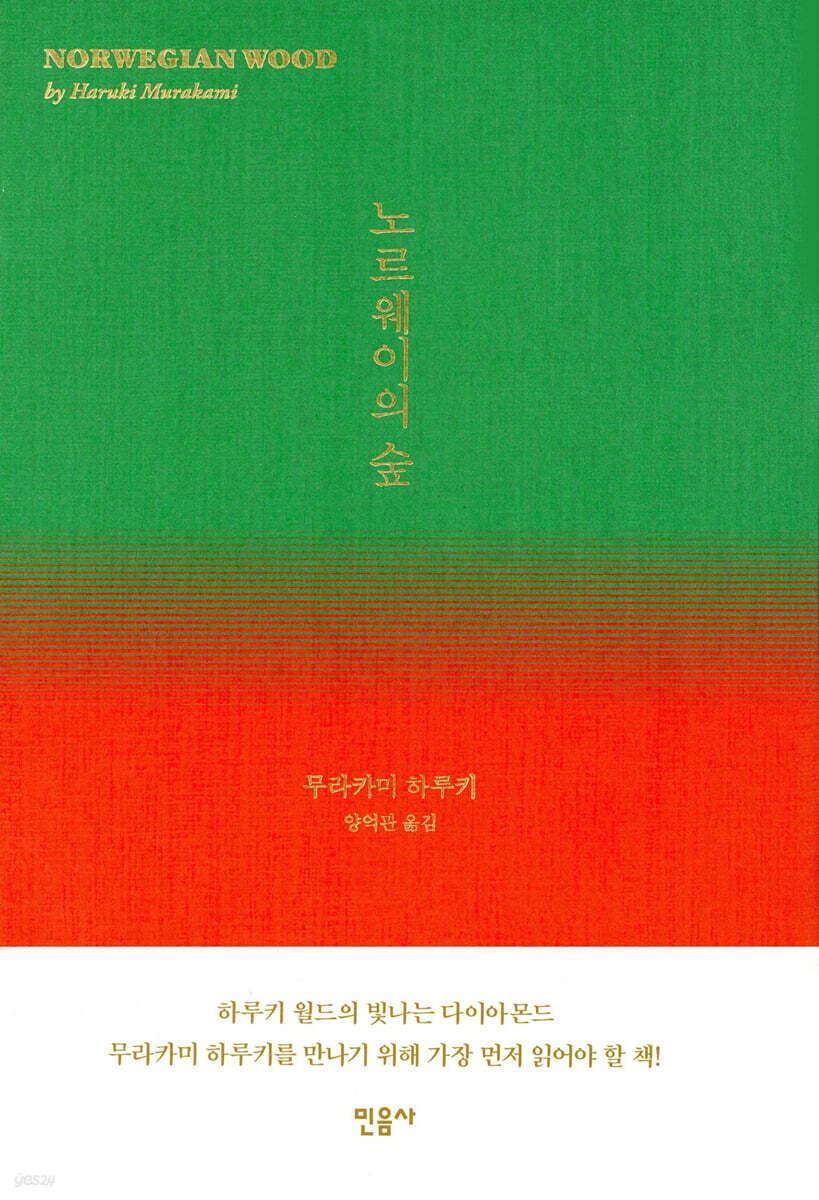
Book Introduction
“Never forget me, remember that I was here.” The shining diamond of Haruki's world The first book you must read to meet Haruki Murakami! To the youth of today who are opening the pages for the first time, and to the youth of yesterday who cherish a passage from the book in their long memories, Haruki Murakami's masterpiece, "Norwegian Wood," is a timeless must-read, conveying the sensitive and delicate emotions of youth with a consistent resonance. First published in 1989 under the title "The Age of Loss," the novel "Norwegian Wood," which has remained an event and has been the longest-running bestseller in the history of Korean publishing, has been published as a single volume following the Minumsa World Literature Collection. Set in Japan during its period of rapid economic growth in the late 1960s, this novel depicts the fragile relationship between individuals and society and the vivid moments of youth that seem as if they could be grasped if you just reached out. It has been translated and introduced in over 36 countries, creating a global "Haruki Boom" and widely publicizing Haruki Murakami's literary achievements, making it a representative work of modern Japanese literature. A contemporary novel that powerfully depicts the pain and moments of love of youth living in the middle of a lonely city. The essence of Haruki Murakami's literature, presented through a fluid and sensuous translation, will provide unforgettable memories to readers who reminisce about their first encounter or those who await a new one. |
- You can preview some of the book's contents.
Preview
index
Norwegian Wood 9
Detailed image
Publisher's Review
About loving one person, about living in one era
A masterpiece of modern Japanese literature that vividly captures the loneliness of modern people and the wandering of youth.
A work of vivid descriptions, brimming with Haruki Murakami's signature symbolic potential, with a radiant and delicate structure.
―[Guardian]
"Norwegian Wood" shows Haruki Murakami's clear signature.
―[New York Times]
Haruki Murakami's works are literature for tomorrow.
His language is special, and his interest is focused on humanity.
― Reasons for being selected for the Kafka Prize
"Norwegian Wood" is a work like a sketch that vividly depicts almost every aspect of human life, including disconnection and communication, loneliness and love, the past and memory, life and death.
This work is set in Japan in the late 1960s, a time when the splendid rapid economic growth led by the older generation coexisted with the resistance culture brought about by the new generation. Through the eyes of a young man named Watanabe, it confronts the most important issues in an individual's life: love and death.
“Don’t ever forget me, remember that I was here.” Hearing the Beatles’ “Norwegian Wood” playing on a plane that had just landed at Hamburg Airport in Germany, Watanabe travels back in time and recalls a desperate request and the woman who left it behind.
Watanabe was always with his close friend Kizuki and his girlfriend Naoko during his high school days.
However, the happy time with the friends who get along well ends with Kizuki's sudden suicide.
At the age of nineteen, Watanabe leaves his hometown, which holds sad memories, to enroll in a private university in Tokyo. Soon after, Naoko also comes to Tokyo, and the two share a special compassion and affection that only those who have shared their sorrow can know.
But one day, after losing contact for a while, Naoko sends him a letter saying that she has been admitted to a nursing home, and Watanabe goes to the nursing home to visit her, and only then does he become certain that his feelings are love.
Meanwhile, Midori, whom he met at the same university, has a completely different charm from Naoko, and she boldly enters Watanabe's daily life.
Watanabe lives the beautiful and precarious years of his twenties, spending everyday life with Midori, who is lively, energetic, and unpredictable, and occasionally visiting Naoko, who has not yet overcome Kizuki's death.
What I'm trying to say is this.
I'm almost twenty, and some of what Kizuki and I shared when we were sixteen and seventeen has already disappeared, and no matter how much I lament it, it will never come back.
I can't explain it any better, but I think you'll be able to understand what I feel and what I'm trying to say.
And I think you're probably the only one who understands this.
-From page 428
One person loves another person, and lives in the same era with that person.
It means having a language that allows us to understand each other, like Watanabe and Naoko, Watanabe and Midori, Kizuki and Naoko.
And their language, engraved in this work, reaches out to all of us who read it, reviving our youth, our love, our memories, those moments.
The fact that the pain of a youth in 1960s Japan resonates with us today, and the universality and timelessness of Haruki Murakami's literature, are enough reasons to encounter this work again as one of today's classics, and to eagerly await that encounter.
A day in my twenties, a day filled with memorable quotes and the Beatles' meditative and melancholic melodies, a sensual cityscape and a lyrical forest landscape, unredeemed love and salvation through love coexisting.
Meanwhile, the carefully selected translation and editing, which delicately polishes the beautiful language and expressions that illuminate the novel, will double the joy of encountering this work, which is called the essence of Haruki Murakami's literature.
A masterpiece of modern Japanese literature that vividly captures the loneliness of modern people and the wandering of youth.
A work of vivid descriptions, brimming with Haruki Murakami's signature symbolic potential, with a radiant and delicate structure.
―[Guardian]
"Norwegian Wood" shows Haruki Murakami's clear signature.
―[New York Times]
Haruki Murakami's works are literature for tomorrow.
His language is special, and his interest is focused on humanity.
― Reasons for being selected for the Kafka Prize
"Norwegian Wood" is a work like a sketch that vividly depicts almost every aspect of human life, including disconnection and communication, loneliness and love, the past and memory, life and death.
This work is set in Japan in the late 1960s, a time when the splendid rapid economic growth led by the older generation coexisted with the resistance culture brought about by the new generation. Through the eyes of a young man named Watanabe, it confronts the most important issues in an individual's life: love and death.
“Don’t ever forget me, remember that I was here.” Hearing the Beatles’ “Norwegian Wood” playing on a plane that had just landed at Hamburg Airport in Germany, Watanabe travels back in time and recalls a desperate request and the woman who left it behind.
Watanabe was always with his close friend Kizuki and his girlfriend Naoko during his high school days.
However, the happy time with the friends who get along well ends with Kizuki's sudden suicide.
At the age of nineteen, Watanabe leaves his hometown, which holds sad memories, to enroll in a private university in Tokyo. Soon after, Naoko also comes to Tokyo, and the two share a special compassion and affection that only those who have shared their sorrow can know.
But one day, after losing contact for a while, Naoko sends him a letter saying that she has been admitted to a nursing home, and Watanabe goes to the nursing home to visit her, and only then does he become certain that his feelings are love.
Meanwhile, Midori, whom he met at the same university, has a completely different charm from Naoko, and she boldly enters Watanabe's daily life.
Watanabe lives the beautiful and precarious years of his twenties, spending everyday life with Midori, who is lively, energetic, and unpredictable, and occasionally visiting Naoko, who has not yet overcome Kizuki's death.
What I'm trying to say is this.
I'm almost twenty, and some of what Kizuki and I shared when we were sixteen and seventeen has already disappeared, and no matter how much I lament it, it will never come back.
I can't explain it any better, but I think you'll be able to understand what I feel and what I'm trying to say.
And I think you're probably the only one who understands this.
-From page 428
One person loves another person, and lives in the same era with that person.
It means having a language that allows us to understand each other, like Watanabe and Naoko, Watanabe and Midori, Kizuki and Naoko.
And their language, engraved in this work, reaches out to all of us who read it, reviving our youth, our love, our memories, those moments.
The fact that the pain of a youth in 1960s Japan resonates with us today, and the universality and timelessness of Haruki Murakami's literature, are enough reasons to encounter this work again as one of today's classics, and to eagerly await that encounter.
A day in my twenties, a day filled with memorable quotes and the Beatles' meditative and melancholic melodies, a sensual cityscape and a lyrical forest landscape, unredeemed love and salvation through love coexisting.
Meanwhile, the carefully selected translation and editing, which delicately polishes the beautiful language and expressions that illuminate the novel, will double the joy of encountering this work, which is called the essence of Haruki Murakami's literature.
GOODS SPECIFICS
- Date of issue: August 7, 2017
- Format: Hardcover book binding method guide
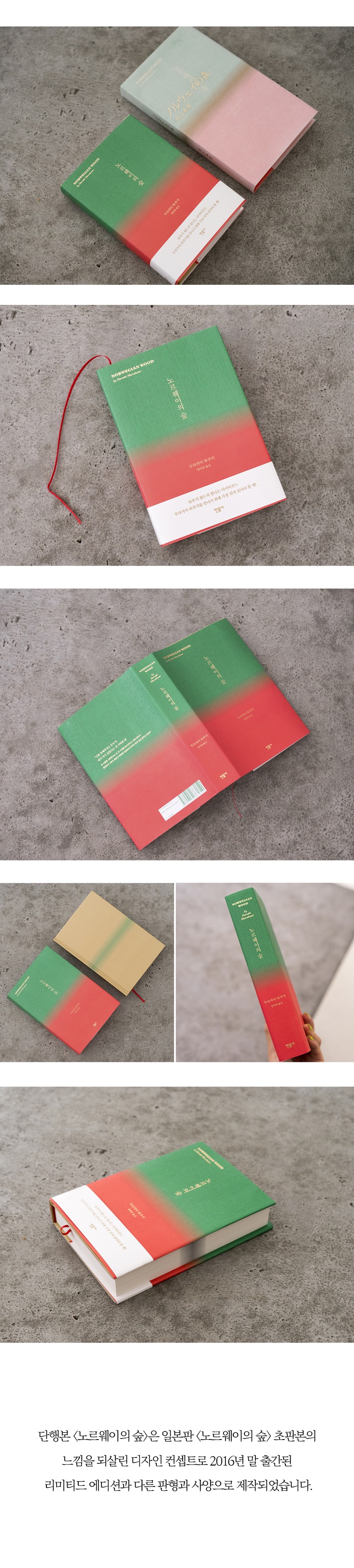
- Page count, weight, size: 572 pages | 602g | 127*188*35mm
- ISBN13: 9788937434488
- ISBN10: 8937434482
You may also like
카테고리
korean


korean

![GQ KOREA Mark (Monthly): December [2025]](http://librairie.coreenne.fr/cdn/shop/files/8ef265dbbfbf186523ed75ba7319009d.jpg?v=1765340328&width=3840)


