

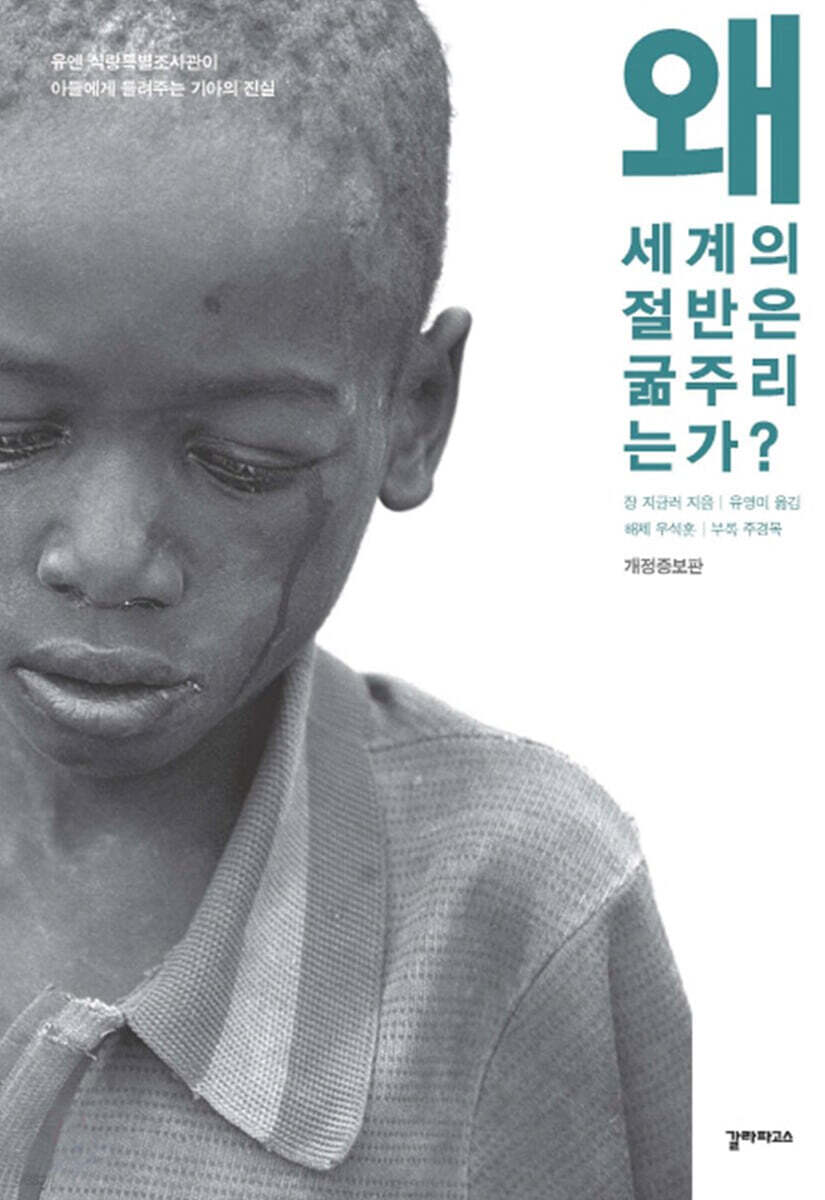
Why is half the world starving?
 |
Description
Book Introduction
Why do 100,000 people a day, one child every five seconds, die of hunger when there is more than enough food to feed 12 billion people?
How did this irrational and murderous world order emerge? Who is responsible? The truth about hunger, unknown to anyone, in schools or the media!
Jean Ziegler, a practical intellectual of our time, has garnered attention for his rigorous yet humanitarian writings on the relationship between poverty and social structure.
Jean Ziegler, who is working tirelessly to overcome hunger around the world, hopes to create a system that transcends inequality and fosters solidarity and mutual support among humanity.
This book, which contains such earnest wishes, is recommended and introduced by various institutions and organizations in Korea, and is read by many readers.
Many Korean readers learned about the harsh reality of famine through this book and sympathized with the author's warm love for humanity.
Especially for the younger generation, it will be an opportunity to awaken the attitude of global citizens by looking back at their neighbors living miserably around the world.
This book, which has been loved by readers for nine years since its publication in 2007, has been revised to reflect changes in the world's political situation and statistical data.
This revised edition has been supplemented with the latest writings of Jean Ziegler and the most recent materials to enhance its timeliness.
How did this irrational and murderous world order emerge? Who is responsible? The truth about hunger, unknown to anyone, in schools or the media!
Jean Ziegler, a practical intellectual of our time, has garnered attention for his rigorous yet humanitarian writings on the relationship between poverty and social structure.
Jean Ziegler, who is working tirelessly to overcome hunger around the world, hopes to create a system that transcends inequality and fosters solidarity and mutual support among humanity.
This book, which contains such earnest wishes, is recommended and introduced by various institutions and organizations in Korea, and is read by many readers.
Many Korean readers learned about the harsh reality of famine through this book and sympathized with the author's warm love for humanity.
Especially for the younger generation, it will be an opportunity to awaken the attitude of global citizens by looking back at their neighbors living miserably around the world.
This book, which has been loved by readers for nine years since its publication in 2007, has been revised to reflect changes in the world's political situation and statistical data.
This revised edition has been supplemented with the latest writings of Jean Ziegler and the most recent materials to enhance its timeliness.
- You can preview some of the book's contents.
Preview
index
Preface to the 2016 Edition: May we not become indifferent to the suffering of hunger.
Preface to the 2011 Edition: If We Don't Do It, No One Will
Preface to the Korean Edition Where Is Hope?
1.
Hunger has become a daily occurrence
2.
850 million hungry people
3.
Is starvation a natural consequence or an inevitable fate?
4.
Somalia, the country where the problem is concentrated
5.
Selecting life
6.
Solving the problem with emergency relief?
7.
The rich's trash is the poor's food
8.
The graves of the little ones without names
9.
International organizations struggling with funding shortages
10.
The cow fills its stomach, but the man starves?
11.
Behind the Market Price
12.
The man who makes the world's most useless food
13.
Schools that don't teach about hunger
14.
A war that adds insult to injury
15.
Kia turned into a weapon
16.
International corporations exploiting hunger
17.
Famine as a tool of state terrorism
18.
environmental refugees due to desertification
19.
deforestation
20.
$43 billion to combat desertification?
21.
In search of Le Raieu
22.
ever-growing urban population
23.
The unhealed scars of colonial policy
24.
Meeting Thomas Sankara
25.
The parched land, the Sahel
26.
Sankara, the courageous reformer
27.
The Last Days of Sankara
28.
In search of a true path
Epilogue
Reviews
A note from an international expert on the topic of hunger
Appendix: Neoliberalism
Translator's Note
Preface to the 2011 Edition: If We Don't Do It, No One Will
Preface to the Korean Edition Where Is Hope?
1.
Hunger has become a daily occurrence
2.
850 million hungry people
3.
Is starvation a natural consequence or an inevitable fate?
4.
Somalia, the country where the problem is concentrated
5.
Selecting life
6.
Solving the problem with emergency relief?
7.
The rich's trash is the poor's food
8.
The graves of the little ones without names
9.
International organizations struggling with funding shortages
10.
The cow fills its stomach, but the man starves?
11.
Behind the Market Price
12.
The man who makes the world's most useless food
13.
Schools that don't teach about hunger
14.
A war that adds insult to injury
15.
Kia turned into a weapon
16.
International corporations exploiting hunger
17.
Famine as a tool of state terrorism
18.
environmental refugees due to desertification
19.
deforestation
20.
$43 billion to combat desertification?
21.
In search of Le Raieu
22.
ever-growing urban population
23.
The unhealed scars of colonial policy
24.
Meeting Thomas Sankara
25.
The parched land, the Sahel
26.
Sankara, the courageous reformer
27.
The Last Days of Sankara
28.
In search of a true path
Epilogue
Reviews
A note from an international expert on the topic of hunger
Appendix: Neoliberalism
Translator's Note
Into the book
For now, the core of the problem lies in the social structure.
Although food itself is abundant, the poor do not have the economic means to secure it.
Unfortunately, because food is distributed so unequally, millions of people starve to death every year. --- p.51
Can you imagine what it must be like for a nurse to have to do this screening process? She has to tell the mothers:
“Your child is too weak, and our rations are too tight.
So, I can't put a bracelet on my child." How would a mother feel in that situation? --- p.69~70
Karim, what's even more tragic is that the curse of hunger is passed down from generation to generation.
Millions of severely malnourished mothers give birth to millions of unhealthy babies every year around the world. --- p.77
Dad agrees with the relief organization's policy.
Relief organizations work under extreme conditions and have to contend with various contradictions.
But no price can compare to the life of a child.
If I can save even one more child, all the losses will be compensated.
Although food itself is abundant, the poor do not have the economic means to secure it.
Unfortunately, because food is distributed so unequally, millions of people starve to death every year. --- p.51
Can you imagine what it must be like for a nurse to have to do this screening process? She has to tell the mothers:
“Your child is too weak, and our rations are too tight.
So, I can't put a bracelet on my child." How would a mother feel in that situation? --- p.69~70
Karim, what's even more tragic is that the curse of hunger is passed down from generation to generation.
Millions of severely malnourished mothers give birth to millions of unhealthy babies every year around the world. --- p.77
Dad agrees with the relief organization's policy.
Relief organizations work under extreme conditions and have to contend with various contradictions.
But no price can compare to the life of a child.
If I can save even one more child, all the losses will be compensated.
--- p.107
Publisher's Review
A long-term bestseller that has sold over 300,000 copies since its publication in 2007.
A revised and expanded edition of the best book on poverty and hunger, recommended by numerous organizations and prominent figures.
Jean Ziegler, a renowned expert on hunger issues and former UN Human Rights Commission Special Rapporteur on the Right to Food, is a practical intellectual who has devoted all his efforts to helping starving children around the world.
In this book, Ziegler explains, in an easy-to-understand, point-by-point format, in the form of a father-son dialogue, why half the world is starving even though there is more than enough food to feed 12 billion people.
It clearly shows how political and economic relations are intertwined with the "problem of making a living": the reality that relief measures are meaningless due to war and political disorder, the dilemma of international relief organizations, people surviving on the garbage of the rich, the reality that cattle are well fed but people are starving, environmental refugees due to desertification and deforestation, the impact of urbanization and colonial policies, and especially the financial oligarchy that exacerbates inequality.
As a scholar and activist who has been deeply involved in the real world of hunger, Ziegler's book is one of the most expert books on the issue of hunger, and it is also written in an easy-to-read format that adults and teenagers can read together without any problems.
Through this book, readers can learn in detail about who is unfairly profiting from the famine, how such profits are reproduced, and how they are pushing more and more children into starvation.
Since its publication in 2007, this book has been a steady seller and long-term bestseller in the social sciences field. It addresses the issues of poverty and hunger that we must know about, while being written in an easy-to-understand way for people of all ages and genders. As a result, it has been selected as a recommended book by many organizations, including the Publication Ethics Committee, Bookttase, and the National Library of Korea, and has been recommended by prominent figures such as Yoo Si-min, Lee Dong-jin, and Han Bi-ya.
Through this book, many Korean readers learned about the harsh reality of famine and sympathized with the author's warm love for humanity.
Especially for the younger generation, it will help them develop an attitude as global citizens by looking back on their miserable neighbors around the world.
This book, which has been loved by readers for nine years since its publication in 2007, has been revised to reflect changes in the world's political situation and statistical data.
This revised edition includes additional information on Jean Ziegler's latest writings and the most recent statistics.
May we not become indifferent to the suffering of hunger.
If we don't fight hunger, no one will.
In a new addition, Jean Ziegler speaks of the still-dismal state of hunger, calling the fact that millions of people die of hunger every year on a planet overflowing with wealth a shameful scandal of our time.
Although some time has passed since this book was published, hunger still rages.
The murderous systems and structural violence that dominate this world—the plunder of global agricultural land by multinational corporations, the speculation in stocks by food speculators, the burning of vast quantities of grain to create agrofuel, the agricultural dumping policies perpetrated by the European Union on global food markets—have not changed at all.
Rather, the number of victims only increased as a result.
Ziegler says that now that there is more than enough food to feed all of humanity, there is no inevitability of starvation, and that a child who dies of starvation is murdered.
The only difference between us and the victims of famine is the accident of birth.
Ziegler urges democratic citizens to rise up and protest to prevent such tragedies.
If we take organized action to stop agricultural dumping, stock market speculation, food destruction by agrofuel manufacturers, and over-exploitation of farmland in poor countries by financial predators, we can save countless people from starvation.
To overcome the harsh market order dominated by multinational corporations and powerful nations and the resulting destructive situation, and to end hunger, international political reform is necessary.
Ziegler appeals not to be indifferent to the suffering of hunger, and through this book, he hopes that humanity will help and unite with one another to overcome the structure of inequality.
If we don't do it, no one will.
Because humans are the only creatures that can empathize with the suffering of others.
A revised and expanded edition of the best book on poverty and hunger, recommended by numerous organizations and prominent figures.
Jean Ziegler, a renowned expert on hunger issues and former UN Human Rights Commission Special Rapporteur on the Right to Food, is a practical intellectual who has devoted all his efforts to helping starving children around the world.
In this book, Ziegler explains, in an easy-to-understand, point-by-point format, in the form of a father-son dialogue, why half the world is starving even though there is more than enough food to feed 12 billion people.
It clearly shows how political and economic relations are intertwined with the "problem of making a living": the reality that relief measures are meaningless due to war and political disorder, the dilemma of international relief organizations, people surviving on the garbage of the rich, the reality that cattle are well fed but people are starving, environmental refugees due to desertification and deforestation, the impact of urbanization and colonial policies, and especially the financial oligarchy that exacerbates inequality.
As a scholar and activist who has been deeply involved in the real world of hunger, Ziegler's book is one of the most expert books on the issue of hunger, and it is also written in an easy-to-read format that adults and teenagers can read together without any problems.
Through this book, readers can learn in detail about who is unfairly profiting from the famine, how such profits are reproduced, and how they are pushing more and more children into starvation.
Since its publication in 2007, this book has been a steady seller and long-term bestseller in the social sciences field. It addresses the issues of poverty and hunger that we must know about, while being written in an easy-to-understand way for people of all ages and genders. As a result, it has been selected as a recommended book by many organizations, including the Publication Ethics Committee, Bookttase, and the National Library of Korea, and has been recommended by prominent figures such as Yoo Si-min, Lee Dong-jin, and Han Bi-ya.
Through this book, many Korean readers learned about the harsh reality of famine and sympathized with the author's warm love for humanity.
Especially for the younger generation, it will help them develop an attitude as global citizens by looking back on their miserable neighbors around the world.
This book, which has been loved by readers for nine years since its publication in 2007, has been revised to reflect changes in the world's political situation and statistical data.
This revised edition includes additional information on Jean Ziegler's latest writings and the most recent statistics.
May we not become indifferent to the suffering of hunger.
If we don't fight hunger, no one will.
In a new addition, Jean Ziegler speaks of the still-dismal state of hunger, calling the fact that millions of people die of hunger every year on a planet overflowing with wealth a shameful scandal of our time.
Although some time has passed since this book was published, hunger still rages.
The murderous systems and structural violence that dominate this world—the plunder of global agricultural land by multinational corporations, the speculation in stocks by food speculators, the burning of vast quantities of grain to create agrofuel, the agricultural dumping policies perpetrated by the European Union on global food markets—have not changed at all.
Rather, the number of victims only increased as a result.
Ziegler says that now that there is more than enough food to feed all of humanity, there is no inevitability of starvation, and that a child who dies of starvation is murdered.
The only difference between us and the victims of famine is the accident of birth.
Ziegler urges democratic citizens to rise up and protest to prevent such tragedies.
If we take organized action to stop agricultural dumping, stock market speculation, food destruction by agrofuel manufacturers, and over-exploitation of farmland in poor countries by financial predators, we can save countless people from starvation.
To overcome the harsh market order dominated by multinational corporations and powerful nations and the resulting destructive situation, and to end hunger, international political reform is necessary.
Ziegler appeals not to be indifferent to the suffering of hunger, and through this book, he hopes that humanity will help and unite with one another to overcome the structure of inequality.
If we don't do it, no one will.
Because humans are the only creatures that can empathize with the suffering of others.
GOODS SPECIFICS
- Date of publication: March 21, 2016
- Page count, weight, size: 232 pages | 145*210*20mm
- ISBN13: 9791187038030
- ISBN10: 1187038032
You may also like
카테고리
korean


korean

![GQ KOREA Mark (Monthly): December [2025]](http://librairie.coreenne.fr/cdn/shop/files/8ef265dbbfbf186523ed75ba7319009d.jpg?v=1765340328&width=3840)


