

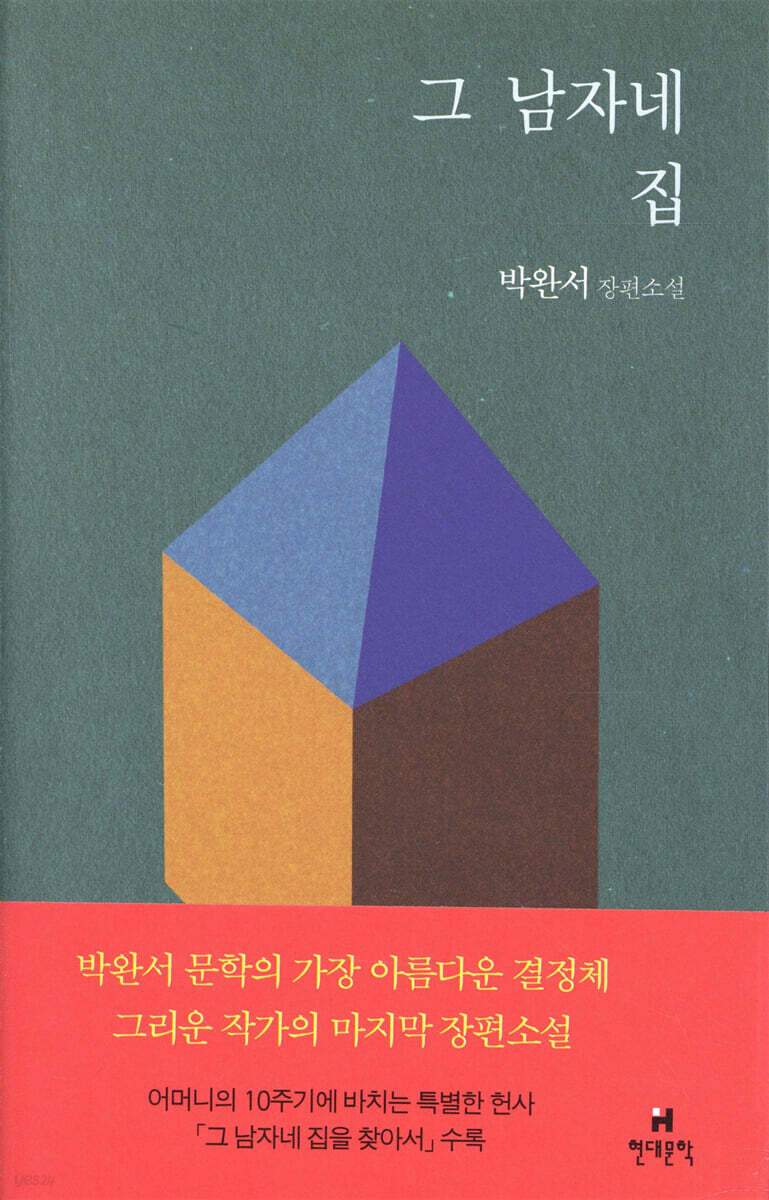
That man's house
 |
Description
Book Introduction
The most beautiful embodiment of Park Wan-seo's literature
The last full-length novel by the beloved author
Park Wan-seo, a novelist who created numerous masterpieces such as 『Who Ate All Those Singa』, 『Was That Mountain Really There』, 『Namok』, and 『Mother's Stake』.
Having personally experienced the turbulent times from the Japanese colonial period to the Korean War and rapid economic growth, she wrote warm and vibrant works based on her passion for literature, which enabled her to endure the hardships of life, both big and small. She is the true "Mother of Korean Literature."
Park Wan-seo debuted relatively late in life in 1970 at the age of 40, and published 15 full-length novels, 80 short stories, fairy tales, and prose collections over the next 40 years until her passing in January 2011. Among them, her final full-length novel, "That Man's House," written in 2004 to commemorate the 50th anniversary of the founding of "Modern Literature," is a special work in which she, well into her 70s and nearing the end of her life, unravels the memory of her "first love" that she had cherished in her heart for decades.
Contemporary Literature presents a new edition of this novel, which the author himself described as “a tribute to ‘literature’ that helped me endure difficult and arduous times,” to mark its 10th anniversary.
In March 2011, immediately after her passing, the book included messages of condolence from figures in the Korean literary and cultural arts world, including Yoo Jong-ho, Kim Hwa-young, Gu Hyo-seo, Gu Bon-chang, and Lee Hae-in, which were included in the special edition of “Park Wan-seo Memorial Special” in “Modern Literature,” along with the essay “In Search of That Man’s House,” written by the author’s daughter, Ho Won-sook, in memory of her mother and dedicated to her on the 10th anniversary of her death.
The last full-length novel by the beloved author
Park Wan-seo, a novelist who created numerous masterpieces such as 『Who Ate All Those Singa』, 『Was That Mountain Really There』, 『Namok』, and 『Mother's Stake』.
Having personally experienced the turbulent times from the Japanese colonial period to the Korean War and rapid economic growth, she wrote warm and vibrant works based on her passion for literature, which enabled her to endure the hardships of life, both big and small. She is the true "Mother of Korean Literature."
Park Wan-seo debuted relatively late in life in 1970 at the age of 40, and published 15 full-length novels, 80 short stories, fairy tales, and prose collections over the next 40 years until her passing in January 2011. Among them, her final full-length novel, "That Man's House," written in 2004 to commemorate the 50th anniversary of the founding of "Modern Literature," is a special work in which she, well into her 70s and nearing the end of her life, unravels the memory of her "first love" that she had cherished in her heart for decades.
Contemporary Literature presents a new edition of this novel, which the author himself described as “a tribute to ‘literature’ that helped me endure difficult and arduous times,” to mark its 10th anniversary.
In March 2011, immediately after her passing, the book included messages of condolence from figures in the Korean literary and cultural arts world, including Yoo Jong-ho, Kim Hwa-young, Gu Hyo-seo, Gu Bon-chang, and Lee Hae-in, which were included in the special edition of “Park Wan-seo Memorial Special” in “Modern Literature,” along with the essay “In Search of That Man’s House,” written by the author’s daughter, Ho Won-sook, in memory of her mother and dedicated to her on the 10th anniversary of her death.
- You can preview some of the book's contents.
Preview
Into the book
In the early 1950s, the neighborhood where I got married and moved in with my in-laws was an old neighborhood with small, Joseon-style tile-roofed houses with their eaves facing each other in narrow, winding alleys.
It was an ordinary residential area, neither particularly poor nor wealthy, but as it was just after the war, the living conditions were fierce and shabby.
One day, in a time when there was no exit in sight and I was feeling suffocated, a sign that read 'Modern Literature Society' appeared on an old Joseon tile-roofed house not far from my house.
Because life was so difficult at the time, it was common for people to tear down one wall of a house and open a hole-in-the-wall shop if the street was good.
When that sign was put up on a house that was no different from a neighborhood hole-in-the-wall store, not only the house but the entire alley suddenly became brighter.
The fact that literature existed even in those shabby and barren times made my heart flutter.
--- p.5~6
When looking at the house from the street, the main gate was not visible, but the Hongyemun Gate, which can only be seen in palaces.
Hongyemun was the gate leading to Sarangmadang, and the main gate leading to Anchae was located at a bend in the wall with Hongyemun and Giyeok.
For some reason, I was more overwhelmed by the elegant and antique Hongye Gate than by the imposing stone threshold.
It looked different from the small tile-roofed houses of Joseon Dynasty with their eaves lined up.
As the young man carrying the luggage stopped by our side and seemed to want to know us, the old woman introduced him as our youngest.
He was a sad and handsome man.
--- p.20~21
Whether or not she knew my humiliation, the shaman Park Soo-moo held up five flagpoles in front of me.
As I was backing away, not knowing English, my mother-in-law told me that our new baby doesn't know anything and told me to pull out a flagpole.
I tucked the rolled-up flag under my arm and pulled out one of the poles that was held out.
Even though I had given up on the idea that there was no way out, I trembled for no reason.
A fluttering blue flag came out.
My mother-in-law's face hardened.
I guess that's not a good sign.
The shaman also tilted his head and made a gesture to pull it out again.
I, too, was nervous for no reason, so instead of pulling out all at once, I took a deep breath and pulled out the second time carefully.
This time it was green.
I could tell by sight that it wasn't a good color either.
It was annoying to just pick out the ominous colors without knowing what they meant or what color flags would come out.
I was terrified by the power of superstition, the belief that I could turn a blind eye to my mistakes without having done anything wrong.
--- p.176~177
Every time the word first love crossed my mind, the boring time began to pulse and shine.
There was still a week left until I would see the man again, but the long wait was exhilarating.
What should he wear? How disappointed would a man be if his first love showed up wearing a long skirt tied with a belt and carrying a shopping basket?
That man is my first love too.
That was not polite to my first love.
I took out some nice outdoor clothes and put them on, then looked at myself in the mirror.
Some clothes looked decent, some looked tacky, and occasionally some looked sexy.
I didn't like it at all.
The first compliment the man gave me was that I looked like a bead.
I wanted to be a virgin like a bead once again.
--- p.203~204
Even so, Jonghee thinks of her older sister the most.
He named his first daughter after me.
I think camellia is called camellia in English.
Did you say that? Sorry, sorry, can you listen to me again? Even if my name is not Dongbaek Miss but Bom Miss, Dongbaek Miss still suits me.
Anyway, the fact that she wants to name her daughter after her aunt is proof that she doesn't ignore her aunt.
How grateful I am.
But I heard that Camellia bitch was so good at studying that she even got a scholarship to a prestigious university. I don't know what kind of doctorate she has, but I think she's researching and preparing a thesis on how much the sex industry contributed to the Korean economy during the Korean War.
If you listen to his story, it seems that at a time when there was no industry in Korea, it was the only way to earn foreign currency other than free aid.
I guess they're going to calculate that specifically.
I feed my family with the money I get from PFC or Colpo's less than $100 salary, and in between, I sell my body to black people for cheaper prices, listening to the shit-talking of idiots.
Ah, M-Bing, I wonder how much that would cost, but I guess it's not that much when you add it up.
I find it strange that my shameful past has become a subject of study.
Camellia is proud.
He's not the kind of kid who would be ashamed of me.
Whenever my younger brothers would occasionally look down on me for my past, I would feel so sad, M-byung, five dollars, ten dollars, just seeing a dollar would make you spread your legs wide and feel resentful that we didn't starve, and when I think that research results might come out that that was the driving force behind the national economy, I feel like I'm letting out my anger and I'm about to burst into tears, M-byung.
--- p.365~366
When my mother passed away, she was wearing my old underwear.
I heard my wife grumble that my underwear was dirty and I was throwing it away when it was perfectly fine, but I didn't know she was that tidy.
My wife probably didn't know either.
When I was changing new clothes for him after he passed away, my wife saw that and dragged my hand over to me and forced me to touch the hole in his underwear.
I have to see that one.
It really was my panties.
I felt around with my hand to see if there was any damage.
I remember my mother wearing my worn-out running shoes when she went to work.
There was nothing wrong with it, but my mom was so skinny.
The man trailed off.
I was crying.
Tears streamed down my cheeks as I sobbed harder and harder.
I couldn't hold back my heart, so I hugged the man.
The man also came hugging me as if he was collapsing.
Our hug was different from the hug I had dreamed of and the hug I had desired.
Our hug was as calm and perfect as water.
That was enough for our breakup.
It was an ordinary residential area, neither particularly poor nor wealthy, but as it was just after the war, the living conditions were fierce and shabby.
One day, in a time when there was no exit in sight and I was feeling suffocated, a sign that read 'Modern Literature Society' appeared on an old Joseon tile-roofed house not far from my house.
Because life was so difficult at the time, it was common for people to tear down one wall of a house and open a hole-in-the-wall shop if the street was good.
When that sign was put up on a house that was no different from a neighborhood hole-in-the-wall store, not only the house but the entire alley suddenly became brighter.
The fact that literature existed even in those shabby and barren times made my heart flutter.
--- p.5~6
When looking at the house from the street, the main gate was not visible, but the Hongyemun Gate, which can only be seen in palaces.
Hongyemun was the gate leading to Sarangmadang, and the main gate leading to Anchae was located at a bend in the wall with Hongyemun and Giyeok.
For some reason, I was more overwhelmed by the elegant and antique Hongye Gate than by the imposing stone threshold.
It looked different from the small tile-roofed houses of Joseon Dynasty with their eaves lined up.
As the young man carrying the luggage stopped by our side and seemed to want to know us, the old woman introduced him as our youngest.
He was a sad and handsome man.
--- p.20~21
Whether or not she knew my humiliation, the shaman Park Soo-moo held up five flagpoles in front of me.
As I was backing away, not knowing English, my mother-in-law told me that our new baby doesn't know anything and told me to pull out a flagpole.
I tucked the rolled-up flag under my arm and pulled out one of the poles that was held out.
Even though I had given up on the idea that there was no way out, I trembled for no reason.
A fluttering blue flag came out.
My mother-in-law's face hardened.
I guess that's not a good sign.
The shaman also tilted his head and made a gesture to pull it out again.
I, too, was nervous for no reason, so instead of pulling out all at once, I took a deep breath and pulled out the second time carefully.
This time it was green.
I could tell by sight that it wasn't a good color either.
It was annoying to just pick out the ominous colors without knowing what they meant or what color flags would come out.
I was terrified by the power of superstition, the belief that I could turn a blind eye to my mistakes without having done anything wrong.
--- p.176~177
Every time the word first love crossed my mind, the boring time began to pulse and shine.
There was still a week left until I would see the man again, but the long wait was exhilarating.
What should he wear? How disappointed would a man be if his first love showed up wearing a long skirt tied with a belt and carrying a shopping basket?
That man is my first love too.
That was not polite to my first love.
I took out some nice outdoor clothes and put them on, then looked at myself in the mirror.
Some clothes looked decent, some looked tacky, and occasionally some looked sexy.
I didn't like it at all.
The first compliment the man gave me was that I looked like a bead.
I wanted to be a virgin like a bead once again.
--- p.203~204
Even so, Jonghee thinks of her older sister the most.
He named his first daughter after me.
I think camellia is called camellia in English.
Did you say that? Sorry, sorry, can you listen to me again? Even if my name is not Dongbaek Miss but Bom Miss, Dongbaek Miss still suits me.
Anyway, the fact that she wants to name her daughter after her aunt is proof that she doesn't ignore her aunt.
How grateful I am.
But I heard that Camellia bitch was so good at studying that she even got a scholarship to a prestigious university. I don't know what kind of doctorate she has, but I think she's researching and preparing a thesis on how much the sex industry contributed to the Korean economy during the Korean War.
If you listen to his story, it seems that at a time when there was no industry in Korea, it was the only way to earn foreign currency other than free aid.
I guess they're going to calculate that specifically.
I feed my family with the money I get from PFC or Colpo's less than $100 salary, and in between, I sell my body to black people for cheaper prices, listening to the shit-talking of idiots.
Ah, M-Bing, I wonder how much that would cost, but I guess it's not that much when you add it up.
I find it strange that my shameful past has become a subject of study.
Camellia is proud.
He's not the kind of kid who would be ashamed of me.
Whenever my younger brothers would occasionally look down on me for my past, I would feel so sad, M-byung, five dollars, ten dollars, just seeing a dollar would make you spread your legs wide and feel resentful that we didn't starve, and when I think that research results might come out that that was the driving force behind the national economy, I feel like I'm letting out my anger and I'm about to burst into tears, M-byung.
--- p.365~366
When my mother passed away, she was wearing my old underwear.
I heard my wife grumble that my underwear was dirty and I was throwing it away when it was perfectly fine, but I didn't know she was that tidy.
My wife probably didn't know either.
When I was changing new clothes for him after he passed away, my wife saw that and dragged my hand over to me and forced me to touch the hole in his underwear.
I have to see that one.
It really was my panties.
I felt around with my hand to see if there was any damage.
I remember my mother wearing my worn-out running shoes when she went to work.
There was nothing wrong with it, but my mom was so skinny.
The man trailed off.
I was crying.
Tears streamed down my cheeks as I sobbed harder and harder.
I couldn't hold back my heart, so I hugged the man.
The man also came hugging me as if he was collapsing.
Our hug was different from the hug I had dreamed of and the hug I had desired.
Our hug was as calm and perfect as water.
That was enough for our breakup.
--- p.374~375
Publisher's Review
The man who was close but never reached me
Park Wan-seo's autobiographical novel about her first love
“While writing this novel, I felt as if I was writing a love letter, full of longing and happiness.”
"That Man's House," which vividly depicts the dilapidated landscape of Seoul around the 1950s, begins with the protagonist, now in his old age, visiting the banks of the Angamcheon Stream in Donam-dong, where his first love, "that man," lived, and recalling old memories.
The man and I met for the first time when I was a high school student when his family, who was a distant relative of mine, moved into the neighborhood where I lived.
And a few years later, while I was working at a US military base during the war, I met that man again by chance on the train on my way home from work, and we exchanged greetings and developed a relationship.
That winter, when everything in sight was devastated and shabby due to war, the man and I wandered through every nook and cranny of the ruined streets of Seoul, spending happy times shining like 'beads'.
In a time when only 'survival' was valuable, the existence of that romantic man who enjoyed music and literature provided me with an escape, allowing me to briefly turn my eyes away from reality.
However, he was a 'poor bum who didn't earn a penny', a 'youngest son who was ignorant of the ways of the world' and a 'fool' who tormented his old mother, and I was the 'breadwinner for a family of five', so I decided to marry a banker who had a small but nice house and a stable job, and I broke up with him.
Waking up from the sweet dream of first love and starting married life, I barely make ends meet with the meager salary my husband brings me, and as I struggle with my mother-in-law who relies on a shaman for all the household matters, I gradually become numb to the reality of marriage.
Without even knowing the joys of being newlyweds, my daily life became very boring. Around that time, I happened to meet the older sister of 'that man' at the market and heard news about him. I met the man again and dreamed of escaping from reality once again.
One day, while they were secretly meeting, avoiding the eyes of her husband and mother-in-law, he proposed a one-night honeymoon trip.
I feel a thrill of joy and eagerly await that day, but on the promised day, he doesn't show up at the train station, and I 'float away to somewhere' and am thrown back into the world. I fall seriously ill and return to my normal life, but I learn that he had brain surgery and lost his eyesight, and I meet him again some time later.
By then everything had already changed.
Unlike him, who still retains the romance and childishness of his youth, I have become a mother of four and a tough housewife.
I feel carnal anger towards him rather than the excitement of first love, and I cut off our relationship by advising him, mixed with insults, to admit that he is blind and start anew.
And we see the man one last time when his mother passes away.
At that time, he met his wife, a middle school teacher, had a child, and was building a happy family.
As I hug the man, who sheds increasingly heavy tears as he recalls his deceased mother, I finally achieve a calm and complete breakup with him.
This novel is a poignant romance filled with Park Wan-seo's signature detailed descriptions and witty prose, and is also a perfect record that provides a detailed glimpse into one woman's life and, by extension, an era.
Mothers who worked as merchants and ran boarding houses to feed their children even during the war, young women who risked being criticized and became prostitutes for their families, and men who became victims of war and ideology.
Not only the central characters, me and that man, but also the people around me each have distinct personalities, which make the story solid and rich.
The harsh daily lives of those who had to experience the hardships of the post-war era firsthand, contrasted with the pure emotion of first love, creates a poignant resonance.
Author Park Wan-seo, who “bears the bitter wounds of winter all over her body, but stands warmly by our side with the language of spring like a proud tree” (Gu Hyo-seo).
This novel, which is his last full-length work and his life itself, will continue to bring warmth and comfort to readers today, as we enter 2021 after a year more difficult and arduous than ever before.
A memorial article (excerpt from the March 2011 issue of "Modern Literature" special issue dedicated to Park Wan-seo)
The destructive impact of the Korean War and its aftermath were the main themes pursued by Park Wan-seo.
This novel, which is both incredibly faithful to its time and an enjoyable read, is filled with vivid characters, compelling details, savory text, and realistic dialogue.
It is not only outstanding as literature, but also a masterpiece of social history of the late 20th century.
It vividly embodies the proposition of literary sociology that excellent literary works also have rich social testimonial value.
_Yoo Jong-ho (English literature scholar, literary critic)
Professor Park Wan-seo rarely criticizes others in her speech or writing.
The teacher's life and literature were about criticism of himself rather than others, a humorous gaze that penetrates the materialism we all possess rather than criticism, and an effort to reach the ultimate love through compassion and understanding of it.
Kim Hwa-young (French literature scholar, professor emeritus at Korea University)
The family stories and the small joys and sorrows of everyday life that appear in Mr. Park's writing are all the more precious because they remind me of the 1960s and 1970s in my memories.
Mr. Park always seemed to me to be a person who lived that kind of life, with a somewhat reserved but confident demeanor.
I think that Professor Park Wan-seo, who paid attention to the small things that were not noticeable and showed love, was the mother of all of us who lived in that era.
_Koo Bon-chang (photographer)
The teacher said that he felt a sense of dignity and a breathtaking warmth while looking at Park Soo-geun's winter tree, which stood silently beside poor women after the war.
The teacher, who bore the bitter wounds of winter all over his body, but who always stood by us warmly with the language of spring like a proud tree.
You were a teacher who hoped that your end would be a quiet and perfect 'collapse', but I cannot accept your natural humility, so I omit one character and call it 'collapse'.
_Gu Hyo-seo (novelist)
Teacher, who always took such good care of me despite my shortcomings and inadequacies in both writing and life, teacher, who always included the words “I love you” along with your autograph when giving me your new book, (……) I also vividly remember you handing me an envelope you had received as a special lecture fee from a church you had been invited to in my place while I was sick, saying with a cheerful smile, “I went in place of the nuns, so of course I should share it.”
_Lee Hae-in (nun, poet)
Park Wan-seo's autobiographical novel about her first love
“While writing this novel, I felt as if I was writing a love letter, full of longing and happiness.”
"That Man's House," which vividly depicts the dilapidated landscape of Seoul around the 1950s, begins with the protagonist, now in his old age, visiting the banks of the Angamcheon Stream in Donam-dong, where his first love, "that man," lived, and recalling old memories.
The man and I met for the first time when I was a high school student when his family, who was a distant relative of mine, moved into the neighborhood where I lived.
And a few years later, while I was working at a US military base during the war, I met that man again by chance on the train on my way home from work, and we exchanged greetings and developed a relationship.
That winter, when everything in sight was devastated and shabby due to war, the man and I wandered through every nook and cranny of the ruined streets of Seoul, spending happy times shining like 'beads'.
In a time when only 'survival' was valuable, the existence of that romantic man who enjoyed music and literature provided me with an escape, allowing me to briefly turn my eyes away from reality.
However, he was a 'poor bum who didn't earn a penny', a 'youngest son who was ignorant of the ways of the world' and a 'fool' who tormented his old mother, and I was the 'breadwinner for a family of five', so I decided to marry a banker who had a small but nice house and a stable job, and I broke up with him.
Waking up from the sweet dream of first love and starting married life, I barely make ends meet with the meager salary my husband brings me, and as I struggle with my mother-in-law who relies on a shaman for all the household matters, I gradually become numb to the reality of marriage.
Without even knowing the joys of being newlyweds, my daily life became very boring. Around that time, I happened to meet the older sister of 'that man' at the market and heard news about him. I met the man again and dreamed of escaping from reality once again.
One day, while they were secretly meeting, avoiding the eyes of her husband and mother-in-law, he proposed a one-night honeymoon trip.
I feel a thrill of joy and eagerly await that day, but on the promised day, he doesn't show up at the train station, and I 'float away to somewhere' and am thrown back into the world. I fall seriously ill and return to my normal life, but I learn that he had brain surgery and lost his eyesight, and I meet him again some time later.
By then everything had already changed.
Unlike him, who still retains the romance and childishness of his youth, I have become a mother of four and a tough housewife.
I feel carnal anger towards him rather than the excitement of first love, and I cut off our relationship by advising him, mixed with insults, to admit that he is blind and start anew.
And we see the man one last time when his mother passes away.
At that time, he met his wife, a middle school teacher, had a child, and was building a happy family.
As I hug the man, who sheds increasingly heavy tears as he recalls his deceased mother, I finally achieve a calm and complete breakup with him.
This novel is a poignant romance filled with Park Wan-seo's signature detailed descriptions and witty prose, and is also a perfect record that provides a detailed glimpse into one woman's life and, by extension, an era.
Mothers who worked as merchants and ran boarding houses to feed their children even during the war, young women who risked being criticized and became prostitutes for their families, and men who became victims of war and ideology.
Not only the central characters, me and that man, but also the people around me each have distinct personalities, which make the story solid and rich.
The harsh daily lives of those who had to experience the hardships of the post-war era firsthand, contrasted with the pure emotion of first love, creates a poignant resonance.
Author Park Wan-seo, who “bears the bitter wounds of winter all over her body, but stands warmly by our side with the language of spring like a proud tree” (Gu Hyo-seo).
This novel, which is his last full-length work and his life itself, will continue to bring warmth and comfort to readers today, as we enter 2021 after a year more difficult and arduous than ever before.
A memorial article (excerpt from the March 2011 issue of "Modern Literature" special issue dedicated to Park Wan-seo)
The destructive impact of the Korean War and its aftermath were the main themes pursued by Park Wan-seo.
This novel, which is both incredibly faithful to its time and an enjoyable read, is filled with vivid characters, compelling details, savory text, and realistic dialogue.
It is not only outstanding as literature, but also a masterpiece of social history of the late 20th century.
It vividly embodies the proposition of literary sociology that excellent literary works also have rich social testimonial value.
_Yoo Jong-ho (English literature scholar, literary critic)
Professor Park Wan-seo rarely criticizes others in her speech or writing.
The teacher's life and literature were about criticism of himself rather than others, a humorous gaze that penetrates the materialism we all possess rather than criticism, and an effort to reach the ultimate love through compassion and understanding of it.
Kim Hwa-young (French literature scholar, professor emeritus at Korea University)
The family stories and the small joys and sorrows of everyday life that appear in Mr. Park's writing are all the more precious because they remind me of the 1960s and 1970s in my memories.
Mr. Park always seemed to me to be a person who lived that kind of life, with a somewhat reserved but confident demeanor.
I think that Professor Park Wan-seo, who paid attention to the small things that were not noticeable and showed love, was the mother of all of us who lived in that era.
_Koo Bon-chang (photographer)
The teacher said that he felt a sense of dignity and a breathtaking warmth while looking at Park Soo-geun's winter tree, which stood silently beside poor women after the war.
The teacher, who bore the bitter wounds of winter all over his body, but who always stood by us warmly with the language of spring like a proud tree.
You were a teacher who hoped that your end would be a quiet and perfect 'collapse', but I cannot accept your natural humility, so I omit one character and call it 'collapse'.
_Gu Hyo-seo (novelist)
Teacher, who always took such good care of me despite my shortcomings and inadequacies in both writing and life, teacher, who always included the words “I love you” along with your autograph when giving me your new book, (……) I also vividly remember you handing me an envelope you had received as a special lecture fee from a church you had been invited to in my place while I was sick, saying with a cheerful smile, “I went in place of the nuns, so of course I should share it.”
_Lee Hae-in (nun, poet)
GOODS SPECIFICS
- Date of issue: January 22, 2021
- Page count, weight, size: 388 pages | 426g | 124*195*30mm
- ISBN13: 9791190885560
- ISBN10: 1190885565
You may also like
카테고리
korean


korean

![GQ KOREA Mark (Monthly): December [2025]](http://librairie.coreenne.fr/cdn/shop/files/8ef265dbbfbf186523ed75ba7319009d.jpg?v=1765340328&width=3840)


