

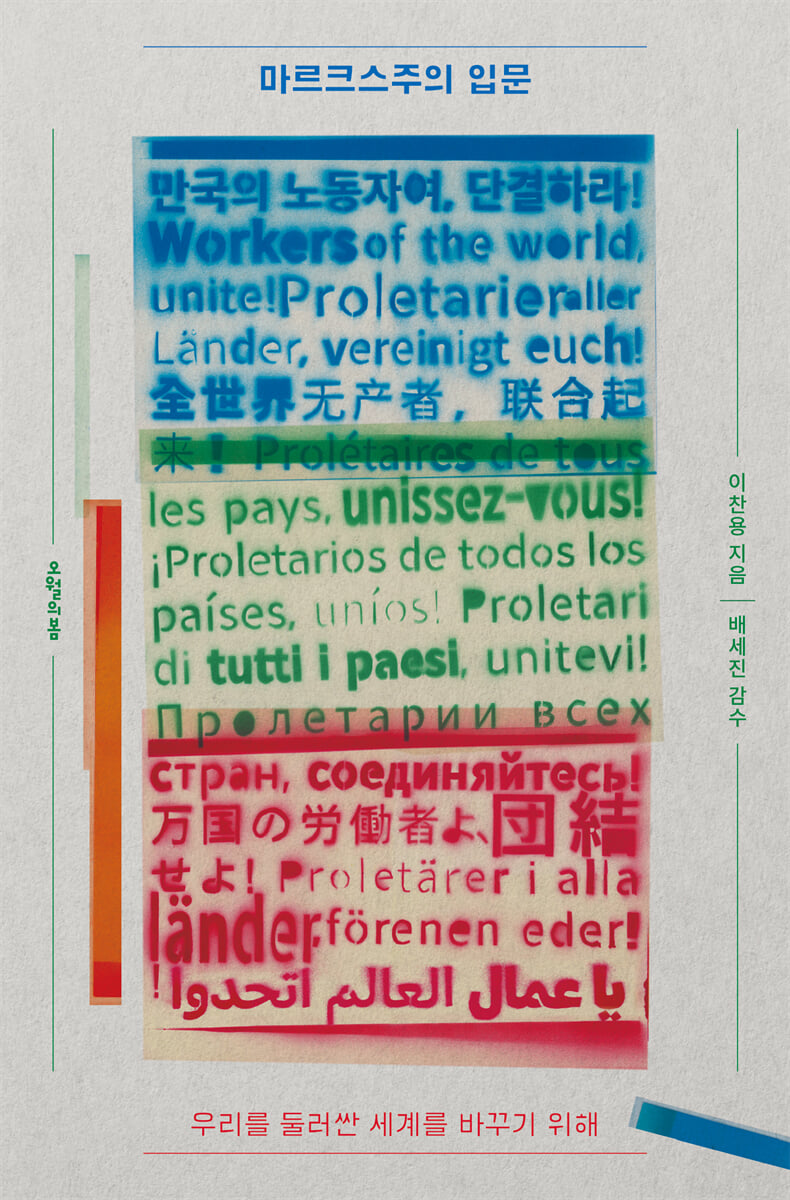
Introduction to Marxism
 |
Description
Book Introduction
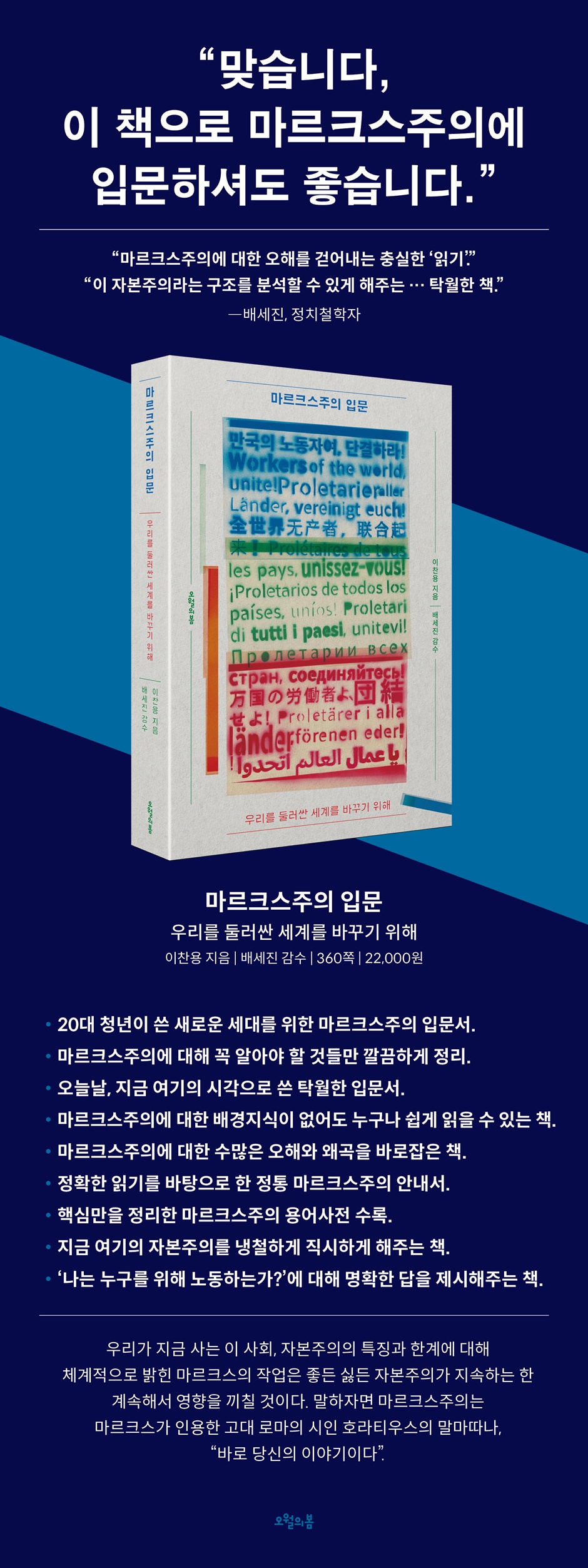
This book is an introduction to Marxism for today, here and now, written by a new generation of young people in their 20s.
Unlike most other Marxist books that have been published so far, which are often old, difficult, distorted, dogmatic, or ambiguous, this book is easy and friendly.
As a book for beginners, it is structured so that readers can acquire knowledge of Marxism without any separate background knowledge or references.
Moreover, through accurate reading, it corrects the concepts that even those who call themselves Marxists treat with prejudice, and persistently conveys only the core of Marxism.
This book covers the entirety of Marxism, from the reasons why Marxism is necessary to the background of its birth, philosophy, history, economics, sociology, and political science. It also includes a list of recommended reading materials and a glossary of Marxist terms for further reading after completing this book.
Although the main text primarily covers Marx and Engels, it also provides explanations of later Marxism and scholars in related fields through reference materials.
The 'Read More' corner introduces the works of Alain de Botton, Thomas Pighetti, Lenin and Stalin, Kohei Saito, Nancy Fraser, David Harvey, Louis Althusser, Pyotr Kropotkin, Karl Polanyi, and Antonio Gramsci, allowing readers to gain a richer understanding of Marxism.
In other words, it is structured so that anyone can systematically understand the ideas of Marx and Engels.
This is truly an excellent introduction to Marxism, written by a new generation and for a new generation.
Unlike most other Marxist books that have been published so far, which are often old, difficult, distorted, dogmatic, or ambiguous, this book is easy and friendly.
As a book for beginners, it is structured so that readers can acquire knowledge of Marxism without any separate background knowledge or references.
Moreover, through accurate reading, it corrects the concepts that even those who call themselves Marxists treat with prejudice, and persistently conveys only the core of Marxism.
This book covers the entirety of Marxism, from the reasons why Marxism is necessary to the background of its birth, philosophy, history, economics, sociology, and political science. It also includes a list of recommended reading materials and a glossary of Marxist terms for further reading after completing this book.
Although the main text primarily covers Marx and Engels, it also provides explanations of later Marxism and scholars in related fields through reference materials.
The 'Read More' corner introduces the works of Alain de Botton, Thomas Pighetti, Lenin and Stalin, Kohei Saito, Nancy Fraser, David Harvey, Louis Althusser, Pyotr Kropotkin, Karl Polanyi, and Antonio Gramsci, allowing readers to gain a richer understanding of Marxism.
In other words, it is structured so that anyone can systematically understand the ideas of Marx and Engels.
This is truly an excellent introduction to Marxism, written by a new generation and for a new generation.
- You can preview some of the book's contents.
Preview
index
introduction
Marxism, "Your Story"
Chapter 1: Various Problems of Capitalism
1.
alienation
* Read more: Alain de Botton's "Anxiety"
2.
inequality
* Read more: Thomas Piketty's Capital in the Twenty-First Century
3.
sexism
4.
Ethnic issues and racial discrimination
* Read more: Vladimir Lenin, Imperialism: The Highest Stage of Capitalism
5.
Political crisis and war
6.
climate crisis
* Read more: Kohei Saito, Unsustainable Capitalism
7.
way out
Chapter 2: The Birth of Marxism
1.
The lives and major works of Marx and Engels
* Read more: Louis Althusser, For Marx
2.
The historical background of the time
* Read more: Eric Hobsbawm's 'The Age Trilogy': The Age of Capital, The Age of Revolution, The Age of Empire
3.
utopian socialism
* Read more Pyotr Kropotkin's The Struggle for Bread
Chapter 3 Marxist Philosophy
1.
Dialectics
2.
materialism
3.
Theses on Feuerbach
Chapter 4 Marxist Historiography
1.
The Birth of Class and Nation
2.
Pre-capitalist stage
* Read more: Joseph Stalin, Dialectical and Historical Materialism & Karl Marx, Draft of a Letter to Zasulich
3.
The beginning of capitalism
* Read more: David Harvey, Paris, Capital of Modernity
Chapter 5 Marxist Economics
1.
Marx's economics
2.
Use value and value
3.
surplus value
* Read more: Nancy Fraser's "The Left Way"
4.
Materialism
* Read more: Karl Polanyi, The Great Transformation
5.
reproduction
6.
Average profit rate and typical
7.
The law of the tendency of the rate of profit to fall
Chapter 6 Marxist Sociology
1.
social structure
* Read more: Louis Althusser, "Ideology and Ideological State Apparatuses"
2.
Types of republics
Chapter 7 Marxist Politics
1.
revolution
* Read more: Antonio Gramsci's Prison Notebooks
2.
Post-revolution appearance
In lieu of a conclusion
Marxism today, here and now
Recommended Book List
References
Reviewer's Note
Glossary
Marxism, "Your Story"
Chapter 1: Various Problems of Capitalism
1.
alienation
* Read more: Alain de Botton's "Anxiety"
2.
inequality
* Read more: Thomas Piketty's Capital in the Twenty-First Century
3.
sexism
4.
Ethnic issues and racial discrimination
* Read more: Vladimir Lenin, Imperialism: The Highest Stage of Capitalism
5.
Political crisis and war
6.
climate crisis
* Read more: Kohei Saito, Unsustainable Capitalism
7.
way out
Chapter 2: The Birth of Marxism
1.
The lives and major works of Marx and Engels
* Read more: Louis Althusser, For Marx
2.
The historical background of the time
* Read more: Eric Hobsbawm's 'The Age Trilogy': The Age of Capital, The Age of Revolution, The Age of Empire
3.
utopian socialism
* Read more Pyotr Kropotkin's The Struggle for Bread
Chapter 3 Marxist Philosophy
1.
Dialectics
2.
materialism
3.
Theses on Feuerbach
Chapter 4 Marxist Historiography
1.
The Birth of Class and Nation
2.
Pre-capitalist stage
* Read more: Joseph Stalin, Dialectical and Historical Materialism & Karl Marx, Draft of a Letter to Zasulich
3.
The beginning of capitalism
* Read more: David Harvey, Paris, Capital of Modernity
Chapter 5 Marxist Economics
1.
Marx's economics
2.
Use value and value
3.
surplus value
* Read more: Nancy Fraser's "The Left Way"
4.
Materialism
* Read more: Karl Polanyi, The Great Transformation
5.
reproduction
6.
Average profit rate and typical
7.
The law of the tendency of the rate of profit to fall
Chapter 6 Marxist Sociology
1.
social structure
* Read more: Louis Althusser, "Ideology and Ideological State Apparatuses"
2.
Types of republics
Chapter 7 Marxist Politics
1.
revolution
* Read more: Antonio Gramsci's Prison Notebooks
2.
Post-revolution appearance
In lieu of a conclusion
Marxism today, here and now
Recommended Book List
References
Reviewer's Note
Glossary
Detailed image
Into the book
The bourgeoisie will make them do whatever it takes to maximize their profits, and the proletariat must do whatever the bourgeoisie tells them to do in order to earn wages and maintain their livelihood.
Labor has now changed from a creative and productive activity that transforms nature through direct control of the process to a forced activity controlled by others.
Workers who lose control over their work may, in extreme cases, resort to domestic violence or self-harm.
Since they cannot control the labor process, they try to escape the feeling of powerlessness by controlling their families and bodies.
--- p.20
In a capitalist society, relationships between people are replaced by relationships between materials such as commodities and money.
Solidarity and love between people disappear, and people begin to judge others based on their own self-interest.
--- p.22
Among the causes of inequality in capitalist society, it is a self-evident fact that many scholars, including Marx and Thomas Piketty, mentioned below, have revealed in various ways that class, an innate factor determined from birth, has a much greater influence than acquired factors such as effort.
--- p.29
The abstract figure of average greenhouse gas emissions per capita ignores class differences, deceives people into believing that all humans share equal responsibility, and that the climate crisis can be solved by curbing population growth rather than through systemic change.
--- p.64
The power of royalty and nobility, which had been passed down through generations, was transferred to representatives of the people elected through elections.
But this freedom and equality was in fact only the freedom and equality of the heirs.
The bourgeoisie, which had been able to defeat the feudal forces through an alliance with the proletariat, attacked the proletariat immediately after taking power.
--- p.146
If we eliminate the differences between all the products in this world, one by one, we will eventually be left with only one common characteristic.
The fact is that all goods are the product of labor.
--- p.163
The labor theory of value should not be understood to mean that labor is the most valuable, but rather that labor is the source of the value of each commodity in a capitalist society.
--- p.165
The coming socialist revolution, centered on the proletariat, can only be achieved through the solidarity of the countless people oppressed and discriminated against under capitalism.
--- p.264
For example, let us look at freedom and equality, the basic ideas of bourgeois politics.
The ostensible freedom and equality in a capitalist society is an equality limited to freedom of ownership and the formal political sphere.
Socialists can counter this by arguing for true freedom and equality in the economic sphere.
--- p.266
Unlike the proletariat, which is a working class that exists primarily on its own, the subaltern refers to a class that is exploited by the bourgeoisie and is also subordinate to bourgeois ideology and cannot speak.
Unlike the ruling class that produces hegemony, the subaltern does not even have the means to properly express themselves.
--- p.276
The dictatorship of the proletariat is also ‘proletarian democracy’ that opposes the dictatorship of the bourgeoisie.
If so, the failure of real socialism can ultimately be traced to the tragedy of the forces that seized power after the revolution, suppressing all critical voices as counterrevolutionary forces and killing proletarian democracy.
In capitalism, education legitimizes bourgeois ideology, makes capitalism seem natural, and teaches workers the know-how to enter society and participate in production as capitalist subjects rather than transformative subjects.
--- p.282
In today's 21st century, it is difficult to find the flames of revolution that swept the world in the past century.
The collapse of socialist states throughout history was seen as a death sentence for Marxism as a whole, regardless of the assessment of actual socialism.
But we must ask:
Marxism has disappeared, but has the capitalism that Marx analyzed also disappeared?
--- p.292
Therefore, as long as capitalism continues as it is today, Marxism cannot disappear.
Among the various socialist liberation discourses that think beyond capitalism, Marxism is the most scientific, most systematic, and most powerful ideology.
Above all, Marxism is the only ideology that has achieved widespread struggle and success in reality, even if only temporarily.
--- p.293
Marxism has now fallen once.
The hope of liberation promised by Marxism is too great, and today's capitalism too destructive, to define this one collapse as an eternal failure.
Today, the flames of revolution seem to have died down, but we must remember.
A single spark can set the field on fire.
Those who wish to protect the fields will have to block the entire vast land, but for us, a single spark is enough.
Labor has now changed from a creative and productive activity that transforms nature through direct control of the process to a forced activity controlled by others.
Workers who lose control over their work may, in extreme cases, resort to domestic violence or self-harm.
Since they cannot control the labor process, they try to escape the feeling of powerlessness by controlling their families and bodies.
--- p.20
In a capitalist society, relationships between people are replaced by relationships between materials such as commodities and money.
Solidarity and love between people disappear, and people begin to judge others based on their own self-interest.
--- p.22
Among the causes of inequality in capitalist society, it is a self-evident fact that many scholars, including Marx and Thomas Piketty, mentioned below, have revealed in various ways that class, an innate factor determined from birth, has a much greater influence than acquired factors such as effort.
--- p.29
The abstract figure of average greenhouse gas emissions per capita ignores class differences, deceives people into believing that all humans share equal responsibility, and that the climate crisis can be solved by curbing population growth rather than through systemic change.
--- p.64
The power of royalty and nobility, which had been passed down through generations, was transferred to representatives of the people elected through elections.
But this freedom and equality was in fact only the freedom and equality of the heirs.
The bourgeoisie, which had been able to defeat the feudal forces through an alliance with the proletariat, attacked the proletariat immediately after taking power.
--- p.146
If we eliminate the differences between all the products in this world, one by one, we will eventually be left with only one common characteristic.
The fact is that all goods are the product of labor.
--- p.163
The labor theory of value should not be understood to mean that labor is the most valuable, but rather that labor is the source of the value of each commodity in a capitalist society.
--- p.165
The coming socialist revolution, centered on the proletariat, can only be achieved through the solidarity of the countless people oppressed and discriminated against under capitalism.
--- p.264
For example, let us look at freedom and equality, the basic ideas of bourgeois politics.
The ostensible freedom and equality in a capitalist society is an equality limited to freedom of ownership and the formal political sphere.
Socialists can counter this by arguing for true freedom and equality in the economic sphere.
--- p.266
Unlike the proletariat, which is a working class that exists primarily on its own, the subaltern refers to a class that is exploited by the bourgeoisie and is also subordinate to bourgeois ideology and cannot speak.
Unlike the ruling class that produces hegemony, the subaltern does not even have the means to properly express themselves.
--- p.276
The dictatorship of the proletariat is also ‘proletarian democracy’ that opposes the dictatorship of the bourgeoisie.
If so, the failure of real socialism can ultimately be traced to the tragedy of the forces that seized power after the revolution, suppressing all critical voices as counterrevolutionary forces and killing proletarian democracy.
In capitalism, education legitimizes bourgeois ideology, makes capitalism seem natural, and teaches workers the know-how to enter society and participate in production as capitalist subjects rather than transformative subjects.
--- p.282
In today's 21st century, it is difficult to find the flames of revolution that swept the world in the past century.
The collapse of socialist states throughout history was seen as a death sentence for Marxism as a whole, regardless of the assessment of actual socialism.
But we must ask:
Marxism has disappeared, but has the capitalism that Marx analyzed also disappeared?
--- p.292
Therefore, as long as capitalism continues as it is today, Marxism cannot disappear.
Among the various socialist liberation discourses that think beyond capitalism, Marxism is the most scientific, most systematic, and most powerful ideology.
Above all, Marxism is the only ideology that has achieved widespread struggle and success in reality, even if only temporarily.
--- p.293
Marxism has now fallen once.
The hope of liberation promised by Marxism is too great, and today's capitalism too destructive, to define this one collapse as an eternal failure.
Today, the flames of revolution seem to have died down, but we must remember.
A single spark can set the field on fire.
Those who wish to protect the fields will have to block the entire vast land, but for us, a single spark is enough.
--- p.294
Publisher's Review
The most excellent introduction to Marxism for a new generation
Why Marxism Again Now?
“As long as capitalism continues as it is today, Marxism cannot disappear.”
* An introduction to Marxism for a new generation, written by a young man in his twenties.
* A neat summary of everything you need to know about Marxism.
* An excellent introduction written from the perspective of today, here and now.
* An easy-to-read book even for those without any background knowledge of Marxism.
* A book that corrects numerous misunderstandings and distortions about Marxism.
* An orthodox Marxist guide based on accurate reading.
* Includes a dictionary of Marxist terms summarizing only the essential terms.
* A book that makes you look at capitalism here and now with a cool head.
* A book that provides a clear answer to the question, 'For whom do I work?'
Marxism, "Your Story"
This book is an introduction to Marxism for today, here and now, written by a new generation of young people in their 20s.
Unlike most other Marxist books that have been published so far, which are often old, difficult, distorted, dogmatic, or ambiguous, this book is easy and friendly.
As a book for beginners, it is structured so that readers can acquire knowledge of Marxism without any separate background knowledge or references.
Moreover, through accurate reading, it corrects the concepts that even those who call themselves Marxists treat with prejudice, and persistently conveys only the core of Marxism.
This book covers the entirety of Marxism, from the reasons why Marxism is necessary to the background of its birth, philosophy, history, economics, sociology, and political science. It also includes a list of recommended reading materials and a glossary of Marxist terms for further reading after completing this book.
Although the main text primarily covers Marx and Engels, it also provides explanations of later Marxism and scholars in related fields through reference materials.
The 'Read More' corner introduces the works of Alain de Botton, Thomas Pighetti, Lenin and Stalin, Kohei Saito, Nancy Fraser, David Harvey, Louis Althusser, Pyotr Kropotkin, Karl Polanyi, and Antonio Gramsci, allowing readers to gain a richer understanding of Marxism.
In other words, it is structured so that anyone can systematically understand the ideas of Marx and Engels.
This is truly an excellent introduction to Marxism, written by a new generation and for a new generation.
In his Theses on Feuerbach, Marx said, “Up to now, philosophers have only interpreted the world; the important thing is to change it.”
The author also states that he wrote this book with the intention of taking a small step toward changing the world.
Looking at the world through Marxism, we can see how wrong capitalism is and how it should be changed.
In other words, Marxism is, to the German scholars who consoled themselves by saying that the content of Capital was only a British story, as the ancient Roman poet Horace said, quoted by Marx, “this is your story” for those living in the capitalist era.
This is the perfect book for anyone who wants to change the world around us and learn a little about Marxism.
Marxism, the most important theoretical tool to counter the worldview of the rulers
Marxism is an ideology that once captivated more than half of the world's literate people.
This was also the case in the southern part of the Korean Peninsula.
According to a survey of Seoul citizens conducted by the US military government immediately after liberation in 1945, 70% of respondents said they wanted socialism and 7% said they wanted communism, meaning that more than three-quarters of Seoul citizens expressed their support for Marxism or a political system related to it.
After the collapse of real socialism in 1991, Marxism was sometimes denigrated as an outdated ideology, but as the contradictions of capitalism exploded, Marxism always received renewed attention as an ideology that could change the world.
What is the world like today? While the richest 1% control more than half of the world's wealth, billions of people still starve, barely surviving hand to mouth.
Women are paid far less than men for the same work, people are discriminated against based on skin color, and authoritarian regimes and the far right are making a comeback around the world, undermining hard-won democracies.
In this century alone, wars have occurred and are occurring in Afghanistan, Iraq, Lebanon, Georgia, Palestine, Sudan, Yemen, Ukraine, India-Pakistan, and other places around the world.
Amidst all this discrimination and violence, climate scientists unanimously predict that humanity will not survive this century.
Therefore, as long as capitalism continues as it is today, Marxism cannot disappear.
Among the various socialist liberation discourses that think beyond capitalism, Marxism is the most scientific, most systematic, and most powerful ideology.
Above all, Marxism is the only ideology that has achieved widespread struggle and success in reality.
Because it is the most important theoretical tool to counter the worldview of the rulers.
Reviewer's Note
Therefore, the weapon for the revolution that will enable the new generation to create a new world (or a 'reunited world') is precisely the thought that allows us to analyze this structure called capitalism, and ultimately, as this excellent book demonstrates, the theory called Marxism.
This book does not prove that Marxism is the most indispensable ideology in the reality we find ourselves in today.
Instead, this book, while presupposing this point, sets its goal as returning to Marxism and performing a faithful 'reading' that dispels misunderstandings about it (as I just mentioned, this book is excellent in that it reconstructs Marxism as an indispensable tool of thought that allows us to analyze the structure of capitalism in a very plain way through a sincere and persistent reading of numerous related references).
Unlike the generation to which the editor belonged, which was able to be baptized in the 'end of Marxism', the generation to which the author belongs was unable to be baptized in Marxism at all due to the incompetence of its predecessors and teachers.
However, the author, to use an expression favored by Althusser, studied various currents of Marxism in a certain "solitude," extracted their basics (or "roots" in modern terms) in his own way, and neatly presented them in this book.
This task is almost impossible, considering the generation to which the author belongs.
I cannot but express my deepest gratitude to the author, who, through solitary study, passed on this excellent book to a new generation of fellow citizens, as well as to his predecessors and teachers, like the editor.
- Bae Se-jin, political philosopher
Why Marxism Again Now?
“As long as capitalism continues as it is today, Marxism cannot disappear.”
* An introduction to Marxism for a new generation, written by a young man in his twenties.
* A neat summary of everything you need to know about Marxism.
* An excellent introduction written from the perspective of today, here and now.
* An easy-to-read book even for those without any background knowledge of Marxism.
* A book that corrects numerous misunderstandings and distortions about Marxism.
* An orthodox Marxist guide based on accurate reading.
* Includes a dictionary of Marxist terms summarizing only the essential terms.
* A book that makes you look at capitalism here and now with a cool head.
* A book that provides a clear answer to the question, 'For whom do I work?'
Marxism, "Your Story"
This book is an introduction to Marxism for today, here and now, written by a new generation of young people in their 20s.
Unlike most other Marxist books that have been published so far, which are often old, difficult, distorted, dogmatic, or ambiguous, this book is easy and friendly.
As a book for beginners, it is structured so that readers can acquire knowledge of Marxism without any separate background knowledge or references.
Moreover, through accurate reading, it corrects the concepts that even those who call themselves Marxists treat with prejudice, and persistently conveys only the core of Marxism.
This book covers the entirety of Marxism, from the reasons why Marxism is necessary to the background of its birth, philosophy, history, economics, sociology, and political science. It also includes a list of recommended reading materials and a glossary of Marxist terms for further reading after completing this book.
Although the main text primarily covers Marx and Engels, it also provides explanations of later Marxism and scholars in related fields through reference materials.
The 'Read More' corner introduces the works of Alain de Botton, Thomas Pighetti, Lenin and Stalin, Kohei Saito, Nancy Fraser, David Harvey, Louis Althusser, Pyotr Kropotkin, Karl Polanyi, and Antonio Gramsci, allowing readers to gain a richer understanding of Marxism.
In other words, it is structured so that anyone can systematically understand the ideas of Marx and Engels.
This is truly an excellent introduction to Marxism, written by a new generation and for a new generation.
In his Theses on Feuerbach, Marx said, “Up to now, philosophers have only interpreted the world; the important thing is to change it.”
The author also states that he wrote this book with the intention of taking a small step toward changing the world.
Looking at the world through Marxism, we can see how wrong capitalism is and how it should be changed.
In other words, Marxism is, to the German scholars who consoled themselves by saying that the content of Capital was only a British story, as the ancient Roman poet Horace said, quoted by Marx, “this is your story” for those living in the capitalist era.
This is the perfect book for anyone who wants to change the world around us and learn a little about Marxism.
Marxism, the most important theoretical tool to counter the worldview of the rulers
Marxism is an ideology that once captivated more than half of the world's literate people.
This was also the case in the southern part of the Korean Peninsula.
According to a survey of Seoul citizens conducted by the US military government immediately after liberation in 1945, 70% of respondents said they wanted socialism and 7% said they wanted communism, meaning that more than three-quarters of Seoul citizens expressed their support for Marxism or a political system related to it.
After the collapse of real socialism in 1991, Marxism was sometimes denigrated as an outdated ideology, but as the contradictions of capitalism exploded, Marxism always received renewed attention as an ideology that could change the world.
What is the world like today? While the richest 1% control more than half of the world's wealth, billions of people still starve, barely surviving hand to mouth.
Women are paid far less than men for the same work, people are discriminated against based on skin color, and authoritarian regimes and the far right are making a comeback around the world, undermining hard-won democracies.
In this century alone, wars have occurred and are occurring in Afghanistan, Iraq, Lebanon, Georgia, Palestine, Sudan, Yemen, Ukraine, India-Pakistan, and other places around the world.
Amidst all this discrimination and violence, climate scientists unanimously predict that humanity will not survive this century.
Therefore, as long as capitalism continues as it is today, Marxism cannot disappear.
Among the various socialist liberation discourses that think beyond capitalism, Marxism is the most scientific, most systematic, and most powerful ideology.
Above all, Marxism is the only ideology that has achieved widespread struggle and success in reality.
Because it is the most important theoretical tool to counter the worldview of the rulers.
Reviewer's Note
Therefore, the weapon for the revolution that will enable the new generation to create a new world (or a 'reunited world') is precisely the thought that allows us to analyze this structure called capitalism, and ultimately, as this excellent book demonstrates, the theory called Marxism.
This book does not prove that Marxism is the most indispensable ideology in the reality we find ourselves in today.
Instead, this book, while presupposing this point, sets its goal as returning to Marxism and performing a faithful 'reading' that dispels misunderstandings about it (as I just mentioned, this book is excellent in that it reconstructs Marxism as an indispensable tool of thought that allows us to analyze the structure of capitalism in a very plain way through a sincere and persistent reading of numerous related references).
Unlike the generation to which the editor belonged, which was able to be baptized in the 'end of Marxism', the generation to which the author belongs was unable to be baptized in Marxism at all due to the incompetence of its predecessors and teachers.
However, the author, to use an expression favored by Althusser, studied various currents of Marxism in a certain "solitude," extracted their basics (or "roots" in modern terms) in his own way, and neatly presented them in this book.
This task is almost impossible, considering the generation to which the author belongs.
I cannot but express my deepest gratitude to the author, who, through solitary study, passed on this excellent book to a new generation of fellow citizens, as well as to his predecessors and teachers, like the editor.
- Bae Se-jin, political philosopher
GOODS SPECIFICS
- Date of issue: October 30, 2025
- Page count, weight, size: 360 pages | 436g | 135*205*23mm
- ISBN13: 9791168731639
You may also like
카테고리
korean


korean

![GQ KOREA Mark (Monthly): December [2025]](http://librairie.coreenne.fr/cdn/shop/files/8ef265dbbfbf186523ed75ba7319009d.jpg?v=1765340328&width=3840)


