

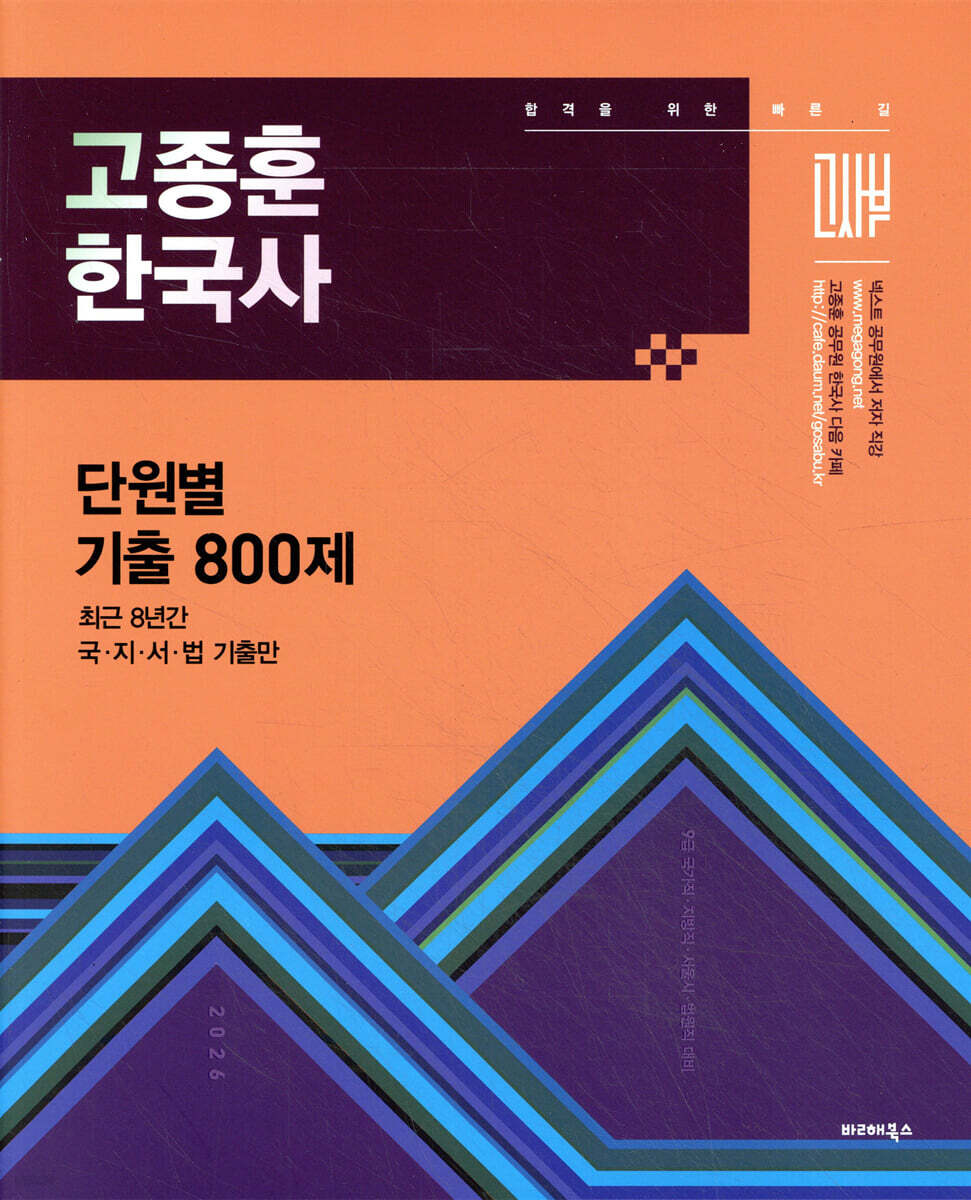
2026 Go Jong-hoon Korean History Exam: 800 Selected Questions by Unit
 |
Description
Book Introduction
Currently, the positions that take the Korean History Exam are the 9th level national, local, Seoul City, and court positions.
The 800 Past Exam Questions contains only the four series of past exam questions from the past eight years.
Frequently recurring topics are limited to a maximum of 5 questions.
Considering the trend of Korean history questions being easy and clear over the past five years (2021-2025), you can get 95 or 100 points just by looking at [800 Past Questions by Unit].
It is divided into three levels according to the difficulty of the problem.
The problems in the text are of three difficulty levels: easy, medium, and high. Problems of high difficulty account for approximately 5% (40 problems).
For those who are lacking in concepts, I recommend that you listen to the explanation lectures (www.megagong.net) focusing on the incorrect problems or the difficulty level.
The 800 Past Exam Questions contains only the four series of past exam questions from the past eight years.
Frequently recurring topics are limited to a maximum of 5 questions.
Considering the trend of Korean history questions being easy and clear over the past five years (2021-2025), you can get 95 or 100 points just by looking at [800 Past Questions by Unit].
It is divided into three levels according to the difficulty of the problem.
The problems in the text are of three difficulty levels: easy, medium, and high. Problems of high difficulty account for approximately 5% (40 problems).
For those who are lacking in concepts, I recommend that you listen to the explanation lectures (www.megagong.net) focusing on the incorrect problems or the difficulty level.
- You can preview some of the book's contents.
Preview
index
Ⅰ.
Gojoseon and the early states
01 The development of prehistoric times… … … … 8
02 Gojoseon and the Early States… … … 16
Ⅱ.
Ancient Korean history
01 Ancient Politics… … … … … … 28
02 Ancient Economy, Society, and Culture 70
Ⅲ.
Korean medieval history
01 Politics of the Middle Ages… … … … … … 90
02 Medieval Economy and Society… … 126
03 Medieval Culture… … … … … … 140
Ⅳ.
Early modern times
01 Politics of the Early Modern Period… … … 158
02 Economy and Society in the Early Modern Period … … … … … … … … … … … … … … 184
03 Culture of the Early Modern Period… … … 196
V.
Late modern times
01 Politics in the Late Modern Period… … … 212
02 Economy and Society in the Late Modern Period… … … … … … … … … … … … 228
03 Late Modern Culture … … … 240
Ⅵ.
Modern Korean history
01 The Invasive Approach of Foreign Powers and the Opening of Ports … … … … … … … … … … … … … … 260
02 Promotion and Reaction to the Enlightenment Policy … … … … … … … … … … … … … … 260
03 The Donghak Peasant Revolution and the Gabo and Eulmi Reforms… … … … … … … … … 276
04 Development of the National Salvation Movement … … … … … … … … … … … … … … 284
05 Modern Economy, Society, and Culture… … … … … … … … 304
Ⅶ.
History of the independence movement
01 Japanese Invasion and the Suffering of the Nation … … … … … … … … … … … … … … 318
02 3 · 1 Movement and the Provisional Government of the Republic of Korea … … … … … … … … 330
03 Development of the Armed Independence Movement … … … … … … … … … … … … … … 342
04 Social and Economic National Movement 358
05 National Culture Protection Movement… 366
Ⅷ.
Modern Korean history
01 Establishment of the Republic of Korea… … … … 376
02 The Trials and Development of Democracy… … … … … … … … … … … … 394
03 Economic Development and Social and Cultural Changes … … … … … … … 406
04 Unification Policy and the Tasks of Peaceful Unification… … … … … … … … … … … 406
05 Others … … … … … … … … … 416
Correct answer… … … … … … … … … … … 422
Gojoseon and the early states
01 The development of prehistoric times… … … … 8
02 Gojoseon and the Early States… … … 16
Ⅱ.
Ancient Korean history
01 Ancient Politics… … … … … … 28
02 Ancient Economy, Society, and Culture 70
Ⅲ.
Korean medieval history
01 Politics of the Middle Ages… … … … … … 90
02 Medieval Economy and Society… … 126
03 Medieval Culture… … … … … … 140
Ⅳ.
Early modern times
01 Politics of the Early Modern Period… … … 158
02 Economy and Society in the Early Modern Period … … … … … … … … … … … … … … 184
03 Culture of the Early Modern Period… … … 196
V.
Late modern times
01 Politics in the Late Modern Period… … … 212
02 Economy and Society in the Late Modern Period… … … … … … … … … … … … 228
03 Late Modern Culture … … … 240
Ⅵ.
Modern Korean history
01 The Invasive Approach of Foreign Powers and the Opening of Ports … … … … … … … … … … … … … … 260
02 Promotion and Reaction to the Enlightenment Policy … … … … … … … … … … … … … … 260
03 The Donghak Peasant Revolution and the Gabo and Eulmi Reforms… … … … … … … … … 276
04 Development of the National Salvation Movement … … … … … … … … … … … … … … 284
05 Modern Economy, Society, and Culture… … … … … … … … 304
Ⅶ.
History of the independence movement
01 Japanese Invasion and the Suffering of the Nation … … … … … … … … … … … … … … 318
02 3 · 1 Movement and the Provisional Government of the Republic of Korea … … … … … … … … 330
03 Development of the Armed Independence Movement … … … … … … … … … … … … … … 342
04 Social and Economic National Movement 358
05 National Culture Protection Movement… 366
Ⅷ.
Modern Korean history
01 Establishment of the Republic of Korea… … … … 376
02 The Trials and Development of Democracy… … … … … … … … … … … … 394
03 Economic Development and Social and Cultural Changes … … … … … … … 406
04 Unification Policy and the Tasks of Peaceful Unification… … … … … … … … … … … 406
05 Others … … … … … … … … … 416
Correct answer… … … … … … … … … … … 422
Publisher's Review
Solving past exam questions is the basis of exam preparation.
The basics of objective exams are to establish a theoretical framework and then solve past exam questions two or three times to flesh it out.
However, many test takers in reality spend a lot of time memorizing summary notes or listening to long lectures.
There are many cases where solving past exam questions is put off.
These are people who are clearly studying incorrectly.
The most basic way to study is to apply the theory to past exam questions after studying it.
Only by solving past exam questions can you understand the difficulty level, style, and key points of the exam you are preparing for.
Students, please don't just repeat theories; please solve problems together.
What's the advantage of the civil service exam from a test taker's perspective? Since the exam's release, over 200 past exam questions have been released each year.
There are no better questions than those prepared by the National Examination Center.
If you just solve enough past exam questions, you can easily get 90-95 points on the 9th level exam.
Analyze recent past exam questions.
The public disclosure issue has been public since 2007.
When the questions were actually released, it turned out that there were many very strange questions in the Korean history section compared to the Korean History Proficiency Test.
There were occasional errors in the exam questions, and there were also some questions that even students who studied hard could not possibly prepare for.
Much criticism was raised, and gradually the problem began to take a more predictable turn.
Currently, the questions are presented at a similar level to the Korean History Proficiency Test, and in a very similar style.
I don't think it's necessary to solve past exam questions that are too old, from 2007 to 2015.
I think that students will lose more than gain by solving this problem.
Repeat as much as you can handle.
Perhaps because of the fear marketing of academies and instructors, students prefer past exam books with a large number of questions.
There is a perception that the best past exam book in Noryangjin is the one with 2,000 or 3,000 questions.
A test taker with an average brain and average patience won't even be able to see all of this.
You have to solve it at least 3 to 5 times to internalize it, but you can't solve it and analyze it properly even once, so you get a bad score.
How could you possibly get there? Don't obsess over the numbers in the workbook. Solving even 800 problems properly and repeating them is the foundation of exam preparation.
We have carefully selected only the past questions from the national, local, literary, and legal examinations over the past eight years.
Currently, the positions that take the Korean History Exam are the 9th level national, local, Seoul City, and court positions.
The 800 Past Exam Questions contains only the four series of past exam questions from the past eight years.
Frequently recurring topics are limited to a maximum of 5 questions.
Considering the trend of Korean history questions being easy and clear over the past five years (2021-2025), you can get 95 or 100 points just by looking at [800 Past Questions by Unit].
It is divided into three levels according to the difficulty of the problem.
The problems in the text are of three difficulty levels: easy, medium, and high. Problems of high difficulty account for approximately 5% (40 problems).
For those who are lacking in concepts, I recommend that you listen to the explanation lectures (www.megagong.net) focusing on the incorrect problems or the difficulty level.
The basics of objective exams are to establish a theoretical framework and then solve past exam questions two or three times to flesh it out.
However, many test takers in reality spend a lot of time memorizing summary notes or listening to long lectures.
There are many cases where solving past exam questions is put off.
These are people who are clearly studying incorrectly.
The most basic way to study is to apply the theory to past exam questions after studying it.
Only by solving past exam questions can you understand the difficulty level, style, and key points of the exam you are preparing for.
Students, please don't just repeat theories; please solve problems together.
What's the advantage of the civil service exam from a test taker's perspective? Since the exam's release, over 200 past exam questions have been released each year.
There are no better questions than those prepared by the National Examination Center.
If you just solve enough past exam questions, you can easily get 90-95 points on the 9th level exam.
Analyze recent past exam questions.
The public disclosure issue has been public since 2007.
When the questions were actually released, it turned out that there were many very strange questions in the Korean history section compared to the Korean History Proficiency Test.
There were occasional errors in the exam questions, and there were also some questions that even students who studied hard could not possibly prepare for.
Much criticism was raised, and gradually the problem began to take a more predictable turn.
Currently, the questions are presented at a similar level to the Korean History Proficiency Test, and in a very similar style.
I don't think it's necessary to solve past exam questions that are too old, from 2007 to 2015.
I think that students will lose more than gain by solving this problem.
Repeat as much as you can handle.
Perhaps because of the fear marketing of academies and instructors, students prefer past exam books with a large number of questions.
There is a perception that the best past exam book in Noryangjin is the one with 2,000 or 3,000 questions.
A test taker with an average brain and average patience won't even be able to see all of this.
You have to solve it at least 3 to 5 times to internalize it, but you can't solve it and analyze it properly even once, so you get a bad score.
How could you possibly get there? Don't obsess over the numbers in the workbook. Solving even 800 problems properly and repeating them is the foundation of exam preparation.
We have carefully selected only the past questions from the national, local, literary, and legal examinations over the past eight years.
Currently, the positions that take the Korean History Exam are the 9th level national, local, Seoul City, and court positions.
The 800 Past Exam Questions contains only the four series of past exam questions from the past eight years.
Frequently recurring topics are limited to a maximum of 5 questions.
Considering the trend of Korean history questions being easy and clear over the past five years (2021-2025), you can get 95 or 100 points just by looking at [800 Past Questions by Unit].
It is divided into three levels according to the difficulty of the problem.
The problems in the text are of three difficulty levels: easy, medium, and high. Problems of high difficulty account for approximately 5% (40 problems).
For those who are lacking in concepts, I recommend that you listen to the explanation lectures (www.megagong.net) focusing on the incorrect problems or the difficulty level.
GOODS SPECIFICS
- Date of issue: July 12, 2025
- Page count, weight, size: 424 pages | 210*260*30mm
- ISBN13: 9791161012544
- ISBN10: 1161012540
You may also like
카테고리
korean


korean

![GQ KOREA Mark (Monthly): December [2025]](http://librairie.coreenne.fr/cdn/shop/files/8ef265dbbfbf186523ed75ba7319009d.jpg?v=1765340328&width=3840)


