

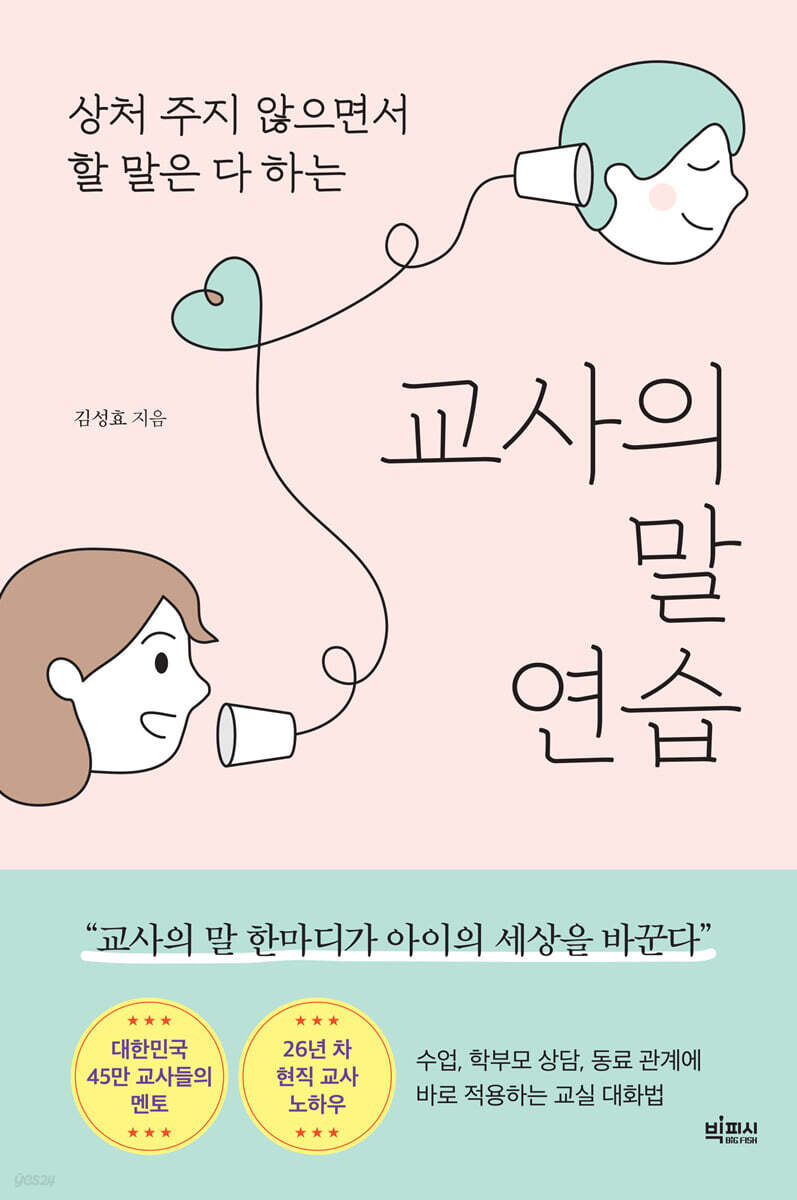
Teacher's Speech Practice
 |
Description
Book Introduction
Classroom conversation techniques that can be applied directly to classes, parent-teacher conferences, and peer relationships. A teacher's words can change a child's world. A teacher's words are powerful. It can change a child's life, lower their self-esteem, or give them the strength to overcome any challenge. This book uses real-life examples to illustrate how teachers can achieve desired results in various challenging situations, such as student guidance, parent counseling, and coworker relationships. The author, who has been an educator for 26 years, has put into this book not only the secrets of classroom speaking that he has learned while working with children, but also the speaking skills that he has refined as an author of over 20 books and his long experience counseling junior teachers. By following the author's solutions to 40 of the most common questions teachers ask, readers will rediscover the principles of education and take control of the conversation. |
- You can preview some of the book's contents.
Preview
index
prolog
When teachers change, classrooms change too.
Chapter 1.
The art of respect that acknowledges things as they are
The power of kind words filled with heart
→Instead of 'Hey!'
[Going one step further] Talking while looking into each other's eyes
Children blooming at their own time and pace
→Instead of 'do it quickly'
[Going One Step Further] A Teacher's Note on Developing Non-Cognitive Abilities
The Power of True Praise to Help Children Grow
→Instead of 'Well done'
If you trust and wait, things will change.
→Instead of 'If this happens, Mom should come'
Please understand my inner desire to be recognized.
→'I told you not to nag, didn't I?' instead
The illusion that a good teacher is someone who listens to everything
→ Instead of 'Why do you talk so much?'
[Seonghyo's Classroom Episode] Teacher, I keep talking without realizing it.
Chapter 2.
The art of empathy, looking at a situation objectively
The Real Feelings of a Rude Student
→ Instead of 'What did you just say?'
Children who suppress their emotions with harsh words
→ Instead of 'I told you not to say you're annoyed, right?'
[Going One Step Further] Creating an Emotion Dictionary
So that resentment does not build up in the child's mind
→ Instead of 'Why did you fight?'
If your child cries easily, check for signs of anxiety.
→ Instead of 'don't cry'
It's still difficult for children to understand other people's feelings.
→ Instead of 'Why are you so selfish?'
[Going one step further] I-speech and you-speech
The One Rule for Dealing with a Child with a High Need for Affection
→ Instead of 'You weren't like that before, why are you like that?'
Why You Need to Be Flexible About Your Perfectionist Tendencies
→ Instead of 'just passing over'
[Going One Step Further] Creating Positive Sentences
Chapter 3.
Make better choices without getting angry
The art of recommendation
Conversation techniques that focus on the child's changes
→Instead of 'Why are you always late!'
[Seonghyo's Classroom Episode] You have the opportunity to choose good behavior.
Say what you expect to happen instead of making emotional judgments
→Instead of 'What is this classroom like?'
[Seonghyo's Classroom Episode] The Secret to a Clean Classroom
How to achieve educational effectiveness without getting angry or scolding
→Instead of 'Is that the best?'
Things to Say to a Child Who Swears
→'I told you not to swear, didn't I?' instead
Let your dysfunctional friendships be resolved on their own.
→Instead of 'Did you fight again?'
[Going One Step Further] An Interview Game That Helps You Look at the Situation Objectively
The meaning of time to change the emotional state
→Instead of 'Are you rebelling now?'
Why You Should Always Look at Your Child with a Positive Mind
→Instead of 'I told you to do it quickly'
Chapter 4.
Teaching techniques that foster an active learning attitude
The most effective way to calm noisy children
→Instead of 'Be quiet!'
[Going One Step Further] Teaching Silence Signals
The secret to avoiding unnecessary repetition of explanations and instructions
→Instead of 'How many times do I have to say the same thing?'
Good feedback from teachers that increases a child's desire to achieve
→Instead of 'Be a little more sincere'
Teachers' Questioning Methods for Classes Without Bystanders
→Instead of 'Who wants to announce?'
[Going One Step Further] 5 Types of Questions Students Find Difficult to Answer
You may not be able to act appropriately yet
→'Do I really have to explain that in words?' instead
Creating a schedule that takes children's concentration into account
→Instead of 'What if I yawn during class?'
Smart Ways to Engage Pranksters in Class
→Instead of 'I told you not to joke around'
Chapter 5.
Communication skills that bring you one step closer to parents
Parents and teachers speak different languages.
Two Meanings of Speaking Kindly
[Seonghyo's Classroom Episode] Instilling Strong Trust Comes First
Speaking from an objective, specific, and professional perspective
[Seonghyo's Classroom Episode] Take a step back and talk with your child at the center.
Parent Counseling Techniques Using the 3:2:1 Dialogue Method
Start with a positive story first
When teachers approach parents, their hearts open.
[Going One Step Further] 3 Ways to Open Parents' Hearts
Chapter 6.
The growth skills that protect and nurture me as a teacher
Ignore advice that crosses the line.
Draw a clear line with colleagues who pass on work.
The reason you don't get help is because you don't ask.
Even through difficult times, you can grow a little more.
Let go of your guilt and embrace yourself.
We need a contrast between firm and gentle.
[Seonghyo's Classroom Episode] What it means to be a good teacher
Look at the situation from a perceptual standpoint
Epilogue
The teacher must have made our Geumjogi angry!
When teachers change, classrooms change too.
Chapter 1.
The art of respect that acknowledges things as they are
The power of kind words filled with heart
→Instead of 'Hey!'
[Going one step further] Talking while looking into each other's eyes
Children blooming at their own time and pace
→Instead of 'do it quickly'
[Going One Step Further] A Teacher's Note on Developing Non-Cognitive Abilities
The Power of True Praise to Help Children Grow
→Instead of 'Well done'
If you trust and wait, things will change.
→Instead of 'If this happens, Mom should come'
Please understand my inner desire to be recognized.
→'I told you not to nag, didn't I?' instead
The illusion that a good teacher is someone who listens to everything
→ Instead of 'Why do you talk so much?'
[Seonghyo's Classroom Episode] Teacher, I keep talking without realizing it.
Chapter 2.
The art of empathy, looking at a situation objectively
The Real Feelings of a Rude Student
→ Instead of 'What did you just say?'
Children who suppress their emotions with harsh words
→ Instead of 'I told you not to say you're annoyed, right?'
[Going One Step Further] Creating an Emotion Dictionary
So that resentment does not build up in the child's mind
→ Instead of 'Why did you fight?'
If your child cries easily, check for signs of anxiety.
→ Instead of 'don't cry'
It's still difficult for children to understand other people's feelings.
→ Instead of 'Why are you so selfish?'
[Going one step further] I-speech and you-speech
The One Rule for Dealing with a Child with a High Need for Affection
→ Instead of 'You weren't like that before, why are you like that?'
Why You Need to Be Flexible About Your Perfectionist Tendencies
→ Instead of 'just passing over'
[Going One Step Further] Creating Positive Sentences
Chapter 3.
Make better choices without getting angry
The art of recommendation
Conversation techniques that focus on the child's changes
→Instead of 'Why are you always late!'
[Seonghyo's Classroom Episode] You have the opportunity to choose good behavior.
Say what you expect to happen instead of making emotional judgments
→Instead of 'What is this classroom like?'
[Seonghyo's Classroom Episode] The Secret to a Clean Classroom
How to achieve educational effectiveness without getting angry or scolding
→Instead of 'Is that the best?'
Things to Say to a Child Who Swears
→'I told you not to swear, didn't I?' instead
Let your dysfunctional friendships be resolved on their own.
→Instead of 'Did you fight again?'
[Going One Step Further] An Interview Game That Helps You Look at the Situation Objectively
The meaning of time to change the emotional state
→Instead of 'Are you rebelling now?'
Why You Should Always Look at Your Child with a Positive Mind
→Instead of 'I told you to do it quickly'
Chapter 4.
Teaching techniques that foster an active learning attitude
The most effective way to calm noisy children
→Instead of 'Be quiet!'
[Going One Step Further] Teaching Silence Signals
The secret to avoiding unnecessary repetition of explanations and instructions
→Instead of 'How many times do I have to say the same thing?'
Good feedback from teachers that increases a child's desire to achieve
→Instead of 'Be a little more sincere'
Teachers' Questioning Methods for Classes Without Bystanders
→Instead of 'Who wants to announce?'
[Going One Step Further] 5 Types of Questions Students Find Difficult to Answer
You may not be able to act appropriately yet
→'Do I really have to explain that in words?' instead
Creating a schedule that takes children's concentration into account
→Instead of 'What if I yawn during class?'
Smart Ways to Engage Pranksters in Class
→Instead of 'I told you not to joke around'
Chapter 5.
Communication skills that bring you one step closer to parents
Parents and teachers speak different languages.
Two Meanings of Speaking Kindly
[Seonghyo's Classroom Episode] Instilling Strong Trust Comes First
Speaking from an objective, specific, and professional perspective
[Seonghyo's Classroom Episode] Take a step back and talk with your child at the center.
Parent Counseling Techniques Using the 3:2:1 Dialogue Method
Start with a positive story first
When teachers approach parents, their hearts open.
[Going One Step Further] 3 Ways to Open Parents' Hearts
Chapter 6.
The growth skills that protect and nurture me as a teacher
Ignore advice that crosses the line.
Draw a clear line with colleagues who pass on work.
The reason you don't get help is because you don't ask.
Even through difficult times, you can grow a little more.
Let go of your guilt and embrace yourself.
We need a contrast between firm and gentle.
[Seonghyo's Classroom Episode] What it means to be a good teacher
Look at the situation from a perceptual standpoint
Epilogue
The teacher must have made our Geumjogi angry!
Detailed image

Into the book
"Hey!", which the children found to be a substitute for "Hey!", worked well in many ways.
Fighting has decreased and relationships between boys and girls have become more comfortable.
Group activities and presentation classes could also be conducted in a much more relaxed atmosphere.
There's a reason why this simple change of words can make such a difference in the classroom.
Words contain the heart.
We don't just call people by their names.
It contains your feelings and emotions towards the other person.
I can't get angry at someone who calls my name so warmly and affectionately.
---From "The Power of Kind Words Filled with Heart"
I've seen parents before who take their children, who love insects, outdoors every weekend to observe insects.
(Omitted) After studying how important non-cognitive skills are, I realized that the best way to develop a child's non-cognitive skills was for this parent to spend time with and make an effort to do things that the child likes and enjoys.
It's because I didn't think of the things my child liked and enjoyed as trivial, but rather valued them as such.
If you are a teacher, carefully observe your own words.
Whether I am using words that undermine my child's cognitive abilities, whether I respect my child as a person, and whether I acknowledge and accept his or her mind and emotions as they are, all are revealed in my words.
If you look closely, you'll be able to figure out what you're doing wrong.
---From "A Teacher's Words on Developing Non-Cognitive Abilities"
Children can change as much as we want if we believe in them and wait for them.
Children who hit and curse, children who feel anxious and uncomfortable, and children who lie and cause trouble all change.
In any situation, the most important thing is for the student to absolutely trust and follow the teacher.
The principle is that classroom work should be resolved in the classroom.
Instill a strong belief that if you trust and follow your teacher, you can solve anything.
---From "If you believe and wait, things will change"
So what kind of feedback is good feedback? It's feedback that's specific and gives you the bottom line.
"huh.
Saying something like “good job” is not feedback.
You need to point out what, how, and why you did it well.
Students may not be sure whether what they are doing is correct or going in the right direction.
You need to point out these parts specifically so that your child can learn properly.
---From “Good Feedback from Teachers that Increases Children’s Achievement Desire”
Parents are not like ordinary conversation partners who just don't like each other and never see each other again.
Parents and teachers view the extremely important subject of students from different perspectives.
Like it or not, there are times when teachers and parents have to face each other over child issues.
If necessary, parents and teachers need to see each other's faces, even tomorrow.
When talking to parents, listen to their side of the story first.
Try to understand what the parents are really trying to say.
First, listen to what the parents are upset about and why they think that way.
Even if you don't understand your parents' feelings, you should at least pretend to understand.
---From "Two Meanings of Speaking Kindly"
There is a saying that kindness should be given to those who know how to be grateful.
Even that little ant gets swarmed by hundreds of ants when he lifts a single leaf, so why does he have to do all the hard school work alone?
It's embarrassing to even call a colleague who just sits around doing nothing or who often defers to others a colleague.
For these people, draw the line clearly and precisely.
“This is fine, but no more.”
By the way, there are many cases where people like this won't accept something you say once.
It's good to say the same thing over and over again.
You shouldn't give up midway by saying, "Okay, I'll do it," because you're tired of this kind of argument.
The reason the other person crosses the line is because I allow them to cross the line.
---From "Please draw a clear line with colleagues who pass on work"
I think a good teacher knows when to be firm and when to be soft.
If you are not firm when you should be, or not gentle when you should be, then you are not a good teacher.
When you need to be decisive, don't back down or cower, but be decisive.
However, you must be able to judge for yourself whether you are being angry at your children or speaking firmly to them.
(Omitted) Teachers must be gentle yet firm.
It's about smiling and listening to what children say, but also telling them that what they say is not true.
If you consistently strive to strike this balance, you will realize it at some point.
It means that the children are already completely captivated by their teacher and that he is a good teacher.
Fighting has decreased and relationships between boys and girls have become more comfortable.
Group activities and presentation classes could also be conducted in a much more relaxed atmosphere.
There's a reason why this simple change of words can make such a difference in the classroom.
Words contain the heart.
We don't just call people by their names.
It contains your feelings and emotions towards the other person.
I can't get angry at someone who calls my name so warmly and affectionately.
---From "The Power of Kind Words Filled with Heart"
I've seen parents before who take their children, who love insects, outdoors every weekend to observe insects.
(Omitted) After studying how important non-cognitive skills are, I realized that the best way to develop a child's non-cognitive skills was for this parent to spend time with and make an effort to do things that the child likes and enjoys.
It's because I didn't think of the things my child liked and enjoyed as trivial, but rather valued them as such.
If you are a teacher, carefully observe your own words.
Whether I am using words that undermine my child's cognitive abilities, whether I respect my child as a person, and whether I acknowledge and accept his or her mind and emotions as they are, all are revealed in my words.
If you look closely, you'll be able to figure out what you're doing wrong.
---From "A Teacher's Words on Developing Non-Cognitive Abilities"
Children can change as much as we want if we believe in them and wait for them.
Children who hit and curse, children who feel anxious and uncomfortable, and children who lie and cause trouble all change.
In any situation, the most important thing is for the student to absolutely trust and follow the teacher.
The principle is that classroom work should be resolved in the classroom.
Instill a strong belief that if you trust and follow your teacher, you can solve anything.
---From "If you believe and wait, things will change"
So what kind of feedback is good feedback? It's feedback that's specific and gives you the bottom line.
"huh.
Saying something like “good job” is not feedback.
You need to point out what, how, and why you did it well.
Students may not be sure whether what they are doing is correct or going in the right direction.
You need to point out these parts specifically so that your child can learn properly.
---From “Good Feedback from Teachers that Increases Children’s Achievement Desire”
Parents are not like ordinary conversation partners who just don't like each other and never see each other again.
Parents and teachers view the extremely important subject of students from different perspectives.
Like it or not, there are times when teachers and parents have to face each other over child issues.
If necessary, parents and teachers need to see each other's faces, even tomorrow.
When talking to parents, listen to their side of the story first.
Try to understand what the parents are really trying to say.
First, listen to what the parents are upset about and why they think that way.
Even if you don't understand your parents' feelings, you should at least pretend to understand.
---From "Two Meanings of Speaking Kindly"
There is a saying that kindness should be given to those who know how to be grateful.
Even that little ant gets swarmed by hundreds of ants when he lifts a single leaf, so why does he have to do all the hard school work alone?
It's embarrassing to even call a colleague who just sits around doing nothing or who often defers to others a colleague.
For these people, draw the line clearly and precisely.
“This is fine, but no more.”
By the way, there are many cases where people like this won't accept something you say once.
It's good to say the same thing over and over again.
You shouldn't give up midway by saying, "Okay, I'll do it," because you're tired of this kind of argument.
The reason the other person crosses the line is because I allow them to cross the line.
---From "Please draw a clear line with colleagues who pass on work"
I think a good teacher knows when to be firm and when to be soft.
If you are not firm when you should be, or not gentle when you should be, then you are not a good teacher.
When you need to be decisive, don't back down or cower, but be decisive.
However, you must be able to judge for yourself whether you are being angry at your children or speaking firmly to them.
(Omitted) Teachers must be gentle yet firm.
It's about smiling and listening to what children say, but also telling them that what they say is not true.
If you consistently strive to strike this balance, you will realize it at some point.
It means that the children are already completely captivated by their teacher and that he is a good teacher.
---From "Being a Good Teacher"
Publisher's Review
★ Mentor to 450,000 teachers in Korea
★ 26 years of experience as a current teacher
Without hurting anyone and maintaining self-esteem
A teacher's speech that says everything he wants to say
All kinds of problematic situations arise in the classroom.
The things that make teachers feel uncomfortable are truly diverse, ranging from everyday situations like a distracted child who disrupts class, a child who argues with friends at the drop of a hat, or a child who disrupts the classroom atmosphere with harsh words and actions, to serious situations like theft or assault.
How can I properly guide my students without hurting them and while maintaining my self-esteem as a teacher?
This book contains the secrets of classroom speaking that the author, who has been an educator for 26 years, has learned while working with children, as well as the speaking skills that he has refined through his long experience counseling junior teachers and as the author of over 20 books.
Thanks to this book, readers can practice speaking gently in countless situations that make teachers feel uncomfortable.
From problem students to demanding parents
40 Conversation Solutions for Struggling Teachers
This book uses real-life examples to illustrate how to speak in a variety of classroom situations to achieve desired results.
This is a format in which the author answers 40 of the most frequently asked questions from teachers he has met during lectures or at schools.
The author suggests six keywords for solving various problems that arise in schools.
These are the skills of respect, empathy, encouragement, teaching, communication, and growth.
It covers a wide range of topics, from the art of using words to positively change children to getting closer to parents, the people teachers find most difficult, to building smooth relationships with fellow teachers, and even the secrets to protecting and nurturing oneself as a teacher.
If you're having trouble with your teaching career, try changing your words by following the guidance in this book.
Any teacher can create a happy and warm classroom.
Firmly, but gently
Take control of the conversation according to the principles
A good conversation always begins with respect for the other person.
Empathy is the best way to communicate so that teachers do not get hurt and children learn to express their emotions appropriately.
One thing to remember, especially when talking to students who are causing all kinds of problems, is the art of persuasion.
In this way, this book reminds us of the educational principles that teachers should always keep in mind.
Teachers should restrain their emotional responses and be firm when it comes to mistakes, but they should never forget that children are still growing and should always provide opportunities for positive change.
If teachers adhere to these principles, they can gain trust from students, parents, and colleagues, and take the lead in conversations.
Moreover, since parents are responsible for education at home, the words of teachers in this book are also useful for parents in teaching their children.
Therefore, this book is a must-read for anyone involved in education.
Because if words change, students change, classrooms change, and education as a whole can change.
★ 26 years of experience as a current teacher
Without hurting anyone and maintaining self-esteem
A teacher's speech that says everything he wants to say
All kinds of problematic situations arise in the classroom.
The things that make teachers feel uncomfortable are truly diverse, ranging from everyday situations like a distracted child who disrupts class, a child who argues with friends at the drop of a hat, or a child who disrupts the classroom atmosphere with harsh words and actions, to serious situations like theft or assault.
How can I properly guide my students without hurting them and while maintaining my self-esteem as a teacher?
This book contains the secrets of classroom speaking that the author, who has been an educator for 26 years, has learned while working with children, as well as the speaking skills that he has refined through his long experience counseling junior teachers and as the author of over 20 books.
Thanks to this book, readers can practice speaking gently in countless situations that make teachers feel uncomfortable.
From problem students to demanding parents
40 Conversation Solutions for Struggling Teachers
This book uses real-life examples to illustrate how to speak in a variety of classroom situations to achieve desired results.
This is a format in which the author answers 40 of the most frequently asked questions from teachers he has met during lectures or at schools.
The author suggests six keywords for solving various problems that arise in schools.
These are the skills of respect, empathy, encouragement, teaching, communication, and growth.
It covers a wide range of topics, from the art of using words to positively change children to getting closer to parents, the people teachers find most difficult, to building smooth relationships with fellow teachers, and even the secrets to protecting and nurturing oneself as a teacher.
If you're having trouble with your teaching career, try changing your words by following the guidance in this book.
Any teacher can create a happy and warm classroom.
Firmly, but gently
Take control of the conversation according to the principles
A good conversation always begins with respect for the other person.
Empathy is the best way to communicate so that teachers do not get hurt and children learn to express their emotions appropriately.
One thing to remember, especially when talking to students who are causing all kinds of problems, is the art of persuasion.
In this way, this book reminds us of the educational principles that teachers should always keep in mind.
Teachers should restrain their emotional responses and be firm when it comes to mistakes, but they should never forget that children are still growing and should always provide opportunities for positive change.
If teachers adhere to these principles, they can gain trust from students, parents, and colleagues, and take the lead in conversations.
Moreover, since parents are responsible for education at home, the words of teachers in this book are also useful for parents in teaching their children.
Therefore, this book is a must-read for anyone involved in education.
Because if words change, students change, classrooms change, and education as a whole can change.
GOODS SPECIFICS
- Date of issue: January 18, 2023
- Page count, weight, size: 288 pages | 456g | 140*210*20mm
- ISBN13: 9791191825749
- ISBN10: 1191825744
You may also like
카테고리
korean


korean

![GQ KOREA Mark (Monthly): December [2025]](http://librairie.coreenne.fr/cdn/shop/files/8ef265dbbfbf186523ed75ba7319009d.jpg?v=1765340328&width=3840)


