

The power of geography
 |
Description
Book Introduction
|
How Geography Determines Individuals and the World
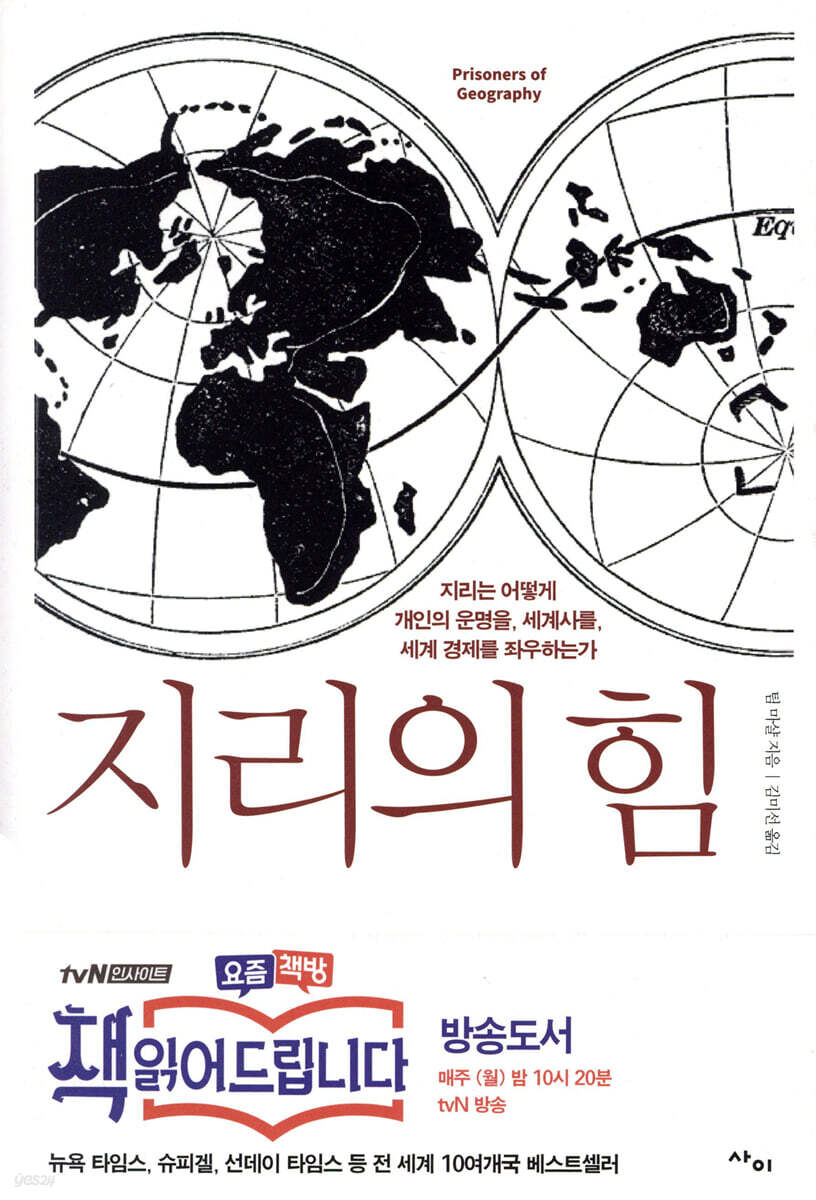
THAAD, the South China Sea, ISIS, territorial disputes, the division of Europe—it all started with geography! Our lives have always been shaped by the land we live on. Hannibal, Xun Zi, and Alexander the Great all acknowledged it. [The Laws of Geography] remain as powerful as ever in the 21st century. An in-depth analysis of the impact of [The Power of Geography] on 21st-century modern history! The author, who has worked as a journalist specializing in international affairs for over 25 years, including as a Turkey correspondent for the Financial Times, a foreign affairs editor for Sky News, and a BBC reporter, has published a book in which he views the world through the lens of geography. This book divides the world into ten regions, specifically China, the United States, Western Europe, Russia, Korea and Japan, Africa, Latin America, the Middle East, India and Pakistan, and the Arctic, and focuses on the impact of [the power of geography] on the rapidly changing modern history of the 21st century. In particular, the [Korea] section points out that Korea cannot help but serve as a [transit point for major powers] due to its location and the geographical characteristics of the Korean Peninsula. It also covers the most recent issues, including the territorial disputes over the South China Sea, Britain's choice of glorious isolation, a divided Europe, Japan's choice of militarism, the neo-hegemonic competition between the United States and China, ISIS's territorial expansion unlike Al Qaeda, and the rise of the Arctic. The author claims that [economic wars], [the division of the world], [territorial disputes], [the gap between the rich and the poor], and [greed and competition for vast resources] ultimately [originate from geography], presenting a key insight into geography, one of the major factors that determined world history. It also shows how geography affects our individual lives and how it shapes world politics and economics. The book is currently a bestseller in the United States, Germany, and the United Kingdom, and will be published in Spain, Türkiye, Taiwan, Japan, and China. |
- You can preview some of the book's contents.
Preview
index
Introduction: Everything in our lives began with geography!
Chapter 1: China, from a continental nation to a maritime power after 4,000 years
From the birth of the Han people to the dream of becoming a military power
A country that is definitely protected by geography
Why China Risks Its Lives in Tibet
Xinjiang, a strategic territory that China can never give up
From a land nation to a maritime power!
The South China Sea, a hotbed of conflict
“America, Taiwan is geographically closer to us!”
Numerous territorial disputes, we will never give up our position as a maritime power.
Chapter 2: The United States Becomes the World's Most Powerful Power Through Geographic Blessings and Strategic Territorial Purchases
A country with an unusual geographical location
A stroke of genius, the Louisiana Purchase
In the territorial dispute with Mexico, history sided with the United States.
In an era when there were no threats, we advanced to Guam and the Caribbean.
The era of American hegemony, with its powerful naval force
Are Europe and Russia really a threat to the United States?
China, China, China! And the East Asia-Pacific region.
Now that the United States has achieved energy self-sufficiency, how will it maintain relations with Middle Eastern countries?
The trend of predicting America's decline
Chapter 3: Western Europe: Ideological and Geographic Divides Together
Western Europe blessed with geography vs.
Southern Europe, discriminated against by geography
The Greek crisis, ideological and geographical divisions in Europe
Signs of rift and tension arising in the East
France fears Germany, and Germany fears France.
The perceived plurality of geographies within the European Union
Britain in glorious isolation?
Will Europe really return to the early 20th century?
Chapter 4: Russia, the Largest Country, but Geography Takes a Bash
Geography was what protected Russia.
Unlimited territorial expansion, becoming a superpower rivaling the United States.
One foot in Europe, the other in Asia
The absence of ice-free ports: Russia's geographic Achilles' heel
Pro-Western countries, pro-Russian countries, and neutral countries
Ukraine is trying to flirt with the West and get a carrot from Moscow.
Crimea, a geographical gift from God to Russia
Russia's Gambling with Geography as a Weapon
NATO vs.
Russia and the Baltic countries
Moscow is close, Washington is far away
Economic warfare using gas, oil, and geography
The honeymoon relationship between Russia and China, which even allows for military cooperation
Chapter 5: Korea, Due to Its Geographical Features, Became a Transit Point for Great Powers
Japan forges a military alliance with the United States to contain China, its greatest concern.
North Korea, which appears weak but plays the role of a dangerous underdog
The artificial 38th parallel divided by one finger
If war breaks out on the Korean Peninsula, what choices will the United States, China, Japan, and Russia make?
Japan, an island nation, once chose isolation, now chooses military intervention.
Will Japan ever become a country capable of waging war?
Japan's biggest concern is China; now it must find friends in its neighbors.
Chapter 6: Latin America, Trapped in a Landless, Vast Geographic Prison
A territorial dispute unfolds at the edge of a vast world.
Mexico, a country destined to live in the shadow of the United States
Nicaragua's Grand Canal: Huge Chinese Capital Already in Place
China exploits the gap between the US and Latin America.
Brazil's geography also hinders domestic transport.
Argentina, with the best geographical advantages in Latin America
Chapter 7: Africa, a Victim of European Geopolitics
Geography is Africa's biggest obstacle.
Borders drawn arbitrarily by Europeans
The Democratic Republic of the Congo, the scene of Africa's version of World War II
The Nile River's Water Resources: A Blessing and a Seed of Conflict
The land of oil and Boko Haram
Angola, plagued by internal and external exploitation
China's approach to Africa: Once it has established a foothold, it will not easily leave.
South Africa, which benefits from its geographical location
Fighting the power of geography
Chapter 8: The Middle East: Artificial Borders Sow Conflict
Borders drawn with ink by the West
Sunni, Shia, and numerous other sects within them
Iraq, the place that Britain has put together in chaos
Jordan, a country built by cutting out the headaches
Lebanon, where the name of a mountain range became the name of a country
Syria, a place of tension where the minority dominates the majority
IS Plays a Game of Death
Israel and Palestine
A country of mountains, nuclear weapons, and oil
Türkiye, destined to become a crossroads of history
Arab Spring
Chapter 9: India, Geographically Advantaged from the Start
Pakistan inherits a troubled border with Afghanistan.
The Partition of the Indian Subcontinent and the Great Slaughter
Pakistan was at a disadvantage compared to India from the start.
The clash between the two countries is not over yet
Afghanistan, making itself the enemy of its enemies
Pakistan, the Taliban, and the United States
The US Becomes India's New Ally
Chapter 10: The Arctic: A Battleground for 21st-Century Economic and Diplomatic Conflicts
The Long History of Arctic Exploration
As the ice melts, the sea route opens up.
Fierce competition surrounding the Arctic
The US lacks an Arctic strategy, while Russia is the Arctic's strongest player.
Gaming in the Arctic must be different
Conclusion: Facing a New Geographic Reality Together
Chapter 1: China, from a continental nation to a maritime power after 4,000 years
From the birth of the Han people to the dream of becoming a military power
A country that is definitely protected by geography
Why China Risks Its Lives in Tibet
Xinjiang, a strategic territory that China can never give up
From a land nation to a maritime power!
The South China Sea, a hotbed of conflict
“America, Taiwan is geographically closer to us!”
Numerous territorial disputes, we will never give up our position as a maritime power.
Chapter 2: The United States Becomes the World's Most Powerful Power Through Geographic Blessings and Strategic Territorial Purchases
A country with an unusual geographical location
A stroke of genius, the Louisiana Purchase
In the territorial dispute with Mexico, history sided with the United States.
In an era when there were no threats, we advanced to Guam and the Caribbean.
The era of American hegemony, with its powerful naval force
Are Europe and Russia really a threat to the United States?
China, China, China! And the East Asia-Pacific region.
Now that the United States has achieved energy self-sufficiency, how will it maintain relations with Middle Eastern countries?
The trend of predicting America's decline
Chapter 3: Western Europe: Ideological and Geographic Divides Together
Western Europe blessed with geography vs.
Southern Europe, discriminated against by geography
The Greek crisis, ideological and geographical divisions in Europe
Signs of rift and tension arising in the East
France fears Germany, and Germany fears France.
The perceived plurality of geographies within the European Union
Britain in glorious isolation?
Will Europe really return to the early 20th century?
Chapter 4: Russia, the Largest Country, but Geography Takes a Bash
Geography was what protected Russia.
Unlimited territorial expansion, becoming a superpower rivaling the United States.
One foot in Europe, the other in Asia
The absence of ice-free ports: Russia's geographic Achilles' heel
Pro-Western countries, pro-Russian countries, and neutral countries
Ukraine is trying to flirt with the West and get a carrot from Moscow.
Crimea, a geographical gift from God to Russia
Russia's Gambling with Geography as a Weapon
NATO vs.
Russia and the Baltic countries
Moscow is close, Washington is far away
Economic warfare using gas, oil, and geography
The honeymoon relationship between Russia and China, which even allows for military cooperation
Chapter 5: Korea, Due to Its Geographical Features, Became a Transit Point for Great Powers
Japan forges a military alliance with the United States to contain China, its greatest concern.
North Korea, which appears weak but plays the role of a dangerous underdog
The artificial 38th parallel divided by one finger
If war breaks out on the Korean Peninsula, what choices will the United States, China, Japan, and Russia make?
Japan, an island nation, once chose isolation, now chooses military intervention.
Will Japan ever become a country capable of waging war?
Japan's biggest concern is China; now it must find friends in its neighbors.
Chapter 6: Latin America, Trapped in a Landless, Vast Geographic Prison
A territorial dispute unfolds at the edge of a vast world.
Mexico, a country destined to live in the shadow of the United States
Nicaragua's Grand Canal: Huge Chinese Capital Already in Place
China exploits the gap between the US and Latin America.
Brazil's geography also hinders domestic transport.
Argentina, with the best geographical advantages in Latin America
Chapter 7: Africa, a Victim of European Geopolitics
Geography is Africa's biggest obstacle.
Borders drawn arbitrarily by Europeans
The Democratic Republic of the Congo, the scene of Africa's version of World War II
The Nile River's Water Resources: A Blessing and a Seed of Conflict
The land of oil and Boko Haram
Angola, plagued by internal and external exploitation
China's approach to Africa: Once it has established a foothold, it will not easily leave.
South Africa, which benefits from its geographical location
Fighting the power of geography
Chapter 8: The Middle East: Artificial Borders Sow Conflict
Borders drawn with ink by the West
Sunni, Shia, and numerous other sects within them
Iraq, the place that Britain has put together in chaos
Jordan, a country built by cutting out the headaches
Lebanon, where the name of a mountain range became the name of a country
Syria, a place of tension where the minority dominates the majority
IS Plays a Game of Death
Israel and Palestine
A country of mountains, nuclear weapons, and oil
Türkiye, destined to become a crossroads of history
Arab Spring
Chapter 9: India, Geographically Advantaged from the Start
Pakistan inherits a troubled border with Afghanistan.
The Partition of the Indian Subcontinent and the Great Slaughter
Pakistan was at a disadvantage compared to India from the start.
The clash between the two countries is not over yet
Afghanistan, making itself the enemy of its enemies
Pakistan, the Taliban, and the United States
The US Becomes India's New Ally
Chapter 10: The Arctic: A Battleground for 21st-Century Economic and Diplomatic Conflicts
The Long History of Arctic Exploration
As the ice melts, the sea route opens up.
Fierce competition surrounding the Arctic
The US lacks an Arctic strategy, while Russia is the Arctic's strongest player.
Gaming in the Arctic must be different
Conclusion: Facing a New Geographic Reality Together
Detailed image
.jpg)
Into the book
Vladimir Putin describes himself as a devout supporter of the Russian Orthodox Church.
If this were true, he might ask God this every night before he goes to sleep:
“God, why didn’t you spread out the mountains in Ukraine?”
If God had spread out the mountainous terrain in Ukraine, the powers on the other side would not have been tempted to invade Russian lands so steadily across the vast plains of the Northern European Plain.
In this situation, even Putin has no other choice.
All that is left is to manage the plains that stretch out to the west.
And no country, big or small, can be an exception to this situation.
--- p.8
Korea has served as a transit point for major powers because of its location and lack of natural geographical barriers.
Even if another country were to invade from the north, there would be virtually no natural barriers to crossing the Yalu River and advancing to the sea.
Conversely, the situation is the same even if you enter by land from the sea.
Japan has a military alliance with the United States because of China, and has recently shown signs of reviving militarism.
--- p.17
Chinese ships continue to face challenges the moment they leave the South China Sea, whether heading for the Pacific or the Indian Ocean.
But without this waterway to transport gas and crude oil to China, its very survival would be impossible.
China must protect this route at all costs.
Not only to export the country's products to the market, but also to import the raw materials needed to make those products, such as crude oil, gas, and precious metals.
So, the possibility of being blocked is unthinkable.
--- p.50
“If China can avoid friction with Japan or the United States, the only danger to China is itself.
There are 1.4 billion reasons why China can succeed.
There are also 1.4 billion reasons why China cannot surpass the United States to become the world's most powerful nation.
But China is not free from the framework of the global economy.”
--- p.53
With a single $15 million purchase, the United States doubled its territory in 1803 by purchasing Louisiana.
This meant securing the world's best [inland waterway transportation rights].
Regarding this, American historian Henry Adams wrote:
“The United States has never received so much for its investment.”
In 1867, the United States purchased Alaska from Russia.
This was even mocked as "Seward's Madness" after the then Secretary of State, William Seward, who had made the deal happen.
He bought Alaska for a total of $7.2 million, which equates to 2 cents per acre.
The press sneered at this as a case of a mountain with only a few snowballs, but the story was quickly forgotten when gold was discovered in the area in 1896.
And then, decades later, a huge oil field was discovered.
--- p.63
As ideological divisions within the eurozone unfold following the 2008 financial crisis, the deep-rooted divisions in Europe's history remain influential.
In 2012, a bailout was implemented in Europe to save Greece from default and keep it in the euro zone.
As soon as Greece's austerity measures were decided and their implementation demanded, [geographic divisions] became apparent.
The donors and requesters were northern countries, and the recipients and petitioners were southern countries.
The eurozone countries had entered into an economic marriage that was, as Greece emphasized, in sickness and in health, but when the crisis of 2008 erupted, the rich countries were forced to bail out the poorer ones, sparking a fierce backlash within the rich countries.
And these spouses are still growling at each other and throwing plates at each other.
--- p.107
The long-held dream of opening a [sea route with warm waters] is a desire that Russia has not fully achieved even today, two hundred years later, and therefore still cannot give up.
Russia's difficult experience in Afghanistan is often compared to America's experience in the Vietnam War, and Afghanistan is often called "Russia's Vietnam," but it was much more than that.
The Kandahar Plain and the Hindu Kush Mountains proved that Afghanistan is the graveyard of empires.
The absence of a floating port with direct access to the ocean has always been Russia's Achilles' heel.
This is especially true given that it has strategic importance, much like the Nordic Plains.
Russia, despite its geographical weakness, has managed to avoid becoming a weaker country thanks to its oil and natural gas reserves.
--- p.134
The African coastline? It's truly a beautiful coastline, but it's also home to some truly formidable natural harbors.
So what about rivers? Rivers are wonderful, but in reality, most are useless for transporting anything.
Even taking this into account, what about waterfalls that appear almost every 10 kilometers?
The problem, however, is that we have now identified only two reasons from a long list of reasons why Africa has not achieved the political and technological success of Western Europe or North America.
--- p.221
What is the "Middle"? What is the "East" from? This name is based on the European perspective on the world.
So to speak, it is their own perspective on the region, shaped by the Europeans themselves.
They drew lines on the map with ink.
Those lines, which do not exist in reality, created unprecedented artificial borders.
And attempts to redraw it are drawing blood.
--- p.255
So what did Pakistan gain? Clearly, it gained far less than India.
First of all, Pakistan inherited India's most troubled border, the northwestern border with Afghanistan.
Pakistan lags far behind India geographically, economically, demographically, and militarily.
Moreover, national identity is not as strong as in India.
On the other hand, India, despite its vast area, cultural diversity, and various separatist movements, has built a solid secular democratic system with a unified concept of [Indian identity].
However, Pakistan is an Islamic country with a history marked by dictatorship, and its people have a higher loyalty to their cultural region than to the nation.
If this were true, he might ask God this every night before he goes to sleep:
“God, why didn’t you spread out the mountains in Ukraine?”
If God had spread out the mountainous terrain in Ukraine, the powers on the other side would not have been tempted to invade Russian lands so steadily across the vast plains of the Northern European Plain.
In this situation, even Putin has no other choice.
All that is left is to manage the plains that stretch out to the west.
And no country, big or small, can be an exception to this situation.
--- p.8
Korea has served as a transit point for major powers because of its location and lack of natural geographical barriers.
Even if another country were to invade from the north, there would be virtually no natural barriers to crossing the Yalu River and advancing to the sea.
Conversely, the situation is the same even if you enter by land from the sea.
Japan has a military alliance with the United States because of China, and has recently shown signs of reviving militarism.
--- p.17
Chinese ships continue to face challenges the moment they leave the South China Sea, whether heading for the Pacific or the Indian Ocean.
But without this waterway to transport gas and crude oil to China, its very survival would be impossible.
China must protect this route at all costs.
Not only to export the country's products to the market, but also to import the raw materials needed to make those products, such as crude oil, gas, and precious metals.
So, the possibility of being blocked is unthinkable.
--- p.50
“If China can avoid friction with Japan or the United States, the only danger to China is itself.
There are 1.4 billion reasons why China can succeed.
There are also 1.4 billion reasons why China cannot surpass the United States to become the world's most powerful nation.
But China is not free from the framework of the global economy.”
--- p.53
With a single $15 million purchase, the United States doubled its territory in 1803 by purchasing Louisiana.
This meant securing the world's best [inland waterway transportation rights].
Regarding this, American historian Henry Adams wrote:
“The United States has never received so much for its investment.”
In 1867, the United States purchased Alaska from Russia.
This was even mocked as "Seward's Madness" after the then Secretary of State, William Seward, who had made the deal happen.
He bought Alaska for a total of $7.2 million, which equates to 2 cents per acre.
The press sneered at this as a case of a mountain with only a few snowballs, but the story was quickly forgotten when gold was discovered in the area in 1896.
And then, decades later, a huge oil field was discovered.
--- p.63
As ideological divisions within the eurozone unfold following the 2008 financial crisis, the deep-rooted divisions in Europe's history remain influential.
In 2012, a bailout was implemented in Europe to save Greece from default and keep it in the euro zone.
As soon as Greece's austerity measures were decided and their implementation demanded, [geographic divisions] became apparent.
The donors and requesters were northern countries, and the recipients and petitioners were southern countries.
The eurozone countries had entered into an economic marriage that was, as Greece emphasized, in sickness and in health, but when the crisis of 2008 erupted, the rich countries were forced to bail out the poorer ones, sparking a fierce backlash within the rich countries.
And these spouses are still growling at each other and throwing plates at each other.
--- p.107
The long-held dream of opening a [sea route with warm waters] is a desire that Russia has not fully achieved even today, two hundred years later, and therefore still cannot give up.
Russia's difficult experience in Afghanistan is often compared to America's experience in the Vietnam War, and Afghanistan is often called "Russia's Vietnam," but it was much more than that.
The Kandahar Plain and the Hindu Kush Mountains proved that Afghanistan is the graveyard of empires.
The absence of a floating port with direct access to the ocean has always been Russia's Achilles' heel.
This is especially true given that it has strategic importance, much like the Nordic Plains.
Russia, despite its geographical weakness, has managed to avoid becoming a weaker country thanks to its oil and natural gas reserves.
--- p.134
The African coastline? It's truly a beautiful coastline, but it's also home to some truly formidable natural harbors.
So what about rivers? Rivers are wonderful, but in reality, most are useless for transporting anything.
Even taking this into account, what about waterfalls that appear almost every 10 kilometers?
The problem, however, is that we have now identified only two reasons from a long list of reasons why Africa has not achieved the political and technological success of Western Europe or North America.
--- p.221
What is the "Middle"? What is the "East" from? This name is based on the European perspective on the world.
So to speak, it is their own perspective on the region, shaped by the Europeans themselves.
They drew lines on the map with ink.
Those lines, which do not exist in reality, created unprecedented artificial borders.
And attempts to redraw it are drawing blood.
--- p.255
So what did Pakistan gain? Clearly, it gained far less than India.
First of all, Pakistan inherited India's most troubled border, the northwestern border with Afghanistan.
Pakistan lags far behind India geographically, economically, demographically, and militarily.
Moreover, national identity is not as strong as in India.
On the other hand, India, despite its vast area, cultural diversity, and various separatist movements, has built a solid secular democratic system with a unified concept of [Indian identity].
However, Pakistan is an Islamic country with a history marked by dictatorship, and its people have a higher loyalty to their cultural region than to the nation.
--- p.312
Publisher's Review
What is happening around the world right now [because of geography]?
Why is [China] so obsessed with the sea that it causes territorial disputes? Why is [Russia] so obsessed with the Crimean Peninsula that it cannot become a superpower because of its geographical Achilles' heel? Why is [Southern Europe] more vulnerable to financial crises than Western Europe? Why was [the United States] bound to become a superpower? Why is THAAD deployed in [South Korea]? Why is [India] growing faster than [Pakistan]? What on earth did European colonialists do in [the Middle East and Africa] that bloody wars continue even now? Why is development slow in [Latin America] and Africa? Why is the world heading towards the [Arctic] and not the South Pole? The answers to these questions lie in [geography].
This book examines these problems in each region in detail.
It is time to look into [geo] in geoeconomics and geopolitics!
The 21st century is an era of new forms of hegemonic competition, the [New Great Game], in which conflicts over territory and resources take place.
Therefore, the author says, we have now entered an era in which [one cannot properly understand the world without knowing geography].
It is time to look into [geo] in geoeconomics and geopolitics.
Our lives have always been shaped by the land we live on.
War, power, politics, and even the social development that humans have achieved today have all been shaped by geographic characteristics.
Of course, modern technology can help alleviate this problem to some extent.
But geography tells us that unless humanity continually strives to overcome its laws, it will overcome us.
The Power of Geography in [10 Major Regions of the World] with Maps
This book divides the world into 10 regions and explains each region with a full map at the front.
It covers a geopolitical legacy that begins with the past (the formation of the nation), extends to the most pressing challenges we face today (China's growing influence, the fragmentation of Western Europe, etc.), and looks to the future (the growing competition over the Arctic).
- China, dreaming of becoming a [maritime power] from a continental country after 4,000 years
- The United States became the world's most powerful nation through geographical blessings and [strategic territorial acquisitions].
Western Europe, where both [ideological division] and [geographic division] are being felt
- Russia, the largest country but with a [geographic Achilles' heel]
- Korea, which became a transit point for major powers due to its [geographical characteristics]
- Japan is forming a military alliance with the United States to [check China], its biggest concern.
Latin America, trapped in a vast [geographic prison] with an empty interior.
- Africa, a victim of geopolitics created by Europeans
- The Middle East, where artificial borders are the seeds of conflict
- India and Pakistan, geographically different from the start
- The Arctic, the arena of economic and diplomatic competition in the 21st century
“The time has come when ideology will be dealt a [revengeful blow] by geography!”
Covering conflicts and strife around the world, the author realized that “ideologies ebb and flow, but geography remains constant over time.”
In Europe, the threats of Charlemagne, Napoleon, Hitler, and the Soviet Union have faded over time, but the Nordic Plains, the Carpathians, and the North Sea remain.
Even today, when the borders of nation-states have been erased, Putin is looking at the same map that Ivan IV saw back in the day.
The European Union, which has also had the ideology of a closer union at its core, has been gradually weakening its ideology since the 2008 financial crisis.
The author says, “We have entered an era where ideology is being dealt a vengeful blow by geography.”
Korea, which became a transit point for major powers due to its geographical characteristics
Korea has continued to serve as a transit point for major powers even in the 21st century due to its location and the absence of natural geographical barriers within the Korean Peninsula.
Even if another country were to invade from the north, there would be virtually no natural barriers to crossing the Yalu River and advancing to the sea.
Conversely, the situation is the same even if you enter by land from the sea.
Because of these geographical characteristics, it has been the target of conquest, occupation, and plunder for centuries, including invasions by the Mongols, the Manchurian Qing Dynasty, and Japan.
This is still the case in the 21st century.
The author says that the uncomplicated geography of the Korean Peninsula also made an artificial division between the South and the North possible.
Japan forms a military alliance with the United States to check China, its biggest concern.
Japan is a country where three-quarters of its land is uninhabitable and where natural resources are severely lacking.
Due to its geographical characteristics as an island nation, it was once isolated, but now it is trying to revive militarism by choosing [military intervention] to jump into the world.
Japan is seeking to form a military alliance with the United States to contain China and is also seeking to revise its postwar constitution, which prohibits it from maintaining an army.
China, a continental country that dreams of becoming a maritime power after 4,000 years
China has never had a decent naval force.
Because of its vast landmass, long borders, and short sea routes, there was no need to become a maritime power.
In other words, China was a country of [land forces].
However, China, which [had spent 4,000 years in chaos trying to pacify its vast lands], is now transforming into a maritime power by building a powerful ocean-going navy.
In other words, it is transforming [from a land nation to a maritime power].
Recognizing that it is difficult to become a hegemonic power in the 21st century without international naval power, China is waging territorial disputes in various oceans and straits, including the East China Sea and the South China Sea.
The reason China is so obsessed with [sea routes] is because these routes allow its products to be exported overseas and also bring in the resources to make those products.
If the straits that transport gas and crude oil to China and the oceans that enable trade are blocked, China will inevitably become isolated.
In other words, [survival itself becomes impossible].
territorial disputes surrounding the South China Sea
The South China Sea, in particular, is a place of fierce competition between China and its neighboring countries.
The dispute extends beyond ownership of the islands to natural resources and control of the oceans and shipping lanes, over which China seeks to assert control, putting its national pride on the line.
However, in July and December 2016, the Permanent Court of Arbitration ruled in a South China Sea sovereignty arbitration case filed by the Philippines that “China has no legal basis to claim historic rights to the nine-dash line in the South China Sea,” and that “China’s claim is invalid.”
However, China has opposed the ruling and has stated that it has no intention of accepting the outcome.
The United States, which became the world's most powerful nation through geographical blessings and [strategic territorial acquisitions]
In a word, America is a place blessed with [climate and geography].
By uniting the region from the Atlantic to the Pacific, the country secured a geographic position that was difficult to invade by force.
In particular, the United States rose to the position of a great power by strategically purchasing territory. In particular, the Louisiana Purchase, called [a stroke of genius], secured the Mississippi River basin, [acquired Florida] brought it to the Pacific Ocean, and the [Alaska Purchase], which was criticized as a purchase the size of a bundle of snow, brought enormous wealth to the country as gold and oil were discovered there.
The United States, which had become the world's strongest economic and military power after the war, gained hegemony not only in the Pacific but also in the North Atlantic and the Mediterranean Sea with its powerful naval force, and went so far as to establish bases directly in the East China Sea and on Japan's Okinawa Island.
Will China ever catch up with the United States?
The only real threat to the United States today is China.
Experts predict that by the mid-21st century, China will overtake the United States and emerge as the world's most powerful nation.
However, the author disagrees with that opinion.
I think it will take at least a century.
Economically, China has grown to rival the United States, but in terms of military power and strategy, it lags behind the United States by decades.
Western Europe, where both [ideological division] and [geographic division] are being felt
Europe is also relatively blessed with geography.
There is no true desert here.
Glaciers are confined to some northern regions, and earthquakes, volcanoes, and large-scale floods are also rare.
In particular, [rivers that connect to each other on the plains] are long and flat, making it easy for ships to sail and navigate, which contributed greatly to the prosperity and growth of this region, and became the background for the birth of the first industrialized countries in this area.
Southern Europe does not enjoy these [geographical blessings].
Spain and Greece suffer from [geographic discrimination] and are still struggling because of it.
The eurozone countries had formed an economic marriage in sickness and in health, but when the Greek crisis erupted in 2012, a geographic divide quickly became apparent.
The donors and requesters were northern countries, and the recipients and petitioners were southern countries.
As Robert Kaplan points out, signs of a [revenge of geography] are being detected within the EU.
These spouses are still growling at each other and throwing plates at each other.
(See pages 106-107)
Britain in glorious isolation?
Britain sometimes set foot on the European continent and at other times chose [splendid isolation].
Britain is in the middle of Europe, yet still outside of it.
And this is a problem that needs to be solved.
The two issues that keep pushing Britain outside the European Union are [sovereignty] and [immigration].
Britons, who voted to leave the European Union in 2016, believe other EU countries are trying to send more immigrants to the UK.
Russia, the largest country but with a geographical Achilles' heel
Russia is the largest country on Earth, with a whopping 11 time zones.
But Russia has a geographical Achilles' heel that makes it difficult for it to become a true great power.
It is the [absence of a floating port] that provides access to the ocean.
Even Vladivostok, the largest port on the Pacific Ocean, is ice-bound for four months a year.
This blocks Russia's desire for free access to the world's major trade routes through ports with warm waters that do not freeze even in winter, and above all, it hinders the Russian fleet from operating as a major power.
But Russia is using [gas and oil] as a weapon that is more powerful than its military.
Latin America, trapped in a vast geographic prison with an empty interior
In the early 2010s, many scholars and the media became so excited that the so-called [Latin American era] had begun that it became a trend.
Of course, that era has not yet arrived, and the region's potential has not yet been fully realized.
The Latin American continent is like a [vast geographical prison], with mountainous terrain and dense jungles dominating its interior.
Overcoming the distance constraints that separate them is also no easy task, making it difficult to build transportation infrastructure on this continent.
Africa, a victim of the geopolitics created by Europeans
The land where Homo sapiens first appeared nearly 500,000 years ago.
Despite the advantage of such an early start, geography is Africa's biggest obstacle and the impact of isolation is also clearly evident.
Africa has many large rivers, but they mostly fall from high altitudes, forming huge waterfalls and not connecting to each other.
Therefore, [the geographical problem of not being able to use rivers as trade routes] is a fatal weakness for the economic development of this region.
This is the exact opposite of the situation in European rivers.
European colonial powers arbitrarily drew borders in Africa, and even today, many Africans are held back by the geopolitics created by Europeans and the natural barriers that impede their development.
The colonial policy of forcibly uniting different tribes within a single nation is the cause of many civil wars witnessed in Africa today.
The Middle East, where artificial borders are the seeds of conflict
The Middle East, like Africa, clearly shows the problems caused by artificial borders drawn by Europeans that ignore topographical features.
Arbitrarily creating a nation-state by bringing together people who are not accustomed to living together in one area is never a recipe for justice, equality, or stability.
Attempts to mend this line are causing bloodshed in the Middle East today.
Moreover, the reality in the Middle East today is that while Al Qaeda is dominating the headlines by killing people, ISIS is taking over [territory] by killing people.
The Arctic, a battleground for economic and diplomatic competition in the 21st century
In 2009, the U.S. Geological Survey estimated that the Arctic holds approximately 1,669 trillion cubic feet of natural gas, 44 billion barrels of natural gas liquids, and 90 billion barrels of crude oil.
Therefore, this place is currently becoming the most fiercely contested arena.
Recommendation
This book shows how geography shapes not only history but also human destiny.
In today's increasingly complex and confusing yet interconnected world, this book serves as a concise introduction and introductory text to geography, geoeconomics, and geopolitics.
- Newsweek
The author's attempt to view the world through the lens of geography offers a new perspective on geography.
Anyone interested in geography, history, and politics will be drawn into it.
- The New York Times
This book reminds us of the important position geography holds in international affairs.
Marshall, a long-time foreign affairs editor at Britain's Sky News, says:
“Ideologies ebb and flow, but the geopolitical truths that shape our lives remain constant.” - The Financial Times
Very helpful.
An accessible introduction to the geography and geopolitics of virtually every region on Earth.
I'm glad to have discovered [Popular Geography] amidst the abundance of popular economics and history books.
- BMIResearch.com
It's very concise, but it's one of the best books imaginable on geopolitics.
As we read this book, we experience a broadening of our horizons of understanding.
The author is cool, perceptive, and masterfully covers a wide range of material in an accessible and coherent way.
It's surprising that, despite the complexity of the issues it deals with, it's so hard to let go.
I wonder if there is a book that better describes the reality of the world today.
- Evening Standard
This book is a timely reminder that despite technological advancements, geography has always held its own, and even world leaders cannot help but succumb to it.
- 《Geographical》
It is an excellent, stimulating and insightful book in every way.
I never realized before how much physical geography affects political reality, but I now realize it.
As you read these books, you will experience the stimulation of a mixture of sharp analysis and almost poetic description.
For readers who have ever wondered about the context behind overly simplistic news or international news headlines, this book will serve as an excellent guide to understanding.
- From an Amazon.com book review
Why is [China] so obsessed with the sea that it causes territorial disputes? Why is [Russia] so obsessed with the Crimean Peninsula that it cannot become a superpower because of its geographical Achilles' heel? Why is [Southern Europe] more vulnerable to financial crises than Western Europe? Why was [the United States] bound to become a superpower? Why is THAAD deployed in [South Korea]? Why is [India] growing faster than [Pakistan]? What on earth did European colonialists do in [the Middle East and Africa] that bloody wars continue even now? Why is development slow in [Latin America] and Africa? Why is the world heading towards the [Arctic] and not the South Pole? The answers to these questions lie in [geography].
This book examines these problems in each region in detail.
It is time to look into [geo] in geoeconomics and geopolitics!
The 21st century is an era of new forms of hegemonic competition, the [New Great Game], in which conflicts over territory and resources take place.
Therefore, the author says, we have now entered an era in which [one cannot properly understand the world without knowing geography].
It is time to look into [geo] in geoeconomics and geopolitics.
Our lives have always been shaped by the land we live on.
War, power, politics, and even the social development that humans have achieved today have all been shaped by geographic characteristics.
Of course, modern technology can help alleviate this problem to some extent.
But geography tells us that unless humanity continually strives to overcome its laws, it will overcome us.
The Power of Geography in [10 Major Regions of the World] with Maps
This book divides the world into 10 regions and explains each region with a full map at the front.
It covers a geopolitical legacy that begins with the past (the formation of the nation), extends to the most pressing challenges we face today (China's growing influence, the fragmentation of Western Europe, etc.), and looks to the future (the growing competition over the Arctic).
- China, dreaming of becoming a [maritime power] from a continental country after 4,000 years
- The United States became the world's most powerful nation through geographical blessings and [strategic territorial acquisitions].
Western Europe, where both [ideological division] and [geographic division] are being felt
- Russia, the largest country but with a [geographic Achilles' heel]
- Korea, which became a transit point for major powers due to its [geographical characteristics]
- Japan is forming a military alliance with the United States to [check China], its biggest concern.
Latin America, trapped in a vast [geographic prison] with an empty interior.
- Africa, a victim of geopolitics created by Europeans
- The Middle East, where artificial borders are the seeds of conflict
- India and Pakistan, geographically different from the start
- The Arctic, the arena of economic and diplomatic competition in the 21st century
“The time has come when ideology will be dealt a [revengeful blow] by geography!”
Covering conflicts and strife around the world, the author realized that “ideologies ebb and flow, but geography remains constant over time.”
In Europe, the threats of Charlemagne, Napoleon, Hitler, and the Soviet Union have faded over time, but the Nordic Plains, the Carpathians, and the North Sea remain.
Even today, when the borders of nation-states have been erased, Putin is looking at the same map that Ivan IV saw back in the day.
The European Union, which has also had the ideology of a closer union at its core, has been gradually weakening its ideology since the 2008 financial crisis.
The author says, “We have entered an era where ideology is being dealt a vengeful blow by geography.”
Korea, which became a transit point for major powers due to its geographical characteristics
Korea has continued to serve as a transit point for major powers even in the 21st century due to its location and the absence of natural geographical barriers within the Korean Peninsula.
Even if another country were to invade from the north, there would be virtually no natural barriers to crossing the Yalu River and advancing to the sea.
Conversely, the situation is the same even if you enter by land from the sea.
Because of these geographical characteristics, it has been the target of conquest, occupation, and plunder for centuries, including invasions by the Mongols, the Manchurian Qing Dynasty, and Japan.
This is still the case in the 21st century.
The author says that the uncomplicated geography of the Korean Peninsula also made an artificial division between the South and the North possible.
Japan forms a military alliance with the United States to check China, its biggest concern.
Japan is a country where three-quarters of its land is uninhabitable and where natural resources are severely lacking.
Due to its geographical characteristics as an island nation, it was once isolated, but now it is trying to revive militarism by choosing [military intervention] to jump into the world.
Japan is seeking to form a military alliance with the United States to contain China and is also seeking to revise its postwar constitution, which prohibits it from maintaining an army.
China, a continental country that dreams of becoming a maritime power after 4,000 years
China has never had a decent naval force.
Because of its vast landmass, long borders, and short sea routes, there was no need to become a maritime power.
In other words, China was a country of [land forces].
However, China, which [had spent 4,000 years in chaos trying to pacify its vast lands], is now transforming into a maritime power by building a powerful ocean-going navy.
In other words, it is transforming [from a land nation to a maritime power].
Recognizing that it is difficult to become a hegemonic power in the 21st century without international naval power, China is waging territorial disputes in various oceans and straits, including the East China Sea and the South China Sea.
The reason China is so obsessed with [sea routes] is because these routes allow its products to be exported overseas and also bring in the resources to make those products.
If the straits that transport gas and crude oil to China and the oceans that enable trade are blocked, China will inevitably become isolated.
In other words, [survival itself becomes impossible].
territorial disputes surrounding the South China Sea
The South China Sea, in particular, is a place of fierce competition between China and its neighboring countries.
The dispute extends beyond ownership of the islands to natural resources and control of the oceans and shipping lanes, over which China seeks to assert control, putting its national pride on the line.
However, in July and December 2016, the Permanent Court of Arbitration ruled in a South China Sea sovereignty arbitration case filed by the Philippines that “China has no legal basis to claim historic rights to the nine-dash line in the South China Sea,” and that “China’s claim is invalid.”
However, China has opposed the ruling and has stated that it has no intention of accepting the outcome.
The United States, which became the world's most powerful nation through geographical blessings and [strategic territorial acquisitions]
In a word, America is a place blessed with [climate and geography].
By uniting the region from the Atlantic to the Pacific, the country secured a geographic position that was difficult to invade by force.
In particular, the United States rose to the position of a great power by strategically purchasing territory. In particular, the Louisiana Purchase, called [a stroke of genius], secured the Mississippi River basin, [acquired Florida] brought it to the Pacific Ocean, and the [Alaska Purchase], which was criticized as a purchase the size of a bundle of snow, brought enormous wealth to the country as gold and oil were discovered there.
The United States, which had become the world's strongest economic and military power after the war, gained hegemony not only in the Pacific but also in the North Atlantic and the Mediterranean Sea with its powerful naval force, and went so far as to establish bases directly in the East China Sea and on Japan's Okinawa Island.
Will China ever catch up with the United States?
The only real threat to the United States today is China.
Experts predict that by the mid-21st century, China will overtake the United States and emerge as the world's most powerful nation.
However, the author disagrees with that opinion.
I think it will take at least a century.
Economically, China has grown to rival the United States, but in terms of military power and strategy, it lags behind the United States by decades.
Western Europe, where both [ideological division] and [geographic division] are being felt
Europe is also relatively blessed with geography.
There is no true desert here.
Glaciers are confined to some northern regions, and earthquakes, volcanoes, and large-scale floods are also rare.
In particular, [rivers that connect to each other on the plains] are long and flat, making it easy for ships to sail and navigate, which contributed greatly to the prosperity and growth of this region, and became the background for the birth of the first industrialized countries in this area.
Southern Europe does not enjoy these [geographical blessings].
Spain and Greece suffer from [geographic discrimination] and are still struggling because of it.
The eurozone countries had formed an economic marriage in sickness and in health, but when the Greek crisis erupted in 2012, a geographic divide quickly became apparent.
The donors and requesters were northern countries, and the recipients and petitioners were southern countries.
As Robert Kaplan points out, signs of a [revenge of geography] are being detected within the EU.
These spouses are still growling at each other and throwing plates at each other.
(See pages 106-107)
Britain in glorious isolation?
Britain sometimes set foot on the European continent and at other times chose [splendid isolation].
Britain is in the middle of Europe, yet still outside of it.
And this is a problem that needs to be solved.
The two issues that keep pushing Britain outside the European Union are [sovereignty] and [immigration].
Britons, who voted to leave the European Union in 2016, believe other EU countries are trying to send more immigrants to the UK.
Russia, the largest country but with a geographical Achilles' heel
Russia is the largest country on Earth, with a whopping 11 time zones.
But Russia has a geographical Achilles' heel that makes it difficult for it to become a true great power.
It is the [absence of a floating port] that provides access to the ocean.
Even Vladivostok, the largest port on the Pacific Ocean, is ice-bound for four months a year.
This blocks Russia's desire for free access to the world's major trade routes through ports with warm waters that do not freeze even in winter, and above all, it hinders the Russian fleet from operating as a major power.
But Russia is using [gas and oil] as a weapon that is more powerful than its military.
Latin America, trapped in a vast geographic prison with an empty interior
In the early 2010s, many scholars and the media became so excited that the so-called [Latin American era] had begun that it became a trend.
Of course, that era has not yet arrived, and the region's potential has not yet been fully realized.
The Latin American continent is like a [vast geographical prison], with mountainous terrain and dense jungles dominating its interior.
Overcoming the distance constraints that separate them is also no easy task, making it difficult to build transportation infrastructure on this continent.
Africa, a victim of the geopolitics created by Europeans
The land where Homo sapiens first appeared nearly 500,000 years ago.
Despite the advantage of such an early start, geography is Africa's biggest obstacle and the impact of isolation is also clearly evident.
Africa has many large rivers, but they mostly fall from high altitudes, forming huge waterfalls and not connecting to each other.
Therefore, [the geographical problem of not being able to use rivers as trade routes] is a fatal weakness for the economic development of this region.
This is the exact opposite of the situation in European rivers.
European colonial powers arbitrarily drew borders in Africa, and even today, many Africans are held back by the geopolitics created by Europeans and the natural barriers that impede their development.
The colonial policy of forcibly uniting different tribes within a single nation is the cause of many civil wars witnessed in Africa today.
The Middle East, where artificial borders are the seeds of conflict
The Middle East, like Africa, clearly shows the problems caused by artificial borders drawn by Europeans that ignore topographical features.
Arbitrarily creating a nation-state by bringing together people who are not accustomed to living together in one area is never a recipe for justice, equality, or stability.
Attempts to mend this line are causing bloodshed in the Middle East today.
Moreover, the reality in the Middle East today is that while Al Qaeda is dominating the headlines by killing people, ISIS is taking over [territory] by killing people.
The Arctic, a battleground for economic and diplomatic competition in the 21st century
In 2009, the U.S. Geological Survey estimated that the Arctic holds approximately 1,669 trillion cubic feet of natural gas, 44 billion barrels of natural gas liquids, and 90 billion barrels of crude oil.
Therefore, this place is currently becoming the most fiercely contested arena.
Recommendation
This book shows how geography shapes not only history but also human destiny.
In today's increasingly complex and confusing yet interconnected world, this book serves as a concise introduction and introductory text to geography, geoeconomics, and geopolitics.
- Newsweek
The author's attempt to view the world through the lens of geography offers a new perspective on geography.
Anyone interested in geography, history, and politics will be drawn into it.
- The New York Times
This book reminds us of the important position geography holds in international affairs.
Marshall, a long-time foreign affairs editor at Britain's Sky News, says:
“Ideologies ebb and flow, but the geopolitical truths that shape our lives remain constant.” - The Financial Times
Very helpful.
An accessible introduction to the geography and geopolitics of virtually every region on Earth.
I'm glad to have discovered [Popular Geography] amidst the abundance of popular economics and history books.
- BMIResearch.com
It's very concise, but it's one of the best books imaginable on geopolitics.
As we read this book, we experience a broadening of our horizons of understanding.
The author is cool, perceptive, and masterfully covers a wide range of material in an accessible and coherent way.
It's surprising that, despite the complexity of the issues it deals with, it's so hard to let go.
I wonder if there is a book that better describes the reality of the world today.
- Evening Standard
This book is a timely reminder that despite technological advancements, geography has always held its own, and even world leaders cannot help but succumb to it.
- 《Geographical》
It is an excellent, stimulating and insightful book in every way.
I never realized before how much physical geography affects political reality, but I now realize it.
As you read these books, you will experience the stimulation of a mixture of sharp analysis and almost poetic description.
For readers who have ever wondered about the context behind overly simplistic news or international news headlines, this book will serve as an excellent guide to understanding.
- From an Amazon.com book review
GOODS SPECIFICS
- Date of issue: August 1, 2016
- Page count, weight, size: 368 pages | 538g | 153*225*30mm
- ISBN13: 9788993178692
- ISBN10: 8993178690
You may also like
카테고리
korean


korean

![GQ KOREA Mark (Monthly): December [2025]](http://librairie.coreenne.fr/cdn/shop/files/8ef265dbbfbf186523ed75ba7319009d.jpg?v=1765340328&width=3840)


